There is a particular kind of account that lands in our inbox more than any other. It isn't blown. The margin call never came. Its owner locked a losing position with an opposite trade months ago, meaning to sort it out when the market calmed down. The market did not calm down. Now a buy and a sell of similar size stare at each other, a floating loss of $5,000 to $10,000 frozen between them, and the owner hasn't opened the platform in three weeks because looking at it makes them feel sick.
If that's you, here is the honest version of a hedged account rescue, in full. Not the marketing version. The version with the intake questions, the baseline paperwork, the slow staged unwinds, the swap bleed nobody warned you about, and two worked cases from our desk, one that ended well and one that only half did. We're publishing the hard case on purpose. Any recovery service that only shows you its wins is showing you its brochure, not its work.
One thing before we start. Nothing here is a promise. Gold and forex trading carry real risk, some locked accounts cannot be fully saved, and anyone who guarantees you a recovery is lying to you in the first sentence of the relationship. What we can promise is a method, and a fee structure where we don't earn a cent unless the account actually climbs.
The situation: locked, bleeding, and afraid to touch it
Let's describe the patient properly, because if you're stuck in a hedge you'll recognise every symptom.
You went long gold, or long a pair, and it moved against you further than you expected. Instead of taking the loss, you opened an equal short. The floating loss stopped growing. That felt like relief. For about a day.
Then you noticed the trap. The moment you close either leg, the account is naked in the other direction, exposed to the full move you were hiding from. Close the short and price keeps falling? The loss on the long grows in real time again. Close the long and price rallies? Same problem, mirrored. So you close neither. The account is technically alive, the equity is technically stable, and you are completely paralysed.
Meanwhile three quiet things are happening under the surface:
- Swap is bleeding you. Two opposing positions means two sets of overnight financing. On gold especially, where swap on the long side is routinely ugly, a locked hedge can cost $8 to $20 a night on a single lot, every night, weekends triple-counted on Wednesdays. Over four months that's a four-figure hole that has nothing to do with price.
- Your margin is hostage. Both legs consume margin. Depending on your broker's netting rules you may have very little free margin left, which means you can't trade your way out even if you wanted to, and one weekend gap in the wrong configuration can still hurt you.
- You've stopped thinking clearly. This is the expensive one. Every trader we've taken a locked account from had, by the time they contacted us, spent weeks doing nothing except checking the price and feeling worse. Paralysis is not a strategy, but it wears the costume of one.
And here's the uncomfortable truth that most people in this position half-know already: the hedge didn't save your account. It preserved a photograph of the moment you lost. The loss is real. It's just wearing a bag over its head.
Why a hedged account rescue is different work
You might reasonably ask why a locked account needs specialist handling at all. Why not just close both legs, eat the loss, and rebuild with clean risk management?
Sometimes that genuinely is the right answer, and we'll tell you when it is, even though it earns us nothing. But for the accounts we take on, the ones floating $5,000 to $10,000 down, an immediate full close usually converts a bad situation into a worse one for three reasons.
First, realising the whole loss at once often takes the account below the equity needed to recover at sane risk. A $12,000 account floating $7,000 down still has $12,000 of balance working for it in margin terms while hedged; close everything and you're rebuilding from $5,000, which means either years of conservative compounding or a lurch into oversized risk. Most people lurch. That's how a drawdown becomes a blown account.
Second, the exit itself has craft in it. A hedge is not one problem, it's a spread of problems: two entry prices, a gap between them, swap accruing at different rates on each side, and a live market moving through the structure daily. Which leg you release, when, in what size, and what you do with the freed margin are decisions with real money attached. Released well, the structure pays for part of its own funeral. Released badly, you take the full locked loss and add slippage and panic on top.
Third, and this is the one nobody talks about, the person who created the lock is almost never the right person to unwind it. Not because they're stupid. Because they're compromised. Every decision they make about this account is filtered through the memory of the mistake, and it shows: they hold the unwind too long hoping to get back to flat, or they flinch out of a working leg two hours early. A stranger's hands are steadier on your tangle than your own. That's most of what you're paying for.
This is exactly the situation our drawdown desk was built for, and we'll say it plainly: hedged rescues are the hardest subset of the drawdown management work we do. A plain drawdown, where the account is simply down from bad trades that are now closed, is a rebuilding job. A locked hedge is surgery first, then rebuilding.
If you want the broader argument about hedging as a habit, we've written before about why hedging instead of using a stop loss is usually a way of postponing a decision rather than making one. This article is about what happens after that postponement has already run for months.
Intake: reading a locked account's true state
Every rescue starts the same way: we ask for read-only access, or a full account statement export, and we spend a day or two doing nothing but reading. No trades. No promises. Reading.
What we're building is an honest picture of the account's true state, which is almost never the number the owner quotes us. People tell us their floating loss. That's the headline, not the story. The story is in eight or nine specifics:
- The gap. The distance between the hedge legs' entry prices. A tight lock (say, long from 3,318 and short from 3,309 on gold) is a very different animal from a wide one where the short went on 600 points below the long. The gap is the loss you've crystallised; everything else is negotiation with the market about the terms.
- The swap picture. How much has financing already eaten, and at what nightly rate is it still eating? We've seen accounts where swap accounted for a third of the total hole. On those, time itself is the enemy, and the unwind plan has to be faster and more aggressive than we'd otherwise choose.
- Margin geometry. Free margin, margin level, and what the broker does with hedged margin (some charge margin on the larger leg only, some on both). This determines how much working room we have, and whether the account can survive us opening any recovery positions at all before the first leg is released.
- Leverage and instrument. A 1:500 gold account behaves nothing like a 1:30 one. Neither is better for rescue, exactly, but the plans differ completely.
- The junk drawer. Locked accounts almost always carry shrapnel: a forgotten 0.03-lot position from a strategy abandoned in March, three pending orders that will fire into the structure if price touches them, an EA still attached and half-alive. All of it gets catalogued and the pendings get cancelled on day one.
- The owner's cash position. Can they add margin if a stage goes wrong? We never require it, but knowing whether a $500 top-up is possible changes how much buffer the plan needs to carry internally.
- The deadline, if any. "I need this money for tuition in August" is critical information. Sometimes it means we decline the job, because a rescue on a stopwatch is a gamble, not a plan.
- How the lock happened. Not to assign blame. Because the answer tells us whether the owner will cope with the plan. Someone who locked a discretionary trade in panic needs different communication than someone whose martingale EA dug the hole over six weeks.
At the end of intake we put a one-page assessment in writing: the true hole including swap, the margin room, what we think is achievable, roughly how long it might take, and the honest probability that it doesn't work. Sometimes that page says "we don't think this is rescuable at acceptable risk, close it down, here's how". Roughly one account in four gets that answer. It's a strange thing to be proud of, but we are.
The baseline: the number that protects both of us
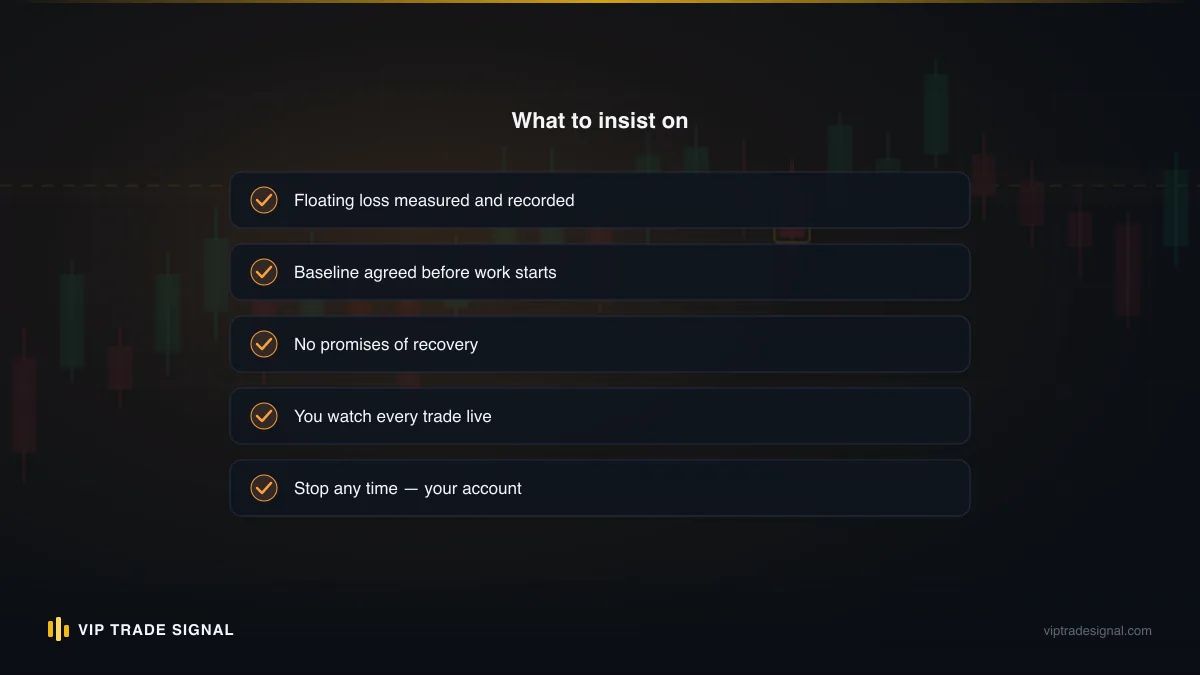
Before a single position is touched, we agree the baseline. This is the single most important piece of paperwork in the whole engagement, so let's be precise about it.
The baseline is the account's equity, not balance, recorded jointly on day one, screenshots exchanged, both parties confirming in writing. Equity, because balance on a hedged account is a fiction; it's the number before the locked loss is counted, and using it would let a recovery service charge you for "profits" that are really just your own loss being realised more slowly.
From then on, one rule governs everything: our fee is 50% of realised profit above that baseline, and nothing else. No monthly retainer. No fee on the recovery of the hole itself. If your equity was $6,400 at baseline and we work the account back to $6,400, you owe us nothing beyond the small advance, because we haven't made you anything, we've only un-lost what was yours. The split starts above the line.
The climb back to your own money is free. We only get paid on the part of the mountain above where you started.
There's a $200 minimum advance at the start, which is credited against the first profit split, and it exists for one reason: filtering. An owner unwilling to commit $200 to a five-figure rescue isn't committed to the process, and this process needs commitment, because there will be a week somewhere in the middle where equity dips and nerves get tested. The advance is on the pricing page along with everything else we charge, and you'll notice the list is short.
Two more protections, both yours. You keep the master password; we trade on investor-style access to an account that remains entirely yours, and you can withdraw or pull our access any day you like. And the baseline never moves. If the rescue takes five months, the line we're measured against in month five is the same line we photographed in week one. A service that "resets" its baseline after a bad month is charging you twice for the same recovery. We've seen it done. It's theft with extra steps.
The rescue toolkit: staged unwinds, momentum harvesting, margin repair
Every locked account is different, but the work draws on three repeatable techniques. Here's each one in plain language, because you should understand what will be happening inside your own account.
Staged unwinds
The core move. Instead of closing a hedge leg whole, we release it in slices, timed to market structure rather than to hope.
Say the account is long 1.0 lot of gold from 3,340 and short 1.0 from 3,285, price now at 3,300. The locked gap is 55 dollars of gold price, $5,500 on the lot pair, plus accumulated swap. A staged unwind might look like: when price runs down into a support zone we've mapped at 3,262 and momentum stalls, close 0.3 of the short there, banking part of its open profit near a local extreme. The account is now net long 0.3, which we want only if that support zone holds; if it doesn't, a hard stop on the released exposure caps the damage at a pre-agreed figure, usually a fraction of a percent of equity.
Each slice does two jobs. It banks realised profit from the winning leg at a better-than-average price, and it converts a frozen structure into a smaller, managed directional position with an actual stop loss, which is what the account should have had in the first place. Over weeks, slice by slice, the lock shrinks. The discipline is in the sizing: no slice is ever big enough that a wrong call undoes more than a couple of weeks of progress.
Momentum harvesting
While the unwind proceeds, the account needs income, because the released losses have to be paid for by something. This is where being a gold desk matters. We run small, normal, stop-lossed trades in XAU/USD alongside the unwind, the same setups our signal side publishes, sized down hard, typically risking 0.5% to 1% of equity per trade. On a $7,000-equity account that's $35 to $70 of risk a trade. It feels almost insultingly small when the hole is $7,800. It's also the only sizing that survives the losing streaks that will absolutely occur along the way.
We call it harvesting because that's the posture: taking what the market offers in the trend of the week, not swinging for the hole. The maths of small edges compounding is boring right up until you watch it fill a $500 slice of released loss in a fortnight.
Margin repair
The quiet third leg. Early in most rescues the priority isn't profit at all, it's room. Cancelling pending orders, closing shrapnel positions, sometimes releasing a small unbalanced piece of the hedge purely to free margin, occasionally recommending a modest deposit (always optional, never pressured). An account at 130% margin level can't do anything except pray. The same account at 400% can work. Weekends and major data releases get special handling; a locked account with thin margin does not stay fully exposed through a Non-Farm Payrolls print if we can help it, because a gap through a thin margin level is the one way a rescue dies suddenly rather than slowly.
If margin is your immediate terror rather than a background worry, our piece on avoiding a margin call in forex covers the emergency version of this triage for accounts still in their owner's hands.
Case one: $7,800 down to baseline-plus in eleven weeks
Two worked cases now. Both are composites of real desk work with identities removed, details altered and numbers rounded; treat them as an honest illustration of the process, not as a published performance record. The shape of each is faithful. The point of telling them is the shape.
Call the first owner Imran. He arrived with a $14,000-balance gold account floating $7,800 down: long 1.5 lots from an average of 3,352 (three entries, averaged down, the classic staircase), fully hedged with 1.5 lots short from 3,300 after the third averaging attempt failed. The lock was ten weeks old. Swap had already taken about $900 of the hole. Equity at baseline: $6,200.
Intake found decent margin geometry (his broker margined the larger leg only, and the legs matched, so margin was light) and no deadline pressure. Our written assessment said: achievable, probably three to five months, with a realistic failure mode of "we return the account around baseline having burned time but not much money".
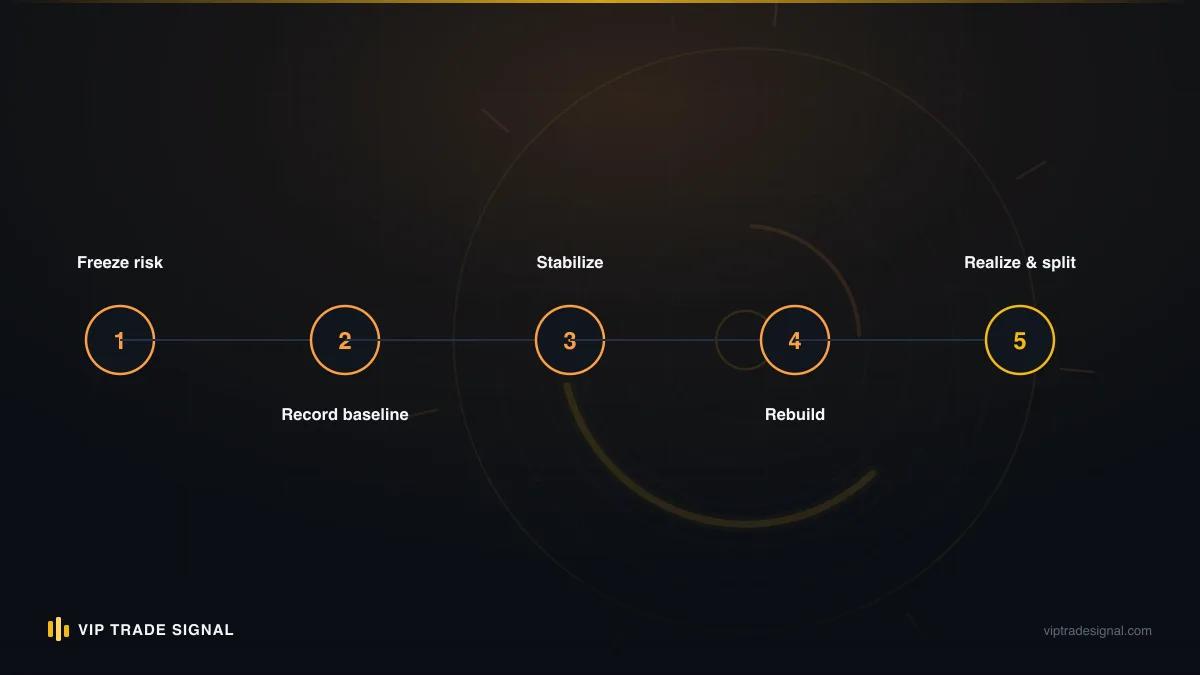
The rescue ran in three phases. Weeks one to three were margin repair and observation: shrapnel closed, pendings cancelled, and two small harvest trades that both won, adding about $210. Nothing dramatic. Then gold gave us the gift this plan waits for: a strong two-week downtrend. We released the short in four slices into that move, each near a level where the decline paused, banking the leg's profit at prices meaningfully better than a single panicked close would have got. Each release left a small net-long remainder with a stop; two of those stops were hit, costing about $180 total, which is the cost of doing business and we'd budgeted three times that.
By week seven the lock was gone. What remained was a clean account at roughly $5,100 equity, $1,100 below baseline, with full margin freedom. Phase three was pure harvesting: nineteen signal-grade trades over four weeks, twelve winners, seven losers, average risk $50. The account crossed the $6,200 baseline in week ten and finished week eleven at $6,940.
Our fee: 50% of the $740 above baseline, so $370, minus the $200 advance already paid, $170 due. Imran got back a working account, up on where he handed it over, unlocked, with stops on everything. The rescue's real product wasn't the $740. It was the removal of the trap and the ten weeks of watching how unlocked, sized, stopped trading actually behaves. He's still running the account himself.
Could he have done this alone? The mechanics, maybe. The eleven weeks of not interfering, almost certainly not. He told us the hardest part was week five, when the released net-long got stopped twice and equity dipped $300 below where he'd handed it over. That's the week owners break and re-hedge. Having someone else's hand on the wheel is the service.
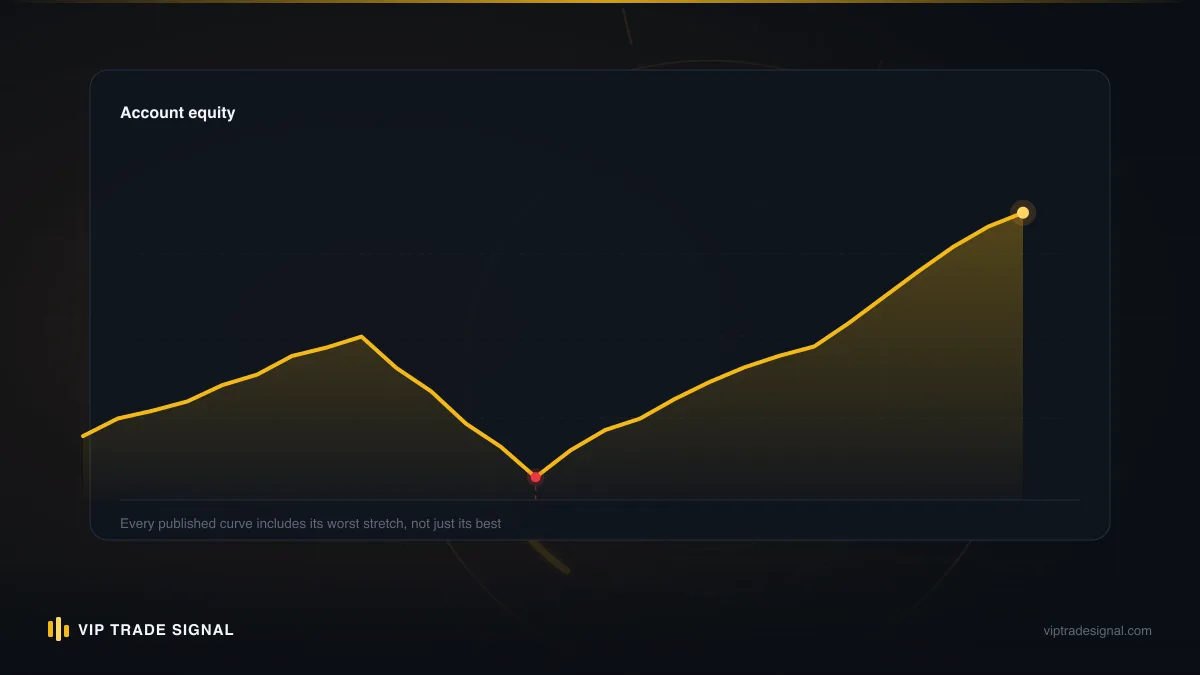
Case two: the five-month grind and the partial save
Now the one that half worked, because publishing this one is the whole reason to trust the first one.
Call her Dalia. Her account arrived at $11,000 balance, floating $9,400 down, equity $1,600. Read that again: the hole was nearly six times the surviving equity. The structure was worse than Imran's too. Not one clean hedge but a lattice built by a grid EA that had then been manually "fixed": 2.2 lots long across nine entries, 1.9 lots short across six, gaps everywhere, and swap eating roughly $14 a night. Margin level hovered near 160%. One bad weekend gap could have ended the account before we did anything at all.
Our intake assessment was blunt and we've kept the phrasing since: "Partial rescue possible. Full recovery to baseline-plus unlikely at survivable risk. Primary goal is to stop the bleeding and salvage a working account; secondary goal is recovery above baseline if the market cooperates. It may not."
She signed anyway, eyes open. Baseline recorded at $1,600 equity.
The first month was ugly and slow on purpose. With margin that thin, we couldn't harvest at all; every unit of margin was hostage. We spent four weeks doing nothing but net-exposure trimming: pairing off the worst-priced slices of each side against each other and closing them together, realising small chunks of the locked loss deliberately to reduce lot load and swap. Equity barely moved. Balance fell, which terrified her, and we'd warned her it would, because realising a locked loss always looks like new damage even when it's old damage finally being buried. The nightly swap bill dropped from $14 to $6. That was the month's entire victory, and it was a real one.
Months two and three were staged unwinds into a choppy, trendless gold market, which is the worst weather for this work. Slices released into moves that reversed. Three stopped remainders in a row at one point, about $120 of new losses, on an account with no fat to spare. By the end of month three, equity was $2,050, up $450 on baseline in raw terms, but the account still carried 1.1 locked lots and the margin level, though healthier at 290%, made every trade a knife-edge decision.
Month four brought the trend we'd been waiting for and we released everything remaining into it. Cleanly, as it happens; the last slice banked the short side's best exit of the entire structure. Fully unlocked, the account stood at $2,700.
And then we stopped, and this is the part that matters. The honest arithmetic said that grinding $2,700 back towards the original $11,000 balance at survivable risk would take well over a year, and Dalia needed access to the money sooner than that. Continuing would have meant either oversizing (her account, our reputation, both at risk) or pretending. So in month five we ran three final weeks of conservative harvesting, brought equity to $3,050, and recommended closure of the engagement.
Final ledger: baseline $1,600, exit $3,050, recovered profit above baseline $1,450, our half $725 less the $200 advance. She left with $2,325 more equity than she arrived with, no locked positions, no EA, and no nightly bleed. She also left roughly $8,000 poorer than before the grid EA ever touched her account, and no rescue on earth was changing that. We couldn't fully save it. Nobody could have. The service you should want is the one that says that sentence out loud and shows you the case anyway.
The lesson we take from Dalia's account, and repeat to every prospect: the time to hand over a locked account is early, when equity still has mass. At $7,800 down on $14,000, Imran's account had options. At $9,400 down on $11,000, Dalia's had almost none. Waiting is not neutral. Swap and shrinking margin make every month of paralysis a worse starting position for whoever eventually takes the wheel, whether that's us or you. If you're weighing up whether it's time to hand a damaged account to a professional, the honest answer is that the decision gets easier and the outcome gets worse the longer you wait.
What the 50% split covers, and what you never pay
Money talk, plainly, because opaque fees are the signature move of the recovery-scam industry and we'd like to be the opposite of it.
| You pay | You never pay |
|---|---|
| $200 minimum advance at the start, credited against the first profit split | Any monthly retainer or management fee |
| 50% of realised profit above the jointly recorded baseline | Anything on the recovery of the hole itself, from lock back up to baseline |
| Your broker's normal spread, commission and swap (they were always yours) | Per-trade fees, "software" fees, or charges to end the engagement |
| Anything at all if the rescue fails to climb above baseline |
Yes, 50% is the high end of the industry. We've written elsewhere about why, and the short version is the shape of the deal: the minimum is $200, there's no lock-in, you hold the master password and the withdrawal rights, and every unit of our compensation sits on the far side of your full recovery. A 20% fee on top of a monthly retainer with a shifting baseline is cheaper on paper and more expensive in every scenario where the rescue struggles, which, as Dalia's case shows, is a scenario worth pricing. We take the deal where struggling costs us, not you.
One number worth staring at: in the failure case, the case where months of work returns the account only to its baseline, our total revenue is $200 and yours is an unlocked, cleaned, stop-lossed account. That asymmetry is deliberate. It keeps our intake honest, because taking on hopeless accounts is how we'd go broke.
While we're on money, three questions people always ask at this point, answered without the usual wriggle. When is the split actually settled? Monthly, on realised profit only, against the fixed baseline; floating gains count for nothing until they're banked, so there's no incentive for us to dress the account up with open positions at month-end. Can you withdraw mid-rescue? Yes, any time, it's your account and your password; a withdrawal simply adjusts the arithmetic (we record it, and the baseline calculation accounts for money you've taken out so you're never charged on your own deposit or penalised for accessing your own funds). And what happens if you want to stop? You say so, we flatten anything that's ours to flatten or hand you a written map of what's still open, and the engagement ends that week. No notice period, no exit fee. Locked accounts are prisons already; the last thing they need is a second set of bars from the people claiming to hold the key.
The risks we will name before you sign anything
The written assessment every prospect receives contains a risk section, and it says these things in these words or close to them. If a rescue service you're evaluating won't put equivalents in writing, close the tab.
The account can finish lower than baseline. Staged unwinds carry real directional risk in the released remainders. We cap each one, but caps get hit, sometimes several in a row. A rescue is a sequence of small controlled risks replacing one large uncontrolled one; small risks still lose.
A gap can beat the plan. A weekend open or a news spike through a thin margin structure can force liquidations no plan survives. We reduce exposure into known events, but the market doesn't schedule everything. Dalia's account lived within one bad Sunday open of failure for its entire first month, and we told her so at the time.
Time is not bounded. Eleven weeks was a kind market. Five months was a stubborn one. A rescue in a dead, choppy market can idle for a month, swap ticking, with nothing responsible to do. We won't manufacture activity to look busy; idleness in bad conditions is the job done right, and it will sometimes feel like nothing is happening because, deliberately, nothing is.
Partial saves are a real outcome. Roughly speaking, of the locked accounts we accept, most reach baseline-plus, a meaningful minority end as partial saves like Dalia's, and a few finish near where they started. We don't publish precise rates because our sample is small enough that a percentage would be decoration pretending to be data. Our closed signal record lives publicly at /signals/history, losses included, because that side of the business generates enough volume to be worth measuring; the rescue desk's honest metric is the written assessment you get before you commit.
And we are not advisors. Nothing in this article or in an engagement is personalised investment advice. We're a trading desk you can hire, with a fee that only exists above your baseline, and the decision to hire anyone at all, including us, should survive a week of you sleeping on it.
Is your account rescuable? The honest checklist
Run your own account through the same first-pass filter we use. Be exact with the numbers; the whole exercise fails on rounded self-deception.
- Equity-to-hole ratio. Divide current equity by the total hole (floating loss plus swap paid to date). Above 1.0, like Imran's 6,200 against 7,800 was close to, you have a genuine rescue candidate. Between 0.5 and 1.0, a rescue is possible but the assessment needs to be brutal. Below 0.3, like Dalia's 1,600 against 9,400, you are in partial-save territory and should hear that before anyone touches the account.
- Nightly swap as a percentage of equity. Multiply your nightly swap bill by 30 and divide by equity. Above 3% a month, time alone is dismantling the account and speed matters more than elegance.
- Margin level. Below 200%, the first job is survival, not recovery. Below 130%, contact someone this week, not this quarter.
- Structure complexity. One clean pair of legs is surgery. A grid EA's lattice is archaeology. Both are workable; the second takes twice as long and you should expect that in any honest timeline.
- Your own state. If you have not opened the platform in a fortnight, or you check it hourly but change nothing, the account effectively has no manager right now. That, more than any ratio, is the signal it needs different hands. Whose hands is a separate question.
- The deadline test. If you need this specific money within three months, a rescue is probably the wrong tool, and the right conversation is about orderly closure. Painful, cheaper than hope.
Score yourself honestly and three of the six answers will tell you more than any sales call.
Where this leaves you is simpler than the 5,000 words above might suggest. A locked account has exactly three futures: someone unwinds it with a plan, the owner eventually closes it whole in a moment of exhaustion, or swap and one bad gap finish it slowly and then suddenly. Only the first future has a method attached. If you want our version of that method applied to your specific tangle, send us the account statement and you'll get the same one-page written assessment Imran and Dalia got: the true hole, the honest odds, the likely timeline, and, one time in four, our advice not to hire us at all. The assessment costs nothing. The paralysis is the only thing here with a guaranteed price.