The last trade in a blown account is almost never the interesting one. By the time it fires, the outcome was already decided. We've sat with enough traders going through their statements after a wipeout to know where to look, and it's rarely the final margin call that tells the story. It's the trade four days earlier. The one that lost $180 on a $2,000 account and got answered with a position three times the size.
If you want to understand why traders blow accounts, stop studying the crash and start studying the response to the first real loss. That's where accounts die. Not in the fire, but in the decision to pour petrol on a small flame because the flame was embarrassing.
We audit trading histories as part of our drawdown work, mostly gold accounts, mostly retail-sized, mostly already deep underwater by the time they reach us. And after enough of them, the individual stories blur into a pattern. Nine causes come up again and again. They're ranked below by how often we see them, but honestly, the ranking matters less than the thread running through all nine. Every single one of them is survivable at sensible size. Every single one of them is fatal when leveraged. Hold that thought, because we're going to keep coming back to it.
Accounts don't die from losses. They die from responses
Here's a statement that sounds wrong until you check it against your own history: losing trades don't blow accounts.
A losing trade at 1% risk costs you 1%. String ten of them together, which is a genuinely horrible run, and you're down roughly 10%. Painful. Annoying. Completely recoverable. You need about an 11% gain to get back to flat, and nothing about your situation has structurally changed. Your account is bruised, not broken.
Now run the same ten losses through the account of someone who doubles size after every second loss because they "need to get it back". The first loss costs 1%. By loss six they're risking 8% a trade. By loss eight the account can't post margin for the size they want, so they go all-in on the ninth. There is no tenth. The market didn't do anything different to these two traders. The losses were identical. The responses were not.
This is the core of it, and it's why "bad luck" almost never survives contact with an actual statement. When we open the history of a wrecked account, we're not looking for the losing trades. We're looking for the moment position sizes changed. There's nearly always a clean line: before this date, lots of 0.05 and 0.10; after this date, 0.50, then 1.0, then whatever margin allowed. Something happened at that line. Usually a loss the trader took personally.
The market sends everyone losing trades. It's the reply that gets accounts killed.
So when someone asks us how accounts get blown, the honest answer is: in two stages. Stage one is an ordinary loss, the kind every strategy on earth produces. Stage two is an extraordinary response. The rest of this piece is a tour of the nine most common shapes that response takes, but keep the two-stage structure in mind throughout. It's the skeleton under all of them.
Why traders blow accounts: the nine root causes, ranked
Across the accounts we've audited, the same culprits keep turning up. Some accounts have one. Most have three or four stacked on top of each other, which is part of why the end comes so fast. Here's the list, ordered roughly by how often each shows up as a primary cause, along with what it typically looks like on a statement.
| Rank | Root cause | What it looks like on the statement |
|---|---|---|
| 1 | Overleverage | Position sizes that risk 5-30% per trade, or margin usage above 50% |
| 2 | No stop, moved stop, mental stop | Losers held 10x longer than winners; SL fields blank or repeatedly edited |
| 3 | Averaging down / martingale | Clusters of same-direction entries at worsening prices, sizes climbing |
| 4 | Revenge trading | Bursts of 10-30 trades in a single session after a notable loss |
| 5 | News and gap ambushes | Large positions held through NFP, FOMC, or over a weekend |
| 6 | One-market concentration | 90%+ of volume in a single instrument, usually XAU/USD |
| 7 | No written plan or loss limits | No consistent size, no consistent setups, no daily stop anywhere |
| 8 | Euphoria sizing after a win streak | Size doubling or tripling immediately after the best week on record |
| 9 | Exhaustion sessions | Trade quality collapsing after hour three of a marathon screen session |
A few things about this table before we take the big ones one at a time.
First, these aren't nine equal villains. Number one is different in kind. Overleverage isn't just the most common cause; it's the amplifier that turns causes two through nine from expensive habits into account-enders. A trader who moves stops at 0.5% risk has a leak. A trader who moves stops at 10% risk has a countdown.
Second, notice what's not on the list: bad strategy. In several years of doing this we have almost never opened a blown account and found a coherent, consistently-applied strategy that simply didn't work. It's genuinely rare. What we find instead is a strategy that worked fine right up until the trader stopped following it, usually at the exact moment following it mattered most. That should be encouraging, in a bleak sort of way. The problem is almost never that you can't find an edge. The problem is what you do when the edge has a normal bad day.
Third, the causes stack. The classic wreck we see runs something like: no daily loss limit (7) allows a revenge session (4), which involves averaging into a loser (3) with no stop (2), at ten times normal size (1), on gold (6), into a Fed announcement (5). Five or six causes, one afternoon, one dead account. Each cause on its own might have cost a bruise. Together they cost everything.
Let's take them properly, starting with the amplifier.
Overleverage: the amplifier inside every wreck
Overleveraging in trading isn't really about the leverage number your broker advertises. 1:500 leverage doesn't blow accounts. Using it does. The number that matters is how much of your account a normal adverse move can take, and most people have never actually calculated it for the sizes they trade.
So let's calculate it. Say you've got a $2,000 account and you open one standard lot of XAU/USD. That's 100 ounces. Every $1 move in the gold price is $100 against you or for you. Gold routinely moves $20-$40 in a day, and on a lively one, $60 or more. So your "normal day" exposure on that position is $2,000 to $4,000 of swing. On a $2,000 account. You are not trading at that point. You've bought a lottery ticket where the losing outcome is total, and you've paid full price for it.
The insidious thing is that overleverage often works at first. That's what makes it so effective at killing accounts. The trader who opens 0.50 lots on a $1,500 account and catches a $15 move makes $750 in an hour. Half the account, one trade. Try telling that person their sizing is broken. The maths says it clearly, but the balance says otherwise, and the balance is louder. So they do it again. And maybe it works again. What they've actually done is run a coin-flip sequence where one tail ends the game, and every head persuades them the game is safe.
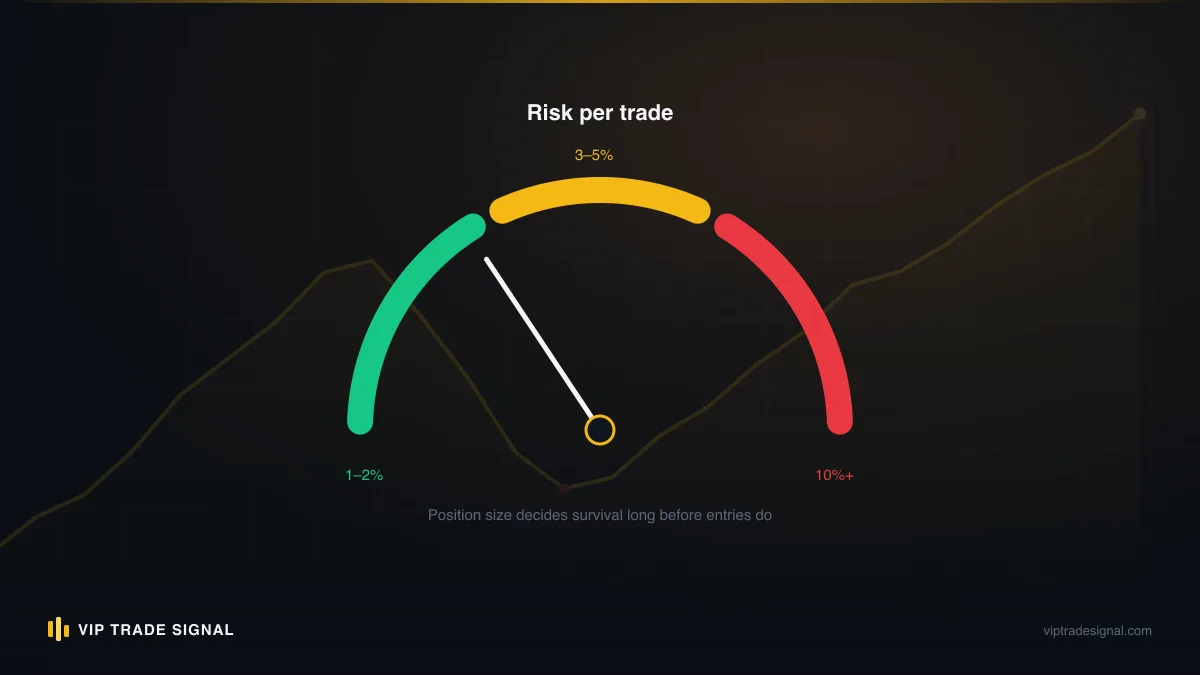
Here's the frame we'd rather you used. On a $2,000 account risking 1%, you have $20 of room per trade. If your stop on gold is 400 points, that's 0.05 lots. Feels tiny. Is tiny. But it means a ten-trade losing streak costs you $190ish and a bruised ego, rather than a funeral. We wrote up the full sizing arithmetic for gold specifically in our piece on XAU/USD risk management, and if you only ever read one thing we've published, honestly, make it that one.
Why does overleverage sit inside every other cause on the list? Because it converts mistakes into catastrophes. Moving a stop at proper size costs you an extra half percent. Moving a stop at 20x size costs you the account. Revenge trading at proper size is a bad evening. Revenge trading oversized is an obituary. Every failure mode further down this list is, at reasonable leverage, a lesson. The leverage is what upgrades lessons to endings.
No stop, moved stop, mental stop
The second most common thing we find is an account where losers live far longer than winners. Winners closed in 40 minutes for 300 points. Losers held for six days, 3,000 points underwater, "waiting for it to come back". The statement makes the asymmetry brutally visible in a way the trader's memory never did.
There are three variants, and they're worth separating because traders always believe their variant is the responsible one.
No stop at all. The honest version. The trader simply doesn't place one, usually because they got wicked out once in 2023 and decided stops were a scam. What they've actually decided is that every trade they take is allowed to grow into an unbounded loss. One eventually accepts the invitation.
The moved stop. The most common version. A stop gets placed, price approaches it, and the trader drags it lower. Then lower again. Each move feels small and reasonable in the moment. But a stop you'll move isn't a stop; it's a decoration. The whole point of the thing is that it executes precisely when you least want it to, because the moment you least want it to is the moment your judgement is most compromised.
The mental stop. The sophisticated-sounding version. "I don't place hard stops, I manage the exit manually." In our experience this translates as: I exit manually when the loss is small, and freeze when it's large. Mental stops work right up until the trade that matters, which is exactly the design flaw. The trades where a mental stop and a hard stop behave differently are the only trades where the choice matters, and on those trades the mental stop always loses.
We went deep on the psychology behind all three in why traders hold losing trades, because the mechanism is more interesting than "discipline". Short version: realising a loss converts it from a hopeful maybe into a permanent fact, and human brains will pay astonishing amounts to avoid making bad things permanent. The market happily collects that payment.
One practical note. If you take signals, from us or anyone, the stop that comes with the signal is part of the trade. We publish every closed signal, stops honoured, wins and losses alike, at /signals/history, and the losses are there precisely because a stop that fires is the system working. A signal service whose stops never seem to trigger isn't skilled. It's editing.
Averaging down and martingale spirals
Cause number three has the best marketing of the lot. Averaging down gets dressed up as "scaling in", "improving my average price", "zone recovery", "grid strategy". Some of those can be legitimate techniques in the right hands with the right capital. On the retail accounts we open, they are overwhelmingly the same move wearing different jackets: the trade went against me, so I bought more.
The statement signature is unmistakable. Long gold from 3,340. Long again at 3,325. Again at 3,310, size up. Again at 3,290, size doubled. Five, six, eight entries, all the same direction, each at a worse price, sizes climbing. And here's the thing that makes it so lethal: the maths of a martingale means your largest position of the entire sequence is always the one running when you're proven wrong. You are structurally guaranteed maximum size at maximum wrongness. It's not that it might go badly. It's engineered to go worst at the worst moment.
The defenders will tell you it wins most of the time, and they're right. That's the trap. A martingale wins constantly, in small amounts, until the one trending day it loses everything, all at once. Gold produces those trending days several times a year. It'll run $80 in a session without a meaningful pullback, and every averaged-down layer becomes another millstone. We've seen accounts survive eleven months of grid trading on XAU/USD and die in four hours on the twelfth.
There is a defensible version of position recovery, with hard caps on layers and total exposure, and we've written about where the line sits in our breakdown of the zone recovery strategy. But note the load-bearing words: hard caps. The moment the cap is soft, you're not running a strategy, you're running a countdown, and the market decides the date.
If you catch yourself adding to a loser and the honest reason is "so I can get out at breakeven sooner", close the position. All of it. The desire for breakeven is the tell. Sound scaling plans are written before the trade, when you're calm. Averaging decided mid-trade is almost always the losing brain negotiating with reality, and reality doesn't negotiate.
News and gap ambushes
Some accounts don't die slowly. They die between 13:29 and 13:31 on a Friday.
Gold is a macro asset. It reacts, hard, to a short list of scheduled events: US CPI, non-farm payrolls, FOMC decisions and the press conference after, and the occasional geopolitical shock nobody scheduled at all. On a big print, XAU/USD can move $20-$30 in under a minute, spreads can blow out from 20 cents to $2 or more, and stops fill wherever liquidity happens to exist rather than where you placed them. That last part matters: a stop is an instruction to exit at the next available price, not a guarantee of that price. On a violent spike, "next available" can be a long way past your line.
Now put an overleveraged position in front of that. A trader carrying 0.80 lots on a $3,000 account into NFP isn't making a trading decision, whatever they've told themselves about their bias being right. They're betting the account on a number generated by the US Bureau of Labor Statistics, with slippage as the house edge.
Weekend gaps are the quieter cousin. Gold closes Friday night and opens Sunday evening, and anything that happens in between, an escalation, a surprise announcement, a bank wobble, gets priced in one jump. No stop protects you inside a gap. If price closes at 3,340 and opens at 3,308, your stop at 3,332 fills at 3,308, and the difference comes out of your balance with no appeal process.
The fix is boring, which is why so few people apply it. Know the calendar. Flatten or cut size ahead of the red-flag events unless trading the event is explicitly your plan, with sizing built for the slippage. Treat weekend holds as a position in themselves and size them like one. None of this is sophisticated. It's the trading equivalent of not standing in the road, and every quarter we meet another account that stood in the road.
The revenge session
If overleverage is the amplifier, revenge trading is the detonator. It's the cause most likely to be the actual, final, proximate reason an account hit zero, and it has the most recognisable statement signature of all: a normal, sedate history, two or three trades a day, and then one session with twenty-six trades in four hours, sizes climbing, directions flipping, ending in a balance a tenth of where the day started.
The trigger is nearly always a loss that meant something beyond money. A loss that broke a winning streak. A loss on a trade the trader had told someone about. A loss that took back a week of careful gains in one hit. The money is recoverable; the feeling isn't, and the feeling is what takes over the mouse.
What happens next isn't trading, and it's worth being blunt about that. The revenge session has no setups, no plan, no risk calculation. It has one goal, get it back, and one timeframe, now, and those two constraints eliminate every good decision available. You can't get it back now at sensible size, so size explodes. You can't wait for a setup, so entries become coin flips. Each new loss raises the required win, which raises the required size. The spiral has its own gravity, and inside it, the trader isn't stupid. They're not really present at all. We've had people describe watching themselves do it, narrating the mistake in real time, unable to stop.
Which is why the only defences that work are the ones installed before the trigger. A daily loss limit with teeth: down 3%, platform closed, no exceptions, no "one more to end green". A rule that doubling your normal size requires a written note you'll read tomorrow. Even something as crude as a broker setting that caps your lot size. Willpower in the moment is worthless; the moment is precisely when willpower is offline. Structure survives the moment. Intentions don't.
And if you've had revenge sessions before, plural, treat that as data rather than shame. It means your trigger exists and will fire again. Plan for the trigger, not for the fantasy of never being triggered.
One-market concentration, and the gold special
We're a gold-only signal desk, so this next part might sound odd coming from us: a huge share of the wrecked accounts we see are 95%-plus XAU/USD, and the concentration itself did real damage.
Not because gold is a bad market. We think it's the best retail market there is, liquid, technical, active in every session. But it has a personality, and the personality punishes specific habits. Gold trends hard when it trends, which executes martingales. It spikes on news, which executes overleveraged positions. It moves in dollars-per-second during London and New York overlap, which turns a moved stop into a moved-again-and-again stop. Nearly every failure mode on this list runs faster on gold. Trading only gold means every one of your habits gets stress-tested at gold speed, with no quieter market diluting the exposure.
There's a subtler cost, too. The one-market trader who's currently in a losing position has no neutral ground. Every chart they look at is the chart hurting them. A trader with three markets can walk away from a bad EUR/USD position and find a clean setup elsewhere; the gold-only trader in a bad gold trade is emotionally all-in whether their sizing is or not. The obsession loop, checking the same chart every ninety seconds, feeds directly into causes two, three and four.
To be clear about our own position: specialising is right, and we built the whole service on that belief. Specialisation is how you learn one market's behaviour deeply enough to have an edge in it. But specialising in a market's setups is different from concentrating all your risk in its worst moments. The gold specialist who survives is the one who respects what the metal does at 13:30 New York time, sizes for $30 spikes because they happen, and accepts that some days the correct gold position is none. Specialise in the market. Don't marry its volatility.
No written plan, no loss limits
Ask a trader with a blown account whether they had a trading plan and most will say yes. Ask to see it and the plan turns out to live "in my head", which is to say, nowhere. A plan you can't show someone is a mood.
This cause ranks lower than the dramatic ones, but it's really the enabling condition for all of them. The trader with no written maximum daily loss has no tripwire before the revenge session. The trader with no written sizing rule has nothing to violate when euphoria suggests tripling up. You can't break rules you never wrote, and that's exactly the problem: nothing is ever technically a violation, so nothing ever triggers a stop-and-think. The account drifts wherever the strongest emotion of the week points it.
What a real plan looks like is unglamorous. One page. Which setups you take and, more importantly, which you don't. Fixed risk per trade as a percentage, written as a number. A daily loss limit that closes the platform. A weekly loss limit that ends the week. What events you stand aside for. When you're allowed to change any of the above (answer: on a weekend, in writing, never mid-trade). That's it. Ours would fit on an index card.
The measurable difference a written plan makes isn't better entries. It's that violations become visible. When you risk 4% on a trade and your card says 1%, you now know something specific: you broke a rule, at this time, on this trade, and you can go find out why. Without the card, the same act is just "a bigger position I felt good about". Blown accounts are stuffed with trades the trader felt good about. Feelings are not a risk framework, and the statement doesn't record them anyway. It records the sizes.
The two quiet killers: euphoria and exhaustion
The last two causes on the list deserve a section together, because they share a disguise: neither feels like a mistake while it's happening. One feels like success and the other feels like dedication.
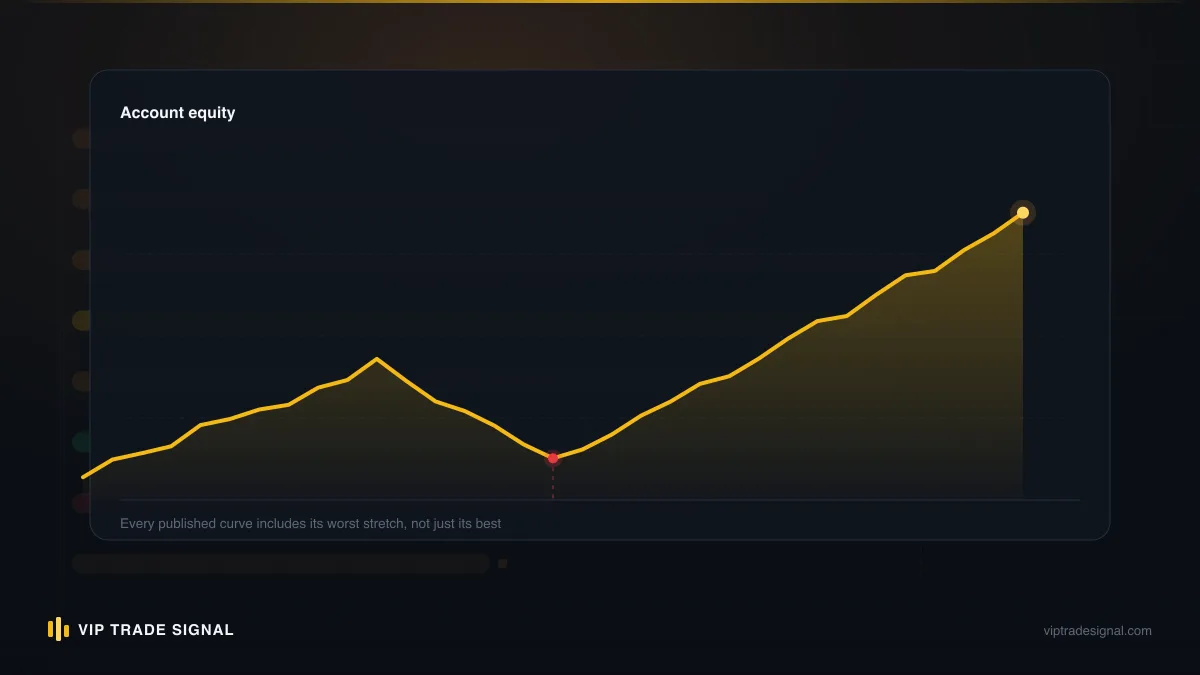
Euphoria sizing shows up after the best fortnight of a trader's life. Eight wins in ten, account up 22%, and a thought arrives wearing a business suit: imagine these results at three times the size. So size triples, right at the moment when, statistically, a normal losing patch is due, because losing patches are always due, that's what makes them normal. The patch arrives, but now each loss is 3x, and four ordinary losers claw back the entire hot streak plus half the account underneath it. We see this shape constantly: the equity high and the beginning of the collapse are the same candle. If you take one rule from this section, take this one: winning streaks earn you the right to keep your size, not to raise it. Raise size on schedule, after sustained months, in small steps. Never inside a streak, when your confidence is at its least reliable.
Exhaustion sessions are the opposite energy, same result. The trader who's been at the screen for six hours, mostly flat or slightly down, and won't leave until the day is green. Decision quality after hour three falls off a cliff; every study of vigilance tasks says so, and every audited statement agrees. The trades from hour one have logic, structure, patience. The trades from hour six are entries because a candle was big. Fatigue doesn't feel like impairment from the inside, which is what makes it dangerous, it feels like commitment. But the market pays for good decisions, not for attendance, and staying longer while making worse choices isn't dedication. It's donation.
The 48 hours before every blow-up: shared warning signs
Here's something that took us a long time to notice, because you can only see it with a stack of statements side by side: blown accounts look alike in their final two days. Different traders, different strategies, different countries, and the last 48 hours could be photocopies of each other.
The signature has five parts, and we'd suggest you read this list slowly, once as an observer and once against your own recent history.
- Trade frequency jumps 3-10x. A two-trade-a-day account suddenly prints fifteen. The trades stop being chosen and start being emitted.
- Average position size at least doubles, then keeps climbing. Not gradually. In steps, each one after a loss. This is the single most reliable marker we know of.
- Hold times split to the extremes. Winners get snatched in minutes, tiny profits banked for relief. Losers get held for hours or days. The 40-minute-average trader now has an open loser from Tuesday.
- Stops disappear from the record. Either literally blank, or set so wide they're ceremonial. Often this is the first day in the account's whole history without consistent stops.
- The session goes long and late. Trades appear at 2 a.m. local time from a trader who never traded past dinner. The final session of a blown account is very often the longest one it ever recorded.
Individually, each sign has innocent explanations. Together, they're a fire alarm. And the brutal part is that the trader living inside those 48 hours almost never sees them, because every one of the five feels, from the inside, like doing something about the problem. More trades feels like effort. Bigger size feels like conviction. Holding the loser feels like patience. The all-nighter feels like commitment. The pattern reads as fighting back. It is, in fact, the drowning.
So borrow eyes. Show a fortnight of your statement to someone who trades, or frankly to anyone numerate, and ask one question: is anything about the last three days different from the rest? You'll defend yourself against your own review. It's much harder to defend against someone else pointing at the size column.
If your account is halfway there right now
Some of you didn't read this as a forensic piece. You read it as a mirror, because your account is currently 30%, 40%, 60% down, and three or four sections in you stopped nodding and started wincing. This last part is for you, and we'll keep it practical.
First, and before anything else: flatten or cut the oversized exposure. If you're carrying an overleveraged forex account and wondering what to do, the first move is always the same, reduce until a normal daily move in your instrument can't take more than a couple of percent of what's left. Yes, closing oversized losers makes the loss real. It was already real. The open position wasn't a plan, it was an anaesthetic, and the surgery doesn't get cheaper while you wait.
Second, take 48 hours completely off the platform. Not to punish yourself. Because every mechanism in this article, revenge, sunk cost, exhaustion, runs on immediacy, and 48 hours breaks the circuit. The market will still be there. Gold has been trading for five thousand years; it can spare you a weekend.
Third, do the audit we've been describing, on your own account, in writing. Find the line where sizes changed. Find the trade that triggered it. Count your causes against the table above. Most people find three or four, and naming them specifically ("I martingale after streak-breaking losses on Thursdays and Fridays") beats vague resolutions ("I'll be more disciplined") every single time, because you can build a rule against a named behaviour.
Fourth, restart small enough that the maths protects you while you rebuild the habits. 1% risk per trade, hard daily stop at 3%, written on the index card, platform lot cap set at your broker if they offer one. Rebuilding a damaged account at 1% risk is slow. That's fine. Slow is what surviving looks like from the inside.
And fifth, be honest about whether you should be doing the recovery alone. Digging out of a deep hole is a genuinely different job from normal trading; the temptation to over-size "just to speed things up" is exactly the disease that dug the hole. If the account is floating somewhere in the $5k-$10k-down range and you don't trust yourself with the shovel, structured drawdown management is a thing that exists, ours charges a flat 50% of recovered profit above a recorded baseline, and we'll tell you to your face that no recovery is ever guaranteed, because it isn't, and anyone who says otherwise is selling you cause number ten. If you'd rather hand off the day-to-day entirely while keeping your own MT4/MT5 login and full control of withdrawals, that's what account management is for. And if you just want a second pair of eyes on a statement before deciding anything, send it over; the audit is the useful part regardless of what you do next.
One closing thought, and it's the whole article in a sentence. The market will hand you losing trades for as long as you trade, that part is not negotiable and never was. The only question on the table, the only one that decides whether you're still here in five years, is what you do in the hour after one lands. Get that hour right at survivable size, and the nine causes above become other people's stories. Get it wrong, and it doesn't much matter which of the nine gets the credit.