There's a question we get asked more than any other, usually with a slightly suspicious tone: why trade only gold? XAUUSD is one instrument out of hundreds. Every other signal service on Telegram covers EURUSD, GBPJPY, oil, indices, three flavours of crypto and whatever else moved yesterday. We cover one chart. To a lot of people that looks like a limitation, maybe even laziness.
We think it's the single most defensible decision we've made. And the case for it isn't philosophical — it's practical, built out of years of watching what actually happens when a desk spreads itself across thirty pairs versus what happens when it lives inside one.
This piece is the full argument, including the part most gold-only outfits skip: the genuine downside. Specialisation means our edge and our risk both live in the same chart. When gold goes quiet, we don't have a Plan B pair to rotate into, and we're not going to pretend otherwise. But first, the case for.
The generalist trap: watching 30 pairs means knowing none
Open the typical multi-pair signal channel and look at what it actually posts. Monday it's a EURUSD short off a trendline. Tuesday it's GBPJPY because "momentum". Wednesday there's a USDCAD trade around an oil headline, Thursday it's back to gold, and Friday it's NAS100 because the week needed a winner. Ask yourself a simple question: what does that desk actually know?
The honest answer is: chart patterns. That's it. Because chart patterns are the only thing those thirty instruments have in common. A head and shoulders looks the same on EURUSD as it does on gold, so a generalist desk trades head and shoulders. What it cannot possibly hold in its collective head is the specific personality of each instrument — how EURUSD behaves in the hour before an ECB press conference versus how gold behaves in the same hour, which is genuinely different and genuinely tradeable.
Think about what instrument-specific knowledge actually consists of. Typical spread at 3am versus 3pm. How far the first spike after a news print usually travels before the retrace. Which round numbers attract orders and which get sliced through like they're not there. Whether stop hunts tend to run 5 points past the obvious level or 15. How the instrument behaves on the Monday after a big Friday move. None of that transfers between pairs. Gold's relationship with the 50-point round number is not EURUSD's relationship with the 50-pip round number, and anyone who tells you otherwise has studied neither properly.
Now do the arithmetic. Say a serious trader can genuinely internalise one instrument's behaviour with something like two thousand hours of focused screen time — watching it, journalling it, being wrong about it and finding out why. A desk covering thirty pairs would need sixty thousand hours to reach the same depth everywhere. It won't get them. So it substitutes the one thing that scales: generic technical analysis, applied thinly, everywhere. That's the generalist trap. It's not that multi-pair traders are stupid. It's that the maths of attention doesn't allow them to be deep.
And depth is where the edge is. Everyone can see the trendline. The market pays you for knowing what this instrument, specifically, tends to do at that trendline, at this time of day, in this kind of week.
Why trade only gold XAUUSD and not some other single instrument
Accepting the case for single instrument trading still leaves a choice: which instrument? You could specialise in EURUSD, or the DAX, or crude. People do, and some do it well. So the second half of "why trade only gold XAUUSD" is about gold specifically, and it comes down to three properties.
First, range. Gold moves. A normal day on XAUUSD covers somewhere in the region of 250 to 500 points — call it $25 to $50 of price travel — and a lively day can double that. Compare a quiet EURUSD session grinding through 40 pips. Range matters because it's the raw material of active trading: your targets need room to be hit and your stops need enough distance from the noise that they aren't clipped by spread and jitter. Gold provides that room almost every single day. There are weeks where EURUSD simply does not offer a trade worth the spread. Gold has very few of those weeks.
Second, liquidity. Gold is one of the deepest markets on the planet — London bullion, COMEX futures, ETF flow, central bank buying, and an enormous retail CFD market layered on top. For a signal follower that translates into tight spreads at reasonable brokers, fills close to the quoted price, and the ability to run the same trade on a $500 account and a $50,000 account without the market noticing either. Exotic pairs and small-cap anything fail this test. Gold passes it around the clock.
Third — and this is the one that took us longest to appreciate — gold has a personality that repeats. It is a fear asset, an inflation hedge, a dollar inverse and a momentum playground all at once, and the way those forces interact produces recurring behaviour you can learn. Which brings us to the next section.
The final point worth making here: gold is also brutal. The same range that creates opportunity destroys accounts that size positions like they're trading EURUSD. We'd estimate more retail money dies on XAUUSD than on any other single retail instrument, mostly through oversized lots meeting normal volatility. Specialising in gold without specialising in gold's risk is how you end up as someone else's cautionary tale. Keep that in mind for the whole rest of this article — it's the tax on everything good we're about to say.
Gold's personality: what makes XAUUSD learnable
Every instrument has habits. Gold's are unusually consistent, which is what makes an xauusd trading strategy worth building in the first place. A few of the recurring ones, in plain terms.
Gold respects round numbers with almost embarrassing reliability. The $50 levels — 3,300, 3,350, 3,400 — act as magnets and battlegrounds. Price accelerates towards them, stalls at them, fakes through them and reverses off them, and the order flow around them is visible enough that after a few hundred sessions you develop a feel for which behaviour is coming. Not certainty. A lean. Trading is a game of leans.
Gold trends harder than the major currency pairs. Currencies are pairs of economies pulling against each other, which tends to produce mean reversion — EURUSD spends most of its life chopping inside ranges that would bore a stone. Gold, when it decides to go, goes. Multi-week runs of hundreds of dollars happen every year, because the buyers of gold in a fear or inflation regime are not price-sensitive the way FX desks are. Central banks accumulating reserves don't wait for a pullback to the 61.8% retracement. That persistent, price-insensitive flow gives gold trends a stubbornness that rewards holding runners and punishes fading strength.
Gold overreacts, then corrects. The first move after a data surprise is routinely too far, driven by stops and momentum algorithms, and some portion of it retraces within the hour. Knowing the usual shape of that spike-and-retrace on this specific instrument — how far, how fast, how often it fails — is exactly the kind of narrow, deep knowledge a specialist accumulates and a generalist never does.
And gold has a session rhythm you could nearly set a clock by, which deserves its own section.
Session behaviour: how gold moves through Asia, London and New York
Watch gold for a hundred consecutive days and the daily shape starts to look familiar. Not identical — nothing in markets is identical — but familiar the way a person's gait is familiar.
Asia, roughly 00:00 to 07:00 London time, is usually the quiet stretch. Tokyo and the Shanghai gold market are active, and there's genuine physical-demand flow in there, but the ranges are typically modest: often 100 to 200 points of drift. Asia frequently establishes the initial range for the day, and one of the oldest habits in gold is the London open raiding that range — running the Asian high or low to collect stops before the real move goes the other way. If you've never watched that happen live, it looks like betrayal. After the fiftieth time it looks like a setup.
London, from about 07:00 to 12:00, is where gold wakes up. The LBMA is the centre of the physical bullion world, spreads tighten, volume arrives, and the day's first real directional attempt usually happens somewhere in this window. A lot of our best entries come from the first two hours of London, precisely because the Asian range gives you a clean reference: a fake below it followed by reclaim is a very different signal from a clean acceptance beneath it, and gold telegraphs which is which more honestly than most instruments.
New York, from about 13:00, is the loud part of the day. COMEX is the main futures venue for gold, the big US data prints land at 13:30 London, and the overlap between London and New York — roughly 13:00 to 16:00 — is reliably the most volatile stretch of the 24 hours. This is where trends extend or violently reverse, where the round-number battles get decided, and where a disproportionate share of the day's total range gets built. Then, after London closes out its book around 16:00–17:00, the afternoon US session tends to thin out and drift, with a last flurry sometimes arriving around the COMEX close.
| Session (London time) | Typical character | What we do with it |
|---|---|---|
| Asia, 00:00–07:00 | Quiet drift, range-building, physical flow | Mark the range; mostly watch |
| London open, 07:00–09:00 | Stop-raids on the Asian range, first real direction | Primary entry window |
| NY overlap, 13:00–16:00 | Heaviest volume and volatility, data-driven | Trend continuation, news trades, management |
| Late NY, 17:00–22:00 | Thinning liquidity, drift, occasional squeezes | Tighten stops, take profits, avoid fresh risk |
Here's the point of all this detail: none of it is secret. Any diligent trader can learn gold's session map. But a desk juggling thirty instruments cannot use it, because using it means being present, on this one chart, at the specific hours when the behaviour occurs, day after day. Session knowledge is only an edge if you show up for the session. Specialisation is what makes showing up possible.
Gold and news: the events that actually move it
Part of learning one instrument is learning its calendar — which scheduled events matter, which are noise, and what the reaction usually looks like. Gold's list is short and stable.
US CPI is the big one in most months. Gold is priced in dollars and traded substantially as an inflation and real-yields instrument, so an inflation surprise moves it immediately and hard — 200 to 400 points inside a few minutes is a routine CPI reaction, and larger prints have produced double that. Non-farm payrolls, first Friday of the month, is the other headline act, because it reshapes rate expectations. Then the Federal Reserve: rate decisions and, often more violently, the press conference half an hour later, where a single phrase from the chair can reverse the initial move entirely. That reversal habit — the knee-jerk on the statement, the true move on the presser — is one of the most reliable patterns in gold, and it's exactly the sort of thing you only trust after you've watched twenty of them.
Below that top tier: PCE inflation, ISM surveys, JOLTS and the weekly claims numbers on hot labour-market weeks, plus the unscheduled category — geopolitics. Gold is the market's fear gauge, so wars, sanctions, banking wobbles and election shocks all land on it first and hardest. Unscheduled news is by definition untradeable in advance, but even here the specialist has an advantage: knowing how gold typically digests a fear spike (fast up, partial fade, then a decision) beats guessing.
Just as valuable is the negative knowledge — what doesn't move gold much. ECB decisions barely touch it. UK data, Japanese data, most European prints: usually a shrug. A generalist desk has to care about all of it because some pair somewhere reacts to each release. We get to ignore roughly 80% of the economic calendar and concentrate our preparation on a handful of US events per month. That's not a small perk. Attention is the scarcest resource on any desk, and gold's narrow calendar hands a specialist most of theirs back.
Our house rule, for what it's worth: we don't hold new positions into CPI, NFP or the Fed with normal size. Either we're flat, or we're small, or we're in a trade that's already paid and running on a protected stop. The spread widens, the slippage is real, and the first tick after the print is a coin toss dressed as opportunity. There are services that market the coin toss. We'd rather skip it and trade the digestion, which is where the readable behaviour lives.
The repetition advantage: ten thousand hours on one chart
There's a reason surgeons specialise. Nobody wants a generalist doing their heart bypass — they want the person who has done this exact procedure a thousand times, because volume of repetition on a narrow task builds a kind of knowledge that can't be taught, only accumulated.
Trading is the same, and it's worth being concrete about what the repetitions actually build. Say you trade one London open per weekday. That's around 250 per year. After four years a gold specialist has watched a thousand London opens on this one instrument — a thousand examples of the Asian-range raid, the fake-out, the clean break, the day it did something weird. A generalist who glances at gold twice a week has seen a tenth of that, interleaved with a thousand other charts that blur together.
What do the thousand repetitions get you? Pattern recognition, obviously, but something subtler too: calibration. The specialist doesn't just recognise the setup; they know roughly how often it works, how far it usually runs, and what failure looks like early. When a trade starts misbehaving — moving in your favour too slowly, stalling where it should accelerate — the specialist feels it in the first thirty minutes, because they've watched hundreds of healthy versions of the same trade and this one doesn't move like those did. That feeling is not mysticism. It's a statistical sense built from a large sample of one distribution, and it's precisely what you cannot build from small samples of thirty distributions.
An edge isn't a secret. It's a large sample size on a narrow question, and the discipline to only ask that question.
Repetition also compounds through the journal. Every trade we take gets logged against the same instrument, the same sessions, the same event types. After a few years the journal stops being a diary and becomes a dataset: our win rate on London-open range fakes, our average excursion on NY continuation trades, the specific hours where our entries underperform. You can only mine a dataset like that when the entries are comparable — and thirty instruments' worth of trades are not comparable. Single instrument trading is what turns a trade log into a research programme.
None of this means a specialist stops losing. We lose all the time; every closed signal, red ones included, sits publicly on our signals history because we think a track record with the losses removed is fiction. What repetition changes is not the existence of losses but their character. The specialist's losses cluster where the edge genuinely wasn't, and get smaller as calibration improves. The generalist's losses are scattered everywhere, carrying no lesson, because each one happened on a chart they barely knew.
Volatility as raw material: why gold suits active management
If you're going to manage trades actively — moving stops, scaling out, cutting early when the move dies — you need an instrument that gives you something to manage. This is where the gold vs forex pairs comparison gets stark.
Take a concrete day. EURUSD ranges 60 pips. On a $2,000 account risking 1%, that's $20 of risk buying you a trade whose realistic target, in that regime, might be 30 to 40 pips against a 20-pip stop. Workable, but thin — spread eats a meaningful slice, and there's simply not enough travel for management to add much. Your choices are basically "hold to target" or "don't".
Same day on gold: 350 points of range. A trade risking 100 points can realistically target 200 to 300, and the journey between entry and target has texture — a stall at the round number, a retest, an acceleration after the US open. That texture is what active management feeds on. Move the stop behind the reclaimed level. Bank half at 150 points into obvious resistance. Let the rest run with the trend because gold trends stubbornly. On a low-travel instrument these decisions barely matter; on gold they are frequently the difference between a scratched trade and a paid week.
This is also, frankly, why our account management service exists on gold and not on a basket of majors. Managing someone's MT4 or MT5 account for a share of realised profit only makes sense on an instrument that regularly offers enough movement to produce realised profit worth sharing — and enough recurring structure that the management decisions are informed rather than improvised. Gold is that instrument. We take 50% of realised profit and nothing when there isn't any, so we are directly, personally exposed to the difference between an instrument that moves and one that doesn't. We chose the one that moves.
The flip side needs saying in the same breath: volatility is raw material, not free money. The 350-point day that pays a well-sized trade destroys an oversized one. Gold's generosity and gold's brutality are the same property viewed from different position sizes. Which is a good bridge to the uncomfortable section.
The honest trade-off: our edge and our risk live in one chart
Here is the part of the gold-only pitch that most gold-only services quietly leave out. Concentration cuts both ways, and anyone selling you specialisation without naming its cost is doing marketing, not analysis.
When you trade one instrument, you have no diversification. None. Every position we open is correlated 100% with every other position we've ever opened, because they're all the same chart. A multi-pair trader having a bad month on GBPJPY might be having a decent month on gold; the losers and winners partially offset, and the equity curve smooths. Ours doesn't get that smoothing. When our read on gold is wrong for three weeks, there is no other market bailing out the month. The losing streaks are undiluted, and if you follow our gold trading signals on XAUUSD, yours will be too.
There's regime risk on top. Gold's behaviour is shaped by the macro backdrop — real yields, the dollar, fear — and regimes change. A specialist's pattern library is built under particular regimes, and when the regime shifts, some of that library quietly stops working until it's rebuilt. The generalist has the same problem, in fairness, but spread across instruments it arrives in instalments. For us it can arrive all at once.
And there's a subtler cost: no escape valve for discipline. A multi-pair trader who can't find a setup on EURUSD can go looking elsewhere — which is usually how overtrading starts, but occasionally it's legitimate. We can't. If gold isn't offering a trade, our only correct move is to not trade, and sitting on your hands while the calendar says "signal service" at the top of your Telegram channel is genuinely hard. We think we've got better at it. We were not always good at it.
So why accept all this? Because we think the arithmetic still favours depth. Diversification across instruments you half-understand isn't really diversification — it's several small uninformed bets instead of one informed one, and uninformed bets have negative expectancy after costs no matter how many of them you spread yourself across. We'd rather hold one edge we can actually demonstrate, publish every result of it — the full closed-signal history stays public, losses in — and let you judge whether the trade-off earns its keep. High risk either way, to be clear. Gold trading loses money for most retail participants, ours included some months, and nothing in specialisation repeals that.
When gold-only underperforms: the quiet regimes
Let's be specific about when this model looks bad, because it periodically does.
Gold has quiet spells. A few times a decade it settles into a genuine low-volatility regime — months where the daily range compresses, the big levels hold, and price grinds sideways in a band that produces very little for an active strategy. The mid-2010s had long stretches like this; anyone who started trading gold after 2019 has mostly seen the loud version and may not believe the quiet one exists. It does, and it will come back at some point, because it always has.
In a quiet regime, a gold-only desk faces a choice with no good options, only honest ones. Option one: trade anyway, forcing setups out of compressed ranges, paying spread on moves too small to justify it. This is how specialists blow up in quiet markets — not through volatility, but through boredom dressed as diligence. Option two: trade much less, take the smaller targets the regime actually offers, and accept months that look unimpressive next to whatever is moving elsewhere. We pick option two, and we'll tell you plainly: during a compressed regime our signal frequency drops and our average target shrinks, because pretending the range is bigger than it is would just be donating your spread to the broker.
What we won't do is the thing the incentive structure pushes every signal service towards: quietly bolting on new instruments when gold goes flat. You've seen it happen if you've followed enough channels — the "gold specialists" who start posting US30 trades the week gold stops trending. That's not strategy, that's revenue defence, and it lands subscribers on exactly the thinly-understood charts this whole article argues against. If gold ever went structurally quiet for years, the honest responses would be to adapt the strategy to the regime or to say so openly — not to become overnight experts in an index we've never seriously traded.
There's a portfolio answer here for you, though, and it's worth spelling out: we have to be gold-only; you don't. Nothing stops you treating a gold strategy as one sleeve of your trading rather than the whole of it. Plenty of our subscribers follow our XAUUSD signals alongside their own longer-term investing or another uncorrelated approach. Specialisation is our discipline. Diversification, if you want it, can still be yours — done properly, at your level, across strategies rather than across a heap of half-watched pairs.
How specialisation shapes our risk rules
Everything above feeds directly into how we actually size, place and manage trades. Concentration doesn't just demand caution in the abstract; it dictates specific rules.
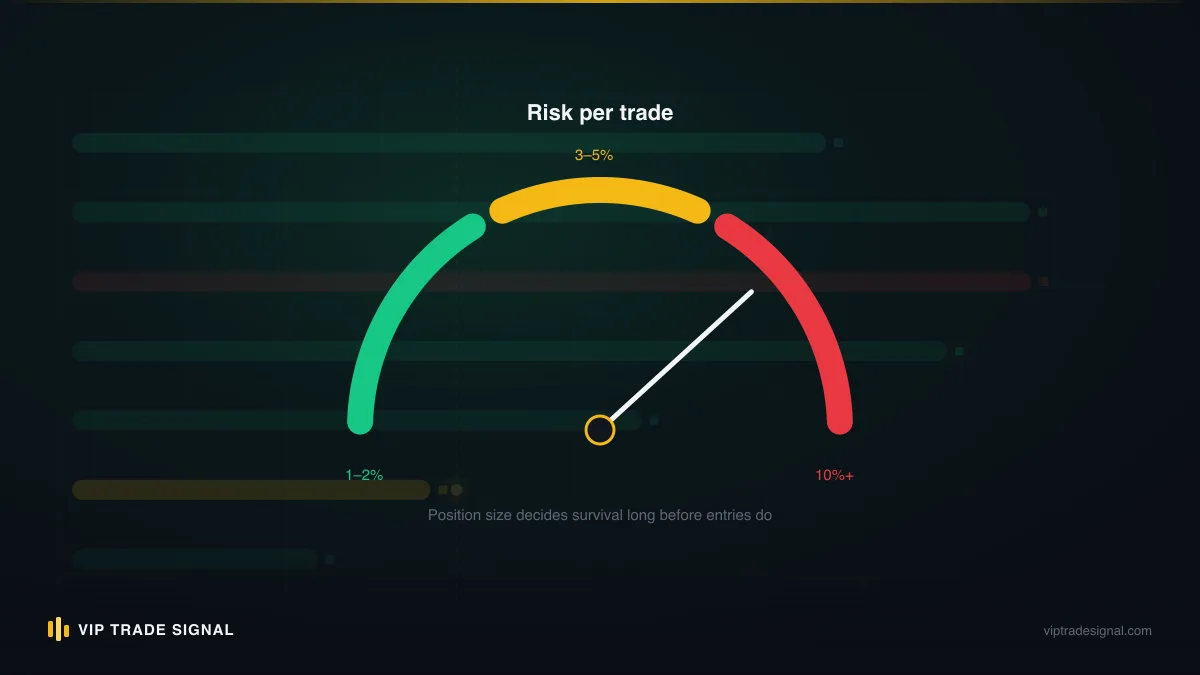
Sizing comes first, and it's stricter than a diversified book would need. Because every trade is the same chart, a losing streak has nothing to hide behind — so per-trade risk has to assume streaks. We plan around the ordinary maths of it: a strategy that wins around half its trades will hand you five or six consecutive losses somewhere in any given year, more or less guaranteed. At 1% risk per trade that streak is an entirely survivable 5–6% dent. At 5% per trade — which is roughly what a 0.10 lot gold position with a 100-point stop represents on a $1,000 account — the same perfectly normal streak takes a quarter of the account, and the psychological damage usually finishes what the maths started. Gold's volatility means the lot sizes that feel small are not small. Most of the wreckage we see in other people's accounts traces back to exactly this.
Stops, next. Gold's noise floor is real: ordinary two-way jitter of 30 to 80 points happens constantly around any level, which means a 30-point stop on gold isn't a tight stop, it's a donation. Our stops live behind structure — beyond the round number, past the session extreme — at distances the instrument's normal breathing won't reach. That usually means 80 to 150 points depending on the setup, with position size scaled down to match so the account risk stays constant. Wide stop, small size, same risk. People resist this because the lot number looks unexciting. The alternative is being right about direction and stopped out anyway, which is the most corrosive loss in trading.
Then the calendar rules already mentioned — reduced or no fresh exposure into the top-tier US prints — plus a daily circuit-breaker: after a fixed number of consecutive losers in a session, we stop for the day, because a specialist's greatest occupational hazard is knowing the chart well enough to always see one more setup. And a weekly review discipline, where the single-instrument journal gets mined for drift: are the session patterns still paying, is the regime shifting under us, are our stops getting clipped more than the sample says they should.
If you want the deeper treatment of position sizing and stop mechanics on gold specifically, we've written those up separately — the sizing piece in particular pairs well with this one. And if you'd rather see how these rules operate when we're trading a client's own account, the account management article walks through it end to end, including the fee structure and what the client keeps control of (short version: the master password and the withdrawals — always).
What this means for you: one edge, fully disclosed
Strip the argument to its skeleton and it's this: markets pay for information advantages, information advantages come from depth, and depth is bought with focus that cannot be faked or scaled. We chose to spend all of ours in one place. Our about page says the same thing in fewer words, but the practical consequences for you, as someone deciding whether to follow a specialist service, are worth listing straight.
You get an edge that can actually be examined. One instrument means every signal we've ever closed is comparable with every other, and all of them are public. You can look at the history and ask precise questions — how it performed through the last quiet stretch, what the losing streaks looked like, whether the results survive the months when gold was hard. Try running that analysis on a channel that posted forty instruments; the sample is mush.
You get transparency about the trade-off. We've spent a third of this article on the downside of our own model, which is not how marketing normally works. Concentration risk is real, quiet regimes are real, and a gold-only equity curve will be lumpier than a well-diversified one. If that lumpiness doesn't fit your temperament or your finances, a specialist service — ours or anyone's — is the wrong tool for you, and we'd rather you concluded that now than three losing weeks in.
And you get a filter for everyone else. Once you understand why depth beats breadth, you can interrogate any service you're considering: what do you actually know about this instrument that the chart doesn't show everyone? A specialist has answers — session tendencies, news digestion patterns, a thousand logged repetitions. A generalist has a subscription page. If you're weighing up the managed route rather than signals, the same filter applies to PAMM operators and copy-trade providers, most of whom spread across whatever's fashionable; our piece on alternatives to PAMM accounts goes through how the structures compare, and the broker-selection guide covers where to hold the account whoever ends up trading it.
Where this leaves you
If you take one thing from this piece, don't let it be "gold is the best instrument". It might not be, for you. Let it be the sharper question underneath: whatever you trade, and whoever you follow, where exactly does the depth live?
Ask it of yourself first. Count the instruments in your own recent history. If it's eleven, you don't have eleven edges; you almost certainly have none, and the fastest improvement available to you is subtraction. Pick the one chart whose behaviour you're most willing to study for a thousand sessions, and let the rest go. That decision costs nothing and, in our experience, changes everything downstream of it — the journal gets useful, the losses start carrying lessons, the noise drops.
Then ask it of any service that wants your money, including us. Our answer is on the record: one instrument, every closed trade published, $99 a month or free through a partner broker with $250 maintained, and no pretence that specialisation abolishes losing — it just makes the losing measurable. Whether that's worth following is your call, and the signal history is the evidence table.
But the question stands on its own, and it's worth asking before every subscription and every trade: depth, or breadth pretending to be depth? Gold taught us our answer. One chart, known properly, beats thirty known by sight.