We trade gold for a living. Only gold. Every signal we've ever published is XAU/USD, and the whole desk is built around one instrument. So it feels a bit strange to open an article by admitting this: when a wrecked account lands on our drawdown desk, the instrument that did the wrecking is almost always the one we love.
Not exotic crosses. Not indices. Not crypto CFDs, most of the time. Gold.
If you've ever wondered why gold trading blows accounts faster than trading EUR/USD or GBP/USD with the same habits, this piece is the honest answer. It isn't a curse and it isn't manipulation, whatever the Telegram conspiracy channels tell you. It's arithmetic. Gold's contract size, its margin consumption, the way its spread behaves when the market panics, and the way it gaps over weekends all stack in the same direction: against an under-capitalised account sized by forex reflexes. Once you see the machinery, the blow-ups stop looking mysterious and start looking almost scheduled.
We're going to walk through that machinery with actual numbers, side by side with EUR/USD, because the comparison is where the penny drops. And then, because we obviously haven't stopped trading gold, we'll cover the adjustments that let you keep the instrument without the account funeral.
The pattern in our rescue intakes: it's usually gold
Part of our work is drawdown management, which means taking over accounts that are floating somewhere between $5k and $10k underwater and trying to work them back toward a recorded baseline. No guarantees, ever, and we say that up front. But the intake conversations follow a script so reliable we could print it.
The trader started on forex. Usually majors, usually a year or two of mediocre-but-survivable results. Then they discovered gold. The candles were bigger, the moves were faster, the wins felt enormous. For a few weeks it was the best trading of their life. Then one session (a CPI print, an FOMC evening, one Sunday open) took back a month of profit and then kept going. By the time they contact us, the account history shows the same fingerprint: small tidy forex trades for pages, then gold positions at the same lot sizes, then bigger gold positions to win it back, then a margin call.
The instrument didn't change its nature halfway through that story. It was always going to do this. The trader just priced it like a currency pair, and gold is not a currency pair. It plays one on your broker's platform, with the same MT5 window, the same one-click lot field, the same "0.10" you've typed a hundred times. That costume is exactly what makes it dangerous.
One intake sticks with us. A trader we'll call Sam (a composite, not a client, but you'll recognise him) spent eighteen months trading EUR/USD and GBP/USD on a $6,000 account. Nothing spectacular. Up maybe 9% over the period, disciplined stops, a written plan, the lot. Genuinely better habits than most. Then a friend showed him a gold chart during a trending month, and Sam did what any reasonable person does with a new instrument: he traded it exactly the way he traded the old one. Same 0.40 lots, same 40-point mental stop, same willingness to sit through a bit of drawdown because "it always comes back". Six weeks later the account was at $1,100 and the message he sent us opened with the sentence we've read a hundred times: "I don't understand what happened, I was doing everything the same."
That's precisely the problem. He was doing everything the same.
Here's the uncomfortable bit for us as a signal service: the traders who blow up on gold aren't stupid. Most of them had risk rules that worked fine for two years. The rules were just calibrated to a different machine. Nobody warned them the machine had changed, because the platform makes the two instruments look identical, and because half the gold content online is written by people selling the excitement rather than pricing it.
One lot of gold is not one lot of EUR/USD
Start with the contract, because everything downstream flows from it.
A standard lot of EUR/USD is 100,000 euros. At around 1.09, that's roughly $109,000 of notional exposure, and a one-pip move is worth $10.
A standard lot of XAU/USD is 100 ounces of gold. With gold around $3,300, that's $330,000 of notional. One lot of gold carries three times the exposure of one lot of EUR/USD, before you've considered a single point of volatility.
But notional is only half the story. The other half is how far the thing actually moves. EUR/USD on a normal day travels maybe 60 to 80 pips. Gold on a normal day (not a news day, just a Tuesday) moves $20 to $40, and $20 on a 100-ounce contract is $2,000 per lot. On an ordinary EUR/USD day, a full lot might swing $600 to $800 against you at the extreme. On an ordinary gold day, the same "1.00" in the volume box can swing $2,000 to $4,000.
So the honest exchange rate between the two instruments is brutal. Like-for-like in daily risk terms, 0.10 lots of gold behaves like something in the region of 0.30 to 0.50 lots of EUR/USD, and on a violent day considerably more. The trader who moves from trading 0.50 lots of euro to 0.50 lots of gold hasn't kept their risk constant. They've roughly tripled the notional and multiplied the daily dollar swing by a factor of three to five, while the number on the screen, the one their brain has spent two years calibrating to, stayed exactly the same.
That's the original sin of most gold blow-ups. Everything else in this article is an aggravating factor.
The points-versus-pips confusion makes it worse
There's a small unit-labelling mess that deserves its own paragraph, because it quietly feeds the sizing error. Brokers quote gold to two decimal places, and different platforms call different digits "points" or "pips". Some traders read a $3.00 move as "300 pips" and mentally file it next to a 300-pip forex move: a huge event, a week of movement. But $3 on gold is nothing. It's a fifteen-minute candle. Meanwhile the per-lot value of those units is completely different. A "pip" of EUR/USD on one lot is $10, while $1 of gold movement on one lot is $100. So the trader's internal dictionary translates gold's numbers into forex feelings, and the feelings are wrong in both directions at once; the distances sound bigger than they are, and the dollar values are bigger than they sound. If you take one habit from this section, make it this: stop thinking in pips or points on gold entirely. Think in dollars of price movement and dollars of account impact. Those two numbers never lie to you. The units do.
How gold trades consume margin faster
Now put that oversized contract inside a leveraged account and watch what it does to your free margin, because margin is where accounts actually die. Nobody blows up from being wrong. They blow up from being wrong with no margin left.
Say you've got a $2,000 account at 1:500 leverage, a very common retail setup. One lot of EUR/USD needs about $218 of margin (109,000 ÷ 500). One lot of gold needs about $660 (330,000 ÷ 500). Same leverage, same account, but the gold position eats three times the margin on day one. And plenty of brokers don't even give you 1:500 on metals; gold margin requirements are frequently stiffer than forex at the same broker, often 1:100 or 1:200 on XAU/USD while forex majors enjoy 1:500, precisely because the broker's risk desk has read the same volatility numbers we're discussing. At 1:100, that single lot of gold locks up $3,300 of margin. On a $2,000 account you can't even open it, which, frankly, is the broker doing you a favour.
The margin consumption problem has a second, nastier gear, though. Your margin level isn't just about what's locked at entry. It's (equity ÷ used margin) × 100, and equity is being dragged around by the position in real time. Because gold moves in bigger dollar increments, your equity falls faster for the same "distance" of being wrong, which means your margin level collapses faster, which means the gap between "comfortable" and "margin call" that took days to cross on EUR/USD can be crossed on gold in an hour.
Run the numbers on that $2,000 account. Trader opens 0.20 lots of gold at 1:200 metal leverage: margin used is $330, margin level starts at a healthy-looking 606%. Gold drops $35, a completely unremarkable move, the kind that happens a couple of times a week. That's $700 against a 0.20 position. Equity is now $1,300, margin level 394%. Another $30 leg down, equity $700, margin level 212%. One more push and the stop-out engine starts closing things. Total distance travelled: about $80, which gold has covered inside a single London-New York session more times this year than we can count. The same trader being equivalently wrong on 0.20 EUR/USD would need around 350 pips of adverse movement, the better part of a week of one-directional pain, with dozens of natural exits along the way.
That's the real answer to why gold trades trigger margin calls faster: the position starts with less margin headroom and then burns what's left at three to five times the speed. Faster fuse, bigger bomb.
A $20 move is routine — your sizing habits say it's a catastrophe
Here's a mental exercise we give every trader who joins our signals after a forex background. Ask yourself what a "big move" means to you, in your gut, after years of watching currency pairs.
For most forex traders, the honest answer is something like 100 pips. That's a headline day on EUR/USD. Your instincts, your stop distances, your tolerance for floating loss: all of it is built around the idea that 100 units of movement is a lot and usually takes a while.
Gold moves $20 the way EUR/USD moves 20 pips. Which is to say: constantly, in both directions, often within an hour, frequently for no reason your news feed can explain. A $20 wiggle isn't a trend, a breakout, or a reversal. It's noise. XAU/USD volatility runs so much hotter than the majors that gold's boring days would be a euro trader's best day of the quarter.
Now look at what that does to the forex-trained stop-loss. A trader who's used to risking 30 pips on EUR/USD sees gold at 3,318 and places a stop $3 away, because "300 points" sounds like a generous stop on the platforms that quote gold in points. Three dollars. Gold covers $3 in the time it takes to make coffee. That stop isn't risk management, it's a donation with a delay on it. It'll be collected within the hour by the ordinary jitter of the instrument, the trade will be a loss, and (here's the poison) the direction call might have been perfectly right. Gold does this to people repeatedly: stops them out with noise, then completes the move they predicted, without them.
So the trader responds the way stung people respond. They stop using stops. And now the routine $20 move has a clear path to becoming a $2,000-per-lot floating loss with nothing between it and the margin call except hope. Most of the accounts that reach our drawdown management desk got there through exactly this two-step: stops too tight for the instrument, then no stops at all. We wrote more about that second, fatal step in why traders hold losing trades; gold just runs the same psychology on a faster clock.
The fix is not complicated, but it is expensive-feeling: gold stops need to live outside the noise, which usually means $8 to $15 away at minimum for intraday work, sometimes more. And a wider stop with the same account demands a smaller position. Which brings us back, always, to size.
Spread widening: the cost that arrives when you can least afford it
Everything so far assumed you get filled at the prices on your screen. Let's break that assumption, because gold breaks it regularly.
In quiet hours, gold spreads at a decent broker are tight; 15 to 35 cents is normal, and it feels almost free. But gold's spread is not a constant. It's a weather system. Around major news releases, in the minutes after a violent breakout, at the daily rollover, and above all at the Sunday open, gold spreads can widen from 20 cents to $1.50, $3, occasionally more. For a few minutes, the cost of doing anything (entering, exiting, being stopped out) multiplies by ten.
And notice when those minutes happen. Not at random. Spread widening clusters at precisely the moments you're most likely to be forced to transact: the news candle that's smashing through your stop, the panic move you're trying to bail out of, the market open that's gapping against your weekend position. The spread is widest at your worst moment, by construction. Liquidity providers pull quotes exactly when uncertainty spikes, and your stop order becomes a market order into a thin book.
Concretely: your stop is at 3,295. NFP hits, gold drops hard, the spread blows out to $2.50, and your long is closed not at 3,295 but at 3,292.60. On 0.50 lots, that surprise is $120 of extra loss that appeared in the two seconds your order took to fill, on top of a slippage-prone fill of the stop itself, which in a real cascade might be another few dollars of price away. We've seen news-candle fills land $8 from the stop price. Not often. But "not often" happens every few months, and an account sized to survive the stop you set is not sized to survive the stop you actually get.
EUR/USD does this too, in fairness; no instrument's spread is truly fixed. But the magnitudes are different leagues. A euro spread going from 0.1 to 1.5 pips on news costs a standard lot an extra $14. A gold spread going from 30 cents to $3 costs a standard lot an extra $270. Same event, twenty times the bill.
The practical rule we run on the desk: assume every gold stop will fill $1 to $2 worse than placed during news, and size so that outcome is annoying rather than structural. If a $2 worse fill would change your account's future, the position was too big before the spread ever moved.
Weekend and news gaps: the risk your stop cannot see
A stop-loss protects you from prices the market trades through. It does nothing about prices the market skips.
Gold closes on Friday evening and reopens Sunday. In between, the world keeps happening. Elections, missile strikes, central bank surprises, ratings downgrades: gold, being the market's designated panic asset, absorbs all of it at the open in a single repricing. When gold gaps $15 or $30 over your stop, your stop fills at the far side of the gap. The order worked exactly as designed. The design just can't protect you from a price that never printed.
Run it: you're long 0.30 lots from Friday, stop $10 back, risking $300 on a $2,400 account. That's 12.5%, already too hot, but survivable if the stop means what it says. Sunday, gold opens $28 below Friday's close on Middle East headlines. Your fill is $28 away, not $10. The loss is $840, not $300. You've lost 35% of the account over a weekend you spent doing nothing wrong except holding.
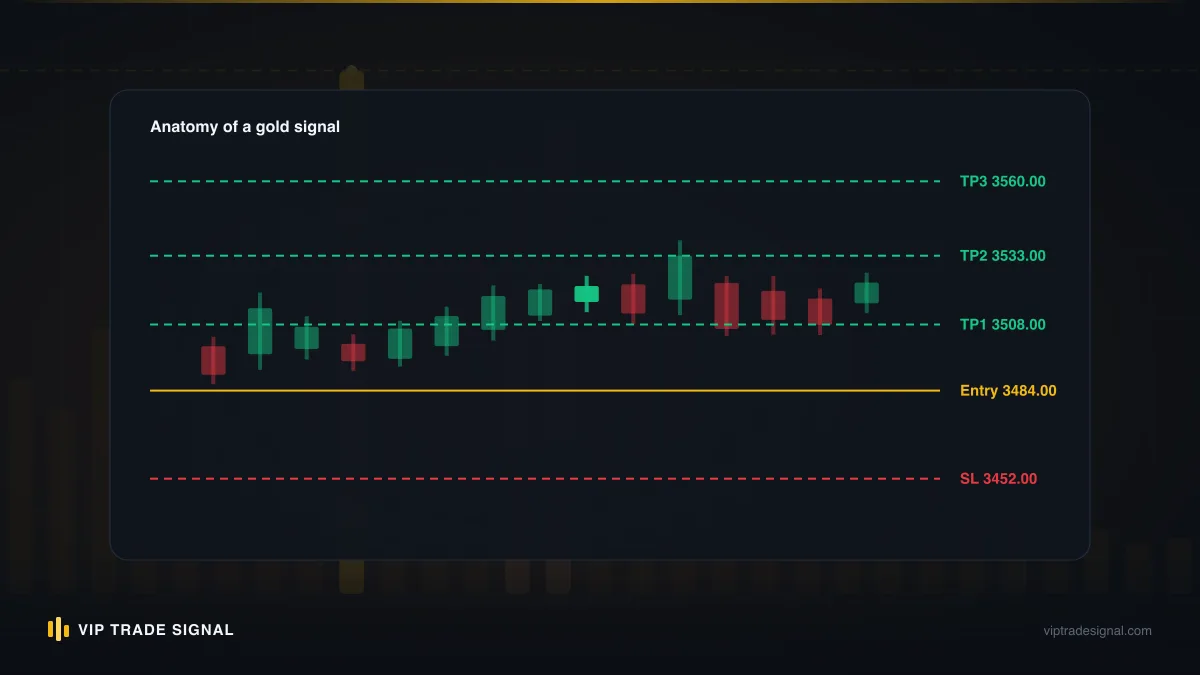
The bitter irony is that the very quality people buy gold for, its reflex to reprice violently on fear, is the quality that produces the gaps. You cannot have a safe-haven instrument that doesn't gap on weekend war news. It's the same feature viewed from two sides.
Intraday news does a smaller version of this several times a month. High-impact US data can move gold $15 to $30 in the first minute, and within that minute the chart is more staircase than line: price jumps in $2 and $3 increments with nothing in between. Stops inside that zone fill wherever liquidity happens to exist.
And note what gaps do to the maths of averaging down, since that's the standard retail response to a position gone wrong. The trader who is $15 underwater on gold and adds a second position "at a better price" has doubled the exposure that any subsequent gap acts upon. If Sunday opens $25 lower, both positions eat the full gap. We've unwound accounts where a single weekend converted a recoverable 20% drawdown into a stop-out purely because the trader spent Friday afternoon "improving the average". Three entries, one direction, one gap, no account. Averaging down is a questionable habit on any instrument. On the one instrument that reprices world events in a single Sunday print, it's a standing invitation.
What actually works against gaps is dull: hold less over weekends, or nothing; cut size ahead of red-calendar events rather than adding "because it'll be volatile"; and treat your true worst case per trade as stop distance plus a $20 to $30 gap allowance when deciding what you can carry overnight. On our own signals we set stops and targets assuming gold will occasionally do something unreasonable, because it will. You can check how those trades actually resolved, losses included, in our full signal history.
The forex-trained sizing mistake, dissected
Time to name the central error precisely, because "trade smaller" is advice everyone nods at and nobody converts into a number.
The forex-trained trader sizes by lot-number habit. Two years of EUR/USD taught their hands that 0.50 lots feels like a normal trade on their account. The feeling is the unit. When they switch to gold, the feeling comes along, and the feeling is now wrong by a factor of three to five.
The correct unit was never lots. It's dollars at the stop. The sizing formula that survives contact with gold is the same one that works everywhere, applied without sentiment:
- Decide your risk in money. On a $5,000 account risking 1%, that's $50. (Yes, 1%. Gold will test whatever number you pick; pick one you can be wrong ten times in a row on.)
- Set the stop where the trade is wrong. For gold, that means outside the noise, so realistically $8 to $15 for intraday setups.
- Divide. Risk ÷ (stop distance × $100 per lot per dollar). $50 ÷ ($10 × $100) = 0.05 lots.
Sit with that result for a second, because it's the number that offends people. Five micro-lots. The forex trader who "moved up" to gold expecting bigger trades discovers that honest sizing on gold is smaller in lot terms than what they traded on the euro, because each lot is heavier and each stop is wider, and both factors divide against you. The market doesn't care that 0.05 feels beneath you. On a $10 stop it's a $50 loss, which is exactly what you budgeted, which is the whole point.
Gold doesn't blow accounts because it moves too much. It blows accounts because traders bring euro-sized positions to a gold-sized market and call the difference bad luck.
There's one more turn of the screw worth naming: the win-first trap. Oversized gold positions often pay off immediately, because a big mover cuts both ways and a lucky fortnight on 0.50 lots of gold can add 40% to a small account. That fortnight is the most expensive thing that can happen to a developing trader. It converts a sizing error into a belief. The full anatomy of that spiral (oversized wins, doubled conviction, the one week that takes it all back) is basically the standard biography of a blown account, and we've written it up separately in why traders blow accounts. Gold's contribution is speed. What takes six months to unwind on the majors takes six days on metal.
Margin call maths: gold vs EUR/USD, side by side
Let's put the whole comparison in one place. Same trader, same $3,000 account, same broker offering 1:500 on forex and 1:200 on gold, same habitual 0.30-lot position, no stop (as is tradition, by the time it matters). Prices: EUR/USD 1.0900, gold $3,300. Margin call warning at 100% margin level, stop-out at 50%.
| 0.30 lots EUR/USD | 0.30 lots XAU/USD | |
|---|---|---|
| Notional exposure | ~$32,700 | ~$99,000 |
| Margin locked at entry | $65 | $495 |
| Starting margin level | ~4,600% | ~606% |
| $ per pip / per $1 move | $3/pip | $30 per $1 |
| Typical daily range, in $ | $180–$240 | $600–$1,200 |
| Adverse move to 100% margin level | ~978 pips | ~$83 |
| Adverse move to 50% stop-out | ~989 pips | ~$88 |
| Time for such a move, historically | many weeks of one-way disaster | one bad session to a few days |
Look at the bottom rows. The euro position needs nearly a thousand pips of uninterrupted wrong to reach stop-out, a move so large and slow that the trader has weeks of chances to act, and usually some retracement to escape into. The gold position needs $88. Gold has covered $88 inside two sessions repeatedly this year; on the wildest days it's covered it before lunch. Identical lot number, identical account, and one position is a slow-motion problem while the other is a trapdoor.
It's worth being clear about what those last few minutes actually look like, because most traders have never watched a stop-out happen and imagine it as one clean event. It isn't. When margin level hits the broker's stop-out threshold, the platform starts closing the largest losing position first, at market, into whatever spread exists at that moment. If the account holds several positions, they go one by one, each closure realising a loss, each realised loss dropping equity further, sometimes triggering the next closure in a chain. On a fast gold move this cascade can take seconds. Traders describe refreshing the app and finding the account simply empty of positions, with a balance they don't recognise. There's no phone call, no grace period, no "margin call" in the old-fashioned sense of a banker asking for funds. The 1980s version was a conversation. The 2020s version is an execution.
This is also why the margin call itself feels so different on gold. Euro traders describe margin calls arriving like a tide. Gold traders describe them arriving like a car crash: the 100% warning and the 50% stop-out can be minutes apart when the metal is running, because the same violence that created the loss is still accelerating it. By the time the platform starts force-closing, the spread is wide, the fills are poor, and the final equity is worse than any of the maths above predicted.
If you want the one-sentence version of this entire article, it's in that table: at equal lot sizes, gold reaches your stop-out roughly ten times faster than EUR/USD, and retail habits are calibrated to the euro's speed.
Trading gold safely anyway: the adjustments that actually matter
None of this is an argument to avoid gold. It's an argument to stop pricing it like forex. Here's what changes on a desk that takes the instrument seriously, ours included, and any trader's who wants to keep both the metal and the account.
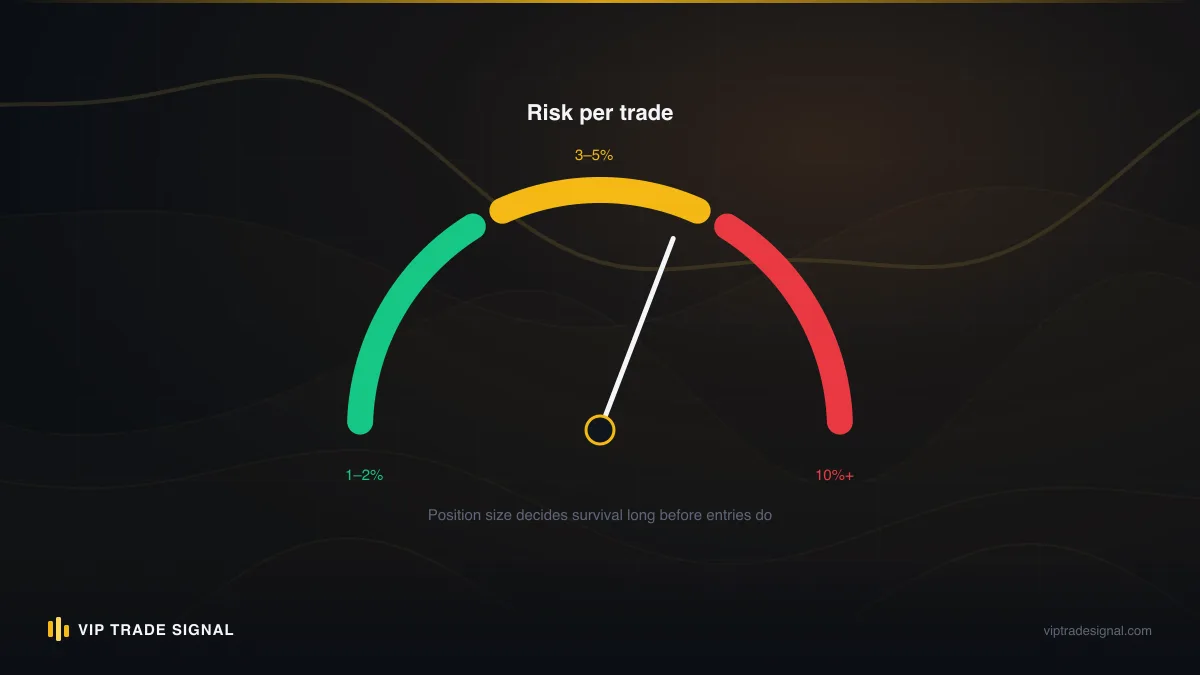
Size in dollars, permanently. The lot-number habit has to die. Fixed fractional risk, meaning 0.5% to 1% of equity at the stop, computed fresh for every trade, is the entire foundation. On gold this produces positions that look embarrassingly small next to your forex history. Good. Embarrassment is cheaper than a rescue mandate.
Widen stops to where the instrument lives, then size down to afford them. A gold stop inside $5 is noise-bait for most intraday setups. Put stops beyond a real structural level with room to breathe, and let the wider stop shrink the position via the formula, rather than keeping the position and praying the tight stop holds. Wider stop, smaller size, same dollar risk. That trade survives the $20 wiggle and is still there when the actual move happens.
Cap total exposure, not just per-trade risk. Three gold positions at 1% each are not three independent bets. They're one 3% bet on the same chart, and gold will treat them as one. On a single-instrument book, correlation is total. We run hard caps on simultaneous exposure and on daily loss (2% and the day is over, no appeals), because with gold, the second trade after a loss is where discipline goes to die.
Respect the calendar and the clock. Flat or small into FOMC, CPI, NFP. Reduce or flatten into the weekend unless the position is far enough onside to absorb a $30 gap. Know that the late-US session and the Sunday open are where spreads misbehave, and don't leave tight stops sitting in those windows.
Assume worse fills than your platform shows. Budget $1 to $2 of slippage-plus-spread on every news-adjacent stop. If that budget breaks the trade's maths, the trade was too big.
Keep leverage as a ceiling you never touch. 1:500 on the account doesn't mean 1:500 in use. Sized at 1% risk with proper stops, your effective leverage on gold will land somewhere around 3:1 to 8:1, and your margin level stays in the thousands of percent where stop-outs can't reach it. The broker's maximum is a marketing number, not a suggestion.
Rehearse the exit before the entry. Before the buy button, answer three questions in writing if you have to: where is this trade wrong, what does it cost me there in money, and what do I do if price gaps past it. Traders who can answer all three tend to survive gold. Traders who answer "I'll manage it" tend to meet us later, professionally.
One more adjustment that costs nothing: demo the transition. If you're moving from forex to gold, run two to four weeks on a demo account sized exactly as the formula dictates, and let your hands learn what 0.05 lots of gold feels like when it moves $18 in an afternoon. The point of the demo isn't to test a strategy. It's to recalibrate the feelings, the same feelings that currently insist 0.50 lots is normal, before they can spend real money defending themselves.
There's a longer, more systematic version of this list, including how we structure targets and manage partial exits on metal, in our piece on XAU/USD risk management. But if you only take the first two items and actually implement them, you've already left the population that fills our intake queue.
Why we still choose gold — with the controls on
After four thousand words of prosecution, the defence, briefly. We trade gold exclusively, and not out of stubbornness.
The volatility that destroys badly-sized accounts is the same volatility that makes gold worth trading at all. A properly sized gold position can reach a sensible profit target in hours, in a market that trends hard and often, with liquidity deep enough that retail size never moves it, around levels that the entire world watches and therefore respects. EUR/USD spends whole quarters in 200-pip coffins where nothing you do matters. Gold gives you movement, the raw material of every trading profit, every single week. The specialist's bargain is simple: accept the strictest sizing discipline in retail trading, and in exchange get an instrument that actually goes somewhere.
The single-instrument focus compounds the edge. One chart, one set of behaviours, one calendar of events that matter, years of watching how this specific market treats a London session versus a New York one. We'd rather know one violent instrument intimately than five calm ones vaguely. Every closed trade we've taken on that conviction, the wins and the losses (because there are always losses), sits publicly at /signals/history, and we'd encourage that standard of proof from anyone whose gold calls you're considering following. Fuller answers about how the service and the partner-broker option work live on our FAQ.
But the honest close is this. Gold doesn't care whether you respect it. The mechanics in this article, from the 100-ounce contract to the margin burn, the spread weather and the gaps, operate identically on every account, ours included. The difference between the traders who keep this instrument for years and the ones who send us a rescue email is not prediction skill. It's that one group sized for the market gold actually is, and the other sized for the market their hands remembered.
So, the hard question before your next gold trade: if the position went $30 against you tonight, gapped and all, what percentage of your account disappears? If you can't answer in one second, you haven't done the sizing. And if the answer is more than a couple of percent, you're not trading gold. You're waiting for it.