Nobody plans their fifth consecutive loss. The first one you shrug off. The second stings a bit. By the fourth you're checking the chart on your phone in the supermarket queue, and by the fifth you're either frozen at the screen or doubling your lot size to "get it back before the weekend". Every trader who has been at this longer than a few months knows exactly the feeling I'm describing, and almost none of them had a written answer to the only question that matters in that moment: when to stop trading after losses, decided in advance, in cold blood, before the streak ever started.
That's the whole problem in one sentence. The decision to stop is the single most important risk decision you'll make in a bad month, and most traders leave it to be made by the version of themselves least qualified to make it: the tilted one, five losses deep, at 11pm.
This piece gives you the framework we actually use on the desk. Not vibes. Not "take a break when you feel emotional", which is advice roughly as useful as "buy low, sell high". Hard tripwires: a daily stop, a weekly stop, and a full reassessment threshold, each with a number attached and each with an objective condition for coming back. Plus the bit almost nobody covers, which is the maths of how long a normal losing streak actually runs for your win rate, because you cannot judge whether a streak is a crisis until you know what ordinary looks like.
Stopping is a position too
Here's the reframe that makes everything else work. When you stop trading, you haven't gone flat in some passive, defeated sense. You have taken a position. You are long cash and short your own strategy, and you've done it because the evidence in front of you says that's the best trade available.
Think about what that means. A trader who exits a losing gold long at 3,290 because the setup invalidated isn't "giving up on the trade". They're executing a decision they made when they placed it. Stopping your whole trading operation for a day or a week is the same move one level up. The stop-loss on the trade protects the account from the market. The stop on the trader protects the account from you.
And it needs the same properties a good stop-loss has. It has to be set before you're in the position, because a stop you invent mid-drawdown will always be one more loss away. It has to be a specific number, because "I'll stop when it gets bad" means never. And it has to be honoured mechanically, because a stop you negotiate with isn't a stop, it's a suggestion.
The traders who survive long enough to get good are not the ones who never hit losing streaks. Everybody hits them. Gold hands them out generously. The survivors are the ones who had the tripwires written down and actually tripped them. We've watched accounts come into our drawdown management service sitting $7,000 or $8,000 underwater, and the story is nearly always the same: the losses that did the real damage weren't the first five. They were losses eight through twenty, taken after every reasonable stopping point had been blown through because no stopping point existed.
The stop-loss on the trade protects the account from the market. The stop on the trader protects the account from you.
So treat this article as position-sizing for your own behaviour. We're going to work out where your personal stop-losses go.
Is this streak normal? The maths by win rate
Before any tripwire makes sense, you need a baseline, because the human brain is catastrophically bad at intuiting streaks. Ask a trader with a 50% win rate how many consecutive losses would be alarming and most will say four, maybe five. The maths says they should expect worse than that as a matter of routine.
The back-of-envelope version: over a run of trades, the longest losing streak you should expect is roughly the natural log of your number of trades divided by the natural log of one over your loss rate. You don't need to remember the formula. You need to remember the outputs, because they are genuinely surprising the first time you see them.
| Win rate | Expected worst streak in ~100 trades | Expected worst streak in ~200 trades |
|---|---|---|
| 60% | 5 | 6 |
| 50% | 6–7 | 7–8 |
| 45% | 7–8 | 9 |
| 40% | 9 | 10–11 |
| 35% | 10–11 | 12 |
Read that middle row again. A coin-flip win rate, which describes a huge number of perfectly viable strategies that make their money on reward-to-risk rather than accuracy, should expect a six or seven trade losing streak somewhere in every hundred trades. Not might suffer one in a freak scenario. Should expect one, roughly every hundred trades, forever, as a structural feature of the strategy working exactly as designed.
If you trade a signal-following approach at two or three gold trades a day, a hundred trades is about seven weeks. Which means a six-loss streak isn't a once-a-year catastrophe. It's a quarterly appointment.
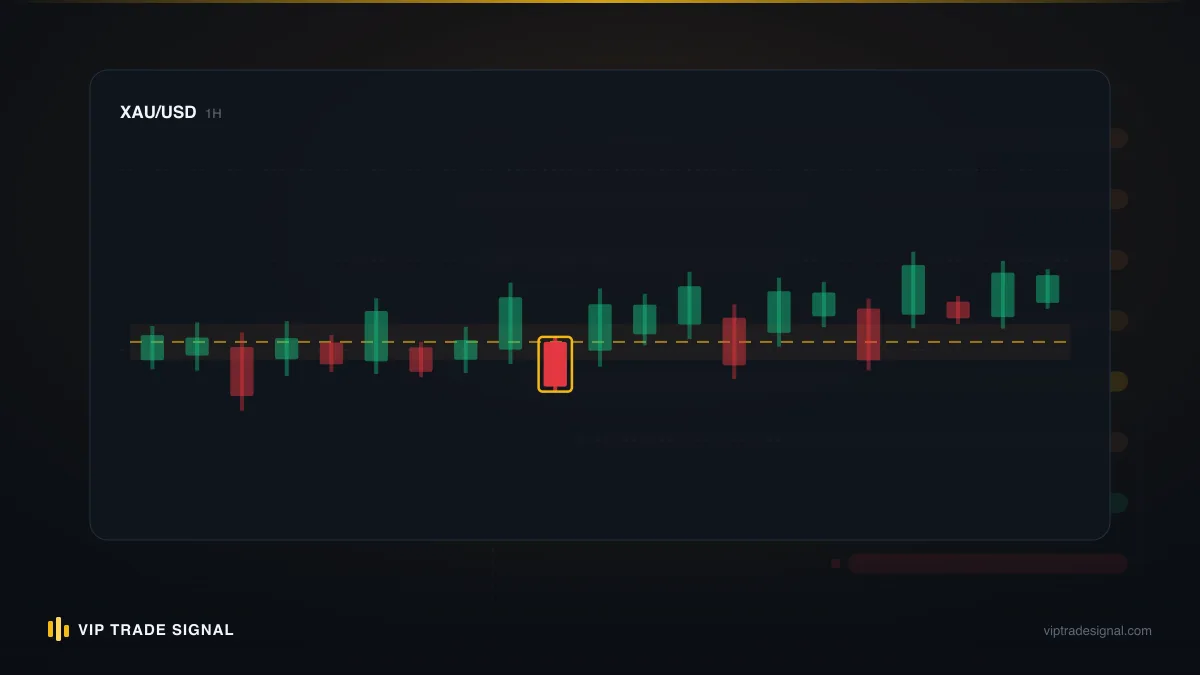
Now flip it around, because this is where the table earns its keep. If your honest win rate is around 45% and you're eight losses deep, you are inside normal variance. Uncomfortable, but normal. Your strategy has not broken; the dice have simply come up cold in exactly the way dice do. Whereas if you're running a genuine 60% win rate and you've just taken nine straight losses, something has probably changed, because that streak sits well outside what your edge should produce.
There's a second implication buried in the table that deserves dragging into the light. Streaks scale with time in the market. The 200-trade column is worse than the 100-trade column not because anything changed, but because more trades means more chances for the cold run to show up. Trade for five years and you will, at some point, meet a streak noticeably uglier than anything in either column, and it still won't mean your strategy died. The traders who quit at exactly the wrong moment are usually the ones who treated their worst-ever streak as new information, when it was really just an old promise finally being kept.
Two honesty checks before you use this table. First, you need your real win rate, from your actual trade log, not the flattering number you carry around in your head. Most traders' remembered win rate runs a good few points above their recorded one. Second, streak length is only half the story. Five losses at 1% risk each is a 5% drawdown and a shrug. Five losses where you doubled up twice out of frustration might be 15%, and at that point the streak isn't the problem anymore. You are. We wrote about that specific spiral in why traders blow accounts, and the short version is that it's almost never the market that does the blowing.
Streak or decay: telling variance from a broken edge
The table tells you whether the streak's length is plausible. It can't tell you whether the streak is random cold dice or the first symptom of an edge that has genuinely stopped working. For that you need to look at the character of the losses, not just the count.
Variance losses have a particular texture. The setup appeared, you took it at the planned size, price went to your stop, the stop did its job. Annoying, clean, forgettable. If you showed the trade to another trader who follows the same approach, they'd nod and say "fair enough, that was the trade". Ten of those in a row is painful but it's the strategy losing, which is a thing strategies are allowed to do.
Decay losses feel different, and they usually show one of these fingerprints:
- The trades stop resembling the plan. You review the losing run and find entries you can't justify from your own rules. Late chases, revenge entries, positions taken during hours you never normally trade. That's not the edge failing. That's you no longer trading the edge.
- The market regime has visibly changed. A breakout strategy built during a trending gold market will bleed steadily when price goes into a 40-dollar range for six weeks. The strategy isn't broken in some permanent sense, but its habitat is gone, and it will keep losing until the habitat returns.
- The losses cluster around one repeated failure mode. Every stop-out happens the same way: filled on a spike through your level during the New York open, say, or every winner reverses at the same session boundary. One repeating pattern across a whole streak points at structure, not luck.
- Your average loss is quietly growing. If losses one to three were each 1R and losses six to eight were 1.4R because you kept widening stops, the strategy's numbers no longer describe what you're doing.
Here's a rough diagnostic, and I'd stand behind it: variance looks like your plan losing; decay looks like either your plan changing or the market changing underneath it. The first calls for patience and smaller size. The second calls for a proper review, and no amount of gritting your teeth through it will help, because you'd be gritting your teeth through a strategy that no longer exists.
The catch, and it's a real one, is that you cannot make this diagnosis at full emotional temperature while still in the streak. Which is precisely why the tripwires below exist. They force the pause during which the diagnosis becomes possible.
Tripwire 1: the daily stop
The first tripwire is the smallest and you will trip it the most often. Good. That's what it's for.
The rule: pick a daily loss limit as a percentage of your account, write it down, and stop placing trades for the rest of the day the moment you hit it. Not "stop after this one recovers". Stop. Platform closed, or at minimum no new positions.
For most retail accounts trading gold, somewhere between 2% and 3% is the sensible zone. If you risk 1% per trade, a 3% daily stop means three full losses ends your day, which maps neatly onto reality: three clean stop-outs in one session usually means either the market is doing something your approach doesn't handle today, or you're off. Either way, the correct exposure for the rest of that day is zero. On a $5,000 account that's a $150 day. Painful enough to respect, small enough that it decides nothing about your future.
Notice what the daily stop is actually protecting you from. It isn't really protecting the account; a 3% day, taken cleanly, is recoverable within a normal week. It's protecting you from the fourth trade. The fourth trade after three losses is statistically just another trade, but behaviourally it's the most dangerous trade in retail trading, because it's the first one placed by someone who wants money back rather than someone executing a plan. Anyone who has held a losing gold position through a 30-dollar adverse move "because it has to bounce" knows this trade personally; we dissected that impulse in why traders hold losing trades, and the daily stop is the cheapest vaccine against it.
The re-entry condition matters as much as the stop itself, and here it's deliberately light: the next trading day, at normal size, provided you complete one piece of admin first. Log the day's trades and write one sentence per loss stating whether it followed the plan. That's it. Five minutes. If all three sentences say "planned trade, stopped out", tomorrow you trade normally with a clear conscience. If one of them says "chased the break after missing the entry", you've caught a discipline leak while it costs 1% instead of 15%.
A quick word on mechanics, because they matter more than they should. If your broker or platform supports it, set the daily limit as an actual hard control rather than a promise; several platforms and third-party tools will lock new orders once a daily loss figure is reached. If yours won't, the low-tech version works fine: when the stop trips, close the terminal and put the day's log entry in your calendar for the evening. The friction of reopening everything is a surprisingly effective barrier for the ten minutes it takes the urge to fade. What you're engineering is distance between impulse and order ticket, by whatever means you've got.
One thing the daily stop is not: a target for the day's acceptable damage. Hitting it once a month is the system working. Hitting it twice a week means either your stops are too tight for gold's genuine range, your size is too big, or trouble is brewing that the weekly tripwire is about to catch.
Tripwire 2: the weekly stop
The second tripwire is where the framework starts to bite, because it costs you something you'll actually miss: days of market access.
The rule: set a weekly loss limit, typically 5% to 7% of the account, and if you hit it, you are done until Monday, full stop. No Friday afternoon redemption trade. No "the NFP setup is too good to skip". Done.
The number should relate to your daily stop sensibly. If your daily stop is 3%, a 6% weekly stop means two maxed-out days ends your week, and that's about right. Two separate days in one week where the market handed you your full daily allowance is no longer a bad afternoon. It's a pattern asking to be looked at.
And the weekly stop, unlike the daily one, triggers real work. The re-entry condition is a written review, done over the weekend when you cannot act on any conclusion, covering four questions:
- Count and character. How many losses, and were they plan-following losses or improvised ones? Sort every trade into one pile or the other. Be brutal about the sorting; a trade that followed the plan except for a doubled position size goes in the improvised pile.
- Streak context. Against the table above and your honest win rate, is this streak's length inside normal variance or outside it?
- Regime check. Has gold's behaviour changed in a way your approach is on the wrong side of? Range compression, a shifted session pattern, spreads widening at your usual entry times?
- Size check. Is your risk per trade still the number you chose, or has it crept?
If the review comes back "planned trades, normal-length streak, no regime change, sizing intact", then you've simply been living inside the left tail of your own distribution, and the correct response is the least dramatic one available: resume on Monday, same strategy, and I'd suggest half size for the first week purely as a concession to your own nervous system. Nothing is broken. It just hurt.
If the review finds improvised trades doing most of the damage, the strategy isn't the patient. Resume at half size with one extra rule: for the next twenty trades, every entry gets a one-line written justification before the order goes in. Tedious by design. Tedium is the point; it re-installs the pause that tilt removed.
And if the review finds a regime change or a streak well outside your maths, don't resume at all. Escalate straight to tripwire three.
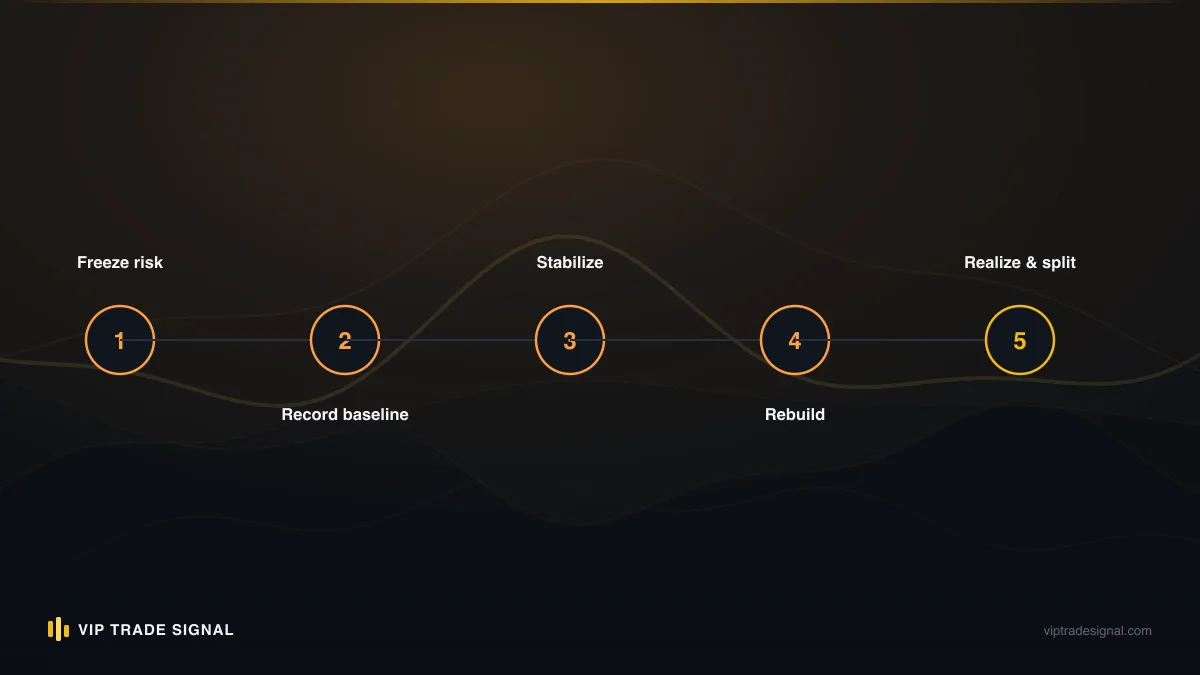
Tripwire 3: the full reassessment threshold
The third tripwire is the one traders resist writing down, because writing it down means admitting it could happen. Write it down anyway.
The rule: pick a peak-to-trough drawdown number at which you stop trading the strategy entirely, for weeks not days, and conduct a full reassessment. For most retail approaches, 15% to 20% from equity peak is the honest zone. If your backtest or track record says the strategy's historical worst drawdown is 12%, then a live drawdown of 18% is your own data telling you that either you've been unlucky to a degree the strategy has never before produced, or the strategy you're trading live is not the strategy you tested. Both possibilities justify a halt.
This tripwire is different in kind from the first two. The daily stop assumes you're fine and the day was noise. The weekly stop assumes the strategy is fine and asks whether you are. The reassessment threshold suspends both assumptions. Everything goes on the table: the strategy's logic, its fit to current conditions, your execution of it, your sizing, and honestly, whether you should be the one trading it at all right now. A trader in the middle of a divorce or a redundancy is a different trader, and pretending otherwise is expensive.
What does a real reassessment involve? At minimum: a full re-run of the strategy's numbers over recent market data to see whether the edge still shows up when a machine trades it without you attached; a trade-by-trade audit of the drawdown to measure how much was strategy and how much was pilot error; and a genuinely open verdict, where "retire this strategy" is a permitted outcome. Give it two to four weeks. A reassessment concluded in a weekend is a rubber stamp with extra steps.
There's a version of this that's worth saying plainly because it's unfashionable: sometimes the reassessment should conclude that you press pause on self-directed trading for a few months. Not forever. Not as punishment. Just as an acknowledgement that the current combination of strategy, market and trader isn't producing anything except smaller account balances, and that capital preserved is optionality preserved. The market will still be there in the spring. Your remaining capital might not be, if you keep feeding it into a machine that's currently set to shred.
What to do during a stop (it isn't demo revenge)
The most common way traders ruin a trading break is by not actually taking one. They close the live platform and immediately open a demo account, where they proceed to trade twice their normal frequency at ten times their normal size, "testing ideas". That's not a break. That's methadone administered by the same doctor who caused the addiction, and it keeps every tilted circuit fully lit while teaching you precisely nothing, because demo trades placed in a revenge state have no evidential value about anything.
A stop has two jobs: cool the nervous system, and generate the information your review needs. Everything you do during one should serve one of those two jobs.
What actually helps, in rough order of value:
- Complete your trade log if it's behind. You cannot review what you didn't record. Half the traders who come to us have three weeks of unlabelled MT5 history and a memory that flatters them.
- Reread the losing trades with the chart open. Not to relive them. To sort them into the planned pile and the improvised pile, which is the raw material for every decision above.
- Watch the market without an order ticket open. Genuinely useful and genuinely hard. Observing gold for a week with no ability to act rebuilds the watcher's stance that trading from inside a losing streak destroys.
- Do the boring life things trading displaced. Sleep. Exercise. Dinner with people who don't know what a pip is. This sounds like wellness filler and it is not; decision quality after a proper week off is visibly different, and everyone who has done it knows it.
What doesn't help: doubling your screen time on trading YouTube looking for a new strategy to replace the one you haven't finished diagnosing, and shopping for a new broker as if the spread were the problem. New-strategy shopping during a drawdown is how traders end up with five half-tested systems and zero tested ones.
If you follow signals rather than trade your own setups, a stop works the same way with one adjustment: you keep receiving and logging the signals, you just don't take them. That turns your break into a live forward-test. If the signals perform well during your two weeks out, you've learned your execution was the leak. If they lose too, you've learned the streak was upstream of you, which changes your options considerably; a service that publishes every closed result, ours included at /signals/history, makes that comparison checkable rather than a matter of trust.
Re-entry: earning your way back to full size
Coming back is where most stop frameworks quietly fall apart, because they specify the exit and leave the re-entry to mood. "I feel ready" is exactly as reliable on the way back in as "it feels wrong" was on the way out, which is to say not at all. Re-entry needs conditions as objective as the tripwires.
The principle: return is staged, and each stage is earned by process, not by profit.
Here's the ladder we recommend, and you should adjust the numbers to your account rather than treating them as scripture:
| Stage | Size | Advance condition |
|---|---|---|
| 1. Observation | No trades | Review complete, verdict written down |
| 2. Quarter size | 0.25× normal risk | Ten trades logged, 80%+ plan-compliant |
| 3. Half size | 0.5× normal risk | Ten more trades, compliance held |
| 4. Full size | 1× normal risk | Twenty total post-break trades, no daily stop hit |
Read the advance conditions again, because the design choice hiding in them is the entire trick: not one of them mentions profit. You advance from quarter size to half size by following your plan for ten trades, even if those ten trades lose money. A quarter-size losing streak that's fully plan-compliant is a trader doing everything right inside normal variance, and punishing it by resetting the ladder teaches your brain that process doesn't pay, which is the single worst lesson available. Equally, ten sloppy winners advance you nowhere. Winning at the wrong size with off-plan entries during your probation period is the market handing you a loaded gun as a welcome-back gift.
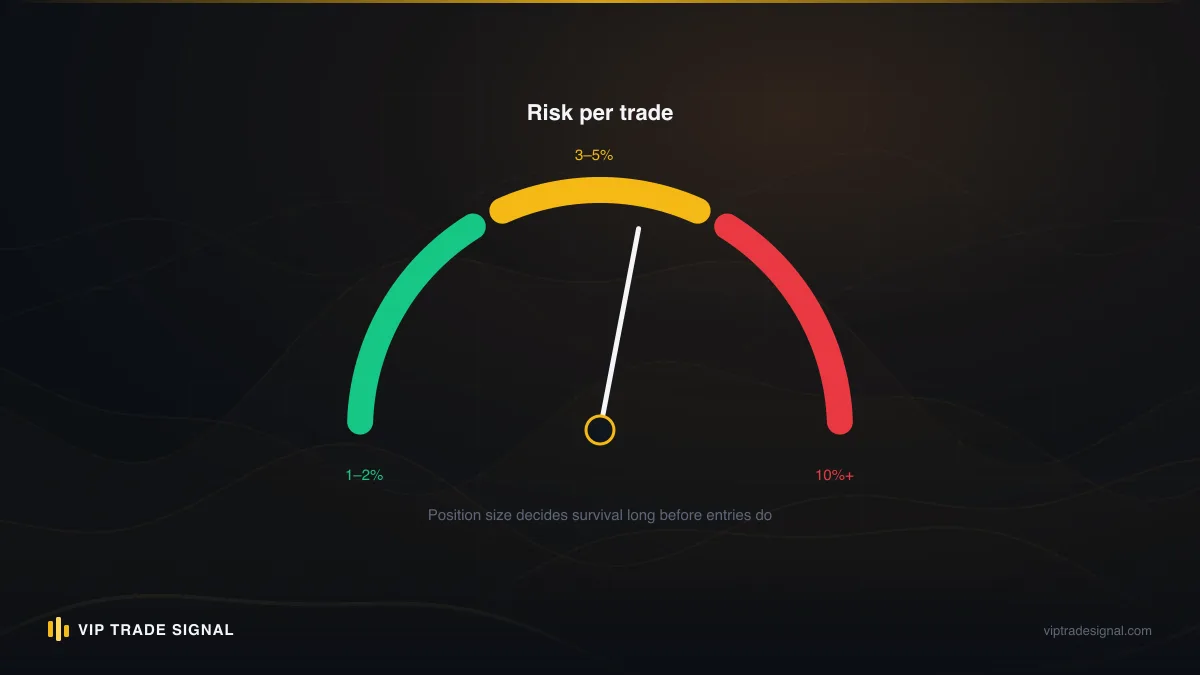
Why quarter size and not just half? Because the first trades back have a job beyond making money: they're diagnostic. At 0.25% risk on a $4,000 account you're risking $10 a trade, which is small enough that your nervous system stays quiet and large enough that the trades are real. You are testing whether the trader who returned is the one who did the review, or the one who caused the drawdown wearing the reviewer's clothes. Ten trades at stakes that don't matter answer that question cheaply.
One more rule for the ladder, and it's the one people hate: any daily stop hit during stages two or three sends you back one stage. Not to zero. One stage. Harsh enough to mean something, gentle enough that you'll actually obey it rather than abandoning the whole framework in a sulk.
When the streak reveals the strategy is dead
Sometimes the reassessment comes back with the answer nobody wants: the edge is gone. Not resting. Gone.
Strategies die. This is a normal fact about markets that retail trading culture treats as unspeakable, because the culture is largely funded by people selling strategies. Edges get arbitraged away, the volatility regime that fed them ends, a structural change in how a market trades removes the inefficiency they harvested. Gold in particular reinvents its personality every couple of years; an approach tuned to 2023's behaviour met a very different animal once the market started routinely covering multiples of its old daily range. We've written before about why gold blows accounts, and half of that story is traders running position sizes and stop distances calibrated to a gold that no longer exists.
How do you distinguish a dead strategy from a sleeping one? Honestly, with difficulty, and anyone who claims a clean test is selling something. But the useful signals are these. A sleeping strategy's losses coincide with an identifiable, plausibly temporary regime: a range-bound summer, a compressed-volatility stretch, a distorted holiday season. You can name the condition hurting it and describe what its return would look like. A dead strategy's losses persist across regimes, and its re-tested numbers over the last six or twelve months show the edge shrinking steadily rather than dipping and recovering. Decline with a trend is decay. Decline with a named cause and a comeback condition is hibernation.
If it's hibernating, you don't trade it; you shelve it with a written re-activation condition ("returns to service when 20-day average daily range exceeds X") and either sit out or run something suited to the current regime at modest size. If it's dead, you thank it for its service and you stop, completely, without the six months of half-sized denial trading that most people insert here. The most expensive words in strategy management are "it just needs one good month".
And do not skip the grief step, silly as that sounds. Traders get attached to systems the way people get attached to old cars. The attachment is human. Funding it is optional.
When to hand over instead of restarting
There's a scenario the standard advice never covers, and it's the one we see weekly. A trader arrives at tripwire three not with a tidy 15% drawdown but with an account floating $6,000 or $9,000 down, positions still open, held through every level because closing them would make the loss real. The framework above assumes you stopped when the tripwire said stop. What if you didn't?
First, the uncomfortable truth: an account in that state has two problems, and the open positions are the smaller one. The bigger one is that the trader attached to the account has demonstrated, at length and at cost, that they cannot currently execute a stop. Handing that same trader a recovery plan and wishing them luck has a predictable failure mode, because recovery trading is harder than normal trading. It demands smaller size, tighter discipline and more patience, from someone whose recent record shows less of all three.
Sometimes the honest answer is that the next phase shouldn't be flown by the person who flew the last one. That can mean several things and most of them are free. Give a trusted friend your daily loss report and permission to nag. Move to strictly signal-following with pre-set stops for a quarter, so the discretion that caused the damage is out of the loop. Or, for accounts deep enough underwater that structured recovery makes sense, use a professional arrangement.
Since we offer one, here are our terms, stated flatly so you can judge them: our drawdown management service takes on accounts floating roughly $5k to $10k down, trades your own MT4/MT5 account while you keep the master password and full withdrawal control, and charges a flat 50% of recovered profit above a baseline we record together at the start. Half of recovered profit is a high fee, and we say so ourselves; you're paying for the discipline layer, not a secret. And there is no recovery guarantee, from us or from anyone honest, because a guaranteed recovery in leveraged trading is a contradiction in terms. The FAQ covers the mechanics, but the decision logic is the part that belongs in this article: hand over when the evidence says the pilot is the problem, and not before, and never to anyone who promises you an outcome.
Whatever route you pick, pick it while flat or freshly stopped. Choosing a recovery path while holding open losers is just one more decision made at maximum tilt.
Writing your tripwires down today
All of this is worth nothing as reading material. Frameworks for stopping only work if they exist before the streak, in writing, with numbers, because a rule stored as a vague intention will be renegotiated by the first bad Tuesday. So here is the entire article compressed into fifteen minutes of admin you can do tonight.
Open a document. An actual one, not a mental note. Write five lines:
- My honest win rate is ___%, taken from my last 50+ logged trades, not from memory. If you don't have 50 logged trades, write "unknown" and let that sting; it means every streak judgement you've ever made was guesswork.
- My expected worst streak is ___ losses. Read it off the table above. Say it out loud once. This is the number of consecutive losses your own strategy has already promised you, and meeting it is not an emergency.
- My daily stop is ___% (2–3% for most), and hitting it ends my trading day with a five-minute log entry as the price of tomorrow.
- My weekly stop is ___% (5–7%), and hitting it ends my week and triggers the four-question review: count and character, streak context, regime, size.
- My reassessment threshold is ___% from equity peak (15–20%, or 1.5× my worst tested drawdown), and hitting it stops everything for at least two weeks of genuine review, in which "retire the strategy" and "pause trading" are both permitted verdicts.
Then add the re-entry ladder underneath: quarter size for ten compliant trades, half size for ten more, full size after twenty with no daily stop hit, process moves me up, tripwires move me down.
Date it. Sign it, even. It sounds theatrical, and there's decent evidence from every field that handles risk professionally that people honour commitments they've formalised far better than ones they've merely thought. Airlines don't let captains decide mid-emergency whether the checklist applies today.
One last thing, and then I'll leave you to your document. At some point in the next year, if you trade actively, you will hit one of these tripwires. That's not pessimism; it's the table in section two doing arithmetic. When it happens, the streak will feel like an emergency and the tripwire will feel like an overreaction, and you will be strongly tempted to explain to yourself why this particular streak is different. It isn't. The whole value of deciding when to stop trading after losses in advance is that the decision is already made by the calmest version of you, and the version of you in the streak has only one job left.
Obey the tripwire. Do the review. Earn the way back. Stopping is a position, and the traders still standing in five years are the ones who learned to take it.