There's a picture in most people's heads when they hear "forex fund manager". Three monitors. A man in a good shirt leaning back while numbers scroll past. Occasionally he leans forward, clicks once, and makes someone rich.
The real job is closer to being an air traffic controller with a spreadsheet habit. Most of the day is spent not trading. It's spent checking things: overnight moves, open exposure, margin levels across a stack of client accounts, whether the calendar has a central bank speaker at 2pm who could vaporise a position that looked fine at breakfast. The clicking part, the actual entering of trades, might take twenty minutes out of a ten-hour day. Sometimes zero minutes, because the honest answer to "what should we do today" is frequently "nothing".
I want to walk you through the job properly, because the gap between what a professional forex fund manager does and what the average Telegram "account manager" does is enormous, and almost nobody investing money with either can tell them apart from the outside. They both send you screenshots. They both talk about risk management. One of them has a written process he could hand to a stranger; the other has vibes and a martingale. By the end of this you should be able to tell which is which in about five minutes of conversation.
Fund manager, money manager, account manager: sorting the labels
The industry uses these three terms almost interchangeably, which is sloppy, because they describe genuinely different arrangements.
A fund manager in the strict sense runs a pooled vehicle. Investors put money into a fund, the fund has its own account (or prime brokerage relationship), and the manager trades that single pool. Investors own units of the fund, not positions. This is the regulated end of the spectrum in most jurisdictions: running a pooled fund without authorisation is illegal in the UK, most of the EU, the US, Australia, and plenty of other places. If someone with a Gmail address offers you a spot in their "forex fund", the word doing the heavy lifting is not "fund", it's "unregistered".
A forex money manager typically trades investor capital through structures the broker provides, PAMM and MAM accounts being the common ones. Money sits in sub-accounts under a master; the manager trades the master and allocations flow down proportionally. It's a halfway house. The investor usually keeps nominal ownership of their sub-account but has signed away trading control, and often withdrawal timing too.
A forex account manager, the way we use the term and the way most retail arrangements actually work, trades your account. Your broker, your name, your MT4 or MT5 login. The manager gets trading access, ideally through the investor password model where you keep the master password and they get a trade-only credential. Nothing pools. Your money never leaves an account with your name on it.
The distinctions matter because the risks are different. In a pooled fund, your main exposure is the manager and the fund's custodian. In a PAMM, it's the manager plus the broker plus the fine print of the PAMM agreement, which frequently locks withdrawals to rollover windows. In a managed personal account, the manager can lose your money by trading badly but cannot walk off with it, because withdrawals route to your own bank details and you never handed over the master password. We've written before about why the PAMM structure specifically deserves suspicion, so I won't rehash it all here, but the short version: the more layers between you and your money, the more things can go wrong that have nothing to do with trading skill.
For the rest of this article I'll say "manager" and mean anyone paid to make trading decisions on someone else's capital, whatever the plumbing looks like. The daily job is surprisingly similar across all three structures. The accountability is not.
The daily routine: analysis, execution windows, journaling
Here's what an actual working day looks like on a desk that takes the job seriously. Not a fantasy day. A Tuesday.
Before the session opens. The first task is boring and non-negotiable: reconcile. Every open position across every account gets checked against the journal. Did anything fill overnight? Did a stop get hit in the Asian session? Is any account showing a position the journal doesn't know about? (If yes, that's an incident, not a shrug.) Then the overnight review: what did Asia do, where are we relative to yesterday's levels, did anything happen in bonds or the dollar index that changes the picture. Fifteen to forty minutes, done before coffee number two.
The calendar check. Every serious desk starts the day knowing exactly which scheduled events could move its instruments. For a gold desk that's US data above all: CPI, non-farm payrolls, FOMC anything, plus the parade of Fed speakers. The rule on our desk is blunt: no new positions in the final window before top-tier releases, and existing positions get reviewed for whether they should survive the print. A manager who gets blindsided by a payrolls Friday didn't have a bad day. He skipped his homework.
Analysis and planning. This is where levels get drawn and scenarios get written. Note the word scenarios, plural. A professional plan is conditional: "if we reclaim 3,340 and hold above it, longs toward 3,362 with stops under 3,328; if we reject, stand aside until the London close". An amateur plan is directional: "gold is going up". The difference sounds academic until you've watched both types handle a morning where the market does the thing they didn't expect. The scenario trader executes plan B. The directional trader freezes, averages down, and starts talking about manipulation.
Execution windows. Trades get placed when the plan's conditions trigger, and mostly that happens in a couple of concentrated windows: the London morning and the London–New York overlap, when spreads are tightest and liquidity deepest. Placing the trade takes a minute. Sizing it took longer, because sizing is done per account: a $2,000 account and a $20,000 account under the same manager should not be running the same lot size, and if a manager can't explain how his position sizes scale to account equity, he doesn't size, he guesses.
The long middle. Then comes the part nobody makes YouTube videos about: monitoring. Watching open risk. Trailing a stop when the plan says to and not when your stomach says to. Answering client messages. Updating the journal in real time, because a journal written from memory at 6pm is fiction.
End of day. Positions reviewed, journal completed, tomorrow's calendar pre-read, and on reporting days, client updates written. Then stop. The traders who blow up client money at 11pm are almost always the ones who were flat and bored at 9pm.
Total screen time: eight to ten hours. Total trigger-pulling: minutes. If that ratio surprises you, good. It's the single most reliable difference between fund management and gambling.
How managers handle many accounts at once
One client account is straightforward. Thirty is a systems problem, and how a manager solves it tells you a lot about how professional the operation is.
There are three broad approaches.
MAM/PAMM master accounts. The broker-provided route. The manager trades one master account and the platform allocates fills across sub-accounts by equity, by fixed lots, or by percentage. It's operationally clean, one click and everyone's in, and it's how most larger money managers work. The trade-offs sit with the investor: your money lives in the manager's structure at the manager's chosen broker, and leaving usually means a withdrawal request that settles on the structure's schedule, not yours.
Trade copiers. Software (local or hosted) that mirrors trades from a source account onto client accounts, with per-account risk multipliers. This is how most managed personal-account services run, including ours. The client keeps their own broker account; the copier just replicates entries, exits and stop adjustments, scaled to each account's equity. The honest downside is slippage: copies fill milliseconds after the source, and on a fast gold spike milliseconds cost points. On a $2,000 account trading 0.02 lots that's pennies. It's still worth saying out loud, because "identical results across all accounts" is a promise physics doesn't allow.
Manual replication. Placing each trade by hand on each account. Fine for two or three accounts. Beyond that it guarantees inconsistency, the fifth account gets a worse price than the first, and it doesn't survive the manager having a dentist appointment. A manager running fifteen accounts "manually" is either lying or providing fifteen different services of fifteen different qualities.
| Approach | Whose account holds the money | Exit speed | Typical use |
|---|---|---|---|
| PAMM/MAM | Manager's structure at their broker | Days, per agreement | Larger money managers |
| Trade copier | Your own account, your broker | You revoke access, done | Managed personal accounts |
| Manual | Your own account | Immediate | Tiny operations only |
Ask any prospective manager which of these they use. There's no wrong answer in the abstract, but there are wrong answers for you. If keeping custody matters, and for most retail investors it should matter more than an extra percent of performance, the copier-on-your-own-account model is the one where firing your manager is a password change rather than a negotiation.
How fund managers actually get paid
Follow the money and most of the industry's behaviour suddenly makes sense.
The classic structure is management fee plus performance fee, the "2 and 20" inherited from hedge funds: 2% of assets per year regardless of results, plus 20% of profits. Retail forex fund management rarely charges the full 2%, but plenty of managers take some flat fee, and you should notice what a flat fee does to incentives. A manager collecting 1% of assets annually on $10 million makes $100,000 for existing. Profitable, flat, or slightly down, he gets paid. That's a business model that rewards gathering assets, not growing them.
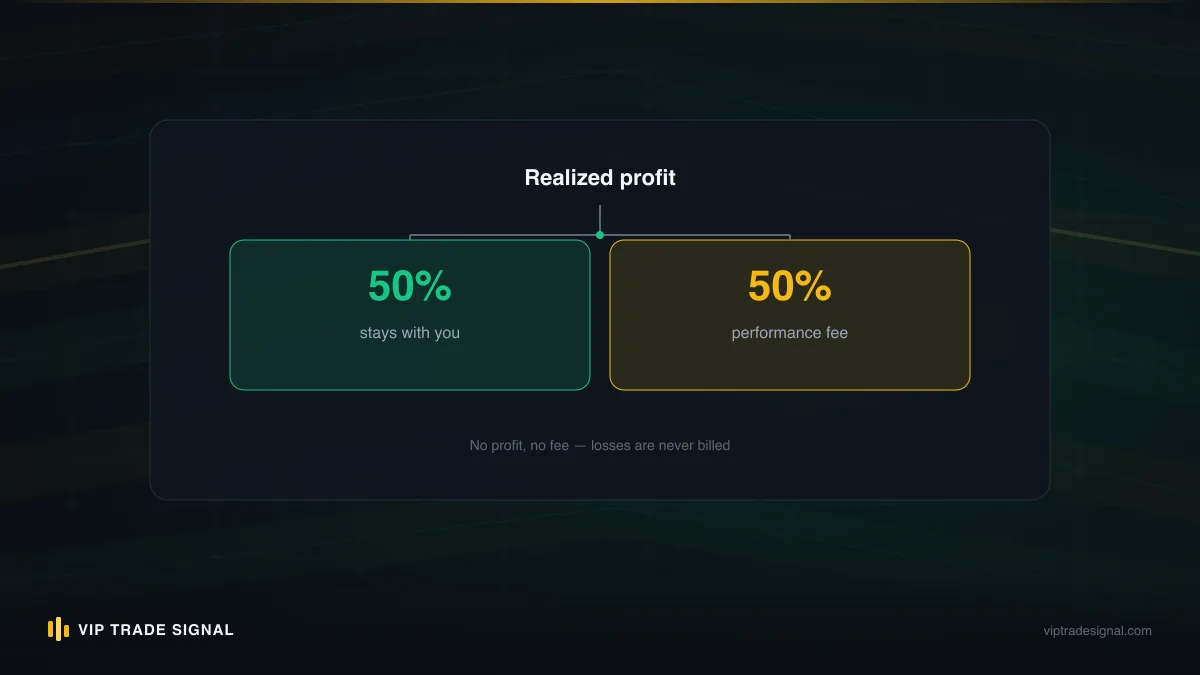
Performance-only is the cleaner alignment: the manager earns a percentage of realized profit and nothing else. No profit, no fee. The rate varies wildly, 20% to 50% across the retail space, and here's where I'll be straight about our own pricing because the style of this site is to be straight: our account management service charges a flat 50% of realized profit with a $200 minimum advance. That is the high end of the market, and we say so. The reasons are structural: our minimums are low (most performance-fee managers won't look at accounts under $10,000; we take small ones), there's no management fee eating you in flat months, and everything is pay-as-you-go with no lock-in. Whether that trade-off suits you depends on your account size. On $50,000, a 30% fee with a $25k minimum elsewhere is probably better arithmetic. On $2,000, almost nobody else will professionally manage it at all.
Two mechanisms separate honest performance fees from sneaky ones.
High-water marks. A high-water mark means the manager only charges performance fees on profits above the account's previous peak. Grow you to $12,000, draw down to $10,500, recover to $11,800: no fee on the recovery, because you've been at $12,000 before. Without a high-water mark, a manager can lose your money, make some of it back, and charge you for the "profit" of the round trip. Any manager charging performance fees on drawdown recovery without a mark or an agreed baseline is billing you twice for once-earned money. Walk.
Realized versus floating. Fees should be calculated on closed profit only. A manager who bills on floating (unrealized) profit is charging you for positions that can still reverse, and has an incentive to hold winners open past their sell-by date just to inflate a billing snapshot.
Then there's the third payment model, the one nobody advertises: rebates and hidden flow. Some "free" account managers earn nothing from you directly and everything from the broker, via a cut of the spread or a per-lot commission on your volume. Think about what that pays for. Not profits. Volume. A rebate-paid manager makes more money the more you trade, win or lose, which is why rebate-driven accounts tend to look like a strobe light: constant trading, tiny targets, no discernible reason for half the entries. It's the same conflict of interest that ruins most free signal channels, and if you want the full anatomy of that machine we've pulled it apart in how free signal services actually make money. Managed accounts just add leverage to the problem, because now the churning happens with your login instead of your finger.
How do forex account managers get paid, then, in one line? The good ones get paid when you make money, on closed profit, above a recorded baseline. Every other structure pays them for something that isn't your profit, and they will, eventually, optimise for the thing that pays them.
The skills that matter more than win rate
Everyone shopping for a forex money manager asks about win rate first. It's the worst first question, because win rate is the easiest number in trading to manufacture. Run wide stops and tiny targets and you can post 90% winners for months, right up until the 10% arrives and takes the account with it. Any grid or martingale system prints beautiful win rates. Then it prints a margin call.
The skills that actually separate managers who last from managers who flame out:
- Position sizing discipline. Not the concept, the arithmetic, applied every single trade, per account. Risking 0.5–1% of equity per trade means a $4,000 account has $20–40 of room per idea. A manager who can't tell you his risk per trade in percent, instantly, doesn't have one.
- Drawdown behaviour. Every manager loses. The professional question is what happens next. Does size come down after three losers, per a written rule? Or does it double, because the fourth trade is "due"? The second behaviour has a name, martingale, and it is the single most common way managed retail accounts die.
- Selectivity. The willingness to do nothing. Some of the best weeks on our desk have two trades in them. Clients occasionally grumble about quiet weeks; they'd grumble harder about the forced trades that fill quiet weeks at churn-driven shops.
- Record-keeping. Unsexy, decisive. A manager with a complete journal can tell you why trade #214 was taken, what the plan was, and whether it was followed. A manager without one is running on memory and mood.
- Emotional flatness. Not the absence of feeling, the refusal to let it size positions. The tell is language: a professional talks about the process ("the setup invalidated, we stopped out, fine"); an amateur talks about the market like it owes him money.
Notice what's missing from that list: prediction. Nobody, and I mean the entire industry, nobody, reliably predicts where price goes next. Fund management isn't a prediction job. It's a risk-allocation job wearing a prediction costume. The manager's edge, where one exists, is small and statistical, and it only survives if the risk framework around it keeps any single trade, day or week from mattering too much. That's also why every honest manager will tell you losing months happen. Ours have. Anyone whose pitch implies otherwise is selling you something other than fund management.
What a manager owes you: reporting and transparency duties
Hand someone trading access to your money and you are owed things. Not favours. Duties. In the regulated fund world these are written into law; in the retail managed-account world they're written into whatever agreement you signed, which is exactly why you should know what belongs in it.
Read access, always. You should be able to log into your own account, any hour of any day, and see every position, every closed trade, the equity and the margin. This is automatic when the manager trades your own MT4/MT5 account and you've kept the master password. It is conspicuously not automatic in pooled structures, where "reporting" means whatever PDF the manager chooses to send. If your only window into your money is a screenshot the manager took, you don't have reporting, you have theatre.
A recorded baseline. Before the first trade: opening equity, in writing, both parties. Every fee calculation for the life of the relationship hangs off that number. Same discipline applies to any later deposit or withdrawal, each one adjusts the baseline and gets logged. Fee disputes are almost never about the percentage. They're about the baseline nobody wrote down.
Regular, honest summaries. Weekly or monthly: trades taken, closed P/L, current drawdown from peak, fees accrued. The critical word is closed. Floating profit is weather, not results. And the summary must include the losers, itemised, not netted into a vague "another green month". A manager who reports the way our desk publishes its full signal history, every closed trade, red ones on display, is showing you the habit that matters: comfort with being seen losing. That habit is rarer than trading skill and worth more.
Incident disclosure. Slippage on a news spike, a platform outage mid-trade, a copier misfire that gave your account a different fill from the master: things go wrong on every desk. The duty is to tell you before you find it yourself. Trust in this business dies in one of two ways, a blown account or a discovered omission, and the second is more common.
Boundaries in writing. Maximum risk per trade. Instruments traded. What happens at an agreed drawdown limit (trading pauses and you talk, is the sane answer). Whether the manager may change strategy without telling you (no). None of this is exotic. It's a page of A4. The managers who resist putting it on paper are telling you, precisely, which parts they intend to improvise.
Specialists vs generalists: why instrument focus matters
Scroll through any money manager marketplace and you'll find profiles trading twenty-eight pairs plus gold, oil, indices and, since it's the 2020s, a side of bitcoin. That breadth is presented as capability. Read it as the opposite.
Every instrument is its own animal. EUR/USD is a slow, deep river that trends politely and dies for hours. GBP/JPY is a knife fight. Gold has its own personality entirely: it runs on US real yields, dollar flows and fear, it moves $30–50 on ordinary days, it can travel $40 in the minute after a CPI print, and its spread behaviour around news punishes anyone sizing it like a currency pair. A stop that gives EUR/USD room to breathe gets executed in gold's first sneeze.
Knowing one of these animals deeply takes years of watching it daily: how it behaves into London, what it does around the majors' data, where its liquidity thins out, which of its patterns are real and which are chart-astrology. Knowing all of them deeply is not a job one person can do. So the generalist retail manager doesn't actually know his twenty-nine instruments; he applies one generic template across all of them and hopes the template travels. Sometimes it does for a while. Volatility regimes change, and templates that travel stop travelling.
There's a portfolio-theory counterargument, that spreading across instruments diversifies risk, and at institutional scale, with a desk per asset class, it's true. One person with MetaTrader is not an institution. For a solo manager or a small desk, focus is the risk management: fewer variables, deeper pattern library, faster recognition when the instrument starts behaving out of character. It's the whole reason our desk trades XAU/USD and nothing else, a decision we've defended at length in why we only trade gold, and the summary fits in a sentence: we'd rather be genuinely good at one market than presentable in thirty.
So when you're evaluating a forex fund manager, ask what they trade and listen for a short answer. "Gold" is a good answer. "Majors, mainly EUR/USD and USD/JPY" is a good answer. "Whatever's moving" is a casino answer from someone who'll be trading natural gas the week it's fashionable.
How to evaluate whether a manager runs a real process
Everything above describes the job from the inside. From the outside, you can't watch a manager's morning routine. You can only probe for its fingerprints. Here's how.
Ask for the track record, then attack it. Not a screenshot. Screenshots are Photoshop practice. You want an investor-password login to a live account, or a third-party verified feed (Myfxbook, FX Blue) with the account age visible. Then look past the return figure to the shape of the equity curve. Smooth, stair-stepping curves with no visible drawdowns are the signature of grid and martingale systems, strategies that hide open losses in floating drawdown until the day they can't. A lumpy curve with visible losing streaks that recover is what real trading looks like. Check the maximum drawdown against the average monthly return: a manager averaging 4% a month with a 60% historical drawdown isn't skilled, he's pre-detonation.
Time-in-market. Twelve months is the bare minimum before a record means anything, and even that only spans a regime or two. Six weeks of results is a coin that's landed heads a few times.
Demand the written process. Ask: what's your risk per trade, what's your maximum open exposure, what happens after a losing week, what's your rule around red-folder news? A real manager answers these instantly and identically every time you ask, because the answers are written down and lived. An amateur improvises, and improvised answers drift between conversations. Ask twice, a week apart. Compare.
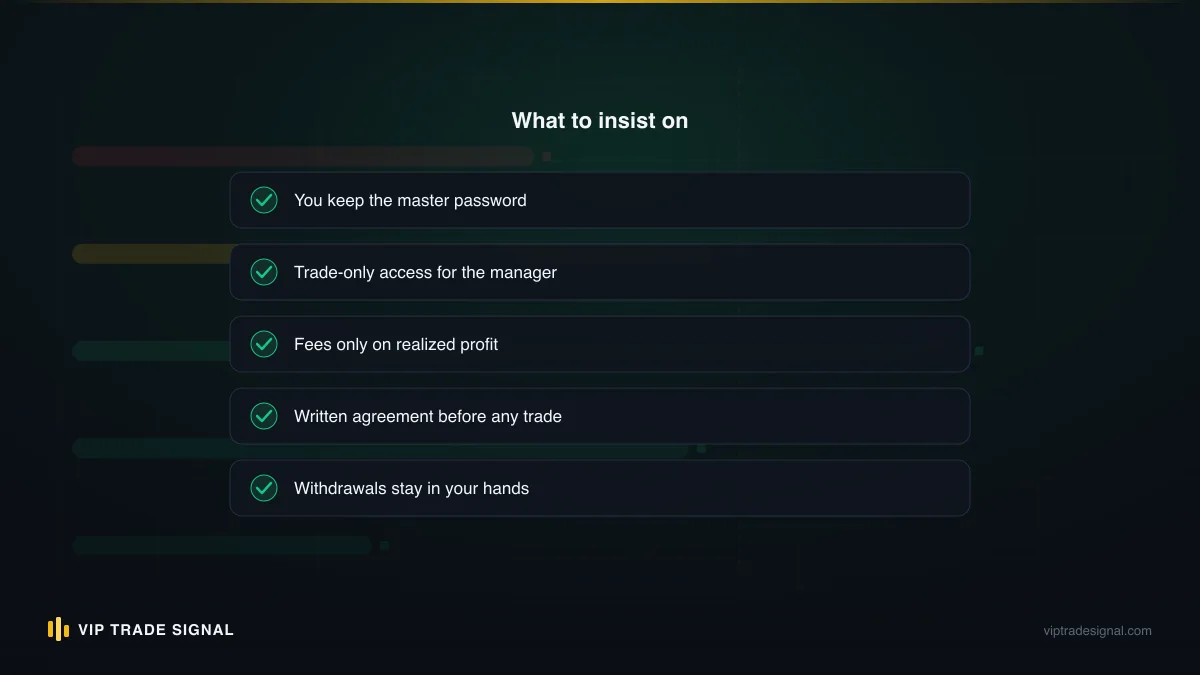
Check the custody arrangement. Where does the money sit, whose name is on the account, and what, mechanically, does leaving look like? The good answer: your account, your broker, and firing the manager means changing a password tonight. Any answer involving sending funds to the manager or "processing" your exit is an answer about their cash flow, not your investment.
Verify the fee mechanics, not just the rate. Realized or floating? High-water mark or baseline? Who calculates, and can you audit it from your own statement? A 30% fee with sloppy mechanics costs more than a 50% fee with clean ones.
Look for published losses. This one filter alone removes most of the industry. Anyone can publish wins. Publishing the losses, permanently, where prospects can see them, is a structural commitment to honesty that fakers won't make because it ruins the pitch. If a manager's public history contains no red, the history is curated, and curation is the polite word.
And check the humans. A real operation has named people with faces and a traceable footprint; a scam has a stock photo and a stolen name. Reverse-image-search the profile pictures. It takes ninety seconds and it catches more frauds than any other single step.
A manager's process is what he does when the market humiliates him. Everything else is marketing.
Questions that expose an amateur in five minutes
You don't need a due-diligence deep dive to filter most candidates. Five questions, asked live, will do it. What you're listening for isn't the "right" answer so much as the speed and shape of it: professionals answer from a written process, so the answers arrive fast, specific and boring. Amateurs answer from imagination, so the answers arrive slow, flattering and vague.
- "What's your maximum drawdown, ever, and when was it?" Pro: a specific number, a specific month, unprompted context about what changed afterwards. Amateur: "very low", "we don't really have drawdowns", or a pivot to the win rate.
- "Walk me through your worst losing streak." The professional has one and can narrate it calmly, because he journaled it. The amateur either denies having one (lie, or account too young to count) or gets visibly irritated by the question. Irritation is data.
- "How do you size a position on my account specifically?" You want arithmetic: percent risk, stop distance, resulting lot size, with your equity plugged in. "We use professional risk management" is not arithmetic.
- "What happens the day I want to leave?" The clean answer takes one sentence: change your password, settle any accrued fee on closed profit, done. Every additional clause, notice periods, exit processing, "transfer windows", is friction someone designed on purpose.
- "Show me a losing month in your published record." Then watch. This is the question the whole filter hangs on. Either the losses are sitting in public where anyone can check them, or you're about to hear a story about why they aren't.
Bonus tell, no question required: who contacted whom? Managers with genuine capacity constraints don't cold-DM strangers on Instagram. If the first touch was them sliding into your messages with "hello dear, are you interested in forex investment", you already have your answer, and it cost you nothing.
None of this requires financial expertise. It requires the willingness to be slightly rude to someone who wants your money, which, oddly, is the skill retail investors most lack. Be rude. The professionals won't mind; they get these questions from every serious client and answering them well is how they win business. Only the amateurs need you polite.
How our gold-only desk structures its week
Since I've spent four thousand words telling you what to demand from a forex fund manager, it's only fair to show our own homework. Here's the actual weekly shape of the desk that runs our managed accounts. Not a brochure version. The real one, dull bits included.
Sunday evening is the planning block. The week's economic calendar gets mapped, and honestly this takes ten minutes because gold's calendar is dominated by a handful of US releases; a CPI or FOMC week gets planned entirely differently to an empty one. Weekly levels get drawn on XAU/USD from the higher timeframes, and a one-page weekly bias note gets written: the levels, the scenarios, the events, what would invalidate the whole read.
Monday to Friday runs the daily routine from earlier: reconcile, calendar, plan, execute in the London and New York windows, journal, stop. Managed accounts take the same trades as our signal service, sized per account, through the copier. Some days that's two trades. Plenty of days it's none. We don't trade the final stretch into top-tier US releases, and we're generally flat or reduced into weekends, because gold gaps on Sunday opens and a gap doesn't respect your stop.
Wednesday is the mid-week risk review. Open exposure across all managed accounts, any account approaching its drawdown conversation threshold, any copier discrepancies from the week's fills. Fifteen minutes when everything's normal. The point of the meeting is the weeks when it isn't.
Friday after New York closes the loop: the week's journal gets reviewed against the Sunday plan, every deviation gets a written reason, and the week's closed trades post to the public history alongside every other week's, the losing ones with their red on display. Client-facing summaries go out on their agreed schedule, closed P/L only, fees shown against the recorded baseline.
That's it. No secret sauce, and that's rather the point. The value of a fund manager was never the crystal ball, there isn't one, ours included, and gold will hand us losing weeks whenever it feels like it. The value is that this loop runs every week, identically, whether the previous week was green or ugly. Discipline is only worth paying for because it's rare.
Where this leaves you
Strip away the mystique and a forex fund manager is a person you're paying to run a repeatable process on your money with less emotion than you would. That's the whole product. Not predictions. Not a secret indicator. A process, run on schedule, by someone whose incentives you've checked.
Which means your decision comes down to three questions, in order. First: does a verifiable process exist? Demand the written risk rules, the live-verified record with its losses intact, the boring specific answers to the five questions above. Second: does the structure protect you if the process fails? Your own account, your master password, your withdrawals, an exit that takes one evening. Third, and only third: is the price fair for your size? Performance-only, on closed profit, above a recorded high-water mark, at a percentage you've compared against what your account size can actually get elsewhere.
Most people run this order backwards. They start with fees, get seduced by the cheapest or the "free" option, and never reach the questions that decide whether the money survives. The fee on a professionally-run account is visible and negotiable. The cost of an amateur one arrives all at once, and there's no invoice.
If your account is small and you want it run by a desk that will show you every losing trade before you've paid a cent, ours is one of the options worth interrogating, and I mean interrogating: bring the five questions, ask for the history, check our answers against this article. And if you ask a manager these questions, any manager, and feel like a nuisance for asking? That feeling is the product they're selling instead of a process. Keep your password. Keep looking.