Somebody in a Telegram group has just offered to "manage your account" and turn your $500 into $5,000 by Christmas. You don't know what that actually means, mechanically. You don't know where your money would sit, what this person could do with it, or how they'd get paid. And you have a vague, correct feeling that not knowing those three things is how people get robbed.
So let's fix the not knowing. What is a managed forex account? In one sentence: it's a trading account that belongs to you, held at a broker in your name, on which someone else — the manager — has permission to place trades, usually in exchange for a share of the profits they generate. That's the whole idea. Your account, their hands, an agreed fee.
Everything else in this article is that sentence unpacked. Who the three parties are. What the manager can and cannot physically do. Where the money lives. How fees work, which return claims are plausible and which are fantasy, what the real risks look like, and how a managed account differs from signals, copy trading and PAMM pools. By the end you'll have the vocabulary to read the rest of our library — and, more usefully, to interrogate anyone who offers to trade your money.
We run an account management service ourselves, so we're not neutral. But the mechanics below are true regardless of who you eventually hire, including if it's nobody.
What is a managed forex account? The car-and-driver answer
Here's the one picture to hold in your head for the whole article. You own a car. You've decided you don't want to drive it yourself — maybe you don't know how, maybe you don't have time, maybe you've crashed it twice and you're honest enough to admit it. So you hire a driver.
Notice what stays true when you hire a driver:
- The car is still yours. Your name is on the registration. The driver never owns it, not for a second.
- The car stays in your garage. The driver comes to it. You don't deliver your car to the driver's house and hope.
- You can take the keys back any time. Fire the driver at 9am, drive yourself to lunch. No permission needed.
- The driver can steer, but can't sell the car. Driving authority and ownership authority are different keys, and you only handed over one.
- You still carry the risk of the road. A good driver crashes less often than you would. No driver crashes never. If the car gets dented, it's your car that's dented — the driver's skill reduced the odds, it didn't delete them.
A managed forex account maps onto this almost perfectly. The account is the car: opened in your name, at a broker you chose, funded with your money. The manager is the driver: they get trading access — the ability to open and close positions — and nothing more. You keep the master keys: the main password, the withdrawal rights, the power to revoke access whenever you like. And the market is the road: sometimes smooth, sometimes icy, occasionally littered with central bank announcements doing 90 in the wrong lane.
Every scam in this space, and there are many, works by quietly breaking one of those five bullet points. The "manager" who asks you to send money to them instead of to a broker has taken the car to their house. The one who wants your master password has asked for the ownership documents, not the keys. The one who promises no crashes ever is lying about the road. Hold the analogy and the scams become easy to spot, because they all require you to forget it.
The three parties: you, your broker, the manager
A proper managed account always involves exactly three parties, and the relationships between them are worth spelling out because the whole safety model lives in the gaps between them.
You are the account owner. You open the account, you pass the broker's identity checks (passport, proof of address — the boring stuff that exists precisely so that only you can withdraw), you deposit the money, and you sign whatever agreement you make with the manager. You hold the master password to the account and, critically, you are the only person the broker will send money to.
The broker is the regulated company that actually holds your deposit and executes trades in the market. Think of names like Exness, IC Markets, XM, Vantage — firms with licences, client-money rules, and a website where you log in and see your balance. The broker doesn't care who's pressing the buttons on your account as long as the access was granted legitimately. Its job is custody and execution. It is not judging the manager's strategy, and it will not refund losses from bad trading, any more than your garage refunds you for a driver's wrong turns.
The manager is the person or firm you've authorised to trade. They connect to your account through limited credentials (more on those in a moment), run their strategy, and invoice you — one way or another — for the results. The manager should never be the same entity as the broker, and should never hold your money directly. The moment those roles merge, you've lost the structural protection, because the person taking risks with your money is also the person deciding whether you can have it back.
The triangle matters more than any individual corner. Your money's safety comes from the fact that the party trading it (manager) can't touch it, and the party holding it (broker) isn't trading it. If anyone proposes collapsing that triangle into a line — "just send the funds to us, it's simpler" — the correct response is a polite no, followed by a less polite block.
How do managed forex accounts work day to day, then? Quietly, mostly. You'll see trades appear and close in your broker's app or in MT4/MT5, the account balance moves around, and at whatever interval you've agreed — weekly, monthly — the manager reports and settles fees. You don't need to watch every trade. You do need to be able to watch every trade, which is a different and more important thing.
What the manager can and cannot do with your account
This is the part most beginners never ask about, and it happens to be the part that determines whether you're safe. Trading platforms — MetaTrader 4 and 5 being the ones you'll meet most — were built with this exact arrangement in mind, so they support two levels of access.
The master password is the ownership key. Whoever holds it can trade, yes, but can also change the account's settings, alter passwords, and generally act as you. It stays with you. Always. No legitimate manager needs it, and any "manager" who asks for it has just failed the interview. (Our own service is built this way on purpose: you keep the master password, full stop. It's written into how our account management works, not offered as an optional upgrade.)
The investor password — sometimes called read-only access — lets someone view the account without touching it. Useful for auditors, spouses, and you on holiday.
Trading access for the manager is granted either by a limited trading password or, increasingly, through the broker's own linking system where you authorise a manager from inside your broker dashboard and can un-authorise them with one click. Either way, here's the clean division of powers:
The manager can: open positions, close positions, set and move stop losses and take profits, and see the account's balance and history. That's it. That's the entire toolkit, and it's all a trading strategy needs.
The manager cannot: withdraw money (the broker only pays out to the verified account owner — you), deposit money, change your registered details, close the account, or move funds anywhere. They can't add themselves as a beneficiary. They can't redirect your withdrawals. The plumbing simply doesn't allow it.
Now, the honest asterisk, because there always is one. "Can't withdraw" does not mean "can't lose." A manager with trading access can absolutely trade your balance down — through bad luck, bad strategy, or recklessness — and oversized positions can do it fast. Trading authority is real authority. The system protects you from theft, not from losses; the only protections against losses are the manager's competence, the risk rules you agree in advance, and your willingness to watch the account and pull access when something looks wrong. Which you can do at any moment, remember. Keys back, driver sacked, no notice period required by the platform even if your written agreement asks for one.
Where your money physically sits
Short answer: at the broker, in an account with your name on it, and it never moves from there while the management relationship runs. This deserves its own section because it's the single question that separates a managed account from a wire-fraud scheme, and beginners skip it constantly.
When you deposit $1,000 into your broker account, the broker (a regulated one, anyway) holds it as client money. You can log in and see it. You can withdraw it — to your own bank card or account, after the broker's identity checks — whenever you like, subject only to not yanking out margin that's currently holding open positions. The manager never receives your deposit, never routes it through their company account, never "pools" it with other clients' funds. There is nothing to send them. They come to the money; the money never goes to them.
Compare that with the arrangement the Telegram DM crowd proposes: send USDT to this wallet, or transfer to our "company investment account", and we'll trade it on our platform, and you can watch your balance grow on our website. Every clause in that sentence is a red flag wearing a hat. Their platform shows whatever numbers they type into it. Your "balance" is a picture of a balance. And when you ask to withdraw, you discover the withdrawal department has questions, then fees, then silence. The money left your control at the moment you sent it, and everything after that was theatre.
So the custody test is beautifully simple, and worth memorising as a sentence: if your money ever leaves an account in your own name, it is not a managed account — it is a donation with extra steps. A managed forex account in your own name isn't a premium variant of the product. It's the product. Anything else is called something ruder.
It's worth pausing on how the theatre actually plays out, because knowing the choreography inoculates you against it. The fake platform pays out small withdrawals early — $50 here, $120 there — precisely so you'll trust it with more. Some victims withdraw twice, tell three friends the thing is real, and then deposit their savings. That early payout isn't evidence of legitimacy; it's the cost of goods sold in the fraud business. A real broker, by contrast, is slightly boring about withdrawals in a reassuring way: same verified bank account or card you deposited from, standard processing window, no drama, no bonus offered for cancelling the request. If withdrawing your own money ever feels like a negotiation, you've already learned what you needed to know, hopefully cheaply.
One nuance worth knowing: fees are the exception to "no money moves to the manager", and rightly so — after a settled period, you pay the agreed fee out of realized profits, as an ordinary payment you make deliberately, from money you've already seen land. The manager still never dips into the account themselves. You pay them the way you'd pay any contractor: after the work, having seen it.
How the manager gets paid
Managers eat, so somebody pays them, and the shape of that payment tells you a great deal about their incentives. There are three models you'll meet in the wild, plus one to run from.
Performance fees are the standard. The manager takes an agreed percentage of the profit they generate — commonly anywhere from 20% to 50% of gains — and takes nothing on losing periods. Done properly this comes with a high-water mark: if the account falls from $2,000 to $1,700 and then recovers to $2,100, the manager is paid only on the $100 above the previous peak, not on the $400 of recovery. Without a high-water mark a manager can lose your money, win some of it back, and charge you for the round trip. Ask for the high-water mark by name; watching someone pretend to know what it is tells you plenty.
Management fees are a flat charge — say 2% of the account per year, or a fixed monthly amount — paid regardless of results. Common in traditional wealth management, rarer in retail forex, and worth being wary of in this context: a manager paid whether or not they perform has a hammock where their incentive should be.
Hybrids combine a small flat fee with a smaller performance cut. Fine in principle; just do the arithmetic on what you'd pay in a flat year.
And then there's the model to run from: the manager who is paid by your losses. Some "managers" are secretly introducing brokers earning a rebate on every lot you trade, or worse, are affiliated with dodgy counterparty brokers who profit directly when your account bleeds. If someone offers to manage your account for free — no performance fee, no flat fee, nothing — their compensation is coming from somewhere, and the only somewhere left is your trading volume or your losses. Free management is the most expensive kind.
For calibration, here's roughly how the market shakes out:
| Model | Typical range | You pay when | Watch out for |
|---|---|---|---|
| Performance fee | 20–50% of profits | Only on gains (with high-water mark) | No high-water mark; vague "profit" definitions |
| Flat management fee | 1–3% per year, or fixed monthly | Always, win or lose | Paying for a pulse, not performance |
| Hybrid | ~1% flat + 10–20% of profits | Both | Fees stacking in flat years |
| "Free" | $0 visible | Invisibly, via spreads/rebates/losses | Everything |
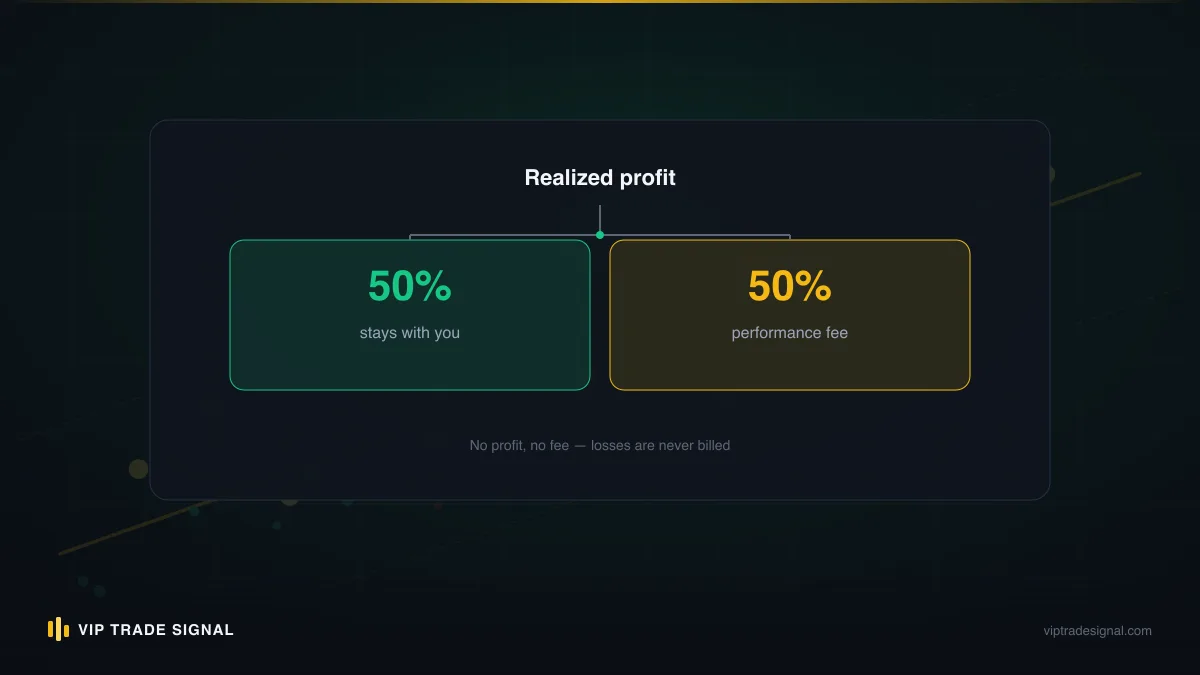
Our own numbers, for transparency: we charge a flat 50% of realized profit — deliberately at the top of that performance-fee range — with a $200 minimum advance, no flat fee, and nothing owed on losing periods. Fifty percent is a lot, and we say so plainly: it's the price of a service with a low minimum where everything is pay-as-you-go, rather than one that quietly needs you to deposit $25,000 to be worth its while. Whether that trade-off suits you depends on your account size. A trader with $100,000 should negotiate a lower percentage somewhere; a trader with $800 mostly can't get institutional pricing at all, and the honest comparison is against the other options actually available at that size.
Whatever the model, insist on one thing: fees settle on realized profit — trades that have closed — never on floating paper gains that can evaporate before lunch.
A worked example makes the arithmetic honest. Say a trader we'll call Sam funds an account with $2,000 and agrees a 50% performance fee with a high-water mark, settled monthly. Month one, the manager closes trades for a net $300 gain: account at $2,300, Sam pays $150, keeps $150 of new money, and the high-water mark is set at $2,300. Month two goes badly — closed losses of $400 take the account to $1,900. Sam pays nothing, and nothing refunds either; the fee model shares profits, it doesn't insure losses. Month three recovers $500 to $2,400. The fee isn't 50% of $500. It's 50% of the $100 above the old $2,300 peak — $50 — because the manager already charged for ground the account then gave back. Run that same three months without the high-water mark and Sam pays $150, then $0, then $250: $400 in fees on an account that is up $400 overall, meaning the manager took every penny of the actual progress. Same trades, same results, one missing clause, wildly different outcome. This is why we keep saying: get the fee mechanics in writing, with the words "realized", "high-water mark" and the settlement date all present, before anyone trades anything.
What returns are realistic (and what claims are fantasy)
Here's where we'll lose the readers who wanted a different answer, and that's fine.
Realistic, for a genuinely skilled manager trading retail-sized forex or gold accounts: low single-digit percentages in a good month, flat or slightly negative months mixed in, losing streaks that last weeks, and years where the honest annual figure lands somewhere between "underwhelming" and "quite good" — with genuine uncertainty about which, in advance. Anyone who has actually traded through a few years knows that a consistent 3–6% a month would make you one of the best money managers alive, and that most months don't cooperate.
Fantasy: "10% per week." "Guaranteed monthly returns." "Double your account in 30 days." "No-loss strategy." Run the compounding on 10% a week sometime — a $1,000 account becomes roughly $142,000 in a year and about $20 million in two. If that were achievable, the person achieving it would not need your $1,000, and they certainly wouldn't be messaging strangers on Instagram to find it. The maths isn't subtle. It's a fluorescent sign reading this is a lie, and the only people who can't see it are the ones who'd rather not.
Any return claim that would embarrass a hedge fund should terrify a beginner.
The uncomfortable middle truth is that even honest, competent management involves losing. A manager who wins 60% of trades with sensible risk-reward is doing well, and that manager still hands you four losing trades in ten, some of them consecutively, occasionally in your very first week. Drawdowns — periods where the account is below its previous peak — are not a malfunction. They are the operating condition of trading. The realistic question isn't "will there be losing periods" but "how deep do they go, and does the manager's risk framework keep them survivable". A manager who talks fluently about their maximum drawdown and worst historical month is showing you the scar tissue of real experience. A manager whose track record only bends upward is showing you Photoshop.
And a track record should be checkable, not narrated. Ours is a signal-first operation — every closed gold signal we've ever issued sits publicly at /signals, wins and losses both, because we think a results page without losses on it is a confession. Apply the same standard to any manager: closed-trade history, verifiable on the platform or a third-party tracker, including the ugly months. Screenshots of open floating profit count for nothing; open profit is a mood, not a result.
One more calibration point: trading forex, gold and CFDs is high risk in itself, before any manager touches it. Most retail accounts lose money — brokers in regulated jurisdictions are required to publish that fact next to their sign-up buttons, and it doesn't stop being true because you hired help. A managed account changes who is driving. It does not change the road.
The main risks in plain terms
Let's list them the way you'd want a friend to, without the padding.
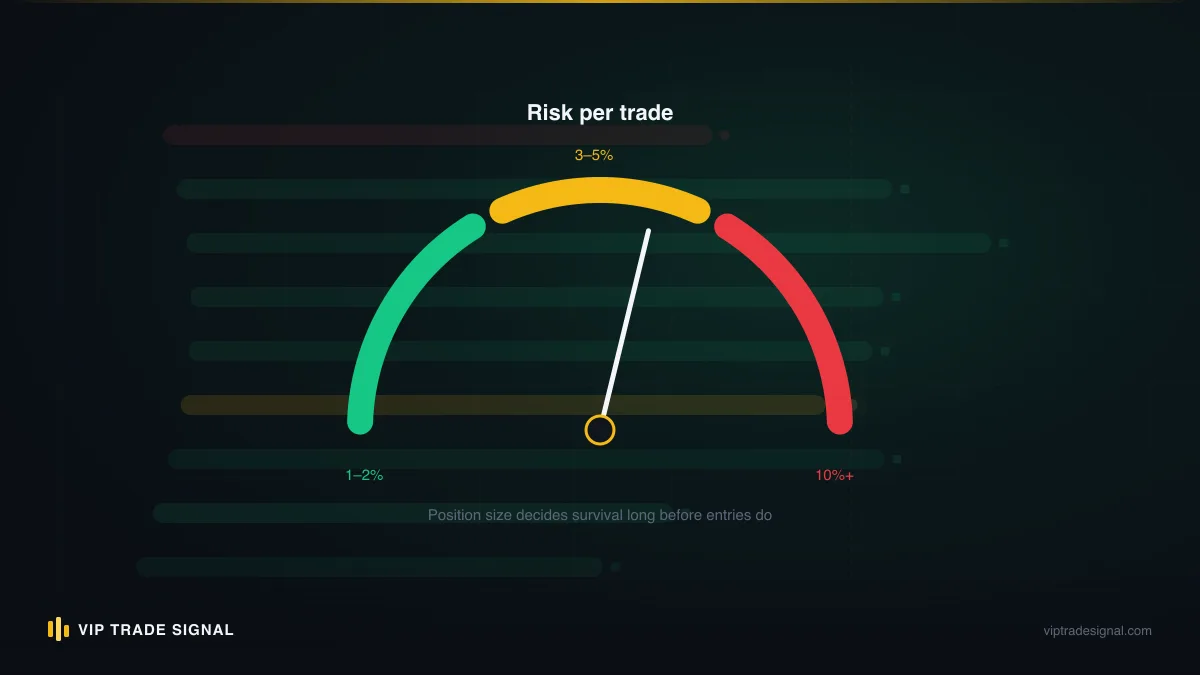
Losing money through legitimate trading. The big one, and the one no structure protects you from. The manager trades badly, or trades well through a bad patch, and your $2,000 becomes $1,400. This is a normal outcome that you must be genuinely able to afford before you start. The old rule holds: fund the account only with money whose total loss would annoy you rather than change your life.
Reckless risk-taking. A subtler flavour of the same thing. Because performance fees pay on the upside and cost the manager nothing on the downside, a cynical manager is incentivised to swing big: oversized lots, no stop losses, martingale-style doubling after losses. Heads they take a fat fee, tails it's only your money. Your defences are agreeing risk limits in writing before trading starts (maximum lot size relative to balance, a drawdown level at which trading pauses and you talk), watching the account, and revoking access the moment the agreed rules bend. A manager who resists written risk limits is telling you the plan.
Outright fraud. Mostly solved by the custody rules above — money stays in your name, master password stays with you — but stay alert for the softer cons: fabricated track records, "verified" results on websites the manager controls, urgency ("the fund closes to new clients Friday"). Legitimate managers are never in a hurry to get your money. Only the other kind are.
Broker risk. Your money sits at the broker, so the broker's solvency and honesty matter independently of the manager. Use regulated, established names; be suspicious if a manager insists on one specific obscure broker you've never heard of, because that insistence sometimes marks a rebate arrangement or worse.
Over-trust drift. Nobody warns beginners about this one. Months of decent results breed complacency: you stop checking the account, you top up the balance beyond your original comfort line, you stop asking questions. Then the bad stretch arrives — it always arrives — and it's larger in money terms than anything you signed up for, because the account grew while your attention shrank. Check in on a schedule, not a mood.
None of these risks should stop a clear-eyed adult from using a managed account. All of them should stop you from using one casually.
Managed accounts vs signals vs copy trading vs PAMM, briefly
The retail forex world offers four main ways to get someone else's trading into your account, and beginners meet them in a confusing jumble. Here's the sorted version.
A managed account is what this whole article describes: your account, the manager trades it directly, you pay a fee on results. Maximum hands-off, maximum need to trust and verify one specific human or firm.
Signals flip the labour. A provider sends you trade instructions — buy gold at 3,315, stop loss 3,301, take profit 3,340 — and you place every trade yourself. Nobody but you ever touches the account. It's the most work and the most control: you can skip trades you don't like, size them your own way, and stop any second. It's also where mistakes creep in, because entering trades correctly at 2am is a skill in itself. (This is our home turf — a gold-only signal service, every result public — and if you want the fuller picture of what a signal even contains, the FAQ walks through it piece by piece.)
Copy trading automates signals. Software mirrors a chosen trader's positions into your account automatically, usually proportionally to your balance. Less error-prone than manual signal-following, less considered too — you copy their genius and their tantrums with equal fidelity, at machine speed.
PAMM (Percentage Allocation Management Module — the last acronym, promise) pools many investors' funds under one manager at the broker level, allocating profits and losses proportionally. It's a managed arrangement without an account of your own to watch; you hold a slice of a pot. Regulated PAMM platforms are legitimate, but you trade away the transparency of watching your own account line by line, and the word "PAMM" gets borrowed by unregulated pools that are just fraud in a branded jacket.
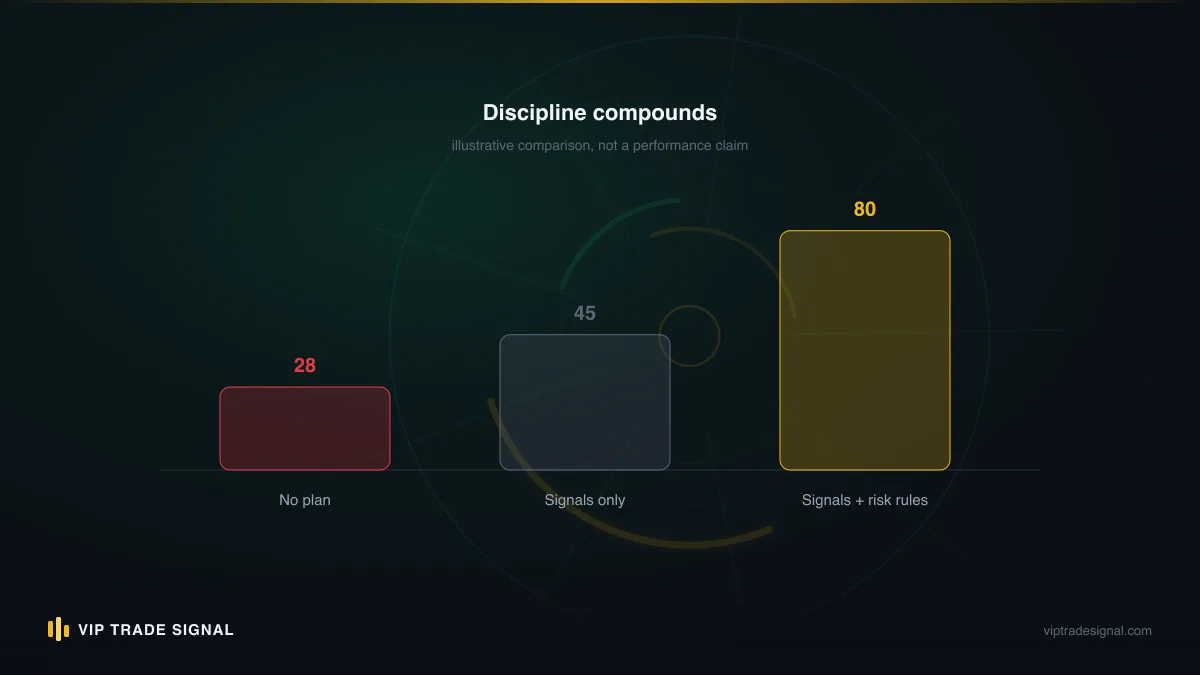
The pattern across all four is a slider between control and convenience. Signals sit at the control end, PAMM at the convenience end, managed accounts and copy trading in between — with the managed account keeping something PAMM gives up: your own account, in your own name, visible down to the individual trade. For a longer treatment of how the person on the other side of these arrangements actually operates, the primer on what a forex fund manager does picks up where this section stops.
Which should a beginner choose? Unpopular opinion: if you have the hours and the interest, start with signals, because placing trades yourself for a few months teaches you the vocabulary of the market — lots, stops, margin, slippage — faster than any article can, and that vocabulary is exactly what you need to supervise a manager later. If you genuinely haven't the time, a managed account done by the rules in this article beats copy-trading a stranger off a leaderboard. And if someone's first suggestion is an unregulated PAMM, suggest a different someone.
The ten terms you'll meet next
Every article you read from here will lean on a handful of terms. Here they are in plain English, once, so nothing ambushes you later.
- Broker — the regulated company holding your money and executing trades. The garage, in our analogy.
- MT4 / MT5 — MetaTrader 4 and 5, the standard trading platforms where your account lives and where you (and the manager) see every trade. Your window into the garage.
- Master password — the account's ownership key. Trades, settings, everything. Yours, never shared.
- Investor password — read-only access. Lets someone view without touching. Handy for showing an account to anyone you like.
- Lot — the unit of trade size. A standard lot of gold is 100 ounces; at that size, a $1 move in the gold price is $100 to your account. Lot size is where risk actually lives, which is why your written agreement should mention it.
- Stop loss — a pre-set price at which a losing trade closes automatically. The seatbelt. A manager who trades without them is a driver who's cut yours out of the car.
- Drawdown — how far the account has fallen from its highest point, usually in percent. The single most honest statistic in trading; ask every manager for their worst one.
- Realized vs floating profit — realized profit comes from closed trades and is real; floating profit belongs to trades still open and can vanish. Fees and judgments should rest on realized numbers only.
- High-water mark — the rule that performance fees are paid only on profit above the account's previous peak, so you never pay twice for the same recovered ground.
- Equity — your balance plus or minus the floating result of open trades; what the account is actually worth this second, as opposed to what it was worth when the last trade closed.
Ten terms, one paragraph each of meaning, and you now speak enough of the language to read a manager's agreement without nodding along at words you don't know. Which — quietly — puts you ahead of most people who've already handed over money.
Where to go from here
You came in asking what a managed forex account is. You're leaving with something more useful: a test kit. So here's the pointed version of everything above, as the questions to put to any manager — us included — before a single trade goes on:
- "Does my money ever leave an account in my own name?" The only acceptable answer is no. Any hesitation, any "well, our structure...", walk.
- "What access do you need?" Trading access only. A request for the master password ends the conversation.
- "How are you paid, and is there a high-water mark?" You want fees on realized profit above the previous peak, defined in writing. Vagueness here is expensive later.
- "Show me closed results, including the losing months." Verifiable history or nothing. If every month is green, you're looking at fiction.
- "What are the written risk limits, and what happens at X% drawdown?" A real manager has answers rehearsed by experience. A chancer improvises.
- "How do I revoke access, and how fast?" The answer should be: yourself, from your broker dashboard or by changing the trading password, immediately, without asking anyone.
Ask all six. The good managers will respect you more for it — these are the questions their best clients asked. The bad ones will get twitchy around question one, and their twitchiness is the cheapest due diligence you'll ever run.
If, after all that, you decide managed trading suits your situation, the mechanics of our own version are straightforward and public: we trade your MT4/MT5 account — gold only, and we've written up why we trade nothing but XAU/USD rather than a menu of pairs — for a flat 50% of realized profit with a $200 minimum advance, while you keep the master password and every withdrawal right, exactly as this article insists you should. The gold-specific detail of how that looks in practice is covered in our piece on XAU/USD account management, and the fine print lives on the account management page. No guarantees come with any of it. That's not modesty; it's the defining feature of the honest end of this industry.
And if you decide it doesn't suit you — the money's too dear to risk, or you'd rather learn to drive first — that is also a good outcome of this article. The worst reason to hire a driver is that a stranger on the internet insisted the road was safe.