Somewhere on your phone right now there is probably a message that reads something like this: "Join our VIP channel FREE. Just open an account with our partner broker and deposit $200." Maybe it came from a Telegram group. Maybe an Instagram story with a Lamborghini in it. And your instinct, which is a good instinct, said: nothing is free, so where's the catch?
Here is the honest answer. Free VIP signals with broker deposit offers are neither a scam by definition nor a gift by any definition. They are a commercial arrangement called introducing broker (IB) partnership, and the way it works decides whether you are getting a genuinely decent deal or quietly being farmed. We run this exact model at VIP Trade Signal, our commission comes from the same plumbing everyone else's does, and the model's grubby reputation costs honest operators more than it costs the grifters. So this piece takes the whole machine apart in public: where the money actually flows, why minimum balances exist, what the abusive versions look like, and how to check any offer, including ours, before you connect an account to it.
Fair warning: this is long. The model deserves a full explanation, not a paragraph, because the details are exactly where the difference between fair and predatory lives.
The offer decoded: what "free VIP with deposit" actually means
Strip the marketing off and the offer is this: a signal provider has a referral agreement with one or more brokers. If you open your trading account through the provider's link and keep some money in it, the broker pays the provider a slice of the trading costs you were going to pay anyway. In exchange, the provider waives their subscription fee.
Three parties, three motives.
- You want the signals without paying a monthly fee.
- The provider wants recurring revenue that scales with active traders rather than chasing card payments every month.
- The broker wants funded, active accounts, and will pay a commission to whoever delivers them.
Notice what the offer is not. It is not the broker giving you money. It is not the provider giving you money. It is a redirection of a cost you already carry, the spread and commission baked into every trade you place, so that a portion of it lands with the signal provider instead of staying entirely with the broker.
That reframing matters, because it kills two lazy takes at once. The first lazy take: "it's free, brilliant." It is not free. You pay through spreads, same as you would at any broker, and the provider is paid out of those spreads. The second lazy take: "it's a scam, they only want your deposit." Also wrong, at least for the honest operators, because in a properly structured arrangement the provider never touches your deposit at all. Your money sits with a regulated broker, in your name, withdrawable by you. The provider gets paid on your trading activity, not on your balance.
Whether a specific offer is fair comes down to questions you can actually check. Who holds the money? What are you obliged to do? What happens when you withdraw? We'll do all of them.
Follow the money: your spread, the broker, our commission
Let's trace a single trade through the pipes, with numbers, because "the broker shares revenue" is exactly the kind of vague sentence this model hides behind.
Say you take a signal on gold, XAU/USD, one standard lot, at a broker whose spread on gold averages around 20 cents ($0.20 per ounce). One standard lot of gold is 100 ounces, so that spread costs you roughly $20 on the round trip. That $20 is the broker's gross revenue on your trade. It exists whether or not any signal provider is involved. Trade the same lot at the same broker with no referral link and you pay the same $20.
Now add the IB link. The broker's partnership agreement says something like: for clients introduced by this partner, we pay a rebate of a few dollars per standard lot traded, or some percentage of spread revenue. The exact figure varies by broker, account type and volume tier, and partners are typically not allowed to publish their specific rates, but the honest range across the majors is single-digit dollars per lot on gold. Call it somewhere between $2 and $10 depending on the broker and account type.
So on your one-lot trade: you pay ~$20 in spread, the broker keeps the larger share, and a few dollars flow to us as the introducing partner. You trade fifteen lots in a month, the provider earns fifteen times that rebate. That is the entire business model. No secret levy on your account. No cut of your profits. No access to your funds. The provider is, functionally, a marketing channel that the broker pays on performance, and the performance metric is your traded volume.
Two consequences drop straight out of this, and both are worth sitting with.
First, the provider's income scales with how much you trade. That is the model's original sin, and we will spend a whole section on the abusive things it tempts people into. An honest operator sends the trades the analysis justifies and accepts the revenue that follows. A dishonest one reverses the arrow and generates trades to generate rebates.
Second, an active trader on a $500 account can be worth more to a provider than a dormant trader on a $5,000 account. Which is precisely why the minimum is a maintained balance rather than a huge deposit. Speaking of which.
Why there is a minimum maintained balance, and why ours is $250
Every broker-route VIP offer has a floor. Ours is $250 maintained across a partner account. Some channels ask $100, some ask $1,000, and the number is not arbitrary in any of these cases, so it is worth understanding what it is actually doing.
The minimum exists for one structural reason: an unfunded or nearly-unfunded account produces no trading, and an account that produces no trading produces no rebates, which means the provider is giving away the service for nothing. "Free via broker" only works as a trade: you route your trading costs through the partnership, we waive the fee. An account with $30 in it isn't routing anything. It is just a free subscription with extra steps, and a provider who allows that at scale either goes broke or starts making money some other, darker way.
But there is a second reason for the floor, and it is about you, not us. Gold signals need room to breathe. A typical XAU/USD signal might risk 300 to 500 points (cents) with sensible position sizing. On a $250 account risking 1-2% per trade, that is $2.50 to $5 of risk per position, which maps to micro lots, 0.01 or 0.02. Perfectly tradeable. On a $50 account, the same signal either cannot be sized at all or forces you above 5% risk per trade, at which point a normal losing streak, and losing streaks are normal, we publish ours, ends the account. A minimum that low would let people set themselves up to fail and then blame the signals. $250 is roughly the smallest account where our typical stop distances and 1-2% risk still produce a placeable position at most partner brokers.
Could we have picked $200 or $300? Sure. The honest answer is that $250 sits at the intersection of "small enough that the offer is genuinely accessible" and "large enough that the account can actually follow the signals as intended". Brokers' own IB terms also commonly set activity or balance thresholds below which no rebates are paid, so a floor materially lower than ours would have us servicing accounts that generate nothing while costing the same to serve.
One thing the minimum is not: a hostage. It is a maintained balance, checked as a condition of continued VIP access, not a lock on your money. Drop below it and the consequence is boring: your access lapses back to the free tier until you top up or switch to the paid plan. Nobody confiscates anything. If an offer's fine print says otherwise, that is a different model wearing this one's clothes, and we will get to it.
What you give up versus just paying the subscription
Radical transparency means saying this part out loud: the broker route is not strictly better than paying. You are trading one set of costs and constraints for another, and for some people the $99 subscription at our pricing page is genuinely the smarter buy.
Here is what the broker route costs you that the subscription doesn't.
Broker choice. The deal only works at partner brokers, ours are Exness, XM, IC Markets and Vantage. If you have three years of history, a verified account and a payment method you trust at some other broker, moving has real friction: new KYC, new deposit rails, learning a new platform's quirks. That friction is a cost even though no invoice is ever issued for it.
Capital commitment. $250 has to sit in a trading account rather than your pocket. It is your money and it is working capital, not a fee, but it is still committed. If that $250 is money you cannot afford to expose to leveraged gold trading, stop here; the honest answer is that neither route suits you yet, because trading gold on margin can and regularly does lose people their stake.
A marginally wider effective cost per trade in some cases. Rebates come out of the broker's share, not stacked on top of your spread, and at the partner brokers we list the referred and non-referred spreads on the same account type are the same. But brokers differ from each other. If your current non-partner broker offers genuinely tighter gold spreads than the partner you would move to, the difference is a per-lot cost of the switch. Measure it on the pair you actually trade, XAU/USD in our case, not on the EUR/USD headline number brokers advertise.
A relationship with an incentive in it. This is the subtle one. When you pay $99, our only financial interest is that you stay subscribed, which means the signals have to keep being worth $99. On the broker route, our revenue tracks your volume, and you should hold any provider on this model, including us, to the standard of the next two sections precisely because of it.
What you get in exchange is simple: no monthly bill, ever, for as long as the balance is maintained. For a trader who would be funding a gold account anyway, that is often close to a free lunch, or as close as this industry gets. For a trader who would not otherwise open a new account, it is a decision worth running through the cost comparison further down before touching anything.
Your money stays yours: broker custody, explained
The single most common fear about broker sponsored free trading signals, and the most reasonable one, is "they just want to get their hands on my deposit". So let's be precise about who can touch what in a properly structured arrangement.
You open the account yourself, on the broker's website, in your own name, with your own documents. The broker is the regulated entity; depending on which one and which region, that regulation might be CySEC, the FSCA, ASIC or an offshore licence, and you should care about which. Your deposit goes from your bank or wallet to the broker. It is held by the broker under whatever client-money rules its licence imposes.
The signal provider's role in that chain is: nothing. We appear in the broker's back office as the introducing partner tagged to your account, which entitles us to rebates on your traded volume and, at most brokers, to see aggregate volume statistics. We cannot withdraw from your account. We cannot place trades on it. We cannot move it, close it or borrow against it. When you request a withdrawal, the money goes from the broker back to a payment method in your own name, and no partner sits in that path or approves it.
The clean test of any "free VIP" offer is brutal in its simplicity: at any moment, can you withdraw every cent without asking the signal provider's permission? If yes, the custody is right. If no, walk.
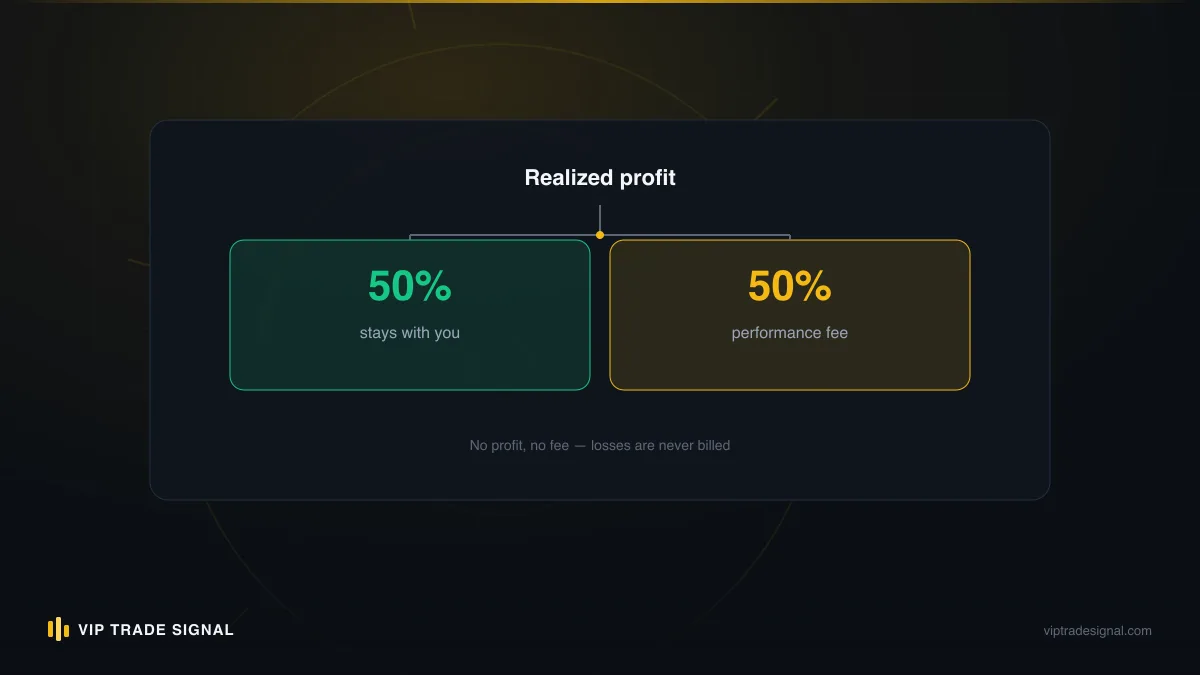
Two boundary cases so nobody quotes us out of context. First, this describes the signals service. Our separate account management service is different by design: there we do place trades, through trade-only credentials you grant on your own MT4/MT5 account, while the master password and withdrawals stay with you, and we charge a flat 50% of realised profit. Different product, different mechanics, deliberately separate. Second, custody being clean says nothing about trading results. Your money being safe from us does not make it safe from the market. Gold moves hard, leverage cuts both ways, and a string of losing signals will shrink a properly-custodied account just as effectively as a badly-custodied one. Safe plumbing is the floor, not the pitch.
The abusive variants: forced lots, bonus traps and B-book games
Now the ugly part, and the reason this article exists. The IB model's incentive, provider income scales with client volume, has spawned a family of predatory variants. Every one of them is recognisable from the outside if you know what to look for. Refuse all of them, including from us, if you ever see them, and you won't; publishing this list is our way of handcuffing ourselves to it.
The volume churner. The provider sends eight, ten, fifteen signals a day, many with tight stops and wide targets that reverse an hour later, because every filled lot pays them. How to spot it: signal frequency that no analytical process could justify, pressure to take every signal, "recovery" signals doubling size after losses. What a fair version looks like: signals arrive when the analysis produces them. Some weeks that is two a day. Some days it is none, and a provider who is comfortable sending nothing is a provider not trading your account for their rebate. Our published record at /signals/history shows the real cadence, losses included, which is the only honest way to demonstrate it.
The forced-lot minimum. Access conditional not on a maintained balance but on traded volume: "minimum 5 lots per month or you're removed". Read that requirement for what it is, an invoice denominated in your own risk. A $500 account forced to trade 5 standard lots of gold a month is being ordered to take on wildly oversized positions so someone else's rebate cheque clears. Balance minimums are legitimate. Volume minimums imposed on you are not, full stop.
The bonus trap. You are steered toward a deposit bonus, "deposit $250, trade with $500", whose terms lock withdrawals behind enormous volume requirements. The provider gets paid on the inflated volume you grind through trying to unlock your own money; the maths of most such bonuses means the account usually dies before the requirement is met. Any provider who pushes a bonus as part of the signup flow is monetising the trap. Decline the bonus even if you take the offer.
The B-book arrangement. The darkest variant. Some unregulated or lightly regulated brokers internalise client trades, meaning the broker's profit is literally the client's loss, and pay partners a share of client losses rather than a spread rebate. A provider on that deal is paid to make you lose. You cannot see the contract from the outside, but you can see the proxies: an unknown broker with no meaningful licence, a provider who accepts only that one broker, aggressive pressure to deposit large, and signals that feel engineered for stop-hunts. This is one reason we only partner with large, multi-regulated brokers where standard IB programmes pay on volume; a name-brand broker's rebate structure is boring, public-ish and auditable in ways a bucket shop's never is.
The deposit-size upsell. "VIP requires $250, but Diamond VIP requires $2,000 and gets the REAL signals." Tiered access by deposit size is a pressure mechanic, not a service design; analysis does not get better because your balance did. One service, one signal stream, one modest floor. Anything shaped like a ladder is shaped like a funnel.
The exit blocker. Withdrawal requests met with calls from the provider, guilt, delays, "your access will be terminated" threats designed to feel like financial penalties. The correct consequence of dropping below a minimum is quiet downgrade of access, nothing else. Anyone making withdrawal feel like betrayal has told you what the relationship really was.
If a single sentence summarises this section: fair versions of this model put conditions on your access, abusive versions put conditions on your money and your risk. Check which side of that line every clause of an offer sits on.
How to verify a broker link is a real partnership
An introducing broker ib signal groups explained article that skipped verification would be leaving out the practical half, because a decent share of "partner broker" claims are not partnerships at all. Some are plain affiliate spam. A few are worse: cloned broker websites that harvest deposits directly. Ten minutes of checking removes most of the risk.
Check the domain before anything else. The link should land on the broker's real domain, exness.com, xm.com, icmarkets.com, vantagemarkets.com in our case, with a referral parameter attached, not on a lookalike domain a few letters off. Type the broker's name into a search engine independently, compare the domains character by character, and treat any mismatch as disqualifying. Deposits sent to a cloned site do not come back.
Confirm the regulation that applies to you. Big brokers run multiple entities under different licences, and referral links sometimes route to a specific entity. Check which entity your account will sit under, it appears in the account opening documents and the site footer, and look that entity up on the regulator's own register, not on the broker's marketing page.
Verify the tag with the broker. Most brokers will confirm through live chat or support whether your account is attached to a partner, and some show the partner code in the client area. This cuts both ways: it confirms the provider's claim is real, and it confirms you will actually receive the free access you connected for. If the provider gets cagey when you say you'll ask the broker directly, that is your answer about the partnership.
Confirm the spread is not marked up. Open the same account type through the referral link and check the live gold spread against the broker's published typical spread for that account type. At mainstream brokers, referred accounts price identically and the rebate comes from the broker's share. A visibly wider spread on a referred account means the "free" signals are being billed to you per trade, silently.
Check the provider is findable. A partnership implies a business on the other end. A registered name, a working contact page, terms you can read before connecting, and a public signal history with losses in it. A channel with no surname, no terms and no history is not a partner of anything; it is a link with a chart attached.
None of this is exotic. It is the same diligence you would apply to any company you were about to route money past, applied to an industry that relies on people not applying it.
Withdrawing: what changes and what doesn't
The withdrawal question is where honest and dishonest versions of this model separate cleanly, so here are the mechanics in unglamorous detail.
Withdrawing from a partner account works exactly like withdrawing from any broker account, because it is any broker account. You log into the broker's client area, request the withdrawal, and it pays back to a method in your own name under the broker's normal processing times. The signal provider is not notified for approval, cannot delay it and cannot veto it. On the account side, nothing about being IB-tagged changes the process.
What changes is one thing only: if the withdrawal takes your maintained balance below the floor, $250 with us, your VIP access lapses. Not immediately with sirens; balances get checked, you get told, and you choose between topping back up, moving to the $99 subscription, or dropping to free content. The tag on your account persists either way, so restoring access later needs a top-up rather than a whole new signup.
A few practical wrinkles worth knowing before they surprise you.
- Floating positions count. Most brokers compute withdrawable balance net of margin on open trades. If you are holding two open gold positions, part of your equity is committed and the broker will cap withdrawal accordingly. That is margin mechanics, not a partner restriction.
- Profits are yours, entirely. On the signals service we take no share of your wins and no share of your losses. A provider on the IB model is paid on volume; any additional claim on your profits should make you re-read their terms very slowly.
- Bonus-tainted balances behave differently. If you ignored our earlier advice and took a deposit bonus, its volume requirements will bite here. This is the single most common cause of "the broker won't release my money" complaints, and it is a bonus problem, not an IB problem.
- Dormancy cuts access too. An account that maintains $250 but never trades generates nothing on the partnership, and after a long enough dormant stretch we will nudge you toward either trading, the paid plan, or parting as friends. We would rather say that here than surprise anyone with it.
The test from earlier bears repeating in operational form: request a small withdrawal in your first month. $50, say. Watch how the broker processes it and how the provider reacts. A fair operator's reaction is nothing at all.
Which partner broker fits which trader
We keep four partners, and they are not interchangeable. Every one of them is a large, multi-regulated operation, that was the entry criterion, but they differ in ways that matter once real money is on the line. What follows is a fair sketch, not a ranking; check current conditions yourself because brokers revise them, and the right answer depends on your deposit size, region and style.
Exness suits traders who care about fast, flexible withdrawals and near-instant processing, and its low minimum deposits make the $250 floor easy to reach in one step. Gold spreads on the standard account are competitive, and its calculators and swap policies are unusually transparent for the industry. If you are in a region Exness serves well and you value getting money out quickly above all else, it is the default pick.
XM is the beginner-shaped option: long-running, heavy on education, micro accounts that make 0.01-lot gold sizing straightforward, and a support operation used to first-time traders. Spreads on the entry accounts run a touch wider than the tightest in this list, which on micro sizing costs you pennies rather than dollars.
IC Markets is where the cost-focused end up. Its Raw account model, tight spreads plus fixed commission, typically produces the lowest all-in round-trip cost on gold for anyone trading meaningful size. The trade-off is that raw-style accounts reward people who already know their volume; on tiny size the fixed commission's relative weight rises.
Vantage lands between them, a solid all-rounder with competitive raw-account pricing and decent platform breadth, and depending on your region it may be the strongest of the four on funding methods available to you.
The honest meta-advice: the broker choice matters less than the sizing discipline you bring to it, and any of the four supports the service properly. Pick on withdrawal experience in your country and the account type matching your size, in that order. If you already hold a funded account at one of the four, ask us via the FAQ and support routes about linking options before assuming you must open fresh; brokers differ on whether existing accounts can be re-tagged, and the answer changes the setup path below.
The maths: broker route versus $99 a month at your volume
Time to put actual numbers on the choice, because "free is better than $99" is only sometimes true once you cost both routes properly.
The subscription route costs $99 a month, flat, at any volume, at any broker you like. The broker route costs $0 in fees but commits $250 of capital and ties you to a partner broker. If the partner broker's all-in cost on gold matches your alternative, the broker route wins on pure cost at every volume above zero. The interesting case is when it doesn't match, so let's cost that.
Suppose your preferred non-partner broker's all-in cost on XAU/USD works out to $18 per standard lot round trip, and the partner account you would use costs $22. That $4 per lot is the true price of "free" signals for you. The crossover is simple division: $99 divided by $4 is about 25 standard lots a month. Trade less than 25 lots, the broker route is cheaper; trade more, the subscription plus your cheaper broker wins.
Now make it concrete for typical account sizes, because 25 lots means very different things to different traders.
| Account size | Typical risk per trade (1-2%) | Typical gold position | Signals taken per month | Monthly volume |
|---|---|---|---|---|
| $250 | $2.50-$5 | 0.01-0.02 lots | 20-40 | 0.2-0.8 lots |
| $1,000 | $10-$20 | 0.03-0.06 lots | 20-40 | 0.6-2.4 lots |
| $5,000 | $50-$100 | 0.15-0.30 lots | 20-40 | 3-12 lots |
| $25,000 | $250-$500 | 0.75-1.50 lots | 20-40 | 15-60 lots |
Read the last column against the 25-lot crossover and the pattern is stark. At $250 to $5,000, sensible sizing produces low single-digit lots a month, and even a $4-per-lot cost gap totals $1 to $50 monthly, far under $99. For small and mid-size accounts, the broker route is cheaper in essentially every realistic case, which is exactly why it is the route most of our traders take. Only somewhere north of $20,000, or at aggressive sizing, does the equation start favouring $99 plus the tightest broker you can find, and at that point the subscription is small change against your cost base anyway.
Three honest caveats on the table. The sizing column assumes the 1-2% risk discipline we advocate, not what people actually do after two losses. The $4 gap was an assumption; at the partner brokers' raw-style accounts the gap versus good alternatives is frequently near zero or negative, which collapses the crossover entirely and makes the broker route dominant. And none of this arithmetic includes the column that dwarfs it: trading results. A signal service's costs are worth optimising only after you have decided the signals themselves are worth following, which is a judgement about published history and risk process, not about fees; our take on how to judge that lives in win rate versus risk-reward, and it matters more than everything in this section combined.
Setting it up, step by step
If you have read this far and the model suits you, here is the entire setup, ours specifically, though the shape is identical at any honest operator. Nothing in it takes technical skill; the whole thing is an evening's admin.
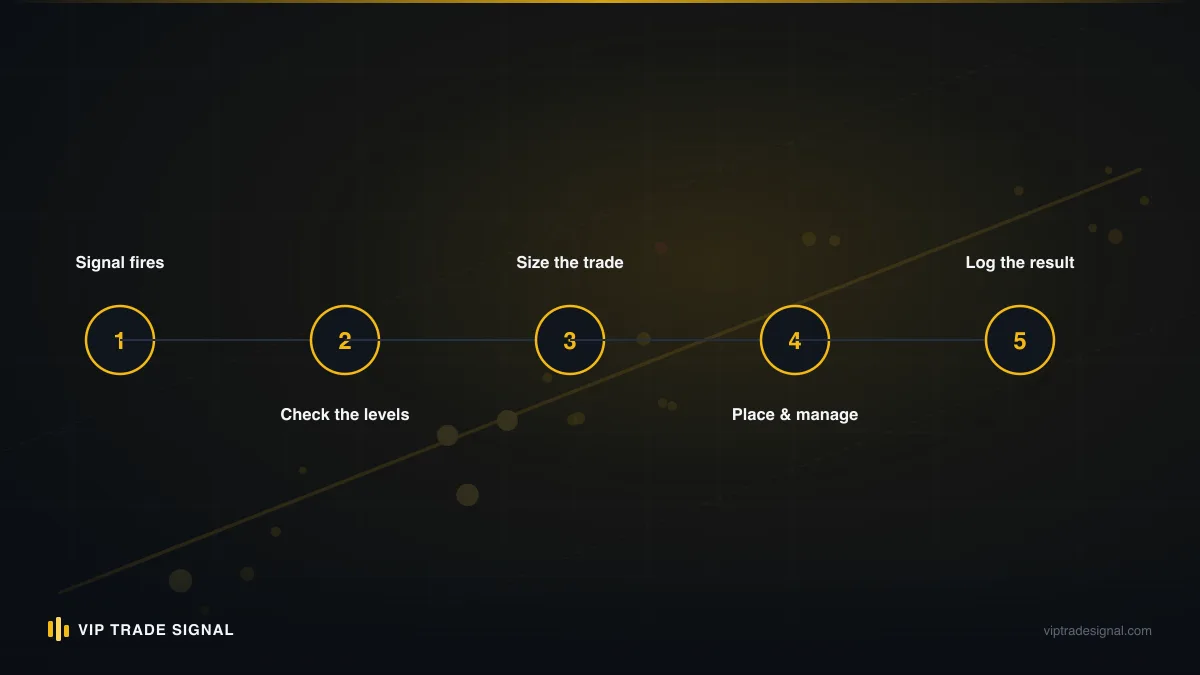
- Pick your partner broker. Use the fit sketch above: Exness or XM for smaller and newer accounts, IC Markets or Vantage raw-style accounts if cost per lot is your priority. Region matters, so check the broker serves your country under a licence you are comfortable with.
- Take the referral link from the source, and verify it. Ours live on the VIP via broker page, not in DMs. Before clicking through, do the domain check from the verification section, character by character.
- Open the account on the broker's site. KYC is the broker's process: identity document, proof of address, the usual. Choose the account type you costed, standard or raw, and the base currency you will fund in.
- Confirm the partner tag before depositing. Ask the broker's live chat whether the account is attached to our partner code. Two minutes, and it prevents the annoying failure mode where an untagged account earns no access and needs support tickets to fix.
- Deposit $250 or more. Decline any bonus the funding page offers, however shiny; you read the bonus-trap section. Deposit only money whose total loss you could absorb, because leveraged gold can deliver exactly that.
- Tell us the account number. We check the tag and balance on our side and switch your access on. From that point every signal, entry, stop, targets, and the reasoning, reaches you the moment it is published, and every closed result lands on the public history page whether it flatters us or not.
- Trade it small first. Take your first weeks at minimum size while you learn the rhythm of the signals and your broker's execution. And put in that small test withdrawal early. We would genuinely rather you verified the exit works before you scale anything up.
If you drop below $250 later, access pauses, you top up or switch plans, life goes on. That is the whole machine.
The questions that separate a fair offer from a farm
Strip everything above down to a pocket checklist and you get twelve questions. Put them to any provider offering to get free signals through partner broker links, us included, and refuse any offer that fails even one, because each question maps to a specific abuse this article has already named.
- Is the minimum a maintained balance rather than a required trading volume?
- Does the referral link land on the broker's real domain, verified independently?
- Is the broker regulated somewhere that would actually answer your complaint, and under which entity will your account sit?
- Can you withdraw everything, any time, without the provider's permission, with lapsed access as the only consequence?
- Are referred spreads identical to the broker's normal spreads for that account type?
- Is the provider's revenue volume rebates only, with no claim on your profits and no benefit from your losses?
- Is there a public, complete signal history, losses included, not screenshots of winners?
- Is the signal cadence something analysis could plausibly produce, rather than a rebate engine?
- Were you steered away from deposit bonuses, or at least not toward them?
- Is there one access tier, not a deposit-size ladder?
- Can you find a registered business, terms and a working support channel behind the offer?
- Does the provider talk about risk and losing streaks unprompted, or only about lifestyle?
Notice that not one question requires trusting anyone's word. Every answer is checkable from outside: on the broker's register, in the account terms, on the history page, in a test withdrawal. That is deliberate. The whole reason vip forex signals channels get away with the abusive variants is that the pitch arrives faster than the diligence, and a checklist you can run in an evening reverses that.
Where does this leave you? If you were going to fund a gold trading account anyway, the broker route is close to strictly sensible: same trading costs, no subscription, your money at a name-brand regulated broker, full walk-away rights. If you were not going to trade otherwise, do not start because a "free" offer arrived; signals are an input to trading, not a reason to begin, and if you are still working out what a signal even consists of, start with what forex signals actually are and what actually moves the gold price before connecting anything to anyone. And if you do go ahead, with us or a competitor, hold the operator to every line of this article. We wrote the terms down in public precisely so you could.