Somewhere on Telegram right now, a man in a rented Lamborghini is posting a screenshot of a $47,000 trading day. The screenshot is real, in the sense that it is a genuine picture of a screen. Everything else about it is negotiable. The account might be demo. The number might be edited. The trade might have existed alongside nine losers that never made the feed. Or the whole thing might have been generated in thirty seconds with a free web tool built for exactly this purpose.
And yet screenshots like that one move money. People wire deposits, hand over investor passwords, and sign up for $300-a-month signal channels on the strength of a JPEG. If you take one idea from this article, take this: there is a hierarchy of evidence in trading, and most of what gets presented as proof sits at the very bottom of it. A verified forex track record — genuinely verified, by a system the trader doesn't control — is rare precisely because it's hard to fake. That's the whole point of demanding one.
We publish our own record, every closed signal, wins and losses, and we'll get to how and why later. But this piece isn't really about us. It's about giving you a working standard of proof, so that the next time someone shows you their results, you know exactly what you're looking at — and exactly what you're not.
The hierarchy of evidence, from screenshot to audit
Think of trading proof the way a court thinks about evidence. Hearsay at the bottom. Sworn testimony above it. Physical evidence above that. Independent forensic analysis at the top. Each level up costs more to fake, and that cost is what gives it weight.
Here's the trading version, from weakest to strongest:
| Level | Evidence | Can it be faked? | Effort to fake |
|---|---|---|---|
| 0 | Screenshots, videos, testimonials | Trivially | Minutes |
| 1 | Broker statements (PDF, HTML) | Yes | An hour with a text editor |
| 2 | Investor-password read access | Partially | Requires account manipulation |
| 3 | Third-party verification (Myfxbook, FX Blue) | With difficulty | Requires structural tricks |
| 4 | Audited, regulated fund records | Barely | Requires committing actual fraud against a regulator |
Level 4 exists mostly for institutional money — audited funds with administrators and custodians — and you will almost never encounter it in retail forex. That's fine. For evaluating a signal service, a managed account provider, or a trader asking for your money, Level 3 is the practical ceiling and should be your minimum standard. Anything below it is a story, not a record.
The hierarchy matters because sellers deliberately blur it. A polished PDF statement feels more official than a screenshot, so people treat it as several levels stronger when it's barely one. A video of a live MT4 terminal feels unfakeable, and isn't remotely. Learning where each artifact actually sits on the ladder is most of the skill.
One more framing thought before we climb it. The question you're really asking at every level is not "does this look real?" but "what would it cost this person to fabricate what I'm seeing?" Fraudsters are lazy in a very specific way: they'll spend exactly as much effort as the average victim requires and not a penny more. Your job is to be more expensive than the average victim.
Level 0: screenshots and videos — assume fabricated
Start with the brutal rule: any screenshot of trading results, from anyone, should be treated as fiction until proven otherwise. Not "viewed with caution". Fiction.
Why so absolute? Because the fabrication cost is effectively zero, in at least four independent ways:
- Demo accounts. MT4 and MT5 demo terminals look pixel-identical to real ones apart from one small label. A demo account funded with $100,000 of imaginary money produces beautiful, entirely genuine screenshots of imaginary profit. Half the "results" on Instagram are this.
- Image editing. Changing a balance figure in a screenshot takes less time than reading this paragraph. There are literally web-based mockup generators that output fake MT4 profit screens with your chosen numbers.
- Selective sampling. Even a real screenshot of a real winning trade proves nothing about the account it came from. Open twenty trades in both directions on a volatile pair, screenshot the winners, quietly close the losers. Every screenshot authentic, the overall picture a lie.
- Other people's trades. Copy a public trader for a week, screenshot the wins, present them as your own. Nobody can tell.
Videos add nothing. A screen recording of a live terminal showing open profit is a recording of one moment on one account of unknown type, unknown size, and unknown history. The classic move is opening large hedged positions — long and short simultaneously — so that whatever the market does, one side shows a fat green number to film. The red side never makes the edit.
Testimonials sit at this level too, arguably below it. Screenshots of grateful customers ("just withdrew $5k, thank you boss!") are the cheapest content on earth to manufacture, and entire Telegram ecosystems exist where the same fake testimonial images circulate between channels. We wrote elsewhere about how these funnels work end to end, and the pattern is always the same: Level 0 evidence, presented with total confidence, at volume.
The corollary is uncomfortable but worth saying: a trader who only offers screenshots, when third-party verification is free and takes ten minutes to set up, has made a choice. Either they don't know verification exists — worrying in a professional — or they know exactly why they're avoiding it.
Level 1: broker statements — better, still forgeable
One step up sits the broker statement: the detailed account history MT4/MT5 exports, or the periodic statement a broker emails. It lists every trade — instrument, direction, lot size, open and close prices, swap, commission, profit. It looks like an accounting document because it nearly is one.
Statements beat screenshots for one honest reason: completeness. A full statement shows the losers, the lot sizing, the timing, everything. If someone hands you a genuine twelve-month statement, you can learn more from an hour with it than from a year of their marketing. So when a statement is real, it's useful.
The problem is the "when". An MT4 statement exports as an HTML file. HTML is text. Open it in any editor, find the losing trades, change the signs, adjust the totals, save. The output is indistinguishable from the original because it is the original file format, just with different numbers in it. PDF statements are marginally harder — you need a PDF editor rather than Notepad — which is to say, still trivial. There is no signature, no checksum, no way to phone the document and ask if it's telling the truth.
A few tells help you catch lazy forgeries, and it's worth knowing them even though a careful forger avoids all of them:
- Arithmetic that doesn't reconcile. Running balance should equal previous balance plus profit, minus commission and swap, on every line. Forgers edit profits and forget the cascade. Spot-check ten random rows with a calculator.
- Impossible prices. Every fill has to have been inside that day's actual range. If a statement shows gold bought at 3,281 on a day gold traded 3,305–3,340, the statement is lying. Historical OHLC data is free; checking five trades takes five minutes.
- Suspicious uniformity. Real trading is lumpy. Statements where every win is 40-60 pips and every month gains 8-11% have usually been written backwards from a target, like a student inventing lab results.
- Weekend timestamps. Forex closes Friday night to Sunday night. Trades stamped inside the gap are a gift.
But understand what you're doing when you run these checks: you're catching incompetent fraud. A forger who reconciles the arithmetic and pulls real historical prices sails past every one. That's why statements are Level 1, not Level 3. Treat a clean statement as a reason to keep asking questions, never as a reason to stop.
Level 2: investor password read access — live but limited
MetaTrader accounts have two passwords. The master password controls everything — trading, withdrawals, settings. The investor password is read-only: log in with it and you can watch the account live — open positions, full history, balance, equity — but touch nothing.
Handing out the investor password is the traditional "come and see for yourself" of retail forex, and it's a real step up. You're now looking at the broker's own server data, live, not a document the trader prepared. Editing is off the table. If they were long gold at 08:14 this morning at 3,318, you'll see it, timestamped, priced, sized.
So why isn't this the top of the ladder? Three genuine limitations.
First, you can't verify the account's nature from inside it. Is this a demo server? A cent account where "$50,000" is actually $500? A live account at an unregulated bucket-shop broker that lets favoured accounts trade on fantasy fills? The investor login shows you the account's contents, not its context. You'd need to independently confirm the broker, server name, and account type — possible, but most people don't.
Second, you see one account, chosen by the trader. The oldest trick in managed forex is running multiple accounts with opposing strategies — one aggressive long-bias, one short-bias — then showing prospects whichever one the last six months happened to favour. The losing sibling gets quietly retired. Your live, honest, unfakeable window is pointed at a survivor. Statisticians call it survivorship bias; sellers call it marketing.
Third, history can be manipulated before you arrive. A trader can internally transfer funds between accounts to dress up returns, or run a fresh account hard and hot for three months — surviving on luck and oversized risk — and give out the password only if it works. Ten traders try this; three survive by chance; those three now have "live verified proof". The seven blown accounts are invisible.
None of this makes investor access worthless. Far from it — if you're evaluating someone to manage your money, live read access to their real trading should be a hard requirement, and any account manager who refuses it is finished as a candidate right there. (It's also, incidentally, how a properly structured managed account arrangement should run in reverse: the money stays in your account, you keep the master password, and the manager trades with limited access. You watch them, not the other way round.) Just don't confuse "live and unfakeable" with "complete and representative". Level 2 tells the truth about what it shows. It just doesn't show everything.
Level 3: third-party verification — the Myfxbook and FX Blue standard
Now the level that should be your working minimum. Third-party verification services — Myfxbook and FX Blue are the two that matter in retail forex — connect directly to a trading account and independently record everything that happens on it. The trader can't edit the record, because the trader never touches the record. That single structural fact does more work than every forgery check combined.
Here's what proper verification looks like, because the details are where fakes hide. On Myfxbook, a fully verified account displays two separate green ticks: Track Record Verified, meaning Myfxbook has confirmed the trading history through a direct broker connection rather than an uploaded statement, and Trading Privileges Verified, meaning it has confirmed the account is real and tradeable — typically via the master password check — not just a spectator's view. An account with one tick but not the other is half-verified, and the missing half is usually the interesting half. FX Blue works similarly: results published through a live platform connection carry weight; manually uploaded statements carry precisely the weight of Level 1, because that's what they are.
A myfxbook verified forex account manager — both ticks, live broker feed, real account — has cleared a bar that eliminates the overwhelming majority of the industry at a stroke. The same standard applies doubly to automated systems: if you're evaluating an EA, forex robot verified real results mean a live-connected, real-money account with both verifications, not the vendor's backtest and not a "verified" demo. (Yes, demo accounts can be Myfxbook-verified. The tick confirms the data is honest, not that the money is real. Always check the account type field.)
What third-party verification buys you, concretely:
- Tamper-proof history. Every trade, recorded as it happened, by a party with no stake in the outcome.
- Losses on display. Drawdown curves, losing streaks, the full equity path — the material sellers most want hidden.
- Comparable metrics. Standardised drawdown, monthly returns, and risk figures you can line up against other traders instead of taking each seller's homemade maths on faith.
- Time-stamping. A record that started three years ago provably started three years ago. Nobody can conjure history retroactively.
And what it costs the trader: about ten minutes and nothing. Which brings back our recurring question. When verification is free, easy, and standard, its absence is not an oversight. It's an answer.
What even verified records can hide
Time for the uncomfortable half of the argument. Third-party verification proves the trades happened. It does not prove the record means what the seller says it means. Verified data can still assemble a misleading picture, and the mechanisms are worth knowing cold.
Survivorship selection, again. Nothing stops a trader running five verified accounts and marketing only the winner. The Myfxbook page you're shown is genuine; the four dead siblings simply don't get shown. This is probably the single most common way honest-looking records lie, and no verification service can catch it, because each account's record is accurate. Your defence is longevity — five parallel accounts can produce one lucky year far more easily than one lucky five-year run — and asking directly: "Is this your only account? Has it always been?" Watch how they answer.
Hidden risk in the method. A verified equity curve that climbs smoothly for eighteen months can be produced by genuine skill — or by strategies that sell tail risk: martingale (doubling position size after losses), grid systems without stops, or holding losers indefinitely while banking small winners. These produce gorgeous verified records right up until they produce a single catastrophic one. The tell is in the open-trade drawdown data: floating losses far exceeding realised losses, average losing trades held ten times longer than winners, position sizes that grow after losses. Myfxbook exposes most of this if you look past the front-page return figure. Almost nobody looks.
Hidden metrics. Both Myfxbook and FX Blue let account owners hide specific data — balance, lot sizes, sometimes the trade list itself. Each hidden field is a decision. A record with a glowing return percentage and a hidden balance might be a $180 account. Percentages on toy accounts are noise; a trader risking meaningful money behaves differently from one gambling lunch money for marketing material.
Deposit distortions. Percentage gain calculations can be flattered by well-timed deposits and withdrawals. Check the deposit history against the gain curve. A record whose big percentage months coincide with a nearly-empty account has told you something.
None of this collapses Level 3. It refines it: verification makes the data honest, and then you still have to read the data. A tick mark is where your analysis starts, not where it ends.
Track record length: why three months means nothing
Here's a number worth carrying around: a coin-flipping strategy with mild positive luck can look brilliant for a quarter. Say a trader takes 60 trades in three months with a fifty-fifty method and decent reward-to-risk. Simple variance means a meaningful slice of all such traders will post excellent quarters on randomness alone. Run a thousand monkeys for three months and you'll get dozens of verified, tamper-proof, entirely genuine track records of monkeys who look like geniuses.
Time is the filter luck can't pass. Not perfectly — long lucky streaks exist — but each additional year of live results shrinks the population of impostors exponentially. Our rough working scale, and we'd defend every line of it at the pub:
- Under 6 months: ignore entirely. This is an audition, not a record.
- 6–12 months: interesting, provisional. Enough to see the method's shape, nowhere near enough to trust it.
- 1–2 years: the minimum for real consideration, if the period included at least one rough market regime.
- 3+ years: now we're talking. Multiple regimes, multiple drawdowns survived, luck substantially washed out.
That regime point deserves a beat. Two years of results earned entirely inside one market condition — say, a steady trending bull run in gold — tells you the strategy works in trending bulls. It's silent on what happens when the trend dies. A shorter record spanning a violent reversal, a dead choppy range, and a trend can actually be more informative than a longer one that surfed a single wave. When you audit a record, pull up a chart of the instrument over the same period and ask: what conditions did this trader actually face? Gold traders who started in 2024 have, so far, mostly been examined by a market that kept rewarding one answer. The harder exam paper hasn't been handed out yet — and the honest ones will tell you that themselves. (We're gold-only ourselves, for reasons argued at length in why we trade only XAU/USD, and we'd apply this exact scepticism to our own history.)
And watch for the reset pattern: sellers whose "verified track record" is perpetually four months old. Account blows up, new account, fresh Myfxbook page, the cycle repeats. Each individual record is verified and each is meaningless. The question isn't "is this record real?" but "how many records came before this one?"
Losses in the record: the credibility signal most skip
Flip the usual logic for a second. Most people scan a track record for wins. The experienced eye goes straight to the losses, because losses are where honesty lives.
Every real trading method loses. Regularly, visibly, sometimes in clumps. A record without meaningful losing trades and losing weeks is one of exactly three things: fabricated, curated, or a tail-risk time bomb of the martingale family that hasn't detonated yet. There is no fourth option. Decades of market data and every honest professional's experience agree on this, and the industry-wide commonplace — most retail traders lose money overall — exists precisely because trading is hard and losses are constant. Anyone whose record disagrees with that reality is disagreeing with reality.
A track record without losses isn't a good record. It's a confession you haven't read carefully yet.
So when you find losses in a verified record, don't relax — read them, because their shape is the most informative data you'll get:
- Loss size versus win size. Losses clustered around a consistent size suggest actual stop-losses being honoured. A record of small wins punctuated by rare, enormous losses is the signature of cut-winners-hold-losers, the retail death spiral.
- Losing streaks. Any active strategy will string five or six losers together eventually. A multi-year record without a single losing streak has been laundered somewhere.
- Behaviour after losses. This is the big one. Pull the trade list and check position sizes immediately following losses. Flat sizing after a loser: disciplined. Doubled sizing after a loser: martingale DNA, and the smooth history is borrowed time.
- Drawdown depth and recovery. A 25% verified drawdown that was traded through and recovered with consistent sizing tells you more good things about a trader than a year of wins does. It's the stress test passed in public.
There's a sales-psychology angle too. Sellers hide losses because prospects punish them for honesty — the channel posting nine wins and no losers outsells the one posting six wins and four losses, every time, even though the second is far likelier to be real. Which means the services that do publish their losses are deliberately choosing credibility over conversion. That choice is itself a signal, arguably the strongest soft signal in this whole business. It's why our own full signal history shows every closed signal including the red ones; a results page that only ever shows green is an advert wearing a lab coat.
Demo, cent, and real accounts: check which one you're shown
An entire class of deception lives in the gap between account types, and it survives because the differences are invisible in a screenshot and easy to miss even in a verified record.
Demo accounts trade imaginary money with, frequently, better-than-real execution: no slippage worth mentioning, instant fills, no psychological weight. A strategy can be demo-profitable and live-losing purely on execution costs — scalping methods especially, where the demo-versus-live gap in fills can be the entire edge. And the psychological difference is bigger still. Trading $50,000 of nothing produces decisions that trading $50,000 of your actual money does not. A demo record, even a Myfxbook-verified demo record, is evidence about a strategy's logic. It is zero evidence about a trader.
Cent accounts are the sneakier cousin. Balances denominated in cents mean the terminal shows "$25,000" while the account holds $250. Everything about the record is real — real market, real fills, real money — but the scale is theatre, and risk tolerance at $250 tells you nothing about behaviour at $25,000. Some brokers' cent accounts are identifiable in Myfxbook's account details; some hide behind hidden-balance settings. If the balance is hidden, assume small until shown otherwise.
Real, meaningfully-funded accounts are the only records that count as evidence about a trader rather than an idea. "Meaningfully" is doing work in that sentence — it doesn't need to be six figures, but it needs to be enough that losses hurt. A trader risking money that matters and surviving is demonstrating the entire skill. A trader compounding a $100 stunt account is demonstrating marketing.
Checking takes two minutes. On Myfxbook: the account page lists broker, account type, and whether it's demo or real — demo accounts are labelled. Cross-check the server name against the broker's published server list (demo servers usually say so in the name). Look at whether the balance is shown and whether Trading Privileges are verified. On FX Blue, check the system's stated account details and, again, whether results flow from a live connection or an upload. Any evasiveness about account type when asked directly — "why does it matter, the percentages are the same" — is a complete answer. The percentages are not the same. They never were.
Auditing a verified forex track record in 15 minutes
Theory assembled, here's the practical drill. Fifteen minutes with a laptop, applied to any trader, signal service, EA, or prospective fund manager showing you results. Run it in order; most frauds die at step two or three and save you the rest.
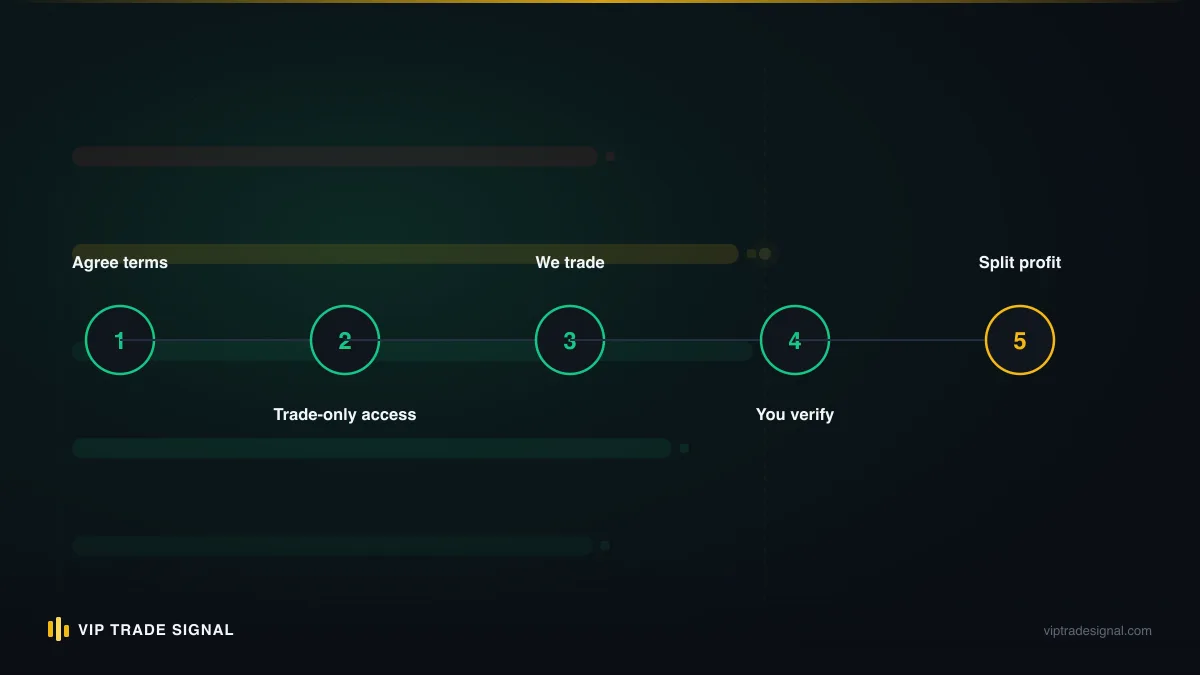
Minutes 0–2 — Establish the level. What are you actually being shown? Screenshots or a video: stop, ask for a Myfxbook or FX Blue link, and treat refusal as your result. A statement file: park it, same request. No third-party link after a direct request means the audit is over and the answer is no.
Minutes 2–5 — Check the verification itself. On the Myfxbook page: both badges present? Track Record Verified and Trading Privileges Verified? Real account, not demo? Balance visible, and large enough to matter? Broker recognisable and regulated somewhere credible? On FX Blue: live platform connection, not manual upload? Any hidden fields — note each one as a deliberate choice.
Minutes 5–8 — Age and continuity. Record start date: under a year, downgrade everything that follows. Look for gaps — weeks or months with no trading can mark blown accounts quietly restarted, or strategies switched mid-record. Check deposit/withdrawal history for balance resets: a record that "recovered" via a fresh deposit hasn't recovered anything.
Minutes 8–12 — Read the risk, not the return. Skip the gain figure — it's the number designed for you. Instead: maximum drawdown (both closed and open/floating — the floating figure is where grid and martingale bodies are buried). Average win versus average loss. Average holding time of winners versus losers — losers held dramatically longer is the classic red flag. Position sizing after losses, from the trade list. Monthly returns table: implausible smoothness is a worse sign than lumpy honesty.
Minutes 12–15 — Reality-check the context. Pull a chart of the traded instrument across the record's lifespan. One-directional market the whole time? Note that the exam's been easy. Then the direct questions, in writing: Is this your only account? What happened to previous ones? Why is [hidden field] hidden? Honest traders answer these comfortably — they've usually pre-empted them. Watch for answers that redirect to returns.
Fifteen minutes. Perhaps £5,000 or more of not-lost money per application. We know of no better hourly rate in trading — and every step works exactly the same whether you're vetting a $30 signal channel or someone asking to trade your account, a decision with its own extra layer of checks we've covered in our piece on managed forex accounts.
Red flags that end the conversation immediately
Most of this article is about weighing evidence. Some things need no weighing. Any single item on this list, and we'd close the tab without finishing the sentence:
- Guaranteed returns of any size. "Guaranteed 10% monthly" is not optimistic marketing; it's a mathematical impossibility being sold to you, and in most jurisdictions it's also illegal to promise. Real trading has losing months. All of it. Ours included.
- Refusal to provide third-party verification after a direct request. Every legitimate excuse ("privacy", "proprietary strategy", "my clients don't need it") collapses on contact with the fact that verification is free, standard, and doesn't reveal strategy logic.
- Withdrawal-proof screenshots as the primary evidence. Fake withdrawal notifications are a manufactured genre. And even genuine ones prove someone withdrew money, not that trading produced it — Ponzi structures generate perfectly real withdrawal screenshots right up until they don't.
- Perpetually young accounts. The four-month-old record, forever. Ask what happened to the last one and count the seconds of silence.
- Pressure and urgency. "Only 3 slots left", countdown timers, "price doubles Friday". Real records don't expire. Scarcity theatre exists to stop you doing precisely the fifteen-minute audit above.
- Results that improve when questioned. Ask a hard question, receive a fresh screenshot of an even bigger win. This is a tell so reliable it's almost endearing.
The common thread: every red flag is a substitute for evidence, deployed where evidence should be. The louder the substitute, the more certain you can be about what's missing underneath.
How we publish ours, losses included
Cards on the table, since we've spent five thousand words setting a standard someone will reasonably ask us to meet.
VIP Trade Signal publishes every closed signal — gold only, XAU/USD is all we trade — on a public history page. Wins and losses, entry, stop, targets, outcome. Not a highlights reel; the page includes the losing streaks, because we have them, because everyone has them, and a results page without red on it is exactly the kind of curated fiction this article exists to warn you off. You can read the reasoning behind the single-instrument focus on our about page, but the short version is that we'd rather be genuinely good at one market than performatively good at thirty.
We'll be honest about where that sits on our own hierarchy: a self-published signal history is our own record of our own calls, which makes it stronger than screenshots and weaker than a third-party feed — you're trusting our publication process rather than Myfxbook's servers. What makes it auditable is the same thing that makes any record auditable: completeness and time. Signals are published before outcomes are known, the history accumulates in public, and the losses stay up. Apply the fifteen-minute drill to us. Check whether the losses are there. Check whether the sizing logic is consistent. Ask us the awkward questions — is this everything, what happened in the bad weeks — and judge the answers by the standard in this article, not by our tone of voice. We built the standard knowing we'd be measured against it, which is rather the point.
And the risk sentence, said plainly rather than in small print: gold is a violently volatile instrument, signals — ours or anyone's — lose regularly, and no track record, however verified, is a promise about next month. Anyone who tells you otherwise has skipped to the red-flags section of someone's article and decided to become an example.
Where this leaves you
A working standard, compressed to its bones:
- Screenshots and videos are fiction. No exceptions worth planning around.
- Statements are claims, checkable for lazy fraud but forgeable by anyone careful.
- Live investor access is honest but partial — one chosen account, context unverified.
- Third-party verification is the minimum standard — both badges, real account, visible balance — and its absence after a direct request is a verdict.
- Verified still isn't the same as meaningful. Read the losses, the drawdowns, the sizing after losers, the record's age, and the market conditions it was earned in.
- Fifteen minutes of audit beats any amount of gut feel.
The deeper shift is in what you look for. Amateurs evaluate records by the size of the wins. You now know to evaluate them by the honesty of the losses, the age of the data, and the distance between the trader and the record-keeping. That inversion — losses as the credibility signal, independence as the proof — will disqualify most of what the industry shows you. Good. It was disqualifiable.
One closing question to carry into every pitch, every channel, every glossy Myfxbook link: what would it have cost this person to fake what I'm seeing? When the answer is "minutes", walk. When the answer is "years of live, independently recorded trading through markets that punished everyone else" — that's when you're finally looking at proof. Even then, size your risk like the record might be wrong. The best traders we know do exactly that with their own.