There's a message sitting in a few million Telegram inboxes right now that reads something like this: "Hello dear, I saw your comment in the trading group. Are you interested in earning passive income from forex? My account manager helped me make $8,400 last month from a $500 investment."
If you trade, or even if you've just joined a couple of trading groups to lurk, you've seen it. Maybe you've replied to one. Maybe you're in the middle of one right now and something feels off, which is why you're reading this. The telegram forex account management scam is probably the single most profitable fraud template operating in retail trading, and it works not because its victims are stupid but because the script is genuinely good. It has been A/B tested on millions of people. Every message, every pause, every screenshot has a job.
We run a Telegram channel ourselves — it's how we deliver gold signals to members — so we have an awkward, close-up view of this. Scammers impersonate services like ours weekly. We've had people message our admin asking why "we" stopped responding after they sent $3,000 to a wallet address. We never asked for it. Someone wearing our logo did. So this article is part public service, part self-defence: a full autopsy of the script, the personas, the screenshot factories, the WhatsApp and Instagram variants, and — because it matters just as much — what a legitimate provider's Telegram actually looks like, so you can tell the two apart in about ninety seconds.
Why Telegram became scam central for account management fraud
Fraud goes where the friction is lowest, and Telegram is nearly frictionless. You can create an account with a burner SIM, set any display name and photo you like, join public trading groups with hundreds of thousands of members, and DM any of them. No identity verification. No real moderation of DMs. And when a scam account gets reported and banned, the operator spins up a new one in four minutes with the same photos and a slightly different username. The cost of getting caught is effectively zero.
Compare that with running the same fraud through a website. A website needs hosting, a domain, a payment processor — all of which leave a trail and all of which can be seized or shut down. A Telegram account needs a phone number from a country the operator has never visited.
There's a second reason, and it's less obvious: Telegram is also where the legitimate end of this industry lives. Real signal providers, real analysts, real broker communities all use it, because it's free, it handles large groups well, and traders are already there. That's cover. A scammer on Telegram isn't a fish out of water; they're one more account in an ocean of accounts that all look roughly the same. When someone searches for forex account management telegram groups, the results mix honest services, mediocre services, and outright fraud with no visual distinction between them. The platform can't tell them apart. Google can't either. That job lands on you.
The third ingredient is the audience. Trading groups self-select for people who want money outcomes and are comfortable sending funds to online platforms. That's the exact psychographic a fraudster wants, pre-gathered into rooms with open member lists. A scammer doesn't have to find victims. Telegram groups are lead lists that assemble themselves.
None of this means Telegram-the-platform is the villain, any more than the phone network was the villain of boiler-room fraud. But you should walk into any trading group there with the same posture you'd bring to a street market famous for pickpockets: the venue is fine, the crowd is mixed, and your wallet stays in your front pocket.
The script, message by message: first DM to blocked account
Here is the whole arc, condensed from dozens of real conversations we've reviewed (victims forward them to us more often than you'd think). Details vary; the skeleton never does.
Message 1 — the pretext. "Hi, I saw your comment in [group name]." Or "Sorry, is this Daniel? … oh, wrong number, but you seem nice." The opener's only job is to get a reply. Any reply. The wrong-number version is the pig-butchering variant, which we'll come back to; the group version is the trading-specific one.
Messages 2–10 — the soft interview. Friendly questions. Where are you from, do you trade, have you tried forex before. Two things are happening here. The scammer is qualifying you — how much money you might have, how experienced you are (less is better), how lonely or eager you sound. And they're building the reciprocity of ordinary conversation. By message ten you've told a stranger your country, your job, and your frustration that your savings earn nothing. You've written their sales script for them.
The pivot. "Actually, I don't trade myself — my account is managed by a professional. I just withdraw profits every Friday." Note the construction. They're not selling. They're sharing. First-person testimony from a peer beats any advert, and it lets the scammer play satisfied customer rather than salesperson, which disarms the exact scepticism a pitch would trigger.
The introduction. You get handed to a second account — the "manager", the "mentor", sometimes a "certified account manager from [real bank name]". Two-handler structure is deliberate: the friend stays your friend, checking in, celebrating with you, keeping social pressure on, while the manager handles logistics. If you get doubts, you voice them to the friend, who reassures you. It's a closer and a shill, the oldest team in fraud.
The small deposit. The manager proposes something modest — usually $300 to $500, sometimes as low as $100. Small enough that you can afford to lose it, which is precisely the point. You send it, almost always in crypto or to a "broker" platform that is actually the scammer's own website, a skinned template that displays whatever numbers the operator types into an admin panel.
The performance. Within days your dashboard shows profits. 20%, 40%, sometimes an implausible 300% — they calibrate to what you'll swallow. The trades listed aren't real. Nothing is being traded. It's a number on a screen the scammer controls, and it exists to trigger the next stage.
The withdrawal test. You're allowed — sometimes encouraged — to withdraw a small amount. This is the hook, and it deserves its own section below.
The escalation. Now the asks grow. A "VIP tier" needs $5,000. A "guaranteed insurance trade" needs $10,000 by Friday. If you hesitate, urgency arrives: the opportunity closes tonight, the mentor is disappointed, everyone else in the group already joined. People borrow at this stage. People liquidate pensions at this stage.
The exit. When you finally ask to withdraw the big balance, there's a problem. A tax must be prepaid. A "withdrawal fee" of 10%. Your account was flagged and needs a $2,000 unlock deposit. Each fee, once paid, spawns another. This is the recovery-of-sunk-costs phase and it's where the worst damage happens, because victims keep paying to rescue money that stopped existing months ago. Eventually you push too hard, and the manager, the friend, and the platform all go silent. Blocked. The account name changes, the photos move to a fresh profile, and the script starts again on someone else.
Read that arc again and notice something: at no point does the scam depend on you being greedy or gullible. It depends on ordinary human wiring — reciprocity, social proof, sunk costs, trust in evidence you've personally verified. The withdrawal test is personal verification. That's what makes it lethal.
The fake mentor persona: profile forensics
The manager account is a constructed character, and the construction is surprisingly consistent. Learn the type and you'll clock it on sight.
The profile photo is a confident, well-dressed person — frequently a real trader, influencer or model whose images were scraped from Instagram. Lifestyle shots follow: airport lounges, a rented Lamborghini, a watch photographed on a car's steering wheel (always the steering wheel; it's practically a uniform), stacks of cash on a bed. Sometimes a family photo for wholesomeness. The bio claims credentials — "Senior account manager, 8 years experience, FCA certified" — that fall apart on a single check, because the FCA certifies firms, not Telegram accounts, and a real regulated individual would point you to a firm's register entry, not a bio line.
Run the forensics yourself, in this order:
- Reverse-image search the photos. Google Lens or TinEye, thirty seconds. A shocking fraction of these personas use images belonging to identifiable real people who have public warnings up about being impersonated.
- Check the username against the display name. Display name says "Mark Whitfield | Fund Manager"; the @username is @cryptoqueen_lucia88 or a fresh string of characters. Display names cost nothing to change. Usernames leave history.
- Look at account age signals. No posts before last month, or a channel whose entire history was created in one afternoon (check the timestamps — scammers backfill "past signals" in bulk and the dates give it away).
- Ask a boring professional question. "Which regulated entity holds client funds, and what's its register number?" A legitimate operation answers precisely because it's asked daily. A scammer deflects, changes the subject to profits, or gets huffy that you don't trust them. Huffiness at due diligence is a confession.
And one detail people miss: the writing. These operations are run from call-centre-style offices, often with one operator juggling thirty conversations off a script sheet. The tone lurches — warm and idiomatic in the scripted parts, stilted and oddly formal in the improvised ones. Pet names appear early ("dear", "my friend") because the script says to build intimacy fast. If a stranger's affection arrives faster than a stranger's affection plausibly could, that's not chemistry. That's a KPI.
The small-win hook: why they let you withdraw once
This is the mechanism that separates the amateurs from the professionals, and it's worth understanding deeply because it defeats the exact defence most people rely on.
Your instinct, and it's a decent instinct, says: test it with small money first. Deposit $300. If profits appear and, crucially, if you can withdraw them, the operation must be real — a thief wouldn't hand money back. So you withdraw $150, it lands in your wallet within a day, and every alarm in your head switches off.
But look at the economics from the scammer's side. They've spent $150 to purchase something worth vastly more: your verified trust. The average victim of these schemes eventually sends four figures at minimum, frequently five, occasionally six. Refunding $150 to unlock a $15,000 escalation is a 100-to-1 return on the refund. It's not a leak in their scheme. It's their best-performing line item. Casinos comp your first drinks for the same reason.
There's a name for the general pattern — it's a Ponzi micro-cycle, paying early "returns" out of your own deposit or the next victim's — but the psychology matters more than the taxonomy. Once you have personally received money, you stop evaluating the scheme as an outsider and start defending it as a participant. Friends who warn you sound jealous. Articles like this one sound paranoid. The scammer has converted you from mark to advocate, and many victims recruit their own family into the scheme during this phase, genuinely believing they're sharing a good thing. That's the cruellest part of the design, and it's fully intended: warm referrals from a convinced victim beat any cold DM.
If a stranger's system only reveals its true nature after you've sent the big money, then the small test told you nothing. It was the bait, not the trial.
So invert your test. Don't ask "can I withdraw a small profit?" — the script has an answer for that. Ask "can this operation show me independently verifiable losses?" Real trading has losing weeks, and a real provider's record shows them. We publish every closed signal, red ones included, on our signals history page precisely because a track record with no losses is the signature of fiction. If you want the fuller method for auditing any provider's numbers, we've written up how to verify a forex track record step by step.
Screenshot factories: how the profit images are made
The evidence stream that keeps victims paying is a river of screenshots: MT4/MT5 trade histories, broker dashboards, bank transfer confirmations, testimonials from other "clients". Nearly all of it can be manufactured in minutes, and knowing how is the fastest way to stop being impressed by it.
Demo accounts. MetaTrader demo accounts look pixel-identical to live ones in a cropped screenshot. Open a $100,000 demo, take huge positions with no real risk, screenshot the winners, delete the account. Ten minutes of work produces a month of "proof". The tell — the word "Demo" in the account title bar — sits exactly where crops always happen.
Website generators. There are online tools whose entire purpose is generating fake MetaTrader results, fake bank transfer receipts, and fake exchange balances. Type numbers, download image. Some scam operations subscribe to them the way our office subscribes to charting software.
Cherry-picking real accounts. The more sophisticated version: run several small real accounts with reckless leverage. Some will blow up; statistically one will hit a hot streak. Screenshot the hot one forever. The blown ones never existed, publicly.
Recycled and stolen images. The same screenshots circulate between scam networks for years. Reverse-image search catches these too — we've seen a "yesterday's profit" screenshot that first appeared online in 2019.
The defence is a single rule with no exceptions: a screenshot is not evidence. Not one screenshot, not a hundred. Evidence is data you can check on infrastructure the claimant doesn't control — a third-party verification service linked to a live account (with the investor-password linkage intact, not just a badge image), a regulator's register you look up yourself, a public log of every closed trade with timestamps that predate the outcome. If the entire evidence base for an operation lives in images that the operation itself sends you, you have been shown nothing.
One more asymmetry worth naming. Producing a fake screenshot takes two minutes. Checking one properly takes twenty. Scammers win the volume game, which is why the right move is to refuse the game — don't audit their images, demand the class of evidence that can't be imaged.
The WhatsApp and Instagram variants of the same script
The script is platform-independent; only the entry point changes. If you understand the Telegram version, you understand them all, but the variants have distinguishing features worth knowing.
The whatsapp forex trading scam usually starts with a wrong-number text or with your number harvested from a leaked database or a group you joined once. WhatsApp's edge, from the fraudster's perspective, is that a phone number feels personal — a message there lands with more intimacy than a Telegram DM from a stranger. The wrong-number opener does heavy lifting: "Is this the vet? I'm asking about my dog Bella" is disarming in a way no trading pitch could be, and the conversation drifts to investing only after days of small talk. WhatsApp is also where victims get moved after being hooked elsewhere, because it's harder for platforms and researchers to observe.
The instagram forex trader scam works the funnel in reverse: instead of cold outreach, it builds a lifestyle account — rented supercars, beach clubs, "another client withdrawal 💰" stories — and waits for you to come to them. Engagement is manufactured with bought followers and comment pods full of "changed my life bro" from other fake accounts. When you DM to ask how it works, you're routed to, guess where, Telegram or WhatsApp, because Instagram bans get expensive once money talk starts in DMs. Instagram's role is the shop window; the till is always elsewhere. A useful tell: check whether the glamour account allows comments from accounts older than a year, and search the trader's name plus "scam" — impersonated real traders usually have warnings pinned somewhere.
There's also a newer entry point worth flagging: dating apps. Match, build rapport for a week, mention the uncle who manages money. Same script, softer opening.
| Stage | Telegram version | WhatsApp version | Instagram version |
|---|---|---|---|
| First contact | DM after "seeing" you in a group | Wrong-number text or cold message | You DM them after seeing lifestyle posts |
| Persona | Mentor / account manager | Friendly stranger, then their "uncle/manager" | Successful young trader |
| Proof shown | Channel of screenshots, backfilled history | Forwarded screenshots in chat | Story highlights of withdrawals |
| Where money moves | Crypto or fake broker site | Crypto or fake broker site | Routed to Telegram/WhatsApp first |
| Exit | Block, rebrand, repeat | Number goes dead | Account renamed or abandoned |
Same play, three costumes. The constant across all of them is the destination of funds — crypto wallets or "platforms" you've never heard of that exist only as a login page — and the constant refusal to interact with anything regulated, verifiable, or reversible.
Romance-adjacent crossovers: pig butchering comes to forex
The industrial-scale version of this fraud has a grim name — pig butchering, from the operators' own slang about fattening victims before slaughter — and it deserves its own section because it's the version that takes houses, not hobbies.
Pig butchering merges the romance scam and the investment scam into one long con. Contact starts innocuously (wrong number, dating app, social comment), and the operator spends weeks or months building a genuine-feeling relationship before money is ever mentioned. Daily good-morning texts. Photos of meals. Real emotional labour, performed to a script, often by trafficked workers held in compounds in Southeast Asia who are themselves victims — forced to run twenty conversations a shift under threat. It's one of the bleakest supply chains in modern crime, and it means the "person" you're falling for may be a rotating team working a shared persona document.
The trading pitch, when it comes, arrives as intimacy rather than sales: "I want us to build a future together, my aunt taught me how she trades gold." The platform is fake, the profits are fake, the withdrawal test happens right on schedule, and the escalation stage weaponises the relationship — "don't you trust me?" is a far sharper hook than any VIP-tier deadline. Losses in these cases routinely run into six figures because the victim isn't evaluating an investment; they're investing in a person.
Why does this belong in an article about the telegram forex account management scam? Because the back end is identical. Same fake platforms, same screenshot factories, same crypto rails, frequently the same criminal networks running both scripts in parallel and routing whichever opener worked into the same "manager" accounts. If you see the account-management back end appear inside a relationship that started with a wrong number, you are not in a grey area. You are in the machine.
The defence here is uncomfortable but simple: any romantic interest you have never met in person who introduces an investment opportunity is presumed fraudulent. Not "possibly". Presumed. The overlap between real love stories and this pattern is close enough to zero that the rule costs you nothing.
What a legitimate provider's Telegram actually looks like
Since we operate one, let's define the standard — partly so you can hold us to it. A real service's Telegram presence differs from the scam template in structural ways that are hard to fake, because they cost something.
Broadcast, not DM. Legitimate providers publish to a channel you chose to join. They do not cold-message strangers. We have never once DMed a stranger first, and no serious service does, because the economics of honest work don't support paying people to charm individuals one at a time. Any first-contact DM offering account management is, with a rounding error's worth of exceptions, a scam. Treat "someone claiming to be us DMed you" as proof of impersonation — it's on our FAQ for exactly that reason.
Losses in the feed. Scroll any provider's history. Real trading shows red. Our full closed-signal record, wins and losses, is public at /signals, and a losing week sits there in plain view because pretending otherwise would be both dishonest and, frankly, impossible to sustain. A channel showing 94 wins in 94 posts hasn't discovered the holy grail; it's deleting posts or backfilling history.
Fees stated like a menu, not whispered like a secret. You should find pricing without asking a human. Ours is boring and public: signals at $99/month or free through a partner broker with $250 maintained; managed accounts at a flat 50% of realized profit with a $200 minimum advance. High-end fees, we'd be the first to say — that's the trade-off for low minimums and pay-as-you-go — but findable in one click, with a real company behind them you can read about on our about page. Scammers quote fees dynamically, calibrated to whatever they've learned you can pay.
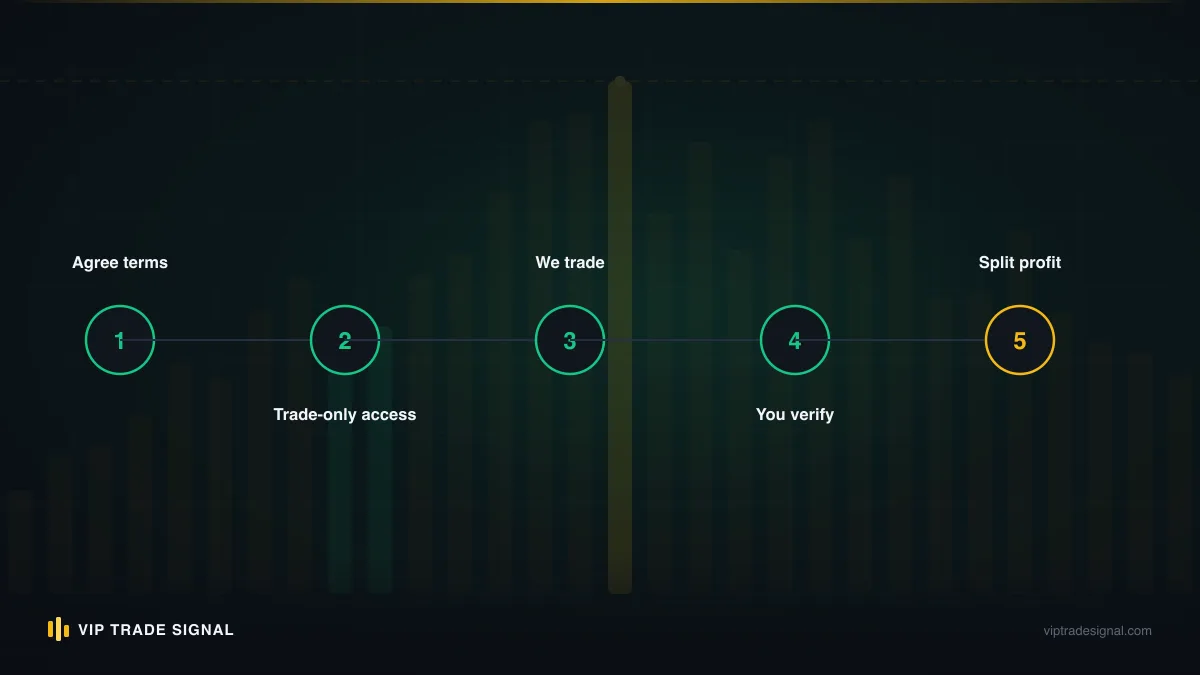
Your money never lands in their hands. This is the biggest one. Legitimate account management means trading your account at your regulated broker. You open it, you hold the master password, only you can withdraw. The manager gets trade-only access. Nobody legitimate asks you to send crypto to a wallet or deposit into a platform they recommend and you can't independently verify — the moment "send funds to us" appears, the conversation is over. We've written up how the honest structure works in what a managed forex account actually is, and what separates a real fund manager from a Telegram persona in our piece on forex fund managers.
No guarantees, anywhere. Real providers say losing is part of trading, because it is, and because regulators take a dim view of anyone who says otherwise. "Guaranteed 30% monthly" is not an aggressive marketing claim. It's a confession written in a different font.
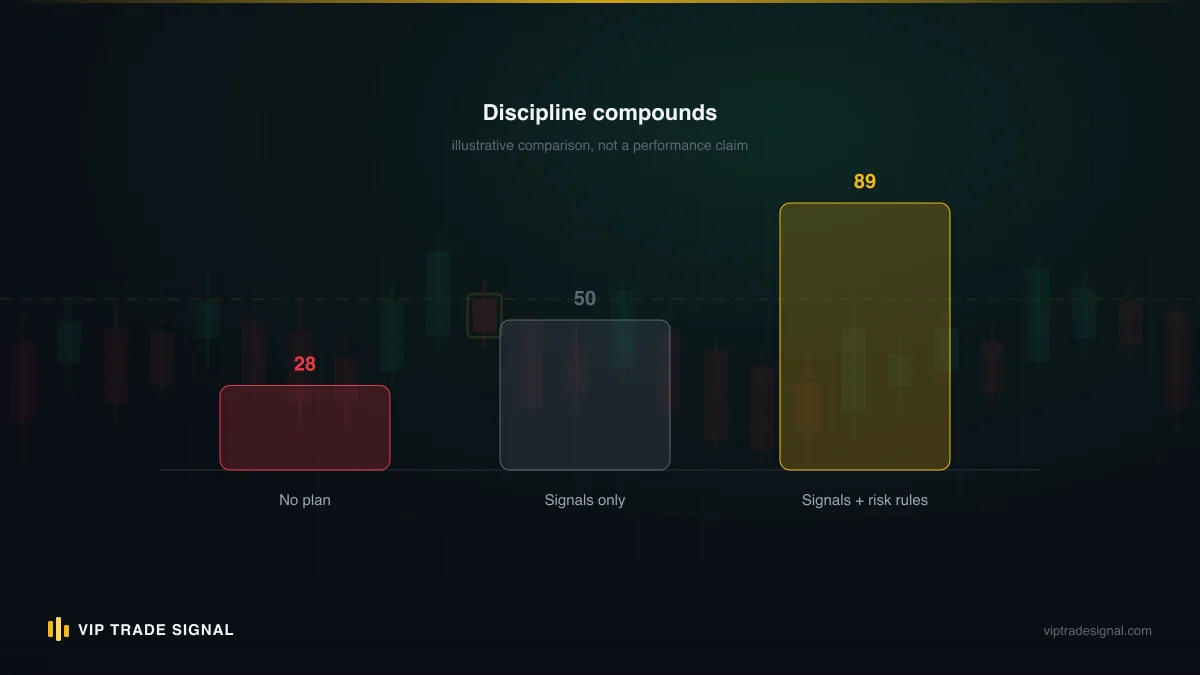
Notice that every item on the legitimate side is verifiable from outside the conversation. That's the design principle. A scammer controls everything inside the chat; they control nothing on a regulator's register, a broker's platform, or a public history page with dated posts. Push every check outside the chat and the scam has nowhere to stand.
The search trap: hunting for the "best" channel
A quick word about how people actually arrive in these traps, because it's often not a DM at all. It's a search. Someone types best forex account management telegram channel into Google or Telegram's own search, and the results are a minefield wearing a ranking.
Here's the uncomfortable truth about that search: it has no good answer, because the framing is wrong. "Best" implies a league table of vetted operators, and no such table exists. The listicles ranking "top 10 managed account channels" are almost all pay-to-play or outright affiliate fronts — some are written by the scam networks themselves, ranking their own channels first. Telegram's search ranks by member count, and members can be bought for about $5 per thousand. A channel with 180,000 subscribers and 200 views per post is telling you its members are bots; the view-to-member ratio is one of the few honest numbers on the platform, so look at it.
The right search isn't for the best channel. It's for a verifiable operator who happens to use Telegram as a delivery pipe. Start from the entity: is there a company with a name, a site, a public fee schedule, a public loss-inclusive record, and a structure where funds stay at your own broker? Then, and only then, does their channel matter — as plumbing, not as proof. Any evaluation that starts inside Telegram and stays inside Telegram is being conducted entirely on the scammer's home turf, with evidence the channel owner manufactures. You wouldn't judge a restaurant solely by photos the restaurant printed. Same energy here.
And be honest with yourself about the impulse behind the search. Usually it's "I want returns without doing the work of vetting". That's the exact impulse the entire fraud economy is built to serve. The work of vetting is not optional. It is the price of not being farmed.
If you've already sent money: immediate steps
If you're reading this mid-scam, or just after the block, move fast and in this order. Speed matters more in the first 48 hours than at any later point.
- Stop all payments now, including "release fees". This is the hardest one, so it goes first. Every fee you pay to unlock your balance is new money lost; the balance itself has been gone since the day you deposited. There is no amount that unlocks it. Anyone telling you otherwise, including a sympathetic "support agent", is the same operation or its sequel.
- Preserve everything before you get blocked or the channel vanishes. Screenshot the full chat history, usernames, phone numbers, wallet addresses, transaction hashes, the platform URL, and any emails. Export the Telegram chat if you can. Evidence disappears the moment they realise you've woken up.
- Call your bank or card provider immediately. If any payment went by card or bank transfer, ask about chargeback or recall. Card payments have real recovery odds; bank transfers less so but recalls do land, especially within days. Say the word "fraud" explicitly — it routes you to a different team with different powers.
- If you paid in crypto, report the wallet addresses to the exchange you sent from and to law enforcement. Full recovery is rare — be prepared for that — but exchanges freeze destination wallets more often than people assume, and your report adds to the case file that occasionally does bring a network down.
- Lock down your accounts. You've likely shared your name, number, and financial situation. Change passwords, enable two-factor everywhere, and expect follow-up scams — see step 6.
- Treat "recovery agents" as round two. Within days or weeks, someone will contact you claiming they can recover your funds for an upfront fee. Sometimes they cite details only the scammer would know, because they are the scammer, reselling your file. Legitimate recovery does not cold-call and does not charge upfront. This second wave catches people at their most desperate and it is entirely predictable, so predict it.
- Tell someone. Shame is the scammer's last line of defence — it's what keeps victims paying quietly and never reporting. You were worked by a professional operation running an optimised script on thousands of people. The fault sits with the operators, not with the person who trusted a well-built lie.
One thing not to do: don't confront them with what you've learned. Venting at the scammer feels good for a minute and accomplishes two bad things — it burns your access to evidence, and it confirms your number as live and emotional, which raises your value on the victim lists these networks trade between themselves.
Reporting channels that actually do something
Reporting can feel like shouting into a void, so let's be precise about which reports have teeth and which are mostly for the record.
Your bank, first and always. Not really a "report" — an action. It's the only step with a direct line to getting money back, and it's time-sensitive.
National fraud reporting. In the UK, Action Fraud (with the FCA's ScamSmart and warning list alongside — do check the warning list; the FCA names specific clone operations). In the US, the FBI's IC3 and the FTC. In Australia, Scamwatch and ReportCyber. Individual reports rarely trigger individual rescues, but aggregated reports are how wallet clusters get flagged and how the occasional multinational takedown gets built. Your report is a data point in the only dataset that matters.
Telegram itself. Report the account and channel in-app. Bans happen and rebirths follow, but a ban still destroys the account's built-up history and member list, which costs the operator real conversion rate. It's a speed bump. Speed bumps have value at scale.
The platform's real owner, if impersonation is involved. If the scam wore the branding of a real service — a real trader's photos, a real firm's name, ours — tell that firm. We actively pursue impersonators and pin warnings when clones surface, and most legitimate operators do the same. It protects the next person in line.
The image victims. If reverse-image search identified the real person whose photos were stolen, a short note to them lets them warn their own audience.
Set your expectations honestly: most individual cases don't end in recovery, and any "guaranteed recovery" pitch is itself fraud. You report anyway, for the same reason you'd report a burglary you don't expect solved — because the aggregate is the weapon.
Where this leaves you
Strip away the crypto wallets and the Lamborghini photos, and the telegram forex account management scam is a Victorian confidence trick with better distribution. The script survives because each stage defeats a specific, reasonable defence: the friendly interview defeats stranger-danger, the peer testimony defeats sales resistance, the small withdrawal defeats "test it first", the screenshots defeat "show me proof". Reasonable people lose to it precisely because they run reasonable checks — the ones the script was built to pass.
So run unreasonable ones. Here's the whole article as five rules you can apply in under two minutes:
- Any first-contact DM offering account management is a scam. Not a maybe. The base rate makes exceptions not worth entertaining.
- A screenshot is not evidence. Only data on infrastructure the claimant doesn't control counts: regulator registers, your own broker's platform, dated public records that include losses.
- Your money never moves to them. Legitimate management trades your account at your regulated broker, with the master password and withdrawal rights staying yours. "Deposit to our platform" ends the conversation.
- A successful small withdrawal proves nothing except that the operator has read the same psychology you now have.
- No guarantees exist. Real trading loses regularly and says so. We'd know; our own losing trades are sitting in public view right now.
And if you take one habit from all of this, make it the direction of verification. Never verify inside the chat. Always step outside it — to the register, to the broker, to the public record — and make the operation prove itself on ground it doesn't own. Honest providers survive that test easily, because we built for it. The script, for all its craft, cannot follow you out there.