Nobody wakes up planning to blow their account by lunch. It happens in about forty minutes, usually, and it starts with a loss that felt unfair.
We reconstructed one of these sessions with a client last year. Call him Dan, because that's not his name. He came to us after turning a $1,200 loss into a $9,600 one in less time than it takes to watch a football half. He wasn't a beginner. He'd been trading gold for three years, had a written plan, knew his risk numbers cold. And none of it mattered, because the thing that took over his account at 14:22 that afternoon wasn't a trading decision. It was a physiological state. Poker players have a word for it: tilt. Revenge trading is tilt with a margin account, and if you want to know about revenge trading and how to stop it, the first thing to accept is that you will not stop it with willpower. You'll stop it with structure: lockouts, loss limits, size ceilings that survive the exact moment you most want to override them.
That's what this piece is about. Not "master your emotions". Not breathing exercises, though we'll touch on why a version of them works. Structure. The kind that holds when you're not yourself, because for forty minutes after a bad loss, you genuinely aren't.
The forty minutes that turn a bad day into a wrecked account
Here's Dan's afternoon, trade by trade, reconstructed from his MT5 history. It's worth walking through slowly, because if you've ever revenge traded, you'll recognise every beat.
14:22. Dan is long gold from 3,318 with a stop at 3,306, risking $1,200 on a $14,000 account. Price drops hard on a headline, tags 3,305.80, takes his stop, then reverses and rallies forty dollars without him. This is the trigger. Not the loss itself, but the injustice of it. Stopped by twenty cents, then the move he predicted plays out in his face.
14:31. He re-enters long, same idea, but now with double size "to make it back". No stop this time, because the stop is what betrayed him. Price chops. He's down $800 within minutes and the position feels like an enemy.
14:39. He closes for -$850, immediately flips short because "it's obviously reversing". Triple his normal size now. Gold ticks up sixty cents against him and he's watching the ticket, not the chart.
14:47. Closes the short for -$1,400. Flips long again. Bigger again. There's no analysis happening at this point; he told us later he couldn't remember what the four-hour chart even looked like. He was trading the P&L number, trying to make it stop being red.
14:58. Two more round trips, both losers, sizes he'd never used in three years of trading.
15:03. Margin call warning. He closes everything. Total damage: $9,600, about 68% of the account, in forty-one minutes. The original, planned, correctly-stopped loss was $1,200. Everything after it was revenge.
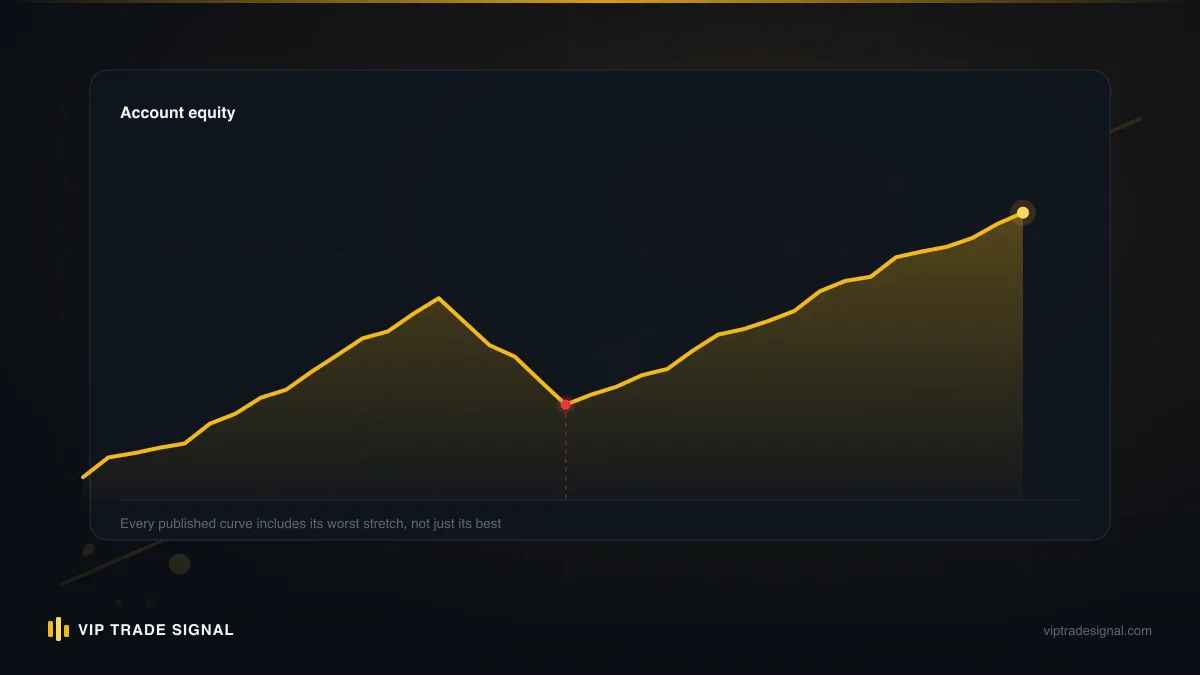
Notice what didn't happen. He didn't get unlucky five times. He got unlucky once, then made five decisions that no calm version of him would have signed off on. The market didn't wreck the account. The state he was in did.
What revenge trading actually is: tilt with leverage
Poker players figured this out decades before retail traders did, mostly because poker punishes tilt so brutally and so publicly that the community had to name it and study it. Tilt is what happens when a loss, especially one that feels unjust, triggers your threat response. Heart rate climbs. Cortisol and adrenaline flood in. Blood flow shifts away from the prefrontal cortex, the bit of your brain that does planning, probability and impulse control, and towards the older machinery that handles fights and escapes.
This is not a metaphor. It's measurable, and it's the same response you'd have if someone shoved you in a pub. The problem is that the fight-or-flight system is magnificent at fighting and fleeing and catastrophically bad at trading. It wants action now. It wants the pain to stop now. It processes the red P&L number as a wound, and it proposes the same solution it always proposes: escalate.
So the tilted trader does exactly what Dan did. Size up, because bigger positions promise faster repair. Drop the stop, because stops are what caused the pain. Flip direction repeatedly, because standing still is unbearable. Every one of those choices is rational to the threat response and suicidal to the account.
Revenge trading isn't a discipline problem wearing a trading costume. It's a hijacking, and you can't out-argue a hijacker who is also you.
Two things follow from taking the physiology seriously. First, you can drop the shame. Roughly every trader we've ever worked with has done this at least once, including everyone on our desk. One of us once turned a bad London morning into a much worse London afternoon in almost exactly Dan's pattern, years ago, and the memory still stings. You're not weak. You're human, and humans running hot are predictable. Second, and more usefully: if the cause is physiological, the cure has to be structural. You don't cure a state you can't think clearly in by planning to think clearly.
The trigger stack: loss, injustice, urgency
Not every loss triggers revenge trading. If it did, nobody would survive a month. Tilt needs a stack of triggers, usually three, and knowing the stack lets you see the spiral forming before it forms.
Loss is the base layer, obviously. But size matters less than you'd think; Dan's $1,200 was well within his plan. What matters is whether the loss lands on top of something. A losing week already in progress. A withdrawal you promised your partner. A quiet belief that this month was going to be the one. The same $1,200 that bounces off you in a good month detonates in a bad one.
Injustice is the accelerant, and it's the most underrated part of revenge trading psychology. A clean loss (you were wrong, price went the other way, the stop did its job) produces disappointment, which is survivable. An unjust loss produces anger, which isn't. Stopped by twenty cents before the reversal. Slipped eight dollars through your stop on a news spike. A broker platform freeze at the worst second. Spread widening at rollover taking out a stop that "should" have survived. Gold is especially rich in these, because it's fast, it's news-sensitive, and its spikes routinely run stops before continuing exactly where you said they would. The feeling isn't "I lost money". It's "I was robbed", and people who feel robbed want it back from the thing that robbed them.
Urgency closes the trap. The session is still open. The move is "still there". Price is moving right now, and every second you sit flat feels like the market getting away with it. This is why revenge spirals happen in minutes, not days: given an hour of forced distance, the state decays on its own. The threat response is a sprinter, not a marathoner. Adrenaline has a half-life. But it doesn't need a marathon; it needs eleven minutes and a working order ticket.
Stack all three (a loss that landed on something, delivered unjustly, with the market still open in front of you) and you are in the highest-risk forty minutes of your trading month. Most traders don't know they're in it. That's the entire problem.
Why willpower fails exactly when you need it
Here's the cruel joke at the centre of all this: the standard advice for trading after a big loss is some version of "stay disciplined". Which is like advising a drowning man to swim better. Discipline is a prefrontal function. The prefrontal cortex is precisely what tilt takes offline. You're being told to use the tool that's been confiscated.
Worse, tilt doesn't announce itself. Dan didn't feel irrational at 14:31. He felt clear. Certain, even; more certain than he'd felt all week. That's the signature of the state. It doesn't feel like losing control, it feels like finally seeing the market properly. The internal narrator keeps producing fluent justifications ("double size is fine because this setup is better", "no stop because I'll watch it") and every justification arrives feeling like analysis. You cannot rely on noticing you're tilted, because the noticing apparatus is the thing that's compromised.
There's a reason casinos love the player chasing losses and airlines don't let pilots self-certify fatigue. Aviation figured out long ago that you don't ask an impaired human to judge their own impairment; you build systems that don't require the judgement. Duty-time limits. Mandatory rest. Checklists that must be completed regardless of how confident the pilot feels. Nobody calls a pilot weak for being subject to duty limits. The limits exist because pilots are excellent, and still human.
There's also a compounding effect that makes willpower even less reliable than the physiology alone suggests: decision fatigue. By 14:22, Dan had already been trading for five hours. He'd made dozens of small judgement calls (take this setup, skip that one, trail the stop or leave it) and each one draws down the same finite reservoir of self-control the discipline advice assumes is bottomless. Tilt landing on a fresh mind at 08:15 meets some resistance. Tilt landing on a depleted one mid-afternoon walks straight in. This is one reason revenge sessions cluster in the back half of the trading day, and it's a quiet argument for front-loading your trading and stopping early on any day that's already cost you a stop-out.
Trading needs the same architecture, and almost no retail trader has it. Your broker will happily let you triple your size at 14:47 with your heart at 130 beats per minute. The platform doesn't know you're tilted and wouldn't care. So the architecture has to be yours, and it has to be built on a calm Tuesday, in advance, with full awareness that Future You (the hot, certain, robbed-feeling version) will hate every piece of it and try to dismantle it. Build accordingly. The next three sections are the three layers we consider non-negotiable.
Structural fix one: a hard daily loss limit
The daily loss limit rule is the single highest-value piece of structure in retail trading, and the version most traders run is worthless. Let's do it properly.
The worthless version is a number in your head. "I stop if I'm down 3%." A number in your head is a suggestion, and tilt eats suggestions for breakfast. At the moment you hit it, the same voice that proposed doubling size will explain why today is an exception. A real daily loss limit has three properties: it's written, it's mechanical, and it costs you something to break.
The number itself: we like 2% to 3% of account equity for most gold traders, and here's the logic rather than the dogma. Your limit should be big enough to absorb your worst planned day, meaning two full stop-outs at your normal risk, and small enough that hitting it five days running is annoying rather than fatal. If you risk 1% per trade, a 2.5% daily limit means two clean losses plus slippage ends your day. On a $10,000 account, that's $250. Painful. Recoverable. Compare it with what an uncapped tilt session costs (Dan's was 68%) and $250 starts looking like the cheapest insurance in finance.
The trigger must be mechanical: the moment closed-plus-floating losses touch the number, the day is over. Not "I'll just manage this last position". Over. And critically, the limit counts the planned loss that started the spiral, which means the limit usually triggers at the exact moment the trigger stack assembles. That's the design. The daily limit isn't really protecting you from losses; two clean losses were always survivable. It's protecting you from what you become after them. It ends the day before 14:31 happens.
Two refinements worth stealing:
- A weekly limit behind the daily one, say 6%. Three max-loss days in a week and you're flat until Monday. This catches slow tilt, the multi-day grind of a trader forcing trades to repair a bad Monday, which is revenge trading in a cardigan.
- A consecutive-loss circuit breaker: three losers in a row ends the day regardless of the money. Losing streaks degrade judgement well before they threaten the account, and gold hands out three-loss runs generously even to good traders. Losses are normal in this business; three in a row means the market and your read have disagreed enough for one day.
If you follow signals rather than trade your own analysis, the limit still applies. Arguably more, since the temptation to "make back" a losing signal with an off-plan trade of your own is its own species of revenge. We publish every closed signal, wins and losses alike, at /signals/history precisely because losing days are part of any honest record, and a subscriber's job on those days is to take the planned loss and stop, not to freelance.
Structural fix two: lockouts and forced delays
A limit tells you when to stop. A lockout makes stopping happen. The difference sounds small and is everything, because a tilted trader treats every rule that lives only in their head as negotiable.
The gold standard here is the prop-firm model, and it's worth respecting even if you dislike prop firms: when an FTMO-style account hits its daily loss number, the platform closes positions and blocks new orders until the next trading day. No appeal. No "one more". The trader's opinion isn't consulted, which is precisely the point, because at that moment their opinion is the most dangerous thing on the desk. Traders who move from self-directed accounts to prop accounts routinely discover their tilt problem just... stops expressing itself. Same person, same psychology. Different architecture.
Retail brokers won't do this for you, so you improvise the same effect in layers:
- Platform-level tools where they exist. Some brokers and add-ons offer daily loss cut-offs or trading-hours restrictions. If yours does, turn them on. An MT4/MT5 "equity guardian" EA that flattens and locks at your limit costs less than one revenge trade.
- Remove the fast path. Delete the phone app, or at minimum bury it and kill its notifications. Phone platforms are tilt machines: one thumb, no chart context, order ticket permanently on screen. Most of the worst revenge sessions we hear about ran through a phone. Trading only at a desk adds a delay between impulse and order, and delay is poison to urgency.
- Pre-commit with a human. Tell someone (spouse, trading friend, our desk if you're a client) your daily limit, and commit to messaging them when you hit it. You will be astonished how well "I'd have to tell Chris I broke it" holds when the number in your head wouldn't. Shame is a lousy motivator for most things and a superb circuit breaker.
- The twenty-minute rule as a floor. If all else fails: after any stop-out, no new order for twenty minutes, timer running, chair physically vacated. Twenty minutes outlasts the sharpest edge of the adrenaline curve. The trade that still makes sense at minute twenty-one was probably fine; the one that evaporates was revenge.
The pattern across all four layers is the same: add friction between the impulse and the order. Tilt is a sprinter. Every second of delay you install is ground it has to cover, and it tires fast.
Structural fix three: size ceilings you can't lift alone
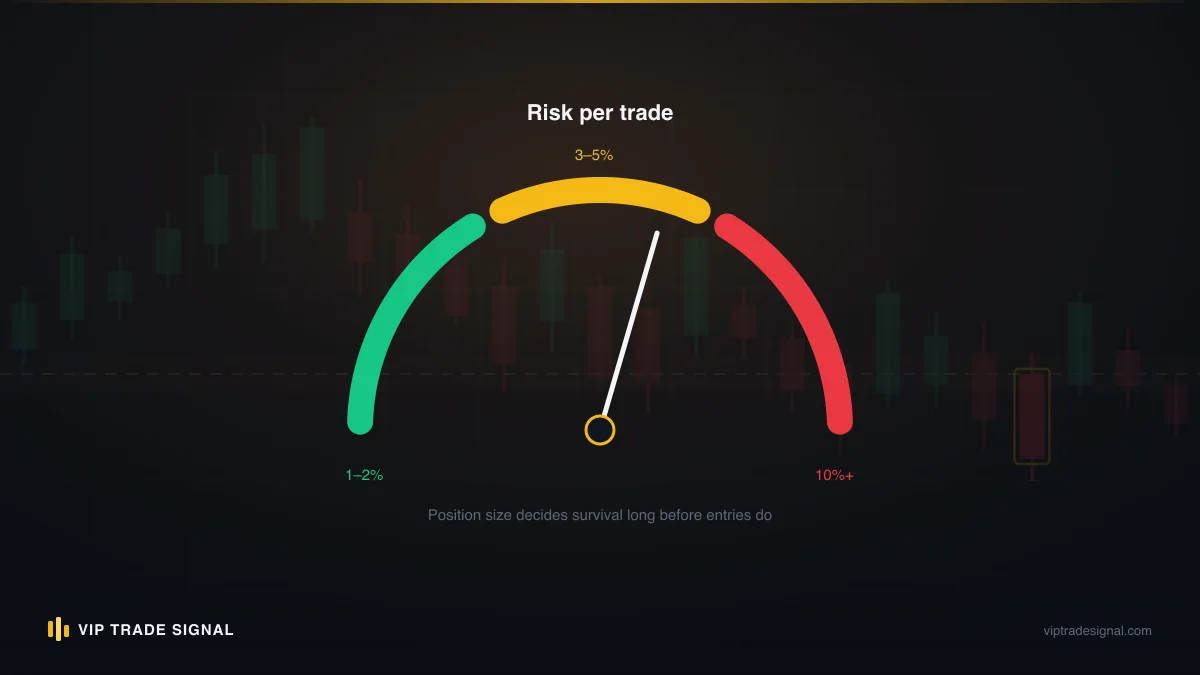
The first thing tilt reaches for is size. Not a new strategy, not a different market. Size, because size is the repair fantasy: big enough position, one trade, all fixed. So the third structural layer caps it in ways the hot version of you can't quietly undo.
Start with the maths of why this matters so much, because it's genuinely not intuitive. A $10,000 account that loses 30% in a tilt session needs a 43% gain to get back to flat. Lose 50% and you need 100%. Lose Dan's 68% and you need over 200%, which is years of good trading to repair one afternoon. Drawdown is asymmetric: the hole is always deeper than the fall that dug it. Every unit of size you add while tilted digs on both ends.
Practical ceilings that hold:
- A hard maximum lot size per trade, written into your plan, sized so that even a no-stop disaster gap costs a survivable amount. If your normal risk on gold is 0.10 lots per $10k, your ceiling might be 0.20. Enough headroom for a genuinely high-conviction planned trade, nowhere near enough to "make it all back", which is the only trade tilt wants.
- A maximum number of positions per day. Four or five, say. Revenge sessions are high-frequency; Dan fired six tickets in forty minutes against a normal pace of one or two a day. A trade-count cap catches the spiral by its rhythm even when each individual ticket looks moderate.
- Broker-level enforcement where possible. Some brokers let you cap maximum lot size on the account itself, changeable only via a support request that takes a day to process. That delay is the entire value. If you can set your ceiling somewhere that requires a cooling-off period to raise, do it. You've moved the decision to a calm future moment by construction.
- If someone else manages the account, size discipline comes built in. Part of what people are actually buying with managed trading is an operator with no emotional stake in the last trade. When we run a client's MT4/MT5 account, position sizing follows the plan because the person sizing the position isn't the person whose money just took the hit. And the client keeps the master password, so the structure cuts both ways.
One warning while we're on sizing: the tilted brain, denied extra size, sometimes reaches for hedging instead, opening an opposite position to "lock in" a loss rather than realise it. It feels like a clever escape and it's usually a slower, more expensive form of the same refusal to take the loss, with financing costs bleeding out daily; we've written about what those trapped hedge structures actually cost and how to unwind them. A ceiling on total open exposure, not just per-trade size, closes this door too.
The reset ritual after any big loss
Structure stops the spiral. It doesn't metabolise the loss, and an unmetabolised loss just waits for tomorrow. So you need a ritual for trading after a big loss, and it needs to be boring, repeatable, and completely independent of how you feel. Ours, refined over a lot of bad afternoons:
Step one: flat and away, immediately. All positions closed or properly stopped, platform shut, physically out of the room. Not "watching, just not trading". Watching is trading with the order step temporarily suspended. The state needs your absence to decay.
Step two: move your body for at least twenty minutes. Walk, gym, stairs, whatever. This is the legitimate core hiding inside all the breathing-exercise advice: adrenaline and cortisol are fuels, and the reliable way to clear fuel is to burn it. A hard walk does more for your next trading decision than an hour of chart study.
Step three: write the loss down before you re-open anything. Longhand, three questions. What was the plan? What actually happened? Was the loss inside the plan or outside it? This matters because it forces the distinction tilt destroys: a planned loss that hit its stop is a cost of business, already accounted for, requiring no response at all. Dan's $1,200 was exactly that. The writing makes your prefrontal cortex re-engage with the event as information rather than injury.
Step four: no trading until the next session at the earliest. After a limit-hitting day, the day is done. Sleep is the only reliable full reset for the stress machinery. If the loss was big enough to think about in the shower, take the whole next day too. The market runs five days a week, every week. It will still be there, and gold in particular will still be doing something dramatic; it always is.
Step five: re-entry at reduced size. First day back, half size, regardless of confidence. You're not punishing yourself; you're acknowledging that judgement recovers on a lag and buying cheap insurance against a second dip. Earn your way back to full size with a few planned trades that follow the plan. Winners or losers, doesn't matter. The metric is process, not P&L.
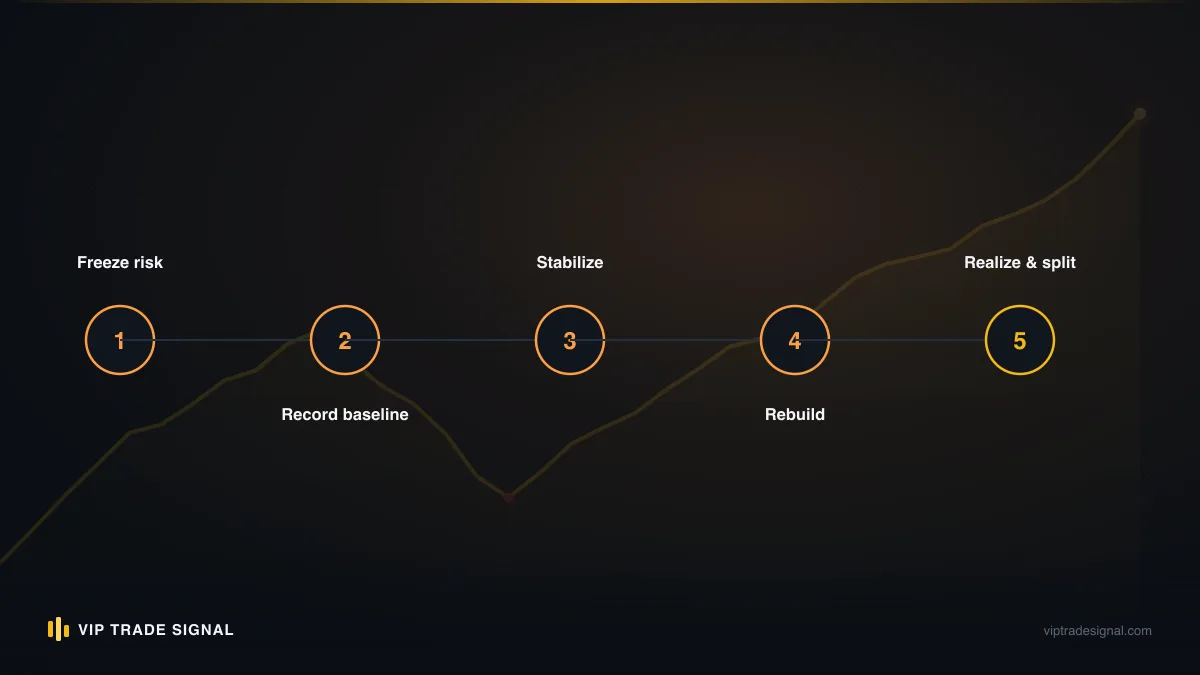
Write these five steps on an index card and put it where you trade. Not because you'll forget them, but because on the day you need them, you need to be able to obey without deciding. Deciding is the compromised function. The card decides.
Spotting tilt in yourself in real time
Everything above works better with early warning, and while you can't rely on catching tilt (that's why the structure exists) you can improve your odds. The state has tells. They're physical and behavioural before they're financial, and they're surprisingly consistent from trader to trader.
The physical tells arrive first. Jaw tension. Leaning towards the screen. Refreshing the P&L rather than the chart. This one is nearly diagnostic, because a calm trader watches price and a tilted trader watches pain. Talking to the market, out loud or in your head, in the second person: "come on", "don't you dare". The moment the market has become a you, an opponent with intentions, injustice-processing is running and analysis has stopped.
The behavioural tells follow within minutes:
- Checking a lower timeframe than you planned the trade on. You planned on the four-hour and you're now watching the one-minute. You've shortened your horizon to match your urgency.
- Reaching for the order ticket before you can state the setup in one sentence.
- The phrase "make back" occurring in your internal monologue. Planned trading tries to get paid for an edge. Revenge trading tries to un-happen a loss. The vocabulary genuinely differs, and "make back", "get it back", "repair" are the tells.
- Certainty spiking after a loss. Real conviction builds slowly from analysis; tilt-certainty appears instantly and feels cleaner than anything you felt before the loss. If you've never been more sure of a trade than in the ten minutes after a stop-out, that surety is a symptom.
What do you do when you catch one of these in yourself? Nothing clever. You don't negotiate with the state or try to trade "carefully" through it. You invoke the structure early. Treat two tells as a hit on the daily limit: flat, platform closed, walk. The whole value of catching tilt at minute three instead of minute fifteen is that the structure fires before the first revenge ticket, not after it.
A trick that helps more than it should: give the state a name. Poker players say "I'm tilting" out loud, and the naming itself does work. It converts a feeling you're inside into an object you're looking at. Some traders on our desk use a dafter version and refer to the tilted self in the third person, as in "that's Angry Dave's trade, and Angry Dave doesn't have order privileges". It sounds ridiculous. It also creates exactly the sliver of distance the moment needs, and ridiculous things you'll actually do beat elegant things you won't.
And do a periodic cold review of your own history, because tilt also shows up retrospectively in ways you can't see live. Trades with no stop. Clusters of tickets within minutes of a loser. Size spikes after red days. Pull your last ninety days of statements and look for those patterns the way you'd audit someone else's account. We run this as part of a broader trading account health check, and revenge clusters are among the most common findings in accounts whose owners swear they don't revenge trade.
Repairing the damage a revenge session left behind
Suppose the defences weren't there in time. You've had your forty minutes, or your bad fortnight, and the account is down 40%, 60%, more. What now?
First, the triage. Get flat or get every remaining position properly stopped, today. A surprising number of post-revenge accounts we see aren't flat; they're carrying the last desperate position, unstopped, floating further down, because closing it would make the loss real. Sometimes there's a hedge "locking" the damage in place, bleeding swap while its owner waits for a miracle. If that's you, the position is trapped, not managed, and there's a right way to unwind it that doesn't involve hoping. Realised losses stop moving. Unrealised ones keep the tilt machinery warm indefinitely.
Second, resist the recovery version of the same disease. The maths from the sizing section now works against you at scale: down 50%, you need 100% to get home, and the tilted-adjacent brain reads that as "I need to trade twice as big". The opposite is true. Deep drawdown demands smaller risk, longer timeframes, and a written recovery plan measured in months, because a second spiral from a half-sized account is how accounts actually die. The first revenge session wounds; the recovery-revenge session kills.
Third, decide honestly whether you should be the one doing the repairing. Some traders can rebuild their own account with discipline they've now, expensively, acquired. Plenty can't. Not because they lack skill, but because every chart now carries the memory of the hole, and trading your own drawdown is trading with maximum emotional load and minimum room for error. It's the worst possible seat. This is roughly why our drawdown management service exists: for accounts floating somewhere in the $5k–$10k-down range, we trade the recovery on the client's own account against a baseline both sides record at the start, and we charge a flat 50% of recovered profit above that line. Nothing upfront on the recovery itself, and, said plainly because this industry is allergic to saying it, no guarantees of any kind. Gold is a high-risk instrument; recoveries fail sometimes, and anyone who tells you otherwise is selling the fantasy that caused the hole. The honest pitch is narrower: an operator with no memory of your loss, working a plan, at a fee that only exists if the plan works. Whether that's worth half the recovered profit is a fair question with a different answer for different people. The FAQ covers the mechanics, including the part where you keep the master password and control of withdrawals throughout.
Fourth, whichever route you choose: install the structure from this article before the recovery starts, not after it succeeds. A repaired account with no daily limit, no lockout and no size ceiling is a hole waiting for its next forty minutes.
The comparison that should change how you spend your effort
Most traders allocate their improvement effort roughly like this: ninety per cent on entries (patterns, indicators, the next setup) and ten per cent, generously, on everything in this article. Run the numbers on your own account and the allocation is almost certainly backwards.
| Typical planned losing day | Typical revenge session | |
|---|---|---|
| Damage | 1–3% of equity | 15–70% of equity |
| Frequency | Weekly, forever — losses are normal | A few times a year, unmanaged |
| Recovery needed | Days | Months to years (a 50% loss needs +100%) |
| Prevented by | Better entries, partly | Structure, almost entirely |
| Effort traders spend on it | The vast majority | Almost none |
A trader with mediocre entries and airtight tilt structure survives indefinitely and improves. A trader with excellent entries and no structure is one unjust stop-out away from donating a year of edge in an afternoon. We'd take the first trader every time, and after enough years watching accounts, so would you.
Where this leaves you
Strip everything above to what you'd actually do this week and it's five items. None of them require talent. All of them require doing them now, while you're calm, because the version of you that needs them can't build them.
- Write your daily loss limit tonight. 2–3% of equity, plus a three-consecutive-losses breaker, and put the number where you trade, on paper.
- Install one real lockout. Equity-guardian EA, broker-level cut-off, or at minimum the twenty-minute rule with a physical timer. Something that acts without consulting you.
- Cap your size somewhere you can't quietly raise it. Broker-side if possible. Per-trade ceiling and a daily trade count.
- Put the five-step reset on a card. Flat, move, write, sleep, half-size. Obey it like a checklist, because that's what it is.
- Tell one human your limits. The cheapest enforcement technology ever invented.
And drop the shame while you're at it. Revenge trading isn't a verdict on your character; it's what a normal human nervous system does when a leveraged loss lands unjustly with the market still open. The traders who last aren't the ones who never feel the surge at 14:22. They're the ones who built the walls at 14:00 the previous month, so that when the surge came, it hit structure instead of an order ticket.
Dan, for what it's worth, rebuilt. Slowly, at half size, with a hard limit, a lockout EA, and his wife holding the "I broke it" message duty. Fourteen months on, the account is above where it started that afternoon. The forty minutes still happened. They just never happened again.