There is a particular kind of silence that settles over a trading account when it stops being an account and becomes a hostage situation. You know the one. You open the platform, look at the floating loss, close the platform. Maybe you check it again at midnight. Maybe you've stopped checking altogether, because the number hasn't been survivable for weeks and looking at it doesn't change it.
We see trapped positions every single week, because a chunk of our business is untangling them for other people. And here's the first thing worth saying: almost nobody gets trapped the same way twice, but almost everybody gets trapped in one of the same four ways. The underwater single trade held too long. The averaged-down stack that grew a second head. The locked hedge that froze the loss in amber. The grid that worked for eleven months and then met a trend.
Each of these is a different animal. Each one has different escape routes, different costs, and different ways of getting worse. Treating them all the same — which is what most "how to recover a losing trade" articles do — is like prescribing one medicine for four diseases. So this is a field guide. We'll identify each species, walk through the honest options for each, and put actual numbers on what escape costs. Some of those numbers will be uncomfortable. They're supposed to be.
What makes a position trapped rather than just losing
Every open trade spends some of its life in the red. That's not trapped. That's Tuesday.
A losing position becomes a trapped position when three things line up. First, the loss is large enough relative to your account that closing it feels like an amputation rather than a haircut. There's no precise threshold, but in practice the psychology shifts somewhere around 15–20% of equity. A $10,000 account floating $300 down closes the trade and moves on. The same account floating $2,500 down starts negotiating with the chart.
Second, your original reason for the trade is dead, and you're holding it anyway. The setup failed. The level broke. Whatever thesis got you in was invalidated three hundred pips ago, and the only thesis left is "it has to come back eventually." That sentence — it has to come back — is the national anthem of trapped traders. Gold doesn't have to do anything. Neither does EUR/USD. Markets have spent years not coming back to levels that felt inevitable at the time.
Third, and this is the defining one: the position has started dictating your decisions instead of the other way round. You're skipping valid new setups because margin is tied up. You're checking swap charges like a pensioner checking a heating bill. You've stopped thinking "what's the best use of this capital?" and started thinking "what does this position need from me today?"
When all three are true, you're not managing a trade anymore. You're serving one.
And the trap has teeth beyond the obvious floating number. There's the margin you can't deploy. The swap bleeding out nightly on the wrong side of the carry — on a large short gold position that can be genuinely painful money, month after month. There's the opportunity cost of every clean setup you watched sail past. And there's the slow corrosion of your judgement, because a trader staring at a five-figure floating loss does not evaluate new information objectively. Nobody does. If you want the deeper mechanics of how floating losses interact with equity and margin, we've covered that ground in what drawdown actually is and how it compounds — it's worth reading alongside this piece.
The four species of trapped position
After enough rescue conversations, patterns stop being anecdotes and start being taxonomy. Here's ours.
| Species | How it forms | Typical floating loss | Main danger |
|---|---|---|---|
| The underwater single | One trade, no stop, held through invalidation | 10–30% of equity | Slow bleed, swap, paralysis |
| The averaged stack | Adding to a loser "to improve the average" | 25–60% of equity | One more leg from margin call |
| The locked hedge | Opening an equal opposite position to freeze the loss | Frozen, often 30%+ | Permanent limbo, double swap |
| The broken grid | Grid/martingale EA meets a strong trend | 40–90% of equity | Sudden death by stop-out |
The species matter because they fail differently. An underwater single dies slowly and gives you time. An averaged stack dies suddenly, because your margin math changed with every leg you added. A locked hedge doesn't die at all — it just costs you rent forever. And a broken grid is usually discovered late, because the EA was quietly "handling it" until the moment it very much wasn't.
They also matter because the escape routes differ. Partial closing, which is sensible surgery on a stack, is nearly meaningless on a single. Unhedging, the central problem of the locked pair, doesn't apply anywhere else. So identify your species first. Everything after that is species-specific medicine.
One more honest note before we go through them: every escape route below involves either realising a loss, accepting risk, or both. There is no fifth option where the loss quietly evaporates and nobody has to feel anything. If someone sells you that option, they're selling the feeling, not the outcome.
Type 1: the deep underwater single trade
The classic. One position, opened with conviction, no stop loss or a stop that got moved "just this once," now sitting 400, 800, sometimes 2,000 pips against you. In gold terms: you shorted at 3,150 because it "couldn't go higher," and it's 3,380. You've done nothing since except hold and hope.
Say the numbers out loud, because trapped traders never do. A 1-lot XAU/USD short from 3,150 with price at 3,380 is $23,000 underwater. Even at 0.10 lots that's $2,300 — on the $5,000 account this trade typically lives in, that's 46% of equity, floating, plus short-side swap ticking away every night it's held.
Your options, honestly priced:
Close it. The cleanest and the most psychologically expensive. You convert a floating number into a realised one, and the account balance finally tells the truth. What you buy with that pain: your margin back, your attention back, and a decision-making brain that isn't hostage to one chart. Most traders who finally close a long-held loser describe relief, not regret. The regret came earlier and stayed the whole time.
Close part of it. Half out now, half with a hard stop. You realise half the loss, halve the nightly swap, halve the sensitivity to further damage, and keep some exposure in case the recovery you believe in actually shows up. This is the compromise we suggest most often for singles, because it works with human psychology instead of against it. Committing to half is achievable. Committing to all, for someone who's held six weeks, often isn't.
Hold with a real stop. Legitimate only if you can pass one test: would you open this exact position today, at this price, at this size, with fresh money? If genuinely yes, then define the invalidation level, place the stop, and accept that it may be hit. If no — and it's almost always no — then "holding" is just refusing to decide, with interest charged nightly.
Hold naked and hope. The default choice, and the worst one. It costs swap, margin, and months of your trading life, and its downside is unbounded. We've talked with traders who held a single underwater position for over a year. The market did eventually come back, in one case. The trader, honestly, didn't — the habit outlived the trade.
The underwater single is the most survivable species. It's one decision away from being over. That's exactly why it lasts so long: one decision is one more than a trapped trader wants to make.
Type 2: the averaged-down stack
This one starts as a rescue attempt and becomes the thing needing rescue. The first trade goes offside, so you add a second at a better price to improve your average entry. Reasonable, on paper. Then price keeps going, so there's a third. A fourth. By the time we usually see these accounts there are five to nine positions, all the same direction, opened at increasingly desperate intervals, with a combined size four or five times the original trade.
The arithmetic that got you here is seductive and worth spelling out. Short 0.10 lots of gold at 3,200, price rises to 3,240, add 0.10 at 3,240 — now your break-even is 3,220 instead of 3,200. Price only has to fall 20 dollars, not 40. Feels like progress. But notice what you actually did: you doubled your exposure to buy a smaller retracement target. Do it three more times and your break-even looks tantalisingly close while your position size has quintupled — which means the next $30 move against you does five times the damage of the first one. You've built a machine that converts small adverse moves into large ones, and you built it voluntarily, one hopeful click at a time.
Stacks are the species most likely to die suddenly. The margin consumed by each leg raises your margin level's sensitivity, and stop-out — the broker force-closing you at the worst prices of the entire episode — arrives not gradually but all at once. If the stack is on gold, there's an extra hazard singles don't face as sharply: weekend gaps. A stack that survives Friday can be executed Sunday night, and we've written before about why gold's weekend gap risk deserves more respect than it gets.
Escape options, in the order we'd actually consider them:
- Stop adding. Immediately and absolutely. The stack's defining sin is the next leg. Remove the possibility. Delete the pending orders. Turn off the EA if one is running the averaging.
- Close the worst legs first. The positions furthest from market are doing the most damage per lot and often carrying the most accumulated swap. Realising the two ugliest legs might convert, say, a 45% floating drawdown into a 25% realised-plus-floating situation that has actual breathing room. Surgery, not amputation.
- Set a stack-wide stop. Treat the whole basket as one position with one invalidation point. If price reaches the level where your account health becomes unrecoverable, everything closes. Decide that level now, calmly, not later, during the spike.
- Work the exits on strength. If the market gives you a retracement, close into it — worst legs first — rather than waiting for full break-even. Traders hold stacks for the day everything closes flat. That day usually doesn't come before the margin call does.
The cruellest thing about a stack is that it punishes patience. Every day you wait to act, swap accrues on every leg, and the size means volatility hurts more. Singles reward deliberation. Stacks punish it.
Type 3: the locked hedge
Somewhere around the fourth week of an underwater position, a trader discovers what feels like a cheat code: open an equal position in the opposite direction. Short 1 lot from 3,200, long 1 lot at 3,350, and suddenly the pain stops. Price can go anywhere and your floating loss doesn't move. It's frozen at $15,000, forever, like a fly in amber. The relief is real and immediate.
The trap is that you haven't reduced the loss by one dollar. You've spent money to stop feeling it.
Run the true cost. A locked 1-lot gold hedge pays swap on both sides — and since swaps are structured to favour the broker, both sides net negative more often than not. Call it a few dollars a night per lot, both directions: comfortably over $100 a month on a 1-lot lock, every month, for the privilege of an unchanged loss. Add the margin both positions consume (some brokers offer reduced hedged margin, many don't), and the capital is as imprisoned as before, just quieter about it.
But the swap isn't even the expensive part. The expensive part is the exit problem, because a locked hedge has no natural ending. To actually recover, you must eventually unlock — close one side and let the other run — and unlocking is a directional trade with all the difficulty of any directional trade, plus a bonus: if you unlock the wrong side, the frozen loss starts growing again, and it grows from a worse starting point than you froze it at. Traders who couldn't pick direction well enough to avoid the original trap are now required to pick direction twice, under pressure, to escape it. That's the machine's cruellest gear.
What we'd honestly tell a friend holding a locked hedge:
- Admit what it is. A locked hedge is a realised loss you're paying rent on to avoid booking. The moment that sentence lands, the right move usually becomes obvious.
- In most cases: close both sides. Book the loss, stop the swap, free the margin, and start recovering with a clear head and full capital. Yes, it stings. It stung the whole time; you'd just soundproofed the room.
- If you genuinely have a directional read: unlock deliberately. Close the side that's against your read, put a hard stop on the survivor, and size the risk as if it were a brand-new trade — because it is one. No read? Then you're unlocking on a coin flip, and coin flips are how the original hole got dug.
- Never "manage" the lock by trading around it. Adding and removing partial hedges around a core lock is how a two-position problem becomes a nine-position problem. We've untangled those. They take weeks.
Locked hedges are the only species that can technically last forever, which is exactly why they're so dangerous. Nothing forces the decision. The account just pays rent, indefinitely, on a loss that was real from the day it was frozen.
Type 4: the grid or basket gone wrong
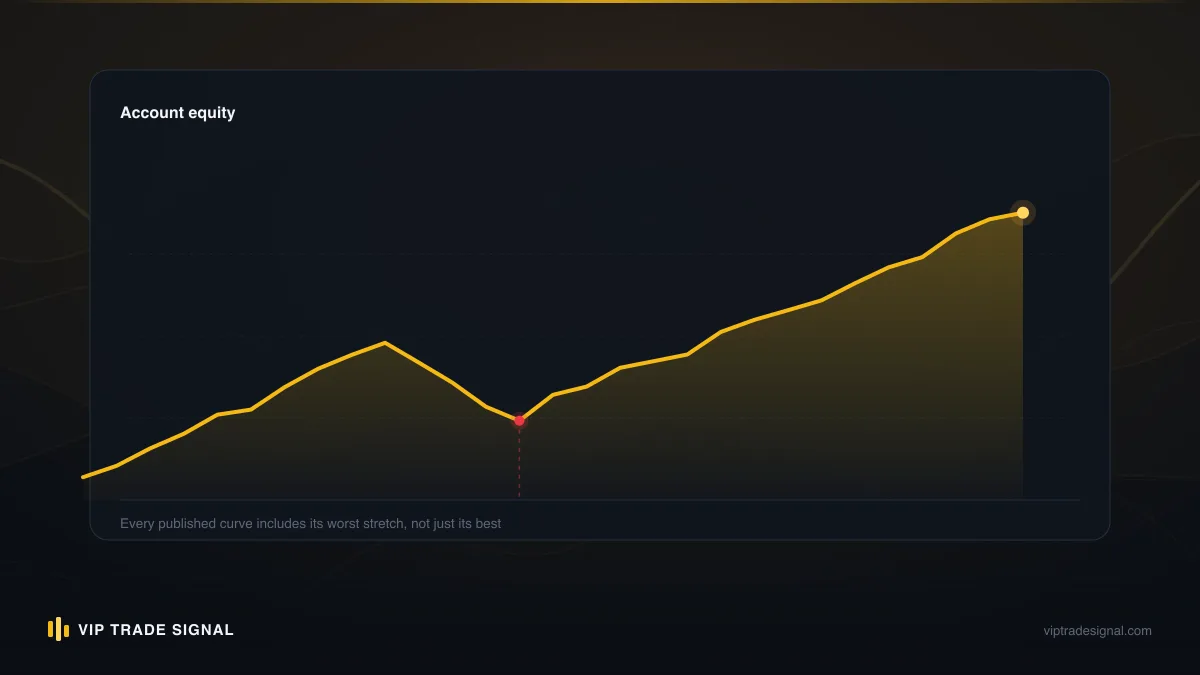
The fourth species arrives wearing the nicest clothes. Grid and martingale EAs produce beautiful equity curves — smooth, steady, upward — for months. Sometimes years. The curve is smooth because the system harvests small profits constantly while quietly warehousing risk in an ever-growing basket of open positions, waiting for the mean reversion that has always come before.
Then gold trends $250 in nine days without a meaningful pullback, and the warehouse door swings open.
By the time the owner of a broken grid contacts anyone, the situation has a recognisable shape: fifteen to forty open positions on one side of the market, sizes stepping up in a geometric ladder, floating loss somewhere between 40% and 90% of equity, and an EA that is either still adding legs or has hit its own limits and simply stopped, leaving the basket orphaned. The trader often can't say precisely what the EA's rules are. They bought the curve, not the mechanism.
Broken grids are the hardest species to rescue, for three compounding reasons. The size is largest relative to the account. The margin situation is usually already critical, so there's no room to ride anything out. And the position structure is genuinely complex — forty positions with different entries, sizes, and swap accruals don't respond to a single decision the way one trade does.
The realistic playbook:
- Disable the EA first, before touching anything. An averaging robot will refill positions you close. We have genuinely seen a trader manually close legs for an hour while the EA re-opened them behind his back. Kill the machine, then operate.
- Screenshot and export everything. Every position, entry, size, swap. You need the full picture to make any structural decision, and if you later want outside help, this record is the starting point of every serious conversation.
- Triage by margin, not by hope. The first question isn't "how do I get back to break-even," it's "what must close today so that a normal bad day doesn't stop me out." Compute the price at which stop-out occurs. If it's within one ordinary session's range of the market, you are choosing which positions to close or the broker will choose for you, at spike prices, with no regard for your ladder.
- Reduce the far legs, keep the near ones. As with stacks: the legs deepest underwater are burning the most per lot. Realising them hurts most on paper and helps most in fact.
- Do not restart the EA "to trade it back." The system that dug the hole does not contain the shovel that fills it. It contains a bigger hole.
If there's one sentence to take from this section: a grid's smooth months were the payment schedule, and the blow-up is the invoice. The maths was always going to present it eventually. The only question was whether the account would be yours when it arrived.
The universal first step: stop adding risk
Four species, four playbooks — but there is exactly one instruction that applies to all of them, and it comes before everything else: stop making the position bigger. Stop averaging. Stop hedging. Stop letting robots add legs. Stop "one small trade on the side to earn back some losses." Freeze the risk profile of the account completely, today, before you've decided anything else.
This sounds too obvious to write down. It isn't. In our experience the majority of trapped accounts that die don't die from the original trap — they die from the rescue attempts. The stack was survivable until legs six and seven. The hedge was merely expensive until the trader started scalping around it. The account had margin room until the revenge trade took the last of it. Trapped traders don't usually drown in the water they fell into; they drown in their own thrashing.
There's a hard psychological reason this step needs stating. A trapped trader's brain is in loss-recovery mode, and loss-recovery mode is measurably risk-hungry — this is the same wiring that makes a losing poker player raise the stakes at 3 a.m. Every instinct says do something, and "something" almost always means adding exposure, because adding exposure feels like fighting back while closing feels like surrender. The instinct is precisely backwards. In a trapped account, doing nothing new is the aggressive move. It's the one that keeps your options alive.
So before any escape route, run the freeze:
- No new positions in the trapped instrument. None. Not even "obvious" ones.
- All EAs off, all pending orders deleted.
- No withdrawals of the remaining free margin to "protect it" — that raises the leverage of what remains and can pull stop-out closer.
- Write down current equity, floating P/L, margin level, and nightly swap. That page of numbers is your baseline; every escape decision gets measured against it.
Only when the situation has stopped moving do you get to choose how to leave it. You can't navigate out of a hole you're still digging.
Escape options ranked by cost and risk
Across all four species, the escape routes reduce to six basic moves. Here they are, ranked from lowest to highest risk — with the honest cost of each, because every one of them has a cost, and the ones that hide it are the ones that hurt most.
| Escape route | Realised cost now | Ongoing cost | Risk of making it worse | Best suited to |
|---|---|---|---|---|
| Close everything | Full loss booked | None | None — it's over | Any species when thesis is dead |
| Close partially | Part of loss booked | Reduced swap/margin | Low | Stacks, grids, large singles |
| Hold with hard stop | None yet | Swap continues | Capped by the stop | Singles with a live thesis |
| Unlock a hedge | None yet | One-sided swap | Moderate — direction risk | Locked hedges, with a read |
| Work exits on strength | Staged | Falling over time | Moderate — needs discipline | Stacks and grids |
| Hold and hope | None yet | Swap, margin, sanity | Unbounded | Nothing. Ever. |
A few things this table understates.
"Close everything" looks brutal and is usually the cheapest line on the board once you price the alternatives properly. The loss is identical to the floating one you already have — closing doesn't create the loss, it stops pretending. What you gain is everything else: margin, swap, attention, and the ability to compound from a truthful base. A $10,000 account that books a $3,000 loss and then earns a modest 3% a month on the remaining $7,000 is back above water in about 13 months. The same account holding the loss and paying $80 a month in swap while too paralysed to trade is going nowhere in the same 13 months, except slowly backwards.
"Hold and hope" looks free and is the most expensive row on the table. Its cost is just invoiced later, with compounding.
And notice what's not on the table: doubling down, recovery martingale, "one big trade to fix it." Those aren't escape routes. They're the same trap with fresh paint.
The math you must run before any escape
Feelings got the account into the trap. Only arithmetic gets it out. Before executing any route above, sit down — actually sit down, spreadsheet open, platform open — and compute five numbers.
One: true equity. Balance plus floating P/L. This is what you actually have, and it is the only honest starting point. Traders quote their balance because it's the bigger number. The market doesn't care which number you prefer.
Two: the stop-out price. At what price does the broker close you? Ask support if you can't compute it — margin call at 100% and stop-out at 20–50% of margin level are common, but brokers differ. Then compare that price to the market's ordinary daily range. Gold routinely moves $30–$50 in a session and considerably more on data days. If your stop-out sits $60 away, you don't have a long-term holding decision to make. You have an emergency.
Three: the monthly carry. Total nightly swap across every open position, times thirty. Write down the actual figure. A locked 2-lot gold hedge can quietly cost more per month than a Netflix-and-groceries budget, and traders who would never pay that as a subscription pay it for years as a swap because it drips instead of billing.
Four: the honest recovery requirement. This is the one that changes minds. The percentage maths of drawdown is brutally asymmetric: down 20% needs +25% to recover, down 40% needs +67%, down 60% needs +150%. Now put a time frame on it. If a disciplined trader can realistically make 3–5% a month — and sustained double digits is fantasy-land for most — then a 50% hole is a two-to-three-year project even done well. Not a bad month. A project. Price your escape options against that timeline, not against the fantasy of next week's reversal.
Five: the re-entry test. For whatever you're considering holding: with this position closed and the cash in hand, would you open it right now at this price and size? It's the same question from the singles section because it's the master question. Every day you hold is a day you chose this trade over every alternative use of the money. Most trapped positions fail this test instantly, and everything after that is grief management, not analysis.
If running these numbers leaves you unable to face the account for a few days — that's information too, and worth taking seriously. We've written about when stepping away from the screens entirely is the correct trade, and there are moments in a rescue where it is.
When professional help beats DIY
Most trapped positions should be resolved by their owner. That's not modesty, it's maths: on a $2,000 account floating $500 down, any professional involvement costs more than it saves, and the lesson of closing your own bad trade is worth more than the money anyway. Take the freeze step, run the five numbers, pick a route, execute. Done.
But there's a tier where DIY reliably fails, and we'd be lying — profitably lying, but lying — if we pretended the line doesn't exist. Consider outside help when several of these are true at once:
- The floating loss is in the thousands — the zone where the account is badly hurt but very much worth saving, which in our experience is where the worst decisions get made.
- The structure is complex: multi-leg stacks, partial hedges around a core position, an orphaned grid with dozens of legs. Untangling these well requires margin arithmetic and sequencing that most retail traders have never had to do.
- You've noticed your own judgement failing. You've moved a stop twice. You've averaged in "one last time" more than once. The observer and the patient are the same person, and the patient is getting worse.
- Stop-out is within normal-volatility range, so the cost of a wrong move is no longer a worse hole but the end of the account.
What should professional help actually look like? A few non-negotiables, whoever you talk to. Payment tied to recovered results, not upfront fees — anyone charging large sums before doing anything has your money either way, which tells you what business they're really in. You keep control of the account: master password, withdrawal rights, all of it. No recovery guarantees, because honest operators know markets don't offer any, and a guarantee on the letterhead is the loudest possible warning about everything else on it. And full transparency on method — if they won't explain what they'd actually do with your basket, they don't know, or you wouldn't like the answer.
The recovery-scam industry deserves its own mention here, because it feeds specifically on trapped traders. If someone contacts you — you didn't contact them — promising to recover your losses, that is the scam's opening line, close to word-for-word, every time. Trapped and desperate is precisely the state these operations screen for. Be less reachable than usual, not more.
What we do differently on rescue accounts
Since we've spent four thousand words telling you what everyone else gets wrong, fairness says we put our own model on the table so you can judge it by the same standards.
Our drawdown management service exists for one specific situation: accounts floating roughly $5,000 to $10,000 down — deep enough that the structural work matters, still shallow enough that recovery is a realistic project rather than a moonshot. We trade the recovery on your own MT4 or MT5 account. You keep the master password and full withdrawal rights the entire time; we work on a trade-only login. Before anything happens, we jointly record a baseline — the account's equity at the start — and our fee is a flat 50% of recovered profit above that line. No recovery, no fee. And no guarantees, ever, because gold is a high-risk market and anyone guaranteeing recovery in it is describing their marketing, not their method.
Is 50% of recovered profit a lot? Yes, and we'd rather say so plainly than let you discover it mid-conversation. It's at the high end of the industry because the minimums are low, everything is pay-as-you-go, and we only earn when the hole actually shrinks — which means the incentive structure is pointed the same direction as your account. Whether that trade-off suits your situation is a judgement only you can make, and it should be made slowly, with the five numbers from earlier in front of you. The FAQ covers the mechanics — logins, baselines, fee timing — in more detail than fits here.
What we will not do is also worth stating. We won't take an account where the honest first advice is "close everything and walk away" — that advice is free, and we give it out regularly. We won't run martingale to dig faster. And we won't quote a recovery date, because the market sets the pace and we've watched too many rescues take twice as long as anyone hoped. If you want to talk through a specific tangle first, contact us with the position export — the screenshots-and-numbers habit from the grid section is exactly what makes that conversation useful.
Where this leaves you
If you came to this article with a trapped position open right now, here's the short version of everything above, in the order it should happen.
Today: freeze. No new legs, no hedges, EAs off, pending orders deleted. Write down equity, floating loss, margin level, nightly swap.
This week: identify your species and run the five numbers — true equity, stop-out price, monthly carry, honest recovery timeline, and the re-entry test. Let the arithmetic argue with your hope. The arithmetic is usually right.
Then decide, deliberately, from the ranked table: full close, partial close, stopped hold, deliberate unlock, or staged exits. Anything but the unbounded row at the bottom.
And one question to sit with, because it's the one that separates traders who get trapped once from traders who make a career of it: what stop-loss decision, made at the very beginning, would have made this entire article irrelevant to you? Whatever the answer is — a hard stop, a size limit, a rule against averaging — that's not just the escape from this trap. That's the fence around the next one. The trade in front of you is one problem. The habit that built it is the real position you need to close.