A trader we'll call Priya passed a $100k prop challenge in March. Six weeks later her funded account was terminated. Not because she blew it up. Her account was up $3,100 at the moment the firm closed it.
Read that again, because it's the whole reason this article exists. She was in profit, on the account, on the day, and she was breached anyway. The clause that did it was four words long: "trailing maximum drawdown, intraday." She'd skimmed it, assumed it meant roughly what "drawdown limit" means everywhere else, and paid her fee. The rule chased her equity high-water mark up during a winning streak, parked itself $4,000 below her best open profit, and when a perfectly ordinary pullback retraced her floating gains, the floor was waiting.
The static vs trailing drawdown distinction is, in my view, the single most consequential line in any prop firm's rulebook. More than the profit target, more than the split, more than the price of the challenge. And it is the line most people read least carefully. So let's fix that properly: what each rule actually is, how equity-based and balance-based versions differ, why end-of-day trailing and intraday trailing are almost different products, and (the useful bit) the same sequence of trades run through three rule sets side by side, so you can watch one account survive and another die on identical trading.
The two rule families, in plain terms
Every drawdown rule is an answer to one question: how far below some reference point is your account allowed to fall before the firm pulls the plug? The two families differ only in what that reference point does.
Static drawdown fixes the reference point at your starting balance and never moves it. Start a $100k account with a 10% static max drawdown and your floor is $90,000. Today, next month, after you've doubled the account: still $90,000. It is a line painted on the floor of the building.
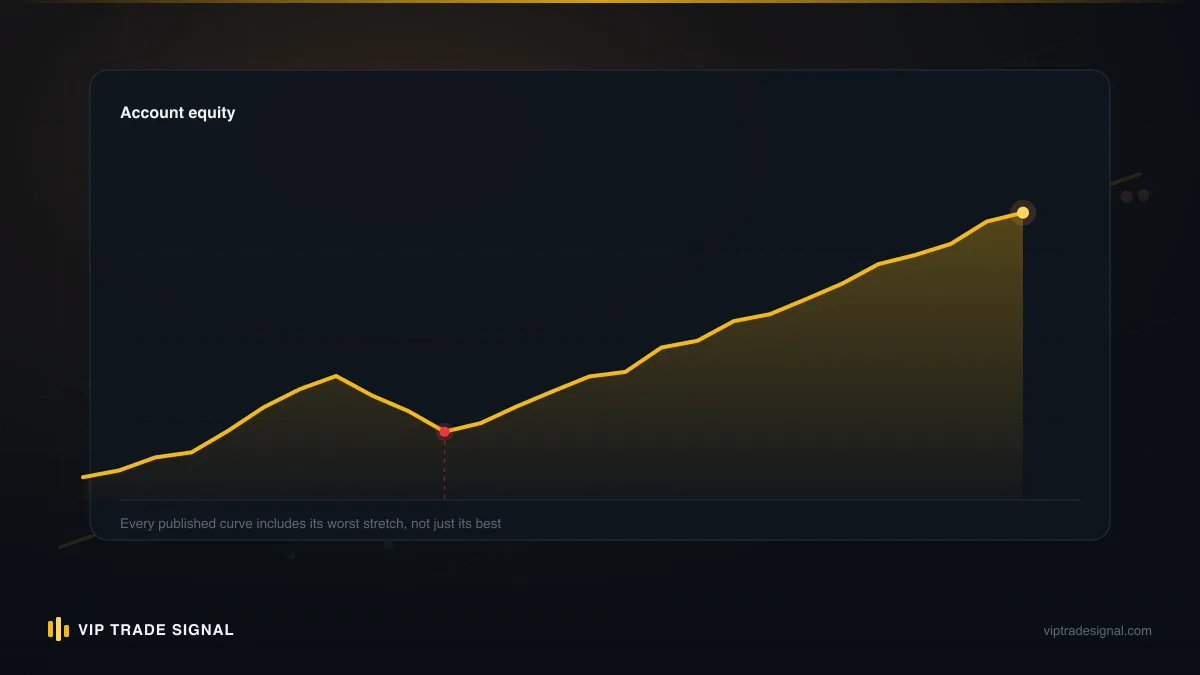
Trailing drawdown attaches the reference point to your high-water mark. The floor starts at the same place, $90,000 on that $100k account with a 10% limit, but every time your account reaches a new peak, the floor climbs to stay a fixed distance below it. Make $6,000 and the floor is now $96,000. Make another $5,000 and it's $101,000, which (notice) is above your starting balance. From that moment, ending up back where you began counts as a breach. The line isn't painted on the floor any more. It's tied to your ankle with a ten-foot rope, and it follows you up the stairs.
That's it. That's the entire structural difference. Everything else falls out of that one design choice plus two implementation details we'll get to: whether the high-water mark is measured on balance or equity, and whether it updates intraday or only at end of day. The horror stories, the "I was in profit and got breached" forum posts, the firms that quietly convert trailing to static at a certain profit level: all of it traces back to those three switches.
Before we go further, one honest note about who's writing this. We run a gold signal service and a drawdown-management desk, not a prop firm, so we have no challenge fees to sell you. What we do have is a steady stream of people arriving at our drawdown management service after a funded account went wrong, and a disproportionate number of those stories start with a trailing rule that wasn't understood. Consider this piece the conversation we'd rather have with you before that happens.
Static drawdown: the fixed floor
Static is the rule your intuition already believes in, which is exactly why trailing catches people out. They assume static and get trailing.
Under a static rule, the maths never changes. $100k account, 10% max drawdown: you can lose up to $10,000 from your starting balance, full stop. If you grow the account to $115,000, you now have $25,000 of room, because the floor stayed at $90,000 while you climbed. Your buffer expands as you win. Every dollar of profit you make is a dollar of extra cushion.
This has three practical consequences worth spelling out.
First, profits genuinely bank. Under static rules, being up is strictly safer than being flat. You can take a winning streak, then trade through a normal losing streak without your earlier success being weaponised against you. The account you built is the account you have.
Second, static rules tolerate normal strategy variance. Say you trade gold with a setup that risks 1% per trade and historically hits losing runs of five or six. On a $100k static account risking $1,000 a trade, a six-loss streak costs $6,000. Uncomfortable, survivable, and survivable again later, because any recovery rebuilds the same buffer. The rule and the strategy can coexist for years.
Third, and firms know this, static is expensive for the house. A trader who gets ahead on a static account becomes very hard to breach, and firms pay real payouts to traders who stay funded a long time. Which is why static drawdown is increasingly a premium feature: you'll see it on the dearer challenge tiers, on "swap" or instant-funding products with smaller drawdown percentages, or paired with tighter daily loss limits that do some of the same containment work. Nothing sinister about that; it's just pricing. A 6% static limit is routinely kinder than a 10% trailing one, and the sticker percentages will tempt you to conclude the opposite.
If a firm offers you static drawdown at a sane percentage with rules you can read in one sitting, that is worth paying more for. I'd take an 8% static over a 12% trailing every single time, and I don't think it's close.
Trailing drawdown: the floor that follows you up
Now tie the rope to your ankle.
A trailing rule keeps the floor a fixed distance below the highest point your account has reached. Usually that distance is a fixed dollar amount, sometimes a percentage, but it never grows. Only the floor moves, and it only moves up. Three properties follow, and each one is the opposite of the static case.
Your buffer never expands. On a $100k account with $10,000 trailing drawdown, you have $10,000 of room on day one and you will never have more than $10,000 of room, no matter how much you make. Winning doesn't build cushion. It relocates the cliff edge so that it's always the same distance behind you.
Profits don't fully bank until you withdraw them. Grow the account to $108,000 and your floor sits at $98,000. Give back $10,000 (a 9.3% pullback from the peak, the kind of retracement every strategy on earth produces eventually) and you're breached, despite never having been below your starting balance by more than $2,000. Under a static rule the same sequence leaves you comfortably alive with $8,000 of room to spare. Same trades. Same trader. One account terminated.
Your best trading raises your risk of ruin. This is the perverse one. A sharp winning streak under a trailing rule drags the floor up fast, and if that streak came from a hot market rather than a genuine edge (most streaks do), the mean-reversion that follows meets a floor that's now pressed right up behind your heels. Traders describe the feeling accurately: the better you do, the closer the rule breathes on your neck.
None of this makes trailing drawdown a scam. It's a legitimate risk-containment tool, and from the firm's side the logic is straightforward: they're limiting how much open risk any account represents at its richest point, and they're filtering for traders who take profits and withdraw rather than letting equity balloon and crash. Some very reputable firms use trailing rules, particularly in futures funding where the model originated. But "legitimate" and "well understood by the people paying for it" are different claims. The second one fails constantly.
The phrase to burn into memory is this: under trailing drawdown, the relevant number is never your profit. It's your distance above the current floor. Traders breach because they track the first number while the firm tracks the second.
Balance-based vs equity-based: the quiet detail that decides everything
Here's where the fine print gets genuinely nasty, and where equity based drawdown vs balance based stops being jargon and starts being money.
The trailing floor follows your high-water mark. But the high-water mark of what? Two answers exist:
- Balance-based trailing: the mark updates only when profit is realised. Closed trades move it; open floating profit doesn't.
- Equity-based trailing: the mark updates on your account equity, which includes floating profit on open positions. Your unrealised gains move the floor.
The difference sounds academic. It is not. Under an equity-based intraday trailing rule, a trade you never closed can breach you.
Walk through it slowly. You're long gold from 3,320 on a $100k account with a $5,000 equity-based intraday trailing drawdown. The trade runs beautifully. Price pushes to 3,352 and your floating profit peaks at $6,400. You haven't closed anything; you're waiting for your target at 3,360, like your plan says. But the firm's server saw your equity touch $106,400, so the floor is now $101,400.
Gold does what gold does: a sharp $30 retrace on a headline, your floating profit evaporates back toward zero, equity dips through $101,400. Breach. The position gets force-closed, the account is done, and your trade, incidentally, would have recovered and hit target two sessions later. You never realised a loss. You never even realised the profit that killed you. The floor was raised by money you never had in hand and enforced against a dip you'd planned to sit through.
Balance-based trailing removes exactly this failure mode. If the mark only moves on closed profit, floating excursions can't drag the floor up behind you mid-trade, and the rule becomes something a swing trader can actually live with. Between two firms with otherwise identical numbers, the balance-based one is materially, not marginally, the safer product.
So when a firm's marketing page says "trailing drawdown: $5,000," that phrase is unfinished. You need the next clause. Balance or equity? Realised or unrealised? If the FAQ doesn't say, email support and get it in writing before you pay, not after. We keep a running list of exactly these ask-before-you-pay questions on our own FAQ because the pattern repeats across every service in this industry, ours included: the headline number is never the rule. The definition under the number is the rule.
EOD vs intraday trailing: a critical distinction
The second implementation detail is when the high-water mark updates, and eod vs intraday trailing is the difference between a rule you can plan around and a rule that ambushes you.
Intraday trailing updates the mark continuously, tick by tick. Every momentary equity peak permanently raises your floor, including the top of a spike that lasted ninety seconds during a news release. This is the version in Priya's story and the gold example above. It's the harshest form in common use, and it interacts brutally with a spiky instrument like XAU/USD, where $15 whips through a position are furniture, not events.
End-of-day (EOD) trailing samples once, at the daily close. (Whatever timestamp the firm defines, usually 5pm New York, but check.) Only your end-of-day balance or equity can set a new high-water mark. Whatever your account touched intraday is invisible to the rule.
Why does that change everything? Because EOD trailing gives you back a decision. If your equity spikes intraday, you have until the close to choose: bank some of it, flatten, or accept that holding it into the close will ratchet the floor tomorrow. The rule becomes something you manage. Intraday trailing offers no such choice. The ratchet already happened, at the top of the spike, whether you were at your desk or asleep in a different timezone. For anyone trading gold through the London/New York overlap and holding positions overnight, that's not a small distinction. That's the product.
A rough hierarchy of harshness, kindest first:
- Static: floor never moves.
- EOD balance-based trailing: floor moves only on realised profit, measured once a day.
- EOD equity-based trailing: daily close equity moves it; intraday spikes don't.
- Intraday balance-based trailing: any closed profit instantly ratchets the floor.
- Intraday equity-based trailing: every tick of floating profit ratchets the floor. The rope is short and someone keeps shortening it.
Two firms can both truthfully advertise "trailing drawdown" while sitting at opposite ends of that list. The word on the sales page tells you almost nothing. The definitions page tells you everything, which is presumably why it's never the sales page.
Same trades, three rules: static vs trailing drawdown in numbers
Enough theory. Let's run one trader through three rulebooks and watch what happens. Same $100k account, same $5,000/5% drawdown allowance, same ten trading days, same trades to the dollar. The only variable is the rule.
Our trader, call him Sam, trades gold, risks about $500 a trade, and has a decent fortnight with one bad patch in the middle. Realistic, unremarkable trading. Day 6 includes an open position that floats +$2,600 intraday before Sam closes it for +$800; that detail matters.
| Day | Day's P/L (realised) | Balance | Floor: static | Floor: EOD trailing | Floor: intraday equity trailing |
|---|---|---|---|---|---|
| 1 | +$900 | $100,900 | $95,000 | $95,900 | $95,900 |
| 2 | +$1,400 | $102,300 | $95,000 | $97,300 | $97,300 |
| 3 | −$500 | $101,800 | $95,000 | $97,300 | $97,300 |
| 4 | +$1,700 | $103,500 | $95,000 | $98,500 | $98,500 |
| 5 | −$500 | $103,000 | $95,000 | $98,500 | $98,500 |
| 6 | +$800 (floated +$2,600) | $103,800 | $95,000 | $98,800 | $100,600 |
| 7 | −$1,100 | $102,700 | $95,000 | $98,800 | $100,600 |
| 8 | −$1,300 | $101,400 | $95,000 | $98,800 | $100,600 |
| 9 | −$900 | $100,500 | $95,000 | $98,800 | BREACHED intraday |
| 10 | +$1,100 | $101,600 | $95,000 | $99,100 | — |
Look at day 6 first. Sam's position floats $2,600 into profit before he closes it for $800. Under the static rule and the EOD rule, only the closed $800 exists. Under intraday equity trailing, the server saw equity touch $106,400, so the floor jumped to $100,600. Six hundred dollars above the starting balance, off profit Sam never took.
Now the losing patch, days 7 to 9. Three losses totalling $3,300. A completely ordinary drawdown; any strategy that risks $500 a trade will produce worse runs than this every year of its life. Under static rules Sam ends day 9 at $100,500 with a floor at $95,000: $5,500 of room, no drama, and he's still above his starting balance. Under EOD trailing he's tighter, sitting $1,700 above a $98,800 floor, but alive, and day 10's win rebuilds a little breathing space.
Under intraday equity trailing, Sam is dead on day 9. His equity dips through $100,600 during the session while he's $500 up on the account overall. Breached in profit, on ordinary variance, by a floor set during a trade that closed green. Three rulebooks, identical trading: one comfortable, one tense, one terminated.
Sit with that table for a minute, because it's the entire argument of this article compressed into ten rows. Nothing about Sam's trading differed. The rule was the trade.
The floating-profit breach that shocks everyone
The day-6-to-day-9 mechanism deserves its own section, because it's the one that produces genuine disbelief. It's the forum post that starts "how is this even legal" and the support ticket that gets a polite quote of clause 4.3 in response.
Under an intraday equity-trailing rule, the most dangerous thing you can do is let a winner run without a plan to bank it — your best trade quietly builds the trap that your next normal pullback springs.
Here's why it shocks people. Every instinct we teach traders (and we teach it on our own desk too) says floating profit isn't yours until it's closed. Don't count it, don't spend it, don't let it change your risk. Correct instincts. But an intraday equity-trailing rule does count it. The firm's risk engine treats your unrealised peak as real for the purpose of raising the floor, and then treats the retrace from it as real for the purpose of breaching you. Your floating profit is simultaneously not-yours (you can't withdraw it) and yours (it moves the rule). Heads the rope shortens, tails you trip on it.
The scenarios that trigger it are painfully mundane:
- The news spike. A CPI print whips gold $25 in your favour and back in four minutes. You did nothing. Your floor is permanently higher.
- The overnight run. You hold a swing position through Asia; it peaks while you sleep, retraces by London open. You wake up with the same position, the same plan, and $1,800 less room.
- The scale-out that came too late. You planned to take partials at a level; price tagged it, rejected fast, and your equity round-tripped before your order filled. The peak still counted.
And the psychological aftermath is its own hazard. A trader breached while in profit doesn't process it as variance; they process it as theft, and the next challenge fee they pay is often spent angry. Angry is the worst state to trade from. It's the engine of every revenge-trading spiral we've ever watched, and prop challenges, with their sunk fees and reset buttons, feed that spiral like nothing else in retail trading. If a rule design reliably produces not just losses but fury, that's worth knowing before you sign, purely as risk management for your own head.
One more honest note: firms disclose all of this. It's in the terms, usually even in the FAQ. The problem is rarely concealment; it's that the phrase "trailing drawdown" sounds like it means one mild thing and can legally mean five escalating things. The disclosure is real. The comprehension isn't.
When trailing stops trailing: lock-in levels
Now for the redeeming feature, because trailing rules come with an off-ramp more traders should weight heavily when choosing a firm.
Many trailing rules don't trail forever. Common designs:
- Lock at breakeven. Once the floor has climbed to your starting balance, it stops. From then on the rule behaves like a static floor at $100k. You can no longer lose the firm's money, and the firm stops chasing you. This is the most common design and it fundamentally changes the endgame: survive the trailing phase and the account becomes, functionally, a static one.
- Lock at buffer. The floor stops some fixed distance above start. Say once you're up 5%, the floor parks at +2% and stays. Rarer, kinder.
- Stepped lock-ins. The floor climbs in discrete stages tied to profit milestones or completed payouts rather than tick by tick. A staircase instead of a rope, where each payout you take permanently banks a step.
- Never locks. The floor trails your high-water mark for the life of the account. Every drawdown you ever have, forever, is measured from your best-ever moment. Avoid these if you possibly can; they convert one bad month in year two into a termination, regardless of everything you built before it.
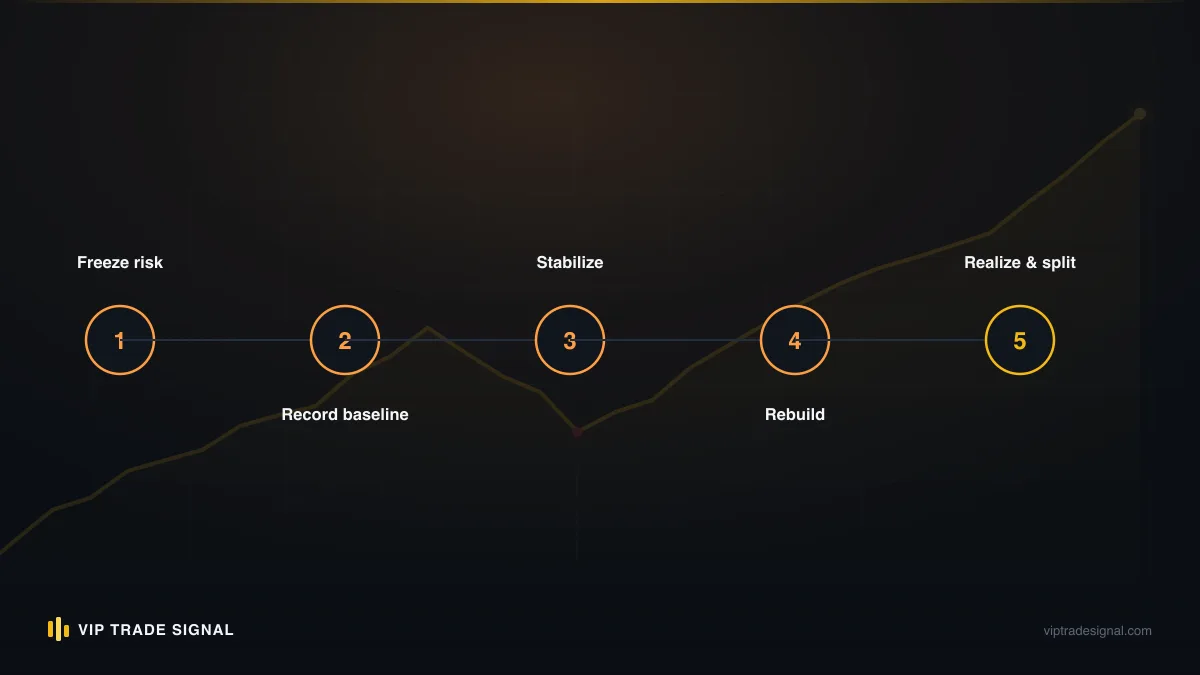
The strategic consequence of a breakeven lock is underrated: it makes the early life of a trailing account a sprint through a minefield, after which the ground goes solid. Your incentives in phase one are peculiar. Bank profit quickly, keep position sizes modest, get the floor to its lock, and then trade your normal strategy. Traders who treat a lock-at-breakeven account the same on day 2 and day 200 are playing one game by another game's rules. The firms' own payout data would show it, I suspect: most trailing-rule breaches happen before lock-in, in that stretch where the rope is still attached.
So when you compare firms, don't just ask "static or trailing?" Ask "where does the trailing stop?" A trailing rule that locks at breakeven after 5% profit is a different species from one that never locks, and both wear the same name on the pricing page.
Which rule suits which trading style
There's a version of this article that ends with "static good, trailing bad," and it would be mostly right and slightly lazy. The fair statement is that trailing rules tax specific behaviours, so the damage depends enormously on how you trade.
| Your style | Static | EOD trailing | Intraday equity trailing |
|---|---|---|---|
| Scalper, flat by end of session, quick partials | Fine | Fine: you realise profit fast, so the floor moves with money you actually banked | Tolerable: small floats mean small ratchets |
| Intraday momentum, lets winners run hours | Fine | Fine | Risky: big floats ratchet the floor before you bank |
| Swing trader, holds days, wide stops | Fine | Workable with planning around the daily close | Genuinely hostile: overnight peaks you never see will breach you |
| News/volatility trader on gold or indices | Fine | Workable | Close to unplayable: spikes ratchet, retraces breach |
| Grid/averaging styles with deep floating swings | The only survivable option | Poor | Do not bother |
A few honest observations from that grid. Scalpers lose the least under trailing rules, which is partly why trailing-rule firms are full of scalpers. The rule selects for the style, not the other way round. Swing traders should treat intraday equity trailing as a near-disqualifying feature and shop accordingly, even at a higher challenge price. And anyone running strategies with large floating excursions, such as hedged baskets, grids and averaging, should note that those styles carry enough hidden costs already (we've written about what swap charges do to hedged positions held for weeks) without adding a rule that measures precisely the thing the style maximises: unrealised swing.
Gold traders specifically, our patch, sit in an awkward spot. XAU/USD's daily range makes intraday equity peaks large and frequent, so trailing rules bite harder on gold than on a docile pair like EUR/CHF at identical account settings. If you're taking gold signals into a funded account with intraday trailing, your effective drawdown allowance is meaningfully smaller than the number on the tin, because a chunk of it will be consumed by floats you never banked. Size like it.
Sizing and profit-taking under trailing rules
Suppose you've weighed all this and you're going in on a trailing account anyway. Reasonable, since they're cheaper and everywhere. Then trade the rule, not just the market. The adjustments that actually matter:
Size off the floor, not the balance. Your real risk capital is your current equity minus the current floor, and under trailing rules that number does not grow when you win. On a $100k account showing $103,000 with a floor at $98,000, you do not have $103k of capital with 5% room; you have $5,000 of survivable loss, exactly as on day one. Risking 0.5% "of the account" is meaningless. Risk a fixed fraction of your distance-to-floor instead. Around 8-10% of it per trade is about as aggressive as I'd ever want, which on $5,000 of room means $400-$500 a trade and sitting through a five-loss streak without sweating the maths.
Bank in pieces, deliberately. Under balance-based trailing, realising profit moves the floor, so scaling out isn't just psychology; it's rule management, converting dangerous float into banked distance with each partial. Under equity-based trailing the calculus inverts on you: the float already moved the floor at its peak, so closing late banks less than the ratchet took. The answer there is to take profits earlier and more mechanically than your ego prefers. Fixed partials at 1R and 2R, trail the rest tight. Elegant exits are for static accounts.
Withdraw on schedule. A payout is the only profit a trailing rule can never claw into its calculation. Traders let five-figure sums sit in funded accounts as a scoreboard; under a trailing rule that scoreboard is raising the floor (or has already raised it) while adding nothing to your safety. Take the money out at every window. Every single one.
Respect the pre-lock phase. If your rule locks at breakeven, your only job until the lock is reaching it alive. Halve your normal size, skip the marginal setups, and treat news days on gold as spectator sport. It's a fortnight of boredom to buy an account that behaves like a static one forever after. Cheap.
Track your floor daily, in writing. Firms display it in the dashboard; almost nobody looks. Note the floor and your distance to it every morning next to your open risk, the same way you'd run any account health check. The breach that shocks is nearly always the one that was visible for a week in a dashboard nobody opened.
None of this makes a hostile rule friendly. It makes it survivable, which under trailing drawdown is the actual game.
Ten questions to ask a firm before paying for a challenge
Send these to support before your card comes out. Written answers, saved. Any firm annoyed by the questions has answered them.
- Is the maximum drawdown static or trailing? (Get the word in writing, not inferred from a diagram.)
- If trailing: is the high-water mark balance-based or equity-based? Does open floating profit move it?
- Does the mark update intraday or end-of-day? If EOD, at exactly what timestamp, on whose server clock?
- Does the trailing floor ever lock? At breakeven, at a buffer, or never?
- Do payouts reset or lower the floor, or does withdrawn profit still count in the high-water mark?
- Is the daily loss limit balance-based or equity-based, and does it interact with the trailing floor or sit separately?
- What happens at breach: instant automated closure of open positions, or a human review?
- Do weekend holds, news windows or high-spread periods carry separate rules that can trigger a breach independently?
- Does the drawdown rule change between challenge phase and funded phase? (Plenty of firms trail hard in the challenge, then soften or lock when funded, or the reverse. Check both.)
- Where is all of this in the written terms? Clause number, please.
Ten answers, one evening, and you'll know more about the product than most of the firm's paying customers. The fee for skipping this homework is a challenge fee, paid as many times as it takes.
Where this leaves you
The kinder rule, plainly, is static. It matches how profit-and-loss actually feels, it lets winning make you safer, and it never manufactures the grotesque outcome of a termination while in profit. If you can get static drawdown at a sane percentage from a firm whose terms you've actually read, pay the premium and sleep.
But "trailing is worse" isn't the takeaway that'll save you money, because trailing accounts are cheaper, common, and, for fast-banking intraday styles on rules that lock at breakeven, perfectly playable. The takeaway is that "trailing drawdown" is not one rule. Balance or equity, intraday or EOD, locking or perpetual: those three switches produce products so different they shouldn't share a name, and the gap between the mildest and harshest combination is the gap between Sam finishing the fortnight up $1,600 and Sam breached on day nine. Same trades. Read the switches, not the label.
And if you're reading this after the breach rather than before it, with a funded account gone or your own account sitting heavily underwater and your head not entirely level about it, slow down before you pay for the next reset in that state. Losses are part of this game at every level; we publish every one of ours, wins and losses alike, precisely because pretending otherwise is how this industry rots. For live accounts floating seriously down, our drawdown management desk works on recovered profit only, with no guarantees offered because none honestly exist. But whoever you work with, or if you work it alone: the first move after a rule-driven blow-up is understanding exactly which clause fired. It's usually four words long. Now you know what they mean.