The account is gone. Maybe it was $500, maybe it was $15,000. The number on the screen is either zero or close enough to zero that your broker's margin call email has stopped being hypothetical. You've closed the platform, opened it again, stared at the trade history, and closed it again. And somewhere in the back of your head a voice has already started up: right, how do I get this back?
That voice is the most dangerous thing in your trading life right now. More dangerous than the market, more dangerous than whatever setup or signal or moment of madness took the account down in the first place. Because if you want to know how to recover a blown forex account, the honest answer starts with an uncomfortable fact: most traders who blow one account blow a second one within a few months, and the second blow-up is almost always caused by the recovery attempt itself.
This piece is the slow route. Forensic review, small-capital rebuild, size increases you earn with process rather than profit. It is not exciting. It works far more often than the alternative, which is a fresh deposit and double the lot size, and I'll be blunt about the parts where "recovery" really means recovering the trader, not the balance.
Why "recover it fast" blows account number two
Sit with the arithmetic for a second, because it's brutal and most people never actually do it.
Say you had $5,000 and it's gone. You deposit another $2,000 (what's left of the war chest) and decide you're going to trade your way back to $7,000, restoring the original five plus the fresh two. That's a 250% return you're demanding from yourself. On a timeline of, what, a couple of months? Traders who make 250% in two months exist the way lottery winners exist: yes, technically, and it tells you nothing about your odds.
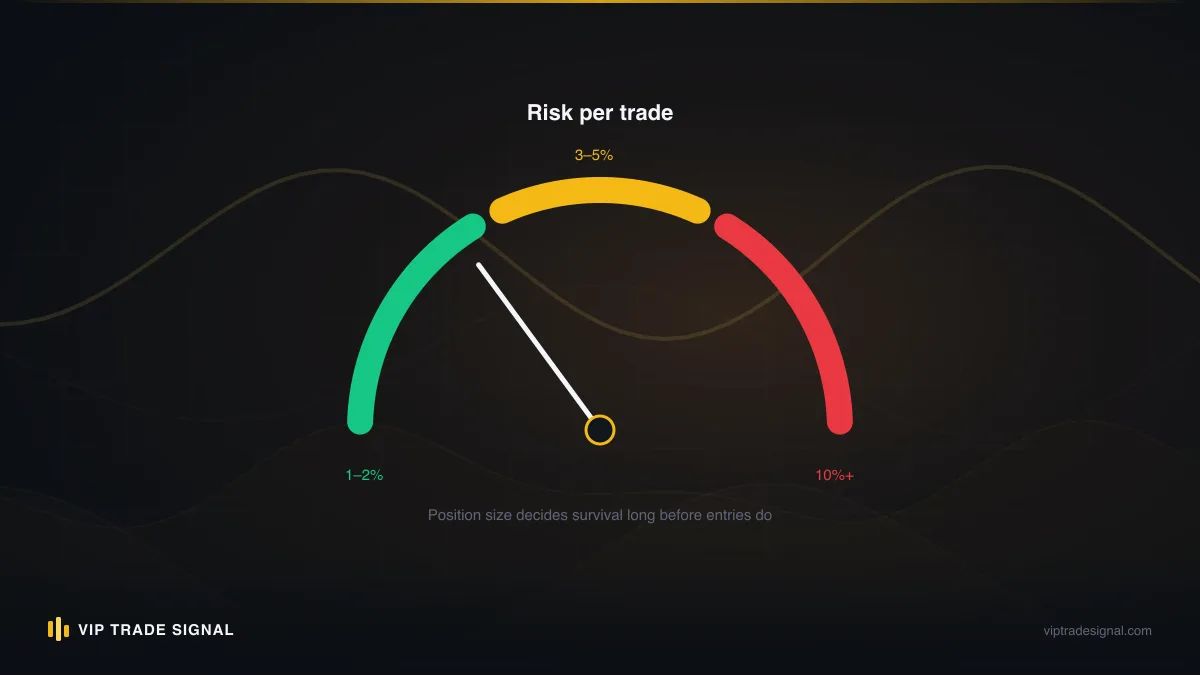
To chase that return on a $2,000 account you need size. Serious size. You'll be risking 5%, 8%, maybe 15% per trade, because 1% risk produces returns that feel insultingly slow when you're $5,000 in the hole. And at 10% risk per trade, a perfectly ordinary run of five losers, the kind every strategy on earth produces several times a year, takes 41% of the account. Two of those runs and you're writing the same forum post again.
There's a name for the maths underneath this: risk of ruin. We've written a full breakdown of how risk of ruin actually works, but the short version is that ruin probability doesn't climb gently as you raise risk per trade. It goes vertical. A trader with a genuine edge and 1% risk can be near-unkillable; the same trader at 10% risk is a coin flip away from zero, edge and all.
But the maths is only half of it. The other half is what the loss does to your head. A trader trying to win back $5,000 is not trading the chart in front of them. They're trading the hole. Every setup gets graded not on quality but on whether it could be the one that puts a real dent in the deficit. Stops get widened mid-trade because taking the loss means admitting the hole got deeper. Winners get closed at +$80 because green feels so unbearably good. It's revenge trading with a spreadsheet, and it has exactly one ending.
The market does not know you're down $5,000, and it will not price your trades any differently because you need them to win.
So rule zero of blown-account recovery: the deficit is not a target. Write the number down, grieve it properly, and then take it off the whiteboard. Everything that follows assumes you've done that.
Step 1: stop, withdraw what's left, and give it two weeks
If there's anything left in the account, $50 or $300 or whatever survived, withdraw it. Today. Not because you'll never trade again, but because a residual balance in a live account is a loaded temptation. At 11pm on a bad Tuesday, that $300 becomes "well, it's basically already lost, might as well try something." Get it out.
Then stop trading for a minimum of two weeks. Not "only take A+ setups". Not "just demo". Stop. Uninstall the mobile platform if you have to; the number of accounts finished off from a phone in bed is higher than anyone admits.
Two weeks does three things. It breaks the physiological loop: the cortisol-and-adrenaline cycle that a blow-up leaves running, which genuinely impairs decision-making for days afterwards. It creates distance, so that when you do the review in step two you can read your own trade history like an analyst instead of a defendant. And it proves something small but important to yourself: that you can not trade. A surprising number of people discover in those two weeks that they can't sit out even with no account, and that discovery matters more than any strategy tweak.
Use the fortnight for exactly one task: export everything. Full trade history from the broker, your journal if you kept one (be honest: most people's journal died three weeks before the account did), screenshots, the Telegram messages if signals were involved. Get it all into one folder. Don't analyse yet. Just collect.
And tell someone. A partner, a mate, a trading friend who won't gloat. Blown accounts thrive in secrecy; the shame of hiding a loss is a big part of what fuels the desperate attempt to fix it before anyone notices. Saying "I blew my account" out loud to one human takes about 60% of the poison out of it. That's not a soft-skills aside. It's load-bearing.
Step 2: the forensic review of what actually happened
Two weeks on, open the folder. You're not looking for the trade that killed the account. You're looking for the pattern that made the killing trade inevitable.
Here's the thing about blown accounts: almost none of them die from one bad idea. They die from a sequence, and the sequence is depressingly consistent. A losing streak within normal statistical bounds. A response to that streak, usually size increases or rule-breaking, that turned a drawdown into a crisis. Then one final session, often a single evening, where half the remaining equity went in a doubling-down spiral.
Work through your history and answer these in writing:
- What percentage of the account did the final week take? If it's more than half, your problem was never strategy. It was what you did under pressure.
- What was your average risk per trade in month one versus the final month? Nearly everyone finds it doubled or tripled. Find the date it changed and what happened that day.
- How many trades broke your own written rules? If you didn't have written rules, you've found finding number one.
- Were the killing trades in one instrument or session? A London-session gold trader who died in the Asian session on a pair they never trade wasn't trading. They were gambling in a costume.
- Did stop losses exist, and did they survive? A stop that gets moved isn't a stop. It's a decoration.
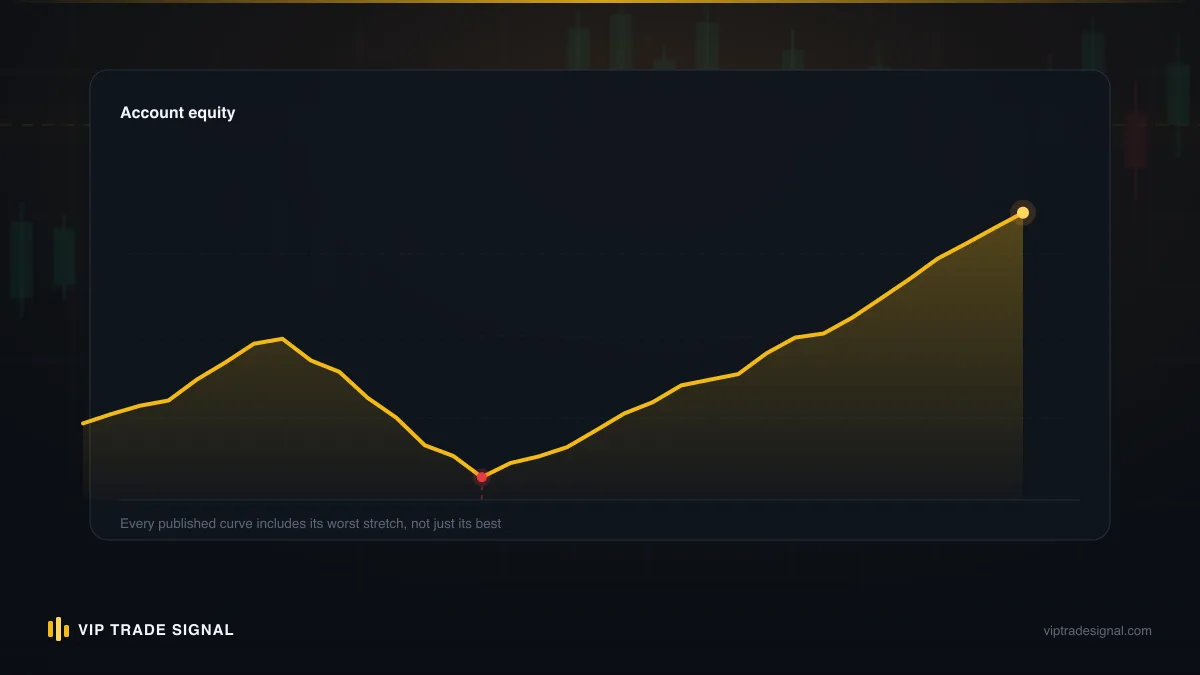
Plot your equity curve if the broker doesn't do it for you. The shape tells the story faster than any journal. A slow, grinding bleed from day one says the strategy never had an edge. That's actually the good news, because strategies can be replaced. A healthy or flat curve with a cliff at the end says the strategy was fine and the trader broke, which is harder to fix and more important to admit.
Then write a one-page post-mortem. Not a novel. One page: what happened, in what order, and the two or three specific failures that mattered. "I risked too much" is not specific. "On 14 March I doubled my lot size after four losses because I wanted the week back, and I did the same thing three more times before the end" is specific. You'll refer back to this page for the next year, so make it honest enough to sting.
A worked example, generic but true to a hundred real histories. A trader we'll call Sam opens a $4,000 account in January. Risk starts at 1%, roughly $40 a trade, and January and February are unremarkable: some red, some green, equity drifting between $3,700 and $4,300. Early March brings five losses in a row. Nothing statistically strange, but Sam has never sat through five straight and it feels personal. On 14 March the lot size doubles "just to get the week back". It works, once, which is the worst possible outcome, because now doubling is a tool. By April the average risk is 6%, the journal has stopped, and a single Thursday evening around a US inflation print takes the account from $2,900 to $600 in four trades, each one bigger than the last. The final trade, at 2am, risks the remaining balance entirely. Read that sequence again and notice where the account actually died. Not on the Thursday. On 14 March, when a normal losing streak got answered with size instead of patience. Your history will have its own 14 March. The forensic review exists to find it.
If you can't identify what went wrong, if the review genuinely reads like a run of bad luck at sensible risk, be suspicious of yourself first. True bad-luck blow-ups at 1% risk per trade are statistically rare almost to the point of nonexistence. Somewhere in that history is a decision. Keep looking.
Step 3: decide to rebuild, pause, or delegate
The post-mortem forces a fork in the road, and pretending it doesn't is how people drift back into trading by default rather than by decision.
Option one: rebuild yourself. The right call if your review found specific, fixable failures and (this part matters) you still actually want to trade. Not want to be rich. Want to trade: the analysis, the routine, the slow compounding. If what you wanted all along was the outcome and not the craft, a rebuild is just a slower way to lose the next deposit.
Option two: pause properly. Months, not weeks. The right call if the review revealed things beyond trading mechanics: you were trading money you couldn't lose, trading was tangled up with debt or family stress, or you recognise addiction-shaped behaviour in your history: hiding losses, borrowing to deposit, chasing with money earmarked for bills. There is no shame in this option and considerable wisdom. The market has been here for decades. It'll be here when you're solvent and steady, and if it turns out you never come back, that's a fine outcome too.
Option three: delegate the trading while you rebuild the trader. Some people conclude the analysis was never the weak point (the execution under pressure was) and would rather have experienced hands run the capital while they either learn from the sidelines or step back entirely. That's a legitimate choice, with real trade-offs around cost and control, and I'll cover what professional account management can and can't do honestly near the end, including why anyone promising to recover your losses on a guaranteed timeline should be blocked on sight.
Whichever you choose, choose it in writing, with a date. "I'll see how I feel" is how you end up funding account number two on a whim at midnight.
How to recover a blown forex account: the small-capital rebuild plan
Suppose you chose the rebuild. Here's the plan, and the first number will annoy you.
Fund the new account with an amount whose total loss would be genuinely painless. Not comfortable. Painless. For most people that's $300 to $1,000. I know. The deficit was $5,000 and you're restarting with $500. The 10x gap between the hole and the stake is precisely the point: it makes "trade my way back" arithmetically absurd, which frees you to trade the account in front of you instead of the ghost of the old one.
The rebuild account has one job, and it is not making money. Its job is generating evidence: proof, at live-money emotional stakes, that you can now do what you couldn't do before. The profit on a $500 account trading 0.01 lots is lunch money either way. The data is priceless.
Rules for the rebuild, written down before the first trade:
- Risk per trade: 0.5% to 1%. Hard cap. On $500 that's $2.50 to $5 per trade. Yes, really. The risk management fundamentals don't change because you're rebuilding; if anything they tighten.
- One market. Whatever you actually know. We're a gold desk so we'd say XAU/USD, but the honest rule is: the instrument from your history with the best discipline record, not the best P/L.
- One setup. A single, written, screenshot-able entry pattern. If you can't describe it to a friend in four sentences, it isn't a setup yet.
- A daily stop. Two losing trades or minus 2%, whichever comes first, and the platform closes for the day. This rule single-handedly prevents the evening death-spirals your post-mortem almost certainly contains.
- Journal every trade before and after. Thirty seconds each side. Planned entry, stop, target, and afterwards: did I follow the plan, yes or no. That yes/no column is the whole ballgame.
- No withdrawals, no deposits for the full stage. The account is a laboratory. Sealed.
Trade this way for a minimum of 40 trades or two months, whichever takes longer. Forty is not arbitrary; below that, results are mostly noise and you learn nothing about edge. Two months is not arbitrary either: habits rebuilt over three good weeks collapse in week five, and you need to see yourself survive at least one proper losing streak with the new rules intact.
Most rebuilds fail here, in the boredom. Week three, the trades are small, the process is working, and it feels like nothing is happening. That itch — this is pointless at this size, let's get serious — is the exact same impulse that blew the last account wearing a more respectable outfit. The size was never the problem. The itch was.
Size increases earned by process, not P/L
Here's where this plan differs from every "grow a small account" thread you've read: you never increase size because you made money. You increase size because you followed the process, and the promotion criteria are written down before stage one begins.
A sane staging structure looks like this:
| Stage | Capital | Risk/trade | Promotion requires | Minimum duration |
|---|---|---|---|---|
| 1 | $500 | 0.5% | 40+ trades, 90%+ plan-adherence, zero daily-stop breaches | 2 months |
| 2 | $1,000 | 0.75% | 40+ trades, 90%+ adherence, survived a 4+ trade losing streak by the book | 2 months |
| 3 | $2,500 | 1% | 60+ trades, adherence holding, max drawdown inside your written limit | 3 months |
| 4 | $5,000+ | 1% | Same metrics at full emotional stakes | Ongoing |
Notice what's missing from the promotion column: profit. A trader can be net negative over stage one (perfectly plausible with a thin edge over 40 trades) and still earn promotion, because the thing being tested is the trader, not the strategy's monthly return. Equally, a trader who doubled the account while breaking the daily stop twice gets demoted, not promoted. Profitable rule-breaking is the most corrosive result in trading; it pays you to rebuild the exact habit that blew the last account.
The plan-adherence number is your true equity curve during a rebuild. Track it weekly: trades taken to plan, divided by total trades. Below 90%, you don't touch size. Below 80% for two consecutive weeks, you drop a stage. Harsh? The market was harsher. This is the negotiated settlement.
And one demotion rule that matters more than all the promotion rules: any single day that breaches the daily stop sends you back a stage, no appeals. The blow-up wasn't caused by your average day. It was caused by your worst day, and the entire staging system exists to keep your worst day small.
Realistic timelines by damage level
Nobody selling you a course will give you this table, so here it is. Assume the staged plan above, a modest genuine edge, and honest adherence. The forex margin: "recovery" here means restored capital and restored process, because one without the other doesn't hold.
| What was lost | Realistic recovery horizon | The actual constraint |
|---|---|---|
| Under $1,000 | 3–6 months | Rebuilding habits; the money itself refills from savings faster than from trading |
| $1,000–$5,000 | 6–18 months | Patience through stages 1–3 without a discipline relapse |
| $5,000–$20,000 | 1–3 years, partly from income | No small account compounds this back quickly at sane risk; fresh capital from earnings does the heavy lifting |
| More than $20,000 | Years, or a decision that it's gone | Full recovery through trading alone is the wrong goal; capital preservation and slow rebuild is the right one |
The uncomfortable truth in rows three and four: for larger losses, the money that refills the account mostly comes from your job, your business, your savings rate, deposited gradually into an account run by a now-disciplined trader. Trading's role is to stop losing and start compounding sensibly, at maybe 2-5% a month in good stretches with flat and losing months mixed in, because that's what real performance looks like. Anyone advertising a service that recovers a $20,000 loss in 90 days is describing either leverage that will kill you or a lie. Usually both.
Run the compounding yourself if you don't believe the table. A $500 rebuild account growing at a genuinely good 4% a month (and plenty of months will be flat or red, so this is generous) reaches about $800 after a year and $1,280 after two. Sobering, isn't it? Now add $200 a month from your salary into the same account and the two-year figure lands north of $7,000, most of it deposits, all of it compounding under discipline from then on. That's what real recovery arithmetic looks like: the trading protects and grows the capital, the income supplies it. The traders who accept this get there. The ones who refuse it are the ones you meet again in the forums, two accounts later, still asking how to recover trading losses fast.
If those timelines make you want to close this tab, that's worth noticing. The gap between the recovery you'll accept and the recovery that's actually available is exactly the gap the "win it back fast" trap lives in.
The psychological rebuild running alongside
The staged plan handles the mechanics. Running underneath it, on its own slower clock, is the other rebuild, and pretending it isn't happening doesn't make it go faster.
A blown account produces a specific cocktail: shame, which makes you secretive; fear, which makes you cut winners at the first wobble; and a strange residual arrogance that whispers the blow-up was a one-off, bad luck, not really you. All three show up in the rebuild account if you don't name them.
The fear is the most visible. Traders three weeks into a rebuild routinely find they can't hold a winner. The moment a trade goes green, the memory of everything going red floods in and they're out at a fifth of the target. It's rational, since the last time they trusted a position it cost them an account, but it quietly destroys expectancy, because a system that takes full stops and fifth-sized targets loses even with a good win rate. The fix isn't courage. It's mechanics: set the stop and target at entry, then remove your ability to interfere. Walk away. Some traders literally hand the phone to a partner for the session. Whatever it takes to make the plan run without a driver.
The shame is quieter and worse. It's why traders skip journalling losing days, why the adherence spreadsheet develops gaps, why nobody in their life knows the rebuild is even happening. Fight it with boring administrative honesty: the journal gets filled in on red days especially, and one person in your life gets a weekly one-line update. Accountability doesn't need an audience. It needs a witness.
And the arrogance, that "I basically know what I'm doing, that was an anomaly" voice, gets answered by your own post-mortem, which is why you wrote it. Read the one-pager at the start of every month. Not to flagellate yourself. To keep the memory of how ordinary the collapse felt while it was happening, because the next collapse will feel ordinary too, right up until it doesn't.
It helps to know roughly how the arc runs, so the bad patches don't read as failure. The first month of a rebuild usually feels fragile and over-careful, all fifth-sized winners and second-guessing. Somewhere in month two the first proper losing streak arrives and this is the real exam: not whether you lose, but whether the daily stop holds and the journal stays honest while you do. Traders who pass that streak by the book tend to describe a strange shift afterwards: the losses stop feeling like verdicts and start feeling like weather. That shift, more than any equity milestone, is what recovered actually feels like from the inside. Expect it around month three or four, not week two, and don't trust it fully until it has survived a second streak.
One more thing, said plainly: if the blown account involved borrowed money, hidden money, or money that had a job (rent, school fees, a wedding), the psychological work is not a subsection of a trading article. Talk to someone qualified. Gambling-pattern trading responds to the same help gambling does, and getting that help is a stronger move than any staging table.
When someone else blew it for you
Some of you did nothing wrong at the terminal, because you were never at the terminal. An EA ran your account into the ground over a weekend. A signal seller's "guaranteed" strategy martingaled your balance into oblivion. An account manager you found on Instagram stopped answering messages around the same time your equity stopped existing.
The recovery path shifts here, because the forensic review has a different subject: not your discipline, but your delegation.
First, triage whether any of it is recoverable through channels. If a regulated broker mishandled something, there's a complaints process and, in many jurisdictions, an ombudsman behind it. If an unregulated offshore outfit or an Instagram manager took the money, be honest with yourself about the odds: close to nil, and the "recovery agents" who will now start DMing you (they find blown-account posts within hours) are a second scam layered on the first. Nobody legitimate cold-messages victims offering to retrieve forex losses for an upfront fee. Nobody.
Then do the delegation post-mortem with the same rigour as a trading one. What did you actually verify before handing over money or access? A track record you could audit trade-by-trade, or screenshots? Did the seller publish losses, or only wins? Did anyone explain what the maximum drawdown could be, or was risk never mentioned at all? Did you keep control of the account, or hand over the master password? Every no is a rule for next time.
The rules that fall out are short and non-negotiable. Any manager or service gets: verifiable full history including losers, your own account with the master password staying in your hands, withdrawal rights that never leave you, and zero guarantees of any kind, because guarantees in this business are a fraud tell, not a feature. It's exactly why our own desk publishes every closed signal, red ones included, and why our management clients keep their master password. Not because we're saints. Because those are the terms under which delegation stops being a leap of faith.
And if the loss was to outright fraud, report it: your national fraud agency, the broker, the platform that hosted the seller. Your individual report rarely gets your money back. Aggregated, they're how these operations eventually get shut, and filing it is also, quietly, part of your own closure.
If the account isn't blown yet, just deep underwater
A different reader has made it this far with an account that's still alive: down 40%, 60%, floating a stack of open positions that would realise a horrible loss if closed. Blown and nearly-blown feel similar at 2am but they're strategically different situations, and the nearly-blown one still has options.
The first is triage, and it's time-critical in a way a blown account no longer is. Stop opening new positions immediately; averaging down into a deep drawdown is the single most reliable account-killer in retail forex. Then map what you're actually holding: each position's size, its distance from current price, and what your margin level does if price runs another 2% against the book. Many deep-drawdown accounts aren't killed by the existing losers but by the margin call the next addition triggers.
The second is understanding what kind of drawdown limit you're actually up against, especially on funded or prop accounts where the difference between a static and a trailing limit changes the whole calculus. We've unpacked that in static versus trailing drawdown, and misreading which one applies to you has ended plenty of otherwise-recoverable challenges.
The third is deciding who unwinds it. Some traders can run their own controlled exit: closing the worst positions in tranches, cutting overall exposure to survivable levels, accepting realised losses to stop the bleeding. Plenty can't; the same attachment that built the position pile makes dismantling it feel impossible, and every bounce becomes a reason to wait. That's the specific situation our drawdown management service exists for: accounts floating roughly $5k–$10k down, where we work the book back toward a jointly recorded baseline and charge a flat half of what's actually recovered above it. No recovery is guaranteed, and we say that in writing before touching anything, because a book that's deep enough underwater sometimes has no good exits left, only less-bad ones. Anyone who tells you otherwise about your specific account, sight unseen, is selling you the fantasy this article opened with.
Whichever route: the goal in a deep drawdown is not getting back to breakeven. It's getting back to survivable, from which breakeven becomes a boring multi-month project instead of a prayer.
What professional recovery can and cannot do
Since we sell services in this neighbourhood, let me be as straight as the style allows about the boundaries, because the industry around blown and bleeding accounts is grubby and you deserve the unvarnished version.
What legitimate professional involvement can do: remove the emotionally compromised trader from the execution seat, which is often worth more than any strategy improvement; apply consistent risk rules that a bleeding account owner can no longer apply to themselves; and unwind or rebuild at a pace set by the market rather than by the owner's desperation. When we manage accounts, that's the actual product, process applied by people who aren't in the hole, priced at 50% of realised profit with a $200 minimum advance, which sits at the high end of the market precisely because the minimums are low and there's no lock-in. High risk remains high risk; a managed account can and does have losing periods too.
What no professional can do, ever: guarantee recovery, promise a timeline, or make a mathematically dead account undead. If the money's gone to a scam, it's a fraud case, not a trading project. If the account is at zero, there is nothing to manage; the rebuild starts with you, your post-mortem, and a small fresh stake, exactly as laid out above. And if anyone in your DMs is currently promising otherwise, you already know what they are.
The honest test for any recovery help, ours included: do they show losses in public, do you keep control of your money, and do they put "no guarantees" in writing before taking a penny? Three yeses or walk away. If you want a second opinion on where your specific situation sits (rebuild, unwind, or write-off), ask us and you'll get the same blunt read you got here, including "don't hire anyone, just do the staged plan" when that's the truth.
Where this leaves you
Strip everything above down to the version that fits on an index card:
- Withdraw whatever's left. Two weeks of no trading, full stop.
- Write the one-page post-mortem. Find the decision, not the bad luck.
- Choose in writing: rebuild, pause, or delegate, with a date.
- If rebuilding: $500-ish, one market, one setup, 1% risk, a daily stop, and a journal with a yes/no adherence column.
- Promotion by process metrics only. Demotion is automatic and appeal-free.
- Give it the timeline the damage actually requires, and let your savings rate, not your lot size, do the refilling on bigger losses.
The traders who come back from a blown account are not the ones who found a better strategy in the wreckage. Strategies were rarely the problem. They're the ones who came back smaller, in size, in ego, in the promises they made themselves, and let the evidence pile up trade by boring trade until size was earned again.
The hole in your old account is real, and it stings, and no paragraph of mine changes that. But the hole is history. The only live question is whether the next account is run by the trader who dug it or the one who studied it. Take the two weeks. Write the page. Then decide.