A trader we'll call Dan passed his evaluation in eleven days. Clean trading, sensible risk, a genuinely decent equity curve. Six days into his funded account he was up $1,900 on a $100k balance, holding a long gold position into the New York close, floating another $700 in profit. He woke up to a breach email. Not a margin call. Not a losing trade, even. The position had dipped overnight, his equity crossed a line he didn't know existed at a time he didn't know mattered, and the account was gone before London opened.
Prop firm drawdown rules did that. Dan's story is boring precisely because it's so common. Talk to anyone who has burned through a few funded accounts and you'll hear the same shape of story over and over: the account didn't die from bad trading, it died from a rule. A daily loss limit calculated from a number the trader wasn't watching. A trailing drawdown that quietly followed floating profit upward. A reset time in a timezone four hours away from the one on their charts.
Prop firm drawdown rules are the actual product you're buying when you pay for an evaluation. Not the capital. The capital is notional; most firms never route your trades to a real market during the challenge, and plenty don't afterwards either. What you're really buying is a rulebook with money attached, and the firms have every incentive to make that rulebook stricter than it looks at first glance. So let's read it properly. All of it. The way the firm's risk desk reads it.
Why prop firm drawdown rules end more accounts than bad trades do
Here's the uncomfortable arithmetic. A typical funded account gives you a 10% maximum drawdown and a 5% daily limit. That sounds like room. It isn't, once you understand how the two interact with normal trading variance.
Say you risk 1% per trade, which is what every sensible risk guide tells you to do. A five-trade losing streak, which will happen to you regularly if you trade long enough (we've written about exactly how regularly in our piece on risk of ruin), puts you 5% down. That's half your total allowance gone to a completely ordinary streak. Now suppose two of those losses landed on the same day, plus a bit of slippage on a news candle. You're brushing the daily limit without doing anything a textbook would call wrong.
The firm knows this. The rules aren't designed around what a reckless trader does; reckless traders eliminate themselves without any help. The rules are calibrated to catch the middle of the distribution, the reasonable traders having a normal bad week. That's where the volume is.
And there's a second, sneakier reason rules kill more accounts than losses do: the rules are mechanical and your attention isn't. A loss you take deliberately, at a stop you placed, is something you saw coming. A breach arrives from a direction you weren't watching. Equity instead of balance. Yesterday's close instead of today's. Server time instead of your time. Every one of those little mismatches between how you think the rule works and how the firm's software actually computes it is a trapdoor, and the software checks it every tick, without sleeping, forever.
So the first mindset shift is this. You are not trading against the market on a funded account. You're trading against the market inside a box, and the box moves. Your job is to know the exact position of every wall at every moment. Most traders can't tell you, mid-session, how many dollars of room they have left before their daily limit. If that's you, that's the entire problem, and the rest of this article is the fix.
Daily drawdown: how it's really calculated
The daily loss limit sounds like the simplest rule on the sheet. "You may not lose more than 5% in a day." Five words of marketing hiding four separate questions, and firms answer each one differently.
Question one: 5% of what? Some firms compute the daily limit from your initial account size, so on a $100k account it's a fixed $5,000 every day, forever. Others compute it from your balance at the start of the day, so if you've grown the account to $108k your daily allowance is $5,400, and if you've shrunk it to $94k the allowance shrinks to $4,700. A third group uses the higher of balance or equity at the daily rollover, which matters enormously if you hold positions overnight. Same headline number, three different boxes.
Question two: measured against balance or equity? This is the one that got Dan. If the daily limit is balance-based, only closed trades count against it, and you can float a large open loss all day without breaching so long as you don't close it (which invites its own catastrophic behaviour, more on that later). If it's equity-based, your open positions count in real time, tick by tick. A long gold position that spikes $3,000 against you for ninety seconds and comes back has still, on some firms' engines, touched a breach level. Touched is all it takes. There is no "but it recovered" appeal.
Question three: from what anchor? The daily calculation needs a starting point, and "start of day" is doing heavy lifting. Most firms anchor at 5pm New York, when the forex day rolls. Some anchor at midnight server time, which the firm's own FAQ occasionally gets wrong. If you're trading from Dhaka or Singapore or London, the firm's day and your day are different days. Your Tuesday afternoon might be the last hour of their Monday, with Monday's allowance nearly spent.
Question four: what happens at the line? Some firms hard-breach you the instant the level is touched: account closed, email sent. Others auto-close all positions at the limit but let the account survive, treating it as a soft violation with a warning. A few only count it as a breach if the day closes beyond the limit. Three very different regimes, and the answer sits in a paragraph on page four of the terms that nobody reads.
Do the reading. Then do one more thing, because reading isn't enough: open a demo account with the same platform, put on a trade, and watch which number moves in the account window as price ticks. Balance or equity. Watch it roll over at the firm's reset time. Ten minutes of observation beats an hour of terms-and-conditions archaeology: you see what the engine actually does, not what the copywriter says.
Max drawdown: the account's hard floor
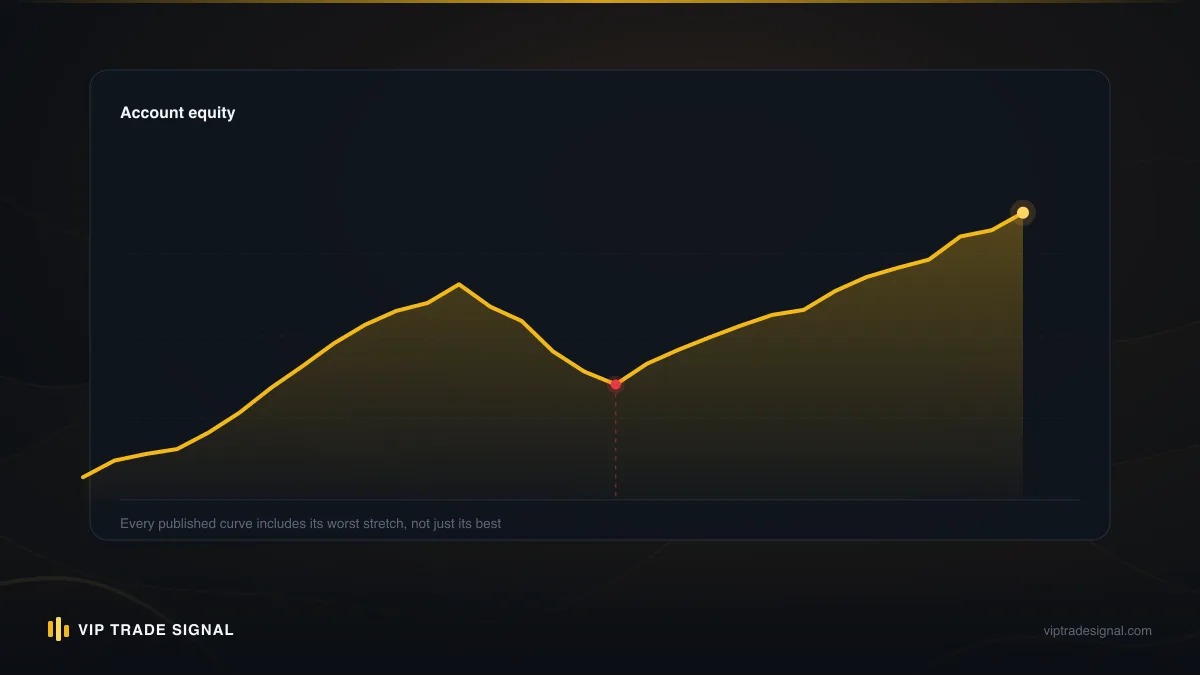
If the daily limit is a fence you can walk into by accident, the maximum drawdown is the cliff edge. Cross it once and the account is finished, no warnings, no second computation at day's end. And unlike the daily limit, it never resets.
The static version is straightforward enough. A $100k account with a 10% max drawdown breaches if equity ever touches $90,000. Fixed floor, known in advance, doesn't move. If your firm offers this, treasure it, because the alternative is nastier.
The trailing version follows you up. The floor sits a fixed distance below your high-water mark, so as you make money, the floor rises behind you. Grow the $100k account to $106k with a 5% trail and your floor is now $100,700; you can no longer even fall back to your starting balance without breaching. Some trails lock at the initial balance once you've gained enough, which is civilised. Some trail forever, which means the account is permanently one bad week from deletion no matter how much profit you've banked.
The question that separates the survivable trails from the lethal ones: does the high-water mark update on closed balance or on floating equity? A balance-trailing floor only moves when you bank profit, so at least you chose to move it. An equity-trailing floor moves the moment a winning trade floats into profit, whether or not you ever close it. We'll come back to that trap, because it deserves its own section. It's the single most account-destroying clause in the industry.
One practical habit worth stealing: write your current floor on a sticky note, in dollars, and put it on your monitor. Not the percentage. The dollar figure of equity at which your account dies. Update it whenever it moves. Traders who can quote that number cold almost never breach the max; traders who "know it's around 10%" breach it constantly, because "around 10%" is not a number the engine recognises.
Balance-based vs equity-based measurement traps
We've touched this twice already; time to nail it down, because balance versus equity is where most misreadings happen.
Your balance is the value of your closed trades. It changes only when a position closes. Your equity is balance plus the floating profit or loss on everything open. It changes every tick. Every drawdown rule at every firm is anchored to one of these two numbers, and the firm's marketing page almost never tells you which; the terms document does, usually in one sentence, usually phrased ambiguously.
Here's why the distinction is worth real money. Take a $100k account, 5% daily limit, and a trader who's down $3,200 on the day with a short gold position currently floating $1,500 against them.
- Balance-based daily limit: they've used $3,200 of $5,000. The floating loss doesn't count yet. Room remaining: $1,800, but only if they don't close.
- Equity-based daily limit: they've used $4,700 of $5,000. Room remaining: $300, roughly one spread-plus-slippage on a fast market. They are seconds from a breach and may not know it.
Same account, same trades, same market. One trader has room to manage the position; the other needs to flatten immediately.
Now notice the perverse incentive balance-based rules create. If floating losses don't count, the "rational" move when a trade goes badly wrong is to not close it, holding the open loss off the books while praying for a comeback. Firms know traders do this, which is why balance-based daily limits are almost always paired with an equity-based max drawdown, so the hold-and-hope trade eventually hits the hard floor instead. The box is designed so that hiding a loss from one rule walks it into another.
The equity-based traps run the other way. Spread widening at rollover, when liquidity thins for a few minutes each day, can flick your equity down $200-$400 on a couple of open gold positions through no price movement at all, just the quote widening. If you're within a few hundred dollars of an equity-based limit at 5pm New York, you can be breached by the spread. That is a genuinely stupid way to lose a funded account and it happens every single day.
The rule of thumb: assume everything is equity-based until the terms explicitly say otherwise, and trade to the equity number. If it turns out the rule was balance-based, you were merely more careful than required. Nobody ever lost an account through that error.
Reset times, weekends and holding overnight
Every daily limit resets somewhere, at some moment, in some timezone, and the gap between when you think it resets and when it actually resets is a trap with your name on it.
The common anchors, roughly in order of frequency: 5pm New York (the forex day roll), midnight server time (often GMT+2 or GMT+3, and shifting with US daylight saving), and midnight UTC. Three plausible anchors spread across seven hours of clock. If you trade the London morning, your session might start with a fresh allowance or with the dregs of yesterday's, depending entirely on which anchor your firm uses.
The scenario that bites: you take a $4,000 loss on a $100k account at 3pm New York, near your $5,000 daily limit. You reason that the day is nearly over, the counter resets shortly, and you'll come back tomorrow with a fresh $5,000. Correct, on a 5pm New York anchor. On a midnight-UTC anchor, "tomorrow" starts at 8pm New York, and the Asian session you planned to trade at 9pm New York is still inside the old day with $1,000 of room. That trade you were about to place with 1% risk? It can breach you on slippage alone.
Weekends are their own category of ambush. Three things happen between Friday's close and Sunday's open that the rulebook cares about:
- Gaps. Gold closes Friday at 3,340 and opens Sunday at 3,326 because something happened in the world over the weekend. Your stop at 3,332 fills at 3,326, not 3,332. If that gap-through loss exceeds your remaining daily or max allowance, you're breached before your Monday alarm goes off, and no firm on earth refunds a weekend gap.
- Weekend holding bans. Many firms simply prohibit holding over the weekend, some auto-flattening everything at Friday's close, others treating a held position as an instant rule violation regardless of outcome. Winning trade held over a weekend, closed for a profit, account terminated anyway. It's in the rules. They warned you, technically.
- Swap and rollover charges. Triple-swap Wednesday on gold shorts adds up, and swaps hit your balance, which on some firms' engines nudges the daily calculation for the following day.
None of this is complicated once you've written it down. That's the point. Get the firm's exact reset time in your own local time, put it in your phone as a recurring reminder labelled "allowance resets", and treat the thirty minutes either side of it as a no-new-trades zone. The rollover window has the worst spreads of the day anyway; you're not missing anything worth having.
The floating-profit trap on trailing rules
Now for the clause that deserves its own wanted poster. On some firms, the trailing maximum drawdown updates on floating equity, not closed balance. Read that again slowly, because the implication is genuinely strange: an open winning trade can move your breach floor up in real time, and the floor stays up after the trade comes back down.
Walk through it with numbers. You start a $100k account with a $5k trailing max, so your floor is $95,000. You go long gold and the trade runs beautifully, floating $4,000 in profit. Your equity high-water mark is now $104,000, so the floor trails to $99,000. You haven't closed anything. You haven't banked a cent. But the floor moved.
Now the trade retraces, as gold trades do, and stops out at breakeven. Your balance is back to $100,000, exactly where you started, having risked nothing and lost nothing. Except your floor is still $99,000. Your effective drawdown allowance has shrunk from $5,000 to $1,000 because a trade you didn't close briefly went well. One ordinary 1%-risk loss now puts you within spitting distance of a breach, on an account whose balance has never been below its starting value.
On an equity-trailing account, your best trades are the ones quietly killing you. The profit you don't take still takes your room.
The defence, if you must trade under this rule, is to manage the floor, not just the trade. That means partial profit-taking as policy: if the floor is going to trail your floating high regardless, you want banked profit rising alongside it, so the gap between balance and floor never compresses. Letting a winner float +4% while banking nothing is, on these accounts, a risk decision, and a bad one. Scale out. Bank the move in pieces. You'll sometimes watch the last third of a runner go without you; that's the tax this rule charges, and it's cheaper than the alternative.
Better still: don't trade under this rule at all. When you're comparing firms, "does the trail update on floating equity?" should be one of your first three questions to support, in writing, before you pay for anything. A firm whose support can't answer it clearly has told you something important too.
A breach post-mortem: three examples
Theory is tidy. Breaches aren't. Here are three composite post-mortems, each built from patterns we've seen repeatedly, each starring a trader who was not doing anything obviously insane.
Breach one: the overnight equity dip. Rana holds a $100k funded account, 5% daily limit, equity-based, anchored at 5pm New York. Tuesday was rough: $3,800 in closed losses. At 4:30pm she's done trading but long gold, floating +$200, planning to hold into Asia. At 5:04pm, rollover spread widening plus a thin-market flick puts the position momentarily $1,400 underwater. Her equity touches $94,800 against a $95,000 line... and doesn't breach, because the day rolled at 5:00 and the counter reset. She got lucky by four minutes and never knew it. The identical sequence on a midnight-server-time firm is a terminated account. The lesson isn't recklessness; it's that she could not have told you, at 4:30, what her breach number was or when it changed.
Breach two: the revenge doubling. Sam is $4,200 down on a $5,000 daily limit by lunchtime, from three losses that were each individually fine. He knows he should stop. But stopping locks in a red day, and there's a clean setup forming, and if it works he ends the day nearly flat. He takes it at double size to make the maths work. It stops out. The loss is $1,600, his equity punches through the daily floor, hard breach. The post-mortem isn't about the last trade, which was actually a decent setup. It's that the decision to size it was made by the drawdown, not by him. When your remaining allowance starts dictating your position size upward, the account is already lost; the breach is just the paperwork arriving.
Breach three: the floating high-water mark. Priya runs a $200k account with a $10k equity-trailing max. Over three weeks she trades well, banks $6,000, and at one point floats a further $5,000 on an open position she eventually closes for +$1,200. Her balance: $207,200. Her equity high-water mark, though, printed $211,000 during that float, so her floor sits at $201,000. She reads her account as "up $7,200 with $10k of room" when the true state is "up $7,200 with $6,200 of room". A normal two-loss day at her regular size takes her to $200,600. Breached, while profitable overall, having never had a losing week. She filed a support ticket genuinely believing the platform had malfunctioned. It hadn't. The rule just worked exactly as written, and she'd read the marketing page instead of the contract.
Three different mechanisms. One common thread: in every case the trader's mental model of the account differed from the engine's model by one variable, and the engine's model is the only one that counts.
Recovery plan when you're near the limit
So let's deal with the situation you might actually be in right now, because a fair number of people land on an article about prop firm drawdown rules with an account that's already bleeding. Say you're on a $100k account, $10k max drawdown, and you're $6,500 down. Thirty-five hundred dollars of life left. What now?
First, the honest version of the odds. To recover $6,500 on the $93,500 you have left, you need roughly a 7% gain while never dipping $3,500, which is 3.7% of current equity, at any point along the way. That's a 2:1 required-gain-to-permitted-pain ratio, and it's brutal. Anyone who tells you there's a technique that makes this easy is selling something. There isn't. There's only a way to make it possible, and it starts with getting smaller, which is the opposite of every instinct you'll have.
The plan we'd actually follow, in order:
- Stop trading for two full days. Not one. Two. The account has a time limit measured in months or none at all; your judgement after a 6.5% drawdown has a recovery time measured in days. You are the damaged asset here, not the account.
- Re-read the rules and write down three numbers: your max-drawdown floor in dollars, your daily limit in dollars, and the exact reset moment in your local time. If any of the three takes more than a minute to find, you've been trading blind and this drawdown was coming eventually anyway.
- Cut risk to 0.25% per trade. On $93,500 that's about $230 of risk. Yes, it feels pointless. That feeling is the point: at $230 a trade you can be wrong fifteen times before the account is in real danger, which means you can trade your normal process without the survival pressure that produces breach number two in our post-mortem section.
- Set a personal daily stop at half the firm's. If the firm allows $5,000, you stop at $2,500. Always leave the engine a margin you control, because the engine's line includes spread, slippage and swap, and yours should too.
- Define the recovery in trades, not money. "Make back $6,500" is a demand the market has no obligation to meet this week. "Take my twenty best setups at quarter size and see where we are" is a plan you can actually execute. At 0.25% risk with a modest positive expectancy, recovery takes months. Accept that or accept the breach; those are the only two doors.
- Bank early and often. Near the floor, a banked $400 is worth more than a floating $900, both mathematically (it can't be taken back by a retrace) and on trailing rules (it moves your balance up with the high-water mark instead of behind it).
Notice what's not on the list: doubling size to recover faster, switching to a new strategy you saw on YouTube this week, or trading more sessions to get more chances. Every one of those raises variance, and variance is precisely the thing the floor beneath you punishes. The maths of recovery is the same on funded accounts as personal ones, just with a hard floor added; we've laid out the personal-account version in how to recover a blown forex account.
And a word on outside help, since this is the point where people go looking for it. There are services (ours included) that manage drawdown recovery on personal accounts; our drawdown management service works on your own MT4/MT5 account for a flat 50% of recovered profit above a recorded baseline, with no recovery guarantee, because honest recovery work can't carry one. But understand clearly: that model does not fit funded prop accounts. Nearly every prop firm bans third-party account access outright, and a copy-trader or account manager touching a funded account is itself a breach, usually one that forfeits pending payouts. Recovery help belongs on your own capital. On a funded account, the only pair of hands allowed on the wheel is yours.
Position sizing reverse-engineered from the rules
Most traders pick a risk percentage from folklore (1% because everyone says 1%) and then hope it fits inside the firm's rules. Better to run it backwards: start from the rules and derive the size they actually permit. The rules are the constraint; your size is the output.
Start with the daily limit, because it binds first. The question to ask: how many consecutive losing trades in one day do I want to survive? Not expect. Survive. If your answer is four, and your daily limit is $5,000, your per-trade risk ceiling is $5,000 divided by four, minus a buffer for spread and slippage, call it 15% off the top. That's roughly $1,060 per trade on a $100k account, or about 1.06%. Suddenly the folklore 1% looks less like received wisdom and more like the maximum the standard 5%-daily box quietly permits for a four-loss day. Funny, that.
But four losses in a day is a thin cushion if you trade actively. Take six as your survival number and the ceiling drops to about 0.7%. Trade gold around news, where slippage on a stop can run 20-40 cents on a fast candle, and your buffer should be fatter still.
Then check the answer against the max drawdown, which binds over weeks rather than days. The question changes shape: how long a losing streak across days should this account survive? A 10% static max at 0.7% risk per trade absorbs roughly fourteen straight losses before touching the floor. Fourteen sounds like plenty until you remember streaks don't need to be consecutive; a choppy month that goes lose-lose-win-lose-lose-lose-win-lose grinds you down just as surely, only slower. If you're on a trailing max, tighten everything again by a third, because your effective allowance shrinks every time a winner floats.
A worked example, all the way through. $200k account, 5% daily ($10,000), 10% trailing max ($20,000), equity-based everything, trader wants to survive five same-day losses and twenty total:
- Daily constraint: $10,000 ÷ 5 = $2,000, less 15% buffer = $1,700 per trade.
- Max constraint: $20,000 ÷ 20 = $1,000, less a trailing-rule haircut of a third = $670 per trade.
- The binding constraint is the smaller: $670, about 0.33% per trade.
Is 0.33% a boring number? Completely. Will the account still be alive in six months? That's rather the idea. The general principles of sizing to survive variance are the same ones we bang on about in risk management for forex trading; the funded-account twist is simply that the firm has pre-committed you to a ruin threshold, in writing, and most traders size as if it isn't there.
What happens after a breach — and what's negotiable
The email arrives, the platform goes read-only, and the first question is always the same: is any of this reversible? Short answer, rarely. Longer answer, it depends on what kind of breach and what kind of firm, and it's worth knowing the terrain before you're standing in it.
What you lose, in the standard case: the account, obviously, and with it any unpaid profit split sitting in the pipeline. Read that clause before you ever need it, because firms differ sharply. The better ones pay out profit earned up to the moment of breach, on schedule. The worse ones void pending payouts on any hard breach, so a trader who earned $4,000 last cycle and breached this cycle gets nothing for either. That single clause is worth more than the entire marketing page, and almost nobody checks it before buying.
What's sometimes negotiable, roughly in descending order of hope:
- Technical breaches with evidence. If you were breached by a demonstrable platform fault, a price spike that exists on no other feed, a server outage that froze your ability to close, firms do occasionally reinstate. Occasionally. You'll need timestamps, screenshots, and a calmly written ticket, and even then the terms usually say their server's data is final. Worth one polite attempt; not worth a crusade.
- Soft-breach forgiveness. Some firms distinguish soft breaches (daily limit, auto-flattened, account survives) from hard ones (max drawdown, terminated). Where a first soft breach carries a warning rather than termination, that's written policy, not mercy, but it does mean one mistake isn't fatal. Know which regime you're in.
- Discounted resets. Nearly every firm will sell you a reset or a new evaluation at 5-20% off within days of a breach. This isn't negotiation, it's the business model showing through the paint: breaches are the top of their sales funnel. Take the discount if a new attempt genuinely makes sense; just notice that the email arriving within the hour of your breach tells you exactly how the economics work.
What's never negotiable: a straightforward rules-as-written breach with clean data behind it. The engine did what the contract said. Every hour spent arguing that the rule is unfair is an hour not spent on the only useful post-breach activity, which is the honest post-mortem: which of the mechanisms in this article actually got you, and what specifically changes on the next account. Traders who can answer that in one sentence tend to keep the next account. Traders who answer "bad luck" fund the industry.
One more thing. If a dispute has substance, put it in writing through the official ticket system, stay boring and factual, and keep your own trade logs independently of the platform. The calm email with timestamps attached is the one that occasionally gets a human review.
Choosing firms by drawdown rule quality
Once you can read drawdown rules fluently, something useful happens: the firms start sorting themselves in front of you. Ignore the payout-split headlines and the Instagram of traders holding novelty cheques. Rank them on the box, because you'll live inside the box.
| Rule feature | Trader-friendly | Hostile |
|---|---|---|
| Max drawdown type | Static, from initial balance | Trailing on floating equity, never locks |
| Daily limit basis | Balance-based, or generous equity buffer | Equity-based, tight, checked per tick |
| Daily anchor | 5pm New York, stated plainly | Midnight server time, timezone unstated |
| Breach handling | Auto-flatten at daily limit, account survives | Hard termination on first touch |
| Payout on breach | Earned profit paid out regardless | Pending payouts void on any breach |
| Weekend holding | Allowed, or clearly auto-flattened | "Violation", judged after the fact |
| Rule clarity | Dollar examples in the docs | Percentages only, terms contradict FAQ |
A few opinions, since you've read this far. A static drawdown with a slightly worse profit split beats a trailing drawdown with a flashier split every single time; you can't collect a split from a terminated account. A firm that publishes worked dollar examples of its own rules is showing you respect and probably deserves some back. And a firm whose support gives you two different answers to "balance or equity?" on two different days has answered a more important question than the one you asked.
Send every firm on your shortlist the same five questions before paying: daily limit basis and anchor time, max drawdown type and what it trails on, whether the trail locks, breach handling at each limit, and payout treatment on breach. In writing. Keep the replies. Twenty minutes of admin, and it filters out most of the grief in the industry.
We're biased towards transparency as a filter because it's the same one we invite on ourselves; our own gold signal results sit publicly at /signals/history, losses included, and any firm handling your funded future can clear that same bar or explain why not. Detailed questions about how our own services interact with prop accounts are covered on our FAQ, and the short version is the one we gave earlier: funded accounts are yours to trade alone.
The rulebook is the trade
Strip everything above down to one idea and it's this: on a funded account, the rules are the market. Price is just the thing that moves you around inside them.
The traders who last in this game read the contract the way they'd read a chart, hunting for the level that kills them. They can quote their floor in dollars at 2am. They know their reset time in their own timezone and their firm's server's opinion of what day it is. They size from the rules backwards instead of from folklore forwards, and when they're near a limit they get smaller, slower and more boring, precisely when every nerve is screaming to do the opposite.
None of that is glamorous. It's also the entire difference between the trader on their fourth evaluation fee this year and the one collecting a payout from an account that's eight months old.
So, three moves before your next trading day, none of which involve a chart:
- Find your exact max-drawdown floor, in dollars, and your daily limit, in dollars, and write both where you can see them while trading.
- Convert your firm's reset time into your local time and set a recurring alarm thirty minutes before it.
- Recalculate your position size from those two numbers using the survival method above, and if the answer is smaller than what you're currently risking, believe the maths over the ego.
Losses you can trade through. Rules you can only obey or breach. Know which wall is closest, always, and the box gets a great deal easier to live in.