Somewhere on your feed right now there is a man leaning against a rented Lamborghini explaining that his forex bot pays him while he sleeps. He is lying, but not in the way you think. The interesting lie isn't that the money doesn't exist. Sometimes it does. The lie is in the two words doing all the work: passive, and income.
We get asked about passive income forex trading more than almost any other topic, usually by people who have a job, a bit of capital, and no interest in staring at charts for six hours a day. That's a completely reasonable position. Most people should not trade actively. The honest question isn't "can forex be passive?" — it's "how passive, exactly, and how income-like, exactly?" Nobody selling you anything wants to answer that with numbers.
So let's do it properly. There are four real paths to making money in forex without trading yourself: bots, copy trading, PAMM pools, and managed accounts. Each one gets audited here against two axes — the hours it actually demands from you, and how much its returns behave like a salary versus a coin flip. We run a managed account service ourselves, so you know where our bread is buttered. We'll be fair anyway, including about our own model's weaknesses. By the end you'll know which path fits your capital and your temperament, and whether the honest answer for you is "none of them, buy an index fund."
The two lies inside "passive income"
Take the phrase apart, because both halves are doing dishonest work.
"Passive" implies zero ongoing effort. Set it up once, collect forever. Nothing in forex works like that. Every method on the list requires initial research (finding the bot, the trader, the manager), ongoing monitoring (is it still doing what it did when I picked it?), and periodic intervention (pulling the plug when it isn't). The hours vary enormously — from a few per month to a part-time job — but they never reach zero. A forex arrangement you genuinely never look at is not passive income. It's an unattended fire.
"Income" implies regularity. Your salary lands on the 28th, same amount, every month. You can build a life on it: rent, groceries, a car payment. Trading returns do not behave this way, not from us, not from the best manager on earth. A strategy averaging 4% a month might deliver +9%, +2%, −6%, +11%, −3% across five months. The average is real. The regularity is fiction. And if you've built your rent payment on the assumption of that 4% landing every month, month three doesn't just disappoint you — it evicts you.
Every "passive forex income" product fails at least one of two tests: either it isn't passive, or it isn't income. The good ones only fail one.
That's the whole framework. The rest of this piece is just measurement.
Axis one: the hours each method actually demands
Let's put rough, honest numbers on the effort. These come from years of watching clients and doing this ourselves, not from a survey, so treat them as an experienced estimate rather than gospel.
| Path | Setup effort | Ongoing hours/month | Skill required |
|---|---|---|---|
| Trading yourself | 200+ hours to competence (often far more) | 40–120 | Very high |
| Running a bot/EA | 20–60 hours of vetting and testing | 5–15 | Medium-high |
| Copy trading | 10–20 hours of trader research | 3–8 | Medium |
| PAMM pool | 8–15 hours of manager research | 2–5 | Medium |
| Managed account | 10–25 hours of due diligence | 1–3 | Low-medium |
Two things jump out. First, nothing is zero. Even the most hands-off option — a well-chosen managed account — costs you an hour or so a month checking statements and confirming the manager hasn't drifted from the mandate. Second, the setup cost is front-loaded everywhere. The ten to twenty-five hours of due diligence before handing anyone your money is where almost all of the outcome gets decided. People invert this. They spend forty minutes choosing a manager and forty hours a month anxiously watching the trades afterwards. Do it the other way round.
Notice also what the table says about trading yourself. If you're reading an article about hands-off forex investing, you have presumably already decided that 40-plus hours a month isn't happening. Good. Own that decision fully, because the worst outcome is the half-measure: someone who won't commit to learning properly but also won't fully delegate, so they override their bot, second-guess their copy trader, and interfere with their manager. That person gets the costs of every path and the benefits of none.
Axis two: variance, or why trading returns are not a salary
Here's a scenario worth sitting with. Two people each have $20,000 generating money. Person A has it in a job-adjacent arrangement — say a rental room — producing $300 a month, every month, boringly. Person B has it in a well-managed trading account averaging $300 a month, arriving as +$900, −$250, +$100, +$800, −$350.
Over a year they might earn the same total. Their lives feel completely different. Person A can budget. Person B cannot — or rather, Person B can only budget on the average, which means holding a cash buffer and treating any single month's result as noise. The moment Person B starts spending each month's winnings as they land, the first losing month becomes a personal crisis, and personal crises make people do the one thing that reliably destroys trading returns: intervene at the worst moment.
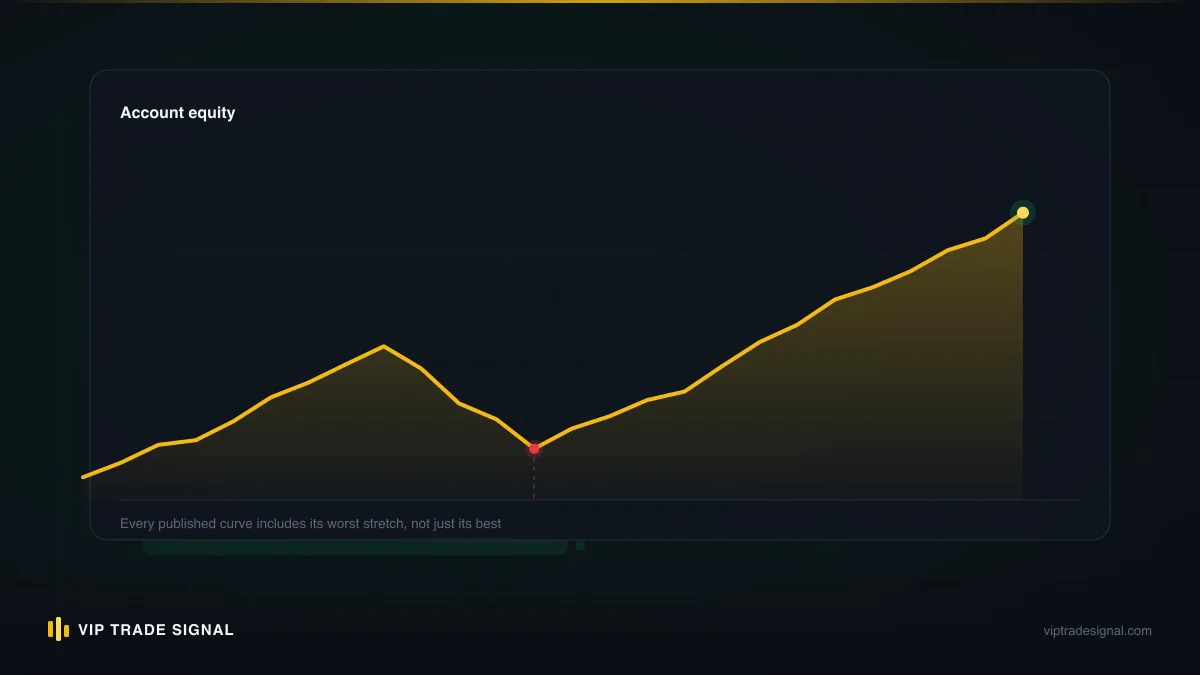
This is why we tell prospective account management clients something that costs us business: if you need this money to arrive monthly to pay bills, don't do this. Trading returns are investment returns wearing a payslip costume. The variance is not a flaw to be fixed by finding a better manager. It is the fundamental texture of the activity. Managers who show you a smooth, salary-like equity curve have either found the holy grail or — vastly more likely — are hiding open losses through martingale, grid stacking, or plain fabrication. A real track record breathes. Ours at /signals/history includes losing trades and losing stretches, on purpose, because the alternative is lying to you.
The practical rule: forex returns can supplement income. They can compound wealth. What they can't do is replace a salary until the account is so large that even a bad quarter leaves your average draw intact — and for most people that number is far bigger than the one they're starting with. We'll get to specifics later.
Path 1: trading bots and EAs, audited
The dream: buy an Expert Advisor for $200, attach it to MT4, retire. The reality deserves a fair hearing, because bots are not all scams. Plenty of quantitative logic genuinely works for stretches. The problems are structural.
How passive is it? Less than any other path on this list except trading yourself. You need a VPS (that's a monthly cost and an occasional 2 a.m. reconnection), you need to monitor whether the bot's market regime still exists, and you need the judgment to switch it off — which is a trading decision, the very thing you were trying to avoid. Call it 5–15 hours a month once running, plus the vetting. And the vetting is brutal: the retail EA marketplace is dominated by curve-fitted backtests that look glorious over the exact historical window they were optimised on and fall apart the week you go live. Distinguishing a genuinely durable strategy from an overfit one requires forward-testing on a demo for months and reading the logic itself. Most buyers can do neither.
How income-like is it? Highly variable, with a nasty distribution. The most common commercial EA architectures — martingale and grid systems — manufacture exactly the smooth equity curve buyers want by hiding risk in open drawdown. They print small steady wins for months, which feels wonderfully like income, right up until one trending week consumes the account. You saw eleven months of salary and one month of bankruptcy. That's not income. That's a loan from the market with a surprise repayment date.
A worked example, generic but realistic in shape: an EA sold with a backtest showing 8% monthly. Buyer runs it on $5,000. Months one to four: +$380, +$290, +$410, +$350. Buyer adds $10,000 more, tells two friends. Month six: gold trends 400 points without a meaningful pullback, the grid stacks into it, and the account closes down 85%. Total arc: eight months of "passive income" ending $11,000 poorer than day one. We've watched versions of this story more times than we can count.
If you're determined to try one anyway, at least stack the odds: demand a live, third-party-verified track record (Myfxbook or FX Blue, linked to a real account, running twelve months minimum — a backtest PDF counts for nothing), read the description for the words "grid", "martingale", "recovery" or "no stop loss" and close the tab if you find any of them, and run the thing on a demo or a $200 live account for a full quarter before real size touches it. That's easily thirty hours of work to responsibly deploy a $200 product. Which is the quiet punchline of the bot path: done properly it's barely passive at all, and done passively it's barely ever proper.
Bots can work as one tool inside an actively supervised operation. As an unattended money printer for a non-trader, they're the worst option on this list.
Path 2: copy trading, audited
Copy trading — eToro, ZuluTrade, broker-native copy systems, or a Telegram signal copier mirroring a signal channel into your account — lets you automatically replicate another trader's positions. It's the most popular hands-off route, mostly because platforms have made it feel like following someone on social media.
How passive is it? Middling. Setup means researching traders, and platform leaderboards actively sabotage this: they rank by recent returns, which means they surface whoever took the most risk and got lucky most recently. The trader at the top of the monthly leaderboard is, almost by definition, the one you should avoid. Real research means reading a year-plus of history, checking maximum drawdown, checking whether the win rate is propped up by tiny take-profits against huge stop-losses, and checking behaviour during the last genuinely violent market week. Ongoing, budget 3–8 hours a month, because copy traders drift. A sensible trader with a good year attracts a pile of follower money, feels the pressure to keep the streak going, sizes up, and blows the very record that attracted you. Style drift is the silent killer of copy trading, and you only catch it by looking.
How income-like is it? You inherit the trader's variance, amplified by two frictions. Slippage: your copy executes milliseconds after theirs, and on fast moves those milliseconds cost real spread — we've written about why your results never quite match the leader's. Proportion mismatch: if the leader trades a $500,000 account and you copy with $2,000, their comfortable 0.5% risk translates into position sizes that may round badly or violate your account's margin. Expect your curve to be a slightly worse photocopy of theirs.
A scenario that plays out constantly, with a trader we'll call Sam. Sam finds a copy leader with a lovely eight-month curve, +6% average, and allocates $4,000. For three months it works — Sam's up about $600 and has mentally spent it twice. Then the leader hits a normal losing fortnight, down 9%. Nothing about the strategy has changed; this drawdown is well within the leader's history, which Sam never actually read. But Sam is watching daily, and every red day feels like evidence. In week three of the drawdown Sam unfollows, locking in the loss. The leader recovers fully over the next six weeks — for the followers who stayed. Sam, meanwhile, has moved to the new top of the leaderboard, who is one hot streak away from doing the same thing to him. Multiply Sam by a hundred thousand and you have the actual economics of copy platforms: the strategies often work, and the followers still lose, because the following behaviour is the strategy nobody backtested.
The fair verdict: copy trading is a legitimate middle path for someone with modest capital — say $1,000 to $10,000 — who accepts they're choosing a person, not a product, and that the choosing never fully stops. It's how to invest in forex without trading yourself at the small end. Just never believe the leaderboard, and never copy anyone whose worst historical month you couldn't stomach personally.
Path 3: PAMM pools, audited
PAMM (Percentage Allocation Management Module) and its cousins MAM and LAMM are broker-side structures where many investors pool funds under one manager, and profits or losses are split by capital share. It's institutional plumbing offered retail.
How passive is it? Genuinely quite passive — 2–5 hours a month once you're in. The broker handles allocation, the manager trades, you watch a dashboard. The setup research is the same manager-vetting exercise as everywhere else, with one advantage: PAMM track records live on broker infrastructure, which makes them harder (not impossible) to fake than a screenshot in a Telegram channel.
How income-like is it? Same variance as any trading strategy, with a structural quirk worth understanding: the manager typically earns a percentage of profits, often with a high-water mark, and the pooling means their incentives are averaged across all investors rather than aligned with you specifically. If the pool is deep in drawdown below the high-water mark, a rational manager sometimes has more incentive to swing for recovery — with your money — than to grind carefully. You're also structurally anonymous. Try getting the manager of a 400-investor pool on a call to explain last month.
And there's a custody question people skate past. In most PAMM structures your money sits in a pooled arrangement where you cannot see individual trades in your own terminal, cannot close a position yourself, and can only exit at the structure's liquidity windows — sometimes weekly, sometimes monthly. That's a real reduction in control compared with a managed account on your own login. For some people the trade-off is fine. It should at least be a conscious one.
One more thing to check before joining any pool: how the track record handles closed pools. Some managers run several PAMMs at once, let variance sort them, quietly close the losers, and market the survivor as their record. It's the mutual-fund incubation trick in forex clothing, and it makes the visible history systematically rosier than the manager's true skill. Ask directly how many pools they've run and what happened to each. A manager with one pool and four years of unbroken history is worth ten with a spectacular six-month survivor.
Verdict: a reasonable option at the $5,000–$50,000 level if you find a manager with a long, broker-verified record and you accept being one row in their spreadsheet. The passiveness is real. The relationship isn't.
Path 4: managed accounts, audited
A managed account means a professional trades your account — your broker, your login, your money visible in your own MT4/MT5 terminal — usually for a share of profits. This is the service we run, so read this section knowing that, and weigh our claims against the questions you should ask any account manager before believing anyone, us included.
How passive is it? The most passive ongoing arrangement available: 1–3 hours a month, mostly reading statements and glancing at open positions. The front-loaded due diligence is heavier than PAMM, though, because you're entering a bilateral relationship: verify the track record trade-by-trade, check the fee structure for hidden charges, confirm you keep the master password (walk away instantly from anyone who wants it), and confirm withdrawals stay in your hands. Ours works exactly that way — investor-password access only, your master credentials, your withdrawal rights — because the alternative arrangement is indistinguishable from handing a stranger your wallet. Full structure is on the account management service page; the short version is a flat 50% of realized profit, $200 minimum advance, no monthly fee, no charge in losing months. Fifty percent is at the high end of the industry, and we say so openly — the trade-off is that the minimum is low and there's nothing to pay when we don't perform. Whether that trade is worth it depends on your capital size, and we've laid the honest pros and cons of managed forex accounts out separately, including the cases where the answer is no.
How income-like is it? More predictable in behaviour than a bot or a copied stranger — you know the strategy, the risk cap per trade, and the human accountable — but the returns themselves carry full trading variance. A performance-fee-only structure helps alignment: the manager eats zero in your losing months, which kills the incentive to churn. It doesn't kill variance. Nothing does. Any manager who tells you otherwise, or who quotes you a guaranteed monthly percentage, has just failed the interview. We put that in writing before every engagement, and it's the first thing covered in our FAQ: losing months happen, drawdown happens, and no recovery or return is guaranteed, ever.
Verdict: the best passiveness-to-accountability ratio on the list, and the strongest option once your capital justifies the diligence — roughly $2,000 upward for it to be worth anyone's time, meaningfully more before the returns matter to your life. The catch is concentration: you're trusting one desk's judgment rather than a pool or an algorithm, so the vetting is everything.
Scoring all four on the two axes
Put the audit together and the picture is clean.
- Bots/EAs — moderately passive, least income-like. The variance hides in open drawdown and detonates late. Fine as a supervised tool, poor as a hands-off vehicle.
- Copy trading — moderately passive, moderately income-like, heavily dependent on your ongoing selection skill. Best at small capital.
- PAMM — very passive, trading-variance returns, weakest personal accountability and control. Best at mid capital with a verified manager.
- Managed account — most passive ongoing, trading-variance returns, strongest accountability, heaviest upfront vetting. Best from mid capital up, if and only if the diligence checks out.
None of them scores full marks on both axes. That's not a market failure. It's arithmetic: returns above bank-deposit rates carry risk, and risk expresses itself as variance, and variance is precisely what "income" pretends not to have. The only dial you genuinely control is the passiveness one — and even that has a floor.
The monitoring floor: hours you can never delete
Whatever path you choose, there is a bundle of ongoing work that cannot be delegated, because delegating it recreates the original problem (who monitors the monitor?). Call it the monitoring floor. It's roughly an hour or two a month, and it consists of:
- Statement review. Once a month, open the account statement and read every closed trade. Not the summary — the trades. You're looking for size creep, new instruments, or stop-losses quietly widening.
- Drawdown check. Know the maximum drawdown you agreed to (or the historical max of the bot/trader you copied). Check current open and closed drawdown against it. Agreed 15% and you're floating 22%? That's an intervention trigger, not a "let's wait and see".
- Withdrawal test. Every few months, withdraw a small amount. Not because you need it — because a withdrawal that processes smoothly is the only proof the money is real. Every collapsed forex scheme in history paid dashboards beautifully and withdrawals slowly.
- Strategy drift sniff-test. Does this month's trading resemble the strategy you signed up for? A gold swing strategy suddenly scalping thirty trades a day has changed without telling you.
There's a fifth item that isn't monthly but matters more than the other four: the annual re-underwrite. Once a year, pretend you're choosing this bot, trader, pool or manager from scratch, today, with fresh eyes. Would the current twelve months of results get your money if you saw them cold? Arrangements that would never win your capital today keep it anyway through pure inertia, and inertia is not a thesis. Plenty of people are two years into a copy relationship they'd never start now.
Skip the floor and you haven't made your investment more passive. You've made it unsupervised, which is a different word with a different ending. The people who lost everything in the famous collapsed "passive forex" schemes weren't stupid. They were people who stopped doing step three.
The tax and withdrawal plumbing nobody mentions
Here's a boring section that will save you real money, because "income" has an administrative meaning as well as an emotional one.
First, taxes. In most jurisdictions, profits from forex trading — whether you traded, copied, or had a manager trade for you — are taxable, typically as capital gains or miscellaneous income depending on where you live and how the activity is classified. A managed account doesn't change this: the account is yours, so the tax liability is yours, calculated on your gross profits before the manager's performance fee in some jurisdictions and after it in others. We are not tax advisors and this varies wildly by country, so budget for one hour with a local accountant before the first withdrawal, not after the first tax letter. That hour is part of the true cost of the "income".
Second, the mechanics of actually getting paid. Broker withdrawals take anywhere from hours to five business days. Some brokers require withdrawals to return by the original deposit method first (an anti-money-laundering rule, not malice). PAMM structures add liquidity windows on top. If you're imagining the 28th-of-the-month payslip experience, the plumbing alone rules it out — plan withdrawals quarterly, keep a fiat buffer, and never schedule a bill against money still inside a trading account.
Third, compounding cuts against withdrawing. Every dollar you pull out stops working. A $10,000 account earning an average 3% monthly and withdrawing everything stays a $10,000 account forever, producing about $300 average months indefinitely. The same account withdrawing nothing for two years — if the average holds, which is a genuine if — grows past $20,000 and now produces $600 average months. The whole reason to accept trading variance is the compounding; strip the compounding out with monthly withdrawals and you've kept the risk while discarding most of the reward. Withdraw profits above a threshold, not profits per se.
Passive income forex trading numbers, by capital level
Time for the numbers everyone scrolls for, delivered with the caveat that makes them honest: these are illustrative planning ranges based on what disciplined, risk-capped trading has historically been able to target — not promises, not our performance claims, and comfortably capable of being missed in any given year. Anyone quoting you tighter numbers with a straight face is selling something.
Assume a competent, risk-managed operation averaging somewhere between 2% and 6% a month across a full year — a range that already puts you well ahead of most retail outcomes, since the industry commonplace holds that most retail accounts lose money.
| Capital | Plausible average month (2–6%) | A normal bad month | What it can honestly be |
|---|---|---|---|
| $500 | $10–$30 | −$40 | A lesson budget. Nothing more. |
| $2,000 | $40–$120 | −$160 | Pocket money with homework attached |
| $10,000 | $200–$600 | −$800 | A meaningful supplement, not rent |
| $50,000 | $1,000–$3,000 | −$4,000 | Rent-sized, salary-shaped it is not |
| $250,000 | $5,000–$15,000 | −$20,000 | Livable average, if you can hold a −$20k month without flinching |
Read the third column as hard as the second. The bad month isn't a tail scenario; it's a routine part of any honest distribution, and your real question at every capital level is whether that number breaks you financially or emotionally. If a −$800 month on your $10,000 would keep you up at night, the correct response isn't a better manager. It's a smaller allocation.
Worth spelling out how these ranges interact with fees, too, because the headline percentage isn't what reaches your pocket. On a performance-fee model at 50% — ours, and the top of the market — a 4% gross month on $10,000 is $400 gross, $200 net to you. On a typical PAMM at 30%, it's $280 net. Copy platforms take their cut through spread markups and copy fees that are harder to see but no smaller for it, often 1–2% of capital a year before the leader earns anything. There is no fee-free path; there are only visible fees and hidden ones, and we'd argue the visible kind, charged only on profit, is the least dangerous of the bunch — but run your own numbers at your own capital level rather than taking any provider's word for it, ours included.
The uncomfortable summary: passive income from forex trading only starts resembling actual income somewhere north of $50,000 in dedicated capital, and only resembles a livable salary at levels most people would need a decade of disciplined compounding to reach. Below that, it is a wealth-building supplement with lumpy delivery. That is still worth having. It just isn't the Lamborghini pitch.
Who should skip all of this and buy index funds
We run a forex desk and we're about to argue some of you away from forex entirely, because the alternative is you finding out the expensive way.
Buy a boring global index fund instead of pursuing any of this if:
- You need the money within three years. Trading variance plus a short horizon is a coin flip you can't afford to lose. So is equity variance, frankly, but at least the fund won't have a performance fee on top.
- You cannot spare the monitoring floor. If two hours a month of statement-reading genuinely won't happen, unsupervised trading arrangements will eventually punish you. An index fund is the only instrument on earth that truly forgives total neglect.
- Your total investable capital is under about $2,000. At that size, even good percentage returns are beer money, while the due-diligence hours and the psychological load are identical to a $50,000 account's. The maths of your time says index fund, and revisit forex when the capital is bigger.
- You would check the account daily. Sounds contradictory — surely attention is good? No. Daily checking of a variance-heavy account manufactures anxiety, and anxiety manufactures intervention, and intervention at emotional moments is how good arrangements get destroyed by their own beneficiaries.
- You are replacing a lost salary. If the money must arrive monthly or your household fails, no honest trading arrangement fits. Full stop.
The dirty secret of this whole industry is that a cheap index fund compounding at historical equity averages, ignored for twenty years, beats what most retail forex participants — passive or active — actually achieve. Forex's honest pitch is different: higher potential returns, uncorrelated with your stock portfolio, on capital you can afford to put at genuine risk, with variance you've made peace with. That's a real pitch for the right person. It's a terrible pitch for someone's emergency fund.
Where this leaves you
Strip away the marketing and the audit comes down to three sentences. Forex can be mostly passive — an hour or three a month, forever, no less. Forex returns are never income in the salary sense — they're investment returns with a lumpy delivery schedule and a real chance of losing months, and any pitch claiming otherwise is your cue to leave. And the choice between the four paths is mostly a function of your capital and your willingness to do front-loaded homework.
If you've read this far and still want a hands-off allocation, here's the order of operations we'd give a friend. Decide the allocation first — money you could lose entirely without changing your life. Pick the path by capital: copy trading small, PAMM or managed mid, managed with serious diligence above that. Spend the boring ten-plus hours vetting before a single dollar moves, with special attention to trade-level track records and who controls withdrawals. Then commit to the monitoring floor in your calendar, monthly, like a dentist appointment you actually keep.
And if the managed route is the one that fits, judge us by the same standard as everyone else. Our closed signals sit publicly at /signals/history, losses included; the account management terms and full pricing are published, not quoted in a DM; and we've written up what a clean performance-fee-only structure should look like so you can hold ours against it. If we fail your checklist, walk. That's what the checklist is for.
The Lamborghini man was half right, by the way. Money can work while you sleep. He just skipped the part where you have to stay the kind of person who checks on it when you wake up.