Here's an awkward admission from a desk that manages accounts for a living: about a third of the people who email us about account management shouldn't use one. Not ours, not anyone's. Some of them are better off trading their own money badly for a year, because the lesson is worth more than the returns. Some of them can't afford the fee drag. Some of them are so anxious about their capital that handing it to a stranger, even a stranger with a track record, would ruin their sleep worse than trading it themselves ever did.
You won't hear that from most providers, because most providers write about the pros and cons of managed forex accounts the way an estate agent writes about damp. The pros get four hundred glowing words. The cons get a sentence about "of course, all trading carries risk" and a fast change of subject.
We're going to do it properly. Every genuine advantage, argued as hard as we can argue it. Then every genuine drawback, argued just as hard, including the ones that cost us business when people take them seriously. At the end there's a scored self-assessment you can actually use. If you come out the other side deciding to trade your own account, we'll consider that a good outcome. There are worse things than an informed no.
What "managed" actually means, because half the arguments depend on it
Before we can weigh anything, we need to pin down what's on the scale, because "managed forex account" covers arrangements that carry wildly different risks.
At one end you have the model we consider the only defensible one: a manager trades your account, at your broker, under your name, via trading-only access. You keep the master password. You can watch every trade in real time, withdraw whenever you like, and revoke access in about ninety seconds. That's how our own account management service works, and it's how you should insist any manager works.
At the other end you have the model that generates most of the horror stories: you send money to the manager, who pools it with other people's money in an account you can't see, at a broker you didn't choose, and sends you a statement (of sorts) once a month. That isn't account management. That's an unsecured loan to a stranger, dressed up in trading vocabulary, and in most jurisdictions it's also illegal without a fund licence.
Everything in this article assumes the first model. If someone's offering you the second, you don't need a pros-and-cons analysis. You need to close the chat.
One more definition. When we say "self trading" we mean you, alone, doing your own analysis and pulling your own trigger. Following a signal service sits somewhere in between the two (you keep execution but outsource the analysis), and it changes the maths in ways we'll come back to, because for some people it's the honest answer to this whole dilemma.
Right. The ledger.
The case for: expertise you didn't have to spend five years building
The strongest argument for a managed account is brutally simple: competence in trading is expensive to acquire, and you pay for it whether you buy it or build it.
Building it yourself costs years and losses. Not months. Years. The typical path runs something like: six months of demo trading that teaches you the platform and almost nothing else, a first live account that dies to overleverage, a second that dies to revenge trading, a long humbling middle period where you break even minus spread, and then, if you're in the minority that persists, some version of durable competence somewhere in year three to five. The tuition along the way is real money. A trader we'll call Dan, a composite of a hundred people we've spoken to, put £4,000 into his education across three blown accounts before his first profitable year. He'd tell you it was worth it. He'd also tell you he underestimated the bill by a factor of four.
Buying competence costs a fee. A steep one, usually, and we'll get to fee drag soon. But the thing you're buying is specific and valuable: pattern recognition that only comes from thousands of trades, position sizing that's automatic rather than aspirational, and, above all, the discipline to follow rules on the day following them feels wrong. That last one is the expensive part. Anyone can size a position correctly on a calm Tuesday. The skill is doing it on the Friday after three straight losses, and that skill is almost impossible to shortcut.
There's a quieter version of this advantage that gets less airtime: consistency of process. A decent manager runs the same playbook in week forty as in week one. Self-directed traders, especially newer ones, change systems every time a system has a bad fortnight, which means they never stay in one approach long enough to collect its edge. If you recognise yourself in that sentence, a manager isn't buying you brilliance. It's buying you the boring, repetitive sameness that profitable trading actually looks like.
Is the expertise you're buying always real? No, and that's a con we'll treat with full seriousness later. But where it is real, it's the single biggest item on the pro side of the ledger.
The case for: distance from your own money
Most retail traders don't lose because their analysis is bad. They lose because their analysis is fine and their behaviour around it is a car crash.
You know the sequence. A loss stings, so the next position is bigger, to win it back faster. That one loses too, and now you're down 8% in an afternoon and trading with the specific, clenched desperation that produces the worst decisions of your trading life. Or the mirror image: three wins in a row, a warm feeling of having figured it out, and a position size that quietly doubles right before the market reminds you who's in charge.
None of this is stupidity. It's what human nervous systems do when their own money moves. And it's why the second-strongest argument for a managed account is emotional, not technical: a manager trading your account does not feel your losses. Your drawdown is a number on their screen, not a hole in their stomach. That sounds cold. It's exactly what you want. The clenched-desperation trade never happens, because the person at the keyboard isn't desperate.
The best trade management tool ever invented is a person who doesn't care about your money the way you do.
We see this most clearly in the drawdown cases that land on our desk: accounts that got 40% down not through one bad idea but through one bad idea defended with doubling-down for six weeks. Almost every one of those charts is a picture of emotion, not analysis. The account holder could usually tell you, precisely, which rule they broke. Knowing the rule was never the problem.
The honest caveat: distance cuts both ways. A manager who doesn't feel your losses also doesn't feel your fear, and a bad manager can be as reckless with your money as you'd never dare be. Distance is only an advantage when it's paired with rules, which is why the fee model and drawdown limits matter so much (later section, we promise).
The case for: the hours nobody counts
Ask someone considering self-trading how much time it takes and they'll say something like "an hour a day?" That's off by a lot, and the miscount matters because time is the cost everyone forgets to put on the scale.
Here is the honest weekly bill for trading your own account with any seriousness. Daily chart review and level marking: 30 to 45 minutes before your session, not during it. Trade monitoring: gold in particular does not respect your calendar, and an open position during a US CPI print will occupy your entire attention whether you planned it or not. Journalling and review, if you're doing the part that actually produces improvement: two or three hours a weekend. News and calendar awareness: constant, low-level, always-on. Add it up honestly and a serious self-directed trader spends ten to fifteen hours a week, and the ones who spend three are usually the ones donating money to the ones who spend fifteen.
Now price your hours. Someone earning £30 an hour who spends twelve hours a week trading is spending £1,440 a month of opportunity cost before a single pip of profit or loss. On a $5,000 account, that time cost dwarfs any realistic return the account can produce. This is the arithmetic that makes managed accounts rational for busy professionals: not that the manager is better than you could ever be, but that the hours you'd need to become good are worth more elsewhere.
And there's a compounding version of this: fatigue. Trading badly because you're checking charts at 11pm after a full workday isn't a character flaw, it's physiology. Plenty of people have the aptitude to trade well and simply do not have the life that allows it. If that's you, outsourcing execution isn't laziness. It's an accurate reading of your own constraints.
The case against: fee drag compounds too
Now the other side of the ledger, and we'll start with the one that's most measurable: fees compound with exactly the same relentlessness as returns, and most people never run the numbers.
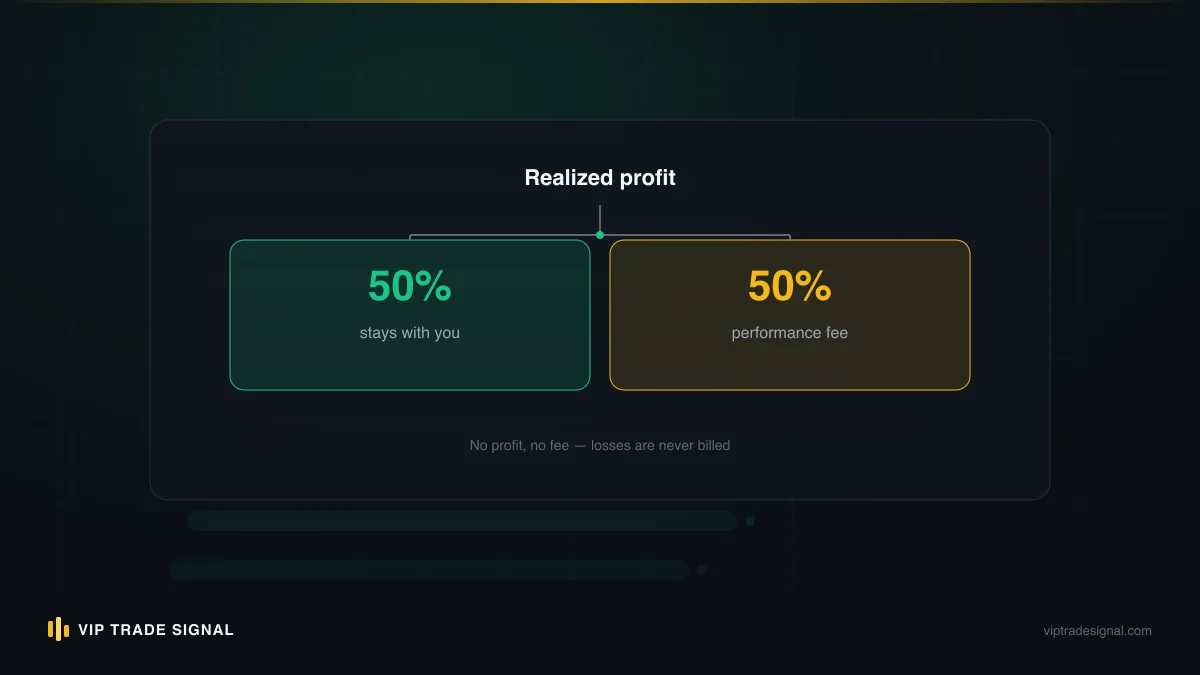
The standard performance fee in this industry runs 30% to 50% of profits. Ours is a flat 50%, which sits at the top of that range, and we're upfront that it's high; the trade-off is a $200 minimum advance instead of a $10,000 account minimum, and pay-as-you-go instead of lock-ins. But whatever the number, the mechanism is the same, and you should see it clearly before signing anything.
Say a manager produces a genuinely good year: 30% gross on your $10,000. At a 50% performance fee, you keep 15%, or $1,500. Fine. Now run it forward five years at the same gross rate. Self-traded at 30% (a heroic assumption, but hold it fixed for the comparison), $10,000 compounds to about $37,000. Managed at 15% net, it compounds to about $20,100. Same gross performance, and the fee has quietly consumed nearly $17,000 of terminal value. The gap isn't the fee itself; it's the compounding you never got on the fee.
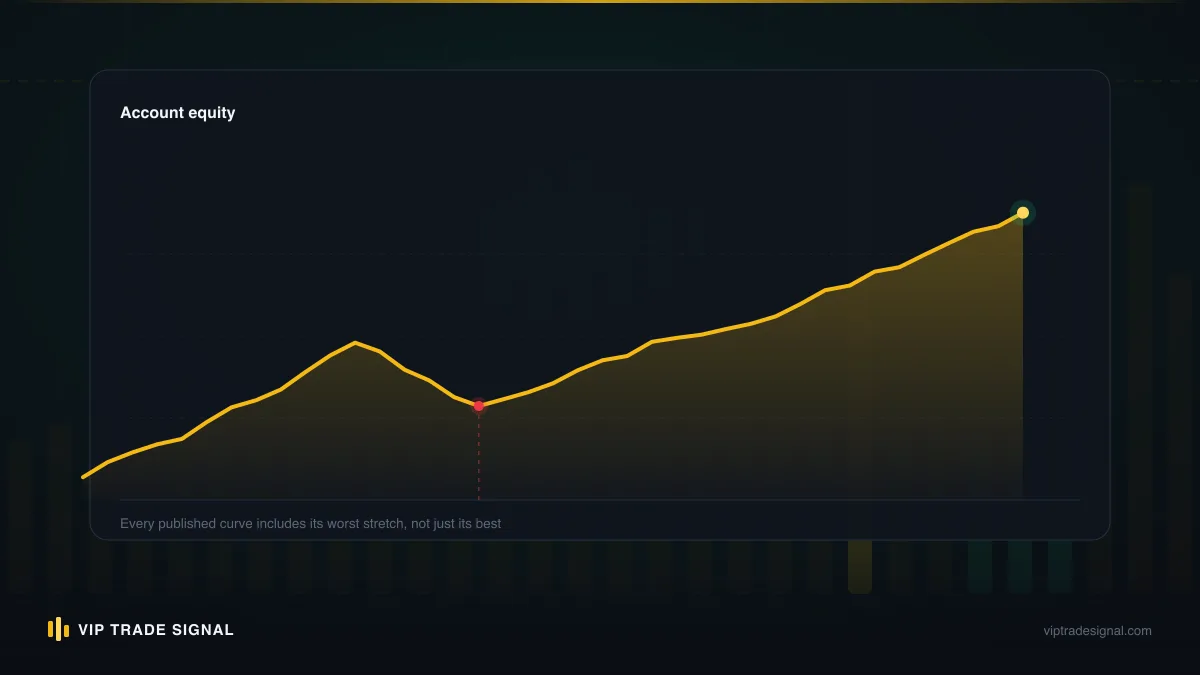
Does that settle the argument for self-trading? No, because the comparison assumes you'd have matched the manager's gross return yourself, and for most people that assumption is fantasy (base rates section coming). The correct comparison is manager-net versus your realistic self-traded return, which for a typical first-year trader is negative. A fee of 50% of something beats 100% of a loss.
But here's what fee drag does mean, concretely. First, a managed account has to clear a higher bar to be worth it: a manager returning 10% gross leaves you 5% net, which a boring index fund beats without anyone touching a chart. Second, fee structure matters more than fee size. A performance-only fee (no profit, no fee) at least aligns incentives. A management fee charged on account balance regardless of results is drag with no alignment at all, and we'd tell you to walk away from it even if the percentage looks small. If you want realistic context for what gross returns are even achievable, we've written up what monthly returns actually look like without the marketing gloss, and the honest numbers are lower than almost everyone's expectations.
The case against: manager risk is a new risk you didn't have yesterday
When you trade your own account you carry market risk. When you hand it to a manager you still carry all of the market risk, plus an entirely new category: the risk that the human being you selected is incompetent, reckless, or crooked. This risk did not exist in your life last week. You created it by signing up.
It comes in three flavours, escalating.
Incompetence is the common one. The barrier to calling yourself a forex account manager is a Telegram account and a confident tone. Plenty of "managers" are eighteen months into their own trading journey, running a strategy that's been lucky in one regime and will be flattened by the next. Their screenshots are real, in the narrow sense that those trades happened. What's missing is everything around them: the losing months, the risk per trade, the fact that the account in the screenshot is one of four and the other three died.
Recklessness is the profitable-looking one, and it grows directly out of the fee model. A performance-fee manager holds a free option on your account: half your gains, none of your losses. The incentive-literate response to that option is to swing huge, because a lucky month pays them handsomely and an unlucky month costs them nothing but your custom. The signature of this manager is a beautiful first two months, because oversized risk looks like brilliance right up until it doesn't. Then one bad week returns 60% of your account to the market. You'll find this pattern behind most managed-account disasters, and it's why the single most important question you can ask a prospective manager is not "what do you return?" but "what's your maximum drawdown and what happens when you hit it?" We keep a longer list of questions worth asking a manager before any money moves, and we'd genuinely rather you interrogated us with it than signed blind.
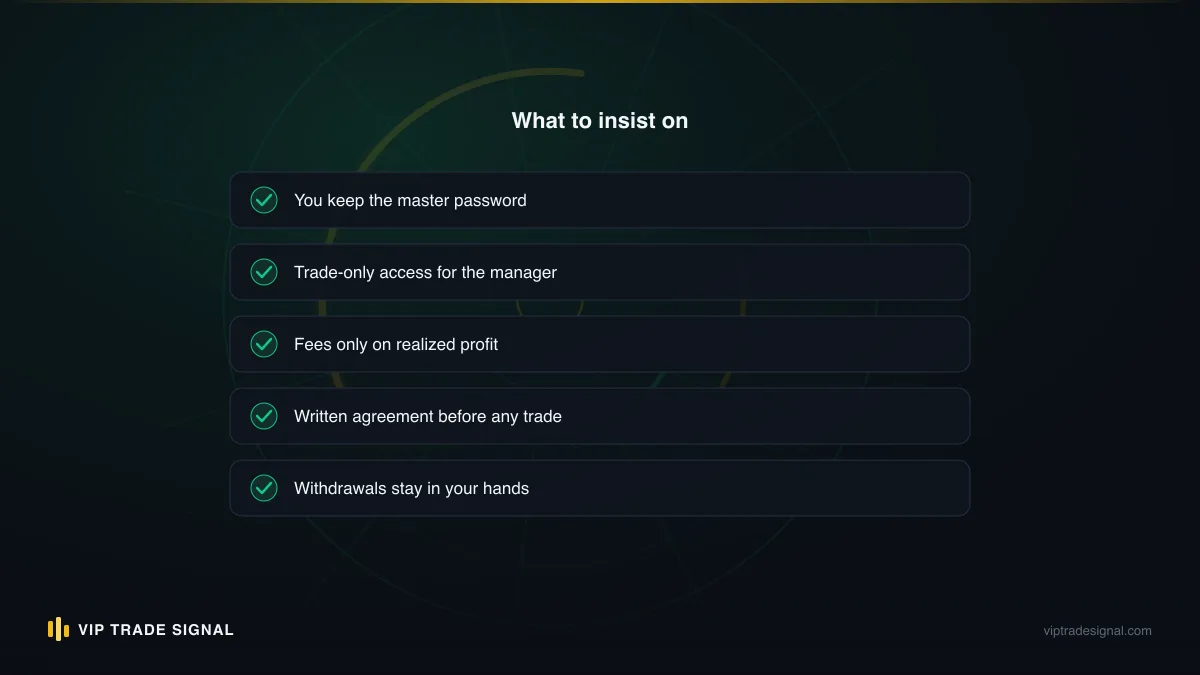
Fraud is the rare, fatal one: managers who demand your master password, or your money into their account, or who trade specifically to harvest commissions from a broker kickback. The defences are structural, not psychological. You keep the master password. Money stays at your broker, in your name. Withdrawals stay in your hands only. Any manager who resists any of those three terms has told you everything, politely decline and keep your evening free.
Notice what all three flavours have in common: none of them can be diversified away by the market going your way. Manager risk is uncorrelated with markets and entirely correlated with your diligence before signing. Which is a strange kind of good news. It's the one risk in trading you can mostly eliminate with a fortnight of unhurried checking.
The case against: you learn nothing while someone else trades
This is the con that never appears in provider marketing, ours included until now, and for a certain kind of person it's the decisive one.
Every month a manager trades for you is a month you don't develop. You don't learn to read a market, size a position, sit on your hands, or take a loss without flinching, because you're not doing any of those things. You're watching. And watching, as anyone who has watched a lot of football will confirm, builds precisely none of the ability to play.
Why does that matter, if the results are fine? Three reasons, in ascending order of seriousness.
You can't evaluate what you don't understand. A client who knows nothing about trading cannot tell a skilled manager from a lucky one, cannot tell sensible drawdown from the start of a disaster, and cannot ask a single question that would expose a problem early. The less you know, the more completely you depend on trust, and trust without the ability to verify is exactly the condition every bad actor in this industry is engineered to exploit.
Dependence is permanent by default. If the plan is "the manager trades forever," fine, but say that out loud and check you mean it. Most people vaguely assume they'll "learn along the way." They won't, not passively. Watching trades appear in your MT5 teaches you what happened, never why, and never what it felt like to hold the position. Ten years of that leaves you exactly as dependent as day one.
And the capability itself has value beyond returns. The person who spends two years learning to trade a small account badly, then adequately, then decently, owns something for life: a skill, a calibrated relationship with risk, an immunity to a whole class of financial nonsense. The person whose account was managed for those two years owns a slightly larger or smaller account. If you're 28 with £2,000 and decades of compounding ahead of you, the skill is probably worth more than the money. If you're 55 with £50,000 and a demanding career, it almost certainly isn't. Age and account size change this answer more than anything else on the ledger.
There's a middle path worth naming here, because it exists for exactly this reason. Following signals while executing every trade yourself keeps your hands on the wheel: you place the orders, you feel the losses, you watch how a stop is placed and where a target sits, and some of it genuinely transfers. It's slower than a mentor and less passive than a manager. For people whose main hesitation about managed accounts is the learning problem, it's often the more honest fit.
Managed forex account vs self trading: the base rates nobody quotes
Every comparison so far has quietly assumed some level of self-trading skill. Time to stop assuming and look at the base rates, because they're the most important numbers in this entire decision and no provider on either side of the argument likes quoting them.
Start with self-trading. Brokers regulated in Europe and the UK must publish the percentage of retail CFD accounts that lose money, and the figures cluster in the same ugly band year after year: somewhere around 70% to 80% of retail accounts lose. That's not a snapshot of beginners; that's the standing population. Longitudinal studies of retail day traders (the Brazilian futures study is the most quoted, and its findings rhyme with everything brokers publish) find that only a small minority remain profitable over multi-year horizons, and a much smaller minority earn more than they would have in ordinary employment. The honest base rate for "I will self-trade my way to meaningful profits" is low. Not zero. Low.
Now the uncomfortable symmetry: nobody publishes equivalent base rates for managed accounts, and that absence should bother you. Our strong suspicion, from years of watching this industry, is that the distribution of managed-account outcomes is also mostly poor, because the population of people calling themselves managers overlaps heavily with the population of traders in that losing 75%. The difference is selection: you don't have to accept the average manager. You get to choose from the top of the distribution, if, and only if, you can identify it. A verified multi-year track record, published losses included, coherent answers about drawdown, structural safeguards on custody. The pool of managers who clear all four hurdles is small. It is not empty.
So the real comparison is not "average manager versus average self-trader." It's this:
| Self trading | Managed account | |
|---|---|---|
| Base rate of success | Low; most retail accounts lose | Unpublished; poor on average, better with hard selection |
| Where the variance lives | Your discipline, your time, your learning curve | Your selection skill, exercised once, up front |
| Cost when it works | Time, tuition losses, stress | 30-50% of profits, forever |
| Cost when it fails | Your capital, slowly, with lessons attached | Your capital, sometimes fast, lessons not included |
| What you own after 3 years | A skill (maybe) and a track record of your own | An account balance and a monthly statement |
One line from that table deserves underlining: with a managed account, the variance moves from a skill you exercise daily (discipline) to a skill you exercise once (selection). That's the entire bet. If you're a rigorous, sceptical selector who will spend two weeks verifying before wiring anything, you're playing to your strength. If you're the sort who gets excited by a screenshot and signs up the same evening, you've moved your money from a game you'd lose slowly to a game you might lose quickly.
The pros and cons of managed forex accounts, on one page
Ledger time. Here are the pros and cons of managed forex accounts as we'd state them to a friend, with the weightings we actually believe rather than the ones that sell.
The pros, honestly argued:
- Bought expertise. Where it's real, it shortcuts a three-to-five-year learning curve you'd pay for in losses anyway. The strongest item on the list.
- Emotional distance. The manager doesn't feel your losses, so the revenge trade and the panic close mostly disappear. For traders whose problem is behaviour rather than analysis (which is most traders), this alone can flip the sign on results.
- Time. Ten-plus honest hours a week returned to your career, family or sleep. For high earners this is frequently the whole justification.
- Process consistency. One playbook, run identically in month one and month fourteen, instead of the system-hopping that keeps most self-directed traders permanently at the start of the curve.
The cons, equally honestly:
- Fee drag. 30-50% of profits, compounding against you forever. Raises the bar the manager must clear to beat a boring alternative.
- Manager risk. A new, uncorrelated risk of incompetence, incentive-driven recklessness or fraud, created the day you sign, reducible mainly by up-front diligence and custody structure.
- Zero learning. You end the arrangement no more capable than you began it, and less able to evaluate the person you're depending on.
- Dependence and opacity. Your outcomes now run through someone else's decisions, health, discipline and honesty. Even with full read access to your account, you're watching the game, not playing it.
Notice the shape of the ledger. The pros are mostly about performance and lifestyle in the present. The cons are mostly about cost, fragility and capability over time. Which side wins depends less on the items than on you: your money, your hours, your temperament, your horizon. So let's do that properly.
Who the pros genuinely outweigh the cons for
Having argued both sides, here's the profile of the person for whom a managed account is, in our view, the right call. The more of these describe you, the stronger the case.
Your time is genuinely expensive. You earn well, your hours are contested, and the twelve weekly hours serious self-trading demands would come out of work, family or health. For you, the fee isn't just buying returns; it's buying back the only resource you can't top up.
The capital is real but not life-critical. A useful band is capital that matters enough to deserve professional handling but whose total loss wouldn't change your life: for most people something like 5-15% of investable assets. Below that, fees and minimums eat the point. Above that, you're carrying concentration risk no manager's skill can justify.
You know your own behavioural record, and it's bad. You've self-traded, you've kept honest records, and the records say your entries were fine and your behaviour torched them. This person gets the most value from a manager, because they're buying the exact component they've proven they lack. Counter-intuitively, the trader with a losing year of honest journals behind them is often a better managed-account client than the complete beginner, because they can evaluate what they're watching.
You'll actually do the diligence. Two weeks minimum. Track record verified through the account history, not screenshots. Losses published and discussed without flinching. Drawdown rules stated before you ask. Custody structured so the manager can trade and do nothing else. If reading that list felt energising rather than tedious, selection is a game you can win.
You have realistic expectations, in writing. You've internalised that a good year is a modest-sounding percentage, that losing months are part of any real track record, and that anyone promising monthly consistency is describing either a fantasy or a fraud. You will not fire a good manager after one bad month or double your allocation after one good one.
That's the profile. Notice what's not in it: nothing about being rich, nothing about being clever, nothing about loving markets. The profile is mostly about self-knowledge and patience, which tells you something about what this decision actually tests.
Who should absolutely not use a forex account manager
The mirror list, and we mean every word, including the ones that cost us clients.
Anyone whose deposit is money they can't lose. Rent, emergency fund, borrowed money, the redundancy payment that has to last. No. Not with us, not with anyone, and no manager who accepts such money deserves the title. Gold trading involves real and sometimes rapid drawdowns; if a 30% temporary hole in this capital would force a panicked withdrawal at the worst moment, the arrangement fails even when the manager is good.
Anyone who wants to become a trader. If the actual goal is skill, a manager is a detour dressed as a shortcut. Trade small, yourself, expect tuition losses, and treat them as course fees. You'll be tempted to have it both ways ("manage my account while I learn from watching"). Watching doesn't teach. We said it above and it's worth the repetition.
Anyone who can't stomach dependence. Some people, on discovering that their money moved 4% while they were in a meeting and they had no say in it, feel a spike of anxiety no track record can soothe. This is temperament, not logic, and temperament wins every time. If checking the account five times a day and wincing sounds like you, self-directed trading with small size, or signals you execute yourself, will cost you less in both money and cortisol.
Anyone shopping on promised returns. If your shortlist is ranked by the percentage in the advert, you are pre-selected prey. The managers promising the most are, with grim reliability, the ones swinging free options on your capital or simply lying. The moment "8% monthly, guaranteed" sounds attractive rather than alarming, you're not ready to select a manager, because the selection skill is the whole game and that reaction fails the entry test.
Anyone unwilling to do two weeks of boring verification. No exceptions for charisma. The most dangerous managers are the most likeable ones; charm is a customer-acquisition skill, not a trading skill, and the industry's disasters are staffed almost exclusively by people everyone described as lovely right up to the end.
Score yourself before you decide
Enough argument. Here's the self-assessment we'd put in front of a friend. Ten statements; score each honestly from 0 (not me at all) to 2 (exactly me). No one's watching, so lying only burns your own money.
- My hours are worth more than the ten-plus per week that serious self-trading demands.
- The capital I'd allocate is under about 15% of my investable assets, and its total loss would hurt but not harm.
- I have honestly tried self-trading, or honestly do not want the skill, and I've admitted which.
- My own trading records (if any) show behaviour, not analysis, as my main leak.
- I can watch my account drop 15% in a drawdown without demanding intervention or firing the manager.
- I am willing to spend two full weeks on verification before any money moves.
- I can name the three custody safeguards (my broker, my master password, my withdrawals) without looking back up the page.
- A pitch of "consistent monthly returns" makes me suspicious, not excited.
- I understand the fee maths: at a 50% performance fee, the manager's gross must roughly double a passive alternative before I break even against it.
- I accept, in advance and in writing to myself, that losing months will happen and are not evidence of betrayal.
14-20: The pros plausibly outweigh the cons for you. Proceed to selection, slowly, with the question list, and start smaller than you want to.
8-13: Borderline, which in practice means not yet. Usually one specific item is the blocker: capital that's too central, diligence you won't really do, or a temperament question you answered hopefully rather than honestly. Fix the item or choose the middle path of executing signals yourself for six months, then re-score.
0-7: Don't. Not as a judgement, as a mismatch. Either build the skill yourself with money sized for tuition, or keep this capital in something boring. Both outcomes beat a managed account entered from this starting point, and it isn't close.
If you score high and want to see how one provider structures the arrangement, our own setup is documented plainly: your MT4/MT5 account at your broker, trading-only access, flat 50% of realized profit with a $200 minimum advance, and you keep the master password and every withdrawal. High fee, low minimum, no lock-in, and the FAQ answers the awkward questions before you have to ask them. Hold us to the same two weeks of scrutiny you'd apply to anyone else. We'd think less of you if you didn't.
Where this leaves you
Strip the article to its skeleton and the decision is smaller than it looks.
A managed forex account converts one problem into another. It removes the problems most retail traders actually fail at (discipline, time, emotional execution) and replaces them with two problems most retail traders never think about: fee drag that compounds silently, and a one-time selection decision that carries nearly all the risk. Whether that trade is good depends on which problems you're better equipped to solve.
If your edge is judgement (you're sceptical, patient, willing to verify, honest about your own record) then the swap favours you, because you're moving the risk to the exact skill you have. If your edge is time and interest (you have the hours, you want the craft, the learning itself has value to you), the swap runs against you, and you should trade your own money, small, and keep the fees.
And if, having read five thousand words of a provider arguing against its own service half the time, you still can't decide, here's the tiebreaker we actually use with people on the phone. Imagine it's eight months from now and your account is 12% down. Whose hands do you want to have been on the wheel? If the honest answer is "mine, even if I'd have done worse," you've already decided, and no fee structure changes it. If the honest answer is "someone who's been through twenty of these drawdowns and didn't flinch," then start the diligence.
Either answer is respectable. The only wrong move is drifting into one of them by default, because in this business the people who decide nothing get decided for, usually by whoever's advert arrived first.