There is a sentence that appears in almost every managed account pitch you will ever read: "We only get paid when you do." It is a good sentence. It sounds like alignment, it sounds like skin in the game, and for a client who has already been burned by monthly fees on a losing account, it sounds like relief.
Here is the uncomfortable part. That sentence describes both the fairest fee structure in retail forex and one of the most dangerous, and the words themselves cannot tell you which one you are looking at. A performance fee only managed account, done properly, is the cleanest deal available to a small client: no charge for existing, no charge for losing, a bill only when there is realized profit to bill against. Done badly, the exact same structure becomes a machine that pays a struggling manager to take stupid risks with your money, because stupid risks are the only route back to a payday.
We run this model ourselves, so we are not neutral. But we have also watched enough versions of it go wrong, on other people's desks and occasionally near our own early history, to know precisely where the cracks form. This piece is the honest version: the case for paying on profits only, the case against, and the short list of contractual guardrails that decide which case applies to you.
What a performance fee only managed account actually means
Strip the marketing off and the model is simple. A manager trades your account. When the account makes profit over an agreed period, the manager takes an agreed percentage of that profit. When it makes nothing, or loses, the manager takes nothing. There is no monthly management fee, no setup charge, no per-lot commission flowing back to the manager, no "platform fee" invented to smooth their cash flow.
Three details do most of the work in that definition, and each one gets fudged constantly.
First, profit over an agreed period has to mean realized profit, measured against a recorded starting point. If your account started the month at $5,000 and ended it at $5,600 with all positions closed, there is $600 of profit and the fee applies to that. If the account shows $600 of floating gain on open trades, there is no profit yet. There is a hope. Managers who bill on floating profit are billing you for trades that can still turn into losses, and you would be amazed how often those trades do exactly that in the week after the invoice clears.
Second, percentage has to be the whole of the manager's compensation. The moment a "performance-only" service also earns a rebate from the broker on every lot traded, the model has quietly changed. Now the manager earns from volume whether you profit or not, and the performance fee is a bonus on top rather than the incentive itself. Ask the volume question directly. We will come back to it.
Third, your account should mean exactly that: your name on the brokerage account, your master password, your withdrawal rights. The manager gets trading access and nothing else. A performance fee structure bolted onto an account you cannot independently control is not a fee structure, it is a hostage situation with an invoice attached.
When people search for forex account management no upfront fees, this is the honest shape of what they should be looking for. Everything else in this article is about whether that shape holds up under pressure.
The alignment argument: no profit, no pay
The case for the model is genuinely strong, and it starts with what the alternative does to incentives.
The traditional structure, inherited from the hedge fund world, is "2 and 20": a 2% annual management fee on assets plus 20% of profits. At institutional scale, the management fee covers offices, compliance staff, data feeds, the machinery of running money. At retail scale, it covers nothing of the sort, because the numbers are too small. Two percent of your $5,000 account is $100 a year. No desk keeps the lights on with that. So retail versions of the management fee inflate: $50 a month, $99 a month, sometimes more, plus setup charges, and suddenly a $5,000 account is paying north of 12% annually before a single trade has to succeed.
Think about what that does to the manager's motivation. A firm with 300 clients paying $79 a month has $23,700 of monthly revenue that arrives regardless of results. The trading becomes almost decorative. Mediocre performance loses a few impatient clients at the margin, but marketing replaces them, and the subscription base rolls on. The manager's real business is client acquisition, not trading. You are not paying for performance. You are paying for the privilege of being counted.
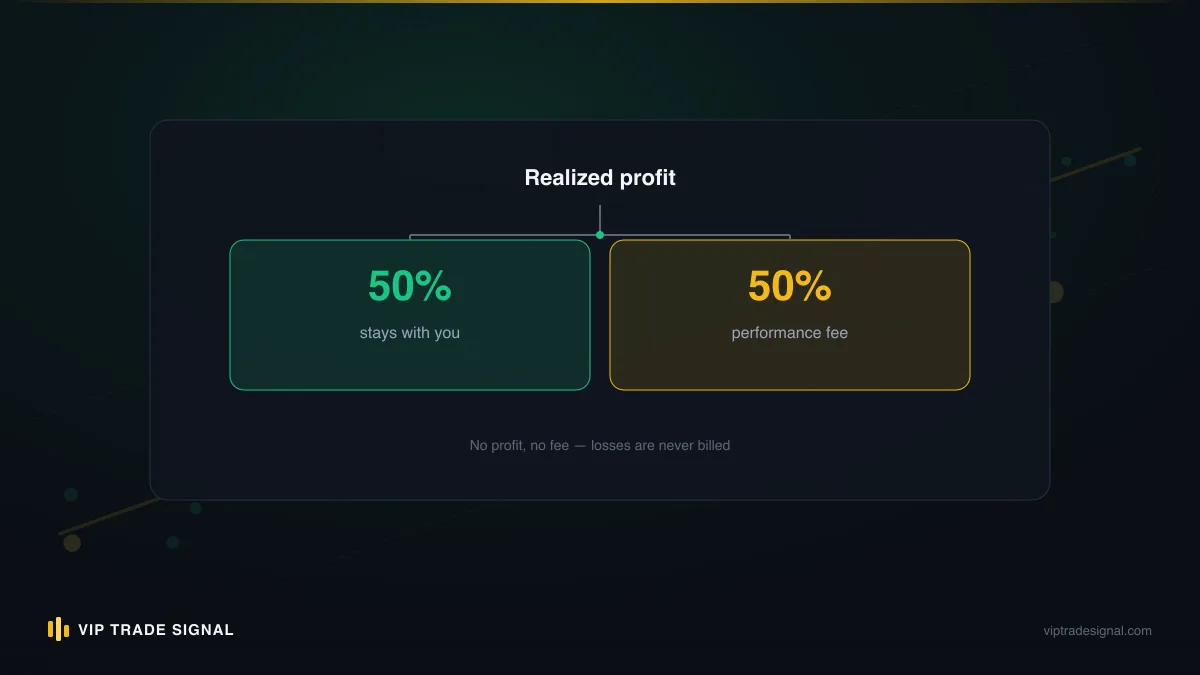
A performance fee only managed account deletes that comfortable floor. The manager who does not produce realized profit produces no revenue. Flat month, zero income. Losing month, zero income and a hole to climb out of before the next payday. Every pound the manager earns corresponds to a pound (more, in fact, depending on the split) that landed in your account first.
The fastest way to learn what a manager actually believes about their own trading is to ask them to eat their own flat months.
There is a second, quieter benefit: the model is self-culling. A manager who cannot trade cannot survive on performance fees, so the incompetent ones either quit or migrate back to subscription models where the revenue does not depend on being right. Fixed monthly fees keep bad managers alive indefinitely. Performance-only starves them out. When you meet a desk that has run this model for years and still exists, that survival is itself a piece of evidence, not proof of future returns, nothing is, but evidence that the trading has fed the business rather than the other way round.
And for the client, the downside arithmetic is kind. Your worst case with a performance-only manager is trading losses, which were always a possibility, minus zero in fees. Your worst case with a fee-charging manager is trading losses plus twelve months of charges paid for the privilege. One of these worst cases is strictly worse, and it is not the performance-only one.
The dark side: what fee pressure does to a struggling manager
Now the part the pitch pages skip.
Imagine a manager, call him Dan, who runs eleven accounts on a performance-only basis and has just finished a bad quarter. Down 8% across the book. Under a proper agreement (we will get to why this matters) Dan cannot bill anyone until each account climbs back above its previous peak. His rent, however, has not paused to wait for the recovery.
Dan now faces a choice that has nothing to do with what the gold chart is showing. He can trade his normal system, at his normal risk, and grind back the 8% over two or three months of patient work while earning nothing. Or he can double the position size, because doubling it turns a three-month recovery into a possible three-week one, and three weeks is a horizon his bank balance can survive.
You already know which option the desperate version of Dan picks. And you can see the poison in it: the performance fee, the very mechanism designed to align his interests with yours, is now paying him to gamble. If the oversized trades work, he is back above the mark and billing again. If they fail, the account that was down 8% is down 20%, and the client wears every point of the difference while Dan wears none of it. His downside was already zero. Yours was not.
This is the asymmetry at the core of every performance fee vs management fee forex debate, and it deserves to be stated plainly: a performance fee is a call option on your account. The manager owns the upside of your equity curve and none of the downside. Options become more valuable when volatility rises. So a manager holding that option, especially one behind on the quarter, has a mathematical incentive to increase volatility, which in trading terms means bigger positions, tighter margins, and more prayer.
Notice what did not cause this problem. Not dishonesty. Dan is not a scammer; scammers do not bother recovering drawdowns, they open new accounts under new names. The problem is structural. Give an honest, competent, cash-strapped human a payoff that rewards variance, and some of them, some of the time, will reach for variance. The clients who get hurt by performance-only accounts are rarely hurt by fraud. They are hurt by incentives working exactly as designed on a manager having a bad enough month.
So the question is never "is performance-only aligned?" It is aligned right up until the account is underwater, at which point it can invert violently. The real question is what stops the inversion. Which brings us to guardrails.
The guardrails that make the model safe
A performance fee only managed account without guardrails is an incentive bomb on a timer. With three specific guardrails, it becomes the fairest structure retail money can access. Every one of the three needs to be written down, not promised over Telegram.
The high water mark
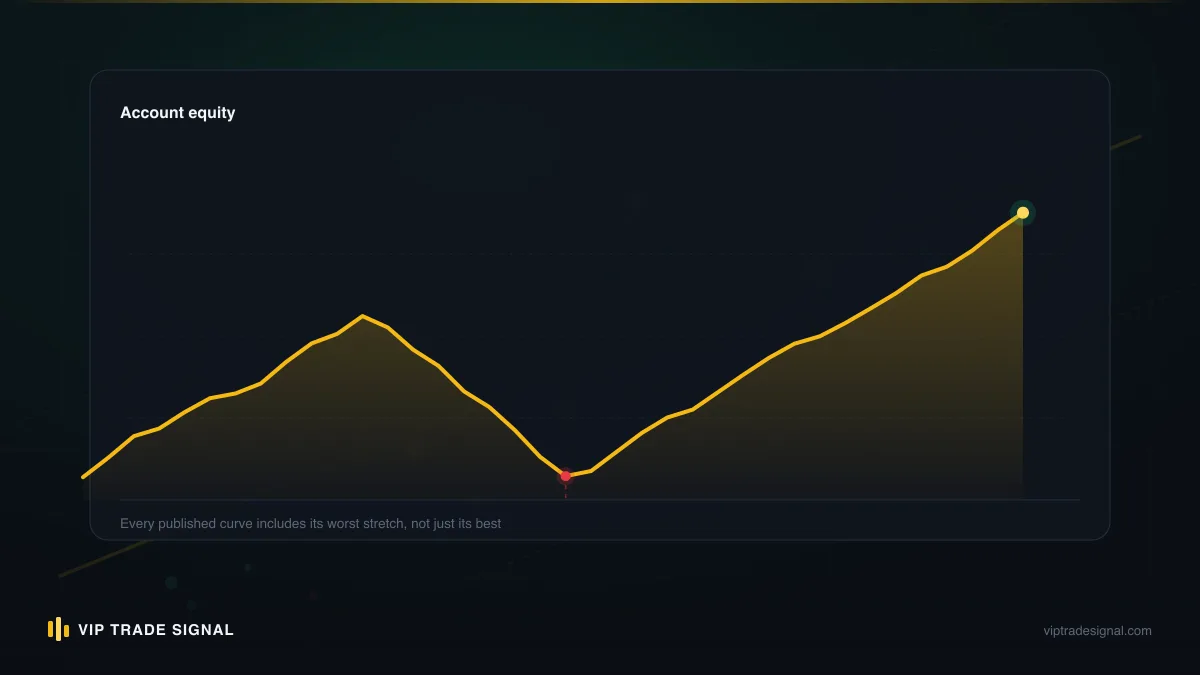
The high water mark performance fee rule says the manager only earns on profit above the account's previous highest billed level. If your account peaked at $6,000, dropped to $5,200, and recovered to $6,000 again, that $800 of recovery generates no fee. It is not new profit. It is your own money coming home. Fees resume only above $6,000.
Without this rule, drawdowns become billable events. Watch the arithmetic: account rises from $5,000 to $6,000, manager bills on $1,000. Account falls back to $5,000, then rises to $6,000 again, and without a high water mark the manager bills on the same $1,000 of ground a second time. A choppy account that goes nowhere over a year can generate fee after fee on the up-swings while the client ends the year flat and poorer. Some of the uglier operations in this industry are not trying to trend your account upward at all. Oscillation pays them just fine.
The high water mark also directly medicates the overtrading disease from the previous section. A manager underwater on your account is working unpaid until the old peak is regained, which makes drawdowns expensive for the manager, in time and effort, rather than free. Dan's incentive to gamble does not vanish under a high water mark (nothing removes it entirely), but the mark at least ensures he cannot profit from the round trip.
One refinement worth knowing: the mark must survive manager convenience. Some agreements quietly reset the high water mark each calendar year, or after any month the client withdraws funds. A resetting mark is barely a mark at all. Ask when, if ever, it resets. The right answer is close to never.
The drawdown cap
The second guardrail is a hard equity floor: a written level at which all trading stops and the client decides what happens next. Something like "if account equity falls 25% below the recorded baseline, all positions are closed and trading is suspended pending the client's written instruction."
This is the guardrail that directly caps the option problem. The manager's call option on your equity gets its value from unlimited volatility; a drawdown cap truncates it. However badly a month goes, there is a floor below which the manager cannot dig in pursuit of recovery, because the agreement takes the shovel away. And because the floor is written and numeric, you do not have to argue about it mid-crisis while the account bleeds and the manager insists the market is about to turn. The number is the number.
Where should the number sit? Tighter than you think. A manager promising steady returns with controlled risk should be able to live inside a 20-30% maximum drawdown with room to spare; if they push back hard against any cap, saying their strategy "needs breathing room," what the strategy actually needs is the freedom to martingale, and you have just learned something valuable before losing anything. On the other side, a cap of 10% on a leveraged gold account is probably too tight to let any real strategy survive normal noise. We trade XAU/USD all day and it can swing $40 in an hour on a data release. Caps exist to stop disasters, not to strangle ordinary variance.
Kill switches you hold personally
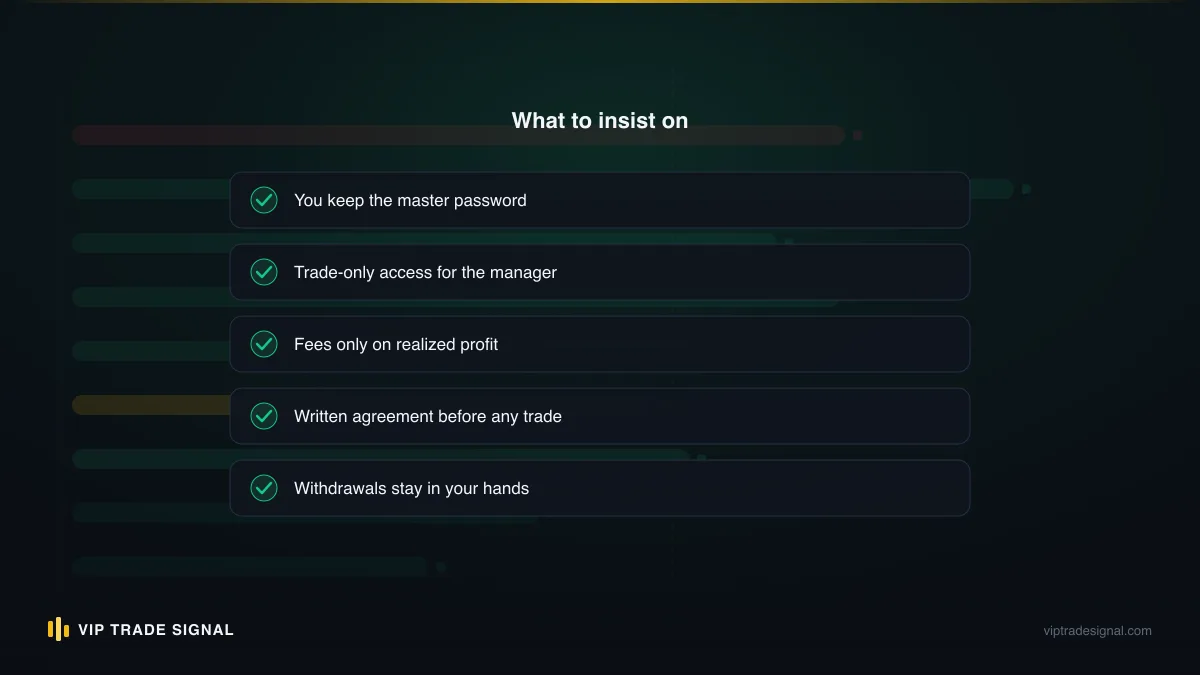
The third guardrail is not in the agreement so much as in the account setup: you keep the master password, the manager gets investor or trading access only, and you can revoke that access at the broker in minutes without asking permission. You also keep withdrawal rights, always.
This matters because the first two guardrails are promises, and promises need enforcement. If the manager blows through the drawdown cap and keeps trading, your remedy should not be a strongly worded email. It should be changing the password before lunch. Any structure where the manager can prevent you from withdrawing, or where the account sits in the manager's name with your money merely deposited into it, fails this test completely and no fee structure can redeem it. Money in an account you do not control is not managed. It is gone, pending goodwill.
Stack all three together and the picture changes entirely. High water mark: the manager cannot earn from chop or bill you twice for the same ground. Drawdown cap: the manager cannot chase losses past a written floor. Kill switch: you can enforce both without anyone's cooperation. That stack is what makes "we only get paid when you do" true instead of merely pleasant.
Billing mechanics: where honest models quietly go wrong
The headline percentage gets all the attention, but the mechanics of how and when the fee is calculated move real money, and this is where otherwise fair agreements leak.
Realized versus unrealized. Fees must be computed on closed trades only. An account showing $900 of floating profit has earned nothing yet; those positions can and regularly do give it all back. Billing on unrealized gains also hands the manager a grubby little trick: hold winners open past month-end so they count, close losers before it so they realize. The invoice looks great. The account does not. Realized profit, positions flat or their open P/L excluded, measured at the billing date. Accept nothing else.
Billing frequency. Monthly billing on realized profit above the high water mark is the industry-standard compromise and it is fine. Per-withdrawal billing, where the fee is only charged when you actually take money out, is even more client-friendly but rare, because it wrecks the manager's cash flow. Weekly billing is a small red flag: it slices the profit measurement so thin that the high water mark barely gets a chance to operate, and it whispers that the manager is living hand to mouth. Remember what fee pressure does to Dan.
The measurement window interacts with the mark. A subtle one. A fee assessed monthly on an account that swings hard can bill you in an up month and leave you holding the subsequent down month, with only the high water mark to make you whole over time. That is acceptable if the mark never resets. It is why the reset question from earlier is not pedantry. A monthly-billed fee plus an annually-resetting mark equals paying full fees on a flat year, just slowly.
Deposits and withdrawals must adjust the baseline. If you add $2,000 to the account, the high water mark and any baseline must rise by $2,000, or your own deposit gets billed as "profit." If you withdraw, the mark adjusts down proportionally. This sounds obvious. It is mishandled, sometimes innocently, in a startling share of retail agreements, so check the clause exists.
And the rebate question. Ask, in writing: "Do you or any affiliated party receive any payment from the broker based on my account's trading volume?" Introducing-broker rebates of a few dollars per lot are the silent killer of performance-only alignment. A manager earning $7 per lot round-turn has an income stream that scales with churn, not profit, and every extra trade pays them even when it costs you spread. If the answer to the question is yes, you are not in a performance-only arrangement, whatever the pricing page says.
Comparing 20%, 30% and 50% splits honestly
Now the number everyone fixates on. Profit split forex account management deals in the retail market run from roughly 20% at the low end to 50% at the top, and the instinctive reaction is that lower must be better. It is the same instinct that makes people buy the cheaper flight with two stopovers. Sometimes right. Often not, once you count everything.
Here is the comparison that actually matters, run on a $5,000 account that gains a gross 30% over a year, which is an aggressive but not fantastical outcome for an actively traded gold account (and, said plainly, a level that plenty of accounts will not reach in a given year, because losing periods are part of trading and no split percentage changes that):
| Structure | Gross profit | Performance fee | Other fees (year) | You keep | Effective cost |
|---|---|---|---|---|---|
| 20% split + $75/month + $150 setup | $1,500 | $300 | $1,050 | $150 | 90% of profit |
| 30% split + $40/month | $1,500 | $450 | $480 | $570 | 62% of profit |
| 50% split, nothing else | $1,500 | $750 | $0 | $750 | 50% of profit |
Read that first row twice. The "cheap" 20% deal consumed ninety percent of a good year's profit on a small account, because the fixed fees do not care how small the account is. And that was the good year. Re-run it on a flat year: the 50% desk earns nothing and costs you nothing. The 20%-plus-fees desk still collects $1,050 from an account that made zero. On a losing year the gap widens again, since you are now paying fixed fees on top of trading losses.
The pattern generalises. Fixed fees are regressive: they hit small accounts proportionally hardest, and they hit bad years absolutely hardest. Performance fees are proportional: they scale with the account and vanish in bad years. So the smaller your account and the more honest you are with yourself about the possibility of flat or losing periods, the more the maths tilts toward a high pure split over a low split with extras. Somewhere around $25,000-$50,000 the tilt starts reversing, fixed fees shrink relative to the account, and the institutional-style structures begin to earn their keep. Below $10,000 it is barely a contest.
There is also a behavioural read on the split itself. A desk that charges 20% plus fixed fees has hedged its own performance; the fixed income cushions bad trading. A desk at 50% and nothing else has gone all-in on its ability to produce. That does not make the 50% desk better, but it does make the desk's confidence legible. They have structured their own payroll as a bet on their trading. You can decide what that is worth, but it is not nothing.
Is 50% a lot? Yes. Half your profit is a serious price and we will not pretend otherwise; on large accounts it is frankly more than you should pay, and a large account can negotiate institutional terms elsewhere. The honest frame is that a high split with zero fixed costs is the price of admission at low minimums. The desk carrying twenty $500-to-$5,000 accounts through a losing quarter earns nothing that quarter. The high split on the winning quarters is what makes serving small accounts viable at all. You are not paying 50% because the trading is twice as good. You are paying it because nobody bills you for the months that go nowhere.
When performance-only is the wrong choice anyway
Fair is fair: there are clients for whom this whole model is a poor fit, guardrails or not, and it saves everyone time to name them.
If you cannot afford to lose the money in the account, no fee structure fixes that. A performance-only deal removes the fee risk, not the trading risk, and trading risk on leveraged gold is the large kind. The account you hand to any manager should be money whose loss would annoy you and change nothing about your life. That rule is older than every fee model and outranks all of them.
If you will not be able to leave positions alone, you are also a poor match. The model works because the manager runs a strategy through its full cycle, losing patches included. A client who logs in nightly, panics at every red floating number and revokes access at the first 6% dip is paying the psychological cost of drawdowns while denying the strategy the time that makes drawdowns recoverable. Better to trade signals yourself, where the finger on the trigger is at least your own.
And if your account is large, say $50,000 and up, a flat 50% split is simply more than you need to pay. At that size you can access structures with lower splits, negotiated terms, sometimes regulated wrappers with proper custodial separation. The high-split, no-fixed-fee model earns its keep at the small end of the market, where fixed fees would eat accounts alive. Use it for what it is good at.
None of this is disqualifying in some shameful way. It is matching. The best fee structure is the one whose failure modes you personally can live with, and knowing yourself here is worth more than any percentage point of split.
What the agreement must say, line by line
A performance-only arrangement lives or dies on paper. Verbal assurances from a friendly account manager evaporate the moment the account draws down 15% and everyone's incentives sharpen. Before any money moves, the written agreement (a proper document, or at minimum a dated exchange you both confirm) needs to nail down every item below.
- The fee, complete. The exact percentage, stated as the only compensation from any source. A clause confirming no volume rebates, no markups, no affiliated introducing-broker income on your account.
- The profit definition. Realized profit only, net of trading costs, measured against a recorded baseline, with the measurement date fixed.
- The high water mark. Stated explicitly, with its adjustment rules for deposits and withdrawals, and its reset conditions (ideally: none).
- The drawdown cap. A number, not a sentiment. What equity level triggers it, what happens when it triggers (positions closed, trading suspended), and who restarts trading (you, in writing).
- Access architecture. The account in your name, master password yours, the manager on trading access only, withdrawal rights untouched. If the manager's onboarding requires anything else, stop.
- Exit terms. You can revoke access at any time, with open positions closed or handed over at your instruction, and any fee owed calculated on realized profit to that date. No lock-in period, no exit penalty. Lock-ins exist to stop you leaving when leaving is exactly what you should do.
- Reporting. What you receive and when, though frankly the honest answer is that you have live access to your own MT4/MT5 and can watch every trade the moment it opens, which beats any monthly PDF ever produced.
- The risk statement. Real language admitting that losses are possible and normal, that leveraged gold and forex can move fast against a position, and that no past result implies a future one. An agreement that cannot bring itself to mention losing is telling you what the relationship will be like when losing happens.
Two of these do most of the protective work: the high water mark and the drawdown cap. If a manager resists either one, the resistance is the information. There is no honest reason to refuse a rule that only limits you when your client is underwater.
We keep a longer interrogation list in our FAQ, and there is a full companion piece on the questions to ask a forex account manager before handing over access. Use both. Managers who welcome hard questions are showing you something; so are the ones who get huffy by question four.
How we run it, guardrails included
Since this is the model we use, here is our implementation, laid out to the same standard we have just demanded of everyone else. Judge it with the same suspicion.
We trade your own MT4 or MT5 account, gold only. XAU/USD is the single instrument this entire desk works, which is a concentration choice with real consequences: deep specialisation in one market's behaviour, at the cost of everything riding on that one market. We think the trade-off is right. You should know it exists.
The fee is a flat 50% of realized profit. Nothing else: no management fee, no setup charge, no per-lot anything, and no rebate income from your volume. As covered above, 50% is the top of the market range, and the pay-as-you-go structure with low minimums is the reason. Full numbers sit on the pricing page rather than buried in a PDF.
The mechanics follow the rules from this article because this article is describing our rules. Profit is realized only, measured against a jointly recorded baseline. The high water mark applies: after a losing period we trade back to the prior peak unpaid before any new fee accrues. You keep the master password and full withdrawal rights; we operate on trading access you can revoke at the broker whenever you choose. There is a $200 minimum advance against future performance fees, which exists to filter out drive-by tyre-kickers, and it is an advance, not an extra charge, it nets against fees you would owe anyway.
For accounts that arrive already wounded, floating roughly $5,000-$10,000 underwater from previous trading, the drawdown management service applies the same logic to recovery work: a flat 50% of recovered profit above a jointly recorded baseline, and no recovery guarantees of any kind. We say that last part in every conversation because the recovery space is where this industry keeps its worst promises. Some accounts recover. Some partially. Some are carrying positions no honest desk can fix, and we say so during review rather than after a fee.
And the losing months exist. We publish every closed signal from the signal side of the desk at /signals/history, red ones included, precisely because a track record with no losses on it is a track record someone has edited. The same trading feeds the managed accounts. If a run of losing weeks would make you pull access, that is a legitimate choice, and the architecture above means it is always yours to make.
Questions to confirm before you sign anything
Whether it is our desk or anyone else's, here is the pre-signature list. Every question has a right answer. Collect all of them in writing before funding.
- "Is the performance fee your only income from my account, from any source?" Right answer: yes, in writing. Follow-up on broker rebates specifically.
- "Is the fee on realized or floating profit, and when is it measured?" Realized, at a fixed billing date.
- "Is there a high water mark, and does it ever reset?" Yes, and effectively never.
- "What is the maximum drawdown before trading stops, and where is that written?" A number, in the agreement, with a stop mechanism you can enforce.
- "Whose name is the brokerage account in, and who holds the master password?" Yours, and you.
- "Can I withdraw at any time without your approval?" Yes, unconditionally.
- "What does leaving look like?" Revoke access any day, settle fees on realized profit to date, done.
- "Show me losing trades." A real track record has them. A manager who cannot produce a single loser is producing fiction, and there is a whole art to verifying what a track record actually shows before you weight it.
- "What return should I expect?" The only honest answer contains ranges, losing periods, and the word "risk." Anyone quoting a smooth monthly figure with a straight face should be read against what returns are actually realistic and then politely left.
Notice that none of these questions requires trading expertise. They are structural questions, and structure is the part a client can actually verify from the outside. You cannot audit a stranger's edge. You can absolutely audit who holds the password.
Where this leaves you
The honest verdict on the performance fee only managed account is that it is neither aligned nor a trap by nature. It is a payoff structure, and payoff structures take their character from the rules around them. Naked, with no high water mark and no drawdown floor, it hands a struggling manager a lottery ticket printed on your equity, and some fraction of struggling managers will scratch it. Fenced in properly, it is the only retail structure where your flat months cost you nothing, your losing months cost the manager their income, and every fee you ever pay maps to money that landed in your account first.
So do not ask whether a service is performance-only. That is the pitch, not the substance. Ask whether the mark, the cap, and the kill switch are in writing, then ask to see the losses. A desk that answers all four without flinching has earned a small account and a probation period. A desk that dodges any one of them has answered a bigger question than the one you asked.
And keep the last lever for yourself, permanently. The password, the withdrawals, the right to walk on any Tuesday you choose. Alignment on paper is good. Alignment you can enforce before lunch is better.