Somebody hands you a brochure for a managed forex account. The performance table is glossy, the manager's bio mentions fifteen years of experience, and there is a small line near the bottom that says the account operates "under a PAMM structure". You nod. Almost everyone nods. Almost nobody asks the only question that will decide whether this ends well: when things go wrong, who is actually holding my money, and what can they legally do with it?
That question is the whole subject of this article. The PAMM vs MAM vs copy trading comparison gets written a hundred times a year, and nearly every version judges the three models on convenience, minimum deposits and advertised returns. Those things matter a little. Structure matters enormously more. A mediocre trader in a structure that protects you will cost you some money. A fraudster in a structure that doesn't will cost you all of it.
So we're going to do this differently. We'll walk through each model the way a suspicious person would: follow the money, find out who can touch it, and map exactly how each structure fails when it fails. We'll cover LAMM accounts because people still ask about them, separate social trading from copy trading because the difference is bigger than the marketing suggests, and finish with a fourth model that most comparisons leave out entirely, even though for a certain kind of investor it beats all three.
PAMM vs MAM vs copy trading: the three models in one paragraph each
Before the detail, the shapes.
A PAMM account (Percentage Allocation Management Module) pools investor money into a single master account. You deposit into the pool, you own a percentage of it, and the manager trades the combined balance as one lump. Profits and losses are sliced back to you in proportion to your share. You do not have your own trading account in any meaningful sense; you have units in someone else's.
A MAM account (Multi-Account Manager) keeps your money in your own individual trading account at the broker. The manager sits above a group of such accounts with software that fires their trades into all of them at once, but the accounts remain separate. Your balance is your balance. The manager has trading rights over it, granted through a power of attorney, and the software gives them flexibility over how much size each account takes.
Copy trading removes the manager's direct access altogether. You open your own account, connect it to a platform, pick a trader to follow, and the platform replicates that trader's positions into your account automatically. The trader you copy may not know you exist. You can disconnect, adjust, or override at any moment, which sounds like pure upside until you learn what retail traders actually do with that freedom.
Three models, three completely different answers to the custody question. Let's take them one at a time.
PAMM: pooled allocation and the custody catch
The PAMM structure was built to solve a genuine problem. A manager running forty client accounts by hand in the early 2000s had a nightmare job: forty logins, forty position sizes, forty chances to fat-finger an order. Pooling everything into one master account fixed that at a stroke. One account, one trade, and the broker's software handles the arithmetic of who owns what.
The arithmetic itself is clean. Say the pool holds $500,000 and your deposit is $25,000, so you own 5%. The manager makes $40,000 in a good month; $2,000 of that is attributed to you, minus whatever performance fee applies. The pool drops 8% in a bad one; you're down 8% too, to the dollar, same as every other investor. Nobody gets a better fill than anyone else. As a fairness mechanism between investors, PAMM is genuinely elegant.
The catch is everything around the mechanism. Your money left your control the moment it entered the pool. You cannot log into the master account. You cannot see individual trades in real time on most implementations; you see periodic statements and an equity figure that somebody else calculates. Withdrawals happen on the pool's schedule, not yours, because pulling money mid-trade would mean liquidating a slice of every open position. Many PAMM offerings run rolling lock-ups of a month or a quarter for exactly this reason.
And here's the part the brochure never dwells on. The protective value of a PAMM depends almost entirely on where the master account sits. At a properly regulated broker, the pool is at least held at a real institution with segregation rules and an audit trail. But an enormous number of "PAMM programmes" pitched to retail investors are not broker-level PAMM at all. They are a company asking you to wire money to them, promising PAMM-style accounting on a spreadsheet you'll never see. That is not a managed account. That is an unsecured loan to a stranger, dressed in trading vocabulary.
We've watched this movie often enough to state it plainly: when a pooled scheme collapses, investors don't lose because the trading was bad. They lose because the pool was the product. The trading, sometimes, never happened at all.
Put a face on it. A trader we'll call Sam finds a PAMM through a Telegram advert: 6% a month, three years of statements, professional-looking dashboard. He wires $15,000, not to a broker, but to the company's own account, "for allocation". For eight months the dashboard shows exactly what the advert promised, and Sam adds another $10,000. In month nine, withdrawals start taking "three to five business days for compliance review". In month eleven the dashboard shows a sudden 40% drawdown attributed to "unprecedented market conditions". By month thirteen the website is gone. Nothing about Sam's story required the operators to know anything about trading. It only required a pool, a dashboard, and patience. Whether real trades ever occurred is a question the liquidator gets to answer, years later, for cents on the dollar.
If you're evaluating a PAMM, the checklist is short. Is the master account at a regulated broker you could verify independently? Does the broker, not the manager, run the allocation software? Can you see the pool's trade history? What is the lock-up, in writing? If any answer is fuzzy, the return figures are irrelevant.
MAM: block trading with per-account flexibility
A MAM account in forex looks superficially similar to a PAMM. One manager, many clients, one set of trades hitting everybody. Structurally, though, it's a different animal, and the difference is the location of the money.
In a MAM, you open a trading account at the broker in your own name. You pass identity checks, you hold the login, the balance sits under your name in the broker's books. Then you sign a limited power of attorney (LPOA) that grants the manager trading rights, and your account joins their block. When the manager buys two lots of gold at the master level, the MAM software splits that across the block: your account might take 0.1 lots, the larger account next to yours takes 0.5, each according to its balance or an allocation setting.
The flexibility is real and occasionally valuable. Good MAM software lets a manager set different risk multipliers per account, so a cautious client can run half the exposure of an aggressive one on the same trades. It can exclude an account below a minimum balance from a trade rather than giving it an absurdly small or oversized fill. LAMM-style lot allocation, percentage allocation, equity-proportional allocation: the manager picks the method per client. PAMM can't do any of that, because in a pool there are no separate clients to treat differently.
But the protective difference matters more than the flexibility. Because the account is yours, you can watch every trade land in real time on your own MT4 or MT5 login. You can see the open positions, the swap charges, the margin level, tonight, without asking anyone's permission. If the manager's statements ever disagree with what your own platform shows, you'll know within a day, not at the end of a quarter. Transparency you don't have to request is worth more than any transparency you do.
The limits of MAM protection are worth stating just as clearly. An LPOA that grants trading rights still grants real power: a reckless manager can over-leverage your account into a margin call while you sleep, and the fact that the wreckage happened in an account with your name on it is cold comfort. Some LPOA documents are also drafted wider than they need to be, sneaking in fee-deduction rights or, in ugly cases, withdrawal permissions. Read the document. The entire value of the MAM structure lives in what that piece of paper does and does not allow.
It's also worth knowing what joining a MAM actually feels like, because the mechanics reassure some people and unsettle others. You'll complete the broker's onboarding yourself, including identity verification, exactly as if you were opening a personal trading account. You'll fund it from your own bank, so the deposit trail runs from you to a regulated institution with your name on both ends. Then the LPOA gets signed, usually through the broker's own paperwork rather than the manager's, and the broker attaches your account to the manager's block. From that moment trades appear on your platform without you touching anything. The first time a position opens itself on your screen is genuinely strange. Get used to watching rather than intervening; the one thing a MAM client must never do is trade manually in the managed account, because a stray manual position tangles the allocation software and usually breaches the management agreement.
One more practical note: minimums. Because MAM blocks need each account to absorb sensibly sized fills, managers often set entry minimums of $10,000 or more. Plenty of retail investors get priced out of decent MAM programmes and pushed toward pooled schemes or copy platforms by that alone.
LAMM, explained in the time it deserves
You'll still see LAMM (Lot Allocation Management Module) on broker comparison pages, so let's deal with it honestly: a LAMM account is mostly a historical artefact, and the reason it died tells you something useful.
Under LAMM, the manager's trades are copied to client accounts by fixed lot multiples rather than by percentage of equity. If the master trades one lot, your account trades one lot (or a fixed multiple), regardless of whether your balance is $5,000 or $50,000. Early copy setups worked this way because it was simple to build.
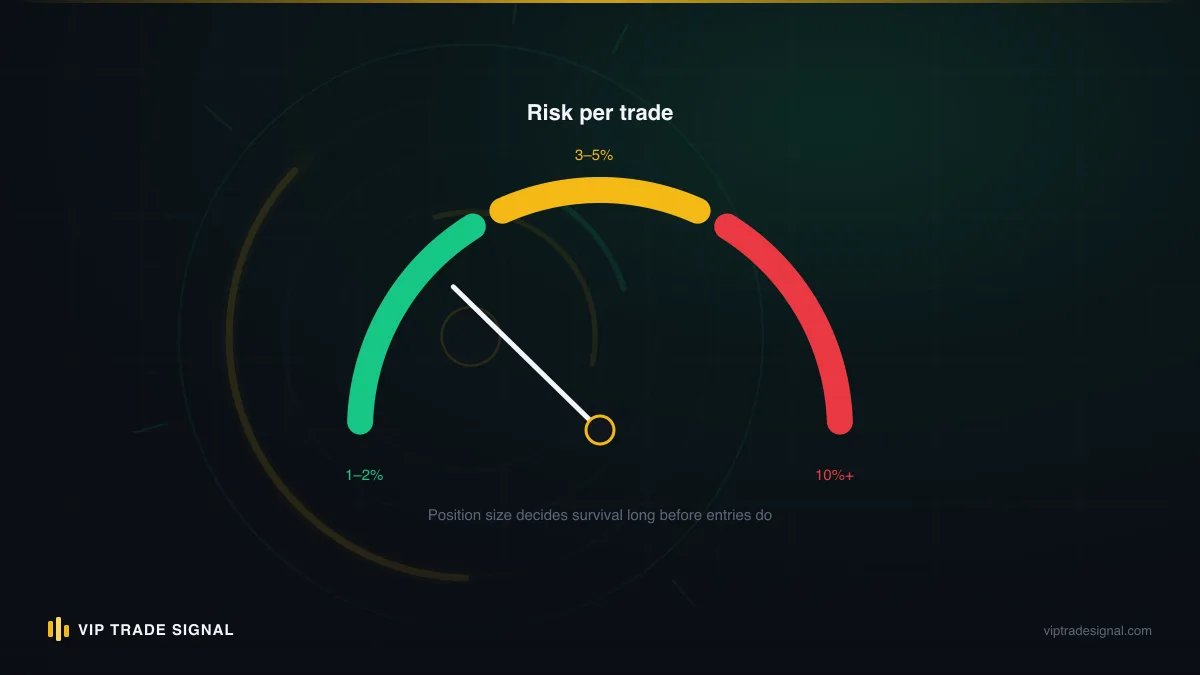
The problem is obvious the moment you put numbers on it. A one-lot gold trade moving $10 per point is a mild day for a $100,000 account and a heart attack for a $5,000 one. Fixed-lot allocation means every client runs a different effective risk, and the smallest accounts run the most. Percentage-based allocation solved this properly, PAMM and modern MAM both absorbed the fix, and pure LAMM faded away except as an allocation option inside MAM software.
The useful lesson survives the acronym: any structure that copies position size without reference to your account size is transferring the manager's risk appetite onto you unscaled. Keep that thought. It comes back with force in the copy trading section, because a large fraction of retail copy trading quietly repeats LAMM's mistake.
Copy trading: control kept, discipline lost
Copy trading is the youngest of the three models and, by user count, the biggest by far. The pitch is seductive because it inverts the custody problem entirely. Nobody holds your money but you. Nobody has trading rights over your account. A platform sits in the middle, watching a signal provider's account and echoing its trades into yours, and you can sever the link with one tap.
On the custody axis, that's genuinely the safest arrangement of the three. So why do copy trading results skew so poorly? Broker disclosures across the industry put retail CFD loss rates somewhere around seven in ten accounts, and there's no evidence copy traders as a group do better. The answer is that copy trading swaps a custody problem for two behavioural ones.
The first is selection. Copy platforms are ranked marketplaces, and the ranking is nearly always recent return. Recent return is close to the worst possible sorting key, because the strategies that top a twelve-month leaderboard are disproportionately the ones taking hidden tail risk: martingale progressions, grid systems without stops, sellers of volatility who look brilliant right up until the week they lose two years of gains. The leaderboard doesn't show you the risk. It shows you the survivors. A trader averaging 4% a month with a smooth curve is either exceptional or, far more often, one news spike from ruin, and the platform's star rating cannot tell you which.
The second is the tap itself. Because disconnecting is effortless, people do it at exactly the wrong moments. The typical copy trading arc goes like this: find a provider after a hot streak, allocate, sit through the inevitable drawdown that the provider's history says is normal, panic somewhere near its bottom, disconnect, and lock in a loss the strategy would likely have recovered. Then repeat with a new provider. The investor experiences a string of realised drawdowns from strategies that each, individually, made money over the full period. Control without a plan for using it is not protection. It's a self-harm instrument with good UX.
There's also a quieter mechanical issue: sizing. Many platforms default to proportional copying, which is fine, but plenty of retail setups copy fixed lots or let you crank a multiplier, and a provider trading comfortably on a $200,000 account can generate position sizes that are lethal on your $3,000 one. That is LAMM's old mistake, reborn with a friendlier interface. If you copy anyone, the very first thing to verify is how size translates from their account to yours, and what a bad week on their curve looks like scaled onto your balance. We wrote more about that class of problem in our piece on the pros and cons of managed forex accounts, and the sizing section applies to copiers word for word.
And then there's the gap nobody prices in: replication drift. Your copied trade is not the provider's trade. It fires milliseconds to seconds later, at whatever price your broker shows by then, with your spread, your swap rates, your slippage. On a slow swing strategy the drift is trivial. On anything that scalps or trades news, it's fatal: a provider whose edge is two pips of precision cannot transmit that edge through a copy pipe that costs two pips to pass through. This is why a provider's published return and their copiers' average return can be entirely different numbers, and why the second figure, on platforms honest enough to show it, is the only one worth reading.
As for the perennial "best copy trading platforms" question: the honest answer is that platform choice matters far less than provider choice and sizing, and any platform that is a regulated broker with transparent provider histories, real drawdown stats and proportional sizing is adequate. People agonise over the venue and then pick a provider off a returns leaderboard in ninety seconds. That ordering is exactly backwards.
Social trading vs copy trading: the distinction that matters
The industry uses these terms interchangeably, and it shouldn't, because they describe opposite relationships between you and the decision.
Copy trading is automated replication. A provider trades; your account mirrors it; your judgement is not in the loop trade by trade. You made one big decision (who to copy, how much) and delegated the rest.
Social trading, strictly speaking, is the information layer without the automation: feeds where traders share positions and reasoning, comment threads, sentiment data, the ability to see what people you follow are doing and then decide, yourself, whether to act. Think of it as a very noisy research department. Nothing executes unless you execute it.
Which is better depends entirely on which failure you're more prone to. Copy trading protects you from your own trigger finger but exposes you fully to the provider's risk appetite and to your own disconnect-at-the-bottom reflex. Social trading keeps your judgement in the loop, which is only a benefit if your judgement, honestly assessed, adds anything. For most beginners it subtracts: they follow confident-sounding strangers into positions they don't understand, at sizes chosen by mood.
Our actual view, having watched both crowds: social trading's feed is best treated as sentiment data, not as trade ideas. When every post about gold turns euphoric in the same week, that tells you something real about positioning. What any individual poster thinks about next Tuesday tells you close to nothing. And if you're going to follow someone's trades mechanically, do it through a structure with defined stops and sizes rather than by eyeballing a feed, because manual copying adds delay and emotion while removing nothing.
Fee flow: where the manager's cut hides in each model
Follow the fees and each model shows you its real shape. The same manager, running the same strategy, gets paid in tellingly different ways across the three structures.
In a PAMM, the standard arrangement is a performance fee taken as a percentage of profits, sometimes stacked with a management fee charged on assets regardless of results. The performance cut typically lands between 20% and 50% of gains. Watch two things. First, whether there's a high-water mark: without one, a manager can lose 20%, recover 20%, and charge you a performance fee for the recovery even though you've merely got your own money back. Any performance-fee arrangement without a high-water mark is a machine for billing you twice. Second, the asset-based management fee itself: 2% annually on the pool means the manager earns whether or not you do, which changes their incentives in ways you can guess.
In a MAM, fees are usually similar in shape (performance percentage, sometimes management fee) but deducted from your individual account, which at least makes them visible on your own statement. The murkier MAM fee is the one nobody itemises: markups. Some managers get paid through widened spreads or per-lot rebates from the broker, which means their income scales with trading volume, not with your profit. A manager on volume-based rebates has an incentive to trade a lot. Ask, in writing, whether the manager receives anything from the broker per lot traded. Hesitation is your answer.
In copy trading, the fee stack is usually smaller per line but has more lines: a platform subscription or profit share to the provider, spread markups on the copy-execution broker, sometimes a per-copied-trade commission. Individually modest, collectively real, and because copy strategies often trade frequently, the spread component quietly dominates. A provider making 30% a year gross on a strategy that costs you 12% a year in spreads and fees is a 30% headline and an 18% reality, before your own timing mistakes take their share.
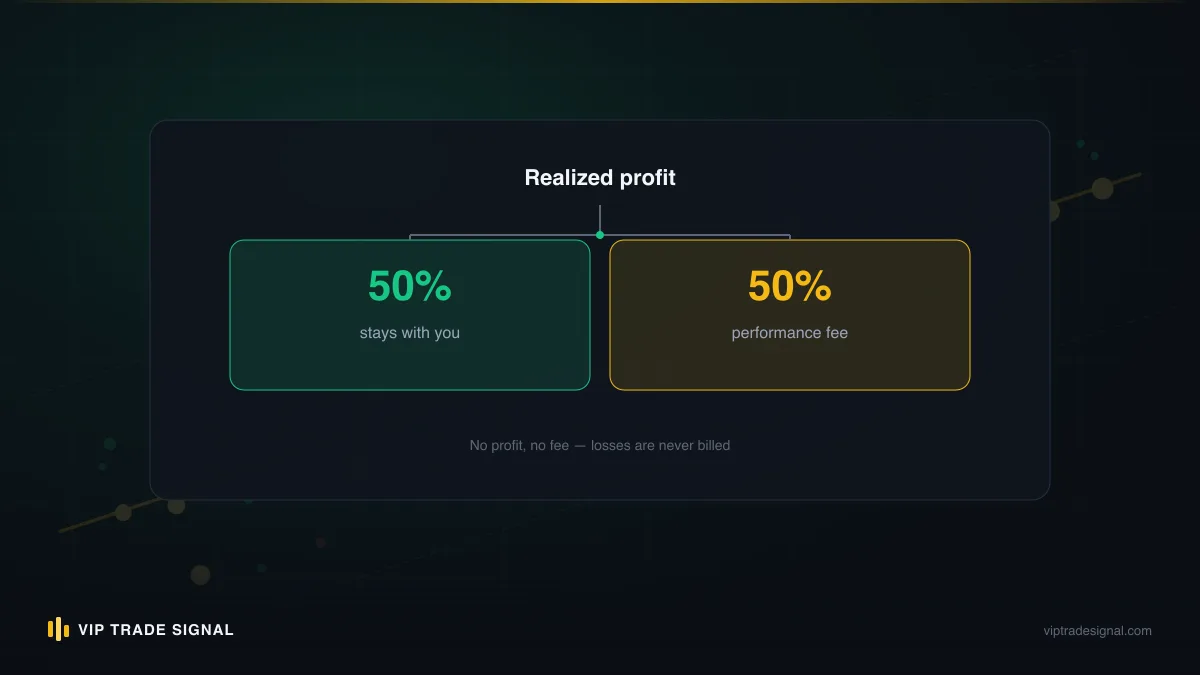
For contrast, and because it frames the fourth model below: the cleanest fee structure in this whole space is performance-only with a high-water mark and zero charges on assets or volume. The manager eats only what they kill, and only above the previous peak. It's rarer than it should be. We've laid out why performance-only pricing changes manager behaviour in a separate piece if you want the incentive mechanics in full.
A fee you can't see on your own statement isn't a fee. It's a leak.
Failure modes: what actually goes wrong in each structure
Comparisons love feature tables. Wreckage is more instructive. Here is how each model characteristically fails, because they do not fail the same way.
PAMM's characteristic failure is custody fraud. The pooled structure is the same shape as a Ponzi scheme; the only difference between the two is whether real trading occurs at a real broker, which is exactly the fact an investor inside the pool cannot directly verify. Most PAMMs at regulated brokers are legitimate. But nearly every headline forex fraud of the past two decades wore pooled clothing, because pooling is what makes the fraud mechanically possible. Secondary failure: gated exits. Even honest pools can trap you behind lock-ups precisely when you most want out, and a manager in deep drawdown has every incentive to keep gates closed and swing for recovery with your money.
MAM's characteristic failure is authorised destruction. The money stays in your account, so it can't silently vanish; instead it can be visibly demolished by over-leverage under a valid LPOA. The classic sequence: manager builds a good year on controlled risk, gathers a larger block, hits a losing streak, doubles size to claw back to the performance-fee threshold, and blows through client accounts in a week. Everything they did was authorised. The lesser MAM failures are paper failures: LPOAs drafted with withdrawal or fee powers the client never noticed, and rebate arrangements that turn the manager into a volume machine.
Copy trading's characteristic failure is distributional. No single villain, no dramatic collapse, just thousands of accounts bleeding through provider tail risk and badly timed disconnects. The martingale provider who tops the leaderboard for eighteen months and then loses 90% in a session takes a whole cohort of copiers with him, none of whom saw the risk because the platform displayed returns and not open-drawdown history. Individually, each loss looks like bad luck. In aggregate it's the predictable output of ranking by return and sizing by vibes.
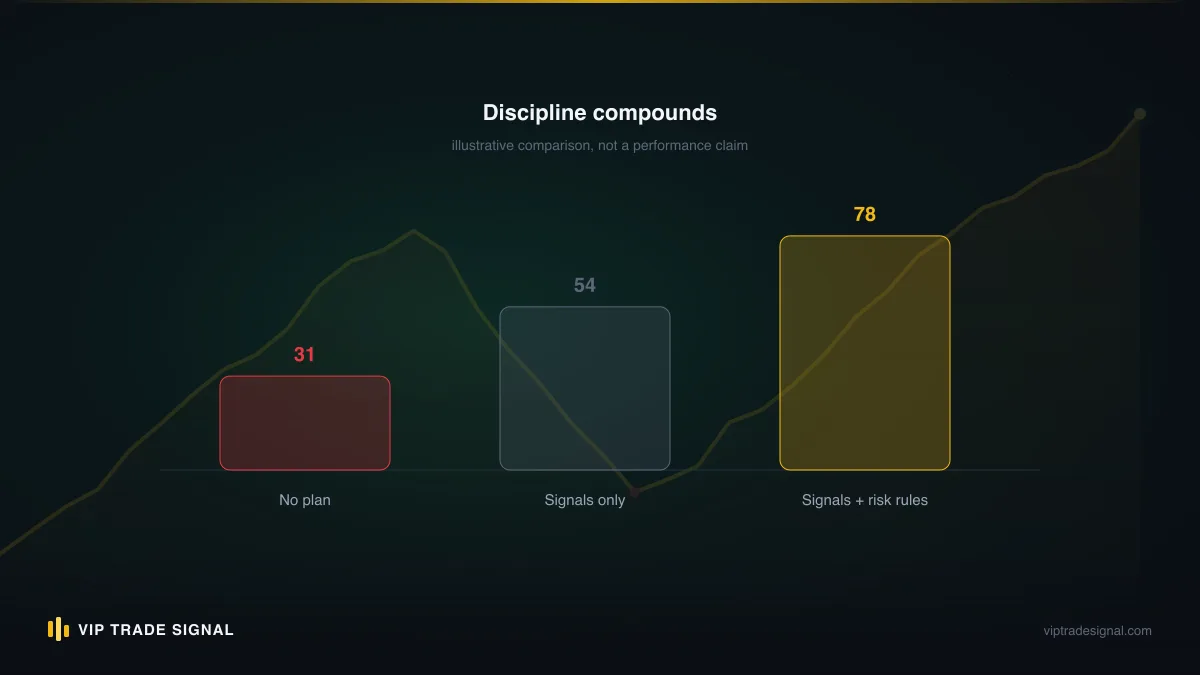
Notice what this list implies. The models fail in different places: PAMM at the custody layer, MAM at the authority layer, copy trading at the selection and behaviour layer. So the right question is not "which model is safest" in the abstract. It's which failure you are least equipped to detect and survive. If you can't independently verify a broker and a pool, PAMM's failure mode will find you. If you won't read an LPOA or monitor an account, MAM's will. If you pick providers off leaderboards and check your phone during drawdowns, copy trading's will. Every structure is safe for the investor who covers its specific weakness and dangerous for the one who doesn't.
The fourth option: direct, trade-only management in your own account
Most PAMM vs MAM vs copy trading articles stop at three. There is a fourth arrangement, older and plainer than all of them, that deserves a seat in the comparison: a manager trading your own individual account directly under a trade-only LPOA, no pool, no block software, no platform in the middle.
Structurally it's MAM stripped to one client. You open the account at a broker of your choosing, in your name. You grant the manager trading access: the investor password on MT4/MT5, or a formal LPOA limited to placing and closing trades. You keep the master password, which means you, and only you, control withdrawals, deposits and the ability to revoke access. The manager can trade. The manager cannot touch the money. Revocation is one password change, effective immediately, no notice period, no gate.
Run it down the axes we've been using. Custody: fully yours, at your broker, nothing pooled. Visibility: total and real-time, since it's your own login watching your own positions. Exit: instant. Authority: trading only, and only until you say otherwise. On the protection axis this is the strongest configuration available to a retail investor, full stop.
So why isn't it the default? Economics, mostly. Managing accounts one at a time doesn't scale the way a pool does, so large managers won't do it below institutional ticket sizes, and the model survives mainly among small desks willing to take modest accounts. And the model shares MAM's honest limitation: trade-only access still means real trades with real risk, and a bad manager can still lose your money in plain sight. Custody protection is protection against theft and gating, not against loss. Anyone who tells you otherwise is selling something.
This is, for transparency, the model we run. Our account management service trades your own MT4/MT5 account, you keep the master password and the withdrawals, and the fee is a flat 50% of realised profit with a $200 minimum advance and nothing charged on assets or volume. Fifty percent is the high end of the industry's range, and we say so openly; it's the price of a low minimum, no lock-up, and pay-for-results-only pricing, and whether that trade-off suits you depends on your account size and your alternatives. Losses happen in this model like every other. The structure determines who holds the money, never which way gold goes next.
If your interest is less "hand it over" and more "learn while following a desk", the same custody logic applies to signals: your account, your execution, our levels, with every closed call public. That route can even be free through a partner broker arrangement, details here, if a $250 balance is maintained.
Decision matrix: matching the model to the investor
Enough anatomy. Here's the comparison collapsed into the axes that actually decide outcomes.
| Axis | PAMM | MAM | Copy trading | Direct (own account, LPOA) |
|---|---|---|---|---|
| Who holds the money | The pool | You, at your broker | You, at your broker | You, at your broker |
| Real-time trade visibility | Rarely | Yes, your own login | Yes | Yes, your own login |
| Exit speed | Lock-ups common | Days (revoke LPOA) | Instant | Instant (password change) |
| Worst-case failure | Total loss to fraud | Account blown under valid LPOA | Provider tail risk + your timing | Trading losses in plain sight |
| Typical minimum | Low to mid | Often $10k+ | Very low | Low to mid |
| Who it fits | Verifiers comfortable with delegation | Larger accounts that will read the paperwork | Self-directed, disciplined small accounts | Control-first investors of any size |
Reading it as recommendations:
- You want full delegation and you're able to verify institutions. A PAMM at a well-regulated broker is defensible, provided the master account is verifiable, the trade history is visible, the performance fee carries a high-water mark, and you treat the lock-up as money you cannot reach. If you cannot personally confirm where the pool lives, do not enter it. Not "probably fine". Do not.
- You have $10,000-plus and you'll actually read documents. MAM gives you delegation with your money in your own name. Your job is the LPOA (trade-only, no withdrawal or fee powers you didn't agree to), the rebate question in writing, and a weekly glance at your own platform. Skip any of those and you've bought PAMM-grade risk at MAM prices.
- You're small, self-directed and honestly disciplined. Copy trading is the cheapest seat at the table. Your protection is entirely in your process: pick providers by maximum drawdown and open-trade behaviour rather than by return, verify how their sizing scales to your balance, and write down, before you connect, the drawdown number at which you'll disconnect. Deciding that number during the drawdown is how copiers lose.
- Your first priority is that nobody can hold or gate your money, at any account size. Direct trade-only management in your own account is the model built for you, whether with our desk or anyone else's. The vetting shifts entirely onto the manager, so demand a public, complete track record including losses, and walk away from anyone whose history only exists in screenshots.
And running through all four: the passive income framing that sells these models deserves permanent suspicion. Every one of them involves real drawdowns, and most retail money in leveraged products loses. Delegation changes who pulls the trigger. It does not change the odds of the market.
Where this leaves you
Strip away the acronyms and the whole comparison reduces to one sentence: PAMM asks you to trust a pool, MAM asks you to trust a document, copy trading asks you to trust a leaderboard and yourself, and direct own-account management asks you to trust a track record while conceding you almost nothing else to lose sleep over.
Our bias is on the record, and it's a custody bias rather than a returns claim: money that never leaves your own account cannot be pooled away, gated, or quietly re-marked on someone's spreadsheet, and that's a category of risk you can simply delete before performance is even discussed. Delete it. Then judge whoever wants to trade for you on evidence.
Whatever model you land on, put it through five questions before a single dollar moves. Where, exactly, does my money sit, and can I verify that without the manager's help? What does the written authority allow beyond placing trades? How fast can I get out, in the worst week, not the best? Which fees exist that never appear on my statement? And where is the full trade history, losses included, in a form nobody could have curated?
A legitimate operator answers all five in ten minutes and doesn't flinch. We publish our answers, ours are on the FAQ and every closed signal sits in public history, and any competitor worth your money can do the same. The ones who can't answer aren't offering you a management model. They're offering you a story, and stories are the one asset class in this business with a 100% loss rate.