Here is a conversation that happens every week somewhere on the internet. An American trader, tired of losing money on his own, messages a slick account management service he found through Telegram or Instagram. The service says yes, of course, we manage accounts for US clients, minimum $500, profits split monthly. Nobody mentions registration. Nobody mentions the CFTC. Three months later the trader is trying to work out whether he has any legal recourse against a company that, it turns out, was never allowed to touch his money in the first place.
If you are searching for managed forex accounts in the USA, you have probably already noticed something odd: almost every provider that ranks for the term is based offshore, and almost none of them will answer a direct question about US regulation. That silence is not an accident. The honest answer hurts their business model.
So let's give you the honest answer. Managed forex accounts are legal in the United States. But the conditions attached are strict enough that the overwhelming majority of services advertising to Americans are operating outside them, and as the client, you carry more of that risk than you might think. We run an account management service ourselves, we are not US-registered, and we will tell you plainly later in this piece what that means for American readers. First, the rules.
The short answer: legal, but tightly boxed in
Nothing in US law bans a professional from trading a forex account on your behalf. What the law does is control who may do it, how they must be registered, where the account can be held, and what they must disclose to you before a single trade goes on.
The practical effect is a funnel. For a US resident who wants someone else trading spot forex in their individual account, the compliant version of that arrangement looks roughly like this: your money sits with one of a small handful of CFTC-registered retail forex dealers, and the person trading it is registered as a Commodity Trading Advisor, is a member of the National Futures Association, and has passed the relevant exams. Every layer of that sentence is a legal requirement, not a nice-to-have.
Count the US retail forex brokers that can legally hold your account and you will run out of fingers on one hand. OANDA, Forex.com, IG US, and a couple of others depending on the year. That is the entire universe. Compare that with the hundreds of brokers available to a client in London or Sydney and you start to see why so many US traders get lured offshore, and why so many managers pretend the rules do not exist.
And the leverage is capped too. US retail forex is limited to 50:1 on major pairs and 20:1 on minors, which quietly kills half the aggressive strategies that offshore managers rely on to make their marketing numbers look exciting. A martingale grid that needs 500:1 leverage to survive its own drawdown simply cannot run inside a US account. Some people frame that as a restriction. Having watched what those strategies do to client money, we would call it a mercy.
It was not always this tight. Before 2008, US retail forex was closer to the wild west than most people remember, with hundreds of dealers, leverage in the hundreds, and a steady procession of firms vanishing with client deposits. The Farm Bill of 2008 and then Dodd-Frank in 2010 closed the gates. Capital requirements went from trivial to twenty million dollars, which alone wiped out most of the dealer list, and the registration net was widened to catch anyone touching US retail forex money in any professional capacity. So when a provider tells you the US rules are recent bureaucratic overreach, they have it backwards. The rules are old news, they were a response to actual carnage, and everyone still operating in the US market has been living with them for a decade and a half.
The regulatory stack: CFTC on top, NFA on the ground
Two bodies matter here, and it helps to know which does what.
The Commodity Futures Trading Commission is the federal regulator. It writes the rules for retail forex under the Commodity Exchange Act, as expanded by Dodd-Frank in 2010. Dodd-Frank is the piece of legislation that changed everything for US retail forex: it required any firm acting as a counterparty to US retail forex trades to register, and it made soliciting US residents without registration a violation in itself. Not a grey area. A violation.
The National Futures Association is the self-regulatory organisation that does the day-to-day supervision. If the CFTC writes the law, the NFA checks your homework. Registration as a CTA runs through the NFA, membership fees go to the NFA, audits come from the NFA, and the public database where you can look up any registered firm or individual, called BASIC, is run by the NFA. When people talk about NFA regulated forex account managers, this is the machinery they mean.
Underneath those two sit the registered firms themselves. Retail Foreign Exchange Dealers and Futures Commission Merchants hold client money. Commodity Trading Advisors direct trades in client accounts. Commodity Pool Operators run pooled vehicles. Introducing Brokers bring in clients. Each category has its own registration, its own disclosure obligations and its own compliance burden.
The piece that matters most for this article is the CTA. Under US law, a person who, for compensation, advises others on trading forex or directs trading in their accounts is a Commodity Trading Advisor and generally must register as one. Trading your account under a power of attorney for a cut of the profits is squarely inside that definition. There is no wiggle room in which a manager takes 30% of your gains each month and somehow is not "advising for compensation".
What CTA registration actually involves
It is worth understanding what a manager has gone through to become a legitimately registered CTA, partly so you can respect the ones who did it, and partly so you can see why so many skip it.
Registration means filing Form 7-R for the firm and Form 8-R for every principal and associated person. It means fingerprinting and background checks. The individuals actually making trading decisions sit the Series 3 exam, and for forex specifically the Series 34 on top. The firm pays NFA membership dues and, for forex CTAs, meets additional requirements that came in with the post-Dodd-Frank forex rules.
Then comes the ongoing burden, which is the real cost. A registered CTA must give every prospective client a disclosure document before opening the account, and that document has to be filed with the NFA and updated regularly. It must lay out the strategy, the fees, the risks and, crucially, the past performance, presented according to strict rules. No cherry-picked screenshots. No "up 400% this year" with the losing months airbrushed out. Performance presented by a CTA has to follow prescribed calculation methods, and the NFA audits against them.
Records must be kept and produced on demand. Promotional material is regulated: the NFA has specific rules about what a registered firm may claim in its marketing, which is why registered CTAs sound boring next to Instagram forex managers. Boring is what compliance looks like.
All of this costs real money, tens of thousands of dollars a year once you count compliance staff or consultants, which is why legitimate US CTAs tend to want larger accounts. A manager who has spent that much becoming compliant is not chasing $500 accounts, because the economics do not work. Sit with that for a second, because it explains the whole shape of this market: the compliant managers do not want small retail clients, and the managers who want small retail clients are almost never compliant.
And registration is not a one-off hurdle that fades into the background. NFA members get examined. An audit team can turn up, pull trade records, compare the performance in your disclosure document against the broker statements line by line, and read your promotional emails against the advertising rules. Managers have been fined and barred for a single misleading chart in a slide deck. Whatever you think of regulators generally, this specific machinery does something valuable for clients: it makes lying expensive. In the offshore world, lying is free, and priced accordingly into everything you are shown.
The compliant managers do not want small accounts, and the managers who want small accounts are almost never compliant. That single sentence explains most of the managed forex market a US resident will ever encounter.
Why offshore managers pitching US clients is a red flag, not a loophole
Now to the part of the market you will actually meet: the offshore manager who cheerfully accepts US clients.
The pitch usually goes one of two ways. Either the provider simply never mentions regulation and hopes you do not ask, or they wave at a licence from an offshore jurisdiction, St Vincent and the Grenadines, Vanuatu, sometimes a Seychelles or Mauritius licence that sounds more official than it is, and imply that this covers everything. It does not. US law follows the client, not the manager. A firm in Dubai or Cyprus that solicits a US resident to open a managed forex account is subject to the CFTC's registration requirements regardless of where the firm sits. That was the whole point of the Dodd-Frank changes.
The CFTC knows this happens at scale, which is why it maintains the RED list, the Registration Deficient list, naming foreign entities that appear to be soliciting US clients without registration. It is a long list. It grows every year. And enforcement actions against offshore forex schemes targeting Americans are a steady drumbeat in CFTC press releases, usually announced after the money is gone.
Some offshore brokers try to thread the needle by refusing US clients at signup, which is why Americans get blocked from most offshore platforms. Others, further down the quality ladder, accept US clients and simply do not care. And a third group coaches Americans to open accounts through a relative abroad or a mismatched address, which converts a regulatory problem into something closer to fraud, with you as a participant.
Picture how this plays out for a trader we'll call Dan, from Ohio, entirely generic and entirely typical. Dan finds a manager through a YouTube ad. The website has a Vanuatu licence number in the footer, which Dan reads as "regulated". He is told to open an account at a broker he has never heard of, with an address in the Marshall Islands, and the signup form does not blink at his Ohio address. He deposits $3,000. For two months the account grows and Dan tells his brother-in-law about it. In month three the equity curve goes vertical in the wrong direction, the "manager" stops replying, and the broker's support desk asks him to submit a withdrawal request that stays pending forever. Dan googles "who regulates forex in the US" for the first time, roughly six months later than would have been useful, and discovers that every party in the chain was violating US rules from the day he clicked the ad. There is nobody to call. That is the standard story, and the only unusual thing about Dan is that some versions of him deposit $30,000.
Be clear-eyed about what "non-compliant" means for you as the client. It does not merely mean the manager might get in trouble. It means the entire arrangement exists outside the system designed to protect you, so if things go wrong, and in this corner of the market they go wrong constantly, you are not standing behind any of the protections a registered structure provides.
What US-compliant managed forex actually looks like
Suppose you find the rare arrangement that ticks every box. What does it look like in practice? It is worth describing, both so you can recognise it and so you can measure any offer against it.
Your account is opened in your own name at a CFTC-registered RFED. You go through that broker's own onboarding, their identity checks, their risk disclosures. The manager never touches your deposit; money moves from your bank to the regulated broker and back, full stop.
Before anything is traded, the manager, a registered CTA, gives you their disclosure document. You sign an advisory agreement and grant a limited power of attorney, which the broker itself processes and keeps on file. US brokers will not accept an LPOA from an unregistered manager on a retail forex account; the broker checks the manager's NFA status because the broker is on the hook too. That single fact is one of the cleanest filters in this whole area: if a manager's process involves any US-regulated broker verifying their registration, they are probably legitimate, and if their process avoids US brokers entirely, ask yourself why.
Fees are typically management plus incentive, the old two-and-twenty shape or some variant, disclosed in writing and often billed through the broker. Performance reporting follows NFA rules. You can revoke the LPOA whenever you like, and the money never leaves your sight.
Here is the same comparison laid flat:
| US-compliant structure | Typical offshore offer | |
|---|---|---|
| Broker | CFTC-registered RFED (a handful exist) | Offshore broker, often on the RED list |
| Manager status | Registered CTA, NFA member, Series 3/34 | Unregistered, or offshore licence only |
| Disclosure | NFA-filed disclosure document before trading | A Telegram chat and a screenshot |
| Performance claims | Regulated calculation methods, audited | Whatever the marketing department invents |
| Leverage | Capped at 50:1 majors | 500:1 or more |
| Your money | In your name at a regulated dealer | Sometimes in your name offshore, sometimes "pooled" |
| If it goes wrong | NFA arbitration, CFTC reparations | Good luck |
The honest downside: this compliant version is expensive to access. Minimums at legitimate US CTAs commonly start at $25,000 and often sit far higher, because the compliance overhead makes small accounts uneconomic. The trader with $2,000 who most wants a managed account is precisely the client the compliant industry cannot profitably serve. That gap is where the offshore sharks feed.
The fifteen-or-fewer exemption and other narrow doors
Whenever we explain the CTA rule, someone raises the exemption. Yes, it exists. No, it is not the loophole the internet thinks it is.
The Commodity Exchange Act exempts a person from CTA registration if, over the preceding twelve months, they have advised fifteen or fewer people and, this is the part everyone skips, they do not hold themselves out to the public as a commodity trading advisor. Both conditions. Together.
The second condition is the killer. A website offering account management is holding out to the public. So is a Telegram channel, an Instagram page, a YouTube pitch, a listing on a managed accounts directory. The exemption was designed for genuinely private arrangements, the family friend who trades accounts for a few people he already knows and never advertises. The moment a manager markets the service to strangers, the exemption is gone, however few clients they currently have.
So when an offshore firm with a polished website tells a US client "we don't need registration, we're under the exemption", they are wrong twice: once because their public marketing defeats the holding-out condition, and once because the exemption was never meant as a commercial business model in the first place.
There are other narrow paths. Family offices have their own carve-outs. Certain advisers already registered with the SEC in other capacities have specific treatment. Trading for qualified eligible persons under Regulation 4.7 lightens the disclosure burden for wealthy investors, though registration is still generally required. None of these help the ordinary retail reader, and any provider citing them at a $500-minimum retail audience is reciting words they found in someone else's compliance memo.
If you take one thing from this section, take this: exemptions in this area are shaped for private, small-scale, unadvertised arrangements. Anything you found through marketing is, by definition, not that.
Futures, pools and the routes that actually work for US investors
If the compliant spot-forex route is priced out of reach, what can a US resident actually do? More than you might think, once you stop insisting on the specific product the offshore marketers sell.
Managed futures are the grown-up sibling of managed forex, and they are a genuine, functioning, regulated industry in the US. Currency exposure through futures contracts on the CME, trades placed by registered CTAs, accounts held at registered FCMs, decades of track record conventions. Minimums are still meaningful, often $50,000 and up for separately managed accounts, but the structure works and the performance data is real.
The other thing managed futures gives you that managed forex marketing never will: comparable data. Because registered CTAs report performance under common rules, databases exist where you can line up dozens of programmes over ten or twenty years, drawdowns included. Spend an hour in one and your expectations get recalibrated fast. The long-run stars of the regulated industry compound in the low teens annually with 20% drawdowns along the way. Not 10% a month. Not "guaranteed 5% weekly". Low teens, in a good programme, with painful stretches. When the fully regulated professionals with real capital behind them produce those numbers, the offshore stranger promising triple that from your $800 deposit is telling you something, if you are willing to hear it.
Commodity pools are the pooled version: your money goes into a fund run by a registered Commodity Pool Operator alongside other investors. Lower practical minimums than a separate account, at the cost of your money being commingled and the strategy being one-size-fits-all.
Then there are the public-markets routes that need no manager at all. Currency ETFs give you directional exposure to the dollar, euro or yen inside an ordinary brokerage account. For readers who come to us asking about gold specifically, and most of ours do, gold futures, gold ETFs and the shares of miners are all available to any American with a Schwab account, no offshore anything required.
And there is the option the industry never mentions because nobody earns a fee from it: trade your own account, smaller and slower than you would like, while you learn. A US resident can trade spot forex or gold CFD-equivalents at a registered RFED entirely legally on their own behalf. The 50:1 leverage cap will feel restrictive if you learned position sizing from Instagram. It will feel sensible after your first serious losing streak, and there will be one; losing streaks are not a sign the strategy broke, they are the tuition everyone pays.
None of these carry any promise of profit. Managed futures CTAs have losing years. Currency ETFs go down. The regulated wrapper changes who is accountable and what you are told, not whether the trades work.
What you risk as the client when the manager is not registered
It is tempting to think the registration question is the manager's problem. Their paperwork, their fine, their headache. As the client of a non-compliant arrangement, though, you are carrying specific, practical risks, and it pays to name them.
First, the recourse gap. Clients of NFA members can bring disputes through NFA arbitration; there is a reparations programme at the CFTC. Clients of an unregistered offshore manager have none of that. Your realistic remedies are a complaint to a regulator in a jurisdiction that may not answer emails, or litigation abroad that will cost more than the account was worth. When the CFTC does act against an offshore scheme, judgments frequently go unpaid because the money is simply gone.
Second, the honesty gap. Everything a registered CTA tells you about performance is produced under rules with audit teeth. Everything an unregistered manager tells you is marketing. That MyFxBook link can be a demo account. That 80% win rate can be a martingale strategy one bad month from zero, and if you want to see exactly how that movie ends, we wrote up the mechanics in our piece on martingale risk in managed accounts.
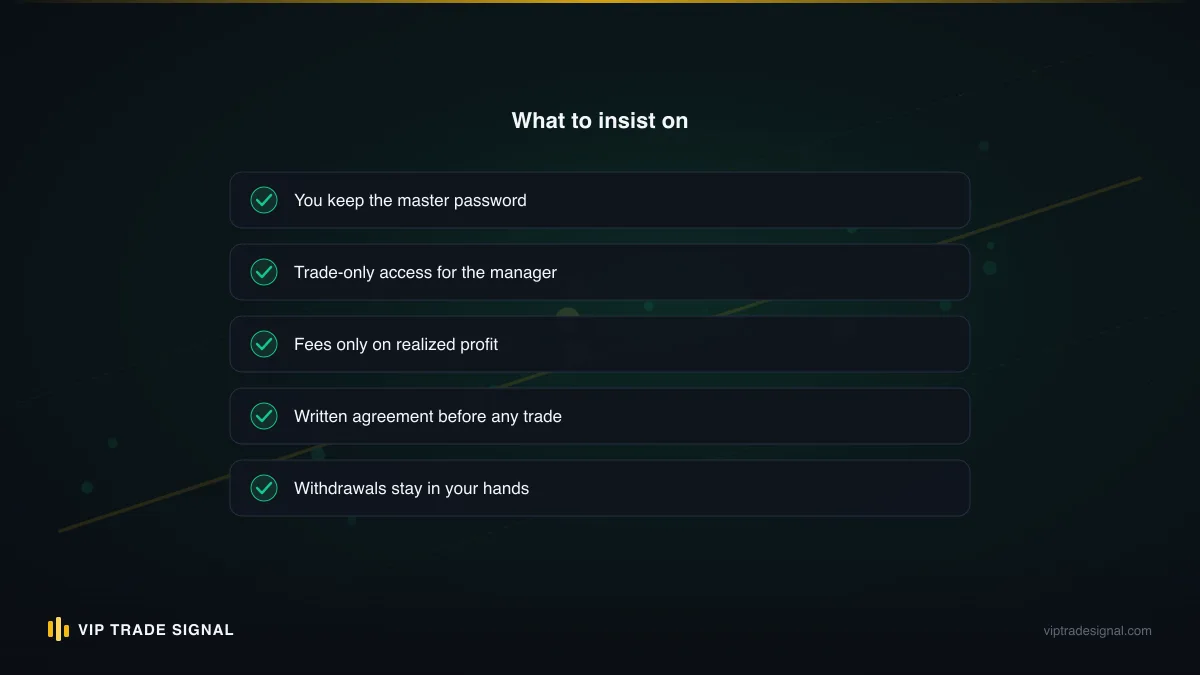
Third, the access gap. The worst offshore arrangements do not stop at trading your account; they ask you to deposit with "their" broker, or hand over credentials that control withdrawals. Once someone else can move money out of the account, the trading strategy is irrelevant, because you no longer have an account, you have a donation. The difference between the investor password and the master password on MT4 is the difference between someone watching your money and someone owning it, and it is shocking how many people learn that distinction after the fact.
Fourth, and this one is uncomfortable: participating knowingly in an arrangement built on a false address or a borrowed identity can put you on the wrong side of the rules too. If a provider's onboarding involves you pretending not to be American, walk.
How to check a manager's NFA status in two minutes
Here is the good news buried in all this: verifying a claim of US registration is genuinely easy. The NFA runs a free public database called BASIC at nfa.futures.org, and it takes about two minutes to use. No account, no fee.
- Get the exact legal name of the firm and, separately, the full name of the individual who will trade your account. Marketing names and legal names often differ; insist on the legal one. A firm that will not give it has answered your question already.
- Search both names on BASIC. You are looking for a current registration, CTA for a firm managing individual accounts, and NFA membership. "Pending" is not registered. "Withdrawn" is not registered. A record that exists but shows no current status is not registered.
- Read the disciplinary history on the record. Actions, arbitration awards, regulatory findings, all listed. One old minor matter with a clear resolution is life; a pattern is a verdict.
- Check the individual's exam history for Series 3 and Series 34. The person directing forex trades should hold both.
- Cross-check the CFTC's RED list if the firm is foreign. If the name appears there, the American regulator has already flagged them for doing exactly what they are now doing to you.
- Finally, ask the manager one direct question in writing: "Are you registered with the CFTC and a member of the NFA, and may I have your NFA ID?" A legitimate US manager answers in one line, because their NFA ID is on their own disclosure documents. Evasion, offence, or a paragraph about their offshore licence is your answer.
Notice what this list does not include: their published returns, their Telegram testimonials, their office photos, the professionalism of their website. All of that is theatre available to anyone with a designer. The register is the only part they cannot fake.
If a manager fails these checks and you are a US resident, the conversation is over. Not "over unless the returns are really good". Over.
Questions US readers keep asking us
Are managed forex accounts legal in the US at all? Yes. This whole article is the long version, but the compressed answer is: legal when the manager is a registered CTA and NFA member and your account sits at a CFTC-registered broker, and effectively illegal in most of the forms actually advertised to American retail traders online.
What if my account is offshore but I trade it myself? Different question, still messy. An offshore broker that accepts your US-resident account without CFTC registration is itself breaking US rules by serving you, and your money sits outside every US protection. Some Americans do it anyway. We would not, and we say that as a firm that has no dog in the fight over where you self-trade.
Can I just use a US broker and give my login to a manager I trust? Handing over your credentials so an unregistered person can trade your account does not make the arrangement compliant; it makes it invisible, breaches your broker's terms, and gives away the exact control that keeps your money yours. If they are worth trusting, they can be verified. If they cannot be verified, that is information.
Does a US person qualify for the private exemption with a friend or family member managing their money? Possibly, if it is genuinely private: fifteen or fewer clients, no public marketing, no holding out. A real lawyer should look at any real case. What we can tell you for free is that no arrangement you found through an advert qualifies.
Is copy trading or a PAMM account a way around the rules? The CFTC treats substance over form. If someone else is effectively directing trading in your account for compensation, the CTA analysis applies whatever the technology is called. PAMM structures at offshore brokers are, for a US resident, usually the offshore problem and the unregistered-manager problem stacked on top of each other.
Do the rules differ state by state? The federal framework, CFTC and NFA, is the one that matters for forex, and it applies in all fifty states. A few states add their own wrinkles for investment schemes generally, and state securities regulators do sometimes chase forex fraud under their own statutes, which occasionally gets victims further than waiting on federal action. But no state offers a permissive side door. Nobody is legally running unregistered retail forex management out of Wyoming because the vibe there is friendlier.
What about crypto or gold instead of forex? Different instruments, overlapping rules. Gold traded as a spot metal contract for retail Americans falls under closely related CFTC retail commodity rules; this is not a trapdoor out of the framework. The pattern to remember is that US regulators care about leveraged retail speculation and who controls it, not the ticker.
Where this leaves you, and where we stand
Time for the disclosure this entire article has been walking towards, because we would rather write it ourselves than have you discover it in a comment section.
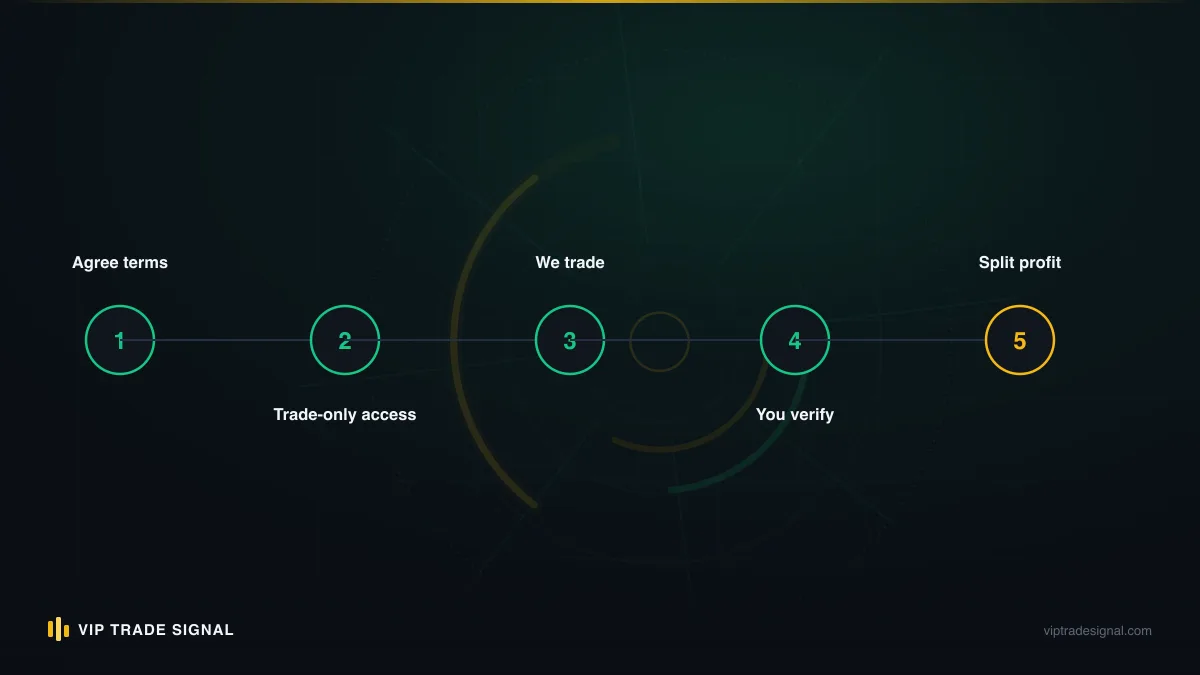
VIP Trade Signal runs an account management service. We trade gold, XAU/USD only, on the client's own MT4 or MT5 account, for a flat 50% of realised profit with a $200 minimum advance, and the client keeps the master password and full control of withdrawals throughout. We are open about the model, about who we are, and about the fact that our fees sit at the high end of the market because our minimums are low and everything is pay-as-you-go. Every closed signal we issue is public, wins and losses both, and losses happen, regularly, because that is what trading is.
We are not registered with the CFTC and we are not NFA members. Which means that everything this article says about offshore managers and US residents applies to us. We cannot compliantly offer account management to US residents, and so we do not. If you are American and you ask us to manage your account, the answer is no, and if you ask us through a cousin's address in Toronto, the answer is a firmer no. It costs us business to say that. It would cost you more if we didn't.
What can a US reader take from us? The educational side of the site, all of it, including the pieces on how MT4/MT5 account management actually works mechanically, which apply to any manager anywhere. Signals as information are a different regulatory animal from managing your money, and Americans routinely read analysis from all over the world; what you execute, and where, is governed by the rules above and by your own judgement. If you are outside the US, the account management conversation is open, the terms are on the table, and the FAQ covers most of what people ask before they contact us.
And the take, since you have read this far. The US managed forex market is small, expensive and heavily policed, and that is the market working as designed. The rules exist because an earlier generation of Americans wired billions to confident strangers and got wreckage back. Every restriction that frustrates you today, the 50:1 cap, the tiny broker list, the registration wall, is a scar from a specific way people got hurt.
So if you are a US resident, your real choices are these: a registered CTA if your account is large enough to interest one, managed futures or a commodity pool if you want professional currency exposure with real oversight, ETFs if you want it simple, or your own two hands at a registered broker while you learn. What is not on the list is the unregistered offshore manager with the beautiful equity curve, and by now you know exactly why. The two minutes it takes to search a name on BASIC is the cheapest risk management available in this entire industry. Use it before you use anything else, including us.