Somewhere around month three, every new trader hits the same fork. You've watched the videos, you've demo-traded, you've maybe put a few hundred dollars into a live account and felt the peculiar sting of watching it shrink in real time. And a thought arrives, quietly at first: should I even be doing this myself?
The managed forex account vs self trading question gets answered badly almost everywhere you look. Trading educators tell you self-trading is the only honourable path, because they sell courses. Account managers tell you delegation is the obvious choice, because they charge fees. Both are talking their book. Neither will put actual numbers in front of you, because the numbers are uncomfortable for everyone involved, us included.
So let's do the thing nobody does. Real loss rates from broker disclosures. An honest price on the learning curve, in hours and in dollars. The genuine costs of handing your account to someone else, including the ones that don't show up on a fee schedule. And at the end, a third option that most articles skip entirely, which is a shame, because for a lot of people it's the right answer.
The fork: your hours or your fees
Strip away the marketing and the choice is brutally simple. Trading your own account costs time and tuition. A managed account costs fees and control. That's it. Everything else is detail.
Self-trading's bill arrives in instalments you don't notice at first. The evenings spent on charts. The Sunday nights reading about interest rate expectations. The first account you blow, then the second one, which you blow more slowly and tell yourself that's progress. (It is, actually. But it's still money gone.) Most people who start this journey spend two to four years and several small accounts before they're consistently not losing, let alone winning. Some never get there. The honest ones will tell you that.
Management's bill is cleaner but no less real. You pay a share of profits, typically 30 to 50 percent of whatever the manager makes you. You accept that in a losing month you're down and there's nothing you can do about it except watch, or leave. And you learn nothing. Five years of managed trading teaches you roughly as much about markets as five years of owning an index fund teaches you about corporate management. Which is to say, almost nothing.
Here's the framing we'd offer, and it's the one this whole article hangs on: the question isn't which path is better. It's which resource you can actually afford to spend. A 26-year-old with a demanding job, a small account, and genuine curiosity about markets has hours to invest and small enough capital that tuition losses won't wreck anything. A 45-year-old with $30,000 of savings, a family, and no appetite for a four-year apprenticeship is spending a completely different currency.
Get honest about which one you are before you read another word. Because the rest of this article is going to give you numbers, and numbers only help people who've already stopped lying to themselves.
Self-trading's real success rates: what broker disclosures actually say
There's a peculiar gift buried in European financial regulation. Since 2018, brokers regulated in the EU and UK have been forced to publish, right on their homepages, the percentage of their retail clients who lose money trading CFDs. Not in a footnote. In the risk warning, in plain text, updated quarterly.
Go look at any major broker's site and you'll see it: somewhere between roughly 70 and 80 percent of retail accounts lose money. Some brokers sit in the high 60s, some touch the low 80s, but the band is remarkably stable across firms, across countries, and across market conditions. Bull markets, bear markets, quiet years, chaotic ones. The number barely moves.
Sit with that. These aren't survey results or academic estimates. This is the brokers' own client data, published under legal compulsion, and it says that roughly three out of four people who try what you're considering lose money over the measured period.
Now, two honest caveats, because raw numbers mislead in both directions.
First, the measurement window is usually 12 months. A trader in year one of a four-year learning curve gets counted as a loser even if they end up profitable in year five. The disclosure figures overstate permanent failure and understate the number of people who eventually make it. Somewhat.
Second, and cutting the other way, the survivors aren't all skilled. Some of the 20 to 30 percent who "made money" in a given year got lucky, sized huge on a trend that happened to run, and will hand it back next year. Consistent, multi-year profitability among retail traders is rarer than the annual snapshot suggests. How much rarer nobody can say precisely, and we're not going to invent a figure. But every experienced desk trader we know would guess it's a single-digit percentage of everyone who starts.
The retail trader success rate is not a secret. It's printed on the front door of every regulated broker in Europe. The remarkable thing is how completely everyone walking through that door ignores it. And to be fair, some ignoring is rational, because the disclosure can't tell you whether you specifically will be in the losing 75 percent. What it can tell you is the base rate you're betting against. Any decision about managed forex account vs self trading that doesn't start from that base rate isn't a decision, it's a mood.
The learning curve, priced honestly
Let's cost out the self-trading path the way you'd cost out any other professional qualification, because that's what it is. Nobody expects to become an accountant in six months of evenings. Trading is harder than accountancy, less structured, and the exams are marked in your own money.
Time. Call it 10 hours a week if you're serious: chart time, journaling, reading, reviewing trades. Over three years that's roughly 1,500 hours. Some people do it faster with good mentoring; plenty take five years or stall entirely. If your working hour is worth $30, you've spent $45,000 of opportunity cost before counting a single trading loss. You won't feel it as a bill. It'll feel like a hobby. It's still gone.
Tuition losses. The polite phrase for blown accounts. A sane learner trades small while learning, so this doesn't have to be catastrophic. Say you fund a $1,000 account, lose most of it in year one making every classic mistake (overleveraging, no stop, revenge trades after a loss). You refund $1,000, lose half of that in year two making subtler mistakes. By year three you're roughly breakeven on new money. Total tuition: $1,500 to $2,500 for a disciplined learner. Undisciplined learners with access to real savings can multiply that by ten, and regularly do.
Tools and education. A decent charting platform, maybe a paid data feed, a course or two if you go that route. Budget $500 to $2,000 across the learning period. Be careful here. The education industry attached to forex is largely a machine for converting hope into course sales, and a $3,000 mentorship is usually worth less than a $40 book and a trade journal. If you want to shortcut some of the pattern recognition, following a transparent signal service and studying why each trade was taken is cheaper than most courses and involves real positions. That's part of why we publish every closed gold signal with its outcome, losers included: the record is the lesson.
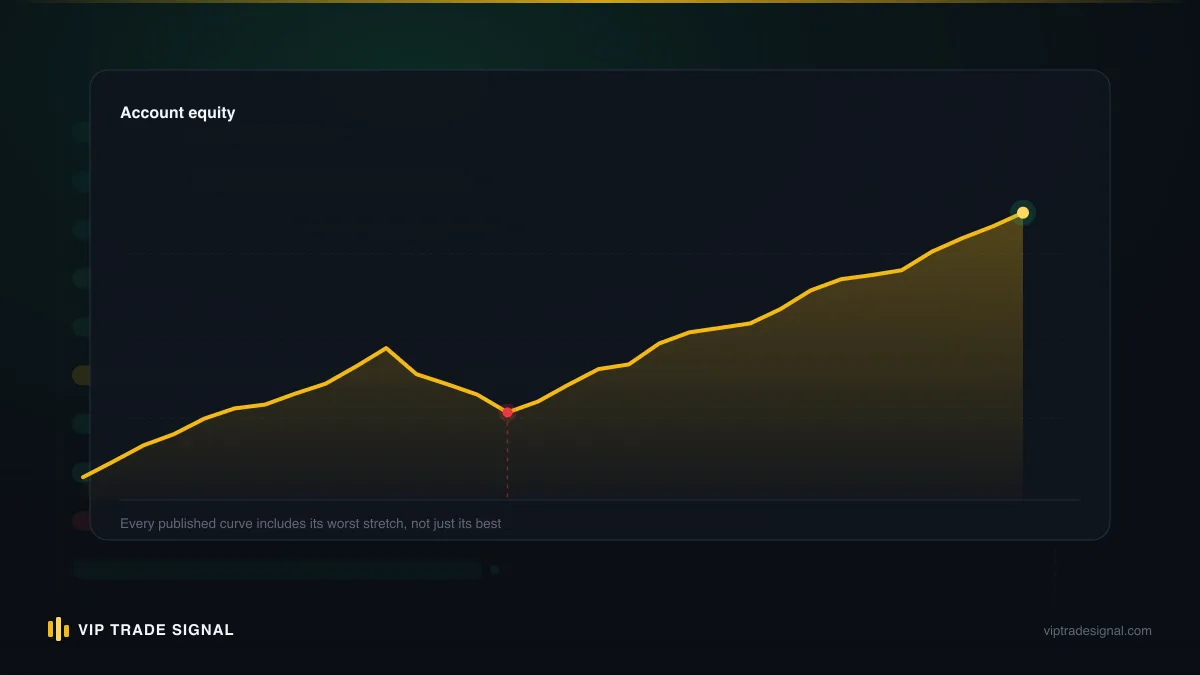
To make that curve concrete, take a trader we'll call Dan. Dan starts in January with $1,000, a YouTube education, and the standard-issue confidence. By April he's down to $340, having discovered that 0.5 lots on a $1,000 account is not "being aggressive", it's a countdown timer. He refunds, trades smaller, and spends the autumn breaking even, which feels like failure but is actually the first milestone that matters. Year two, Dan finds a lane: he stops trading six pairs badly and starts trading one market properly, keeps a journal, cuts his size to 1 percent risk, and ends the year down $180 with a rulebook he mostly follows. Year three he's up 11 percent on the year and, more importantly, he can tell you why: which setups paid, which he should stop taking, what his average loser costs. Nothing about Dan is exceptional. That's the point. His path, tuition and all, is roughly what "it went well" looks like, and it took thirty months. The traders who expect year three's results in month three are the ones funding the broker disclosures.
The emotional line item. No dollar figure, but it's real. The learning curve runs through stretches where you doubt yourself weekly, where a losing streak follows you into dinner, where you hide the P&L from your partner. Some people are constitutionally fine with this. Many aren't, and there's no shame in it. But you should know it's on the invoice.
Add it up honestly: three-ish years, $2,000 to $5,000 in cash costs, north of a thousand hours, and no guarantee of arriving. That's the real price of "I'll just learn to trade." It can absolutely be worth paying. It's just rarely presented as a price at all.
What self-trading gives you that money can't buy
Having laid out the bill, let's be equally honest about what you get, because the case for self-trading is stronger than the loss statistics make it look.
The skill, once you have it, is yours forever. Nobody can raise fees on it, close it down, or run off with it. A trader who has genuinely learned to extract money from markets owns something like a licence to print modest amounts of it for the rest of their life, portable across brokers, countries, and decades. Very few skills compound like that.
The skill also scales for free. A manager taking half your profits takes half whether you've given them $5,000 or $500,000. Your own edge costs the same to run at any size (up to liquidity limits that retail traders will never touch, especially in a market as deep as gold). If you ever expect to trade serious capital, every dollar of tuition paid now is amortised across every future dollar traded.
And there's a defensive value people underrate. A trader who understands position sizing, drawdown, and expectancy is nearly impossible to scam. They can read a signal seller's track record and spot the missing losers. They can look at a manager's returns and know that 20 percent a month means martingale or fraud, usually both; we wrote a whole piece on why smooth martingale curves end in ruin. The education is armour, even if you later choose to delegate anyway. Some of our most comfortable account management clients are former self-traders who learned enough to evaluate us properly, then decided their time was worth more than their edge.
There's also the honest, unquantifiable bit: some people just love it. The market is the most interesting puzzle some of us have ever met. If that's you, the hours aren't a cost in any real sense, and this entire cost-benefit framing slightly misses your point. Fine. Trade small, protect your capital while you learn, and enjoy it.
But notice what all these benefits have in common. They accrue if you finish the curve. The skill, the scaling, the armour: all of it belongs to the trader who gets through years two and three. The 70-something percent who lose money and quit in year one collect none of it. They paid tuition for a degree they never took.
Management's price: fees, dependence, and manager risk
Now the other branch of the fork, with the same cold eye.
The fees are large. Ours are at the top of the market and we'll say so plainly: our account management charges a flat 50 percent of realized profit, with a $200 minimum advance and no other charges. Industry-wide, performance fees run 20 to 50 percent, sometimes with a management fee of 1 to 2 percent of the account on top whether you profit or not. Half your upside is a serious price. We charge it because we take small accounts most managers won't touch, everything is pay-as-you-go, and there's no lock-in; whether that trade-off suits you is genuinely your call, and for large accounts a percentage-fee manager may cost less. Compare properly.
The dependence is permanent. Ten years with a manager leaves you exactly as unable to trade as the day you started. If the arrangement ends, and every arrangement eventually ends, you're back at the fork with a decade less runway. This is the cost nobody prices, and for younger clients it's often the biggest one.
Manager risk is the one that actually destroys people. Fee drag stings; a bad or dishonest manager amputates. The failure modes are well documented. Managers who demand you wire money to them rather than trading your own brokerage account, then vanish. Managers running martingale so the equity curve looks serene right up until the account implodes. Managers who churn your account because their broker rebate deal pays them per lot. The structural defences are simple and non-negotiable: the account stays in your name at a regulated broker, you keep the master password and withdrawal rights, the manager gets trade-only access, and fees come out of realized profit you can verify on your own statement. That's how we structure it, and if any manager anywhere resists that structure, walk. Not negotiate. Walk. (The regulatory picture also varies by where you live; we've covered the specifics for UK residents and the much thornier US situation separately.)
Since manager risk is the item that ruins people, here's the short due-diligence list we'd run on anyone, ourselves included, before granting trade access:
- Where does the money sit? Correct answer: in your account at a regulated broker you chose. Any manager who wants funds sent to their company account has ended the conversation.
- Can you withdraw without asking? Test it in month one with a small amount. A withdrawal that needs the manager's blessing isn't your money any more.
- How are fees calculated, and on what? Realized profit, verifiable on your own statement, is the clean answer. Fees on floating profit, or on volume traded, create incentives that point straight at your balance.
- What does a bad month look like? Ask directly. A manager who claims not to have losing months is either brand new or lying, and the second is more likely. You want a number for expected drawdown and a plan for when it's exceeded, in writing.
- Can you see a full closed-trade history, losses included? Screenshots of winners are marketing. A complete record is evidence. Anything curated is neither.
Twenty minutes of these questions filters out the majority of the industry's problems. The frauds rely, almost universally, on clients who never ask.
And the losses are still yours. A managed account is not a savings product. Gold trading with real leverage means drawdowns, losing months, and the possibility of an outcome worse than cash under the mattress. A manager changes who pulls the trigger. It does not change what markets are.
Management's gift: your evenings back, and no revenge trades
The honest case for delegation isn't "professionals always win." Plenty don't. The case rests on two quieter things.
The first is time, which is easy to state and easy to underrate. All those hours from the learning-curve section, the 1,500 of them, you keep. If you're mid-career, earning well, with kids or a business or a life, the arithmetic is frequently lopsided: your hours invested in your own profession return more, reliably, than they'd return chasing a trading edge you may never find.
The second is subtler and, in our experience of taking over accounts from self-traders, worth more than the first. A manager removes you from the loop where retail accounts actually die.
Go back to that 70 to 80 percent loss rate and ask what's driving it. Mostly it isn't analysis. Retail traders lose overwhelmingly through behaviour: position sizes that treble after a losing streak, stops widened mid-trade because "it'll come back", winners cut at +10 pips while losers ride to the margin call, the 2 a.m. revenge trade after a bad day. Every experienced trader knows this loop from the inside. Knowing it and escaping it are different achievements, and the second one is what takes years.
A decent manager's real product isn't a better entry. It's the absence of your worst evening.
Delegation solves the behaviour problem by force. You cannot revenge trade an account you can't place trades on. You cannot triple your risk after three losers because the sizing isn't yours to touch. For a certain kind of person, intelligent, impatient, prone to tinkering, this is worth the entire fee by itself. We have watched people lose money for years on their own, hand the account over, and do fine, not because our entries were magic but because their interference stopped.
Should you trade forex yourself? For this personality type, the truthful answer is: not with the serious money, no. And that's not an insult. Surgeons don't operate on their own families for the same reason.
Managed forex account vs self trading: five years, $5,000, head to head
Frameworks are nice. Let's run actual numbers. Take $5,000 and five years, and walk both branches. These are illustrative scenarios with stated assumptions, not projections, and certainly not promises; the whole point of this section is that the honest ranges overlap.
Path A: self-directed. Years one and two are tuition. Our disciplined learner trades a $1,000 slice, keeps $4,000 parked, and loses $1,500 across two years while working through the classic mistakes. Years three to five, having survived the curve, they trade the full stack and manage 15 percent a year, which is a genuinely good outcome for a retail trader and far from guaranteed. Five-year result: roughly $8,900 before costs, call it $8,400 after tools. Plus 1,500 hours spent. Plus, and this matters, a skill with decades of remaining life.
But that's the good scenario. Weight it by the base rates and the picture changes. If three in four learners never reach year-three profitability, the expected outcome of Path A across all the people who attempt it is a loss. You're not buying an average outcome, though; you're buying a lottery-like distribution where the prize is a permanent skill and the likely result is reduced capital and an education in humility.
Path B: managed. Assume a competent, honest manager returning 20 percent a year gross on a 50 percent profit share, so 10 percent net compounding. Five-year result: roughly $8,050. Hours spent: near zero. Skill acquired: none. And the risk column is different rather than absent. You've swapped behaviour risk for manager risk, and a bad year or a bad manager can leave you below $5,000, sometimes well below.
| Self-directed (good case) | Self-directed (typical case) | Managed (competent manager) | |
|---|---|---|---|
| Capital after 5 years | ~$8,400 | $3,000–4,500 | ~$8,050 |
| Hours spent | ~1,500 | ~800 (then quit) | ~10 |
| Skill owned at the end | Yes, permanent | Partial, unfinished | No |
| Main risk | Never finishing the curve | Same, realised | Manager quality and honesty |
| Fees paid | Tools and tuition losses | Tuition losses | ~50% of profits |
Before you object to the assumptions: yes, they're doing a lot of work, and you should stress-test them. Drop the managed return to 12 percent gross and Path B ends around $6,700, still ahead of the typical self-directed case and well behind the good one. Push the self-taught trader to 20 percent a year from year three and Path A pulls clearly ahead, at $9,800-ish, which is exactly the scaling argument from earlier: skill keeps paying after the comparison window closes, fees keep charging. Shrink the starting stake to $2,000 and the calculus tilts toward learning, because tuition is a fixed cost and there's less capital for fees to compound against. Grow it to $50,000 and it tilts toward management, or at least toward not learning on the full amount, because year-one mistakes at that size are life-altering rather than educational. The model is a toy. The directions it moves in are not.
Read that table crookedly and you'll conclude whatever you already believed. Read it straight and the conclusion is annoying but useful: over five years, the money difference between a successful self-trader and a well-managed account is small. The difference lies entirely in the other columns. Hours, skill, and which flavour of risk you'd rather hold. Which brings us back to where we started: pick the resource you can afford to spend.
The hybrid nobody writes about: manager for capital, signals for learning
Here's the option that almost every managed-vs-self article misses, and it's the one we'd point most readers toward. The fork is false. You don't have to choose one path with all your money and all your hours. Split them.
Put the serious capital, the money whose loss would actually hurt, with a manager, under the structural protections above: your account, your broker, your master password, fees on realized profit only. That money now compounds (or doesn't; markets are markets) without your behaviour in the loop.
Then take a small learning account, $500 to $1,000, an amount whose total loss you could shrug off, and trade it yourself following a transparent signal service. Not blindly. That's the crucial bit. Copying signals mechanically teaches you nothing and, frankly, isn't even the best way to use signals. Instead, treat each signal as a worked example. Before you place it, write down why you think the entry is where it is, why the stop lives behind that particular level, what the risk-reward is. After it closes, win or lose, review it. You're essentially auditing a live trading desk with real (small) money on the line, which beats any course we've ever seen, and it costs a fraction as much. Our own gold signals run $99 a month, or free if you trade with a partner broker keeping $250 in the account, and every closed trade sits in the public history for you to study, the losers most of all.
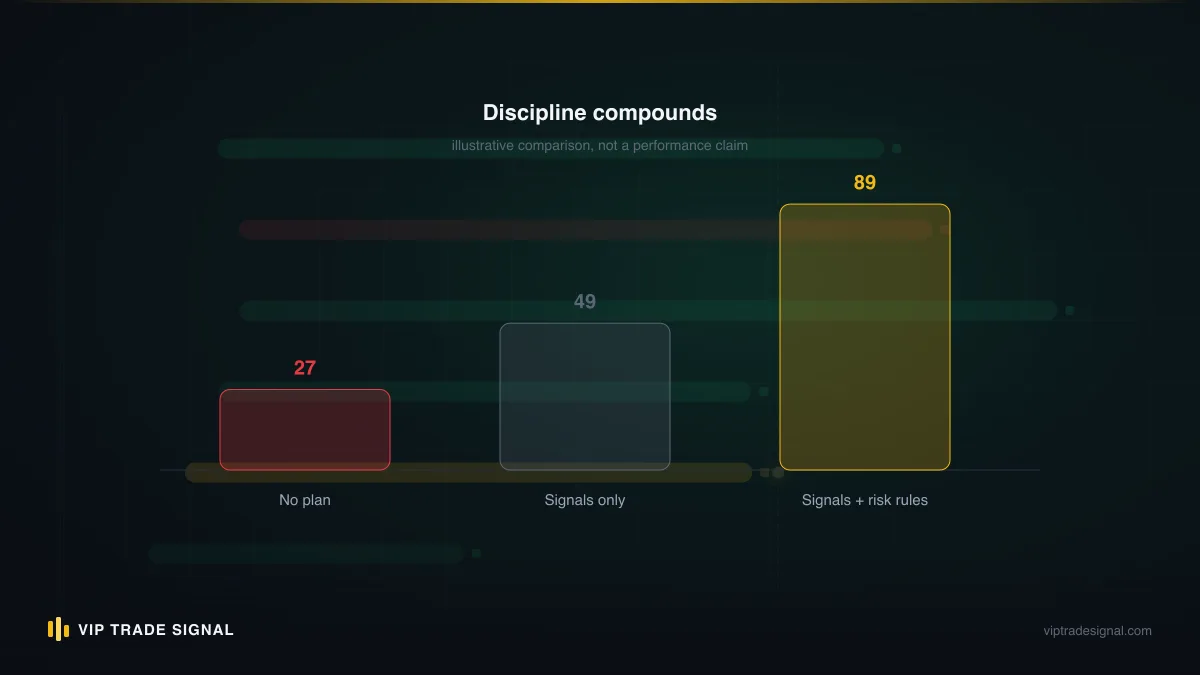
Run this for two years and look what you've built. The serious capital took its market outcome without you sabotaging it. The learning account has taught you, cheaply, whether you have any aptitude and appetite for this. And now the fork reappears, except you're no longer guessing. If the learning went well, start migrating capital from the managed side to your own trading, gradually, as your own verified results earn it. If it went badly, you've discovered that for the price of a small account instead of a large one, and you can delegate with a clear conscience forever.
One warning about the hybrid, because it has its own failure mode. The temptation, usually around month four, is to promote the learning account early. You catch a good fortnight on the small account, conclude the apprenticeship is basically done, and start moving real money across before the sample means anything. Twenty trades tell you almost nothing; a hot month tells you less than nothing, because it arrives wearing confidence. Set the graduation criteria before you start, in writing: something like twelve consecutive months on the learning account, a hundred-plus trades, positive expectancy after costs, and a worst drawdown you actually sat through without breaking your rules. Capital migrates on evidence, not on mood. If that sentence annoys you, please reread the temperament section, because it was written about you.
The hybrid costs more in total fees than either pure path. It buys you the one thing neither pure path offers: an exit from the decision itself. You stop choosing based on self-assessment, which humans are famously terrible at, and start choosing based on your own two-year track record. We'd rather you arrive at either destination that way.
Temperament test: which failure mode is yours
Numbers exhausted, one factor remains, and it outweighs most of the numbers. Each path has a characteristic way of destroying its travellers. The real question is which failure mode your personality is vulnerable to.
Self-trading kills through impulse. Its victims are decisive, competitive, emotionally reactive people. They're often successful elsewhere, and that's precisely the trap: the confidence that built a career meets a market that punishes confidence without competence. If you've ever chased a loss at a casino, checked a position eleven times in an evening, or felt personally insulted by a losing trade, self-trading's failure mode has your name on it. Not forever, necessarily. But now.
Management kills through negligence. Its victims are trusting, busy, conflict-averse people. They skim the statements. They don't ask why the account is suddenly trading 40 lots. They feel awkward demanding withdrawal tests or questioning a drawdown, because the manager seems nice and confrontation is unpleasant. Every managed-account fraud story features a client who noticed something odd and decided not to make a fuss. If that could be you, delegation is only safe with structural protections you verify yourself, on a schedule, like a lift inspection.
A quick self-audit, answered honestly:
- When something you own loses value, do you want to act, or do you go quiet and avoid looking?
- Have you ever finished a losing session (trading, poker, anything) by betting bigger?
- Do you actually read statements, contracts, and terms, or do you sign and hope?
- Is there a person in your life who'd say you tinker with things that were working fine?
- When did you last challenge a professional (doctor, mechanic, adviser) whose answer didn't add up?
Act-and-bet-bigger people should be very slow to self-trade with meaningful money. Sign-and-hope people should be very slow to delegate without forcing themselves into a verification routine. And if you're somehow both, and plenty of people are, that's the strongest argument going for the hybrid: small self-trading account to contain the impulse, managed account with calendar-enforced monthly checks to contain the negligence.
Your one-page decision sheet
Enough analysis. Here's the sheet we'd actually have you fill in, one evening, pen and paper. Write real numbers. The exercise fails if you flatter yourself.
1. Capital. How much would you commit, and, the harder question, what number could you lose entirely without it changing your life? If those two numbers are the same, stop; neither path is for you yet, because both can produce total loss of the committed amount.
2. Hours. How many hours a week can you genuinely give for three years? Not January-resolution hours. February hours. Under five, self-trading as your main path is a slow donation to the market. Ten or more, sustained, and the learning curve is at least physically possible.
3. Horizon. When do you need this money? Trading capital on either path should have a five-year-plus horizon. Money needed sooner belongs somewhere boring.
4. Failure mode. From the last section: impulse, negligence, or both? Write it down. This is the line you'll most want to lie on.
5. The honest fork.
- Big hours, small capital, impulse under control, genuine interest: self-directed, starting tiny, with a written risk cap of 1 percent a trade and a journal you actually keep.
- Small hours, meaningful capital, no appetite for a multi-year apprenticeship: managed, but only into a structure where the account is yours, the master password is yours, withdrawals are yours, and fees come off realized profit you verify. Anything less isn't management, it's donation with extra steps.
- Torn, or scoring somewhere messy in the middle, which is most people: the hybrid. Serious money managed under those protections; a few hundred dollars self-traded against transparent signals as your apprenticeship; a decision revisited in 24 months with your own data in hand.
6. The date. Whatever you choose, write down the date you'll formally review the choice. Twelve months for a pure path, twenty-four for the hybrid. Decisions without review dates aren't decisions, they're drift.
That's the whole sheet. Notice what's not on it: anyone's advertised returns, including ours. Both paths lead through losing months no matter who's at the wheel, and anyone who tells you otherwise, educator or manager, has just told you everything you need to know about them.
If the sheet points you toward management or the hybrid, our account management page spells out the structure in full: your MT4 or MT5 account, your master password, 50 percent of realized profit and nothing else, $200 minimum advance, gold only. Read it alongside two competitors and pick whoever survives your scrutiny. And if the sheet points you toward the charts, genuinely, good luck and go small. The market will still be here when you're ready, which is more than can be said for an overleveraged first account.
Fill the sheet in tonight. The fork doesn't get easier by standing at it longer.