Somewhere right now, a trader with $600 to their name is reading a sales page that says "professional account management, low minimum, start today". The page has a photo of a man in a suit looking at six monitors. It does not say what the fee actually buys. It does not say what happens to the money if no profit ever shows up. And it definitely does not say what a $600 account can realistically earn in a month, because the honest number would end the conversation.
We run a managed forex account with a $200 minimum ourselves, so we are not writing this from a mountaintop. We are writing it because the low-minimum end of the account management market is where most of the rot lives, and because our own model, a $200 advance against a 50% profit share, gets lumped in with joining fees and "activation deposits" that are nothing like it. The difference matters. It is the difference between paying for work that has to happen anyway and paying for a promise that evaporates.
So this is the fine print, all of it, including the parts that make small accounts look less glamorous than the man with six monitors would like you to believe.
What a managed forex account $200 minimum actually gets you
Start with what the $200 is not. It is not a trading deposit. Your trading capital sits in your own MT4 or MT5 account, at your own broker, under your own master password. The $200 never touches your equity and never gets traded. It is an advance, paid to us, against the 50% share of realized profit we charge when the account actually makes money.
What it buys is straightforward: a professional desk trades gold on your account, every day the market gives us something worth trading, with position sizing set to your balance and a risk ceiling agreed before the first trade goes on. You watch every position in your own platform in real time. You can withdraw whenever you like, because the withdrawal function stays with you. Nothing about the arrangement requires trust in our custody of your money, because we never have custody of your money.
Now what it can't get you, and this is the part most low-minimum marketing skips. It cannot get you meaningful income from a small balance. A $500 account managed brilliantly is still a $500 account. If we produce 8% in a month, which would be a strong month, that is $40 of profit, of which you keep $20 after our split. Twenty dollars. Nobody's rent gets paid with that, and anyone implying otherwise is selling you a story, not a service.
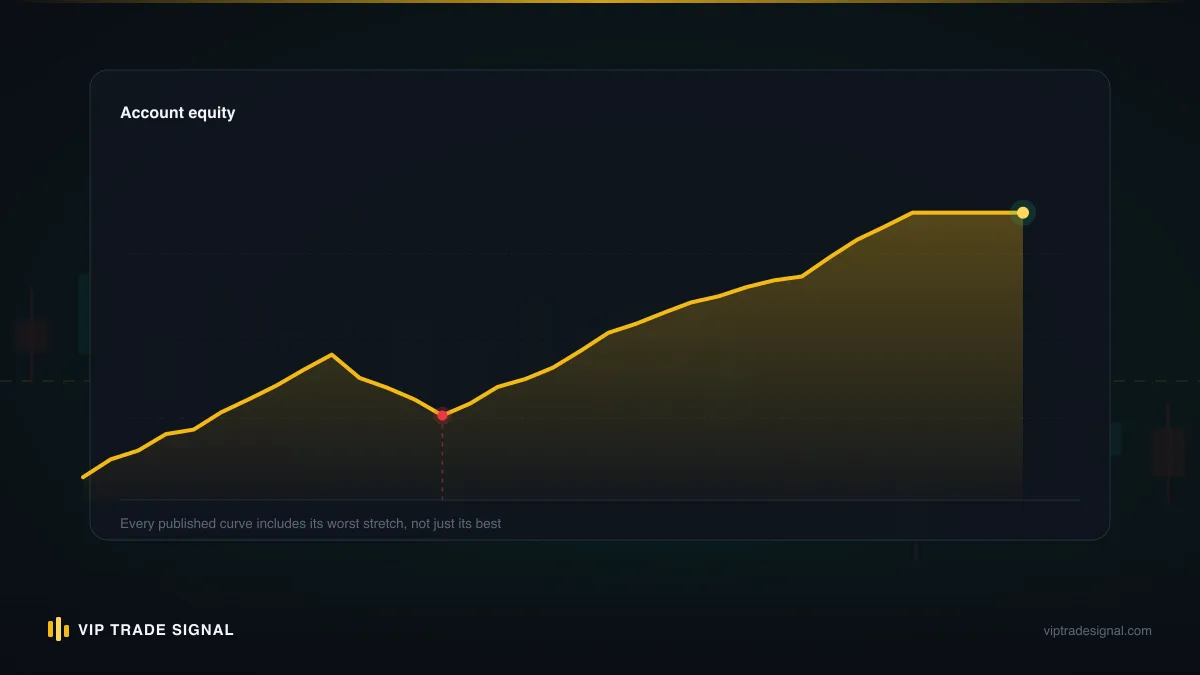
It also cannot get you certainty. Gold trading involves losing trades and losing weeks; ours are published alongside the winners at /signals/history because we think a track record with the losses removed is not a track record, it's an advert. Some months a managed account goes backwards. The $200 does not insure you against that and neither does anything else on this earth.
What the low minimum genuinely does is lower the cost of finding out. That is its honest function. For $200 and a small trading balance, you get to watch a real desk make real decisions on your own account for as long as it takes to form a judgment. Compare that with the traditional route, where managed accounts start at $10,000 or $25,000 minimums and the price of discovering a manager is mediocre is a five-figure education. We charge at the high end on the profit split precisely because we let people in at the low end on capital, and we would rather say that plainly than hide it. The full numbers are on our pricing page if you want them side by side.
Advance against profit share vs the non-refundable joining fee
Here is where the fine print earns its keep, because two arrangements that both cost "$200 to start" can be economically opposite.
A non-refundable joining fee is a purchase. You pay it, the seller has it, and the transaction is complete before a single trade happens. Whatever occurs afterwards, profit, loss, or silence, the fee's job is done. The seller's incentive peaks at the moment you pay and declines from there. This is why joining-fee operations tend to be spectacular at onboarding and invisible afterwards. The money already changed hands. Why would they hurry?
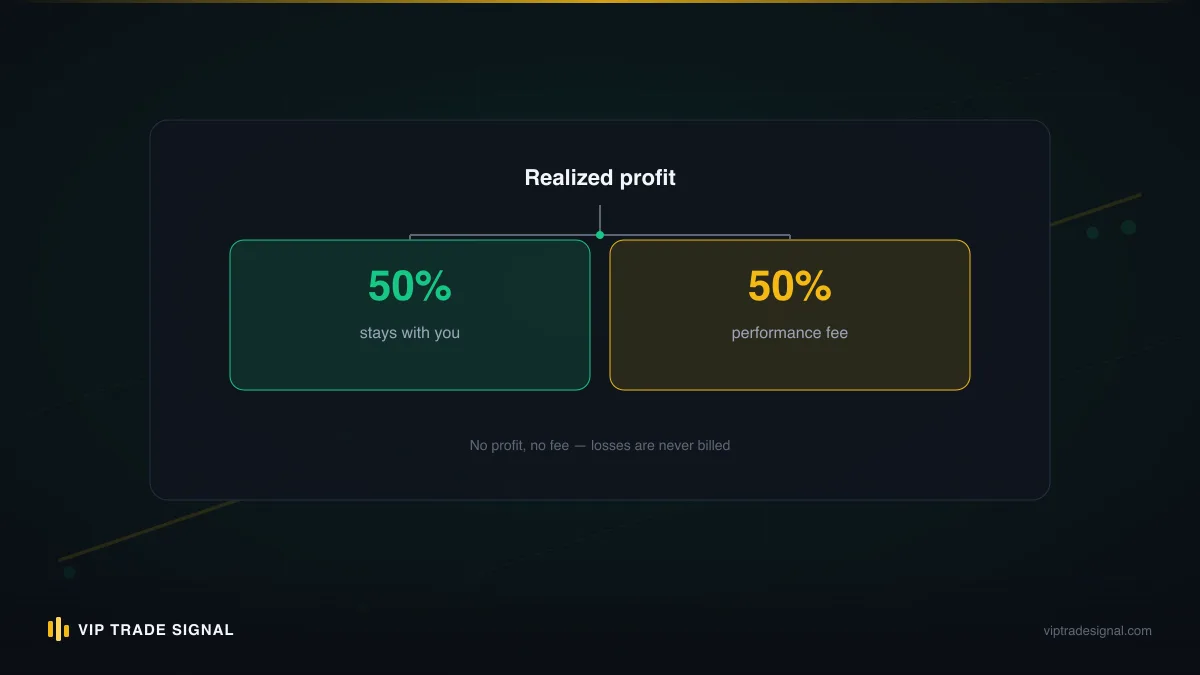
An advance against profit share is a prepayment on a bill that only exists if you profit. Our fee for managing an account is 50% of realized profit, full stop. The $200 minimum advance is the first $200 of that fee, paid up front. When the account produces its first realized profits, your share of those profits is not reduced until our accrued 50% exceeds the $200 you already paid. You have, in effect, pre-bought the first $400 of profit's worth of our fee. If we never produce profit, we never earn past the advance, and the economics of running a desk mean $200 does not remotely cover the cost of managing an account for months. We lose money on clients we fail. That is the point.
Put the three common models next to each other and the incentive shapes are hard to miss:
| Model | When the manager gets paid | Manager's incentive after you pay | If no profit is ever made |
|---|---|---|---|
| Non-refundable joining fee | Immediately, in full | Weak, the sale is complete | Fee is kept anyway |
| Monthly management fee | Every month, regardless of results | Keep you subscribed, not necessarily profitable | Fees accumulate on losses |
| Advance against profit share | Only from realized profit; advance is credited against it | Strong, real earnings only start after your profits do | Manager caps out at the advance and eats the cost |
A percentage-of-profits model with no advance at all would be even cleaner in theory, and some large funds work that way with performance fees. But they can afford to, because a 20% performance fee on a $2 million account is real money. At a $200 minimum deposit level of the market, pure performance fees attract a specific kind of client: the one who signs up ten managers simultaneously, keeps whichever gets lucky first, and costs the other nine their time for nothing. The advance is a filter as much as a fee. It asks for a small, genuine commitment, then converts entirely into fee credit the moment the account performs.
One more distinction worth pinning down, because scammy operators deliberately blur it. An advance is credited against future fees. A joining fee is not credited against anything. If a service charges you to start and then also takes its full percentage of your first profits, you paid twice. Ask the question directly before you send anyone anything: "Is this amount deducted from your future profit share, yes or no?" A straight yes, in writing, or walk.
Why we charge an advance at all
Fair question, and one we get on nearly every onboarding call: if you're so confident, why not free until profit?
Three honest reasons.
The first is the filter we just mentioned. "Forex account management no upfront fees" is a search phrase for a reason; everyone wants the version where they risk nothing. But a manager who accepts unlimited free accounts has no reason to decline unsuitable ones, and unsuitable accounts, too small, wrong leverage, an owner who panics and closes positions mid-trade, drag a desk's attention away from the accounts it can actually serve. A $200 commitment is small enough to be accessible and large enough to mean the person on the other end has thought about it for more than four minutes.
The second is that the work is real whether or not the first month wins. Setting up a new account is not pushing a button. We review the broker, the account type, the leverage, the swap treatment on gold, the balance-to-risk fit. We size a risk plan for that specific equity. Then the account gets traded, monitored, and adjusted every session. If month one is flat or down, which happens, all of that labour occurred anyway. The advance means the desk is not working for literally nothing during the stretch before profits arrive, while still keeping almost all of our compensation tied to your results.
The third is the incentive alignment problem in reverse. Plenty of people assume upfront money always corrupts incentives. It depends entirely on what the money is. A monthly retainer corrupts, because it pays the same for losses as for gains, month after month. A one-off advance that credits against future performance fees does the opposite: after the $200, we earn nothing more until your account's realized profits push our 50% share past what you already paid. From that moment on, every dollar we make, you made two. There is no version of our compensation where you lose and we get rich. There is a version where you profit modestly and we barely cover costs; we accept that trade because the alternative fee structures are all worse for you.
The advance is the only fee we charge that isn't tied to your profit, and it's the first fee to disappear the moment your profits exist.
Could someone copy this structure and still be useless at trading? Of course. A fee model is not a skill. It just tells you which direction the incentives point, and after a decade of watching this industry, we would rather trust a mediocre trader with aligned incentives than a good one paid to lose your money slowly.
Realistic outcomes for a $200-to-$1,000 gold account
Time for the numbers nobody puts on a sales page.
Gold is a volatile instrument, which is exactly why we trade it and nothing else, but volatility cuts both ways and small accounts feel every cut. Here is roughly how the arithmetic works on a $500 balance, using round illustrative figures, not a projection and certainly not a promise.
A disciplined gold desk risking around 1-2% of equity per trade might target monthly returns somewhere in the mid single digits in an average month, more in a strong trending month, negative in a bad one. Say a good month lands at 10% on $500. That's $50 gross. Your half is $25. A more typical month at 5% leaves you $12.50 after the split. A losing month at minus 6% costs you $30 and costs us a month of unpaid work.
Run a plausible year, some good months, some flat, two or three losers, and a $500 account that compounds its retained share might finish somewhere between slightly down and perhaps $650-$700 in a genuinely good year. Might. The honest range includes finishing at $420.
Notice what this means for the advance. At $25 of manager share in a good month, it takes roughly eight good months for our accrued share to work through the $200 you prepaid. On a $500 account we frequently spend most of a year earning nothing beyond the advance. That is not a complaint, it is a disclosure: the model only makes business sense for us across many accounts and because small accounts sometimes grow into larger ones. But you should understand that our enthusiasm for your $500 account is an investment in what it might become, not in what it is.
And this is the part where we say something a marketing department would veto. If you have $300 and it is money you need this year, do not put it in a managed forex account, ours included. The realistic upside is tens of dollars a month and the realistic downside is a chunk of the balance. Most retail traders lose money; managed accounts improve the process, not the laws of arithmetic. A managed forex account for beginners makes sense as a way to participate and learn without trading badly yourself. It does not make sense as a substitute for savings, and any manager who tells a $300 client to expect life-changing returns is telling you everything you need to know about them.
The risk math at small size
Percentages anaesthetise. Dollars wake you up. So let's do drawdown in dollars.
Every trading approach on earth has drawdowns, stretches where equity sits below its previous peak. A well-run gold book might see peak-to-trough drawdowns of 10-20% in a normal year, occasionally worse when the metal does something violent, and gold does something violent a few times a year. That's the asset class. Anyone advertising gold returns without gold drawdowns is advertising fiction.
On a $50,000 account, a 15% drawdown is $7,500 and it feels like a punch. On a $500 account, the same 15% is $75, which sounds trivial until you notice the psychology runs the other way. The $50,000 client has usually seen markets before. The $500 client is often watching their first drawdown ever, on money that took real effort to save, refreshing the platform at 2am. The dollar amount is small; the experience is not. We have watched more small accounts destroyed by their owners closing the desk's positions mid-drawdown than by the drawdowns themselves.
There is also a structural problem unique to small balances: minimum trade size. On gold, the smallest position most brokers allow is 0.01 lots, which moves about $1 per $1 move in the gold price. With gold routinely swinging $30-$50 in a day, even the minimum position can move a $300 account 10% or more in a session. Below a certain balance, proper risk control is not difficult, it is mathematically unavailable, because you cannot size down any further. This is why our floor for the trading balance itself sits where it does, and why we would rather turn an account away than trade it at forced oversized risk. If a manager happily accepts a $150 trading balance on gold, they are either using stops so wide they're decorative or risk so high it's a coin flip. Usually the coin flip.
Two numbers to hold onto before you start:
- Your worst realistic month, in dollars. Take your balance, multiply by 15%, look at the figure. If losing that amount in six weeks would change a decision in your life, the balance is too big for your situation or the service is wrong for you.
- Your best realistic month, in dollars. Balance times maybe 10%, then halve it for the profit share. If that number disappoints you, no manager on earth fixes it. Only more capital does.
Sit with both before anyone gets your $200.
When you should wait and save a bigger base instead
There is a version of this article that ends every section with "so sign up". This is not that article, because a decent chunk of the people searching for managed forex accounts with a low minimum deposit should not open one yet, and we would rather lose the sale than win the refund conversation.
Wait if any of these describe you:
- The money has a job. Rent buffer, visa fees, a course, a flight home. Trading capital must be money whose loss changes nothing important. Not "money I'd prefer not to lose". Money whose loss changes nothing.
- You'd be starting under $400-$500 of trading balance. Below that, gold's minimum position size forces more risk per trade than we consider professional, as covered above. Save the extra hundred first. The market will still be here.
- You need income now. A small managed account is a growth attempt, not a yield product. If your plan requires withdrawing profits monthly to live on, the balance sheet does not support the plan, and pretending otherwise ends badly.
- You haven't emotionally priced a losing quarter. Not accepted intellectually. Priced. If your first drawdown will have you messaging the desk daily or yanking the master password, wait until it wouldn't.
- You're choosing between us and paying off debt above roughly 10% interest. The debt paydown is a guaranteed return. We do not offer guaranteed anything, and nobody honest does.
Saving up has a quiet advantage people overlook: the same percentage result is worth more later. A year spent building $500 into $1,500 through savings means the desk's identical performance now produces three times the dollars, while your $200 advance stayed the same. The advance does not scale with your balance. The returns do. Patience is literally leveraged here.
And if you're mid-decision, do the reading first. Our own FAQ answers the awkward questions people are sometimes embarrassed to ask on a call, and our piece on managed forex account reviews covers how to evaluate any manager's claims, including ours, without taking anyone's word for anything.
What beginners actually get out of a small managed account
One angle deserves its own space, because it is the quiet majority of the people reading this. A managed forex account for beginners is usually pitched as "earn while you learn", which is half true and the wrong half gets the emphasis. The earning, as we've established, is modest at small size. The learning is the real asset, and almost nobody frames it that way.
Think about what a beginner's alternative is. Self-trading a first $500 account is, for most people, an expensive tuition scheme: overtrading in week one, revenge trading in week three, an account obituary by month two. Most retail accounts lose money and first accounts lose it fastest. Against that baseline, handing the execution to a desk while you watch changes what your $500 buys. Instead of funding your own mistakes, it funds a front-row seat.
Because you keep full read access to your own MT4/MT5 platform, you see everything: where entries go on, where the stop sits relative to the entry, how big the position is against the balance, how long trades are held, what happens on the losing days. Six months of watching a disciplined book handle gold teaches things no course quite lands, mostly because courses skip the boring parts and the boring parts are the job. You will notice, for instance, how many days the answer is no trade at all. That single observation is worth more than most $500 courses.
There is a trap here too, and we'll name it. Watching a desk can make trading look easier than it is, the way watching a good driver makes lane discipline look effortless. If the plan is eventually to trade your own money yourself, treat the managed period as study, journal what you see, and test your own ideas on a demo account in parallel, not on the live balance the desk is managing. Mixing your experiments into a managed account is how risk plans die.
And if you never want to self-trade at all? Also fine. Plenty of our longest-standing clients have no interest in becoming traders, the same way people who hire an accountant have no ambition to sit the exams. The service exists so that the skill is optional.
How the advance reconciles against your first profits
Mechanics time, because "credited against future fees" is exactly the sort of phrase that deserves a worked example rather than a nod.
Say you start with a $1,000 trading balance and pay the $200 minimum advance. Month one, the account realizes $120 of profit, meaning closed trades, not floating gains; floating profit is a mood, realized profit is a number. Our fee on that is 50%, so $60. But you have $200 of prepaid credit sitting on your side of the ledger, so nothing is charged. The $60 draws down the credit to $140. You keep your $60 share and, for now, our $60 share too, because you already paid it in January.
Month two is a loser, minus $80. No profit, no fee, and here's a detail that matters: like any serious performance-fee arrangement, we track a high-water mark. The account must first recover the $80 and get back above its previous realized-profit peak before new fees accrue. We do not get paid twice for regaining ground we lost you.
Month three, the account realizes $150 above the high-water mark. Fee accrued: $75. Credit remaining: $140 minus $75, leaves $65. Still nothing leaves your pocket.
Month four, another $150 of realized profit. Fee: $75. The credit covers $65 of it, hits zero, and the remaining $10 becomes the first fee you actually settle since the day you started. From here the arrangement is a clean 50/50 split of realized gains above the high-water mark, invoiced as agreed, and the advance has fully converted from "money I paid to start" into "fees I'd have owed anyway".
Total picture across those four months: the account made $340 net of the losing month, you kept $170 of trading profit plus effectively enjoyed $190 of fee credit, and paid $10 in new fees. The $200 did precisely what it was supposed to do, and it did it visibly, in your own account, where you could audit every closed trade against the statement.
Ask any low-minimum service to walk you through this exact exercise with their numbers. The good ones will do it in one email. The bad ones will send you a brochure.
Comparing low-minimum offers across the market
The low-minimum managed account space sorts into a handful of species once you have seen enough of them. Roughly:
PAMM and MAM pools. Your money joins a pooled structure at a broker and a manager trades the aggregate. Minimum deposits can be genuinely low, sometimes $100. The strengths are real: broker-level accounting, automatic profit splits. The weaknesses are structural: your capital sits inside the pool on the manager's terms, exits often wait for trading periods to close, and the ranking leaderboards these platforms run reward exactly the aggressive risk that eventually detonates. Every PAMM leaderboard is a queue of accounts that haven't blown up yet, sorted by how hard they're trying to.
Copy trading platforms. Adjacent rather than identical, you subscribe to a trader and mirror them. Low minimums, decent transparency on the platforms that enforce it, but slippage between the master account and yours quietly reshapes results, and the incentive for the signal provider is followers, not performance. If you're weighing that route, our comparison of signals versus copy trading goes deeper than we can here.
Traditional discretionary managers. The classic version, real firm, real regulation where applicable, minimums of $10,000-$100,000 and management-plus-performance fees, the old 2-and-20 shape or its retail cousins. Often the most professional option and completely irrelevant to someone with $700, which is honest of them, at least. They price you out rather than misleading you in.
Direct management on your own account. Our model. The manager trades your MT4/MT5 via trading-only access, you keep the master password and the withdrawals, fees come from performance. Minimums can be low because there's no pooled infrastructure and no custody. The catch to watch for is that this structure is only as good as the fee model attached to it; the same setup with a fat monthly retainer or a vanishing joining fee loses most of its virtue.
What should you actually compare across offers? Not the minimum. The minimum is the marketing. Compare: who holds the money, what the total fee comes to in a good year and a bad one, whether any upfront payment credits against future fees, whether losses are published, and how you leave. On that last one, our answer is "log in and withdraw, it's your account", and any answer longer than a sentence deserves suspicion.
Scam patterns that hide behind low minimums
Low minimums are catnip for fraud, for a simple reason: a $200 ask clears almost nobody's suspicion threshold. Stealing $25,000 from one person requires defeating their scepticism. Collecting $200 from five hundred people requires a Telegram channel and stock photography. Same money, less resistance.
The recurring shapes, so you recognise them at distance:
The vanishing joining fee. Pay $199 to "activate management", then the manager needs a "risk assessment fee", then a "VPS fee", then silence. The tell is that every fee is upfront and none credits against anything. We wrote up the broader ecosystem of these in our guide to managed forex account scams, and the fee-that-buys-nothing is its oldest resident.
Send us the capital. Any "managed account" where the money leaves your broker and lands in their wallet, bank transfer, crypto, "our institutional account", is not account management, it is a donation with extra steps. Management means your account, your broker, your master password. No exceptions, including for us.
The doctored screenshot economy. Monthly returns of 40% presented in MyFXBook-style graphics that were never connected to a live account, or were connected to a demo. If a track record is not verifiable at the broker level or published complete with losses, it is decoration. Ours lives at /signals/history with the red included, and we'd frankly trust no one who does less.
The guaranteed return. "3% weekly, guaranteed." Nothing in leveraged trading is guaranteed except costs. A guarantee in this industry is not reassurance, it is a confession, because the only business model that can promise fixed returns on volatile instruments is the one paying old depositors with new deposits. It works right up until it very much doesn't.
The pressure clock. "Only 3 slots at the $200 rate, price doubles Friday." Real desks have capacity constraints, but they express them by declining clients, not by countdown timers. Urgency exists to stop you doing exactly what this article is: reading the fine print slowly.
A useful reflex: the smaller the minimum, the harder you should look at what the operator gains if you never profit. In our model, the answer is $200 against months of desk cost, a losing proposition for us. In the scam patterns above, the answer is everything they were ever going to get. Follow that question and most of the fog clears.
Step-by-step: starting with a small account, properly
If you've read this far and the arithmetic still suits your situation, here is the sequence we'd recommend to anyone, whether they end up with us or elsewhere.
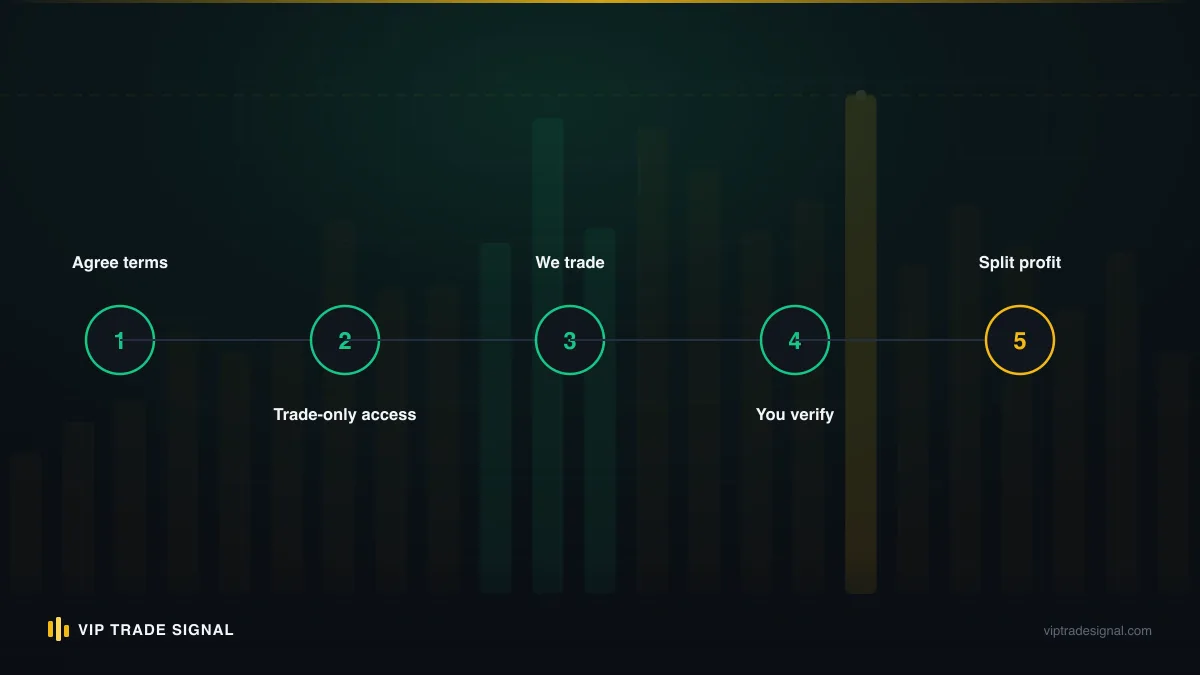
- Fix your numbers first. Decide your trading balance and confirm it passes the tests from earlier: losing 15-20% of it changes nothing important, and half the realistic monthly upside still feels worth having. Write both figures down. Yes, physically.
- Choose the broker yourself. A legitimate manager works at any reputable MT4/MT5 broker; one who insists on a specific obscure broker you've never heard of has a reason, and it is rarely your reason. Regulated entity, sensible gold spreads, a withdrawal you've personally tested with a small amount before management begins.
- Interrogate the fee model in writing. The exact questions: What is the total cost in a profitable year? In a losing year? Does any upfront amount credit against future fees? Is there a high-water mark? Get sentences, not brochures.
- Grant trading access only. The manager receives credentials that can trade, never the master password. You keep withdrawals and the ability to revoke access. This is the load-bearing wall of the whole structure; details of how we set it up are on the account management service page.
- Agree the risk ceiling before trade one. Maximum risk per trade, maximum open exposure, what happens at a defined drawdown level. Recorded where both sides can see it. "We trade responsibly" is a vibe, not a parameter.
- Pay the advance, then verify the credit. Once the first profitable period closes, check the reconciliation yourself against closed trades in your own platform. It should match to the dollar. This is not distrust; it is the audit the structure exists to make possible.
- Then sit on your hands for a quarter. The single most damaging thing small-account owners do is intervene: closing the desk's trades during a drawdown, tinkering with leverage, depositing and withdrawing erratically. Judge the desk on a quarter of closed results, not on Tuesday's floating loss. If after a full quarter the process looks undisciplined, revoke access and leave, which takes you two minutes, because you kept the keys.
Nothing on that list is exotic. It is just slow, and slowness is precisely what the countdown-timer end of this market is engineered to prevent.
The fine print, summarised without the fine print
Strip away fourteen sections of detail and the whole piece reduces to a few blunt sentences.
A managed forex account with a $200 minimum is a cheap way to find out whether a desk is worth your capital, and an expensive way to generate income you actually need. The $200, in our model, is an advance that converts into fee credit against your first profits, which makes it the opposite of the joining fees it superficially resembles; the question "does this credit against future fees?" separates the two in one email. Small gold accounts carry real drawdowns, tens of dollars that feel like thousands, and below roughly $400-$500 of balance the position-size maths stops working at all, which is why our companion piece on managed account minimum deposits exists and why we'd rather you saved for another two months than started underpowered.
Our fees sit at the high end of the market. We'd rather tell you that than have you discover it: 50% of realized profit is a big split, and it is the price of a $200 entry, no custody of your funds, no monthly retainer, and a desk that earns nothing further until you're in profit past the advance. Some people run that maths and decide a cheaper percentage on a $25,000 minimum elsewhere suits them better. Genuinely fine. The clients we want are the ones who read everything above and signed up anyway, eyes open, because those are the ones still here in year two.
And if that's you, the sequence in the previous section is the way in. Take the slow route. The fine print is only frightening when someone else is hoping you won't read it.