Somewhere right now, a bloke is wiring $100 to a stranger on Telegram who promised to "manage" it into $1,000 by Christmas. He found the offer attractive for exactly one reason: the minimum was low enough that losing it wouldn't hurt. That instinct, ironically, is the whole problem. The money is small enough to gamble, so it gets gambled.
The managed forex account minimum deposit question comes up in our inbox more than almost anything else. Can you start with $100? Why does one firm want $50,000 and another wants $250? Is a low minimum generous or suspicious? People treat these numbers like marketing decisions, and sometimes they are. But underneath the marketing sits arithmetic that doesn't care what anyone's landing page says, and once you can do that arithmetic yourself, you can price any minimum you see. High or low.
So that's what this piece is. Not a list of brokers. A working tour of the maths behind minimums: what a manager can actually do with each account size, why some floors are set high, why suspiciously low ones are often a red flag wearing a friendly face, and a simple formula for computing your own sensible starting number before anyone else computes it for you.
Why minimums exist at all
Start with the obvious question. If a manager trades ten accounts with the same strategy, why should they care whether yours holds $300 or $30,000? A percentage return is a percentage return.
Three reasons, and only one of them is about the manager's income.
The first is lot sizing, which we'll spend a whole section on because it decides everything else. Forex and gold trade in standardised sizes, and those sizes have a floor. Below a certain account balance, the smallest tradeable position is already too big for sane risk management. The strategy that works on $10,000 becomes mathematically impossible on $150. Not harder. Impossible.
The second is admin. Every managed account, whatever its size, generates the same overhead: onboarding, identity checks, connecting to the platform, monitoring, answering the client's messages when a trade goes underwater and they panic at 2am. A $200 account and a $200,000 account cost the manager roughly the same in time. A firm charging performance fees on tiny accounts is doing charity or doing volume, and volume has its own dark pattern we'll get to.
The third is client psychology, and managers who've been around a while will admit this is the big one. Small deposits correlate with unrealistic expectations. Someone placing $50,000 usually understands that 20% in a year would be a genuinely good outcome. Someone placing $200 often expects it doubled by autumn, because why else bother? Managers set minimums partly to filter for clients who won't rage-quit during the first normal losing week. A drawdown of 8% on $40,000 is a conversation. On $250 it's twenty dollars, and yet, strangely, it's the $250 client who sends the furious messages. We've watched it happen for years.
None of this tells you what the right minimum is. It just tells you the number isn't random. Now the maths.
The lot-sizing maths behind every managed forex account minimum deposit
Here's the engine room. Skip nothing in this section, because every claim about account minimums, ours included, either survives this arithmetic or it doesn't.
In forex and gold, position size comes in lots. A standard lot of XAU/USD is 100 ounces; at a gold price around $3,300, a $1 move in the metal moves your position by $100. A mini lot (0.10) moves $10 per dollar. A micro lot (0.01), the smallest most brokers allow, moves $1 per dollar of gold movement. Those are the atoms. You cannot trade half a micro lot on a normal account.
Now bring in risk. The rule most professionals live by, and the one any manager worth paying should live by, is risking a small fixed percentage of the account per trade. Call it 1%, maybe 2% for the aggressive. The sum is simple:
Risk per trade = account balance × risk percentage. Position size = that risk, divided by the stop distance. If the smallest lot your broker offers already risks more than your number, you don't have an account. You have a lottery ticket.
Run it. A sensible gold trade might carry a stop $8 to $15 away from entry. Take $10 as a round figure. One micro lot risks $1 per dollar of movement, so a $10 stop risks $10.
- A $10,000 account risking 1% has $100 of room. It can trade 0.10 lots against that stop, with headroom to scale.
- A $2,000 account risking 1% has $20 of room, which buys 0.02 lots. Two micro lots. Tight but workable.
- A $500 account risking 1% has $5 of room. The minimum position, one micro lot, risks $10. To take the trade at all, the manager must either double the risk to 2% or halve the stop, and halving a stop because the account is small (rather than because the chart says so) is how small accounts die.
- A $100 account risking 1% has $1 of room. One micro lot with a $10 stop risks 10% of the account. Per trade. Three losses in a row, which any strategy on earth produces regularly, and the account is down a quarter or worse before fees.
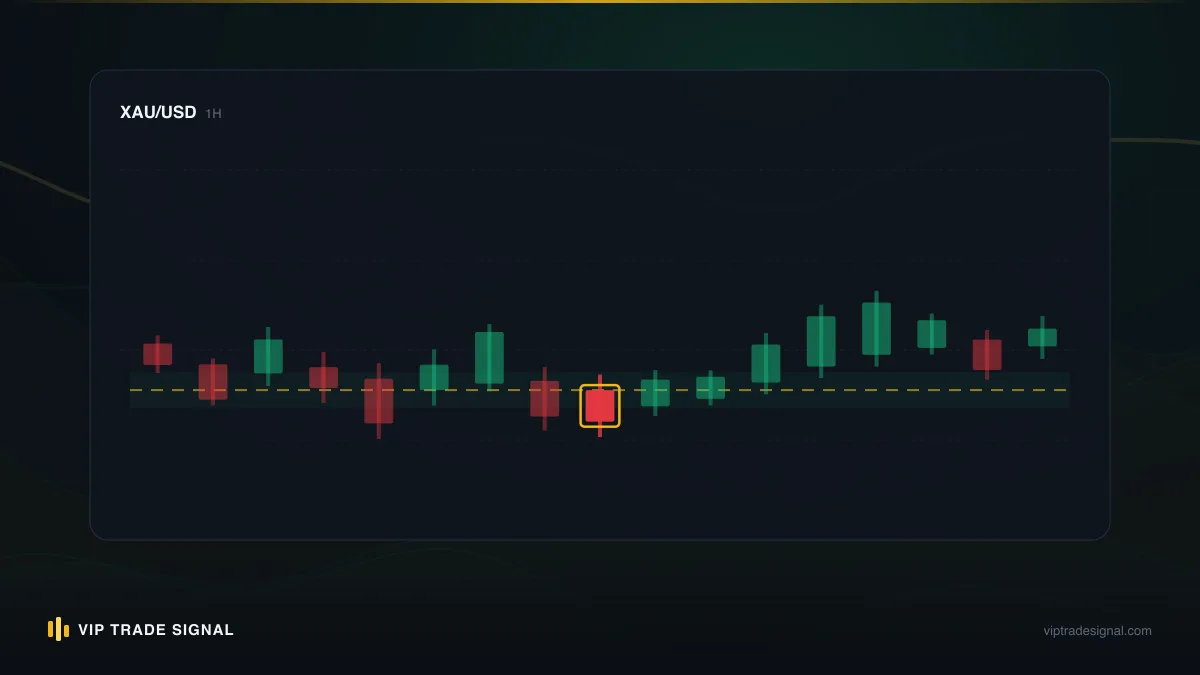
Read that last bullet again, because it's the honest answer to every "managed forex account $100 minimum" advert you will ever see. It is not that managing $100 is hard. It's that managing $100 responsibly is arithmetically impossible on a standard account. Anyone taking that money is either parking it (and charging you for the parking), or over-risking it deliberately. There is no third option, whatever the sales page implies.
And notice something subtle: the stop distance is set by the market, not the account. Gold's volatility doesn't shrink because your balance did. A $10 stop is a $10 stop whether you hold $100 or $100,000, which is precisely why small balances get squeezed. The market charges everyone the same entry fee; small accounts just can't afford the table.
What $100, $500, $2,000 and $10,000 can realistically do
Let's make this concrete with four account sizes and no wishful thinking. Assume gold trading, 1% risk as the ideal, micro lots available, average stop distance $10, and a manager who actually follows their own rules.
| Deposit | 1% risk budget | Smallest viable position | Real risk per trade | Verdict |
|---|---|---|---|---|
| $100 | $1 | 0.01 lots ($10 at risk) | ~10% | Not manageable. Gambling with extra steps. |
| $500 | $5 | 0.01 lots ($10 at risk) | ~2% | Barely functional; zero flexibility, no scaling, no partial exits. |
| $2,000 | $20 | 0.02 lots | ~1% | The first size where proper risk sizing genuinely works. |
| $10,000 | $100 | 0.10 lots | ~1% with room to scale in/out | Full toolkit available: partials, pyramiding, wider stops when the trade needs them. |
The $500 row deserves a closer look because it's the tier most "managed forex accounts low minimum deposit" offers cluster around. At $500, one micro lot per trade at 2% risk is technically defensible. But the manager has no gears. They can't take partial profit at a first target and let the rest run, because you can't split one micro lot. They can't add to a winner. They can't size down slightly after a losing streak, which is a standard professional adjustment, because there's nothing below 0.01. Every trade is all-or-nothing at the same fixed size. It functions, in the way a car with one gear functions. You'll move, slowly, and hills are a problem.
$2,000 is where things change, and it's not a coincidence that a lot of honest managers quietly steer clients toward that region even when their formal floor is lower. With $20 of risk per trade you have two micro lots to play with, which means half-off-at-target is possible. By $5,000 you're at five micro lots and the strategy can breathe. By $10,000 the manager can trade the plan exactly as designed, and, importantly, your results start to resemble the strategy's actual results rather than a constrained, rounded-off version of them.
Worth a quick word on "managed forex accounts $1000 minimum" offers, because $1,000 is the most common advertised floor in the retail space and it sits awkwardly in the middle of our table. At $1,000 with 1% risk you have $10 of room, which buys exactly one micro lot against a $10 stop, with nothing left over. It's the knife-edge tier: honest management is just possible, but only if the strategy's stops stay tight and the manager resists every temptation to stretch. One wider-than-usual stop, one moment of "we'll risk 2% just this once", and the account is over its skis. If you're funding at this level, the questions to ask are about stop discipline specifically, and the sensible move is usually to stretch to $1,500-$2,000 if you can do so without touching money you need. The difference in outcomes between $1,000 and $2,000 is far larger than the difference between $2,000 and $4,000, because it's the difference between a strategy running compromised and running as designed.
Which raises a point people miss constantly: two clients of the same manager, same trades, can see meaningfully different percentage returns purely because of rounding at small sizes. If the model says risk 1.4% and your account can only express 0.01-lot chunks, you get whatever the rounding gives you. Sometimes more risk than intended, sometimes less reward. The smaller the account, the lumpier the copy. We wrote more about that general effect in our piece on why managed account performance varies between clients, and account size is the biggest single cause.
Ultra-low minimums: when $50 is a business model, not a favour
Now the uncomfortable bit. If the maths above is right, and it is, why does the internet overflow with managers advertising $50 and $100 minimums? Are they all bad at arithmetic?
No. Most of them understand it perfectly. The low minimum is the product.
Here's the model, and once you see it you can't unsee it. Recruit hundreds of tiny accounts, because tiny money is easy money to attract; nobody scrutinises a $100 decision the way they scrutinise a $10,000 one. Trade all of them with enormous risk, 10%, 20%, sometimes effectively all-in with martingale sizing on losers. Statistically, some accounts will catch a good run and double or triple fast. Those clients become screenshots. The screenshots become marketing. The blown accounts, the majority, are small enough that most owners shrug, feel a bit stupid, and don't post about it. The manager collects performance fees from the winners and silence from the losers, and the machine feeds itself.
It's the same engine that powers the free-signal-channel funnel, just wearing a suit. The individual client's outcome is irrelevant to the operator because the operator is diversified across victims. You are not.
A worked example, because the abstract version doesn't land the way the numbers do. Say an operator recruits 500 clients at $100 each with a "minimum deposit $100, target 10% weekly" pitch. They trade every account at 20% risk per position. After a few weeks of coin-flip outcomes, perhaps 40 accounts have doubled or better purely by chance; the operator screenshots those, charges them 50% of the gains, and pockets roughly $2,000 for doing nothing skilful whatsoever. The other 460 accounts are wrecked or dying, but each individual loss is small enough that almost nobody files a complaint, leaves a detailed review, or warns the next wave. Then the ads run again, seeded with fresh screenshots. Total capital destroyed: most of $50,000. Total consequences: usually none. That's the entire business, and the $100 minimum isn't incidental to it. It's the load-bearing wall, because the same scheme at a $10,000 minimum would generate lawsuits instead of shrugs.
A few tells that a low minimum is this model rather than genuine accessibility:
- Risk is never mentioned in numbers. Lots of talk about "safe strategies" and "capital protection", nothing about percentage risk per trade or maximum drawdown. Honest managers lead with those figures because they're proud of them.
- Returns are quoted weekly. "5-10% weekly" on any account size is a screaming siren, but on a $100 account it's also the only way the fee maths works for the operator, which tells you what they're planning to do with your money.
- They want your money in their account. Any structure where the deposit leaves your name is a different and much worse product than management of your own broker account, whatever the minimum. We've catalogued the common structures in our guide to managed forex account scams, and pooled deposits with tiny minimums feature in most of them.
- The minimum is low but the "recommended" deposit is 20x higher. The $100 floor is bait; the upsell call comes within a week.
To be scrupulously fair: a low minimum by itself proves nothing. Some legitimate operations accept small accounts on cent-account infrastructure, which we'll cover shortly, and some simply accept that small clients will get a compromised version of the strategy and say so out loud. The signal isn't the number. The signal is a low number combined with big promises, because that combination has no honest resolution. The arithmetic forbids it.
High minimums aren't quality certificates either
Time to be fair in the other direction, because there's a lazy inversion people make: if $100 minimums are suspicious, surely $50,000 minimums mean quality. Prestige pricing works on the brain like that.
It shouldn't. A high floor tells you the manager's cost structure and target market. It tells you nothing about whether they can trade.
Some high minimums are entirely reasonable. A regulated firm running proper PAMM or MAM infrastructure, compliance staff, audited reporting and human account managers genuinely cannot service a $500 client profitably; their $25,000 floor is just their break-even talking. Some strategies also legitimately need size: anything involving multiple concurrent positions, hedged legs, or instruments with larger contract specs wants a bigger base to size correctly, for exactly the lot-maths reasons above but in the other direction.
But some high minimums are pure theatre. The number itself does selling work: "they want $50,000, they must be serious." We've seen operations with five-figure floors, glossy decks, and strategy descriptions that fall apart under two minutes of questioning. The floor filtered for clients wealthy enough not to miss the money quickly, which is its own kind of predation, arguably nastier than the $100 version because the losses are life-changing.
So the floor, high or low, is never the due-diligence answer. It's one input. The questions that actually discriminate are the same at every tier: whose name is the account in, what is the risk per trade in numbers, where is the full closed-trade history including losers, and what exactly triggers the fee. If you're evaluating firms right now, our piece on reading managed forex account reviews covers how to verify claims independently, because at the $50,000 tier the marketing is simply better-produced, not more honest.
One useful heuristic we'll stand behind: be most comfortable when the minimum has a stated reason. "Our minimum is $2,000 because below that we can't size positions at 1% risk" is a manager showing you their arithmetic. "Exclusive access from $25,000" is a manager showing you their aspirations.
Cent accounts and micro capital: the honest small-money route
Everything above assumed standard account mechanics. There is a partial escape hatch, and it's worth understanding properly because it's both genuinely useful and routinely oversold.
Several brokers offer cent accounts, where balances are denominated in cents rather than dollars. Deposit $100 and the platform shows 10,000 cents. The practical effect is that the minimum position size shrinks by a factor of a hundred: a 0.01 "lot" on a cent account is one-hundredth of a normal micro lot. Suddenly the arithmetic works again. Your $100 account can risk 1% per trade, about $1, with room to spare, because the smallest position risks pennies.
So is that the answer for small deposits? For self-directed learning, honestly, yes. A cent account is the best bridge we know between demo trading and real money. The pain of losing is real (that matters; demo pain is fake pain and teaches fake lessons) but the sums can't hurt you. Six months on a cent account will teach a new trader more about themselves than two years on demo.
For managed money, though, cent accounts mostly answer the wrong question. Grant that the manager can now size correctly on your $100. What's the ceiling? A genuinely good year in professional money management is 20-40% with real drawdowns along the way. On $100, the great year earns you $30. The manager's half, if they charge performance fees, is $15, which doesn't cover the time spent onboarding you. So either the manager is running thousands of such accounts on full autopilot (fine in principle, but then you're buying an unattended algorithm, and it should be priced and described as one), or the fee structure has to mutate into something fixed-fee that eats the small account alive, which brings us to the next section.
There's a psychological ceiling too. People do not stay patient with $100 under management. The absolute numbers are too small to feel like progress; up 15% in three months is up fifteen dollars, and fifteen dollars doesn't survive contact with a takeaway order. Clients at this size churn, chase, and top up erratically, which wrecks any strategy's assumptions. Cent accounts are a superb classroom. They are a poor venue for delegation.
The fee interaction: when small accounts can't outrun their own costs
Here's the section that kills more small managed accounts than bad trading does. Fees, and specifically the way fixed fees scale, or rather don't.
Performance-only fees scale perfectly. A manager taking 30-50% of realized profit earns nothing until you do, and the percentage bite is identical at every account size. On the fee structure alone, a $500 account and a $50,000 account get the same deal. This is why performance-only is the small account's friend, and it's the model we run ourselves: half of realized profit, nothing on losses, details on our pricing page if you want the exact mechanics.
But plenty of the industry doesn't work that way. Common structures include monthly management fees ($50-$100 a month is typical at the retail end), fixed setup fees, per-lot commissions kicked back to the manager, and subscription-style "desk fees". Every one of these is a fixed cost, and fixed costs are savage to small balances in a way percentages never are.
Run the numbers on a $75 monthly management fee:
- On a $50,000 account, that's 1.8% a year. Annoying, survivable.
- On a $5,000 account, it's 18% a year. The manager must clear 18% before you've earned a penny. Most professional money managers on earth do not reliably clear 18% a year.
- On a $500 account, it's 180% a year. This is not an account. It's a standing order with a chart attached.
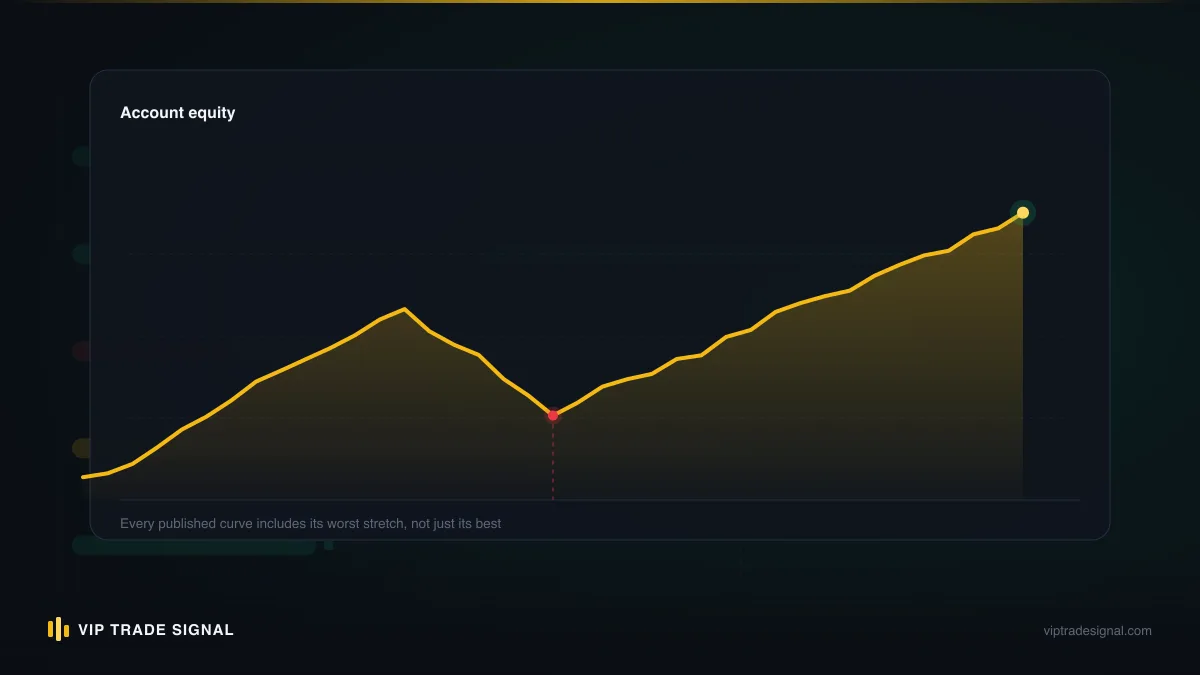
Spread and swap costs deserve a line here too, because they're the fees nobody itemises. A gold trade might cost $3-$4 per micro lot round-trip in spread at a decent broker. Trivial on a large account. But on a $500 account trading, say, fifteen positions a month, that's around $50 of friction, roughly 10% of the balance annually before anyone has made a single good or bad decision. The market itself imposes a fixed-cost floor that small balances feel and large ones don't, which is one more quiet reason the minimum investment for forex management keeps gravitating toward the low thousands regardless of what any individual firm advertises.
Per-lot commission structures are sneakier because they hide inside the trading itself, and worse, they invert the manager's incentives on small accounts. If the manager earns per trade rather than per profit, your $800 account generates income by being traded a lot, not by growing. Overtrading small accounts under commission-kickback arrangements is one of the oldest tricks in this industry, old enough to have a name, churning, and a regulatory history in every jurisdiction that bothers regulating.
The takeaway is a rule you can apply in thirty seconds to any offer: convert every fixed fee to an annual percentage of your intended deposit, add it to the spread costs of the expected trade frequency, and ask whether a sane strategy can outrun that number with 1% risk per trade. If the total fee drag exceeds roughly 10-12% of a small account annually, the arithmetic has already decided your outcome, whatever the manager's skill. Walk.
A formula for your personal minimum
Enough industry analysis. Let's compute your number, because the right question was never "what's their minimum" but "what's mine". Four steps, pen and paper, ten minutes.
Step one: find the strategy's stop distance. Ask the manager directly: what's your typical stop in dollars (for gold) or pips (for pairs), and what's the widest stop the strategy ever uses? If they can't answer this crisply, stop here; there is no strategy, just vibes. Say the answer is $8 typical, $15 maximum on gold.
Step two: price the minimum position against the widest stop. One micro lot of gold risking a $15 stop is $15 of risk. That's the entry ticket the market charges for one properly-stopped trade at minimum size.
Step three: divide by your risk tolerance. For that $15 to be 1% of the account, you need $1,500. At a more aggressive 2%, $750. We'd argue hard for the 1% framing on managed money; you're paying precisely so that someone doesn't over-risk on your behalf, so don't force them to by underfunding.
Step four: multiply by the flexibility factor. One tradeable unit is functioning; three or four units is a strategy with gears (partial exits, scaling, sizing down in drawdowns). Multiply your step-three figure by 2-3 if you want the strategy traded as designed rather than a constrained version of it. That puts a realistic personal minimum for a gold strategy in the $2,000-$4,500 region, and lo, that's the band where honest minimums in this corner of the market tend to cluster. Not a coincidence. Same arithmetic, run from the other side of the desk.
Then apply the two overrides, which outrank everything above. First: never fund a managed account with money whose loss would change your life. Losses are not a tail risk in trading; they are a scheduled feature, and any account should be sized so a 20-30% drawdown is emotionally survivable, because if it isn't, you'll pull the plug at the bottom and convert a drawdown into a permanent loss. Second: if your bankroll only clears the formula at 2%+ risk with zero flexibility factor, the honest conclusion is that you're not ready for managed money yet. Park the capital, learn on a cent account, and come back when the number works. That answer earns nobody any fees, which is exactly why you'll rarely hear it from anyone selling management.
Where we set our own bar, and why
Since we've spent three thousand words auditing everyone else's minimums, fair's fair: here's ours, held up to the same light.
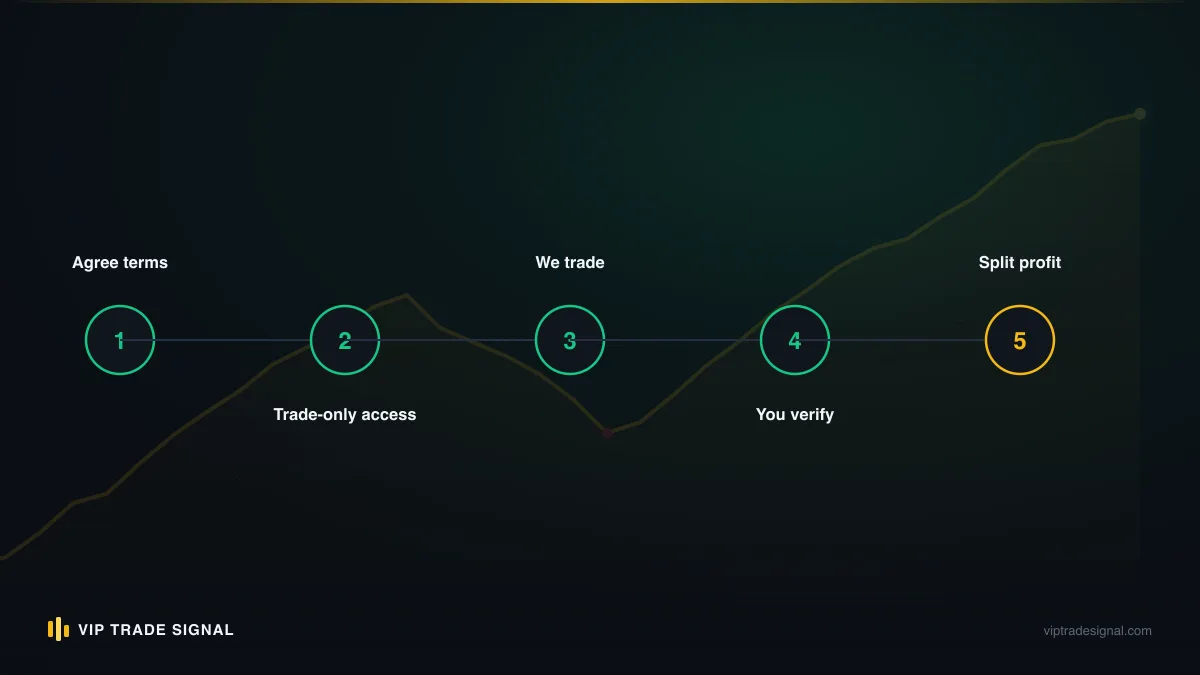
Our account management service works on your own MT4 or MT5 account, in your name, at your broker. You keep the master password; we trade on an investor-level connection, and withdrawals only ever move on your instruction. The fee is a flat 50% of realized profit, with a $200 minimum advance against that fee to start, which exists for the unglamorous reason that onboarding has a real cost and we'd rather charge it transparently than smuggle it into spreads. No monthly management fee, no per-lot kickbacks. If a period closes without profit, the period costs you nothing beyond that advance already made.
Notice what the $200 is and isn't. It is not a claim that $200 is a sensible trading balance; the lot-sizing arithmetic earlier in this piece applies to us exactly as it applies to everyone, and we'll tell you plainly that gold strategies breathe properly from around $2,000 up. The $200 floor is a fee mechanism, deliberately low so the barrier to starting is the size of your trading capital, not the size of our invoice. And yes, 50% of profit sits at the high end of the industry's range. We think that's the honest trade: low entry, no fixed drag, pay-as-you-go, and the fee only exists in months where profit does. A 25% fee with a $30,000 floor and a monthly charge is a better deal for some people. It is a worse one for most of the people actually reading this article, and the FAQ walks through the comparison without flinching, including the months where there's nothing to charge because the trading lost. That happens. Anyone managing money who won't say that sentence out loud is not someone to give money to.
Everything we close, wins and the losers, is public. We'd rather lose a prospect to our own track record than win one with a screenshot.
Growing from a small start: the reinvestment path
Suppose you've run the formula and your honest number today is smaller than you'd like. $2,000 available, ambitions of $20,000. The good news is that account growth compounds from two directions at once, and small starters systematically underrate the second one.
The first direction is trading returns, and here you must think in years, not months. A managed account compounding at a genuinely good 25% a year turns $2,000 into about $6,100 in five years. Respectable. Slow. Anyone who finds that number disappointing has been calibrated by marketing rather than markets, and should recalibrate before funding anything.
The second direction is contributions, and it dwarfs the first at small sizes. Add $200 a month to that same account and the five-year figure lands north of $25,000, with the majority of the growth coming from deposits, not trading. This flips the usual mental model. In year one of a small account, your savings rate matters five times more than your manager's skill. The manager's skill starts to dominate around the point where annual returns exceed annual contributions, which for a $200-a-month saver is roughly the $10,000-$15,000 account region. Before that, the managed account's real job is to be a disciplined container that doesn't blow up while your deposits do the heavy lifting.
Which suggests a staged path we genuinely recommend, including to people who ask about giving us less:
- Below your formula number: cent account, self-traded, small and survivable. Learn what a losing week feels like in your own hands. Bank savings monthly.
- At the formula number (roughly $2,000+ for gold): management becomes arithmetically honest. Fund it, set a standing monthly top-up, and judge the manager on twelve months, not twelve trades.
- From about $10,000: the full strategy toolkit is available, fixed costs (if any) fade to noise, and compounding starts to outrun your deposits. This is where managed accounts stop being containers and start being engines.
And a warning about the shortcut everyone eventually considers: over-risking a small account to "get to the real number faster". Doubling risk doesn't halve the journey; it roughly squares the chance of not finishing it. A 2%-risk account hits a 30% drawdown occasionally. A 10%-risk account hits a 90%+ drawdown near-certainly, given time. The slow path isn't the cautious option. It's the only path with a destination.
The number to write down before you talk to anyone
Strip everything above down to what fits on an index card.
A managed forex account minimum deposit is arithmetic wearing a price tag. Below roughly $1,000-$2,000, standard-account gold trading cannot be risk-sized honestly, so any manager promising real returns down there is either parking your money or gambling it, and the low minimum plus big promise combination is the single most reliable scam tell in this business. High minimums, meanwhile, prove cost structure and self-image, not skill. The only number that should drive your decision is the one you compute yourself: widest stop, times minimum lot, divided by 1%, times two or three for flexibility, capped absolutely by what you can watch draw down 30% without flinching.
So before your next conversation with any manager, us included, write three figures on that card. Your formula minimum. Your true survivable loss. Your monthly top-up. If a service's floor sits below your formula number, ask them why theirs is lower and listen for arithmetic in the answer, because "accessibility" is not arithmetic. If their floor sits above your survivable loss, walk away with zero regret; the market will still be here in a year, and so will we.
And if the honest outcome of the exercise is "not yet"? Take it as a win. Most people in this industry lose money by starting too big, too early, on someone else's schedule. Starting on your own number, at your own time, is the one edge that costs nothing.