A friend of mine, call him Dan, spent most of last year copying a trader on one of the big social platforms. The master account was up 34% over the period. Dan was up 9%. Same trades, same market, same twelve months. He showed me both statements over a pint and asked the obvious question: where did the other 25% go?
That gap is the real subject of any managed forex account vs copy trading comparison, and it's the part almost nobody writes about. The usual articles list features side by side, declare copy trading "more accessible" and managed accounts "more personal", and call it a day. Useless. The differences that actually decide your outcome live in the plumbing: who executes the trade, how many milliseconds later, at what size relative to your account, and whether you can grab the wheel when a position goes against you. Spoiler on that last one: being able to grab the wheel is usually how people crash.
I've traded my own money, copied other people's trades in the early ZuluTrade days, and now sit on a desk that manages client accounts. I have scars from all three. So this comparison is going to be uneven in places, opinionated in most, and honest about where each model genuinely wins. Because each one does win, for a specific kind of person. The trick is working out which person you are before you fund anything.
The core difference: who pulls the trigger in your account
Strip away the marketing and the two models differ on exactly one axis: who has discretion over your money at the moment of execution.
With copy trading, a piece of software does. You link your account to a master trader through a platform, the platform watches the master's account, and when the master opens a trade, the software fires a proportional copy into yours. No human looks at your account. Ever. The master trader doesn't know you exist. You are one row in a database of followers, and your trades are generated by replication logic, not judgment.
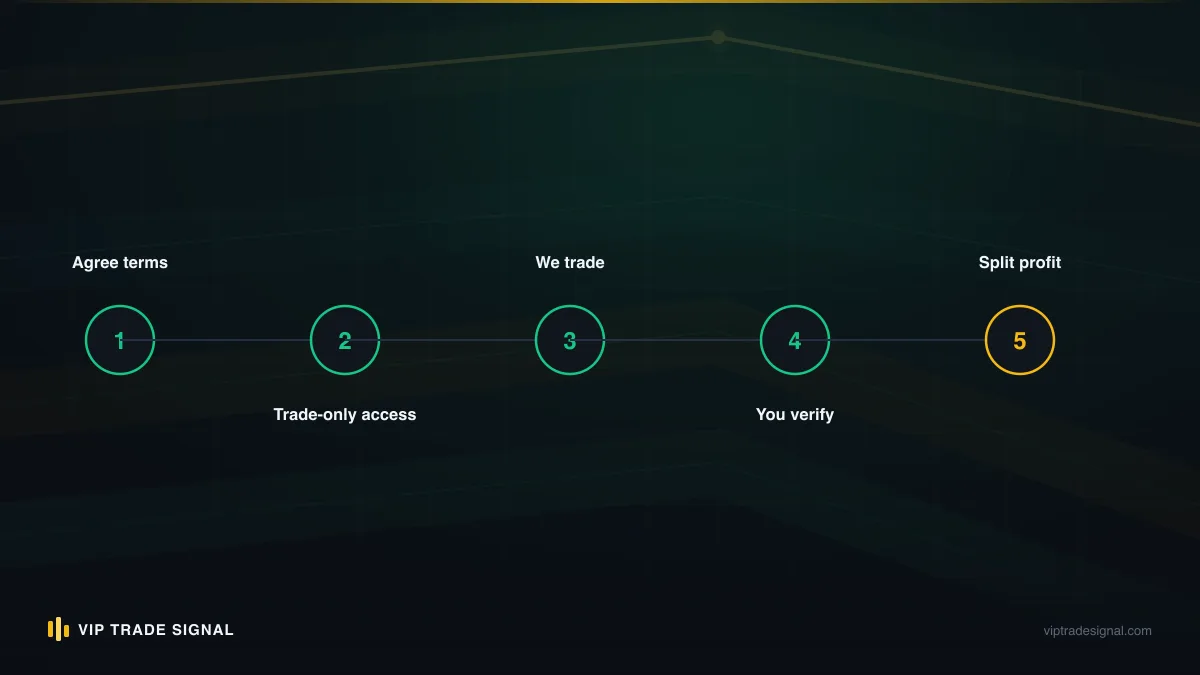
With a managed account, a human does. You grant a manager trading authority over your account (on MT4/MT5 that's usually an investor-style arrangement where they get trading access and you keep the master password), and they place trades directly, sized for your balance, watching your specific drawdown. When we run accounts at VIP Trade Signal, the person deciding whether your position gets closed early on a nasty gold spike is a trader looking at your equity, not a copier script looking at nothing.
Everything else flows from that split. Fees, execution quality, risk control, the psychology, all of it. Copy trading is a broadcast; a managed account is a service. A broadcast scales to ten thousand followers at zero marginal cost, which is why it's cheap or "free". A service does not scale that way, which is why it costs real money. Neither pricing model is a scam. They're just paying for different things.
There's a third cousin worth naming: PAMM. In a PAMM structure your money is pooled with other investors into one master account and the manager trades the pool, allocating profit and loss proportionally. It behaves like a managed account with the individuality removed. The managed forex account vs pamm question mostly comes down to whether you want your capital in your own account under your own broker login, or in a pool where you're trusting the platform's allocation maths. I know which I'd pick, and it isn't the pool, but PAMM does solve the small-account problem neatly since a $500 slice of a $2m pool gets the same trades as everyone else.
Copy trading mechanics, and where copies degrade
Here's the lifecycle of a single copied trade, because the degradation happens at specific points and you should know where they are.
The master clicks buy on gold at 3,318.40. Their broker fills the order. The copy platform's server notices the new position, either by polling the master's account or receiving a push from the broker's API. It then loops through every follower, calculates each one's proportional size, and sends orders to each follower's broker. Your broker receives your order, routes it, and fills it at whatever the market shows by then.
Count the hops. Master's terminal to master's broker. Broker to copy server. Copy server through its follower queue to your broker. Your broker to the market. Each hop takes time, and gold does not wait. On a quiet Tuesday afternoon the whole chain might complete in under a second and you'll get filled a few cents from the master. During a CPI release, when the master's entry is precisely the sort of fast-market moment that made their track record, that chain can take several seconds, and a few seconds in fast gold is easily two or three dollars of price. The master got 3,318.40. You got 3,321.10. The master's stop, copied faithfully, is now proportionally closer to your entry than to theirs. Your reward-to-risk on this trade is worse than the master's before anything else has gone wrong.
And it degrades further at the sizing step. Copy platforms map the master's position to yours by ratio: equity ratio, fixed multiplier, or fixed lots. All three have failure modes. Equity-ratio copying on a small account runs into minimum lot sizes, so a master's carefully sized 0.07-lot probe becomes your 0.01-lot minimum, or gets skipped entirely, and suddenly you hold a different portfolio from the master. Fixed multipliers drift out of proportion as your balance diverges from theirs. And when the master scales into a position with three entries, your account might only qualify for the first one, so you carry a third of their position with all of their risk decisions attached.
None of this is hidden, exactly. It's in the platform documentation, in the grey text. But the marketing page shows the master's equity curve, not the median follower's, and those are different pictures. Ask any platform to show you the average follower's return on their most popular master. The silence is educational.
Slippage, latency and sizing mismatch: the silent tax
Let's put numbers on it, because "slippage exists" is easy to nod along to and easy to underestimate.
Say a master trades gold with an average take profit of 400 cents ($4.00 of price movement) and a stop of 200 cents, and wins 55% of the time. Perfectly decent system. Over 100 trades, the master expects roughly 55 × $4.00 minus 45 × $2.00 per unit of size: $220 minus $90, so $130 of price captured.
Now give the follower just 30 cents of average adverse slippage per trade, entries and exits combined. That's not disaster-scenario slippage; that's normal-copier slippage on a volatile metal, some trades fine, some news entries terrible. Thirty cents off every one of 100 trades is $30. The follower's captured price drops from $130 to $100. That "small" execution friction ate 23% of the edge. Dan's missing 25% suddenly looks less mysterious.
It gets worse when the master's style is faster. A scalper capturing 80 cents per winner has no room to donate 30 of them to latency; the same slippage that mildly annoys a swing trader completely destroys a scalping record in copy form. This is the single most reliable rule in copy trading and the platforms will never print it: the faster the master's style, the less of their performance survives the copy. Long-hold swing traders copy tolerably. Scalpers copy terribly. And the leaderboards are full of scalpers, because scalping produces the smooth, hyperactive equity curves that attract followers.
Sizing mismatch stacks on top. Suppose the master risks 1% per trade on a $50,000 account and you copy with $800. The proportional size for many of their trades rounds below the 0.01-lot minimum on gold at your broker, so the copier either rounds up (you now risk 2 or 3% where they risked 1) or skips (you now miss trades, and never the losers specifically). Over a year, your account has not traded the master's system. It's traded a randomly mutated version of it, and mutations of trading systems are rarely improvements.
A managed account simply doesn't have this class of problem. The manager sizes each trade for your balance from the start. There's no replication delay because there's no replication; the order that hits your account is the original. Whatever else you pay for management, and we'll get to fees properly, you are not paying this silent tax. On small accounts especially, that tax is frequently bigger than the visible fees people spend all their time comparing.
The interference problem: why copiers underperform their masters
Everything so far has been mechanics. Now the uncomfortable part, because the biggest destroyer of copier returns isn't latency. It's the follower's own thumb.
Copy platforms let you interfere. You can close a copied position manually, pause copying, unfollow mid-drawdown, adjust the multiplier after a losing week. This is sold as a feature, control, and it feels like one right up until you use it. Here's how it actually plays out, and I'm describing my own behaviour from years ago as much as anyone's.
You start copying a trader after browsing the leaderboard, which means, almost by definition, you start right after their best run. Regression does what regression does and the first month is flat or down. You hold, uneasy. Month two brings a proper losing streak, the kind every real system has, and you watch a floating loss grow in your own account in real time. At minus 12% you close the copied positions yourself, "just to be safe". The master holds, the trades recover as their system statistically tends to, and their curve climbs on without you. Bruised, you re-enable copying, now with a bigger multiplier to make back the loss. The next drawdown hits the bigger size. You unfollow for good, conclude the master was a fraud, and go looking for a new leaderboard.
The master's twelve months: +34%. Yours: whatever survives that sequence. The trades were identical; the outcomes weren't, because you were present for the decisions. Selling systematically low and buying back systematically high isn't a character flaw unique to you. It's what unsupervised humans do next to a live P&L. I did exactly this with a ZuluTrade provider in the early days: bailed at the bottom of a drawdown that recovered fully within three weeks.
The copy is faithful. The copier isn't. Most of the gap between a master's return and a follower's return is the follower's own hand on the controls.
A managed account amputates the thumb. You can watch, and you should. But you're not sitting on a close button for individual positions, and the person deciding whether to hold through drawdown is someone with a plan, a risk framework, and crucially no panic about this specific account because it's one of many they run identically. When we take on an account under our management service, the hardest conversation isn't about fees. It's explaining that the value of the service is partly that the client can't intervene trade-by-trade, and that this is a feature for the same reason a locked cabinet helps a dieter.
Is handing over discretion psychologically comfortable? No. Plenty of people genuinely can't do it, and for them copy trading's escape hatch is worth the performance it costs. That's a legitimate choice. Just make it knowing the price.
Managed accounts: what you give up and what you get
So what does the managed side of the ledger actually look like? Let me be concrete about the shape of the thing, using our own model as the example since it's the one I can describe from the inside.
The account is yours, at your broker, in your name. That matters more than it sounds. The genuinely dangerous "managed account" offers, the ones that end up in regulator warnings, start with "send us your money". A legitimate arrangement never takes custody: you fund your own MT4 or MT5 account, the manager gets trading access, and you keep the master password and full withdrawal rights. If your manager can block a withdrawal, you don't have a managed account, you have a hostage situation with a login page. Our setup on the account management service works exactly this way, and I'd tell you to demand the same structure from anyone else too.
What you give up is trade-level control and, honestly, some transparency of process. A manager won't send you a commentary on every entry. You'll see the trades appear in your terminal and you can audit everything after the fact, but you're buying the outcome of a process, not a seat inside it. If you're the sort of person who wants to understand every setup, you'll be happier learning to trade signals yourself, and there's an argument that following a signal service is the better education anyway since you execute everything with your own hands.
What you get: sizing done for your actual balance, a human watching your actual drawdown, and someone whose pay depends on your realized profit rather than your activity. That last point deserves a hard look in the fee section, because incentive alignment is where the two models differ most and where copy trading's "free" pricing hides its teeth.
The minimums are the other practical difference. Traditional managed accounts and money managers historically wanted $10,000, often $25,000 and up, because flat management fees only cover the labour at size. The industry has moved. We run accounts from a few hundred dollars with a $200 minimum advance against the profit split, precisely because the profit-share model works at small size where a 2% annual management fee doesn't. We've written separately about how a $200 managed account actually works and what's realistic to expect from one, and about minimum deposits across the industry, so I'll leave the detail there. The short version: small managed accounts now exist, but the maths of fixed costs means fees at that size sit at the high end, ours included.
Fee comparison: spreads, markups, profit splits and where the money hides
Time for the table, and then the part the table can't show.
| Cost | Copy trading | Managed account |
|---|---|---|
| Headline fee | Often "free" to follow | Profit split (commonly 20-50% of gains) or management fee |
| Spread/markup | Frequently widened; platform takes a cut per trade | Your broker's normal spread |
| Master/manager compensation | Volume rebates, spread share, sometimes profit share | The profit split, in the open |
| Slippage/latency cost | Real and continuous | Not applicable |
| Paid in losing months | Yes, via spread on every trade | Usually nothing (profit-share models) |
The copy trading fee structure is the more misleading of the two, and it's misleading in a specific direction. Most platforms charge followers nothing visible. The master gets paid through volume: a rebate per lot their followers trade, or a share of a widened spread. Read that again slowly. The master's income scales with how much their followers trade, not with whether the followers make money. A master who trades 40 times a week earns multiples of one who trades four times, regardless of results. Now revisit why the leaderboards overflow with hyperactive scalpers whose style, as we established, copies worst of anyone's. The incentive structure manufactures exactly the masters who transfer least.
A widened spread is brutally effective at hiding cost. Add 20 cents to the gold spread on a copy account, run 400 trades a year at 0.05 lots, and you've paid about $400 without a single line item ever appearing on a statement. On a $2,000 account that's 20% of your capital, gone into "free". People who would never accept a visible 20% fee pay this one without noticing.
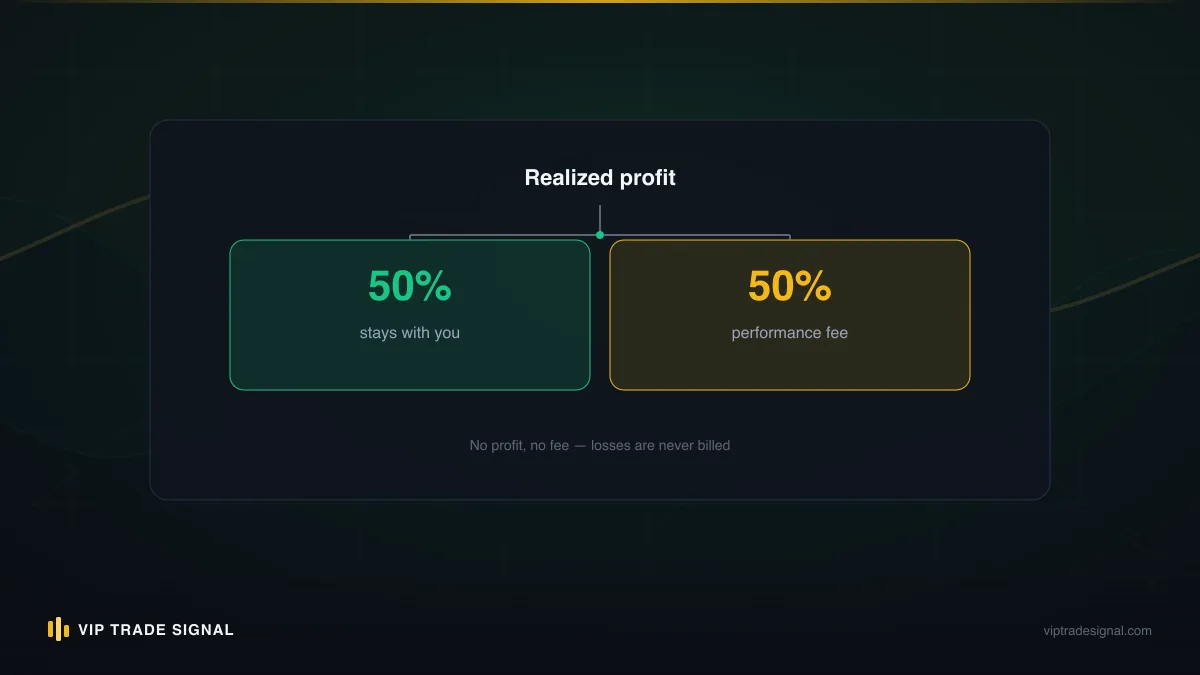
Profit splits are the opposite: painfully visible, and better aligned. Our model is a flat 50% of realized profit with the $200 minimum advance, and I won't pretend 50% is cheap; it's the top of the industry range, which typically runs 20-50%. It's priced there because the minimums are low, everything is pay-as-you-go with no lock-in, and running many small accounts individually costs desk time that pooled structures avoid. The full numbers sit on our pricing page and I'd rather you read them cold than have me soften them here. What a profit split buys you regardless of provider is the incentive: a manager on pure profit share earns nothing in a losing month and nothing on churned volume. They make money in exactly one scenario, the one where you do too. Losing months still happen, to be clear. This is leveraged gold trading and anyone who implies otherwise is selling something. But at least nobody's getting paid for the losing.
One more comparison people ask about: copy trading vs forex signals. Signals are the third model, cheaper than both (ours are $99/month for unlimited gold signals, or free through a partner broker), because you do the execution yourself. You get the trade ideas, the entries, stops and targets, and your hands do the rest. More work, more control, most education per dollar. Different article, but keep it in mind as the option that costs least in fees and most in your own discipline.
Risk control when things get ugly
Sunny-day comparisons are easy. The models really separate during the ugly weeks, so let's game one out.
Gold gaps $18 against a heavy position over a weekend, or a Fed statement rips it $30 in an hour. What happens in each model?
In a copy account, whatever the master does happens to you, later and worse. If the master closes fast, your copy closes after the delay, at a worse price, and in a fast market the difference between their exit and yours can be a large multiple of normal slippage. If the master is one of the martingale merchants who populate leaderboards (smooth curve, no visible losses, doubling into every drawdown), you'll discover it now, at speed, and if their account has deeper margin than yours the strategy can survive on their balance while your proportionally thinner copy hits margin call first. That is the nightmare scenario of ratio copying: the master's account lives, yours dies, and the leaderboard record never even shows a loss. Followers of blown martingale masters are the ghosts of every copy platform.
The platforms do offer follower-side protections: equity stop-outs, max drawdown settings, per-trade stop overrides. Use them if you copy anyone, genuinely. But understand what they are: crash barriers, not risk management. A follower-side equity stop that triggers mid-crisis closes your positions into the worst liquidity of the month. It caps the damage; it doesn't manage anything.
In a managed account, the response depends entirely on the manager's quality, which is honest but unsatisfying, so here's what it looks like when it's done properly. Risk is set per trade as a fixed fraction of your equity, positions are sized so the stop, not the margin level, is the risk boundary, and news events are either avoided or sized down in advance. When the $30 hour arrives, a competent manager is flattening or already flat, and the decision is made once and applied to every account they run, yours included, at first-order execution speed rather than at the end of a copy queue. An incompetent or dishonest manager, meanwhile, can wreck an account faster than any copy platform, which is why the next section exists.
There's also the class of question summed up as expert advisor vs human account manager: some "managed" services are just an EA someone else hosts, running on your account. EAs execute with perfect discipline and zero judgment, which is lovely until the market does the thing the backtest never contained. Machines don't panic, but they also don't notice. For gold around high-impact news, I want a human able to say "not today". You may weigh it differently; just find out which one you're actually hiring, because plenty of services blur it deliberately.
Verifying track records: where each model lies to you
Both models have a characteristic dishonesty, and knowing each one's flavour is half the defence.
Copy trading's flavour is survivorship and curve-shopping. The platform hosts ten thousand masters. A few hundred look brilliant at any moment purely by chance, the way a few hundred coin-flippers in a big enough stadium hit ten heads straight. The leaderboard surfaces exactly those, you pick from the top, and you've selected for luck at its historical maximum. Blown accounts quietly vanish or get restarted under fresh names, so the graveyard is invisible. The records themselves are usually genuine, that's the platforms' real virtue, but the selection process on top of them is a machine for finding peaks. Filters that help: two years minimum history, drawdown you can see and survive, no doubling patterns after losses, position sizes consistent over time, and a follower count that's grown steadily rather than spiked off one hot quarter.
The managed-account flavour is simpler: fabrication. No leaderboard means no forced disclosure, so you're relying on whatever the manager chooses to show, and screenshots of MT4 statements are a solved problem for scammers. Demand read-only proof: a Myfxbook or FX Blue link tied to a live account with the full history, brokerage verification intact, no gaps. Demand losing periods; a record without them is the reddest flag in this business, because every real trader has them. And apply the structural test from earlier: your account, your broker, your master password, your withdrawals. Any wobble on any of those four, walk.
We hold ourselves to the disclosure standard we recommend, which is why every closed signal we've issued sits publicly at /signals/history, losses included, and it's the first thing I'd point a sceptical prospect at. Not because our record is spotless. Because it's complete, and complete is the only kind of record worth reading.
Whichever model you're vetting, the questions converge: full history or curated highlights? Losses shown or scrubbed? Compensation aligned with your profit or with your volume? Money in your custody or theirs? Four questions, ten minutes, and you've filtered out most of the industry's rot before a pound is at risk.
The equity curve nobody publishes
One picture summarises this whole article, and it's the one no copy platform will ever put on a landing page: the master's equity curve with the average follower's plotted underneath.
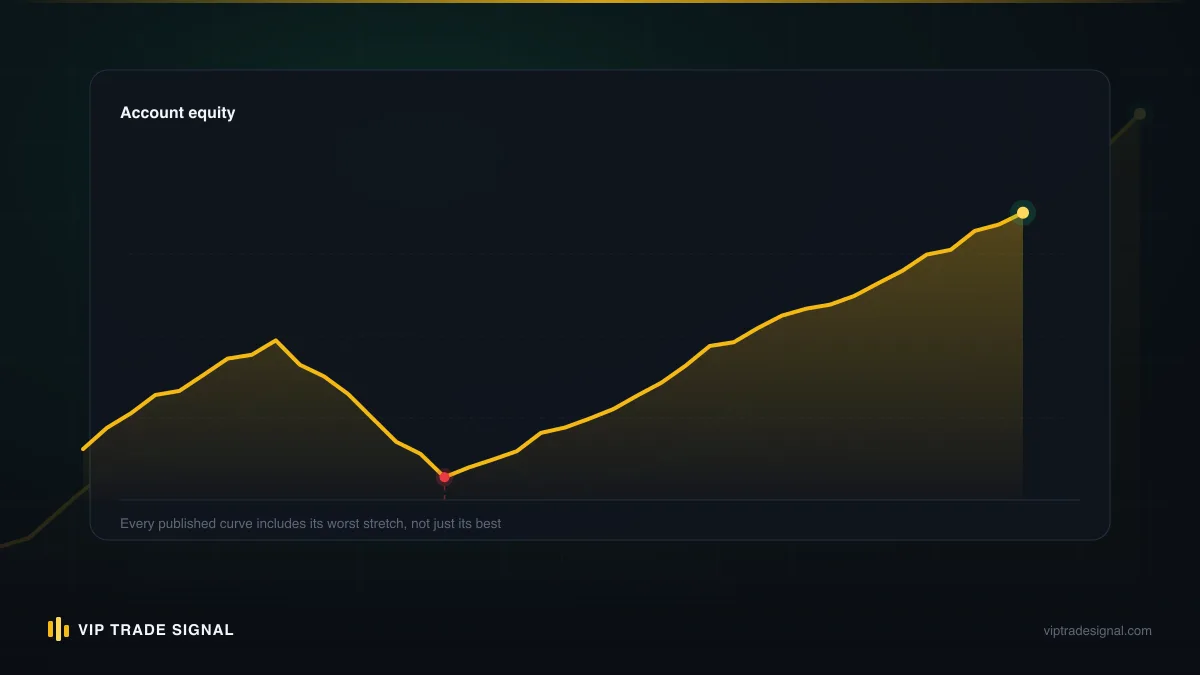
The two curves start at the same point and separate immediately. Slippage bends the follower's curve down a little on every trade. Sizing drift bends it unpredictably. Interference puts cliffs in it at exactly the wrong moments, because followers intervene at emotional extremes and emotional extremes cluster at drawdown bottoms. The gap compounds. Dan's 25 points in a year is not an outlier; it's roughly what the mechanics predict for an active master, a small account, and a human being watching the P&L.
A managed account's curve isn't the master's curve either, mind. It's the manager's actual result on your actual balance, minus the profit split, and it will contain losing months because real trading does. But it's one curve, not a degraded echo of one, and every force in this article that quietly widens the copy gap simply doesn't operate on it. When you compare models, compare the curve you'd actually receive, not the one on the advert. For copy trading that means mentally marking down every leaderboard curve you see, and marking it down hard for fast-trading masters.
Managed forex account vs copy trading: which fits which person
I promised no single champion, so here's the honest sorting. Read the profiles, not the verdicts you were hoping for.
Copy trading fits you if you have a small account (under $500, say), you want cheap exposure to the mechanics of trading, and you can honestly commit to hands off after choosing a slow-style master. The platform handles everything, the visible cost is near zero, and the lessons are real. Treat it as tuition with a chance of profit rather than an income plan. Pick swing traders with multi-year histories, cap your allocation per master, set a follower-side equity stop, and then sit on your hands, which is the clause most people fail.
A managed account fits you if you have capital you genuinely want traded without your involvement, you accept losing months as part of any real strategy, and you're temperamentally able to delegate. Busy professionals are the obvious profile: the person with a decent balance and no time or desire to watch gold at 2am is who the model was built for. It also quietly fits the self-aware over-traders, the people whose own history proves the biggest risk to their account is their access to it. If you've blown two accounts on revenge trades, delegation isn't weakness, it's the trade of the year. If you're weighing management against trading a funded challenge account instead, that's its own trade-off and we've compared managed accounts against prop firms separately.
Signals fit you if you want to keep your hands on the wheel and learn while doing it. Cheapest in fees, most demanding of discipline, and the only model of the three that leaves you more skilled at the end than the start.
None of the above fits you if the money involved is rent money, emergency fund, or anything you can't watch draw down 20% without losing sleep. Leveraged gold does that. Every model in this article can lose, will sometimes lose, and no fee structure changes it. The choice between models decides who executes and who gets paid; it does not decide whether markets cooperate.
The dishonest version of this section names one winner. The honest version says the ranking depends on your balance, your hours, and your self-control under a floating loss, and that the last one is the variable people misjudge most. You know your own record. Sort accordingly.
Hybrids, halfway houses and sensible combinations
Real portfolios rarely sit purely in one box, and a few combinations make genuine sense.
The commonest sensible hybrid is signals plus a managed slice. You run a small account yourself on signals, learning execution and risk management with your own hands, while a separate account sits under management. The self-traded account teaches you enough to properly evaluate what the manager is doing; the managed account stops your learning curve from being your whole net worth's problem. After a year you'll know from experience whether you're the trader or the delegator, which is worth more than any article, including this one.
Copy-then-graduate is another reasonable path: copy a slow master with a small stake for six months purely to watch how a system breathes through wins and losses, then move to signals or management with calibrated expectations. The tuition framing again. What doesn't make sense is copying five masters at once for "diversification": correlated strategies on one underlying aren't diversification, they're the same risk with extra spread costs, and during a sharp gold move all five will demand margin on the same afternoon.
And the halfway houses to be wary of: PAMM pools where your money leaves your custody, "managed" services that are unattended EAs in a trench coat, and any structure, hybrid or pure, where you can't independently verify the record and can't withdraw without permission. Complexity is where bad deals hide. The good versions of both models are structurally simple: your account, visible history, aligned pay.
Where this leaves you
Dan, from the opening, eventually stopped copying. Not because the master was bad; the master was legitimately good. Because he finally did the arithmetic on his own statement and saw that the platform's spread markup plus his three panic exits had consumed most of a genuinely profitable year. He runs a signal service subscription now and executes his own trades, and last time we spoke he was mildly annoyed at how much of the job turns out to be sitting still. That's the right kind of annoyed.
Your version of the decision comes down to three questions, so ask them in order. How much capital, honestly? Under a few hundred dollars, copy a slow master or trade signals; management maths only starts working from a couple hundred up, and even then modestly. How much time and interest? None at all points to management, some points to signals, and "I'll watch it constantly" points to signals whether you like it or not, because you'll interfere with anything else. And the hard one: what does your own history say about you next to a losing position? Answer that one truthfully and the model usually picks itself.
If the answer lands on delegation, our account management page sets out the structure in full: your MT4/MT5 account, your master password, your withdrawal rights, 50% of realized profit and nothing on losses. Expensive at the top of the range, transparent to the pound, and wrong for plenty of people, which is roughly what an honest service looks like from the outside. And if the answer lands anywhere else, take it. The best outcome of a comparison piece isn't a customer. It's a reader who picks the model that fits and stops donating their edge to the plumbing.