There's a specific moment when this question shows up. You've got a couple of thousand dollars set aside, you've watched enough charts to know you're interested, and two adverts are fighting for your attention. One says: pass our challenge and trade $100,000 of our capital, keep 80% of the profit. The other says: hand your account to a professional, do nothing, collect your share. Skill money versus sleep money.
The managed account vs prop firm funded account comparison gets written up constantly and priced honestly almost never. Prop firm articles are mostly written by prop firm affiliates, so the challenge fee is framed as a bargain and the failure rate doesn't come up. Managed account articles are mostly written by account managers, so the profit split sounds generous and the drawdown risk gets a single mumbled sentence near the end. We run a managed account service ourselves, which means you should read our numbers with the same scepticism. But it also means we can put real figures on one side of the ledger instead of guessing at both.
So let's do the thing nobody does. Price both paths properly, including the ugly line items: reset fees, payout denials, losing months, and the cost of your own time. Then run $2,000 through each for twelve months and see what actually comes out.
Two different questions wearing the same costume
Here's the thing that gets missed in nearly every comparison piece: these two products are not competitors. They're answers to entirely different questions that happen to share a marketing audience.
A prop firm funded account answers the question "I can trade, so can I get paid for that skill without risking my own savings?" It's a job interview with an entry fee. The firm isn't investing in you; it's selling you an audition, and if you pass, it rents your skill in exchange for a profit split. Your capital barely matters. What matters is whether you can produce returns inside their rules.
A managed forex account answers the opposite question: "I have capital but not the skill, time, or stomach to trade it, so can I rent someone else's?" Now your money is the whole point. You're not being tested. You're the investor, and the trader works for a cut of what they make you. Managed forex account vs self trading is the real comparison on this side, where you're deciding whether to do the work yourself or pay a specialist half the upside to do it for you.
Confuse the two and you end up in the wrong queue. We've seen people with genuine trading skill park money in managed accounts because it felt safer, earning a fraction of what their own edge could have made through a funded account. And we've seen far more people with no edge at all burn through four or five challenge fees chasing a payout they were never going to reach, when the honest move was admitting they wanted returns, not a trading career.
Ask yourself the blunt version: if someone gave you $100,000 tomorrow and told you to trade it, do you actually believe (based on results, not feelings) that you'd grow it? If yes, prop is worth pricing. If you hesitated, you're an investor, and you should price the managed path. Most people hesitate. That's not an insult; it's just the base rate. The industry commonplace that most retail traders lose money exists because it keeps being true.
How a prop firm funded account really works
Strip away the branding and every mainstream prop firm runs the same machine. You pay an upfront fee, anywhere from $50 for a $5,000 evaluation up to $500-plus for a $100,000 or $200,000 one. You then trade a demo account (nearly always demo, whatever the marketing implies) and have to hit a profit target, typically 8-10% in phase one and 4-5% in phase two, without breaking the risk rules.
The rules are where the machine earns its money. A daily drawdown limit, usually 4-5%: breach it once, even for a minute of floating loss, and the account is dead. An overall drawdown limit, usually 8-10%, sometimes trailing, which is nastier than it sounds because a trailing limit follows your equity peak upward and squeezes your room from behind. Minimum trading days. Maximum position sizes. Bans on holding through news, or over weekends, or both. Consistency rules that fail you for making too much money in one day, which is the kind of clause you only appreciate after it's been used on you.
Pass both phases and you get a funded account. Now you trade under the same drawdown rules, permanently, and split profits, typically 80/20 in your favour at the big-name firms, with payouts on a two-week or monthly cycle. Some firms scale you up after consecutive profitable months. Some genuinely pay quickly and reliably. This part of the industry is real; funded traders exist and get paid.
But hold the two halves of the business model in your head at once. The firm's revenue is challenge fees. Its cost is payouts. Every firm sits somewhere on the spectrum between "evaluation business that tolerates payouts" and "genuine capital allocator", and the marketing gives you no way to tell which one you're buying. The rules aren't just risk management for them. They're the product's failure mechanism, tuned so that most customers pay and don't collect. If that sounds cynical, look at the numbers firms themselves have published when regulators or curiosity pushed them to: pass rates in the single digits to low teens are standard, and the share of purchasers who ever receive a payout is smaller still.
None of which makes prop firms a scam. It makes them a hard exam with an entry fee and a paying job at the end for the few who pass. Price it like that and it prices honestly.
The true cost of a challenge is the resets
Here's the number the affiliate reviews never compute: the expected cost of getting funded, not the sticker price of one attempt.
Say a $100,000 evaluation costs $500. If pass rates sit around 10% (and across the industry's own disclosures that's a generous reading) then the average buyer needs multiple attempts, and the maths of repeated tries is brutal. Even a trader with a genuine 25% chance per attempt, well above the crowd, has roughly a 30% chance of failing four straight challenges. That's $2,000 in fees with nothing to show. The typical buyer, sitting at the base rate, should expect the funded account to cost somewhere between $2,000 and $5,000 in accumulated fees before it exists. Firms know this, which is why "free reset" promotions and discount codes are eternal. Resets aren't a courtesy. They're the checkout page.
And there's a second cost that never gets a line item: your time. A two-phase challenge takes most traders one to three months of daily screen time to pass, when they pass. Fail in week three of phase two (the classic heartbreak) and that time is gone along with the fee. Run four attempts and you've potentially spent most of a year auditioning. If you'd have spent those hours trading anyway, fine, the cost is small. If you carved them out of a job and a family, it isn't.
There's also a subtler tax: the challenge changes how you trade. Profit targets with deadlines push people into oversized positions in the final week. Daily drawdown limits push people into closing good trades early. You end up trading the rules instead of the market, and plenty of traders who are quietly profitable on their own accounts fail challenges precisely because the rule set punishes their style. A swing trader who holds through news is a perfectly viable trader and a near-guaranteed challenge failure at half the firms out there.
The honest way to think about prop firm challenge cost, then, is as tuition with a lottery attached. Budget for three to five attempts. If the total (call it $1,500 or $2,500, whatever your tier implies) would hurt to lose entirely, you can't afford the exam, whatever the sticker says.
Payout risk: passing was the easy part
Suppose you pass. You're funded, you trade well, you're up 6% in your first month on a $100,000 account. That's $6,000 of profit, $4,800 at an 80% split. Time to collect.
This is where the second filter lives, and it's the one nobody budgets for. Payout denial is a documented, recurring pattern across the industry. Not universal, but common enough that pretending otherwise is negligent. The mechanisms repeat: a retroactive review finds you violated a rule you didn't know existed or that was worded ambiguously. Your trading is flagged as "toxic flow" or a banned strategy (arbitrage, news scalping, copy trading, "gambling behaviour"), categories elastic enough to fit almost any profitable month. The firm's terms let it deny, delay, or claw back at its discretion, and you agreed to those terms when you paid the fee. In the worst cases, firms have simply collapsed owing traders months of payouts, because the challenge-fee revenue that funds payouts is a flywheel that stops the moment new sign-ups slow down.
A prop firm payout isn't income until it clears your bank. Until then it's a scoreboard in someone else's stadium.
The practical defences are unglamorous. Read the full terms before buying, especially the prohibited-strategies and payout-conditions sections; the exam's real questions are hidden in there. Favour firms with years of verifiable payout history over whoever's running this month's biggest discount. Withdraw early and often rather than compounding a balance that exists at the firm's pleasure. And mentally discount your expected payouts by some honest haircut for denial and delay risk. Even at a conservative discount, the funded path's expected value drops noticeably once you price the possibility that your best month is the one that gets flagged.
A worked example makes the haircut visible. Take a funded trader who averages $3,000 a month in gross profit and expects $2,400 at an 80% split. Now suppose there's a one-in-ten chance in any given month that a payout gets delayed a cycle, and a one-in-twenty chance over the account's life that it gets denied outright or the account gets terminated on a technicality. Those aren't outlandish numbers; ask around any funded-trader forum and you'll hear worse. The expected value of that $2,400 quietly becomes something closer to $2,100, and the variance (the thing that actually wrecks household budgeting) goes up sharply. A salary that occasionally doesn't arrive isn't a salary. It's a good freelance client, and you should hold it with a freelancer's paranoia.
None of this means don't do it. It means the 80% profit split in the advert is the ceiling, not the expectation, and the gap between them is filled with rules you haven't read yet.
Managed accounts monetise capital, not skill
Now flip the desk around. In a managed account you're not being examined. Your money is, in a sense (the manager wants to know it's real and sufficient), but nobody's timing your drawdowns with a stopwatch. You deposit funds with a broker, in your own name, and grant a trader access to trade them. The trader earns a share of the profit they generate. No profit, no fee, if the arrangement is structured properly. And if it isn't structured that way, walk.
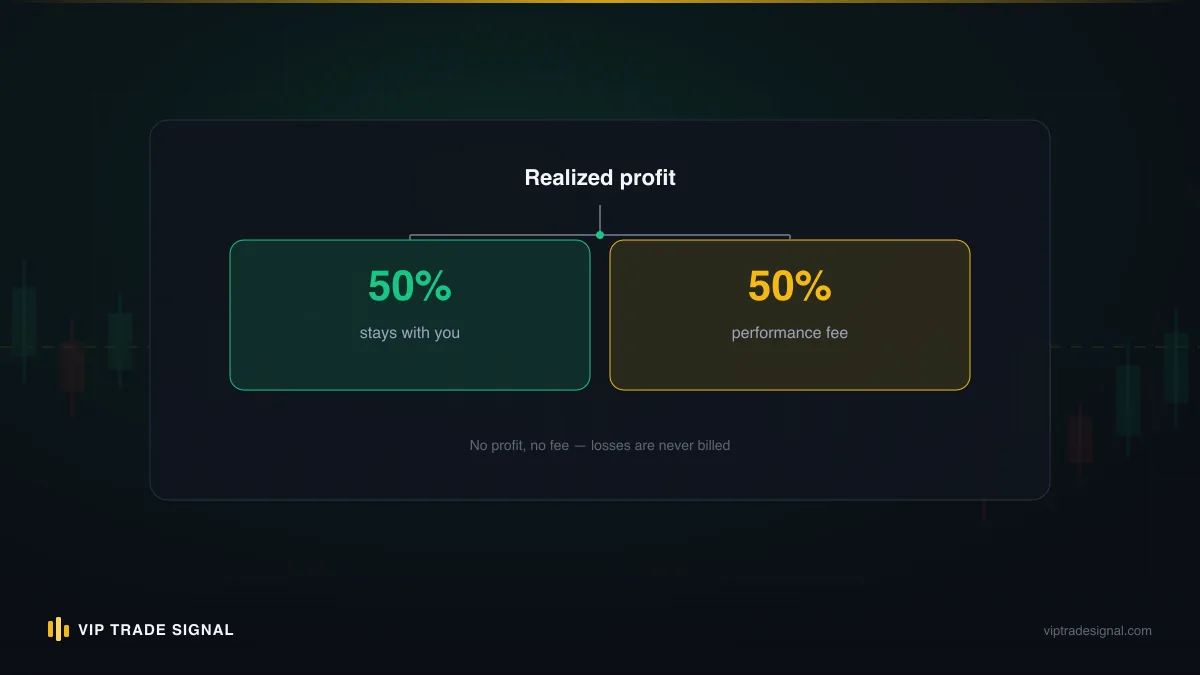
The forex profit split runs the opposite direction here. At a prop firm, you keep 80% of profits made on their capital. In a managed account, you typically keep 50-70% of profits made on your capital, with the manager taking the rest as a performance fee. Our own arrangement at VIP Trade Signal sits at the top of the fee range: a flat 50% of realized profit, with a $200 minimum advance that's settled against that share, on an account you fund from $200 up. We're expensive per unit of profit and we say so plainly; the trade-off is a minimum most managers would laugh at, pay-as-you-go terms, and no lock-in. The full structure is on our account management service page, and the fee logic across everything we do is laid out on the pricing page. Plenty of managers charge 30-40% instead, usually with $10,000-$25,000 minimums and quarterly lock-ups. Cheaper rate, taller door.
The security question matters more than the fee question, and it's where the industry's rot concentrates. A legitimate managed arrangement has three properties. The account is at a regulated broker, in your name. You keep the master password, so you can revoke the trader's access in thirty seconds. And withdrawals go to you alone; the manager can trade the money but can never move it. That's how we run it, and it's the only structure we'd accept as a client. Anyone who asks you to send funds to them, to a wallet, or to a "pooled fund" is asking you to convert market risk into counterparty risk, which is how managed account horror stories are actually written. The trading losses sting; the vanished deposits are the catastrophes.
Why the split runs against you here, and why that's fair
It's worth pausing on the apparent unfairness. At the prop firm you keep 80%; with a manager you might keep 50%. Same industry, opposite splits. How is that not a rip-off on the managed side?
Because the splits are paying for opposite things. The prop firm keeps 20% for supplying capital, infrastructure, and the risk of your blow-up, while you supply the scarce ingredient: profitable trading, hundreds of hours of it. In a managed account you supply the abundant ingredient, money, and the manager supplies the scarce one. Scarcity gets the bigger slice; it always has. The same logic prices hedge funds, where "2 and 20" (a 2% annual fee plus 20% of profits, charged on institutional-sized money) has been the reference point for decades. Retail managed accounts run higher percentages on smaller sums because a $2,000 account takes nearly the same work to trade as a $200,000 one, and someone has to make the small end viable at all. That's the honest reason our rate sits where it does, and the honest reason most managers won't touch small accounts, full stop.
Because losses do happen, and any manager who implies otherwise has told you everything. Gold, which is all we trade, can move 2% in an afternoon. A managed account can and will have losing weeks and losing months, and drawdown (watching your balance sit below its high-water mark for a while) is part of the deal, not a malfunction of it. What the fee structure should guarantee is alignment: the manager eats the drawdown with you, in the sense that they earn nothing until you're back above water. High-water marks, where fees apply only to new net profit, are the mechanism. Insist on one.
Managed account vs prop firm funded account: the $2,000 test
Time to make the comparison concrete. Same trader-slash-investor, same $2,000, two doors, twelve months. Every number below is a scenario, not a promise; we're pricing structures, not predicting markets.
Door one: prop. You spend the $2,000 on challenge attempts at roughly $500 each for a $100,000 evaluation. Give yourself credit as an above-average candidate: a 25% pass chance per attempt, more than double the crowd. Across four attempts that's about a 68% chance of getting funded at some point during the year, and a 32% chance of ending it with nothing but experience. Say you pass on attempt three. That's month four, $1,500 spent. You now trade the funded account for eight months. A genuinely good funded trader might average 2-3% a month on the account with the discipline the rules force; call it 2.5%, so $2,500 monthly, $2,000 to you at the 80% split. But funded accounts die too. One bad day through the trailing drawdown and you're back to a reset fee, and payouts carry the denial haircut. Model six clean payout months out of eight, minus one $500 reset, and the year nets around $10,000. The realistic downside (never passing, or passing and breaching quickly) nets you somewhere between minus $2,000 and roughly break-even. Wide, wide distribution.
Door two: managed. The $2,000 goes into your own broker account and a manager trades it. Suppose the year goes well. Genuinely well, not brochure-well: the account returns 40% gross before fees, unevenly, with two losing months and a stretch of drawdown in the middle that tests your nerve. That's $800 gross profit. At our 50% split you keep $400, about 20% net on your capital for the year. A mediocre year might be 10% gross, $100 in your pocket. A bad year is negative: the account ends down 15%, you've lost $300 of capital, the manager has earned nothing, and everyone's had a miserable time. All three of those years happen to real accounts.
Look at what the table is really saying:
| Prop path | Managed path | |
|---|---|---|
| Your $2,000 becomes | Exam fees (spent) | Trading capital (still yours) |
| Realistic good year | ~$8,000-$12,000 | ~$300-$500 |
| Realistic bad year | −$2,000, plus months of time | −$200 to −$400, minutes of time |
| What's being paid | Your skill and screen time | Your capital's risk-bearing |
| Odds the good year happens | Low without a proven edge | Depends entirely on the manager |
The prop path's ceiling is ten to twenty times higher on the same $2,000. It should be. It's a salary for skilled work, priced against a small capital base, and it consumes hundreds of hours and a real chance of total loss of the stake. The managed path returns like an aggressive investment because that's what it is. Comparing the two on returns alone is comparing a job offer to a savings product. The right question was never "which pays more"; it's "which one am I actually equipped to collect from".
What you can actually lose on each side
Return maths gets all the attention, but the loss maths is where the decision should really be made, because the two paths fail in completely different ways.
On the prop side, your maximum cash loss is capped and known: every dollar you spend on challenges and resets, and not a penny more. The firm's drawdown is the firm's problem. That cap is the path's genuinely great feature. A trader can take a swing at a $100,000 account while risking only $500 of actual money, which is leverage on skill that no personal account can match. But the cap hides the other losses. Time, first: months of screens for a possible zero is a loss that never appears in anyone's spreadsheet. And the psychological loss is real too. Trading under a daily stopwatch, where one afternoon's floating drawdown can vaporise three months of work, does things to people. We've watched disciplined traders turn into revenge traders inside a fortnight of challenge pressure. Some never trade the same afterwards.
On the managed side, your loss is your capital, and it is not capped at zero risk just because a professional is driving. A managed account in a drawdown is your money that's down. The manager's incentive to recover it is strong (they earn nothing until it's back past the high-water mark) but incentive isn't ability, and no honest manager guarantees recovery. We say this on every page we publish and we'll say it here: gold trading is high risk, losing periods are normal, and you should only place capital you can watch fluctuate without needing it back next month. The structural protections, meaning your broker, your name, your master password, your withdrawal rights, cap the catastrophic risk, the vanished-deposit kind. They do nothing to cap market risk. Nothing does.
One more asymmetry, and it's a big one: recoverability. A blown challenge is fully gone. There's no drawdown to trade back, just a receipt. A managed account that's down 12% is bruised but alive; the capital is still in the market, the strategy is still running, and recovery is at least possible, however unguaranteed. That cuts both ways, mind. The prop trader gets a clean slate with every fresh fee, which some people find psychologically easier than staring at a red number for weeks. The managed client has to sit inside the drawdown, and sitting is a skill. We've watched clients pull accounts at the exact bottom of a losing stretch more than once, converting a temporary drawdown into a permanent loss with a single impatient click. If you know that would be you, size your deposit so the swings stay below your panic threshold.
There's a rough symmetry worth noticing. The prop trader risks a small, fixed amount of money and a large, unbounded amount of time and emotional capital. The managed client risks a chosen amount of money and almost no time at all. Which loss you can better afford is a personal fact, not a financial one. Someone with a demanding job and a young family may find $400 of managed-account drawdown far easier to carry than two hundred lost evenings. A 24-year-old with time, focus, and a demonstrated edge should probably feel the opposite.
Who should choose which
We can make this crisp, because the deciding variables are few and they're mostly things you already know about yourself.
Choose the prop route if all of these are true. You have a strategy with a real track record: months of your own results, on a live or at least honestly-run demo account, not a good fortnight. Your style survives the rule set: you use stops, you don't need to hold through every news event, your drawdowns stay inside 8% of equity. You can afford to lose the full challenge budget, three to five fees, without flinching. And you actually want trading as work, because a funded account is a performance job with a boss made of rules, not passive anything.
Choose the managed route if the point of the money is the money. You want your capital exposed to a strategy without becoming a trader yourself. The honest phrase people search is passive income forex trading, and while we'd quibble with "income" (returns are irregular and sometimes negative; that's not a salary), the "passive" half is accurate. You'd rather pay half the upside than spend a thousand hours earning the skill to keep all of it. And you can meet the structural bar: regulated broker, account in your name, performance-only fees on a high-water mark, full withdrawal control. If you're weighing up managers, our piece on reading managed forex account reviews covers how to separate verified results from testimonial theatre, and the why we run a $200 minimum article explains the economics of small managed accounts more honestly than most of the industry would like.
Choose neither, for now, if you can't afford to lose the stake on either path. That's not a rhetorical flourish. If losing $2,000 would touch your rent, the correct forex product is none, and anyone who tells you otherwise is selling something. The markets will still be here when the money is genuinely spare.
And a quiet word to the group the adverts target hardest: if you've failed three or more challenges, the evidence is speaking. Either the rule sets don't fit your trading, in which case try a firm whose rules do, or the edge isn't there yet, in which case a fourth fee is a donation. Pausing to rebuild on your own small account, or moving your capital to the investor side of the desk for a while, isn't quitting. It's reading your own data.
Running both at once
Here's the configuration almost nobody writes about, and it's the one we find most interesting: the funded trader who uses a managed account as the boring half of their finances.
Think about the funded trader's cash-flow problem. Income arrives in lumps. A $4,000 payout here, nothing for six weeks there, occasionally a dead account and a month of re-passing. It's volatile in a way that makes normal financial planning miserable. The temptation is to recycle every payout into more and bigger challenges, scaling the skill bet, which works right up until a rough quarter takes out several accounts at once and the whole tower with it. Prop income and prop risk are perfectly correlated; when your trading is cold, everything is cold at the same time.
Splitting the streams changes the shape. A trader we'll call Dan (generic, illustrative, not a client) passes a $100,000 challenge and starts drawing $2,000-$3,000 in a decent month. He keeps his challenge war chest topped up first: two resets' worth, always. Then he routes a slice of each payout, say 30%, into places that don't depend on next month's trading being good. For Dan, whose actual edge is intraday and who has zero appetite for managing a second, slower strategy himself, a managed account is one plausible bucket alongside genuinely boring ones like an index fund or plain cash savings. The point isn't that a managed account is safe; it isn't, and it can have a losing year exactly when his trading does. The point is that a different strategy, in a different style, on a different timescale, run by different hands, is at least partially uncorrelated with his own cold streaks. And partial is worth having.
The same logic runs the other way, more cheaply. A managed account client who's curious whether they could trade can buy one small challenge, a $10,000 or $25,000 evaluation for $100-ish, as a cheap, honest test of the question, while their capital keeps working elsewhere. Fail it and you've bought clarity for the price of a night out. Pass it and you've discovered something worth restructuring around. Either way you've kept the two questions (is my skill worth paying for, is my capital working) in separate envelopes, which is where they belonged all along. Our FAQ covers how the managed side of that split works in practice, down to the tedious-but-vital details like password control and withdrawal rights.
The checklist before you commit either way
Print this, or don't, but answer it honestly before money moves. It's ten minutes that regularly saves people four figures.
Before buying a prop challenge:
- Do I have at least three months of my own trading results, and are they positive after costs? Not screenshots of good weeks; a full record, losers included.
- Have I read the entire rule set of this specific firm, including prohibited strategies and payout conditions, and does my normal trading style pass without modification?
- Is the drawdown limit static or trailing, and have I understood what a trailing limit does to my room as I profit?
- Have I budgeted for three to five attempts, and can I lose that entire budget without financial or domestic damage?
- Can I find traders (not affiliates) with verifiable payout histories at this firm going back more than a year?
- Have I planned my withdrawal cadence, or am I vaguely intending to compound a balance that isn't legally mine?
Before funding a managed account:
- Is the account at a regulated broker, in my name, with the master password and withdrawal rights staying with me? If any answer is no, stop reading and leave.
- Is the fee performance-only, on realized profit, above a high-water mark? Monthly fees regardless of results are a subscription to hope. (We've written about how minimum deposits shape the whole deal if you're comparing entry sizes.)
- Can I see a full, public trade history, wins and losses both, rather than a highlight reel? Ours lives at /signals/history for exactly this reason, and we'd hold any competitor to the same bar.
- Do I understand the strategy well enough to describe it in one sentence, including what instrument it trades and roughly how deep its drawdowns have historically run?
- Is this money I can leave alone for six to twelve months and watch fluctuate, including downward, without needing it?
- Has anyone, at any point, guaranteed me a return? If yes, run. Guarantees are the one thing no honest operator in this business can sell.
Two paths, and the labels on the doors were never "good" and "bad". One pays skill and charges fees, time, and nerve. The other pays capital and charges half the upside plus real market risk. The expensive mistake — the one that funds this entire industry's advertising — is walking through the door built for a person you're currently not. Price yourself as honestly as you've now priced them, pick the door that matches, and if the managed side is yours, you know where our numbers are published. Nothing here is personalized advice; we're traders, not licensed advisors, and your situation is yours to weigh. But the maths above doesn't care who wrote it. Run it with your own figures before either door gets your money.