Somebody asked me this at a barbecue last summer. Not a client — a friend of a friend who'd been messaged on Instagram by an "account manager" promising 15% a month. He wanted a one-word answer. Is forex account management safe, yes or no?
I gave him the answer I'm going to give you, which annoyed him at the time and probably saved him a few thousand pounds: the question is broken. "Safe" isn't one thing. It's three completely different risks wearing one word as a trench coat, and until you pull them apart you can't evaluate anything. You'll either trust everyone (and get robbed) or trust no one (and miss the handful of arrangements that are actually structured properly).
I manage other people's trading accounts for a living. My business only works if the safety question is answerable — if there's a real, checkable difference between what we do and what that Instagram guy does. There is. But it lives in structure, not in trust, and definitely not in how professional someone's website looks. Let me show you where.
The three risks people blur into one word
When someone asks whether managed forex accounts are legit, they're actually asking three questions at once, and the answers point in different directions:
- Market risk. The manager is honest, competent, and still loses your money, because trading involves losing sometimes and occasionally losing a lot. This risk is irreducible. Anyone who tells you otherwise has just failed the fraud test, which is convenient.
- Fraud risk. The manager was never going to trade at all. Your deposit went into their pocket, the "dashboard" showing your gains is a WordPress template, and the moment you request a withdrawal you discover a "release fee". This risk can be eliminated — genuinely driven to near zero — by structure.
- Incompetence risk. The manager is honest and really does trade, but badly. They over-leverage, revenge trade, martingale into a drawdown, and torch the account with the best of intentions. This risk can't be eliminated, but it can be substantially reduced by verification and capped by the settings on your own account.
Most articles on this subject mash all three together into a vague "be careful out there" and a list of red flags. That's useless, because the mitigations are completely different. You manage market risk with position limits and money you can afford to lose. You manage fraud risk with custody. You manage incompetence risk with track records and monitoring. Get one right and neglect another and you're still exposed — a brilliantly verified trader on a platform where they hold your deposit is still a custody risk, and a perfectly structured arrangement with a reckless trader is still a blown account waiting for a bad week.
So the honest answer to "is forex account management safe" is: it can be structured to be as safe as trading ever gets, which is not very, and it can also be one of the most efficient wealth-destruction machines available to the retail public. The difference is observable before you send a penny. That's the whole article, really. The rest is detail.
Risk 1: market risk — irreducible, but boundable
Start with the risk nobody can remove, because it calibrates everything else.
Forex and gold trading is high risk. Not "high risk" as a legal formality — actually high risk, in the sense that most retail accounts lose money and drawdowns of 20-30% happen to competent traders in bad stretches. If a manager trades your account, your account will have losing trades, losing weeks, and probably a losing month or two per year even when things are going well overall. A managed account is not a savings product. It's trading, done by someone else's hands.
Here's the thing though: market risk is boundable even though it isn't removable. Three levers do the work.
Lever one: only fund it with money whose loss wouldn't change your life. Boring advice, endlessly repeated, still the single biggest safety factor. A trader we'll call Dean put $2,000 of genuinely spare money into a managed arrangement; when it drew down 18% in a rough month, he shrugged and let the plan play out, and it recovered. His mate put in money earmarked for a house deposit, panicked at -9%, pulled it at the bottom, and locked in the loss. Same manager, same trades, completely different outcomes — because the risk that actually fired was the one between the client's ears.
Lever two: agree the risk parameters in writing before a single trade. Maximum risk per trade, maximum open exposure, a drawdown level at which trading pauses and you talk. On a $5,000 account, "1% risk per trade" means about $50 on the line per idea. If your manager can't tell you these numbers, they don't have them, and a manager without risk numbers is just a gambler with your login.
Lever three: the stop-loss on every position. Every trade should carry a hard stop, in the platform, not "mental". You can verify this yourself in five seconds by looking at the open positions on your own account — which brings us neatly to the custody question, because if you can't look at your own account, everything else on this list is theatre.
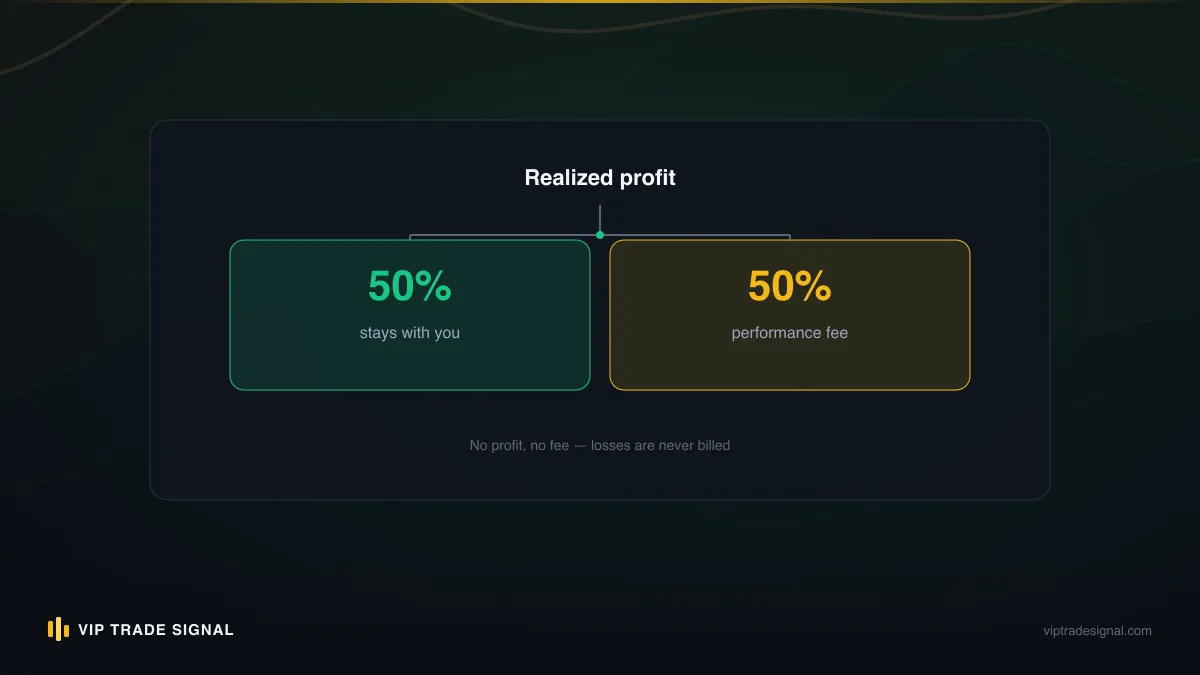
One more uncomfortable truth for this section: performance fees don't remove market risk either. We charge 50% of realized profit on the accounts we manage — no profit, no fee — and that aligns incentives, but alignment isn't insulation. A profit-share manager can still lose your capital. The fee model just means they don't get paid for doing it.
Risk 2: fraud risk — eliminated by structure, not trust
This is the risk that generates the horror stories, and it's the one where the news is genuinely good: fraud risk in account management is almost entirely a custody problem, and custody is a structural choice you control.
Nearly every forex management scam you have ever heard of — the Instagram manager, the "PAMM opportunity" on an unheard-of platform, the Telegram admin with the Lamborghini rental — shares one load-bearing feature: you sent them the money. You deposited into their platform, their wallet, their "company account". From that second, the trading question was irrelevant. Whether they traded well, badly, or not at all no longer mattered, because the money was already gone the moment it left your custody. The fake dashboard showing +40% wasn't the scam. The deposit was the scam. Everything after was stagecraft to get a second deposit.
Now flip it. In a properly structured arrangement:
- The account is yours. Opened by you, in your name, at a regulated broker you chose or at least verified independently.
- You deposit with the broker, never with the manager. The manager never touches the money in transit. Not once, not "just to set things up", not ever.
- The manager gets trading access only. On MT4/MT5 that's the investor-password-plus-trading structure or a limited power of attorney; either way, they can open and close trades and nothing else. If you want the full mechanics of how that permission is scoped and revoked, I've written up how a limited power of attorney works in forex separately.
- You keep the master password. Which means you — and only you — can withdraw, change passwords, or shut the whole thing down at 2am on a Sunday because you got a bad feeling. No permission needed. No notice period. No conversation.
Sit with what that structure does to the fraud scenarios. Can the manager run off with your deposit? No — they never held it. Can they withdraw to their own bank account? No — broker withdrawals go to the account holder's verified payment method, and they don't have the master password anyway. Can they lock you out and feed you a fake balance? No — you log into the real broker account whenever you like and see the real number, ugly weeks included. Can they invent a "withdrawal fee" or "tax clearance" to hold your money hostage? No — your withdrawal is a form on your broker's website that they never see.
What's left for a fraudster inside this structure? Essentially one move: trade your account recklessly and hope to skim a performance fee off a lucky streak. That's not nothing — it's why risk parameters and monitoring still matter — but notice it has collapsed from "steal everything instantly" to "must actually produce real, visible profits on an account you watch, before earning anything". Fraud didn't get harder. It got structurally pointless.
A scammer needs your money or your access. Give them neither — give them a trading password on your own broker account and nothing else — and there is nothing left to steal.
This is why I keep saying safety lives in structure, not trust. I don't ask clients to trust me, and you shouldn't trust me; I'm a stranger on the internet with an obvious commercial interest. I ask clients to verify a structure in which trusting me is unnecessary. Any manager who resists that structure — who needs your deposit on their platform, your master password, custody in any form — has answered the legitimacy question for you, loudly, before a single trade.
Risk 3: incompetence risk — reduced by verification
Custody protects you from thieves. It does nothing about honest people who are bad at trading, and there are far more of those.
Here's the awkward base-rate fact: most people who trade forex lose money. That includes most people who manage forex accounts, because the barrier to calling yourself a manager is a working phone. Some of the most dangerous operators aren't fraudsters at all — they're true believers eighteen months into their trading journey, running other people's money on the same over-leveraged style that hasn't blown up yet. They'll show you three good months quite sincerely. The fourth month is the problem.
You reduce this risk with verification, and verification means one thing: a track record you can independently check, including the losses.
The gold standard is broker-verified performance — a Myfxbook or FX Blueprint link wired to a real account, or read-only investor access to a live account the manager actually trades. What you're looking for isn't a pretty return figure. It's:
- Length. Twelve months minimum, ideally more. Anyone can have a hot quarter. A hot quarter is, statistically, the most common thing in trading.
- Drawdown. What was the worst peak-to-trough fall, and how long did recovery take? A verified 60% historical drawdown tells you exactly what your account might do. Believe it.
- Visible losses. A record with no red is a record that's been curated, martingaled, or invented. Real trading has losing trades on public display. We publish every closed signal, wins and losses both, at our signals history page, and I'd hold any manager — including us — to that standard: if the losses aren't published, assume they're worse than you fear.
- Style consistency. Steady 1-2% risk per trade, or lot sizes that balloon after losses? The second pattern is martingale, and martingale records look beautiful right up until the day they go to zero in an afternoon.
Screenshots verify nothing. MT4 statements sent as PDFs verify nothing — they're editable in ten minutes. Telegram testimonials verify less than nothing, since buying fake ones costs about $30. If the manager's evidence can't be traced back to a broker's servers or watched live on a real account, treat it as marketing.
And then, even after verification, incompetence risk gets capped rather than trusted away: the written drawdown limit from the market-risk section is your circuit breaker. Verified traders have bad runs too. The difference between a bad run and a disaster is whether anything forces a pause — and in a properly structured account, you hold that switch, because you hold the master password.
The structural safety checklist: custody, access, agreement
Everything above compresses into three questions. If you only remember one section of this article, make it this one.
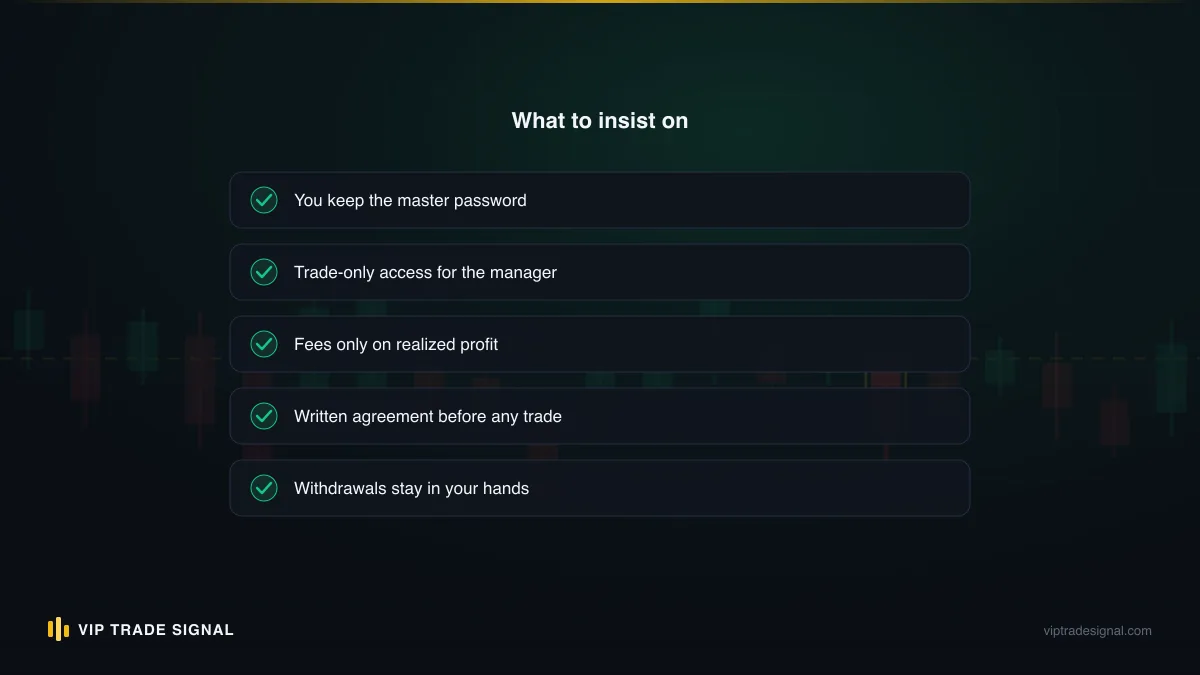
Custody: where does the money live? Correct answer: in a trading account in your name at a regulated broker, deposited by you, withdrawable by you alone. Any other answer — their platform, their PAMM on an unregulated broker, a crypto wallet, "our segregated fund" — is a fail. Not a yellow flag. A fail.
Access: what exactly can the manager do? Correct answer: place and close trades, nothing else. They hold trading access; you hold the master password; you can revoke everything unilaterally by changing one password, tonight, without asking. If revocation requires their cooperation, their notice period, or their "processing", the access is wrong.
Agreement: what's written down? Correct answer: a plain document stating the fee structure (with performance fees, realized profit, defined — floating paper gains don't count), risk per trade, maximum drawdown before a mandatory pause, and how either side exits. It doesn't need to be forty pages of legalese. It needs to exist, and it needs numbers in it.
A quick self-test I give people: imagine the manager vanishes tomorrow — phone dead, website gone. In a correctly structured arrangement your reaction is mild irritation: you change the trading password, close any open positions, withdraw at your leisure. Your money never moved. If instead your stomach just dropped because the vanishing manager takes your funds with them, the structure was wrong from the start, and no amount of charm, credentials, or apparent performance was ever going to fix that.
Notice what's not on this checklist: how professional the website looks, how confident the manager sounds, whether they have an office address, whether their Telegram has 40,000 members. All of that is purchasable. Structure isn't fakeable, because structure is something you can see from inside your own broker login.
Legit vs scam: the observable differences
People ask "are managed forex accounts legit" as if legitimacy were a property of the industry. It isn't. It's a property of the specific arrangement in front of you, and the differences between a legitimate one and a scam are observable — not vibes, observable facts you can check before funding.
| What you can observe | Legitimate arrangement | Scam pattern |
|---|---|---|
| Where you deposit | Your own account at a regulated broker | Their platform, wallet, or "company account" |
| Master password | Yours, always | Theirs, or "shared for convenience" |
| Returns talk | Ranges, drawdowns, "losses happen" | Fixed monthly %, "guaranteed", "risk-free" |
| Track record | Broker-verified, losses visible | Screenshots, testimonials, mocked-up dashboards |
| Fees | % of realized profit, or a transparent flat fee | Fees on deposit, or fees to withdraw |
| Withdrawals | Broker form, no permission needed | "Release fees", "tax clearance", delays, sudden new charges |
| How they found you | You went looking | They slid into your DMs |
| Pressure | "Take your time, verify everything" | "Slots close Friday" |
Two of these deserve a closer look because they're the most reliable single tells.
Guaranteed returns. Anyone quoting a fixed monthly return — "10% a month, guaranteed" — is lying, and it's worth being precise about why it's a certainty rather than a suspicion. Trading returns are variable by nature; the market doesn't distribute profits on a schedule. A genuine 10% monthly return, compounded, would turn $10,000 into roughly $2.1 million in five years, and the person capable of it would be running a fund for institutions, not messaging strangers for $500 deposits. The guarantee isn't optimism. It's the sales script of someone who never intends to trade, which is why "is forex managed account investment a scam" gets a clean answer whenever that phrase appears: that one is, yes, every time.
Withdrawal friction. Legitimate arrangements make withdrawal boring — you fill in your broker's form, money arrives in a few days, the manager finds out afterwards if at all. Scams make withdrawal an event: a fee appears, a "compliance review" begins, an account manager needs to "approve the release". The moment getting your own money out requires their participation, you've learned that it was never really your money once it left your bank. Unfortunately, most people learn this at the exact moment it's too late to act on.
The contact-direction row matters more than it looks, too. Legitimate managers are findable; scammers are finders. If the relationship began with an unsolicited DM, the base rate of fraud is so high that I'd walk away regardless of what the checklist says — some games aren't worth playing even with good cards.
Doesn't regulation sort all this out?
A reasonable objection at this point: why all the DIY structural engineering — isn't this what regulators are for? Partly. It's worth being clear about what regulation does and doesn't cover here, because people lean on the word harder than it can bear.
What regulation genuinely buys you sits at the broker layer. A broker regulated by the FCA, ASIC, CySEC or similar has to segregate client funds from company money, submit to audits, and in several jurisdictions participate in a compensation scheme if the broker itself collapses. That's why the custody rule works at all: "your own account at a regulated broker" is a meaningful sentence precisely because the regulator makes the broker a hard target. Deposit at an unregulated offshore outfit and the custody test quietly fails even if the account has your name on it, because the entity holding the money answers to nobody.
What regulation mostly doesn't buy you is protection at the manager layer, at least in the retail arrangements this article is about. Formal discretionary fund management is a licensed activity in most places, and the licensed version comes with real oversight — and institutional minimums to match. The retail managed-account world largely operates below or beside that regime, through trading-access arrangements on your own account. Which cuts both ways. It's exactly why the structural checklist has to do the heavy lifting: no inspector is checking your manager's risk per trade. But it's also why the structure is so effective — you're not trusting an intermediary who holds your assets, so there's less for oversight to protect.
The practical takeaway is a division of labour. Let regulation handle the broker: check the register yourself, on the regulator's own website, matching the exact entity name — clone firms that mimic real licences are one of the oldest tricks going. Then let structure handle the manager. People get burned when they run it backwards — trusting a slick "regulated" claim from a manager (usually unverifiable, sometimes referring to a company registration, which regulates nothing) while parking the actual money somewhere no rulebook reaches.
Base rates: how often does this go wrong, honestly
I owe you honesty about frequency, not just mechanism, so here's my read after years around this corner of the industry.
Of the "account management" offers a retail trader actually encounters — the DMs, the Telegram promos, the too-smooth Instagram profiles — the majority are fraudulent or functionally fraudulent. Not a slim majority. Most. The unsolicited-contact channel is so polluted that regulators in the UK, Australia and elsewhere put out recurring warnings specifically about social-media "account managers", and action-fraud style reporting keeps romance-adjacent trading scams near the top of the loss tables year after year. I'm not going to invent a percentage, but I will say this: if your sample is "people who contacted me first promising monthly returns", assume scam until proven otherwise, and expect to keep assuming.
Filter for structure, though, and the picture changes shape. Among arrangements that pass the custody test — your account, your broker, your master password — outright theft becomes rare, because the structure gives it nothing to take. What remains is the honest pair: market risk and incompetence risk. And there, the sober truth is that plenty of structurally clean managed accounts still lose money, because plenty of managers are mediocre and all of them work in a market that doesn't owe anyone a profit. Losing money to a verified, honest, risk-controlled manager during a bad stretch is a real and reasonably common outcome. It's just a categorically different event from being robbed — you knew the risk, you sized for it, you watched it happen on your own account, and you kept the power to stop it at any point.
So the failure distribution looks roughly like this: nearly all catastrophic, lose-everything outcomes cluster in arrangements that failed the custody test on day one. The structurally sound arrangements fail the way trading fails — partially, visibly, and stoppably. That's not a comforting sentence exactly. But it's the difference between a risk you can size and a trap you can't escape, and confusing the two is how people end up either robbed or too frightened to ever delegate at all.
For what it's worth, this is also why the comparison shopping matters. Some readers land on account management after ruling out the alternatives; if you haven't done that thinking yet, the honest comparisons with copy trading and prop firms are worth an evening, because the right answer for a given person is sometimes "none of the above, trade your own $500 and learn".
What safety looks like in practice: a monitored account
Structure gets you to the starting line. Ongoing monitoring keeps you honest — or rather, keeps everyone honest, including you.
Here's the strange behavioural fact: a large fraction of managed-account clients never log into their own account. They hand over trading access, then get their information from the manager's weekly summary, which is a bit like hiring a builder and only inspecting the house through photos the builder sends. The whole point of keeping the master password is that you don't need anyone's summary. Use that.
A sensible monitoring routine takes maybe ten minutes a week:
- Log into your own MT4/MT5 directly. Not a portal the manager built. The platform, with your credentials, showing the broker's numbers.
- Check every open position has a stop-loss. This is the single fastest health check that exists. A naked position — no stop — is either carelessness or the start of a hold-and-hope, and both are conversations to have today, not after the account is down 30%.
- Sanity-check position sizes against the agreement. If you agreed roughly 1% risk per trade on a $10,000 account, and you're looking at a lot size that puts $800 at risk, the agreement is already broken whether or not the trade wins.
- Watch the pattern after losses. Sizes staying steady after a losing run is discipline. Sizes doubling after a losing run is martingale, and martingale on your account is a resignation letter you should accept immediately by changing the password.
- Track drawdown against the agreed pause level. If you agreed a 20% stop-and-talk line, know where the equity high-water mark is and where you are relative to it. Don't rely on the manager to volunteer that conversation. Good ones will; you shouldn't need them to.
There's a soft skill hiding in here as well: monitoring without meddling. The failure mode on the client side is watching every tick, feeling every floating loss, and pressuring the manager to close winners early and "do something" during normal drawdowns. If you've agreed the parameters and they're being respected, the weekly check is enough — the point of delegation is that you stop making trade-by-trade decisions, including panicked ones. Monitor the rules, not the P&L. The P&L will breathe. The rules shouldn't.
And if a manager reacts badly to being monitored — gets defensive about you logging in, discourages you from watching, calls the investor password "unnecessary" — that reaction is itself the finding. Honest operators like being watched. It's the cheapest marketing we have.
The safest possible setup, step by step
Pulling it all together, here's the sequence I'd give a family member who'd decided, eyes open, to try a managed account. Slowly, in order, no shortcuts.
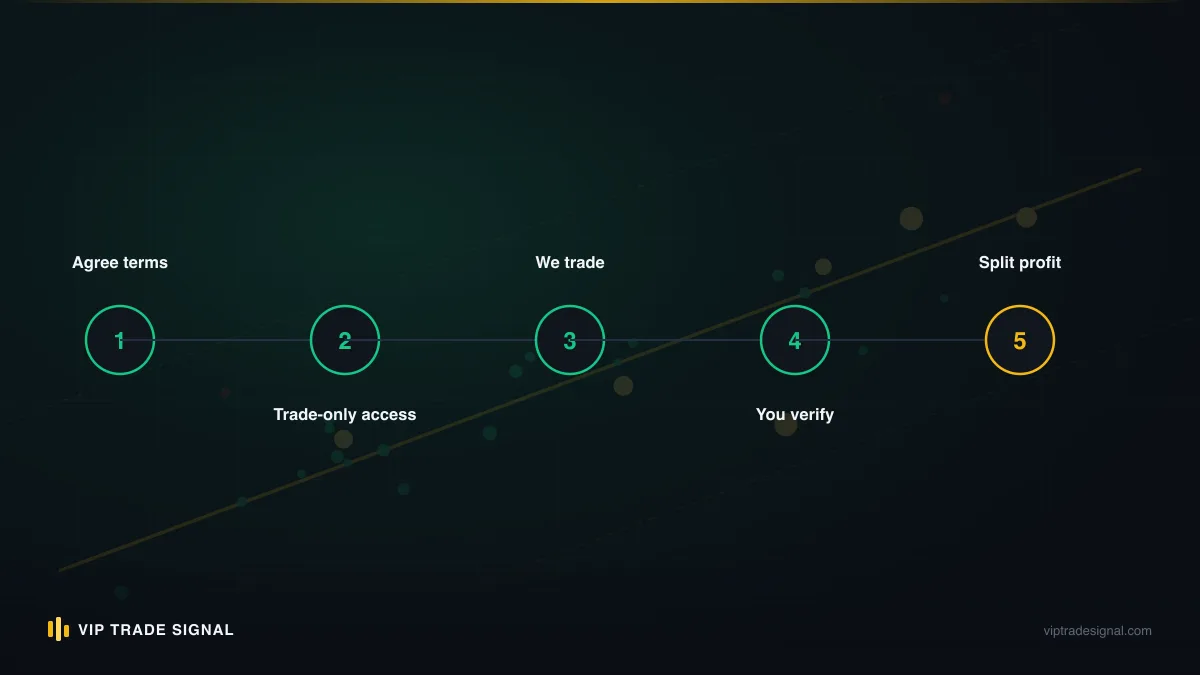
Step 1 — decide the money first. Pick an amount whose total loss you could absorb without changing any life plans. Write the number down before you talk to anyone, because every conversation after this point will exert gentle upward pressure on it.
Step 2 — verify the manager before the structure. Broker-verified track record, twelve months or more, losses visible, drawdown understood, risk style consistent. If verification fails, stop here; structure can't fix a bad trader.
Step 3 — open your own account at a regulated broker. You choose the broker, or at minimum you independently confirm the regulator's register entry yourself — don't take the manager's link on faith. Fund it from your own bank. The manager is not involved in this step at all.
Step 4 — grant trading access only. Trading password or limited power of attorney; master password stays with you, written down somewhere safe, shared with no one. Test that you can log in and see everything.
Step 5 — sign a plain agreement with numbers in it. Fee basis (realized profit only), risk per trade, max exposure, the drawdown pause line, exit terms. One page beats zero pages.
Step 6 — start smaller than you intend to finish. If your written number was $5,000, there's a decent argument for starting at $2,000 and adding after three months of watching the rules hold. You lose a little compounding. You buy a live, personal verification that no track record can match.
Step 7 — run the weekly ten-minute check from the previous section, every week, even when it's boring. Especially when it's boring.
Step 8 — pre-commit your exit triggers. Password changes tonight if: a naked position appears twice, sizing breaks the agreement, the drawdown line is hit without a pause, or anyone ever asks you to move money anywhere. Deciding the triggers now, calm, is the whole trick — decisions made during a drawdown are reliably the worst ones available.
Follow all eight and you have not made forex account management safe in the way a savings account is safe. Nothing does that, and this arrangement can still end with less money than you started with. What you've done is something more precise: you've deleted the fraud risk structurally, compressed the incompetence risk with verification and monitoring, and drawn a hard boundary around the market risk. Every remaining way to lose is one you saw, sized, and accepted in advance. That is what "safe" honestly means in this business, and anyone selling a stronger definition is selling something else.
So, is forex account management safe with us — and how would you check?
I said at the top that my business depends on the safety question being answerable, so it's only fair to end by answering it about us — and, more usefully, by showing you how to check the answer rather than take it.
Our account management service runs on exactly the structure this article describes, because we built the article and the service from the same convictions. We trade your own MT4 or MT5 account at your broker. You deposit with the broker, never with us. You keep the master password and full withdrawal control from the first day to the last; our access is trading-only and you can revoke it any evening by changing one password, no notice, no conversation required. The fee is a flat 50% of realized profit with a $200 minimum advance — and yes, 50% sits at the high end of the industry, which we're upfront about: our minimums are low and everything is pay-as-you-go, and that convenience is priced in. No profit, nothing further to pay. We trade gold, XAU/USD, only.
Now check it instead of believing it. Run us through this article's own gauntlet. Custody: fail us if we ever ask you to deposit anywhere but your own broker account. Access: fail us if we ask for the master password. Verification: every closed signal we've issued is public at /signals/history — losses on display next to the wins, which tells you how we actually trade through bad stretches, not how we describe ourselves. Agreement: the terms above are in writing before we place anything. And the boring stuff has a home too — the FAQ covers the mechanical questions about passwords, fees and revocation in more detail than a barbecue conversation allows.
One thing you will not find anywhere in our material is a promised return, because we don't know what next quarter holds and neither does anyone else who trades for a living. Accounts we manage have losing weeks. Some will have losing months. We are not a licensed advisor and none of this is personalized investment advice — it's one practitioner's map of where the real dangers sit.
So, the friend-of-a-friend's question, answered properly at last. Is forex account management safe? Structured wrongly: no, and almost maximally not — it's the preferred costume of the modern trading scam. Structured correctly: it carries exactly the risks trading always carries, visible on your own screen, bounded by your own settings, stoppable by your own hand. The gap between those two answers is not luck, charisma, or trust. It's about eight checkable facts, and now you know all of them. Check them on everyone. Start with us.