Somewhere right now, a trader is typing their MT4 password into a Telegram chat because a stranger with a screenshot of a Lamborghini promised to double their account. No paperwork. No record of who agreed to what. When that account gets torched, and it usually does, there will be nothing to point at except a chat log that the "manager" deleted twenty minutes after the margin call.
There is a boring, grown-up alternative, and almost nobody talks about it because boring doesn't sell. It's called a limited power of attorney, LPOA for short, and in forex it's the standard legal instrument for letting someone else trade an account that stays in your name at your broker. A limited power of attorney forex arrangement puts the manager's authority in writing, filed with the broker, scoped to trading only, and revocable by you whenever you like. It is the difference between hiring someone and handing them your wallet.
We run managed accounts at VIP Trade Signal, so we fill these forms in every week, and we've read versions from a dozen brokers. Most articles on the subject are three hundred words of fluff written by people who have clearly never seen one. This one walks through the actual document, field by field, clause by clause, including the parts brokers are quiet about: fee deduction authorisations, revocation timing, and what happens to open positions when you pull the plug. If you're ever going to let anyone trade money for you, read this first.
What a limited power of attorney is, in plain language
Strip away the Latin and a power of attorney is just this: a written permission slip that lets Person B act on behalf of Person A in some defined area. Your parents might grant one to a solicitor to sell a house while they're abroad. A company grants one to a director to sign contracts. The law calls Person A the principal and Person B the attorney-in-fact or agent, which sounds grander than it is. Nobody needs to be an actual attorney.
A general power of attorney is the scary version. It can let the agent do more or less anything the principal could do: move money, sell property, open accounts, sign away rights. You'd grant one to a spouse before major surgery, maybe. You would never, ever grant one to a forex account manager, and no legitimate manager would ask.
A limited power of attorney does what it says. The grant is fenced to a specific activity, on a specific account, at a specific institution. In forex account management, the fence is drawn tight: the manager may open, modify and close trades on account number such-and-such at broker so-and-so. That's the whole kingdom. The money stays in your account, which stays in your name, at a regulated broker that answers to you, not to the manager.
Here's the part that trips people up: the LPOA is filed with the broker, not just signed between you and the manager. That matters enormously. Once the broker has processed it, the manager's access exists as a formal record inside a regulated firm. The broker knows a third party is trading the account. Compliance knows. If a dispute ever lands, there's a paper trail with dates, signatures and scope. Compare that with password-sharing, where the broker's records show one person, you, doing everything, including the trades that emptied the account.
One more plain-language point. An LPOA does not transfer ownership of anything. Your money doesn't move. Legally, every trade the manager places is placed on your behalf and at your risk, which is why the honesty part matters: a manager with an LPOA can still lose your money, thoroughly and quickly, entirely within the permissions you granted. The document controls who can act, not how well they act. Anyone who waves an LPOA around as evidence they're profitable has confused a permission slip with a track record.
"Limited" is the operative word: what stays outside the grant
The entire value of the instrument lives in what it refuses to grant. A properly drafted forex LPOA gives trading authority and almost nothing else, and it's worth being pedantic about the boundary because scammers live in the grey area just outside it.
What a standard broker LPOA grants:
- Opening positions, market or pending, in the instruments the account can trade
- Modifying and closing positions, including stops and limits
- Viewing balance, equity, margin and history for that account
- In many templates, authorising the deduction of agreed management or performance fees (more on this clause later, because it deserves its own section)
What it withholds, and this list is the whole point:
- Withdrawals. The manager cannot send funds anywhere. Not to themselves, not to you, not to a "linked wallet". Withdrawal requests can only come from the account holder, and every broker worth using pays withdrawals back to the funding source in your name.
- Changing your details. Email, phone, registered address, bank details: locked. This blocks the classic account-takeover move of quietly re-pointing communications before draining funds.
- Adding or removing other users. The manager can't sub-delegate to a friend or bolt on a second LPOA.
- Closing the account or transferring it to another broker.
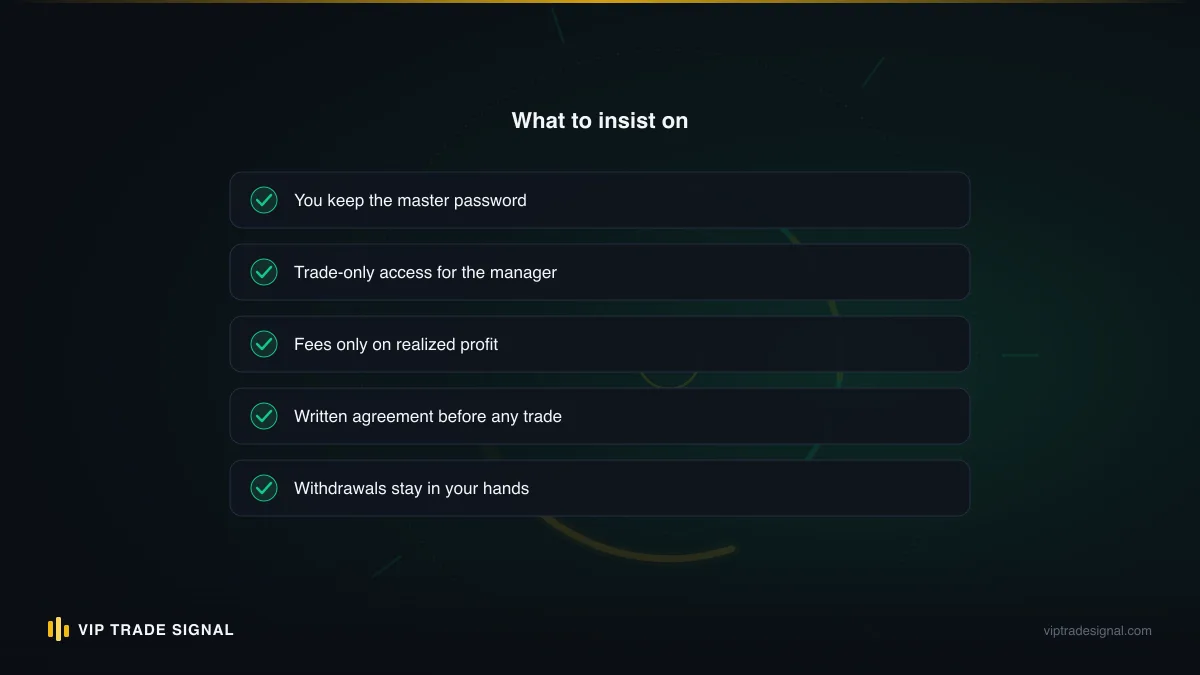
- The master password. Under a clean LPOA setup the manager either gets a separate trading login or trades through the broker's MAM/PAMM layer. You keep the credentials that control money movement.
Say it back to yourself as a scenario, because scenarios stick. A trader we'll call Dana grants an LPOA to a manager. The manager turns out to be reckless, blows 40% of the account in a fortnight of over-leveraged gold longs, and stops replying to messages. Bad outcome. But Dana logs in, sees every trade, revokes the LPOA with one email to the broker, and withdraws the remaining 60% to her own bank account that afternoon. The damage was capped at trading losses. Under a password-sharing arrangement, the same reckless manager could have requested withdrawals, changed the email, and left Dana locked out of her own login while the balance went to zero by other means. Limited means the worst case has a floor. Not a comfortable floor. But a floor.
LPOA vs sharing passwords: why formal beats informal
We should be straight about something: sharing investor or even master credentials is how a lot of retail account management actually happens, including some legitimate arrangements. Our own account management service connects to your existing MT4 or MT5 account, and where a broker's LPOA or MAM route is available we prefer it every single time, because the informal route fails in ways people don't see until it's too late.
Start with the broker's terms. Nearly every retail broker's client agreement prohibits sharing your credentials with third parties. Not discourages. Prohibits. If an account traded by a password-holding third party ends up in a dispute, over a stop-out, a platform error, a mispriced fill, the broker can point at that clause and wash its hands. You handed the keys to someone the broker never approved; why should their compliance team untangle it? An LPOA removes that trapdoor because the broker itself approved the arrangement.
Then there's the evidence problem. With shared passwords, every action on the account is attributed to you. The broker's logs cannot distinguish your clicks from the manager's. If the manager churns the account to farm a rebate deal, or trades against their own book, the audit trail says you did it. An LPOA, or a manager login issued under one, timestamps and attributes the manager's activity separately. When something needs investigating, there's a "who" attached to every ticket.
There's also the small matter of what else your credentials unlock. Plenty of brokers use one login across the client portal and the trading platform. Hand over the portal password and you may have handed over the ability to see your ID documents, your bank details, your card numbers on file. People send this stuff to strangers on Telegram after a three-day conversation. It's genuinely alarming.
A password is a skeleton key handed over in the dark. An LPOA is a named permission, in writing, that a regulated firm has on file.
And the informal route has one final flaw that nobody thinks about at the start: ending it. Revoking an LPOA is a defined broker process with a timestamp. "Revoking" a shared password means changing it and hoping the manager didn't set up anything you can't see, an API key, an EA with hardcoded credentials, a linked copier like the ones we've covered in the managed account vs copy trading comparison. Formal arrangements end formally. Informal ones end with you wondering.
A real LPOA form, field by field
Broker LPOA forms vary in typesetting and hardly at all in substance. Most run two to four pages. Here is what you'll actually meet, in the order you'll usually meet it, based on the templates used by the large MT4/MT5 brokers.
1. Account holder details. Your full legal name exactly as it appears on the account, your account number, sometimes your registered email. Mismatch here is the number one reason forms bounce; if your account says "Daniel J. Okafor" don't sign as "Dan Okafor".
2. Attorney / agent details. The manager's full legal name, address, and often a copy of their photo ID. If the manager is a company, its registration number and the name of the individual acting for it. Pay attention when a manager hesitates here. This field is exactly the accountability the document exists to create, and someone unwilling to put a legal name and ID against their trading is telling you something you should believe.
3. Scope of authorisation. The heart of the form. Typically a paragraph or a checkbox list granting authority to "buy, sell, and otherwise deal in" the instruments available on the account, place and modify orders, and view account information. Read every checkbox. Some forms include optional grants beyond pure trading and default them to ticked.
4. Fee authorisation. A clause permitting the broker to deduct the manager's fees from your account and pay them to the manager, usually with the structure spelled out: X% of profit per period, or a flat monthly amount, or per-lot. Some forms leave this blank for the parties to fill. Never sign one where this section is blank but signed, for the same reason you don't sign a blank cheque.
5. Duration and termination. Whether the LPOA runs indefinitely until revoked, or expires on a date. It will state how revocation works, in writing to the broker, and often a processing window such as "within two to five business days".
6. Risk acknowledgements. A block where you confirm you understand that trading leveraged products is high risk, that the broker doesn't vouch for the manager's competence, and that losses are your own. This is not boilerplate to skim. It's the broker telling you, accurately, that an LPOA transfers authority and nothing else. No profit is guaranteed by anyone in this chain, including us.
7. Indemnity. You agree the broker isn't liable for the manager's decisions made within the granted scope. Fair enough in principle; the broker is a venue, not a supervisor. The thing to check is that the indemnity covers actions within the LPOA's scope, not actions beyond it.
8. Signatures. Yours, the manager's, sometimes a witness, occasionally notarisation depending on jurisdiction and broker. Offshore brokers usually accept a scanned signature and a selfie-with-ID; some EU brokers want wet ink or a qualified e-signature.
A quick reference for the fields and their failure modes:
| Field | What it does | Where people get burned |
|---|---|---|
| Account holder details | Ties the grant to one account | Name mismatch delays processing |
| Agent details | Identifies who's accountable | Manager uses a nominee or fake ID |
| Scope | Fences the authority | Pre-ticked extras beyond trading |
| Fee authorisation | Lets the broker pay the manager | Blank or open-ended percentages |
| Duration / termination | Defines the exit | Long notice periods buried in text |
| Risk acknowledgement | Confirms you own the risk | Skimmed, then "nobody told me" |
| Indemnity | Shields the broker | Wording that covers out-of-scope acts |
Twenty minutes with a highlighter covers all of it. Twenty minutes, against the months it takes to earn back money lost to a clause you didn't read. Cheap insurance.
The powers typically granted, and the ones to strike out
A trading-only LPOA is fine. The trouble arrives in the optional extras that some forms, and some managers, try to slide into scope. If any of the following appear, strike them through, initial the strike, or refuse the form and ask the broker for their standard template.
Strike: any withdrawal or transfer authority. Even "internal transfers between your own accounts" is a wedge. A manager who can move funds between your accounts can move them to an account with different permissions, or use transfers to disguise performance by shuffling losses out of the traded account. Trading authority means trading, full stop.
Strike: authority to deposit on your behalf or accept credit. This sounds harmless and is how people end up with bonus schemes attached to their account that lock withdrawals behind volume requirements.
Strike: power to amend the LPOA or the account's settings. Leverage changes are the sneaky one. A manager who can push your account from 1:100 to 1:1000 has quietly multiplied the damage a bad week can do. Any leverage change should route through you.
Strike: sub-delegation. Wording like "the agent may appoint substitutes or delegates". You did diligence, however much you did, on one person. You did none on their cousin.
Strike or cap: open-ended fee language. "Fees as agreed between the parties from time to time" means the fee can change without a new signature. The number and the calculation basis belong on the form itself.
Question hard: trade-copying and introducing-broker clauses. Some LPOAs double as consent for the manager to earn per-lot rebates from the broker on your trading volume. Rebates aren't automatically evil, but a manager paid per lot is paid to trade a lot, which is the exact opposite of what you want. If a rebate arrangement exists, it should be disclosed as a number, not buried as a clause. This conflict, incidentally, is why performance-only fee models exist: our own account management charges a flat 50% of realised profit with a $200 minimum advance, and nothing per trade, precisely so the incentive points at profit rather than volume. We're at the expensive end of the market on the percentage and we say so; what you're paying for is that no part of the fee rewards churning.
What should survive the highlighter is short: open, modify and close positions; view account data; deduct the specific, numbered fee you agreed. Three powers. Everything else is someone else's convenience purchased with your risk.
How brokers process and enforce LPOAs
Once you submit the form, it goes to the broker's compliance or back-office team, not to a robot. Processing typically takes one to five business days at the large retail brokers, longer if IDs need re-verifying. The broker will usually email you, on your registered address, to confirm the LPOA is active. Keep that email. It is the start-of-authority timestamp, and it pairs with the revocation confirmation you'll hopefully collect calmly at the end rather than urgently in the middle.
Enforcement is where LPOAs get quietly impressive, because the enforcement is largely architectural. At most brokers an approved LPOA results in one of two setups. Either the manager receives their own credentials scoped to trading on your account, or your account gets attached to a MAM or PAMM master structure the manager operates, where the platform allocates trades across many client sub-accounts. In both cases the withdrawal function simply is not present in what the manager can touch. There's no daily judgement call by a broker employee, no "sorry sir, I'll have to check". The permission boundary is enforced by the software the same way your online banking doesn't show you your neighbour's account.
The human layer backs it up. Withdrawal requests get checked against the account holder's identity, and any request to change registered details triggers verification against your documents. If a manager phones the broker pretending to be you, they're asked security questions only you can answer. Is this bulletproof? No. Social engineering exists, and offshore brokers vary wildly in how rigorous their back office is; the fancy Cyprus-regulated names are generally tighter than a three-employee outfit in a jurisdiction you'd struggle to place on a map. Broker selection is part of the security model, which people forget when the manager "recommends" an obscure broker as a condition of working together. That recommendation deserves suspicion in direct proportion to how obscure the broker is.
One practical note on partner-broker arrangements generally, since they're common across this industry and we run one ourselves for signals: a service asking you to use a specific well-known broker (our free-via-broker route uses Exness, XM, IC Markets and Vantage) is a normal affiliate structure and you can verify the broker independently in minutes. A service that only works through a broker you've never heard of, that Google barely knows, is a different animal. The LPOA is only as strong as the institution enforcing it.
Revocation: the exact mechanics and timing
Nobody reads the exit clause on the way in. Read the exit clause. The single most useful thing to know about a limited power of attorney forex arrangement is that you can end it unilaterally, without the manager's consent, cooperation, or even knowledge, and the mechanics are simpler than people expect.
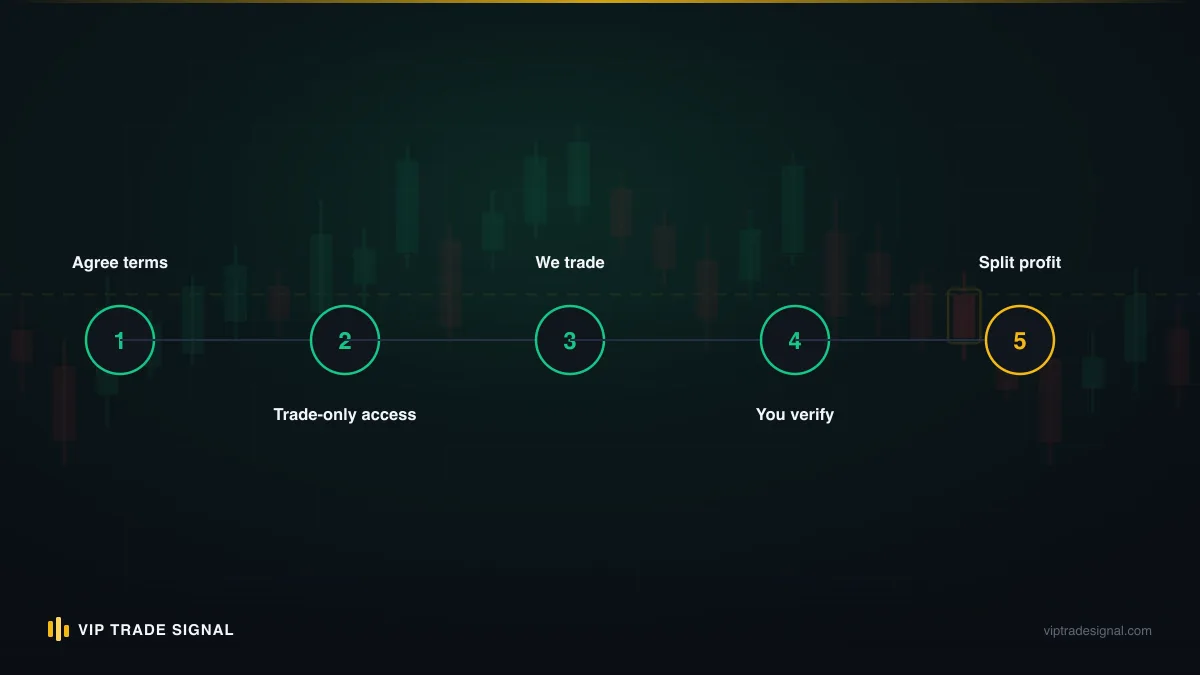
The standard sequence runs like this:
- Written notice to the broker. Email from your registered address to the broker's support or back office: "I revoke the limited power of attorney granted to [name] on account [number], effective immediately. Please confirm removal of all third-party access." Some brokers have a revocation form; use it if it exists, but the email starts the clock either way.
- The processing window. Most LPOAs specify the broker will action revocation within a stated period, commonly two to five business days. In practice the big brokers are faster, often same-day, but plan around the stated window, not the best case.
- Open positions. This is the detail that bites. Revocation cuts the manager's access; it does not automatically flatten the book. If the manager had six open gold positions when you revoked, you now have six open gold positions and nobody managing them. Decide before you send the email whether you'll close everything at market, manage them down yourself, or ask the broker to close all on revocation, which some will do on instruction. A trader we'll call Marcus revoked on a Friday evening, ignored the open trades, and spent the weekend exposed to a gap through his stops that were, it turned out, mental stops the manager never placed. Flatten first or flatten immediately after. Don't drift.
- Confirmation. Get the broker's written confirmation that access is removed, and keep it with the activation email. Between those two timestamps lies the entire period the manager was ever authorised; every trade outside that window is the broker's problem, provably.
- If you're leaving entirely: withdraw, then tidy. Withdrawals were always yours alone, so nothing stops you pulling funds the same day. Change your passwords anyway. Not because the LPOA gave the manager your passwords, it didn't, but because humans reuse credentials and hygiene is free.
Two wrinkles worth knowing. First, some management agreements, the contract between you and the manager, as opposed to the LPOA filed with the broker, include notice periods or early-termination fees. The broker will still revoke on your instruction; the LPOA answers to you, not to the management contract. You might owe the manager a fee under the contract, which is a civil matter, but you cannot be forced to leave them connected while you argue about it. Access first, arguments later. Second, revocation doesn't unwind past fees already deducted under the fee clause. What's been paid is paid unless you can show it was deducted outside the agreed terms.
Total realistic time from decision to fully clean account: an afternoon to a week. Remember that number when someone tells you leaving their programme is complicated.
LPOA in different jurisdictions: variations that matter
The concept travels well; the paperwork mutates. A few variations you'll actually meet, without pretending this is legal advice, because it isn't and we're not licensed to give it.
Offshore and lightly regulated brokers (much of the MT4/MT5 retail world: Seychelles, SVG, Belize entities of the big names) use the simplest process. Scanned form, manager ID, a few days' processing. The LPOA here is mostly an internal broker document; its strength is the broker's own systems and reputation rather than a supervising regulator. Fine with a serious broker, flimsy with a shell.
FCA-regulated UK brokers and EU brokers under MiFID add a layer that surprises people: managing other people's accounts for compensation is itself a regulated activity. A UK broker will generally only accept an LPOA in favour of a manager who is FCA-authorised or an appointed representative, and the same logic applies across most EU states. This is why the informal manager you met online cannot get an LPOA on your UK account, and why they'll steer you offshore instead. Notice what that steering is: not a workaround, a signal.
The US barely participates in this market at retail scale. CFTC and NFA rules push third-party management into registered CTA territory with its own disclosure regime, and the handful of US retail forex brokers are correspondingly strict. If someone offers to manage a US retail forex account via a casual LPOA, something in that sentence is wrong.
Australia sits somewhere between the UK and offshore models; ASIC-regulated brokers accept LPOAs but increasingly expect the manager to hold an AFSL or operate under one.
Notarisation and witnessing vary by broker more than by law. Offshore entities rarely require it. Some European brokers want a qualified electronic signature; a few, mostly serving MENA and Asian clients, still ask for wet ink and a witness.
The pattern underneath the variation: the stricter the jurisdiction, the more the LPOA process doubles as a background check on the manager. When a manager insists on the loosest possible jurisdiction, they are opting out of that background check, and you should read it exactly that way. There are honest reasons to use offshore entities, leverage above 1:30 being the usual one, but "the strict brokers won't approve me as a manager" is not among them.
Fee authorisation clauses: the part to read twice
If the scope section is the heart of the form, the fee clause is the wallet, and it's where the widest gap opens between what people think they signed and what they signed.
The clean version reads something like: "The account holder authorises the broker to deduct from the account and remit to the agent a performance fee of [X]% of net realised profit, calculated [monthly / per high-water mark], as detailed in the attached schedule." Every load-bearing word is a number or points at one. You can check the deduction against the statement with a calculator.
The versions to slow down on:
- Percentage of equity or balance rather than profit. A 2% monthly fee on balance is charged whether the manager wins or loses. Common in traditional asset management, defensible there, and mostly a red flag in retail forex where it pays a manager to gather accounts rather than trade them well.
- Profit without "realised". Floating profit is not profit. A fee clause that lets the manager charge on open-trade gains pays them to hold winners open across a billing date and let them evaporate after. Realised, or high-water mark, or both.
- No high-water mark. Without one, a manager who makes 10%, loses it, then makes the same 10% again gets paid twice for bringing you back to where you started. Any performance fee across multiple periods needs a high-water mark or it's a heads-they-win coin.
- "As invoiced by the agent." The broker deducts whatever the manager bills. That's not a fee clause, it's a standing order with the manager's hand on the pen.
- Per-lot fees dressed as "commission". Covered above under rebates; the conflict is identical. Paying per unit of activity buys you activity.
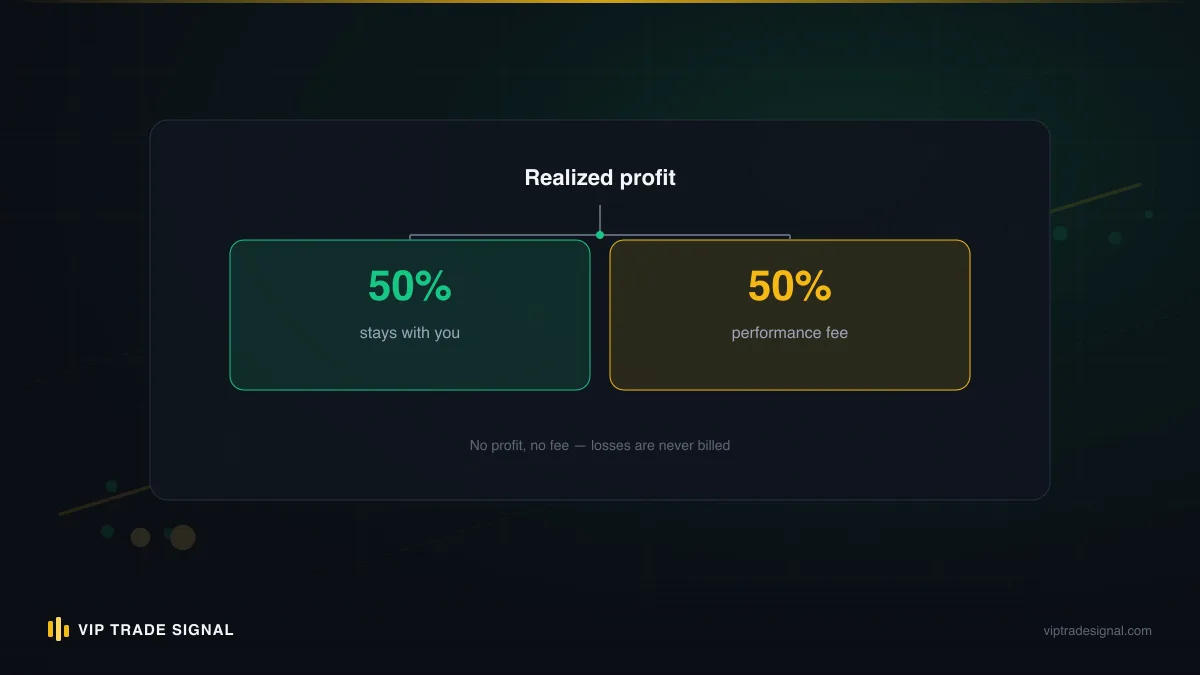
Run one honest scenario. A $2,000 account under a 50%-of-realised-profit deal, the structure we use, makes $400 of closed profit in a month: the manager's share is $200, you keep $200, and a losing month costs you the losses and the manager nothing, which is why they feel losing months too. The same account under 2% monthly on balance pays the manager $40 a month, roughly $480 a year, for existing, profitable or not. The percentages aren't comparable across structures, only the incentives are, and incentives are what you're really signing. We're deliberately at the high end on the percentage because our minimums are low and there's nothing else in the stack, no per-lot anything, no charge in losing months; whether that trade-off suits you depends on your size, and we've written before about what a managed account at a $200 minimum realistically can and can't do.
Whatever structure you sign, the fee clause on the broker's LPOA must match the management agreement word for word. When the two documents disagree, the broker deducts by the one it holds. Check they match before either is signed. Sixty seconds.
When a manager avoids LPOA: what that signals
Time for the uncomfortable section. You suggest doing things properly, LPOA filed with your existing broker, and the manager pushes back. Every pushback you'll hear translates the same way once you've heard them all, and we have.
"Just send the password, it's faster." True, it is faster, in the way that not wearing a seatbelt is faster. The three days an LPOA takes to process are the cheapest diligence period you'll ever get; a manager who can't tolerate them is telling you their pipeline of new clients matters more than the durability of any one of them.
"Your broker doesn't support account managers, use mine." Sometimes genuinely true, plenty of brokers have no MAM infrastructure. So verify it in ten minutes: email your broker and ask whether they accept LPOAs or support third-party managers. If they do and the manager still insists on their unheard-of broker, the broker is the product. Rebates, B-book arrangements, or a "broker" that's a skin on nothing.
"LPOAs are for big accounts, yours is too small for the paperwork." Backwards. Small accounts need the protection more, not less, because their owners can least afford the informal failure modes. The paperwork costs the same twenty minutes at $500 as at $50,000.
"I trade through a copier, no LPOA needed." Half-legitimate. Copy-trading platforms and copiers are a real, different structure with its own trade-offs, we've compared it against proper managed accounts at length, and in a copier setup you hold the keys throughout, which is honestly fine. The flag is only when someone sells you discretionary management but delivers it through your shared password while calling it copying. The label and the plumbing should match.
"Trust me, check my results." Results, sure. Every closed signal we've issued sits public at /signals/history, losses included, because verifiable history is the minimum bar. But notice the substitution being attempted: a track record, even a genuine one, answers "can they trade", while the LPOA answers "what can they do to my account". You need both answers. A brilliant trader with withdrawal access is still one bad month, or one bad decision, from being your expensive lesson.
None of this means every password-based arrangement hides a thief. It means the manager who volunteers the formal route has aligned themselves with your protection before you asked, and the one who dodges it has told you where their comfort ends. In an industry with this much anonymity, how someone behaves around paperwork is one of the few costly signals you get. Managers who intend to be around in five years act like it on day one; it's the same reason serious operations don't mind you asking hard questions about structure and fees before a dollar moves.
Where this leaves you
The LPOA won't make anyone profitable. Worth repeating once more, plainly: leveraged trading loses money for most retail participants, a managed account can go down as easily as up, and no document changes that arithmetic. What the LPOA does is make the arrangement survivable. It caps the worst case at trading losses, keeps the money's exits in your hands alone, timestamps everything, and gives you a one-email ejector seat.
So here's the working checklist, the one we'd want a friend to follow before letting anyone near their account:
- Ask your current broker whether they accept LPOAs or support third-party managers. Ten-minute email.
- Get the manager's legal name and ID on the form. No name, no deal.
- Highlight the scope. Trading, viewing, and one numbered fee survive. Strike withdrawals, transfers, settings changes, sub-delegation, and anything open-ended.
- Check the fee clause against the management agreement word for word, and insist on realised profit with a high-water mark.
- Note the revocation window and file both confirmation emails, activation and eventual revocation, somewhere you'll find them.
- Keep the master password, keep withdrawal control, and check the account yourself weekly. Oversight isn't distrust; it's the arrangement working as designed.
And one hard question to sit with: if the manager you're considering read this article, would they nod along, or start explaining why your situation is different? The nod-alongs are the ones to shortlist. That test costs nothing and filters more sharply than any track record screenshot ever will.
If you want to see how we structure it, our account management page spells out the whole arrangement in the open: your own MT4/MT5 account, flat 50% of realised profit, $200 minimum advance, and you keep the master password and every withdrawal. That's not a pitch so much as a standard. Hold anyone you're considering, including us, to at least that.