Somewhere right now, a 22-year-old with fourteen months of trading experience and one good quarter is setting up a Telegram channel called something like Apex Capital FX. By Friday he'll be quoting "account management from $500" to strangers. By spring he'll have blown six of those accounts and renamed the channel.
That is not how to become a forex fund manager. It's how to become a cautionary tale with a profile photo of a rented Lamborghini.
The real path exists, though. People do go from trading their own $5,000 account to legitimately managing seven figures of other people's money. It takes years rather than weeks, it involves paperwork that nobody posts about on Instagram, and at several points along the way the law has opinions about what you're allowed to do. We run an account management desk ourselves, so we've walked a version of this road, and we've also watched a lot of people try to skip the early miles and faceplant. This article maps the whole route — and if you're not an aspiring manager but someone thinking about hiring one, read on anyway. Knowing what the legitimate path demands is the single best filter for spotting the people who skipped it.
The honest prerequisite: be profitable on your own money first
This sounds too obvious to write down. It isn't, because the industry is full of people managing money who have never made money.
Before you touch a single external dollar, you need a sustained period — we'd say two years minimum, and we'll defend that number in a moment — of trading your own capital profitably. Not demo. Not a $100 account where a lucky 1:500 leverage punt tripled it once. Real money, at a size that hurts when you lose it, through at least one market regime you didn't enjoy.
Why does own-money experience matter so much more than demo results or prop-firm challenge passes? Three reasons, and the third is the one people miss.
First, the psychology is different. Everyone trades a demo beautifully. Add real loss and your hands change. Add someone else's real loss and they change again — so you want the first transition fully behind you before you attempt the second.
Second, a personal account forces you to survive the boring parts. A prop challenge is a two-week sprint with a profit target, which selects for exactly the aggressive, target-chasing behaviour that ruins client accounts. Two years of your own money includes the four-month sideways chop where the right trade count was nearly zero. Clients need a manager who has sat through that without inventing trades.
Third — the missed one — you need to know your actual numbers. Not "I'm profitable." Your average monthly return, your worst peak-to-trough drawdown, your longest losing streak, your risk per trade, your return-to-drawdown ratio. When a serious prospective client eventually asks "what's your max drawdown?" and you don't answer in one breath with a specific figure, the conversation is over. Fairly.
A workable personal benchmark before you even think about clients: something like 3–6% average monthly return with a maximum drawdown under 15%, sustained for 24 months, on an account of at least a few thousand dollars. Plenty of legitimate managers run leaner returns than that. Nobody legitimate runs the "10% a week" that the Telegram crowd advertises, because 10% a week compounds to roughly 14,000% a year, and if that were real the person would not need your $500.
Building a verifiable track record: the 24-month minimum
Profitable is necessary. Provably profitable is the actual asset. A track record that only you can see is worth nothing commercially — it has to be independently verified, continuous, and inspectable by a stranger.
The standard tools are Myfxbook and FX Blue, both of which connect to your MT4/MT5 account via investor password or API and publish your results with broker verification. Set one up on day one of your two-year run, not at the end. A track record that starts 23 months into a 24-month story invites the obvious question: what happened before?
A few rules for a record that will survive scrutiny, because sophisticated clients (the only kind worth having) know every trick:
- Verify both the track record and the trading privileges on Myfxbook. An unverified account can be a demo dressed up as live money.
- Never delete history. One deleted account behind a shiny current one, and any serious allocator walks. The scam pattern of running five accounts and publishing the lucky one is well known; discontinuities look like exactly that.
- Keep the strategy consistent. A record showing 0.5% risk per trade for a year, then suddenly 5% risk in month thirteen, tells a client your risk discipline bends under pressure.
- Show the losses. A 90%+ win rate almost always means no stop losses and a grid or martingale system quietly accumulating a bomb. Real records have red months. Ours does — every closed signal we've ever issued sits publicly at /signals/history, losers included, precisely because a record with no losses convinces no one who matters.
Why 24 months and not 12? Because twelve months can be one regime. Gold trended for most of a year more than once this decade; a trend-following gold system looked like genius the whole way through and then gave half of it back in the consolidation that followed. Two years forces your record through at least one change of market character, usually a central-bank surprise or two, and enough trades — a few hundred, minimum — for the statistics to mean something. One hundred trades of edge can be luck. Five hundred is starting to be evidence.
Your track record is not marketing material. It is the product. Everything else — the website, the pitch, the fee schedule — is packaging.
If you're on the client side of this, by the way, this section doubles as your due-diligence checklist, and we've written a fuller version of it in how to read a Myfxbook track record.
The legal question: when managing money needs a licence
Here's where most aspiring managers either get a nasty surprise or, worse, don't and carry on regardless. Managing other people's money in forex is a regulated activity in nearly every developed jurisdiction once you cross certain thresholds — and in some, from the very first client.
We are not lawyers and this is not legal advice; the point of this section is to show you where the tripwires are so you know when to pay a real one. But the broad shape, jurisdiction by jurisdiction:
United States. The strictest. Managing forex accounts for others generally requires registering with the CFTC as a Commodity Trading Advisor (CTA) and joining the NFA, unless you qualify for an exemption — the most used being fewer than 15 clients in 12 months and no public holding-out as a CTA. Note that second clause. The moment you advertise — a website, a Telegram channel, a tweet — the exemption can evaporate regardless of client count. NFA registration means the Series 3 exam, fingerprinting, fees, and ongoing compliance. Americans DMing strangers with "account management services" are usually committing a federal offence without knowing it.
United Kingdom. Managing investments is a regulated activity under FSMA 2000; doing it without FCA authorisation is a criminal offence. There's no casual friends-and-family carve-out worth relying on. Retail forex managers in the UK either get authorised (expensive, slow, capital requirements) or operate under an existing authorised firm's umbrella as an appointed representative.
European Union. MiFID II territory. Portfolio management requires an investment firm licence from your national regulator. Same story: real money, real compliance staff, real time.
Australia. ASIC requires an Australian Financial Services licence for discretionary management, and after the 2021 CFD intervention orders the regulator has been in no mood for creative interpretations. There is a limited carve-out for genuinely private arrangements, but it's narrow, and holding yourself out to the public kills it just as surely as it does in the US.
Dubai and the wider Gulf. Increasingly popular with manager-influencers, partly for tax and partly because the DIFC and mainland regimes are seen as friendlier. The DFSA does regulate asset management inside the DIFC, though, and "I moved to Dubai" is not, by itself, a compliance strategy — your clients' jurisdictions can still reach you. A UK resident managed from Dubai is still, in the FCA's eyes, being offered a regulated service.
Offshore and lighter regimes. Plenty of managers structure through jurisdictions like Seychelles, Mauritius, Labuan or the Cayman Islands, where fund manager licences exist but are cheaper and faster. This is legal and common — most retail-facing MAM/PAMM managers you'll encounter run this way — but understand what it means: your clients' recourse if you misbehave is a regulator with a small office and a long queue.
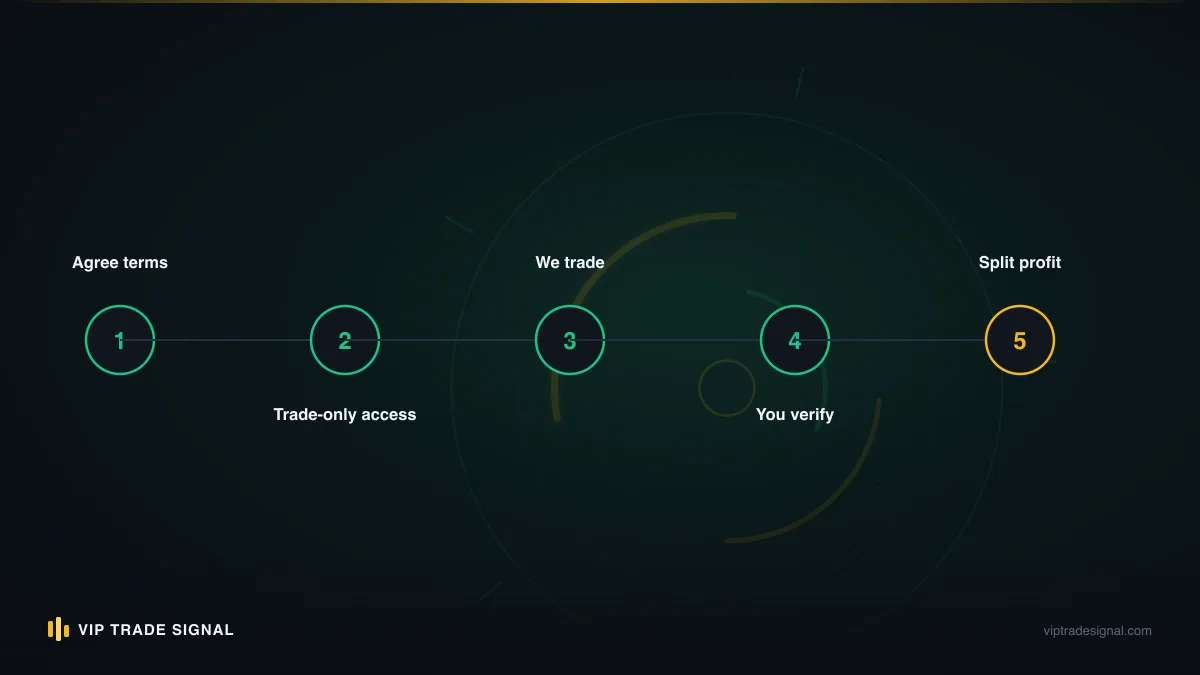
The LPOA sidestep. A huge share of real-world account management, ours included, runs on a limited power of attorney model: the client opens their own brokerage account, keeps the master password and all withdrawal rights, and grants the manager trade-only access. This dramatically changes the risk picture — the manager never holds client funds, cannot withdraw a cent, and can be cut off by the client in five minutes. In several jurisdictions this structure sits in genuinely grey or lighter-touch territory compared with pooled funds. In others, notably the US and UK, discretionary trading authority is still regulated activity even without custody. Grey is not the same as safe. Budget $2,000–$10,000 for a proper legal opinion in your jurisdiction before your first paid client. It is the cheapest insurance you will ever buy.
Structures: friends and family, LPOA business, CTA, fund
There isn't one job called "forex fund manager". There are four or five different businesses that share the name, and you generally climb through them in order.
| Structure | Typical AUM | Custody of funds | Regulatory weight | Realistic timeline from zero |
|---|---|---|---|---|
| Friends and family | $10k–$100k | Client keeps it | Low (but not zero) | Year 2–3 |
| LPOA / MAM business | $100k–$5m | Client keeps it | Medium, varies wildly | Year 3–5 |
| Registered CTA / authorised firm | $1m–$50m | Client keeps it | High | Year 4–7 |
| Pooled fund | $5m+ | Fund holds it | Very high | Year 6+ |
Friends and family is where nearly everyone starts: two or three people who know you personally, trading via investor access or LPOA on their own accounts, ideally with a written agreement even though it feels awkward to hand a contract to your uncle. Especially then, actually. The relationships that get destroyed by informal money management are precisely the ones where nobody wanted to be so crude as to write terms down.
The LPOA business is the same mechanic, professionalised: proper client agreements, a company, standardised onboarding, usually MAM or PAMM software at the broker so one master terminal trades many sub-accounts with proportional sizing. This is the model most working retail managers live in, and it's the model our own account management service uses — client's own MT4/MT5 account, client keeps the master password and withdrawals, we take trade-only access. We chose it deliberately: it caps what a manager can ever do to a client, which is good for clients, and it means we never touch custody regulation, which keeps the minimums low.
The registered CTA or authorised firm is what the LPOA business becomes when it grows up in a strict jurisdiction — same trading, plus exams, audits, disclosure documents and compliance calendars.
The pooled fund — actual fund, actual fund manager — is a different animal entirely: investors buy units of a vehicle, the fund holds the money, and you now need administrators, auditors, possibly a prime broker, and legal spend that starts around $50,000 before the first trade. Nobody should be thinking about this before several million in committed capital. Most careers never need to reach it, and the economics below explain why the LPOA layer can be a perfectly good final destination.
The economics: what the income really looks like
Time for the arithmetic that Instagram never shows. Fund management fees come in two flavours: management fees (a percentage of assets, charged regardless of results) and performance fees (a percentage of profits). Retail forex management runs mostly on performance fees — often exclusively, as ours does at a flat 50% of realised profit — because clients rightly hate paying a manager to lose.
So run the honest numbers on a performance-fee model. Say you're a genuinely good manager producing 40% a year for clients — a strong, real-world figure, not a fantasy one — and you charge 30% of profits, near the industry's middle.
- Five clients at $20k each ($100k AUM): 40% return is $40k of client profit; your 30% is $12,000 a year. A hobby.
- Twenty clients averaging $25k ($500k AUM): $200k profit, $60,000 a year to you. A salary — in a good year.
- $2m AUM: $240,000 a year. Now it's a business, and now you can afford the lawyer, the software and the assistant.
Three sobering footnotes. One: those numbers assume a good year, and you will have flat and losing years in which a pure performance-fee manager earns nothing while still paying costs. Two: high-water marks. Any honest agreement says that after a drawdown you earn no fees until the account exceeds its previous peak — so a 15% drawdown can mean two or three fee-free months even once you're trading well again. Three: capacity is real but distant; retail-sized strategies in a market as deep as gold or major forex pairs scale a long way before slippage bites, but your time doesn't scale — twenty clients means twenty relationships, twenty monthly reports, twenty people texting you during a drawdown.
A word on the other fee flavour. Management fees — the classic 2% of assets, charged rain or shine — barely exist at retail scale, and for good reason: 2% of a $100k book is $2,000 a year, which insults everyone involved, while charging a losing client a percentage of their shrinking balance poisons the relationship faster than the losses do. They start to make sense around institutional size, where the 2% funds an actual operation with staff and audits. Until then, performance-only keeps your incentives pointed the same direction as your clients' — with one caveat you should design against. A pure profit share quietly rewards volatility: swing a client account hard enough and you collect in the up months while the client eats the down ones. The high-water mark blunts this, and so does the drawdown cap in your agreement, but the honest fix is internal. Decide that you're paid for net progress over years, size accordingly, and accept the slower fee curve that comes with it.
And what about your own money in all this? Keep trading it, visibly, in the same strategy. Partly because the track record has to keep running. Mostly because "I eat my own cooking" is the one claim clients can verify that no fee structure can fake — and because the year your performance fees are zero, your own compounding account is what pays the rent.
The honest conclusion: below roughly half a million under management, this is a side income to your own trading, not a living. Which is fine. Your own account compounding at the same 40% is part of the same career.
Getting your first clients without becoming a scammer
Here's the paradox of client acquisition in this industry: the marketing tactics that work fastest are precisely the ones that mark you as a fraud. Cold DMs, screenshot-spam, "guaranteed monthly returns", urgency ("only 3 slots left") — the scam playbook exists because it converts. Refusing it costs you speed and buys you the only clientele worth having.
What actually works, in rough order:
- Warm network first. Your first three clients almost certainly already know you. Not because you pitched them — because they watched you trade your own money for two years and eventually asked. If nobody in your life has asked, that's information.
- Publish the record and let it argue. A public, verified, warts-included track record does the selling. Write about your losing months. Counterintuitively, the post-mortem of a bad month recruits better clients than any winning screenshot, because the people it attracts are the ones who understand drawdowns — the only clients who won't panic-quit at the bottom of one.
- Referrals from clients who've been through a drawdown with you. A referral from someone who watched you handle losing money well is worth twenty from someone you've only made money for.
- Radical fee and risk transparency. Publish your fee structure, your risk-per-trade, your drawdown limits, before anyone asks. Every number you volunteer is a question a sceptic doesn't have to fight you for.
Expect the timeline to feel glacial. A realistic first year of legitimate client acquisition looks like this: months one to four, you publish and nothing happens. Months five to eight, a couple of people you half-know start asking questions, and one of them — usually the most cautious one — becomes client number one with $5,000, watching you like a hawk. Somewhere near month twelve, that client mentions you to a colleague, unprompted, and client two arrives pre-sold. That's the whole flywheel. It never spins fast, but it never spins backwards either, which is more than can be said for the DM-blast approach, where every blown account actively unsells the next hundred prospects.
And be picky. It sounds absurd when you have zero clients, but a bad-fit client — undercapitalised, expecting doubling, secretly trading the account themselves alongside you — costs more in time and reputation than their fees ever pay. We turn people away at our own desk for exactly these reasons, most often people who arrive asking for guarantees. Anyone who promises them is lying; anyone who demands them hasn't yet understood the product. Say the risk sentence out loud, early: this is leveraged trading, losses are normal, and no honest manager can guarantee your money grows or even survives intact.
Operations: agreements, reporting and getting paid
The unglamorous middle of the job, and where amateur operations quietly rot. Four documents and habits separate a business from a mess.
The management agreement. Written, signed, before the first trade — even for your uncle. It needs, at minimum: the fee structure and exactly how profit is calculated (realised only? net of swaps and commission? we'd argue yes to both); the high-water mark mechanics; the risk parameters you commit to (maximum risk per trade, a maximum drawdown at which trading pauses for review); what discretion you have and don't; how either side terminates; and a plain-language risk disclosure. A lawyer should draft the template once. After that it's fill-in-the-blanks.
The access architecture. LPOA or investor-credential trade access only. The client keeps the master password, the withdrawal rights, and the ability to revoke you. This protects them, obviously — but it protects you nearly as much, because a manager who never touches custody can never be accused of theft, and in a dispute that distinction is everything. Any manager who asks clients to send money to him rather than to a regulated broker in the client's own name has left the legitimate path entirely, whatever his returns.
Reporting. Monthly, minimum, and boring on purpose: opening balance, closing balance, return, trades taken, current drawdown from peak, fees accrued. The discipline point is that the report goes out on losing months on the same day, in the same format as winning months. The first delayed loss report is the first crack in the relationship. Clients can forgive a losing month; they cannot forgive discovering one.
Books and tax. Dull, decisive. Performance fees are business income; invoice them properly, keep the ledger reconciled to broker statements, and put a proportion aside for tax from the first dollar, because a good year followed by a tax bill you didn't reserve for has a way of pressuring the next year's trading. A basic accountant costs less per year than one oversized trade taken to cover an overlooked liability.
Fee settlement. Decide the mechanics up front: settlement period (monthly is standard), invoice against realised profit above the high-water mark, paid by transfer — because with the LPOA model you can't pay yourself from the account, which is the point. Keep a running fee ledger per client from day one. Untangling eighteen months of informal "I'll sort you out later" arrangements has ended more manager-client friendships than drawdowns have.
The weight nobody warns you about: losing other people's money
There's a night that every real manager remembers: the first time you close the platform down meaningful money on client accounts and have to decide what to tell them.
Losing your own money is a technical problem. Losing a client's money is a technical problem wearing a moral coat. Take a trader we'll call Dan — two years profitable on his own account, five clients, sailing. Month seven brings a normal, statistically inevitable 9% drawdown. On his own money, Dan has sat through 9% a dozen times without blinking. On client money, he stops sleeping. He starts cutting winners early to lock in something. He skips valid setups because "I can't lose again this week". Within a month he isn't trading his system anymore; he's trading his anxiety, and his anxiety has no edge. The drawdown that would have recovered in six weeks stretches to five months.
This is the single most common failure mode of new managers, and it's why the two-year own-money apprenticeship matters more than any exam. The defences are structural, not motivational:
- Position sizing set for the client's worst day, not your average one. If you risked 1% per trade on your own account, consider 0.5% on client money. The performance-fee cost of trading smaller is real; the cost of trading scared is bigger.
- Pre-agreed drawdown protocols. "At 10% down from peak, trading pauses and we review together" — written into the agreement, so a drawdown triggers a procedure instead of a panic.
- Client selection as risk management. One panicking client calling nightly can distort your trading on every account. This is why turning away nervous money is a trading decision, not just a commercial one.
- Never, ever revenge-trade a recovery. Doubling risk to get a client back to breakeven faster is how a 10% drawdown becomes a 40% one. We run a whole drawdown-management practice around unwinding exactly that spiral, and nearly every account that reaches us got there the same way: a loss, then oversized attempts to erase the loss.
If you can't imagine calmly telling five people you lost 8% of their money this month, and doing it in a scheduled email rather than a dodged phone call, you aren't ready yet. That's not an insult. It's a timeline.
Scaling: from five accounts to a real business
Somewhere around eight to ten clients, manually mirroring trades stops working — you'll fat-finger a lot size on account six while the market moves, and now two clients with identical agreements have different results. This is the point where you either adopt proper infrastructure or your operation degrades.
The standard toolkit: MAM/PAMM software at the broker level, so one master terminal allocates trades proportionally across sub-accounts and every client gets the same entry, same risk percentage, same outcome scaled to their balance. Most serious brokers offer it to managers who ask, typically free above a modest combined AUM. Alongside it, a proper back office grows: a CRM (a spreadsheet, honestly, until ~20 clients), templated onboarding, automated monthly statements, and a fee ledger that reconciles to the broker's records.
Scaling also changes what you sell. At five clients you sell yourself. At forty you sell a process, and clients start asking process questions: what happens if you're hospitalised mid-trade? (You need a documented answer — flat-all-positions instructions with the broker is the crude version.) Who checks your work? What happens to the strategy at 10x the size? Around this point, jurisdictions that tolerated your informal LPOA setup start noticing you, which loops back to the licensing section: growth is what converts grey areas into enforcement letters. The managers who last treat the compliance upgrade as a milestone to plan for, budgeted from about year three, rather than a surprise.
And know your own ceiling. Some excellent traders are terrible at running a forty-client service business and are happier — and richer per hour — capping at a dozen high-quality accounts. There is no rule that says the path must end at a fund. The path ends where your edge, your temperament and your appetite for admin intersect.
What this path teaches you about vetting managers
Flip everything above around, and you have the best due-diligence checklist an investor can own. The legitimate path is the vetting criteria — every requirement a real manager had to meet is a question you get to ask.
| The path requires | So you ask a prospective manager |
|---|---|
| Years profitable on own money | "How long did you trade your own capital before managing?" |
| Verified continuous track record | "Show me your Myfxbook/FX Blue — full history, live, verified" |
| Legal clarity | "What's your regulatory status where I live, and what's the structure?" |
| Client-keeps-custody access | "Do I keep my master password and withdrawal rights?" (If no, run) |
| Written agreements | "Send me the management agreement before I decide" |
| High-water mark fees | "Do you earn fees while I'm below my previous peak?" |
| Drawdown protocol | "What's your max drawdown figure and what happens at it?" |
| Honest loss reporting | "Show me your worst month and what you told clients that week" |
A legitimate manager answers all eight in one email, mildly pleased you asked. The Telegram kid manages perhaps one — and the gap between one and eight is not paperwork pedantry. Each row exists because its absence is a specific, well-worn way clients get hurt. No own-money history means you're the psychological guinea pig. No custody separation means your money can leave. No high-water mark means the manager gets paid for volatility rather than progress.
We hold ourselves to the same list, and you should check rather than take our word: our terms are flat and public — 50% of realised profit, $200 minimum advance, your own MT4/MT5 account, you keep the master password — and our signal history sits open at /signals/history with the losses left in. Our fees sit at the high end of the industry, and we say so plainly; that's the trade for low minimums and no lock-in. If you're evaluating anyone, us included, the longer walkthrough in how to choose a forex account manager and the mechanics in how to open a managed forex account will do the rest.
Where this leaves you
If you came here wanting the shortcut, here's the closest thing to one: there are only three genuinely compressible parts of this path, and none of them is the track record.
You can compress the legal learning curve by paying a lawyer early instead of guessing for two years. You can compress the operational curve by copying the structures above — LPOA access, written agreements, high-water marks, same-day loss reporting — from day one instead of reinventing them after your first dispute. And you can compress the client acquisition curve by publishing everything, losses first, and letting eighteen months of public honesty do what eighteen months of DMs never will.
Everything else takes the time it takes. Two years of your own money on the line. A few hundred trades. At least one drawdown you handled well and can prove it. If you're eighteen months from being ready, the best move available today is unglamorous: open the verified tracking on your own account this afternoon and start the clock.
And if you're on the other side of the table — someone with an account, weighing up whether to hand the keys to a manager — you now know exactly what the real ones had to build. Ask the eight questions. Count the straight answers. If you want to see how our own desk stacks up against that list, the terms are on the account management page and we're straightforward to reach through the contact page; bring the hard questions first, because a manager worth hiring is one who enjoys answering them. Whatever you do, don't hire the rented Lamborghini.