Nobody teaches you how to choose a forex account manager. There's no consumer guide, no comparison site that isn't secretly an affiliate funnel, and the people with the most visible marketing are, almost by definition, the ones spending money on marketing instead of trading. So most people choose the way they'd choose a restaurant in a strange city: whoever's sign is brightest, whoever's testimonials sound warmest, whoever answered the DM fastest.
That's how a trader we'll call Priya ended up wiring $4,000 to a "fund manager" whose entire verifiable history was six screenshots and a profile photo of a rented Lamborghini. She wasn't stupid. She just didn't have a process, so the seller's process won. His process was very good. It had been refined on hundreds of people before her.
This article is the process we'd want you to run on us. It's a funnel: start with a list of maybe ten candidates, apply five elimination filters in cheapest-first order, and end with one manager and a small test allocation. The filters are ordered so the free checks happen before the expensive ones, and the whole thing is designed so a scammer cannot survive to the end. Not "is unlikely to survive". Cannot, if you actually run it.
The funnel: how to choose a forex account manager by elimination
Here's the mindset shift that matters more than any individual check. You are not shopping. You are eliminating.
Shopping mode asks "what do I like about this one?" Elimination mode asks "what disqualifies this one?" The difference sounds academic until you notice that every scam in this industry is built to win shopping mode. Screenshots of wins, a confident voice, social proof, urgency, a story about why now is the perfect time. All of it is engineered to give you reasons to say yes. None of it survives someone methodically looking for reasons to say no.
So build a list first. Ten candidates is a good number; five is workable. Pull them from wherever, honestly, it doesn't matter much: Telegram, forums, a friend's recommendation, a Google search, our own account management service if you like. The quality of your sources barely matters because the funnel does the filtering. What matters is that you have enough candidates that eliminating one costs you nothing emotionally. When you've only got one candidate, you're not vetting. You're rationalising.
Then run the filters in order. Structural checks first, because they're free and kill the most candidates. Track record second. Risk discipline third. Terms fourth. The actual conversation last, because your time is the most expensive thing you'll spend before money enters the picture.
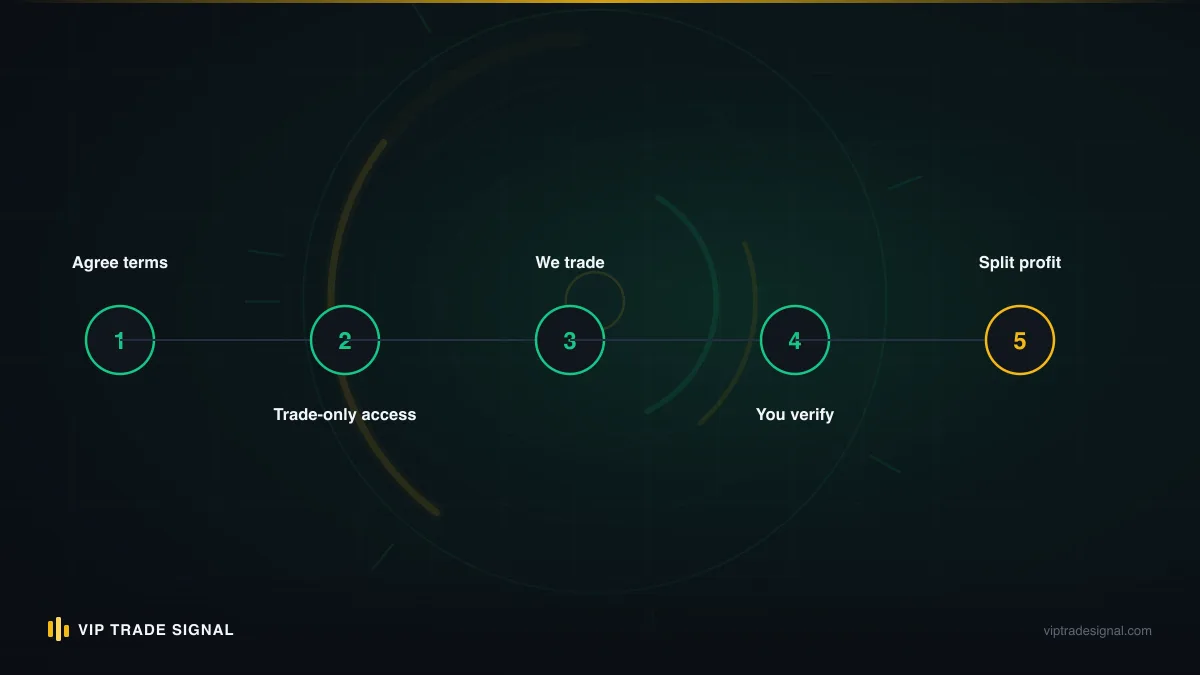
A realistic funnel looks something like this. Ten candidates in. Four fail the custody check within minutes. Three more can't show a verified record. One survives that but has a drawdown history that reads like a heart monitor. One has an agreement so vague it might as well be a handshake. One left. That one gets a conversation, and then a small test allocation, and then, months later, maybe your real money.
If nobody survives, good. That's the funnel working. An empty result costs you nothing; a false positive costs you the account.
Filter 1: custody and access, the free check that kills half your list
The first question is not "can this person trade?" It's "where does my money physically live, and who can take it out?"
There are really only two structures in retail account management. In the first, your money sits in your own brokerage account, opened by you, in your name, and the manager gets trading access only. In the second, you send money to the manager (or to a pooled account, or a wallet address, or a "fund"), and they trade it wherever they trade it. The first structure means the worst-case theft scenario is bad trading. The second structure means the worst-case scenario is that your money simply leaves and you spend six months learning how to report a forex scam instead of trading.
We're not neutral on this, and you shouldn't be either. Any candidate who wants you to send funds to them, rather than to your own account at a regulated broker, is eliminated. Immediately. No exceptions for good track records, no exceptions for people your friend vouches for, no exceptions for "our fund structure requires it". Real funds with real custody arrangements exist, but they come with prospectuses, regulators, and minimums that start around $100,000. Nobody running a genuine fund is recruiting $3,000 accounts in a Telegram group.
Within the correct structure, check the details, because they're where the remaining rot hides:
- You open the brokerage account yourself, directly with the broker. Not through the manager's "onboarding team".
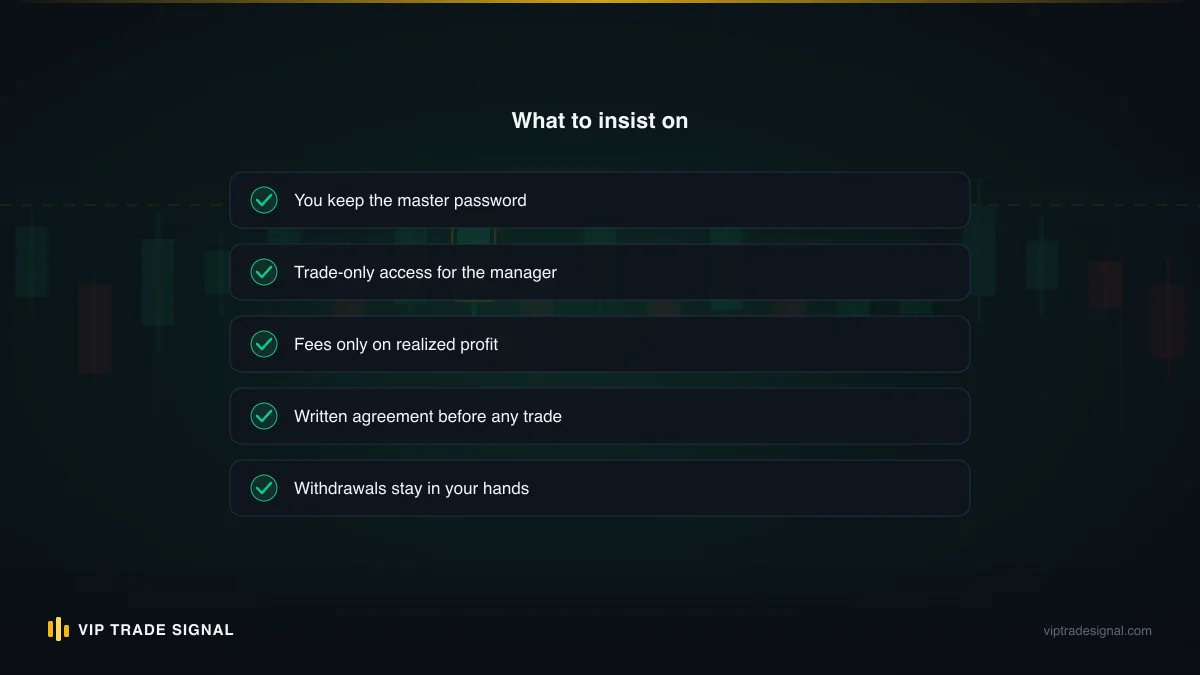
- You hold the master password. The manager gets the investor password or a limited trading login, whichever the platform supports. On MT4/MT5 this separation is built in and takes two minutes to set up.
- Withdrawals go to your bank card or account only. The broker enforces this anyway if it's a regulated one, which is one of several reasons to use a regulated one.
- The manager never touches your broker login email, your 2FA, or your payment details. Anyone who asks for these is not sloppy. They're rehearsing.
A word on the broker itself, because custody is only as solid as the firm holding the account. A managed account at an unregulated offshore shell is barely better than sending the manager cash; if the broker vanishes, so does the distinction between your account and his. Prefer brokers with a real regulator behind them (FCA, ASIC, CySEC, or the serious offshore desks of established names), segregated client funds, and a withdrawal process you've personally tested with a small amount before any manager gets near the login. And be alert to a specific pattern: a manager who insists on one obscure broker you've never heard of, "because our systems only work there". Sometimes that's a genuine platform constraint. More often the broker is paying the manager per lot traded, or worse, the "broker" and the manager are the same people wearing two hats. If a candidate is flexible on strategy but rigid on broker choice, ask why until the answer stops moving.
This filter is free. It requires no financial literacy, no chart reading, nothing but asking "walk me through exactly how my money is held and how you access it" and listening for the wrong answer. In our experience it eliminates somewhere between a third and a half of any candidate list you build from public sources. Run it first, always.
Filter 2: a verified track record, or the bin
Every candidate who survives custody will have a track record. Screenshots, mostly. A photo of a MetaTrader history tab. A monthly returns table in a pinned message. A video scrolling through closed trades.
None of that is a track record. All of it can be manufactured in an afternoon, and much of it is: demo accounts presented as live, cherry-picked winning periods, edited images, or the old classic where a seller runs twenty accounts in different directions and shows each prospect whichever one happens to be up. A screenshot is a claim. What you're looking for is evidence, and evidence in this industry means third-party verification that the seller cannot edit.
Practically, that means one of a few things. A Myfxbook or FxBlue link connected to a live account with verified track record status. A broker-hosted statement you can cross-check. Or, at minimum, full trade-by-trade history published continuously, before outcomes are known, in a form that can't be quietly rewritten. If you've never dissected one of these, our piece on how to read a Myfxbook track record covers the specific tells, because verified platforms have their own manipulation games (unverified track record badges, hidden trade history, demo flags buried in the corner).
The elimination rule is blunt. No independently verifiable history of at least twelve months on a live account, no progression to Filter 3. Twelve months matters because almost any strategy looks brilliant across three good months. A martingale system, the kind that doubles down into losers, can print smooth gains for a year before it deletes the account in a week. Longer is better. Through at least one nasty market period is better still.
A quick story about why the twelve-month rule earns its keep. It's a composite of a pattern we've watched repeat, so treat the details as illustrative. A "manager" in a busy gold trading group runs nine visibly brilliant months: smooth equity curve, modest stated risk, hundreds of clients. What the closed-trade history doesn't show is a floating basket of stacked losing buys that grows every time gold dips, held open so the record stays green. Month ten, gold falls properly, the basket hits margin, and every managed account goes to roughly zero inside two days. Anyone who demanded a verified record with open-trade drawdown visible would have seen the basket months earlier. Anyone who only saw the closed-trade screenshots saw a genius right up until they saw a margin call.
And watch for the deflections, because you'll hear them. "Past performance doesn't matter, let's talk about the strategy." "We keep results private for our clients' protection." "I can show you inside the group once you've joined." Each of these is the sound of Filter 2 doing its job. A manager who genuinely trades well has every incentive to prove it verifiably, and the proof costs them nothing. Refusal is information. Treat it as the answer.
A screenshot is a claim. A verified, third-party, tamper-proof history is evidence. Never pay for claims.
One honest caveat while we're here: a genuine verified record still doesn't promise anything about the future. Most retail traders lose money, managed or not, and a great two-year history can precede a terrible third year. Verification doesn't remove risk. It removes fraud. Those are different problems, and this filter only solves one of them.
Filter 3: risk discipline, or what the drawdown history is really telling you
Now you have candidates with clean custody and real records. This is where most people relax. It's exactly where you should lean in, because the thing that destroys managed accounts is almost never a lack of winning trades. It's what the manager does while losing.
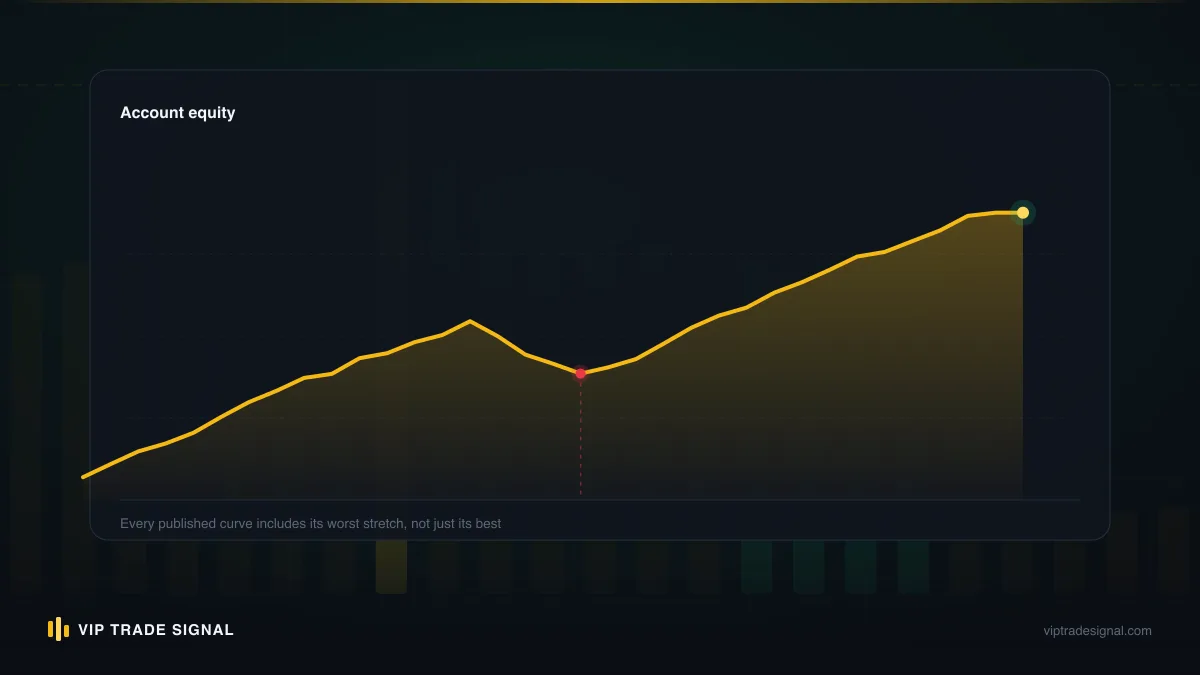
Open the verified history and ignore the return figure for a minute. Look at drawdown. Maximum drawdown first: the deepest peak-to-trough fall the account has taken. Then how it got there and how long it took to climb out. A manager showing 60% annual returns with a 45% max drawdown is not a good manager having a great year. That's a coin flip that hasn't landed on tails yet, and the arithmetic of drawdowns is merciless: a 45% loss needs an 82% gain just to get back to flat.
Look at the trade-level behaviour too, because it tells you things the equity curve smooths over:
- Stop losses on every position. Not "mental stops". Actual, placed stops. A history full of trades with no stop and enormous adverse excursions is a history of someone praying.
- Position sizes that stay boring. Consistent risk per trade, usually somewhere in the 0.5% to 2% range. If lot sizes double after losses, you've found a martingale, and you should leave at whatever speed is available.
- No grid of stacked positions in one direction. Fifteen open buys on the same pair isn't a strategy. It's one opinion wearing fifteen costumes, and it dies as one.
- Floating drawdown that gets realised. Some sellers hold losers open for months so the closed-trade record stays green while the account quietly bleeds. Verified platforms show open-trade drawdown. Read it.
Then ask the candidate directly: what's your maximum acceptable drawdown, and what happens when it's hit? A professional has an answer before you finish the question, with a number in it. Something like "we risk under 1% per trade, and if the account draws down 15% from its high we cut size in half and review". The number itself matters less than the existence of the number. "We don't really have drawdowns" is an elimination. So is any variant of "trust the process". A process you can't state isn't a process.
For what it's worth, this is the filter we'd most want run on ourselves, because it's the one that separates trading businesses from lottery tickets. Our own signal history sits public at /signals/history, losers included, precisely because a record with no red in it is a record you should run from. Everyone has losing trades. The question is only ever whether the losses were sized to be survivable.
Filter 4: fees, exit terms, and the agreement itself
You're down to two or three candidates now, and it's time to read documents. Yes, actually read them. The agreement is where a mediocre operator either becomes acceptable or reveals themselves, and it takes twenty minutes per candidate.
Start with the fee structure, because fee structure is incentive structure. There are three broad models in retail account management:
| Model | How it works | What it incentivises |
|---|---|---|
| Performance fee only | Manager takes a cut of realized profit (20% to 50% is the retail range) | Making you money; also, sometimes, swinging big for the fee |
| Management fee | Fixed % of account per year, win or lose | Gathering accounts, not trading them well |
| Hybrid / hidden | Small headline fee plus spread markups, commission kickbacks, lot-based rebates | Trading volume. Churning your account into the ground |
Performance-only is the cleanest alignment: the manager eats only when you do. It's what we run, at a flat 50% of realized profit with a $200 minimum advance, and we'll be straight with you that 50% sits at the high end of the market. The trade-off we're making is low minimums and pay-as-you-go with no lock-in; a manager charging 25% but requiring $25,000 committed for a year is cheaper per profit dollar and far more expensive per unit of flexibility. Neither number is a scandal. What is a scandal is the third row of that table. If a manager's real income is volume-based broker rebates, they get paid every time they trade whether you profit or not, and your account becomes a lot-size generator. Ask every candidate, in writing: "Do you receive any compensation from the broker, per lot or otherwise?" A yes isn't automatically fatal if it's disclosed and modest. An evasion is fatal.
Then check exit. How do you leave? The right answer is: instantly, unilaterally, by changing your own passwords, which you can do because you passed Filter 1. Anything that slows that down (notice periods over a few days, "exit fees", penalties for withdrawing your own money) is elimination material. You're hiring a service, not entering a marriage.
Finally, three things the agreement must contain, in words, on paper or PDF:
- A high-water mark. Performance fees are charged only on profit above the account's previous peak. Without this, a manager can lose 20%, make back 15%, and bill you for the 15%. With drawdown-recovery arrangements the same idea applies as a recorded baseline, agreed by both sides before anything starts.
- Realized profit, not floating. Fees on open positions are fees on numbers that can evaporate.
- No guarantees anywhere. This one surprises people. A written guarantee of returns feels like protection. It's actually a flare: guaranteeing forex returns is somewhere between impossible and illegal depending on jurisdiction, so its presence tells you the author is either lying or doesn't understand the product they're selling. Honest paperwork says losses are possible, because they are.
Filter 5: the conversation, and what response quality tells you
Only now, with one or two survivors, do you spend real time talking to a human. The conversation isn't for being convinced. You're past convincing; the record either verified or it didn't. The conversation is a behavioural test, and you're grading how they answer at least as much as what they answer.
Bring prepared questions. Ours would be, roughly:
- Walk me through your worst losing month. What happened, what did you change?
- What's the maximum drawdown at which you'd stop trading my account and talk to me?
- What market conditions is your approach bad at? (Every approach is bad at something.)
- Who else has access to trade my account? What happens if you're ill for a month?
- How often will I get reporting, and in what form, beyond me just logging in?
- What would make you fire me as a client?
That last one isn't a trick. Good managers have client standards: people who panic-close positions mid-trade, who demand daily profit, who top up with money they can't afford to lose. A manager with no bad-client criteria is a manager who takes anyone, and a manager who takes anyone is running volume, not a book.
Now grade the responses. Specific numbers over adjectives. Comfort with the word "loss". Questions back at you about your risk tolerance and your finances, because a professional wants to know whether your capital is actually spare. And pace: a real operator answers hard questions slowly and precisely. What eliminates a candidate here is pressure. Countdown offers, "spots closing Friday", flattery about how you clearly get it when others don't, irritation at being questioned at all. Someone with a genuine edge doesn't need you specifically; capital finds verified performance on its own. Urgency is the tell of someone whose product is the pitch.
One more thing worth saying plainly: run this filter even on candidates you like. Especially those. By this point you've invested hours and you'll be tempted to coast the finish. That temptation is precisely the state of mind the industry's worst actors farm.
The test allocation: proving it with money that can afford to lose
The funnel's survivor doesn't get your account. They get a test.
Fund the account with an amount that satisfies the manager's minimum but that you could lose entirely without changing anything about your life. Not "would be annoyed to lose". Could lose, fully, with a shrug. For most people vetting retail managers that's somewhere between $500 and $2,000. If a manager's minimum forces you above your shrug threshold, that's a mismatch, not a stretch goal. Walk away or negotiate the minimum down.
The test runs for a minimum of three months, and here's the part almost everyone skips: define success and failure before it starts. Write it down somewhere you can't edit the memory later. Something like this works:
- Fail immediately if any single behaviour contradicts what was agreed: a trade without a stop, position sizing beyond the stated risk, an instrument you didn't agree to, a request for more access than agreed.
- Fail at review if drawdown exceeds the manager's own stated maximum. Not your pain threshold. Theirs. They set the number in Filter 3; the test checks whether they meant it.
- Pass if three months of live trading on your account matches the character of the verified record you vetted: similar risk per trade, similar hold times, similar loss handling. Note what's missing from the pass criteria: profit. Three months is short enough that a good manager can finish down and a bad one can finish up. You are testing behaviour, because behaviour is what compounds. A flat or slightly negative quarter with immaculate discipline is a pass. A +30% quarter achieved by tripling agreed risk is a fail, and honestly the more dangerous of the two, because it works right up until it doesn't.
Let's make that concrete with numbers, because the abstract version is easy to nod at and hard to apply. Say you intend to eventually allocate $10,000 and the test account holds $1,000 at 1% agreed risk per trade. That's $10 of risk per position, so a normal losing streak of five or six trades costs $50 to $60. Watching that happen is the point of the exercise. If the statement instead shows a single trade risking $150, the manager has told you, with your smallest tranche, exactly what they'd do with your largest. Believe them and leave. The test costs you a little expected return for three months; what it buys is seeing the manager's real behaviour at a price where the lesson is cheap.
During the test, watch without steering. Log in weekly, export the statement monthly, keep your own record rather than relying on theirs. But don't message the manager every time a trade goes red. You're evaluating their process, and their process needs room to include losing, because every real process does.
Scaling up: the schedule from test to full allocation
Suppose the test passes. The instinct is to move everything across in one satisfied transfer. Resist it. Trust that was built in three months should be spent gradually, and a schedule does that while still moving at a reasonable pace.
A structure we'd consider sane:
| Stage | Timing | Allocation | Gate to advance |
|---|---|---|---|
| Test | Months 1–3 | Shrug money ($500–$2,000) | Behaviour matches vetted record |
| Second tranche | Months 4–6 | ~25% of intended total | Discipline holds through at least one losing streak |
| Third tranche | Months 7–12 | ~50–60% of intended total | Stated max drawdown never breached |
| Full allocation | After month 12 | 100% of intended total | A full year of the manager you vetted |
Two rules govern the whole table. First, the gates are behavioural, same as the test: you advance on discipline, not on returns, because returns over these windows are mostly noise and discipline mostly isn't. Second, the schedule runs in reverse too. Any stage-gate violation at any point (a breached drawdown limit, a sizing surprise, a communication blackout) drops the allocation back a stage, or to zero. Money goes in on a schedule and comes out on a trigger.
And "intended total" deserves its own sentence: it is never money you need. Not the house deposit, not the emergency fund, not the money earmarked for anything with a date on it. Leveraged trading can lose fast, good managers have bad years, and the entire structure above only protects you if the worst case was affordable from the start.
If you're at the stage of actually setting one of these up, the mechanics of investor passwords, LPOA paperwork and broker selection are their own topic, and we've written the step-by-step separately in how to open a managed forex account.
Re-vetting: the annual review nobody runs on an incumbent
Choosing a manager isn't a decision you make once. It's a decision you re-make on a schedule, because managers change: strategies stop working and get quietly swapped, discipline erodes after a good year, businesses grow and hand your account to a junior, personal lives fall apart in ways that reach the trading. The manager you vetted in year one is a hypothesis about year three, not a fact.
So book an annual review, in the calendar, and run a compressed version of the funnel on your incumbent:
- Custody: unchanged? Same access model, no new "operational" requests for credentials, withdrawals still tested and working? Withdraw something small once a year regardless. A withdrawal is the only custody check that can't be faked.
- Record: pull the full year's statement from the broker (not the manager's summary) and compare it against the character of the original vetted record. Same risk per trade? Same instruments? A strategy drift isn't automatically bad, but an undisclosed one is, because it means the thing you vetted no longer exists.
- Risk: was the stated max drawdown respected all year? Did losing streaks get handled the way they said losing streaks get handled?
- Terms: any fee changes, any new broker relationships, any nudges toward moving to a different broker mid-year? That last one is worth particular suspicion; "we're asking clients to move to X" is sometimes legitimate and sometimes a rebate arrangement wearing a strategy costume. Ask the Filter 4 compensation question again and see if the answer changed.
- Conversation: one honest call. Worst month, what changed, what's concerning them. Grade it like Filter 5.
Most client relationships that end badly show a wobble at annual-review scale long before the blow-up. The incumbent advantage is real and it works against you: after a year of decent results, scrutiny feels rude. It isn't. Any manager worth keeping treats the annual review as normal professional hygiene, and a manager who bristles at being re-vetted has just handed you a data point that cost you nothing.
Worked example: running us through the funnel
Fair's fair. We've spent four thousand words telling you to interrogate people like us, so here's what the funnel looks like pointed at our own account management service, including where you should push hardest.
Filter 1, custody: we trade your own MT4/MT5 account at your broker. You open it, you keep the master password, withdrawals stay yours, we get trading access only. You can revoke us in the time it takes to change a password. This is the part of our model we'd defend at 3am without notes, because it's the part that makes the worst case bounded.
Filter 2, verification: our full signal history, every closed trade, wins and the losses alongside them, is public at /signals/history. Push here anyway. Ask us how the signal record maps to managed-account behaviour, because they're related but not identical, and a diligent client should want that spelled out for their own account before funding it.
Filter 3, risk: gold only, stops on everything, and we'll state drawdown handling in numbers before you commit, in writing. Hold us to Filter 5's questions; we've sat the exam we wrote, but you should still invigilate.
Filter 4, terms: flat 50% of realized profit, $200 minimum advance, no lock-in, no management fee, no per-lot broker compensation on managed accounts. And here's the honest bit: 50% is the expensive end of the market. If you're bringing $50,000 and comfortable committing it for a year, a 25% manager with a high minimum is arithmetically cheaper and you should consider one. Our structure prices flexibility and low minimums, and that trade is worth making for some accounts and not others. A manager who claims their fee is right for everyone is doing marketing, not maths.
Filter 5 and the test: ask us the hard questions, including the worst-month one, and then test us with shrug money on the same schedule as anyone else. We'd rather earn a scaled allocation over twelve months from a client who vetted us properly than take a full account from someone who saw an ad. The first client stays through a losing streak because they understand what they bought. The second one panics at the first red week, and the panic costs both of us.
No recovery guarantees, no profit guarantees, at any stage, ever. If we're the candidate that survives your funnel, it should be because the evidence held up under pressure, not because this section was persuasive.
Where this leaves you
Here's the whole method on one screen, because you'll want it as a checklist rather than an essay when you're actually in a candidate's DMs:
- Build a list of five to ten candidates. Sources don't matter much; the funnel filters.
- Eliminate everyone who wants your money in their custody. Your account, your broker, your master password, no exceptions.
- Eliminate everyone without twelve-plus months of independently verifiable live history. Screenshots are claims, not evidence.
- Eliminate everyone whose drawdown history or risk answers reveal martingale, grids, stop-free trading, or "we don't really have drawdowns".
- Eliminate everyone whose agreement lacks a high-water mark, charges on floating profit, blocks your exit, or contains a guarantee.
- Interview the survivors. Grade specificity, loss-comfort, and the questions they ask you. Pressure is elimination.
- Test the last one standing with money you could lose entirely, for three months, against behaviour criteria written down in advance.
- Scale on a schedule, gate on discipline, step back down on any violation, and re-vet annually. Withdraw something small every year just to prove you can.
If that feels like a lot of work to hand someone your account, notice what it's actually asking: a few hours of free checks, twenty minutes of reading per finalist, one conversation, and patience. Against that, weigh the alternative that Priya ran, which cost $4,000 and returned six screenshots.
The uncomfortable truth about choosing a manager is that the deciding factor was never going to be finding the perfect one. It's being the kind of client who cannot be sold to, only shown evidence. Managers worth hiring are relieved to meet that client. Everyone else in the industry is hoping you never become one.