Most people who lose money to a bad account manager didn't lose it because the trading went wrong. They lost it because the setup went wrong. The trading losses came later, or never happened at all, because the money was gone the moment it left their hands in the wrong direction.
That's the thing nobody tells you when you start looking into how to open a managed forex account. The pitch is always about returns, strategy, drawdown limits, the manager's genius. Fine. But the part that actually decides whether you keep your money is boring procedure: whose name is on the account, who holds which password, where the deposit goes, what the agreement says about leaving. Get those four things right and the worst realistic outcome is a losing month. Get any of them wrong and the worst realistic outcome is a stranger in another country with your savings and a blocked Telegram account.
So this is a procedural walkthrough. Seven steps, in a deliberate order, and every step carries the safety check that belongs at that exact point in the sequence. Not bolted on at the end as a "tips" section. Built in, because the order of operations is the protection. Do step 3 before step 1 and you've already lost the leverage that makes the whole structure safe.
We run a gold-only account management service ourselves, so we have a horse in this race and we'll say so plainly when we get to it. But the first nine sections apply to any manager, including us. Especially us. If a manager's onboarding can't survive this checklist, walk.
Before step one: the three things to verify first
There's homework that comes before the seven steps, and it takes an evening, not a month. Three checks.
First: does the structure even exist? A legitimate managed account has three separate parties. You, the client, who owns the account. A regulated broker, who holds the money. And the manager, who has permission to trade but can't touch the balance. If the arrangement you're being offered collapses any two of those into one, stop. "Send us the funds and we'll trade them on our master account" is not a managed account. It's a donation with extra steps. This single structural test filters out the majority of outright scams before you've read a single performance report.
Second: is the track record real and verifiable? Not screenshots. Not a PDF. A live, third-party-verified record: Myfxbook or FX Blue linked to a real account, or a public trade history you can audit line by line. We've written a full piece on reading a Myfxbook page properly, because a verified badge alone proves less than people think. For now the rule is simple: if the evidence can be faked in Photoshop in twenty minutes, treat it as if it was.
Third: can you afford the worst plausible outcome? Managed or not, this is leveraged trading in a volatile market. Losing months are normal. Losing quarters happen. A manager who tells you otherwise has told you everything you need to know about their honesty. The money you allocate should be money whose loss would annoy you, not wound you. If losing the whole allocation would change your housing, your family's plans, or your sleep, the correct managed account size for you right now is zero, and there's no shame in that.
Pass all three and you're ready for step one. Fail any and the seven steps below can't save you, because the foundation is sand.
Step 1: choose and vet the manager, not the returns
Here's a pattern we've watched play out dozens of times. Someone compares three managers. Manager A shows 4% a month, Manager B shows 9%, Manager C shows 22%. The comparison ends there. Manager C gets the money.
And Manager C is nearly always the wrong answer, because return is the single least informative number on a track record. Anyone can print 22% a month for a while. You do it by risking ruinous amounts per trade, and the record looks glorious right up until the month it shows minus 80 and the manager quietly starts a fresh account. What you're actually vetting is not "how much did they make" but "how did they behave while making it".
So dig into the boring numbers instead:
- Maximum drawdown. The deepest peak-to-trough fall in the record. A manager showing 8% monthly returns with a 60% historical drawdown is not an 8%-a-month manager. They're a coin flip that hasn't landed on tails yet.
- Track record length. Twelve months minimum, through at least one genuinely ugly market stretch. Six good months in a trending market proves the market trended.
- Risk per trade and behaviour after losses. Open the trade history. Do lot sizes double after a losing day? That's martingale, and martingale ends one way. Are there stop losses on every position, actually placed in the market? Do losers get closed, or held for weeks hoping?
- Consistency of method. A gold scalper who suddenly holds exotic pairs for a fortnight isn't diversifying. They're tilting.
Talk to the manager too, and ask questions designed to be failed. "What was your worst month and what caused it?" is a beautiful question. An honest manager answers with a number and a story. A dishonest one answers with a deflection. Ask what happens to their fee in a losing month. Ask how you exit. Ask them, straight out, whether you'll ever be asked to send money anywhere other than your own broker account. Any hesitation on that last one and the conversation is over.
A quick illustration of why the behaviour check beats the returns check. Take a trader we'll call Sam, who compared two managers last year. Manager one showed 3.5% a month, and the trade history was almost boring: same risk per trade for two years, every position stopped, worst month minus 4%. Manager two showed 14% a month over eight months, and buried in the history were three days where lot sizes tripled after losses, all of which happened to recover. Sam picked the boring one, and six months later manager two's public record went dark after a minus-70% week. Nothing about that outcome was luck. The tripling lot sizes were the ending, written in advance, waiting for the losing streak that always eventually arrives. Sam didn't predict anything; he just read what was already there.
One more filter, and it's ruthless: how did they find you? A manager you sought out after research sits in a different risk category from one who slid into your Instagram DMs. Cold outreach isn't automatically a scam. But among the scams we've seen reported, and we've seen a lot, cold outreach was the first move in nearly every one. If you're already tangled up with someone who found you first, our guide on what to do if a forex arrangement turns out to be a scam covers the recovery playbook. Better to never need it.
Step 2: open the broker account in your own name
Now, and only now, the broker. Notice the order: you've chosen the manager first, and that's deliberate, because most legitimate managers work with specific brokers where their execution, spreads, and technical setup are already proven. Picking a broker first and then hunting for a manager who'll use it is doing the dance backwards.
But "the manager suggests the broker" comes with a hard boundary: the manager suggests, you verify, and you open the account yourself. In your own name. With your own email address, your own phone number, your own login that nobody else has ever seen. If a manager offers to "handle the paperwork" or open the account for you, refuse. It sounds helpful. It means they control the account credentials from day one, and every protection in the rest of this article evaporates.
What makes for the best brokers for managed accounts? Less mystique than the review sites suggest. You want four things:
- Real regulation. FCA, ASIC, CySEC, or a comparable tier-one or solid tier-two regulator. Check the licence number on the regulator's own register, not the broker's website. A Saint Vincent "registration" is a company filing, not oversight.
- MT4 or MT5. The investor-password mechanism that makes step 5 possible lives on MetaTrader. It's the industry's standard plumbing for exactly this arrangement.
- Segregated client funds. Your money sits in a client account, separate from the broker's operating cash.
- Clean withdrawal reputation. Search "[broker name] withdrawal problem" and read the ugly threads. Every broker has some complaints; patterns of stalled withdrawals are the flag.
The big retail names most managers work with, Exness, IC Markets, XM, Vantage and a handful of others, clear these bars comfortably. If the manager insists on a broker you've never heard of, registered offshore, with no searchable history, that's not a broker preference. That's frequently the scam itself: the "broker" is a website the manager controls, and your "account balance" is a number in their database. Verify the broker independently before a penny moves.
It's also worth asking the broker directly whether they formally support managed accounts, because the answer shapes the plumbing. Some brokers run dedicated MAM or PAMM programmes where the manager operates through the broker's own allocation software and never sees individual client credentials; others simply accept a signed LPOA on file and leave the mechanics to MetaTrader's password system. Both are workable. But a broker that officially recognises the manager relationship gives you a third party with records of who was authorised to do what, and when, which matters enormously if you ever end up in a dispute. An email to support asking "do you support LPOA arrangements, and what's your process for revoking one?" costs nothing and tells you how the exit will feel before you've entered.
Do your identity verification, upload the documents, and get the account approved before going further. KYC delays are the most common reason onboarding stalls, and you want that friction out of the way while no money is at stake.
Step 3: fund it, and why the deposit never goes to the manager
Time for money to move, and this is the step where the single most important sentence in this article lives, so here it is on its own:
Your deposit goes from your bank to your broker account. It never, under any arrangement, for any stated reason, goes to the manager.
Not "just this once to speed things up". Not "our company processes deposits centrally". Not to a crypto wallet "to avoid bank fees". The entire safety architecture of a managed account rests on the fact that the manager can trade your money but cannot move it. The moment funds pass through the manager's hands, you don't have a managed account any more. You have an unsecured loan to a stranger, and the trading, if any ever happens, is theatre.
So: fund by bank transfer or card, directly through the broker's own deposit portal, from an account in your name. Most reputable brokers only allow withdrawals back to the funding source, which is quietly one of the better anti-fraud features in the whole chain, because it means even someone with full access can't route your money to themselves.
How much? Start smaller than you intend to end up. Whatever allocation you've decided on, we'd put in a third to a half for the first month or two. A manager who performs on $3,000 the way their track record suggests will still be there when you top up to $8,000. A manager who objects to a small start, who pushes for the full amount now because of some "minimum for the strategy to work" or a limited-time entry window, is telling you their priority is the size of your deposit rather than the length of the relationship. Real strategies scale down fine. Gold trades the same whether the account is $2,000 or $20,000; only the lot sizes change.
And check leverage while you're in the account settings. Managers often request specific leverage, 1:200 or 1:500, and within reason that's a legitimate ask that reflects margin needs, not necessarily risk appetite. But pair it with the drawdown limits you'll set in the agreement at step 4. High leverage plus no written drawdown cap is a car with a big engine and no brakes.
Step 4: sign the management agreement and read the exit clause
Somewhere around here, a proper manager hands you a document. It might be called an LPOA, a limited power of attorney, or a management agreement, or both stapled together. If no document appears at all and the whole arrangement lives in a chat thread, you've learned something important: this person doesn't expect the relationship to survive a disagreement.
Read the whole thing. It's usually only a few pages. But read three clauses like your money depends on them, because it does.
The exit clause first. Yes, first, before the fees, before the strategy description. How do you leave? The answer you want is simple and unconditional: you can revoke trading access at any time, with no notice period, no penalty, and no requirement for the manager's consent. Watch for lock-in periods ("funds committed for 12 months"), exit penalties ("early termination fee of 10% of the balance"), or notice periods longer than a few days. Every one of those clauses exists to slow you down at the exact moment you'll most want to move fast, which is when something has gone wrong. A confident manager doesn't need to lock the door to keep the room full.
The fee mechanics second. Not just the percentage, but the machinery. Performance fees should be calculated on realized profit, actual closed trades, not floating paper gains. There should be a high-water mark or an equivalent mechanism, meaning the manager doesn't get paid twice for recovering ground they previously lost: if the account goes from $10,000 up to $11,000, back down to $10,400, then up to $11,200, the fee on that last leg applies to the gain above $11,000, not above $10,400. And confirm how fees are collected. An invoice you pay after reviewing the period's results keeps you in control. Automatic deduction from the account is common and workable, but it needs precise wording about when and how much.
The risk limits third. Get maximum drawdown in writing, with a number and a consequence. Something like: "if account equity falls 25% below the starting balance, all positions close and trading stops pending client review". Vague comfort language ("the manager employs prudent risk management") is worth exactly the paper it isn't printed on. A number and a trigger. That's a clause.
While you're reading, glance at the practical details people skip: which country's law governs the agreement, and what the dispute process actually is. Be realistic about this. If you're in Manchester and the manager is a company registered in the Seychelles, the agreement's enforceability is mostly theoretical, and that's not automatically disqualifying, but it changes what the document is for. In that situation the contract's real value isn't that you'd win in court; it's that the process of negotiating it shows you how the manager behaves under mild pressure, and the written risk limits give you an unambiguous tripwire for your own exit decision. The protections you can actually enforce are the structural ones: your name on the account, your master password, your broker. The paper is the map, not the wall.
If the agreement fails on any of the three, ask for the change. A legitimate manager negotiates document terms all the time; it's a normal part of taking on a client. If the response to "can we remove the six-month lock-in" is pressure, offence, or a suddenly-expiring discount, the clause was the point.
Step 5: grant trade-only access, keep the master password
This is the step people get wrong most often, and it's maddening because the correct version takes ninety seconds.
MetaTrader accounts have two passwords. The master password logs in with full authority: trading, yes, but also the ability to change settings, request withdrawals through the broker portal in some setups, and generally act as the account owner. The investor password is read-only, built for exactly the situation where someone needs to see an account without controlling it.
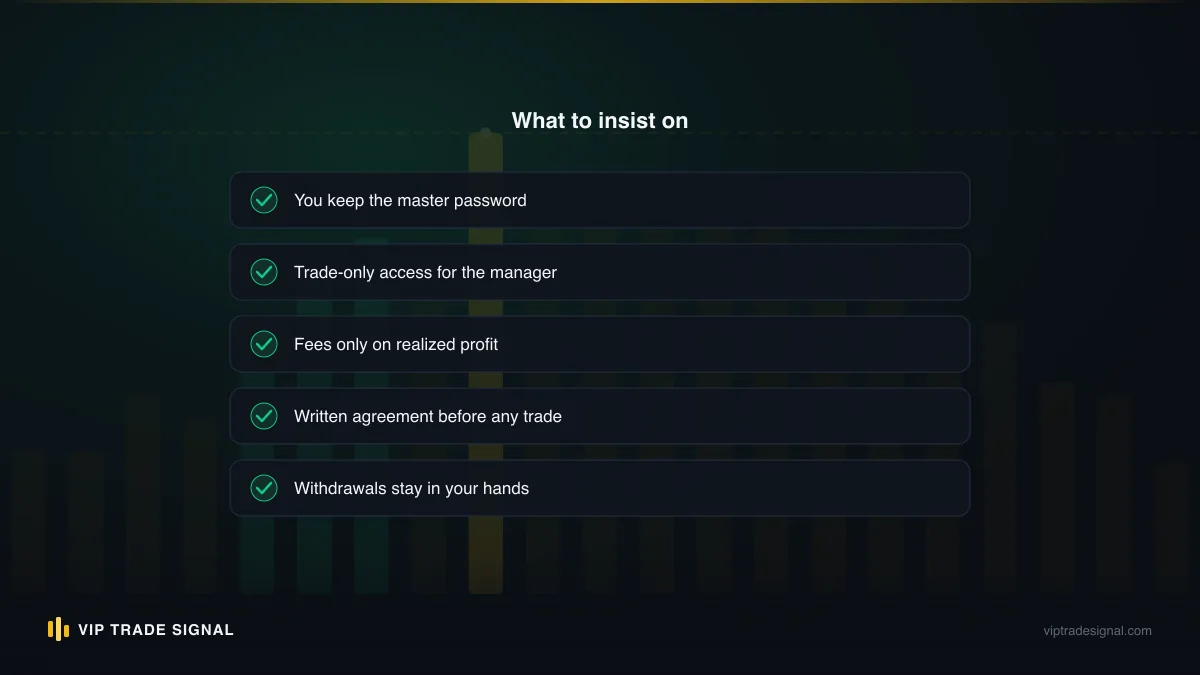
The correct configuration for a managed account depends on the manager's setup, but the principle never changes: the manager gets the minimum access that allows trading, and nothing more. In the most common arrangement, you change the master password to something fresh the moment your account is approved, keep it, and grant the manager trading access through the broker's formal LPOA process or a dedicated trading password where the platform supports one. In MAM/PAMM structures, the broker's own software sits between the manager and your account, and the manager never gets your credentials at all, which is cleaner still.
What must never happen is the lazy version: emailing your master password to the manager because it's quicker. Do that and you've handed over the keys, the logbook, and the deed. We've seen accounts where the "manager" changed the master password, locked the owner out, and traded recklessly for the fee float while the client watched through a window they couldn't open. Recovering access through broker support takes days. Bad trading takes hours.
Two settings to lock down at the broker portal, not the platform:
- Withdrawals go to your bank only, protected by your portal login and two-factor authentication that only you hold.
- Contact details on the account, email and phone, stay yours. A scammer's first move after gaining access is often to change the email so the broker's security notifications go somewhere you'll never see.
And keep the investor password for yourself, because it's about to become your best tool.
Step 6: set your monitoring routine from day one
A managed account is not a fire-and-forget purchase. It's closer to renting your flat out: someone competent handles the day-to-day, but you still check in, because it's your asset and nobody will ever care about it the way you do.
The investor password makes monitoring trivially easy. Log into MetaTrader with it and you see everything, live: every open position, every closed trade, the equity curve, the margin level. The manager can't hide, filter, or prettify any of it. Which is precisely why your monitoring routine should start on day one, not after the first weird statement.
Here's the routine we'd suggest, and it costs you maybe twenty minutes a week:
| Frequency | What you check | What you're looking for |
|---|---|---|
| Daily (2 min) | Equity and open positions | Position sizes in line with the agreement; no sudden pile of open trades |
| Weekly (10 min) | Closed trades for the week | Stops on every trade; losses cut, not nursed; lot sizes steady after losing days |
| Monthly (30 min) | Full statement vs. the agreement | Drawdown inside the written limit; fees calculated correctly; behaviour matching the pitched strategy |
The daily glance is not about second-guessing trades. You will see losing trades, and that's fine; losing trades are a cost of doing business, not a breach. What the daily glance catches is behavioural change: the account that normally holds two positions suddenly holding eleven, the 0.10-lot strategy suddenly printing 0.50-lot tickets. Those changes precede blow-ups the way tremors precede the quake, and they're visible days before the damage lands.
Learn to read one distinction early, because it saves a lot of false alarms: balance versus equity. Balance is the account after closed trades only. Equity is balance plus the floating profit or loss on open positions, and equity is the number that tells the truth. An account can show a rising balance and a sinking equity at the same time, and that combination has a name: someone is closing winners quickly to book fees while letting losers float open and unrealized. It's one of the oldest tricks in the managed-money book precisely because a client who only reads the balance line never sees it coming. If equity sits persistently and deeply below balance, week after week, ask why, and don't accept "they'll come back" as the answer.
Resist the opposite failure mode too. Checking equity every twenty minutes and messaging the manager about each red trade will drive you mad and sour the relationship for no benefit. You hired a professional partly to not live on the charts. The routine exists so you can trust the gaps between checks.
One practical tip: screenshot or export the statement at the end of each week for the first month. If a dispute ever arises about what happened when, you'll have your own records rather than depending on anyone's goodwill.
Step 7: the first month review, and what would make you stop
Thirty days in, sit down for an hour and hold a small, honest tribunal. Not "am I up?", which is nearly useless over one month, but a sharper set of questions.
Did the behaviour match the pitch? If you signed up for a gold strategy risking 1-2% per trade with hard stops, is that what the trade history shows? Strategy drift in month one is a serious flag, because month one is when managers are on best behaviour. It rarely improves from here.
Was the risk inside the written limits? Compare the month's worst drawdown against the number in your agreement. Inside it, fine, even if the month finished red. Outside it, you don't need a conversation, you need the exit clause.
Were the fees right? Recalculate them yourself from closed trades. Most discrepancies are innocent, floating versus realized confusion mostly, but you want any confusion resolved in month one while the amounts are small and the precedent matters.
How did communication feel? Did questions get straight answers within a reasonable time? A manager who's evasive when the account is small and the questions are easy will be worse when neither is true.
Then act on the answers, and this is where people flinch. If behaviour, risk, and fees all check out, top up toward your intended allocation; you started small for exactly this moment. If something's off but explainable, name it, get the explanation in writing, and give it one more month at the current size. And if any of the hard lines were crossed, oversized risk, strategy drift, fee games, evasiveness, then revoke access this week. Change the passwords, notify the broker, end it.
The maths of quitting early is heavily in your favour, and people consistently get it backwards. Leaving a bad manager after one month costs you a month. The sunk-cost voice saying "give it time to work" is how a $600 lesson becomes a $6,000 one. We wrote more about the structural risks in whether forex account management is safe at all, and the honest answer is: it's as safe as your willingness to enforce your own rules. The setup in steps 1 through 6 gives you the power to leave cleanly. Step 7 is where you prove you'll use it.
Common onboarding mistakes, ranked by cost
Every mistake in this list is one we've seen a real person make. Ranked from expensive to catastrophic, because not all mistakes are equal.
5. Skipping the small-start (cost: an oversized first lesson). Funding the full allocation on day one turns a survivable month-one discovery into a serious one. The trader who put in $2,000 to test and found the strategy drifting lost a few hundred dollars and a month. The one who put in $15,000 on the same manager lost considerably more of both.
4. Not reading the exit clause (cost: months of trapped money). A lock-in you didn't notice becomes a cage the day performance turns. Even when such clauses are legally shaky, and they often are, disputing them takes energy and time while your capital sits under someone else's control.
3. Verifying the badge, not the record (cost: your judgement). A Myfxbook link with an unverified track record, a demo account dressed as live, six cherry-picked months from a longer, uglier history. The screenshot-deep check approves managers the two-hour check would have binned.
2. Letting the manager pick an unknown broker (cost: potentially everything). If the "broker" is the manager's own website, there was never an account, never a trade, never a balance. Just a login page rendering whatever numbers keep you depositing. This one hurts most because the platform looks real right up until the withdrawal request.
1. Sending money to the manager directly (cost: everything, immediately). Still number one, still happening every single day, still dressed up in new costumes: crypto "funding wallets", "company deposit accounts", "pooled institutional access". The transfer clears, the trading theatre runs for a while, and then the person and the money are gone. No structure survives this mistake, because this mistake is the absence of the structure.
Notice what the list has in common. Not one of these mistakes is about trading. Nobody on it lost money because a stop was ten pips wrong. Every loss traces back to a skipped step in the sequence you've just read, which is the whole argument of this article in one paragraph: when you open a managed forex account, the onboarding is the risk management.
How onboarding works with our gold-only service
We said we'd declare our interest, so here's how the seven steps look when the manager is us, and you should hold this against the same checklist as anyone else.
We trade one instrument: gold, XAU/USD. Not because other markets can't be traded well, but because we'd rather be genuinely good at one thing than presentable at twelve, and gold is the market our desk has lived in for years. If you want a manager rotating through equities and exotic pairs, we're a bad fit and we'll say so on the first call.
The structure follows this article because this article describes how we think it should work. The account is yours, at your broker, in your name; if you don't have one, we work with the major regulated names, Exness, XM, IC Markets, Vantage, and you open it yourself. You keep the master password. Always. We take trading access only, and you can revoke it any day you like with no notice period and no exit fee, for any reason or none. Your money never passes through us in either direction.
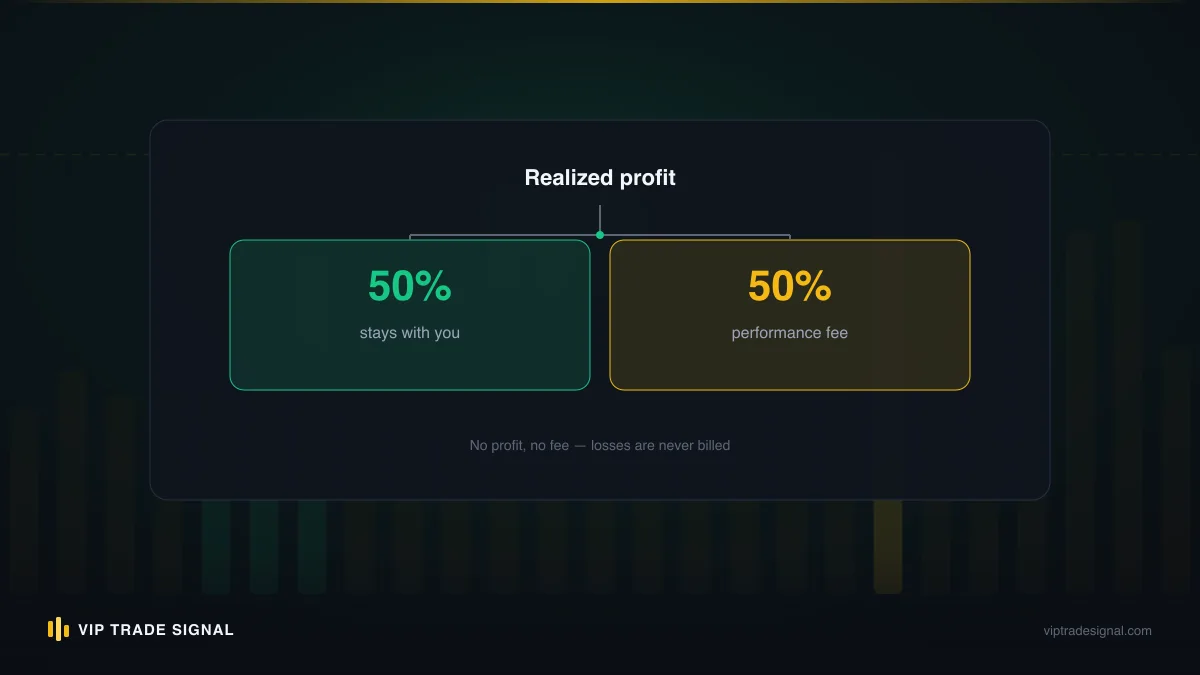
The fee is a flat 50% of realized profit, with a $200 minimum advance to start, and we'll be straight about what that number is: it's at the high end of the industry. The trade-off is deliberate. There's no management fee ticking away in flat months, no percentage skimmed off your balance regardless of results, and the minimum to start is deliberately low. You pay when there's realized profit to pay from, and in a losing month you owe nothing beyond what's already advanced. Some people would rather pay 2-and-20 on a $50,000 minimum; that's a reasonable preference, and it's not what we sell.
If the fuller detail helps, the account management page lays out the whole arrangement, and if you'd rather test our trading before letting anyone near your account, which frankly is the smarter order, our gold signals are free through a partner broker with a $250 balance maintained, every closed signal published publicly, losses included. Watching a track record build in front of you beats any pitch we could write. Questions before any of that, ask us directly; the boring procedural ones are our favourite kind.
The order is the protection
Strip everything above down to a card you could keep in your wallet:
- Vet the manager's behaviour, not their returns, and verify the record with third-party data.
- Open the broker account yourself, in your name, at a broker whose regulation you checked on the regulator's own register.
- Fund broker-direct only. The path from your bank to the manager does not exist.
- Read the exit clause before you admire the strategy. No lock-ins, no penalties, no notice games.
- Grant trade-only access. The master password never leaves you.
- Monitor from day one: glance daily, review weekly, judge monthly.
- Hold the month-one tribunal, and actually act on the verdict.
Seven steps, and not one of them requires trading knowledge. That's the strange, reassuring truth about how to invest in managed forex accounts safely: the skills involved are reading a document, checking a register, and keeping a password to yourself. Ordinary diligence, applied in the right order.
The order matters more than any single step. Vetting after depositing is theatre. An exit clause read after signing is a receipt for a decision already made. Each check only protects you at its own position in the sequence, which is why the person who does all seven steps out of order can still end up in the same forum thread as the person who did none.
And the honest coda, because we promised no hype: a perfectly executed setup gets you a fair game, not a won one. The manager can still have losing months inside every limit you set. Gold can still gap through a stop. Risk is the admission price of the returns, and anyone who tells you the price has been waived is charging you more than 50%. What the seven steps buy you is narrower and much more valuable: the guarantee that if this doesn't work out, you'll lose like a trader, a controlled amount, inside written limits, with the power to stop, and not like a victim.
So before the deposit, before the call with the charming manager, before any of it, go back to the top of this page and do the steps in order. The sequence is dull. Dull is what safety looks like.