The margin call email always arrives at the worst possible time. Sunday night gap. Two in the morning during the Asian session. Ten minutes into a news spike you were sure would reverse. And every single person who receives one says some version of the same thing afterwards: it came out of nowhere.
It never comes out of nowhere. We audit wrecked accounts for a living, mostly ones sitting $5,000 to $10,000 underwater when they reach us, and in every single case the warning signs were visible for days. Sometimes weeks. Margin level drifting down through 400%, then 250%, then 150%, while the trader added positions, removed stops, and told themselves the market owed them a bounce. The call, when it came, was just the invoice for decisions already made.
So this piece is about how to avoid a margin call in forex before you're anywhere near one. Twelve rules, and we've ordered them by how often their absence shows up in the accounts we take apart, not by what a textbook thinks matters. The textbook order puts leverage first. Our audit pile puts position sizing first, because leverage never killed anyone who sized properly. We'll get to why.
What a margin call is, and what it isn't
Quick definitions, because half the traders who ask us what is a margin call in forex are actually asking about stop out, and the difference matters when you're trying to survive one.
Margin is the deposit your broker sets aside when you open a position. Buy one standard lot of EUR/USD at 1:100 leverage and roughly $1,100 of your equity gets locked up as margin. It's not a fee. It's collateral, and you get it back when the position closes.
Margin level is the number that decides your fate. It's your equity divided by your used margin, expressed as a percentage. Equity of $5,000 against used margin of $1,000 is a margin level of 500%. Comfortable. Equity of $1,200 against the same $1,000 of used margin is 120%, and now you're in the room where bad things happen.
A margin call is the broker's warning, usually triggered somewhere around 100% margin level depending on the broker. Historically it was an actual phone call asking you to deposit funds. Now it's an email and a red flash in your terminal. Crucially, at margin call level, nothing has been closed yet. You still have choices.
Stop out is when the choices end. Somewhere lower, commonly 50% but anywhere from 20% to 50% depending on the broker, the platform starts force-closing your positions, biggest loser first, until margin level recovers. No consultation. No mercy. Often at the worst prices of the day, because the same move that crushed your margin is the move everyone else is running from too.
Two things a margin call is not. It's not a debt collection notice; with most regulated brokers offering negative balance protection you can't owe more than your deposit, though offshore accounts are another story. And it's not a random act of broker cruelty. Brokers don't profit from stopping you out early (whatever the conspiracy threads say); the mechanism exists because leveraged losses can exceed your money, and someone has to stop the bleeding before it reaches theirs.
One practical homework item before we go further: find your broker's actual margin call and stop out levels, today, and write them on a sticky note. They're in the account specifications page or the terms document nobody reads. A 100/50 broker and a 60/20 broker behave completely differently in a crisis, and traders who move brokers routinely carry the old numbers in their head for months. We audited an account this year that stopped out at 30% while its owner sat calmly watching, certain he had until 50%. Same platform, different broker, dead account.
The distinction to hold onto: margin call is the warning, stop out is the execution. Everything in this article is about staying so far from the first that the second is never a live possibility.
The anatomy of every margin call we've audited
Here's the uncomfortable pattern. We've been through a lot of statements at the drawdown desk, and the road to a margin call is almost boringly consistent. It has five stages, and knowing them is half the prevention.
Stage one: the oversized winner. It starts with a win, not a loss. Someone takes a position two or three times their normal size, on gold or GBP/JPY or whatever's moving, and it pays. That win recalibrates their sense of normal. Next week, the double-size trade is the normal trade.
Stage two: the first refusal. Eventually one of those oversized trades goes against them, and instead of taking the planned loss they widen the stop "to give it room". The loss that should have been 2% becomes a floating 6%. Nothing is realised yet, so in their head, nothing has been lost.
Stage three: the average down. The position keeps sinking, so they add to it at a "better" price. Now the used margin has grown while equity has shrunk, which means margin level is falling from both ends at once. This is the single most common structural feature of the accounts we audit. Not exotic pairs, not 1:2000 leverage. Averaging into a loser.
Stage four: the hedge. With margin level now under 200% and fear setting in, they open an opposite position to "lock" the loss and think about it later. The floating loss stops moving. The problem doesn't. We've written a whole piece on why locked positions quietly bleed accounts, but the short version is that a hedge freezes the pain without removing the used margin, and swap costs tick away underneath.
Stage five: the news candle. The account limps along at 130-160% margin level for days, sometimes weeks. Then a CPI print, a central bank surprise, a Sunday gap. Spreads widen, equity lurches, margin level punches through the stop-out threshold, and the platform does what platforms do.
Read those five stages again and notice what's absent: bad luck. There isn't a single point in that chain where the market did something unforeseeable. The trader made five consecutive decisions, each one individually survivable, and the margin call was simply their sum. Which is genuinely good news. Decisions can be replaced with rules.
How to avoid a margin call in forex: rules 1-3, sizing and leverage
These three are the foundation. If you only adopt three rules from this whole piece, take these, because in our audit pile the absence of Rule 1 alone accounts for more wreckage than everything else combined.
Rule 1: risk a fixed fraction per trade, and make it small
Risk between 0.5% and 2% of account equity per trade, defined as the distance from entry to stop loss multiplied by position size. Not per position "when it feels right". Every trade, mechanically.
Run the numbers on a $2,000 account risking 1%. That's $20 of room per trade. If your stop on a EUR/USD trade is 40 pips, your size is 0.05 lots, because 0.05 lots makes each pip worth about $0.50 and 40 pips of adverse movement costs you $20. Feels tiny? It should. At that size you can be wrong twenty times in a row, which almost never happens to anyone with a coherent method, and still have 80% of your account.
Now watch what this rule does to margin. That 0.05 lot position at 1:100 leverage uses maybe $55 of margin against $2,000 of equity. Margin level: over 3,600%. You are, for all practical purposes, unstoppable-out. The trader risking 10% per trade on the same account is running 0.5 lots, using $550 of margin, and one 100-pip move against them drops equity to $1,500 and margin level under 280%. Two such trades open at once and a bad afternoon puts them at the warning line.
Position sizing isn't a risk management nicety. It is the margin call prevention mechanism. Everything else is reinforcement.
Rule 2: cap effective leverage at 5:1, whatever your broker offers
Your broker offering 1:500 doesn't mean you should use it, any more than your car doing 240km/h means you should commute at it. Effective leverage is total position value divided by equity. One standard lot of gold at $3,300 controls $330,000 of metal; on a $10,000 account that's 33:1 effective leverage, and a 1.5% move in gold, which happens most months, swings your equity by half.
Keep total open exposure under five times equity. On $10,000, that's positions worth $50,000 combined, maximum. Under 3:1 if you hold trades through news or over weekends. Boring? Completely. But we have never once audited a blown account that was running 3:1.
There's a persistent myth worth killing here, which is that high account leverage itself is dangerous. It isn't, quite. A 1:500 account and a 1:100 account holding the identical 0.05 lot position carry the identical market risk; the 1:500 account just locks up less margin doing it, which on paper makes it safer against stop out. The danger is what the headroom does to behaviour. Give a trader room for twenty positions and they will, eventually, open twelve. High leverage doesn't pull the trigger. It just keeps handing you a bigger gun.
Rule 3: never use more than 20% of equity as margin
A blunt, mechanical backstop for the days you don't feel like doing arithmetic: if used margin ever exceeds a fifth of your equity, you're overexposed, full stop. This keeps your margin level above 500% by construction, which means the market has to take 80% of your equity before your broker even clears its throat. Give yourself that distance. You'll need it on the day you're wrong about everything at once.
Rules 4-6: exposure, correlation and the news calendar
Sizing individual trades correctly and then stacking six of them is how careful people still get carried out. This trio is about the portfolio, not the position.
Rule 4: count correlated positions as one position
Long EUR/USD, short USD/CHF and long GBP/USD is not three trades. It's one large short-dollar trade wearing three hats, and when a hawkish Fed surprise lands, all three lose together. Same with being long gold and long AUD/USD into risk-off. If two positions would bleed from the same headline, their combined risk has to fit inside your single-trade cap. A trader we'll call Dan, whose statement we audited last spring, had five open positions each individually sized at a tidy 1%. All five were, in substance, short dollar. One PCE print handed him a correlated 5% hit and started the exact five-stage slide described above.
Rule 5: know the week's red-folder events before Monday
You don't have to trade the news. You do have to know it's coming. NFP, CPI, FOMC, and for gold traders anything the Fed chair says in public. Spreads on majors can go from 1 pip to 15 during these windows, and on gold from 20 cents to several dollars, which matters more than people think, because a widened spread alone can shove a marginal account through its stop-out level even if price barely moves. Before every red-folder event: reduce size, widen nothing, and if your margin level is under 300%, flatten something. Five minutes with a calendar on Sunday evening is the cheapest insurance in this business.
Rule 6: respect the weekend gap
Forex closes Friday night and reopens Sunday with no obligation to reopen where it closed. Gold gapped over $20 on several Sunday opens in the last couple of years alone. Your stop loss does not protect you through a gap; it fills at the first available price on the other side. If your margin level can't absorb a 1% adverse gap on every open position simultaneously, you're carrying too much into Saturday. Either trim on Friday afternoon or accept that you've turned your weekend into a lottery ticket you can't even watch being drawn.
Rules 7-9: alerts, buffers and a cash reserve
The middle-ranked rules in our audit ordering. Less structural than sizing, more structural than psychology. These are the ones that turn a bad week into an annoyance instead of an ending.
Rule 7: set your own margin alarm at 300%, and treat it as a fire alarm
Your broker warns you at 100%, which is like a smoke detector that only goes off once the sofa is fully alight. Set your own alert, in the platform or a phone app, at 300% margin level. When it fires, you don't analyse, you act: close the worst position or halve the largest one, immediately, before your opinion of the market gets a vote. In every audit we've done, there was a moment around the 300% mark where a single unemotional close would have ended the story. Nobody took it. Make taking it automatic.
If you're asking how to increase margin level in forex once it's already sagging, this is the honest answer, and it's unglamorous: margin level is equity over used margin, so you either raise equity or cut used margin. You can't control equity in the short run. You can always cut used margin. Closing your biggest loser does both at once, which is exactly why it's the move people avoid.
Rule 8: trade with a buffer account, not your whole bankroll
Whatever capital you've allocated to trading, keep 30-40% of it outside the broker account. Two reasons. First, discipline: an account holding $6,000 of a $10,000 bankroll naturally trades smaller than one holding the lot. Second, optionality: if a genuinely unfair event hits (flash crash, gap through a stop), you can top up calmly, on your terms, rather than in a panic at 2am. The buffer is for restoring a healthy account after a controlled loss. It is not, and this matters enormously, for feeding a dying position. We'll get to that.
Rule 9: check margin level daily, out loud, like a pilot
Every day you hold positions, look at three numbers before you look at a single chart: equity, used margin, margin level. Say the margin level number to yourself. This sounds like kindergarten and it works, because the traders who slide into stage four of the anatomy above genuinely stop looking. The floating loss is painful, so the eyes go to the chart, where hope lives, instead of the account metrics, where truth does. Thirty seconds a day keeps the truth in the room.
Rules 10-12: the behavioural three
And now the rules everyone knows and breaks anyway. We put them last not because they matter least but because, by the time behaviour is the problem, rules 1 through 9 have usually already been abandoned. These are the accelerants, not the fuel.
Rule 10: never average into a losing position
Adding to a loser feels like getting a discount. It's actually a double debit: your used margin rises while your equity falls, so margin level collapses at twice the speed. It also converts one wrong idea into a bigger wrong idea. The maths is stark: a 1-lot position 50 pips underwater needs a 50-pip recovery to break even; add a second lot and you've halved the required recovery to 25 pips, sure, but you've doubled the bleed rate if it keeps going, and it usually keeps going, because you're adding against momentum by definition. If the trade idea is still valid, the position you already have will pay you. If it isn't, why are you buying more of it?
Rule 11: never remove or widen a stop loss to avoid taking it
A stop loss you'll move isn't a stop loss, it's decoration. The moment you widen a stop under pressure, you've told yourself the planned loss was optional, and that lesson generalises horrifyingly fast. Within a few trades the stops come off entirely, and an account with no stops is just a margin call with a delivery window. If you're consistently tempted to widen stops, your stops are too tight for your method or your size is too big for your nerve. Fix that in the plan, on the weekend, in cold blood. Never mid-trade.
Special mention here for hedging a loser instead of stopping it. Opening the opposite position feels like a stop loss without the sting of realising anything. What you've actually built is a locked structure that pins your margin and pays swap every night while resolving nothing; getting out of a hedged position cleanly is its own painful skill, and almost everyone who locks in a panic exits it worse than a simple stop would have.
Rule 12: after two consecutive losses, halve your size; after four, stop for the day
Revenge trading is the final stage of most margin call stories, the part where a wounded account gets finished off in an afternoon. The sequence is always the same: a loss stings, the next trade is bigger "to make it back", that one loses too because it was sized by anger rather than by rule, and now the required comeback has doubled again. Three cycles of that and a 6% bad morning has become a 25% crater by dinner.
You will not out-discipline the urge in the moment, so pre-commit to a circuit breaker. Two losses in a row: next trade is half size. Four in a row, or a daily loss over 4% of equity: flat, terminal closed, walk. The market runs 24 hours five days a week. It will still be there tomorrow, and so, if you follow this rule, will your margin.
A margin call is never one bad trade. It's one bad trade, defended.
The margin call warning signs 48 hours out
Every account that reaches our desk showed the same cluster of margin call warning signs in the final 48 hours before the email. If you recognise more than two of these in your own account right now, you are not reading a general-interest article anymore. You're reading about yourself, and the clock is running.
| Warning sign | What it looks like | What it means |
|---|---|---|
| Margin level under 200% | The number in your terminal footer, ignored | One ordinary bad session from the warning line |
| Floating loss over 20% of equity | Big red unrealised number you've stopped looking at | Stage two or three of the anatomy, well advanced |
| Used margin over 40% of equity | Half your account locked as collateral | No capacity to absorb a spike or widened spread |
| A position older than two weeks underwater | "It'll come back" | A refusal, not a trade |
| Recently widened or deleted stops | Modified orders in your history | The defences are already down |
| A fresh hedge against a big loser | Offsetting position opened in the last few days | Pain frozen, margin still pinned |
| Checking the chart hourly but not the equity | You know the price to the pip, not your margin level | Hope has replaced monitoring |
Notice that price isn't in the table. The market's direction over the next two days is unknowable; your account's structure is sitting right there in the terminal. The warning signs are all structural, which is exactly why they're useful. You don't need to predict anything to act on them.
There's a behavioural sign that doesn't fit in a table but shows up constantly in our conversations with the account owners afterwards: they stopped talking about the account. The trader who was happily posting screenshots in a group chat in March goes quiet in April. Partners get vague answers. If you've caught yourself avoiding the subject of your own account with people you'd normally bore senseless about it, take that seriously. Silence is a margin call warning sign that no terminal will ever display, and in our experience it's one of the more reliable ones.
And the 48-hour framing is deliberate. At 200% margin level with normal spreads, you typically have a day or two of ordinary market movement before things turn acute, which is enough time to fix the account calmly. At 120% you have hours, maybe minutes through a news window. The earlier you act on the structural signs, the more your exit is a decision and the less it's an event.
The moment the warning email arrives
Suppose prevention failed. It's 1:47am, your phone lights up, margin level 98%, and the broker's template email is telling you to deposit funds or reduce positions. What you do in the next ten minutes matters more than anything you've done in the last ten days. Here is the sequence, in order, no improvising.
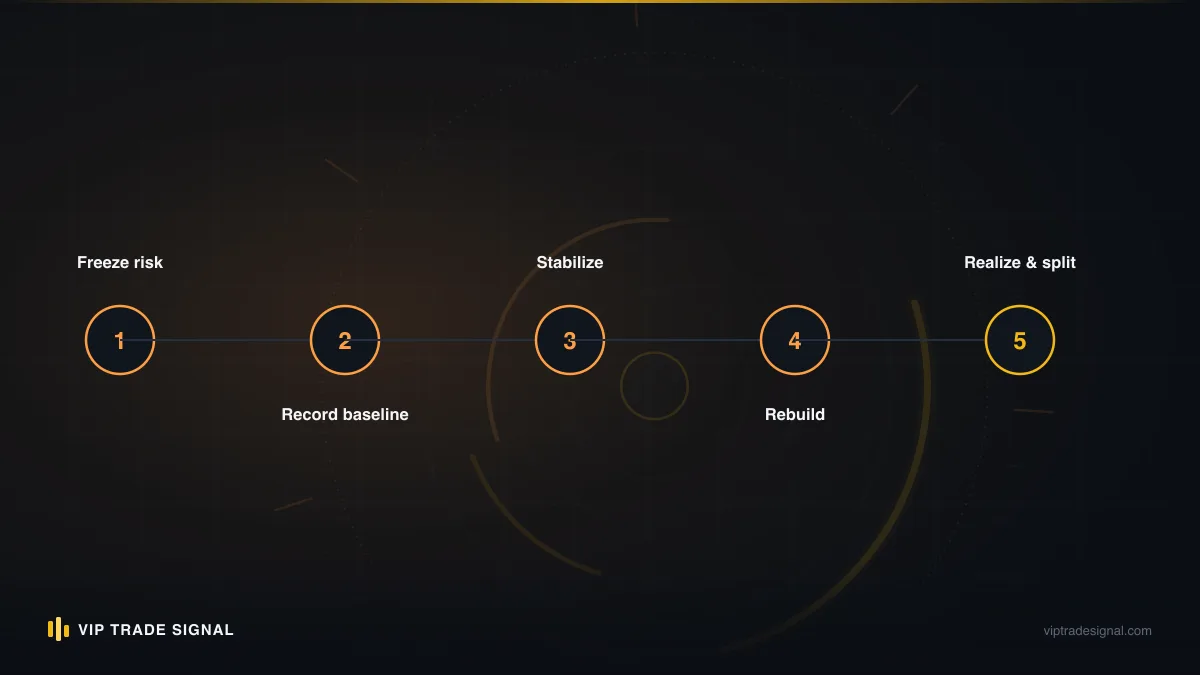
- Do not deposit anything yet. Money is the last resort, not the first response. More on why in the next section.
- Open the terminal and rank your positions by floating loss. Not by how much you believe in them. By the number.
- Close the biggest loser. Fully, at market. This is the single most effective act available: it frees its margin and stops its bleed simultaneously, and margin level jumps instantly. It will also hurt more than any other option, which is precisely why it works and why people skip it.
- Reassess margin level. Above 300%? You can stop and sleep, badly. Still under 200%? Close the next-worst position and check again.
- Halve anything oversized that remains. Partial closes free proportional margin. A 0.8 lot position cut to 0.4 releases half its collateral and halves its ongoing risk.
- Cancel every pending order. Pending orders that trigger during a spike add used margin at the exact moment you can least afford it. We've seen more than one account pushed through stop out by its own buy-limit ladder filling into a falling market.
- Only now, with the structure fixed, decide whether the surviving positions deserve to live on their merits, at their current size, as if you were opening them fresh. Most don't.
The theme running through all seven steps: reduce used margin first, protect equity second, defend opinions never. A margin call is your broker telling you the account's structure has failed. The response has to be structural.
Why adding funds is sometimes the worst response
The deposit button is right there in the email. Brokers make funding mid-margin-call frictionless, and you should notice that they do.
Sometimes topping up is right. If a spread spike or a gap put a fundamentally sound, correctly sized account briefly below the line, a calm top-up from your Rule 8 buffer is a reasonable repair. That's maybe one case in ten among the accounts we've seen.
The other nine times, depositing into a margin call is buying a larger ticket to the same crash. Think about what the deposit actually does: it raises equity, which lifts margin level, which un-flashes the red warning. What it does not do is touch a single one of the reasons the warning fired. The oversized position is still oversized. The averaged-down loser is still bleeding. The correlation stack is still one headline from another lurch. You've refuelled a vehicle that's on fire.
And there's a nastier mechanism underneath, one we see in nearly every multi-deposit wreck: each top-up resets the trader's reference point. The account that was down 60% is now, after a $3,000 deposit, only down 30%, and the brain quietly rewrites the story into "manageable". So the losing structure gets defended for another week, then another deposit, then another rewrite. We've audited accounts with five deposits over six weeks, each one triggered by a margin warning, each one followed by zero position changes. Total lost: the original account plus every rescue payment. The margin call was trying to end that account at a survivable size. The deposits overruled it, at four times the price.
Our rule of thumb, and you can steal it: fresh money only ever enters after the account is structurally fixed, meaning margin level above 500%, no averaged positions, no widened stops, and it enters as a planned decision at least 24 hours after the warning, never during one. If a position only survives because you fed the account, the market isn't validating your trade. Your bank balance is.
Trading on margin is a high-risk business, and losing streaks are not a malfunction, they're a scheduled feature. The whole game is making sure a normal streak can't reach your margin, and money added under duress does the opposite.
When the account is already through the ice
A word for the reader who found this article too late, because some of you did. The margin call already happened, or the stop out did, or you're sitting on a locked, hedged, averaged mess floating five figures down and reading prevention advice through gritted teeth.
First: a stopped-out account is finished cleanly, oddly enough. The decision was made for you, the tuition is paid, and the rebuild starts with rules 1 through 12 and a smaller stake. Painful, but simple.
The harder case is the account that's deeply underwater but still alive, usually because it's been hedged into stasis. Untangling one of those without triggering the stop out you've been dodging is careful, unglamorous work: freeing margin leg by leg, cutting the dead weight in an order that keeps the account breathing, resisting the urge to win it all back on the way. It's the entire job of our drawdown management service, where we work accounts floating roughly $5k-$10k down for a flat 50% of whatever's recovered above a baseline we record together at the start, and we'll tell you plainly that no recovery is ever guaranteed; some accounts are past saving and the honest move is to say so early. You keep the master password and control of withdrawals throughout, which we'd insist on even if you didn't, and there's a longer discussion of how to tell legitimate account management from the other kind if you're weighing up letting anyone near your login. If you just want a second pair of eyes on a statement before deciding anything, send it over; auditing wrecks is most of what we do all day anyway.
But whether you fix it yourself or bring help, the sequencing is identical to the 2am list above. Structure first. Opinions never.
A prevention checklist to pin above your desk
Twelve rules is a lot to hold in your head at 2am, which is the point of writing them down where your eyes land every session. Here's the whole article in pin-up form. Print it. We're not joking.
Before any trade:
- Risk per trade is 0.5-2% of equity, calculated from the stop distance, every time
- Total exposure under 5x equity, under 3x through news or weekends
- Used margin under 20% of equity, always
- Correlated positions counted as one trade against the risk cap
- This week's red-folder events known and sized for
While positions are open:
- Own alert set at 300% margin level, with a pre-agreed action attached
- Equity, used margin and margin level read out loud daily
- 30-40% of the bankroll parked outside the broker account
- Friday afternoon check: could every position absorb a 1% gap at once?
When it goes wrong:
- Never average down. Never widen or remove a stop. Never hedge a loser to avoid closing it
- Two straight losses: half size. Four, or 4% down on the day: flat, done, tomorrow exists
- If the warning fires anyway: close the biggest loser first, cancel pendings, deposit nothing until the structure is fixed and 24 hours have passed
Read the "when it goes wrong" block one more time, because that's the block that actually gets used. The sizing rules keep you out of trouble on the 95% of days that behave. The behavioural rules are for the other days, and they only work if you agreed to them before the trouble started. Nobody negotiates well with their own open loss.
Here's the hard question to leave you with, and we'd ask it to your face if you were sitting at our desk: open your platform right now and look at three numbers, your margin level, your used margin as a fraction of equity, and the age of your oldest losing position. If any of those made you wince, you already know which of the twelve rules you're breaking. The margin call hasn't arrived yet. On current evidence, is it coming?
That question costs nothing this week. In six weeks it might cost you the account. Every trader we've ever helped dig out of a hole could name, with painful precision, the exact day they should have asked it.