A trader we'll call Danny messaged us last spring. He'd wired $4,000 to an "account manager" from an Instagram DM: rented Lamborghini in the profile, a MyFxBook screenshot that turned out to belong to someone else entirely. The manager traded for eleven days, sent daily screenshots of growing profits, then asked for a $900 "withdrawal processing fee". Danny paid it. Then a $1,200 "tax clearance". Then the account went quiet, the profile vanished, and Danny was down $6,100 with nothing to show for it except a folder of fake screenshots.
So when someone types "is forex account management legit" into a search bar, they're not asking an abstract question. They're asking whether they're about to become Danny. And the honest answer — the one most firms in this industry won't give you because it costs them sales — is that the question can't be answered with a yes or a no. Some account management is completely legitimate. A very large amount of it is theft with better branding. The word "legit" doesn't attach to the industry. It attaches, or fails to attach, to one specific firm at a time.
Which means what you actually need isn't reassurance. It's a method. This article gives you seven checks, each one verifiable by you, without needing to trust anyone's word for anything. Then, because we run an account management desk ourselves and it would be cowardly not to, we run our own firm through all seven in public, including the two where we're weakest. By the end you'll be able to evaluate any manager on earth in about an hour. Most won't survive twenty minutes.
Is forex account management legit? The industry earned the suspicion
Let's not pretend the scepticism is unfair. It isn't.
Forex account management sits at the intersection of three things scammers love: money that moves electronically, victims who are hopeful rather than knowledgeable, and jurisdictions that make enforcement nearly impossible. A person in one country wires money to an entity registered in a second country, operating a broker account in a third, promoted through a social platform headquartered in a fourth. When it goes wrong (and the fraudulent version always goes wrong, that's the design) there is no police force on the planet with both the jurisdiction and the motivation to chase a $4,000 loss across four borders.
And the fraud volume is genuinely enormous. Regulators in the UK, US, and Australia have been publishing warnings about "managed forex" schemes for well over a decade. The pattern barely changes. Guaranteed monthly returns. Screenshots instead of verifiable records. A request to send money to the manager rather than to a broker. Withdrawal fees invented at withdrawal time. If you've spent any time in trading Telegram groups you have watched this movie so many times you can recite the script.
But here's the thing the blanket cynics get wrong: the existence of fake surgeons doesn't mean surgery is fake. Legitimate account management exists, and has existed for decades in various forms, from regulated CTAs and money managers down to small desks trading client MT4 accounts under power of attorney. It solves a real problem for a real category of person: someone with capital and no time, no skill, or no temperament for trading it themselves. The legitimate version has a recognisable structure. The fraudulent version has a recognisable structure too. And usefully for you, the two structures are almost perfect opposites.
The structural difference is custody, and almost nothing else matters as much
Strip away the marketing and every account management arrangement on earth answers one question: who holds the money?
In the legitimate structure, you open an account in your own name at a regulated broker. You deposit your money with that broker. The manager receives limited trading access, whether an investor password, a power of attorney, or a PAMM allocation, and that access lets them place trades and nothing else. They cannot withdraw. They cannot change the account's ownership. They cannot lock you out. The worst thing a legitimate-structure manager can do to you is trade badly, which is a real risk and we'll get to it, but it is a categorically different risk from theft.
In the fraudulent structure, the money moves to them. Sometimes bluntly ("send USDT to this wallet and I'll trade it for you") and sometimes with more theatre: a "company account" they control, a broker you've never heard of that they recommended and secretly own, a platform whose numbers are simply typed into a database by the same people who will later refuse your withdrawal. The moment your capital sits somewhere the manager controls and you don't, the trading is irrelevant. There may not even be any trading. The screenshots Danny received were generated by a demo account.
A legitimate manager can lose your money. Only a fraudulent one can take it.
Hold onto that sentence, because it reframes the entire due diligence process. You're not trying to find a manager who never loses. No such manager exists, and anyone claiming to be one has just failed the test. You're trying to find an arrangement where the worst case is a trading loss you understood and sized in advance, rather than total, unrecoverable disappearance of the principal. Every check that follows is really a probe of that one distinction from a different angle.
Check 1: your money never leaves your own broker account
This is the first check because it's the closest thing this industry has to a binary test.
Ask the manager one question: "Where does my money sit, and in whose name?" The only acceptable answer is: in an account in your name, at a regulated broker you chose or at least independently verified, where you hold the master password and the manager holds trading access only. On MT4 and MT5 this is a solved problem; the platform has separate master and investor credentials precisely so that a third party can trade an account without being able to drain it. A manager working under this structure can open and close positions, and that is the entire extent of their power. Withdrawals go from the broker to your bank, initiated by you, and no one else can trigger or intercept them.
Now the failure modes, in rough order of how often we see them:
- "Send the funds to us and we'll allocate them." Walk away. Instantly. This is not a yellow flag to investigate further; it's the entire scam in one sentence.
- "You must use our recommended broker." Sometimes innocent, since a manager may genuinely have execution or rebate reasons to prefer one venue. But verify that broker independently: real regulator register entry, years of operating history, withdrawal reports from users who aren't in the manager's own community. A "broker" that exists only inside the manager's referral funnel is frequently the same entity wearing a different hat.
- "We'll open the account for you to make it easier." No. You open it. You verify your identity with the broker directly. You set the master password. If a manager has ever known your master password, change it before they trade a single lot, and treat any resistance to that as disqualifying.
- "Crypto deposit only, for speed." An irreversible payment rail plus a counterparty you can't identify is the worst possible combination. Legitimate managers get paid fees; they don't take custody of principal in unrecoverable form.
One nuance worth naming: regulated pooled structures do exist. Funds, and PAMM or MAM setups at major brokers, aggregate money under genuine regulatory oversight, and those can be fine, but they're a different product with different verification (fund documents, custodian, auditor, regulator register). For the retail-scale managed account this article is about, the standard is simpler and stricter: your name, your broker, your master password. If check 1 fails, you don't need checks 2 through 7.
Check 2: a track record that includes the losses
Every fraudulent manager has a track record. It's always beautiful. That's how you know.
Real trading produces losing trades, losing weeks, and losing months, at every level of skill, forever. Even a disciplined gold desk can string together ten or eleven trades without a full winner; good process, hostile fortnight, it happens. So when a manager shows you a record of 94% winners and a smooth 45-degree equity line, they have not shown you evidence of skill. They've shown you evidence of fabrication, of a martingale that hasn't detonated yet, or of survivorship selection: running twenty accounts and showing you the lucky one. We wrote at length about why unbroken win streaks are a red flag rather than a credential in our piece on losing streaks, and every word of it applies double when someone wants your capital rather than a subscription.
What does a legitimate track record look like? Four properties:
- Third-party verified or independently checkable. MyFxBook or FxBlue linked directly to a live broker account with the track-record privileges verified, or a broker investor-password read-only login they'll let you watch, or a full public trade log. Screenshots are not a track record. Screenshots are pixels, and pixels are free.
- Losses visible, individually. Not "we average 8% monthly net" but the actual red trades, dates and prices attached. If every visible trade won, the losing trades are hidden somewhere, and hidden losses are the whole ballgame.
- Long enough to mean something. Three good months tells you almost nothing; twenty coin flips can come up heads. Twelve months spanning at least one nasty market regime starts to be evidence.
- Consistent with the strategy they describe. A manager who claims conservative 1% risk but whose record shows 40% drawdown swings is lying to you about one of the two, and it doesn't much matter which.
And here's a test almost nobody applies: ask to see their worst month. A real manager answers in seconds, with a number and usually a story; they remember it the way you remember a car crash. A fraudulent one deflects, reframes, or claims there wasn't one. There was always one.
Check 3: fee mechanics you can compute on the back of an envelope
Legitimate fee structures share one property: you can sit down with a calculator and work out exactly what you'd owe in any scenario, before signing anything. Fraudulent structures share the opposite property: the numbers stay foggy until it's time for you to pay one that was never mentioned.
The honest models in this corner of the industry are few and simple. Performance fees, where the manager takes a stated percentage of realised profit, typically somewhere between 20% and 50%, sometimes above a high-water mark. Management fees, a flat percentage of assets annually, more common at fund scale. Fixed monthly retainers, occasionally. That's roughly the whole menu. Anything exotic deserves hostile questioning.
Run the arithmetic yourself on a concrete case. Say you hand over a $5,000 account and the manager charges 30% of realised profit. A quarter goes well: $900 of closed profit. You should be able to state, without asking anyone, that the fee is $270 and your account keeps $630. Now the ugly case: next quarter loses $600. What's the fee? Under an honest performance model, nothing, and nothing again until the account climbs back past its previous peak. If the agreement is vague on that point (no high-water-mark language, no clear definition of "realised profit") you've found a structure where the manager can churn your account through a sawtooth of wins and losses, get paid on every up-leg, and leave you flat or worse while they collect steadily. That's not always fraud. But it's always a bad deal, and vagueness about it is a choice.
Then there are the fee patterns that are simply scam tells, full stop:
| Fee behaviour | What it actually means |
|---|---|
| Fee charged on unrealised or "projected" profit | Paying for numbers on a screen that can vanish |
| Large upfront fee before any trading | The fee is the business model |
| Withdrawal fee, "tax", or "clearance" invented at exit | The classic exit-toll; Danny paid two of these |
| Fees quietly taken from principal without a statement | Custody breach dressed as accounting |
| "Discounted fee if you deposit more today" | Urgency mechanics, covered in check 7 |
The single most reliable pattern in the fraudulent version is that fees flow toward the manager before profit exists, or as a condition of getting money out. Honest fees are computed after the fact, on closed results, from an account you control. If money has to leave your pocket before anything has been earned, you're the product.
Check 4: the exit path test, or trying to leave before you arrive
Here's a piece of due diligence that costs nothing and exposes almost everything: before you commit a single dollar, ask the manager to walk you through leaving.
"Suppose it's three months from now and I want to stop. What exactly do I do, how long does it take, and what does it cost?"
A legitimate arrangement makes this boring. You change the investor password or revoke the power of attorney (thirty seconds in the broker portal), the manager settles any performance fee owed on closed trades, open positions get closed or handed back to you by agreement, and you withdraw from your own broker account whenever you like, because it was always your account. Total elapsed time: a day or two, most of which is the manager doing the sums. There is nothing to negotiate because there is nothing they physically control.
The illegitimate version reveals itself the moment you push on this. Lock-in periods of six or twelve months "so the strategy can work". Exit penalties. Withdrawal windows, where you can only take money out during the first week of the month, or after a 30-day notice period, on an account that supposedly sits at a regulated broker in your own name. Ask yourself why a broker you contracted with directly would honour a third party's calendar; the answer is the account was never really yours. Or the softest, most common version: the exit path is simply never specified, the agreement silent, every question answered with "you can withdraw anytime, don't worry" and nothing in writing.
One honest complication: an account with open positions can't always be handed back instantly at zero cost, and a truthful manager will say so. If the account is holding trades underwater, closing everything today crystallises the loss. That's not a scam, it's arithmetic, and it's a big part of why accounts end up in the hedged, stuck configurations we dissected in the locked positions article. The distinction to watch is who decides. A legitimate manager explains the trade-off and lets you choose to eat the loss and leave. A fraudulent one uses the open positions as a hostage: "you can't withdraw while trades are running", forever, because trades will always, conveniently, be running.
Rule of thumb: the harder it is to leave, the less legitimate the operation. Run the exit-path question in your very first conversation and watch the reaction as closely as the answer.
Check 5: entity, registration, and humans with faces
Fraudulent operations are structurally anonymous, because anonymity is what makes the endgame survivable for them. So make them non-anonymous, and watch how it goes.
You're checking for four things, none of which require special tools:
- A registered legal entity. A company name you can look up in an actual government registry: Companies House in the UK, the state registry in the US, ACRA in Singapore, wherever. Note the incorporation date. A firm claiming "a decade of managing client capital" from an entity registered fourteen months ago has some explaining to do. Note the registered address too; a real office and a mail-forwarding shopfront look different on Street View.
- Named humans. Real names of the people who will trade your money, findable outside the firm's own website. Not "our team of expert analysts" over stock photos. Reverse-image-search the founder photos; you would be genuinely amazed how often the "head of trading" is a stock model who also sells dental insurance on three other sites.
- Regulatory status stated honestly. Here nuance matters. Depending on jurisdiction and structure, small-scale account management may sit in a genuinely grey zone; trading someone's account under a limited power of attorney is regulated as investment management in some places and effectively unregulated in others. An honest firm tells you exactly where it stands, including "we are not a licensed advisor and this is not personalised advice" where that's the truth. What's disqualifying is a false claim: a made-up licence number, a clone of a real firm's FCA registration (check the regulator's warning list, clone firms are epidemic), or "fully regulated" with no regulator named. Verify any licence number on the regulator's own website, never through a link the firm sends you.
- A history that exists. Old forum posts, archived versions of the website, reviews scattered across platforms the firm doesn't control. Messy, imperfect, and dating back further than last quarter. Fraudulent operations have curiously clean histories because the brand is eleven weeks old and gets burned and reincarnated after every exit scam. A slightly scruffy five-year trail beats a pristine five-month one every time.
None of these checks proves competence. A registered company with named directors can still trade like a drunk. What this check establishes is accountability: whether there exists a person and an entity that could, in principle, be pursued when something goes wrong. Scammers arrange their affairs so the answer is no. That arrangement is visible in advance, if you look.
Check 6: what the reporting cadence tells you
How a manager communicates, before, during, and especially during losses, is a legitimacy signal people consistently underrate, because it feels soft next to registries and fee maths. It isn't soft. It's a direct read on whether the operation expects to still be talking to you in a year.
Before you sign, a legitimate manager interviews you almost as much as you interview them. What's this capital for? Can you afford to lose it? What drawdown would make you panic? They do this because a mismatched client is a future problem they'd rather not acquire; someone who deposits rent money will be on the phone in tears at the first 6% dip, and a real firm knows it. A fraudulent operation asks none of this. Your suitability is irrelevant when the plan is to keep the deposit; the only qualification they screen for is willingness to send money, and the only question they reliably ask is "how much can you start with?"
During the engagement, the tell is whether reporting is independent of the manager's mouth. The gold standard is read-only access to the live account (investor password, or a verified tracking link) so you see every trade at broker level, unfiltered, whenever you like. Around that, a sane cadence: a periodic written summary, availability for questions within a business day or so, statements that reconcile to the broker's own records. What you should not accept is a reporting chain where every number reaches you through the manager: their screenshots, their PDFs, their portal showing balances typed into their database. That's not reporting. That's storytelling, and Danny had eleven days of excellent storytelling.
And the acid test is loss weeks. A legitimate desk reports a losing week in plain numbers, on the same schedule as winning ones, usually with a short note on what happened. The message arrives on Friday whether Friday is fun or not. Fraudulent and merely-cowardly operations go quiet when it's red, resurface when it's green, and if pressed produce a reason the losses were an anomaly, someone else's fault, or (a personal favourite from the genre) "a strategic drawdown". Silence during losses isn't just an annoyance. Behaviourally, it's the strongest predictor of the relationship ending badly, because a firm that hides small bad news is rehearsing for the day it has big bad news to hide.
Check 7: pressure is an inverse legitimacy signal
Everything so far has been about verifying claims. This last check is different: it's about the shape of the sales process itself, and it can be scored from your very first conversation, before you've verified anything.
The principle: legitimate account management does not need you specifically, today. A real firm's economics work across many clients and long horizons; whether you sign this week or next month is close to irrelevant to them. A fraudulent operation's economics are the opposite. Each mark is a one-shot extraction, the brand has a shelf life, and the victim's hesitation is the enemy, because hesitation is when people do exactly the checks in this article. So fraud must apply pressure. It has no choice. Which conveniently means pressure itself becomes a measurable signal, and it scales inversely with legitimacy.
The specific forms, all of which you'll recognise:
- Deadline offers. "The 20% fee discount ends tonight." "Only two managed slots left this month." Capacity limits are real at hedge-fund scale; they are not real at trade-your-MT4 scale, and a discount that expires in hours exists to beat your due diligence to the finish line.
- Escalating deposit pushes. You mention $1,000; they explain why $5,000 "works so much better with the strategy". Any manager more eager to raise your deposit than to understand your risk tolerance has told you what you are to them.
- Manufactured intimacy. Weeks of friendly DMs before money is ever mentioned. This is the romance-scam playbook ported to trading, now common enough that regulators have a name for the genre. The tell is that the friendship formed because you were reachable, and steers, eventually and always, toward an investment.
- FOMO screenshots. A stream of other clients' alleged withdrawals and profits. Real firms are constrained about parading client results; fraudulent ones manufacture them by the folder.
- Punishing hesitation. You say you'd like a week to check the entity registration, and the tone cools, or the guilt arrives: "I thought you were serious." A legitimate manager responds to "I want to verify things first" with something like relief, because careful clients are cheap clients. Hostility toward verification is the closest thing this checklist has to a confession.
Score it bluntly: every unit of urgency in the sales process should subtract a unit of trust. The best managers we know are, frankly, slightly annoying to sign with. Paperwork, suitability questions, "take your time". Slowness isn't a defect in this market. It's the product working.
We run our own firm through all seven checks
We run an account management desk at VIP Trade Signal, which makes everything above self-interested unless we're willing to be graded by it in public. So, in order, with the weak spots left in.
Custody: pass, by design. We trade your own MT4/MT5 account at your broker under trading access only. You keep the master password; we never ask for it, and if you ever gave a previous manager that password we'll tell you to change it before we touch the account. We cannot withdraw, and withdrawals stay yours alone throughout. The full mechanics are on the account management service page, and nothing in the engagement ever involves sending money to us for "allocation".
Track record with losses: pass. Every closed signal from our desk, winner and loser, is published permanently at /signals/history. Red trades sit next to green ones with dates and prices. Managed-account trading follows the same desk and the same discipline. Losing runs happen and are visible; that's the point of publishing.
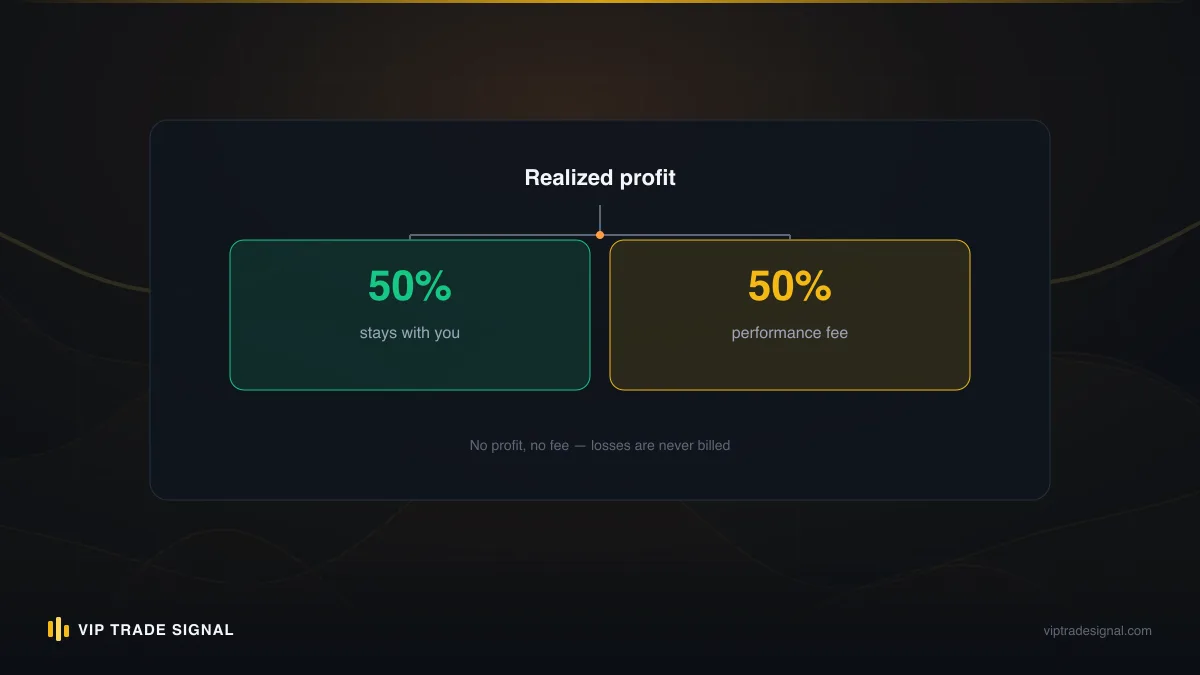
Fee mechanics: pass on clarity, honestly high on price. Flat 50% of realised profit, with a $200 minimum advance to start. You can compute any scenario on a napkin: $700 of closed profit means $350 to us, $350 stays in your account; a losing month means no performance fee accrues. And yes, 50% is the top of the industry range, where most managers of decent size charge 20-35%. Ours is priced where it is because minimums are low, everything is pay-as-you-go, and there are no management fees on assets. But if you're bringing serious size, a lower percentage elsewhere may genuinely suit you better, and we'd rather say that than have you discover it resentfully.
Exit path: pass. Change the investor password whenever you want; the engagement is over at that moment. We settle fees on closed trades, hand over notes on anything still open, and you were never unable to withdraw at any point, because the money never stopped being at your broker.
Entity and humans: our weakest check, said plainly. We're a small desk, not an FCA-regulated asset manager, and we say so everywhere: not a licensed advisor, nothing personalised advice. Who we are and how the operation runs is on the about page, but we won't pretend a small firm's paper trail matches a regulated fund's, and if licensed-and-audited is your bar (a completely reasonable bar) we are not your firm.
Communication: pass, with a confession. Trade log always live, written summaries on a fixed cadence, loss weeks reported in the same format as winning ones. The confession: like everyone, we find the losing-week email slower to write. It goes out anyway. That's the discipline the check demands.
Pressure: pass. No deposit deadlines, no expiring discounts, no minimum-raising. If you tell us you want two weeks to verify everything in this article, our honest reaction is that you're exactly the client this structure was built for.
Five clear passes, one pass-with-caveat on price, one acknowledged weakness on regulatory heft. That's our scorecard. Hold every other manager to the same grid and make them fill it in.
Walk-away rules: when to refuse regardless of everything else
The seven checks are a scoring system, and most real-world decisions are weighed on balance. But a few findings aren't weighed. They end the conversation on their own, no matter how well everything else scored, because each one is either the scam itself or a guarantee of eventual grief.
Walk away, immediately and without negotiating, if any of these appears:
- Money to the manager. Any request to send funds anywhere other than your own account at an independently verified broker. This is the scam. There is no benign version.
- Guaranteed returns. "Guaranteed 10% monthly", "no-loss strategy", "risk-free". Markets do not offer guaranteed returns to anyone; a person promising them is lying about the single most fundamental fact of the business, and someone who lies about that will not be truthful about your balance.
- A fee to withdraw your own money. Taxes, clearance, processing, unlocking: any charge invented between you and your own funds. Real brokers charge, at most, small published transfer costs. Everything else is the exit toll, and paying it buys you another toll.
- Resistance to read-only access. A manager who won't let you watch your own account trade at broker level is hiding either the losses, the strategy's true risk, or the fact that no trading exists. All three are disqualifying, so the distinction doesn't matter.
- Credential requests beyond trading access. Anyone asking for your master password, broker portal login, email access, or identity documents beyond what a normal contract needs is building toward account takeover, not account management.
- A cloned or unverifiable regulatory identity. If the licence number doesn't match on the regulator's own site, you're not looking at a weak firm. You're looking at a costume.
And one softer rule that has saved more people than any registry check: if you notice you're hoping the manager is legit, if the returns pitched are exciting enough that you can feel yourself wanting the checks to pass, slow down by a week. Excitement is the operating environment of every scam ever run, and the fraudulent version of this industry is engineered to produce exactly that feeling at exactly the moment verification matters most. The maths of what you can actually afford to risk is sobering on purpose; if you haven't run your own numbers lately, ten minutes with a margin and risk calculation before any conversation with any manager will anchor you better than any sales call can unanchor you.
Where this leaves you
So, is forex account management legit? Wrong question, and by now you can see why. The industry contains real desks doing honest, risky, sometimes-losing work for a defensible fee, and it contains an enormous parasite economy wearing the same vocabulary. The word "legit" belongs to specific firms that earn it, one verifiable check at a time.
Your move is a sequence, and it's shorter than it looks. Ask where the money sits, and if the answer isn't "your name, your broker, your master password", stop. Demand the track record with the losses in it, and ask about the worst month. Compute the fees yourself on a napkin, including the losing-quarter case. Rehearse the exit before the entrance. Look up the entity, the humans, and any licence number at the source. Watch how they report red weeks. And count every ounce of urgency in the sales process as evidence against them.
An hour of this filters out the overwhelming majority of what's out there. What survives is a short list of small, slightly boring operations that will tell you, unprompted, that losses are part of the deal and the principal is at risk. That boringness is what legitimacy looks like from the outside. If our own version of it (your account, your broker, 50% of realised profit and not a cent otherwise) fits what you're after, the details are on the service page. And if it doesn't, run whoever you do choose through all seven checks anyway.
Danny would have caught his manager on five of them. Inside twenty minutes. Be the person who takes the twenty minutes.