It usually happens at night. A trader we'll call Dan is long two lots of EUR/USD from 1.0980, the pair has dropped 140 pips against him, and his floating loss reads minus $2,800 on a $9,000 account. He can't close it, because closing makes the loss real. He can't add to it, because he's already oversized. So past midnight, half-panicked and half-relieved to have found a third option, he opens a sell for exactly two lots at 1.0840.
And breathes out. The number stops moving. He now holds a locked position, the forex trap this whole article is about, though the word he'd use tonight is hedge. Whatever EUR/USD does, his floating P/L is pinned at minus $2,800 forever, or so it feels. He goes to bed telling himself he'll sort it out at the weekend, when he's calm, when he's had time to think.
That trade is what the industry calls a locked position, and if you've searched for locked positions forex at 1am with a red number staring back at you, you already know why people do it. What most traders don't know, because nobody selling them the idea ever says it, is that the lock doesn't pause the problem. It preserves the problem, in full, indefinitely, while a small meter runs in the background charging you for storage. We see locked accounts constantly in drawdown intakes, some of them locked for over a year. This article is everything we tell those traders in the first call.
What a locked position in forex actually is
Strip the mystique off and a lock is simple: you hold a buy and a sell on the same instrument, in the same account, at the same volume. Long 1.00 lot EUR/USD, short 1.00 lot EUR/USD. Some platforms and forums call it a hedge, a perfect hedge, a same-lot hedge, or "boxing" a position. MT4 and MT5 in hedging mode will happily hold both sides at once and show you two open tickets.
The mechanics are worth spelling out because they're the whole story. Once both sides are open at equal size, every pip the market moves adds to one ticket and subtracts the identical amount from the other. Your combined floating P/L becomes a fixed number. If you locked 140 pips underwater on two lots, you are down $2,800 plus the spread you paid to open the second position, and that figure will not change whether EUR/USD goes to 1.15 or to parity.
Notice what that means. You have no market exposure at all. Zero. A locked position is economically identical to having closed the losing trade and banked the loss, with three differences: the loss doesn't appear in your closed-trade history yet, your margin is still tied up (partially or fully, depending on the broker's hedged-margin rules), and you're now paying holding costs on two positions instead of none.
That first difference is the only reason locks exist. The other two are pure cost. Which tells you something uncomfortable: the product being purchased, when a trader locks, is not protection. It's the right to not look at a realised loss yet. That's a psychological product, not a financial one, and it's one of the more expensive psychological products in retail forex.
There's a version of hedging that does make financial sense, to be clear. Hedging a EUR/USD long with a correlated short elsewhere, hedging a portfolio's dollar exposure, hedging over a news event you can't hold naked exposure through. Those are partial, deliberate, and temporary. The same-lot lock on the same pair is a different animal. It's a full stop dressed up as a strategy.
Why traders lock: panic, hope, and prop-firm rules
Nobody plans a lock. In the dozens of locked accounts we've reviewed, we have never once seen a trading plan that said "if the position moves 150 pips against me, I will hedge at equal size and reassess." The lock is almost always improvised under stress, and it comes from one of three places.
The first is panic with a veto on loss-taking. The trader knows, at some level, that the position should be closed. But closing converts a floating loss into a realised one, and realised losses trigger everything humans hate: the admission of being wrong, the shrinking account statement, sometimes an awkward conversation with a partner who was told this was going well. The lock offers a loophole. The pain stops growing and nothing has to be admitted. It is, in the moment, genuinely soothing. So is putting an unopened credit card bill in a drawer.
The second is hope with a schedule attached. This trader locks deliberately, with a story: "I'll hold the lock through this dollar strength, then remove the short when the reversal starts, and my long rides the recovery." It sounds like a plan. It's actually two predictions stacked on top of each other, and we'll get to why it almost never survives contact with a live chart.
The third is structural, and it's newer: prop firm and challenge-account rules. Funded traders live under daily-loss and max-drawdown limits, and some discover that a lock freezes their floating drawdown right below the breach line. Down 4.8% with a 5% daily limit? Lock it, survive the day, fight tomorrow. As a one-day survival move under explicit rules, this is at least coherent. The trouble is the lock rarely gets removed tomorrow, because tomorrow the same fear applies, and the funded account limps along frozen until the trader stops logging in.
There's a quieter fourth route worth naming: inheritance. The trader read about hedging strategies on a forum, saw the word used the way institutions use it, and assumed a same-lot hedge was what professionals do when a trade goes wrong. It isn't. A bank hedging exposure is offsetting one book against another for a business reason, with the cost of the hedge priced and approved. A retail trader boxing a loser is buying time with borrowed money and calling it strategy because the button says "hedge" instead of "postpone".
What all three, or four, have in common is that the lock was placed to serve an emotion or a rule, not a market view. That matters later, because a position opened without a market view can't be closed by one either. There's no thesis to be proven wrong. There's just a red number and a drawer.
The frozen loss: what locking actually preserves
Here's the reframe that unlocks most of the traders we talk to, sometimes in a single conversation. A lock does not protect your account. It protects your loss.
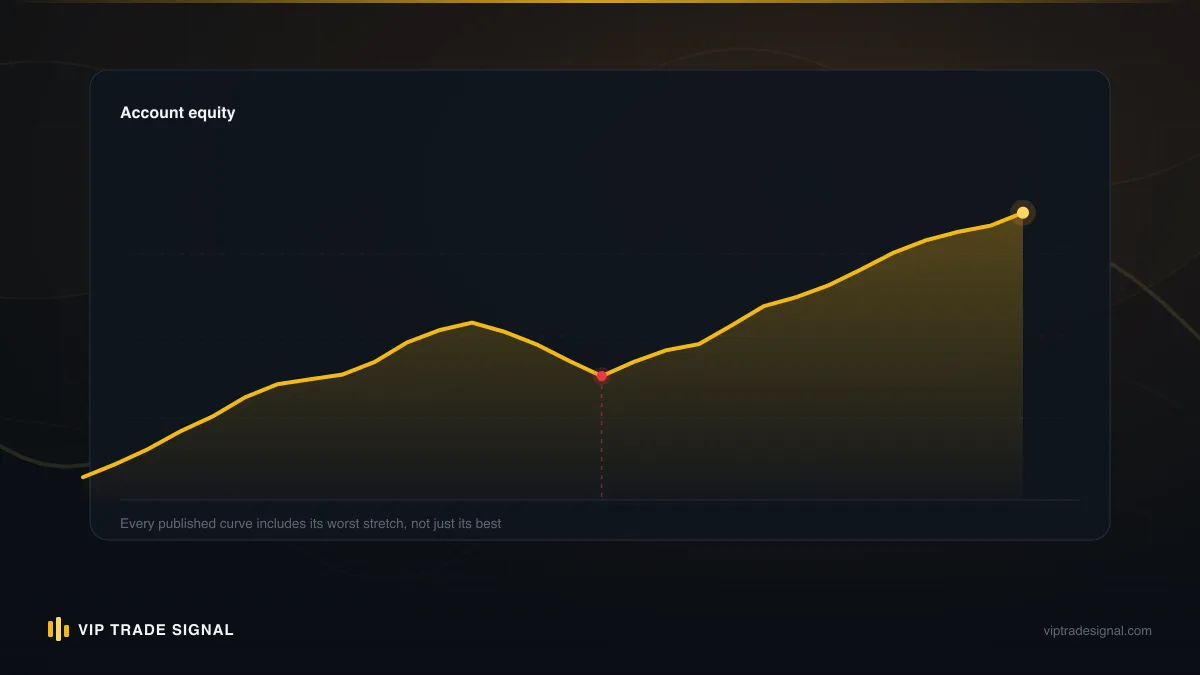
Think about what "the loss can't get worse" really purchases. Before the lock, Dan's two-lot long had two possible futures: EUR/USD recovers and the loss shrinks, or it falls further and the loss grows. Painful, but alive. After the lock, the position has one future: minus $2,800, minus growing costs, until Dan makes another decision. He has traded away the upside of his own trade to eliminate its downside, at the exact moment the downside was the thing he'd already absorbed.
Run it as a comparison, because the arithmetic is blunt:
| Close the trade | Lock the trade | |
|---|---|---|
| Loss today | −$2,800, realised | −$2,800, floating |
| Loss in three months | −$2,800 | −$2,800 minus swap and spread |
| Free margin | Fully released | Partially or fully tied up |
| Can profit from a recovery | Yes, with any new trade | Not until unlocked, and unlocking re-exposes you |
| Decision still pending | No | Yes, every single day |
The only column where the lock wins is "loss realised today: no". Everything else is worse, and the last row is the killer. A closed loss is finished. It costs nothing further and demands nothing further. A locked loss is a decision you have to re-make every day you log in, and re-deciding costs willpower even when you decide nothing. Traders with a locked position trade worse on everything else in the account. We've watched it repeatedly: the lock sits there like a toothache, and revenge trades grow around it.
A lock doesn't protect your account. It protects your loss, and charges rent for the service.
And to say the quiet part out loud, because honesty costs us nothing here: sometimes closing the trade would have been the wrong call too, and the pair would have recovered. Losses and bad luck are normal in leveraged trading; this market takes money from most retail participants over time and nobody, including us, can promise otherwise. The argument against locking isn't that closing always wins. It's that the lock is identical to closing in every financial respect, except it costs more and postpones the accounting.
The meter keeps running: swap, spread and the price of frozen
If a lock were free, you could almost defend it as an expensive comfort blanket. It is not free. Three separate meters run from the moment the second position opens.
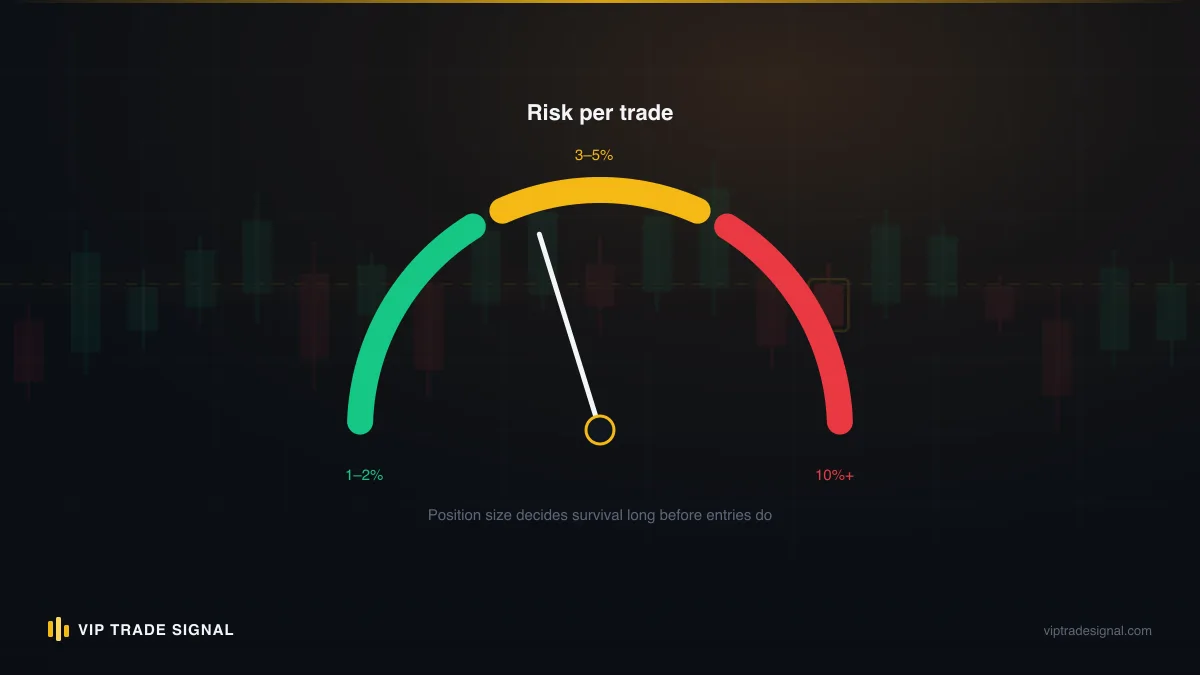
Swap, twice, nightly. Every position held past rollover pays or receives swap, and here's the part that surprises people: on most pairs at most brokers, the long swap and the short swap do not cancel. They're both negative, or one is mildly positive and the other heavily negative, because the broker's financing spread sits inside both quotes. Take a plausible retail example: long EUR/USD paying $7 a night per lot, short side paying $2, on a two-lot lock. That's $18 a night, roughly $6 charged on Wednesday's triple rollover included, call it $390 a month. On Dan's $9,000 account, the lock burns about 4% of the account per quarter for the privilege of holding a number still. Exotic pairs are far worse; we've seen locked USD/TRY positions where the swap alone would have consumed the entire original loss inside a year. Swap-free Islamic accounts dodge the nightly charge, but most brokers convert long-held positions to an admin fee that lands in the same place.
Spread, twice, at minimum. You paid the spread opening the original trade. You paid it again opening the hedge. You will pay it a third and fourth time if you ever unlock and re-enter. On two lots of EUR/USD at a 1-pip all-in cost, that's $80 of round-trip friction before anything else happens, and on gold or exotics it's multiples of that.
Opportunity cost, which is the big one. Margin held against the lock (brokers vary: some charge nothing on perfectly hedged volume, many charge margin on the larger side, a few on both) is margin that can't work anywhere else. But even where the margin is technically free, the mental capital isn't, and neither is the account's purpose. An account exists to take positions. A locked account has taken its position: flat, forever, at a fee. Six months of a frozen $2,800 loss isn't a $2,800 problem any more. It's $2,800 plus maybe $2,000 of swap plus every setup you couldn't or wouldn't take while the lock squatted on the account.
There's a fourth cost that never shows on a statement: the account stops teaching you anything. A live position generates feedback; you're wrong or right, you adjust, you learn something about your sizing or your patience. A locked position generates nothing. Six months of a lock is six months of not becoming a better trader, at the exact stage, post-blowout, when the lessons are most available. Ask any trader what their worst realised loss taught them and you'll get a speech. Ask what their longest lock taught them and you'll get a shrug.
A rough rule we give people: estimate your total nightly swap on the locked pair, multiply by 90, and ask whether you'd pay that figure today, in cash, to avoid pressing close. Most people, seeing the number written down, would not. Then run it once more with 365 as the multiplier, because the average lock we've inherited was closer to a year old than a quarter.
Why "I'll unlock when the market turns" almost never happens
Every locked trader has the same exit plan, and it's worth taking seriously enough to demolish properly. The plan: hold both sides, wait for the market to bottom (or top), then remove the winning hedge and let the original position ride the reversal back to breakeven.
Look at what this actually requires. You must call the turn. Not roughly, precisely, because the moment you remove one side you are fully exposed again at double the emotional stakes. Call it early and the market keeps falling: now your short is gone, your long is bleeding again, and you've reopened the exact wound the lock was meant to close, except from a deeper level. Call it late and you've given back a chunk of the hedge's gains waiting for confirmation. There is no comfortable moment.
Now remember who is making this call. The same trader who couldn't close a losing position at 140 pips down is now assigned the single hardest task in trading, picking a reversal, with the added pressure that being wrong re-releases a loss they've already proven they can't stomach. It's like asking someone who's afraid of the diving board to do the rescue swimming.
So what actually happens, in account after account we've reviewed, is nothing. The trader watches. The market turns, and they wait for confirmation. It turns back, and they congratulate themselves for waiting. Weeks pass. The lock becomes furniture. Picture the late-stage version, a composite of the intakes we see: a GBP/JPY lock well past its first birthday, a trader who can no longer remember the original thesis for the long but can quote the frozen loss to the dollar, swap payments that have quietly doubled the damage, and no new trade placed in months. That account isn't trading any more. It's a monument.
There's a psychological reason it goes this way, and it's the same one that created the lock. Unlocking is just loss realisation with extra steps. Whichever side you close first, you crystallise an outcome, and crystallising outcomes is the exact act the lock was built to avoid. The market turning doesn't change that. Nothing the chart does can unlock a position that was locked for emotional reasons; only the trader changes, or someone changes it for them.
If you recognise this pattern in yourself, it's worth reading how losing streaks warp decision-making more generally; we wrote about that spiral in our piece on surviving losing streaks, and the lock is basically a losing streak compressed into a single frozen frame.
How to unlock locked positions in forex: the three real options
Enough diagnosis. If you're stuck in a hedge right now, there are exactly three honest ways out, plus a family of hybrids we'll cover afterwards. Every "secret unlocking technique" sold on YouTube is one of these three wearing a costume.
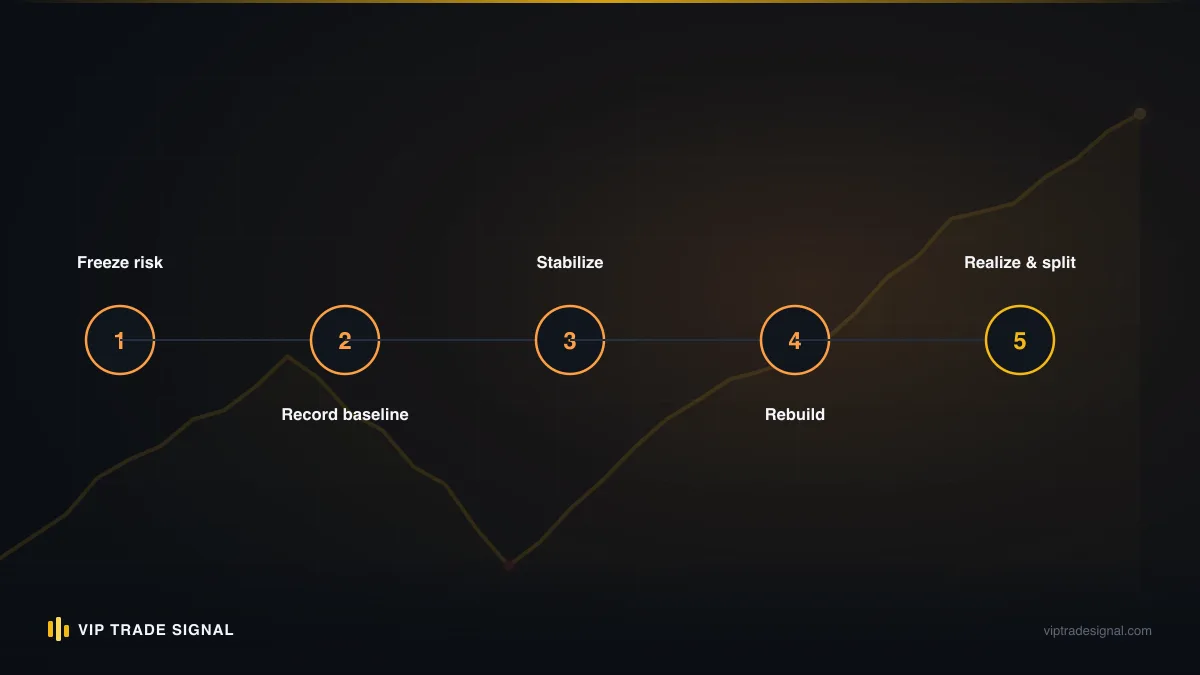
Option one: close both sides. Take the loss. Done. This is the adult in the room and, in maybe seven cases out of ten that we see, the right call. Closing both tickets simultaneously realises the frozen loss at its current size, releases all margin, stops the swap meter that night, and returns the account to a state where it can actually do its job. The loss doesn't get bigger or smaller in the act; it just becomes finished. If the frozen figure would end the account's viability, that's real and worth planning around, but note that it was already true while floating. The account balance you see with a lock on is a fiction; equity is the truth, and closing merely makes the two numbers agree.
Option two: staged exit, reducing both sides in steps. Close 0.5 lots of each side today, another 0.5 next week, and so on. Financially this is identical to option one spread over time, plus extra spread and extra swap for the tail. Its genuine value is psychological: some traders simply cannot press the full close, and a staged exit gets the account free in a month instead of never. We use this in rescue work more for the trader's sake than the maths. If staging is what gets it done, stage it, and write the schedule down before you start so it doesn't quietly stall after step one.
Option three: directional release, closing one side only. Remove the hedge, keep the original position (or the reverse), and go back to being exposed. This is the only option with upside, and therefore the only one that can also make things worse. It is defensible under one condition and one condition only: you have a current, written, independent reason to hold that direction at today's price, sized within your normal risk rules, with a stop. Not "it has to turn eventually". A real setup, one you would take in a clean account with fresh money. The test we give traders is brutal but clarifying: if this account were flat right now, would you open this exact position, at this size, here? If yes, releasing that side is just taking a trade you believe in. If no, and it's almost always no, then you're not unlocking a position, you're re-entering a trade you've already watched fail, and option one is waiting patiently.
A fourth option gets marketed heavily, so let's name it: adding new positions around the lock to "trade your way out", often with a grid or averaging structure layered on top. This isn't unlocking. It's opening fresh risk in an account already carrying a frozen loss, and it's how a $2,800 problem becomes a margin call. The related question of how close that call actually is deserves numbers, and you can run your own through our margin call calculator walkthrough before believing any recovery scheme that involves more volume.
Unlock math: a worked example
Abstractions don't close positions, so let's put real numbers on Dan and walk each path. The setup: $9,000 balance, long 2.00 lots EUR/USD from 1.0980, short 2.00 lots from 1.0840. Frozen loss $2,800. Equity $6,200. Combined swap on the lock, minus $18 a night, about $390 a month. He's been locked for two months already, so roughly $780 of swap is gone; the loss-plus-costs figure is really $3,580 and climbing.
Path one, close everything today. Realised loss $2,800, plus the $780 already burnt. Equity and balance meet at about $6,200. The meter stops. From here, a sensible rebuild risking 1% per trade gives him $62 of risk per position, and reaching back to $9,000 requires roughly a 45% gain on remaining equity, which at 1% risk and a modest positive expectancy is a long, boring, achievable year. Boring is the point. Every month he doesn't close instead subtracts $390 from that starting line before the rebuild even begins.
Path two, staged over four weeks. Same destination, roughly $290 of extra swap and about $40 of extra spread for the slower road, total damage near $3,130 realised by the end of the month. Worth it if, and only if, it's the difference between acting and not acting.
Path three, release the long. Suppose Dan believes, on actual analysis, that 1.0840 is support and the pair recovers. He closes the short, banking that side's outcome within the frozen total, and holds the long from 1.0980 with the market at 1.0840. Now every pip up earns $20 on two lots and every pip down loses $20, with the frozen loss reactivated as a live one. If he's right and price reaches 1.0910, he's halved the loss. If he's wrong and price drops another 70 pips, the loss grows to $4,200 and the panic that built the lock returns with reinforcements. The sober version of this path releases the side and cuts size: close the short, reduce the long to 0.5 lots, place a stop 40 pips below at a further $200 of risk. Small enough to be wrong safely. The distance between that structured risk and simply hoping is roughly the distance between trading and gambling.
The path most people take: nothing. Twelve more months of lock costs about $4,700 in swap alone, more than the frozen loss itself, and delivers Dan to next year with equity near $1,500 and a decision that has grown teeth. Doing nothing is a path. It's the most expensive one on the menu, and it's the default.
One more honest wrinkle: brokers with netting accounts (common outside MT4/MT5 hedging mode, and standard on many exchange-style platforms) won't let this situation exist; the second order simply closes the first. Traders sometimes call that a limitation. It's closer to a safety feature.
Partial unlocking and staged exits, done properly
Between "close it all" and "release a side" sits a middle territory that, handled with discipline, suits a lot of stuck accounts. The principle: asymmetric reduction, shrinking the two sides at different speeds so exposure returns gradually instead of all at once.
Say the lock is 2.00 lots each way. Close 1.00 lot of the hedge and 0.5 of the original, and you're now net 0.5 lots in the original direction, a quarter of the initial exposure, with three-quarters of the frozen loss realised. The account is mostly free, the swap bill has halved, and the remaining directional stake is small enough to run with a stop like a normal trade. If the recovery thesis is right, it participates. If it's wrong, it's a 0.5-lot loser, survivable and ordinary.
Rules that make partial unlocking work rather than becoming a new form of stalling:
- Write the full schedule before touching anything. Dates, sizes, prices if conditional. A staged exit without a written schedule is just a slower way of doing nothing.
- Every remaining net position gets a stop the moment it exists. The original disaster happened because a position ran without one. Don't rebuild the crime scene.
- Never increase either side. The direction of travel is down, always. The first "small top-up" is the lock reasserting itself.
- Cap the calendar. Whatever remains after, say, 30 days gets closed at market, no debate. You set this rule on day one precisely because day-30 you will want to negotiate.
- Total risk on any released exposure fits your normal per-trade limit. If 1% of current equity is $62, the released stake risks $62 to its stop, not whatever the frozen history suggests it's owed.
The failure mode to respect: partial unlocking hands you back exposure during the exact weeks you're most emotionally raw about this pair. Plenty of traders release a quarter position, watch it tick against them for two days, and re-lock. If you've re-locked once already, stop treating this as a technical problem. Close it all, or hand the decision to someone without your scar tissue.
It's also worth being clear about where the real cliff is while any of this is in progress. A locked account with thin equity can still get stopped out if the broker margins the hedge and swap keeps draining equity toward the stop-out level; the mechanics of that trapdoor are laid out in margin call vs stop out, and a locked trader flirting with 50% margin level should read it tonight, not this weekend.
When locking is genuinely the right call
Having spent three thousand words against the lock, fairness demands the other side, because there are a few situations where a temporary same-size hedge is a legitimate tool rather than a drawer for bills.
Over a binary event you cannot exit cleanly. Illiquid pair, huge position, minutes before a rate decision, closing would mean crossing a spread that's blown out to silly widths. Locking through the event and unwinding in normal liquidity afterwards can genuinely beat puking the position into a 15-pip spread. The defining feature: the unlock is scheduled before the lock is placed, and it's hours away, not "when things improve".
Prop-firm daily-limit management, used honestly. Freezing drawdown at 4.8% to avoid breaching a 5% daily rule, with the full intention of closing everything at tomorrow's open and taking the loss inside a fresh daily allowance, is rule-arbitrage rather than denial. We'd rather the position hadn't got there, but as a 24-hour instrument it works. As a lifestyle it fails exactly like every other lock.
A deliberate pause during handover. When an account is being passed to a professional for assessment, briefly locking can hold the state still for a day or two while decisions get made properly instead of at 2am. We occasionally recommend it ourselves for that narrow purpose.
Regulatory reality check. US-regulated brokers ban hedging in the same account outright under FIFO and no-hedging rules (NFA rules, in force since 2009), which means American readers literally cannot construct this trap domestically. Make of it what you will that the world's strictest retail regulator looked at same-pair hedging and concluded clients were better off without it.
Spot the shared shape of the legitimate cases: the lock is short, scheduled, and placed in service of a plan that exists outside the lock. Hours or days, with a named unwind trigger. The moment a lock's horizon is "until the market turns" or "until I feel ready", it has crossed from tool to symptom. A useful tripwire to install right now, while you're calm: any hedge still open after five trading days gets fully closed, both sides, at market. Write it in your plan today and the 2am version of you inherits a rule instead of a choice.
Getting help with a locked account
Some locks are past self-rescue, and the honest markers are these: the lock is months old; the swap bill rivals the original loss; there have been two or more failed unlock attempts; or the account holder has stopped logging in at all. At that point the obstacle isn't knowledge. You've likely understood everything in this article for a while. The obstacle is that the person who owns the loss can't be the person who realises it, for the same reason surgeons don't operate on family.
A third party changes that, sometimes embarrassingly fast. Someone with no memory of 1.0980, looking at the account as it stands today, sees a simple question: is this equity better deployed frozen or free? They'll close in an afternoon what the owner circled for a year. That third party can be a trading friend with permission to be blunt. It doesn't have to be a paid service, and for a small account it probably shouldn't be.
For larger frozen accounts, this is the work our desk does. Our drawdown management service takes on accounts floating roughly $5k to $10k down, locked ones included, and the arrangement is deliberately unexciting: we trade the recovery on your own MT4 or MT5 account, you keep the master password and full withdrawal control throughout, and we charge a flat 50% of whatever profit is actually recovered above a baseline we both record at the start. No recovery, no fee. And no guarantees either, ever; anyone promising to trade a locked account back to breakeven is telling you about their marketing, not their edge. Fifty percent is a high fee, we'll say so ourselves, and it's priced that way because there's no upfront charge and the minimums are low; you pay only from money that actually comes back. If the frozen loss is smaller than that, honestly, close the lock yourself this week and keep the fee. If you want a second pair of eyes before deciding anything, ask us and we'll tell you plainly whether an account is worth professional recovery or better off simply unlocked and rebuilt by its owner.
What we won't do, and what you should run from anyone offering: martingale the account out of the hole, stack grids around the lock, or quote a recovery timeline as if the market had agreed to it.
The question to ask before you log off
Strip everything above down to one test, and it's this. Log in, look at the locked pair, and ask: if this account were flat and this cash were fresh, would I open these positions today, at these prices, at this size?
You already know the answer. Nobody, ever, has looked at a flat account and chosen to simultaneously buy and sell two lots of the same pair to guarantee themselves a $2,800 deficit plus $18 a night in fees. The position you're holding is one you would never open, which means the only thing holding it open is the history attached to it. Markets don't price history. The chart owes your entry nothing and remembers nothing, and every trader on the other side of your pair is trading today's price, not your average.
So here's the homework, and it's short. Tonight: write down the frozen loss, the nightly swap times ninety, and the date the lock was placed. Look at the three numbers together. This week: pick one of the three unlocks, on paper, with sizes and dates, and show it to one person who'll hold you to it. If you can't pick, the answer is option one and you know it. And if the account is big enough and frozen enough that none of this feels possible, get help, ours or anyone competent's, before another quarter of swap makes the decision heavier.
The loss already happened. It happened at 1.0840, weeks ago. The only live question is how much rent you'll pay before the paperwork catches up.