Somewhere right now, a trader is wiring $10,000 to a stranger on Telegram because the stranger posted a screenshot. That is not account management. That is a donation.
Real account management — the kind that survives a regulator's questions and a client's bad month — is a boring, documented pipeline. Money never moves to the manager. Access is granted in a specific, limited way. Trades land in an account the client can watch live. Fees get calculated from numbers both sides can verify. And when it ends, it ends with two clicks, not a hostage negotiation.
So how does forex account management work when it's done properly? That's this article. We're going to follow one hypothetical client — call her Dana, a nurse with a $5,000 MT5 account — through the entire lifecycle, and we're going to follow one single gold trade from the manager's screen to her monthly statement. Every stage, at the level of actual screens and actual documents. By the end you should be able to sit across from any manager, ask them to walk you through their version of this pipeline, and know within ten minutes whether they're running a business or a bucket shop.
How does forex account management work? The lifecycle at a glance
Before we zoom in, here's the whole thing from altitude. A properly run managed account moves through eight stages, and the order matters.
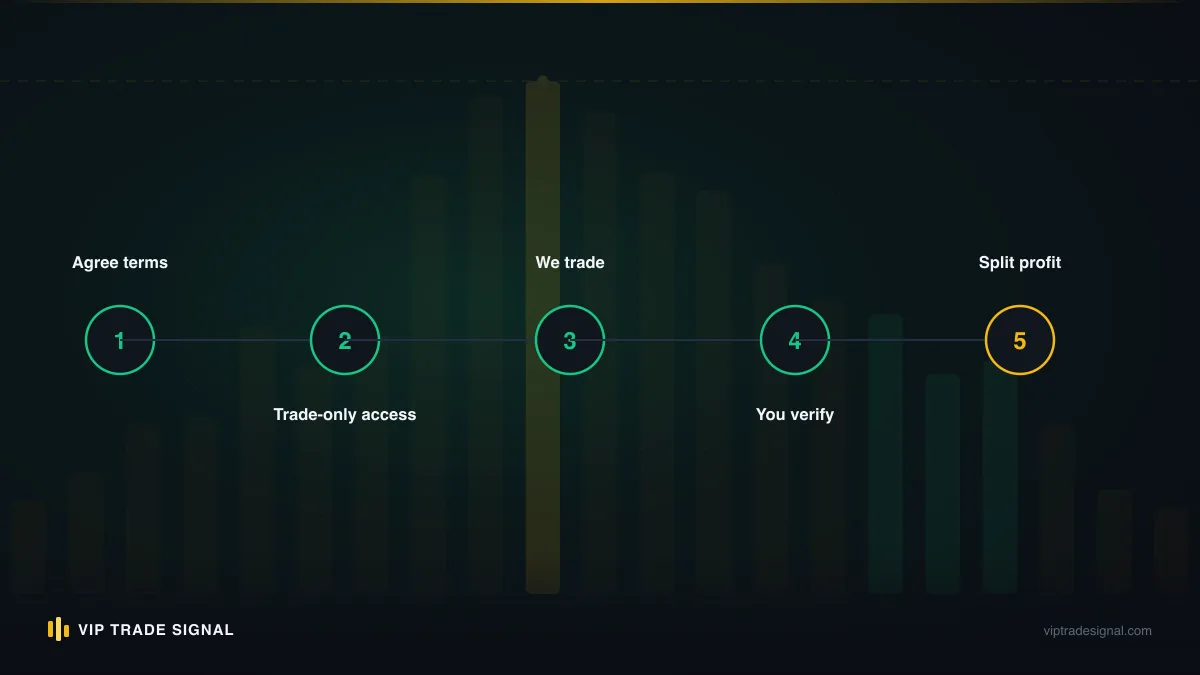
- Agreement — both sides sign something that defines fees, risk limits, and how either party exits.
- Access grant — the client gives the manager trading permission on the client's own account. Not the money. The permission.
- Execution — the manager trades. Every position appears in the client's account in real time.
- Monitoring — the client watches whenever she likes, from her own phone, with credentials the manager cannot change.
- Month end — the broker's statement, not the manager's spreadsheet, establishes what actually happened.
- Fee settlement — the manager gets paid from realized profit, by a method the agreement spelled out in advance.
- Withdrawals — the client, and only the client, moves money out.
- Exit — either side can end it, and ending it takes minutes.
Notice something about that list. At no point does the client's money sit in an account the manager controls. If a service's version of this pipeline starts with "send funds to our wallet," you can stop reading their pitch. There is no stage nine where that ends well.
The rest of this piece takes each stage in turn, with Dana as our guinea pig. Her details are invented — she's an illustration, not a testimonial — but the mechanics are exactly what happens on our desk and on any honest desk we know of.
Stage 1: agreement and what you're actually signing
Dana finds a management service, reads the track record, asks her questions, and decides to go ahead. The first real artefact of the relationship is the agreement — sometimes called an LPOA, a limited power of attorney, though plenty of services use a plainer management agreement that does the same job.
Read the thing. Actually read it. It's usually four to eight pages and it should answer five questions without ambiguity:
- What is the fee, exactly? A percentage of profit, a percentage of assets, a flat monthly charge, or some blend. Our own model is a flat 50% of realized profit and nothing else — no management fee, no charge in losing months — which sits at the high end of the industry precisely because there's no fee when we don't perform. A fund charging 2-and-20 on millions can afford to look cheaper per unit. On a $5,000 account, percentage-of-assets fees are pocket change for the manager and a rounding error of motivation.
- What counts as profit? Realized only, or floating too? This one sentence decides whether you can be billed on open positions that later reverse. Realized-only is the honest answer. If the agreement is vague here, that vagueness will cost you money in month three.
- Is there a high-water mark? Meaning: if the account drops from $5,000 to $4,600 and climbs back to $4,900, does the manager charge on that $300 of recovery? Under a high-water mark, no — fees only apply to profit above the previous peak. Any performance-fee agreement without one is quietly double-charging you for volatility.
- What are the risk limits? Maximum risk per trade, maximum open exposure, and ideally a drawdown level at which trading pauses and both sides talk. "The manager will exercise professional discretion" is not a risk limit. It's a shrug in legal clothing.
- How does either side leave? The answer should be measured in hours, not months. Lock-in periods on a retail managed account exist for one reason, and it isn't your benefit.
The agreement should also say, in plain words, that trading is high risk, that losses are normal, and that no return is guaranteed. Strange as it sounds, the presence of that language is a green flag. Managers who guarantee returns are either lying or planning to trade so timidly the guarantee never gets tested. Usually lying.
Dana signs electronically. She keeps a copy. Total elapsed time: an evening. Money moved so far: zero.
Stage 2: access — how trade-only permission is granted
Here's the stage where most people's mental model is wrong, and where every scam depends on the wrongness.
Dana does not send her $5,000 anywhere. The money is already in her own brokerage account, opened in her own name, with her own verified identity, at a broker she chose. What she grants the manager is access — and specifically a limited kind of it.
MT4 and MT5, the platforms nearly all retail management runs on, have two passwords per account. The master password logs in with full rights: trade, change settings, request withdrawals through the broker's portal. The investor password is read-only — anyone holding it can watch the account but touch nothing. The management setups you'll actually meet arrange these credentials in one of a few ways:
| Access model | Manager can trade | Manager can withdraw | Client can watch live | Verdict |
|---|---|---|---|---|
| Manager gets investor password only | No | No | Yes | Useless for management — this is for auditors |
| Client shares master password | Yes | No (broker portal needs separate login) | Yes | Workable, but change the password the day it ends |
| Broker-level LPOA / trade-only designation | Yes | No, blocked by broker | Yes | The cleanest version |
| PAMM/MAM pooled structure | Yes, across pooled funds | Per PAMM rules | Usually a dashboard, not raw MT5 | Fine at regulated brokers, opaque at bad ones |
| "Send funds to our account" | N/A — it's their account now | Entirely | No | Run |
The phrase you'll hear for the good versions is trade-only access: the manager can open and close positions but cannot move money off the account, because withdrawals at any real broker go through the client's separate broker-portal login, her registered bank account, and her verified identity. Some brokers formalize this with a designated trade-only role or a signed LPOA lodged with the broker itself, which is tidier still.
On our desk, the rule is simpler than the table: we trade your MT4 or MT5 account, and you keep the master password and the withdrawals. If a manager instead insists that managing your account requires you to deposit with them, or demands your broker-portal login "to make things easier," the correct response is a polite no and a fast exit. Withdrawal control is the whole ballgame. Everything else in this article is decoration by comparison.
Dana's setup takes about twenty minutes: she confirms her broker allows third-party management (most do; the details vary, and it's the sort of thing worth checking in an FAQ or a support chat before signing anything), grants access per the agreement, and sends the manager the account number and server. Trading can begin the next session.
Stage 3: inside a trade — from the manager's analysis to Dana's account
Now the part everyone imagines and almost nobody has actually watched. Let's put one trade under the microscope.
It's a Tuesday. The desk's bias on gold has been long for two weeks — this is a gold example because gold is what we trade, but the mechanics are identical on EUR/USD or anything else. Price has pulled back to a level the desk has marked at 3,318, prior resistance now acting as support, with the London session showing buyers stepping in on each dip. The manager decides the setup is worth taking.
First decision: entry. Say 3,320, on a limit order rather than chasing the market. Second decision: stop. Below the level and below the session low, at 3,306 — 14 dollars of room, which on gold is a deliberate choice, not an accident. Third: target, at 3,348, giving a shade under 2:1 reward to risk.
Fourth decision, and the one that separates managers from gamblers: size. This is where managed execution differs from a signal you'd trade yourself. The manager isn't picking one lot size for everyone; each account gets sized to its own equity and its own agreed risk cap. Dana's agreement caps risk at 1.5% per trade. Her account holds $5,000, so the trade may risk at most $75. With a $14 stop distance and gold at roughly $1 per point per 0.01 lots, the position comes out around 0.05 lots. On a $50,000 account sitting next to hers, the identical trade would be 0.5 lots. Same idea, same levels, ten times the size — and exactly the same percentage at risk.
The manager places the order on Dana's account (or, in a MAM setup, places one master order that the software allocates proportionally across every managed account — same outcome, less clicking). Here's what Dana sees, because this is the part that still feels faintly magical to new clients: she opens MT5 on her phone and the position is just there. Pending order at 3,320, then a filled position, then a floating P/L ticking up and down with every tick of gold. Nobody sent her a screenshot. Nobody needed to. The account is hers, so the window into it is hers too.
The trade fills Tuesday evening. Wednesday it chops around, at one point floating $40 against her — which is normal, and if watching a normal pullback makes your chest tight, that's a data point about your risk settings, not the manager's competence. Thursday morning the target prints. The position closes at 3,348 for a realized gain of about $140 on Dana's account, minus a dollar or two of commission and swap. The trade is now a line in her account history that no one can edit. Remember that sentence; it's the foundation of stage five.
And to be clear-eyed about it: roughly one in three or four of these setups loses. If this trade had stopped out, Dana's account would show a realized loss of about $75 instead, equally visible, equally permanent. A month is a set of these outcomes, not a highlight reel.
Stage 4: monitoring — what you see in real time
Between trades, the relationship is mostly silence, and that's healthy. But the client's view never closes.
Dana can see, at any moment, from the MT5 app or terminal: every open position with its entry, stop, target, and floating P/L; every pending order; her balance, equity, margin and free margin; and the complete history of every closed trade with timestamps to the second. Because it's her account at her broker, none of this is mediated by the manager. There is no dashboard the manager built, no "reporting portal" that could show her one thing while the broker's records say another. The broker's data is the only data.
If your only window into your own money is a report your manager writes, you don't have a managed account. You have a newsletter with a balance on it.
How often should she look? Honestly — less than she'll want to early on. Checking every hour turns normal intraday noise into a rolling anxiety feed. Weekly is plenty once trust is established. But the ability to check at 3 a.m. is non-negotiable, and there's a specific reason: divergence between what a manager tells you and what the platform shows you is the single earliest symptom of trouble. The chatty manager whose commentary says "great week" while the account shows a 6% drawdown has told you everything, four weeks before it becomes undeniable.
What does normal look like, so you can recognize abnormal? For a discretionary desk on one instrument, something like two to four positions a week, every one carrying a stop from the moment it opens, position sizes that stay consistent as a percentage of equity, and flat periods — sometimes a full week with no trades at all, because no setup met the bar. Boring is the texture of competence here. A statement that reads like a slot machine printout, with sixty entries and sizes lurching from 0.05 to 0.8 lots, is telling you the plan left the building.
A couple of things worth watching for that beginners miss. Floating drawdown with no stops attached: if you ever see positions running without stop losses, or losing positions being added to at intervals — the classic martingale ladder — raise it that day, in writing. And frequency creep: if a manager who traded eight times a month starts trading forty, something changed, and "the market got busy" is rarely the honest version. We wrote more on reading these patterns in how to choose a forex account manager, and the short version is that the platform never lies, so make the platform your primary source and the manager's commentary the footnote.
Stage 5: month end — statements and profit calculation
The calendar flips. Now the money conversation, and the anatomy of it matters more than any other stage, because fees live here.
The source of truth is the broker statement — MT4/MT5 will generate it directly (right-click in the account history, or through the broker's portal), and it lists every closed trade, every commission, every swap charge, and the resulting balance. Crucially, the client can pull this herself without asking anyone. A manager's monthly report is a courtesy summary; the broker statement is the audit.
Let's do Dana's month with real arithmetic. She started at $5,000. Over the month the desk took eleven trades on her account: seven winners, four losers. Gross gains $612, gross losses $237, commissions and swaps $25. Realized net profit: $350. Her balance reads $5,350, and her equity matches it because nothing is floating at month end — which is itself a sign of discipline, since billing while large positions float unrealized is one of the classic soft frauds of this industry.
Three checks Dana runs, and you should too, every single month:
- Realized versus floating. Fees are due on the $350 of closed profit only. If the account also had a position floating $200 in the green, that $200 doesn't count — it isn't hers yet, and it may never be.
- High-water mark. Her previous peak was $5,000 (it's month one), so the full $350 is above the mark and billable. If instead she'd been at a $5,400 peak in a prior month and merely recovered to $5,350, the billable figure would be zero. Write your high-water mark down somewhere; a manager who "forgets" it is not forgetting in your favour.
- Statement matches invoice. The number on the fee note must be derivable from the broker statement in one line of arithmetic. If you can't reproduce it, don't pay it until you can.
Notice that a losing month makes this stage very short. Account down $180? Statement pulled, checked, filed. No fee, no invoice, nothing owed under a profit-share model. The manager eats the month. That, more than any marketing line, is what performance-only pricing means — and it's also why managers on this model are so allergic to reckless clients demanding double risk. The manager's income depends on the account surviving.
Stage 6: fee settlement mechanics
So Dana owes a fee on $350 of realized profit. At a 50% profit share — our figure, and the top of the retail range, for reasons we lay out openly — that's $175. How does it actually move?
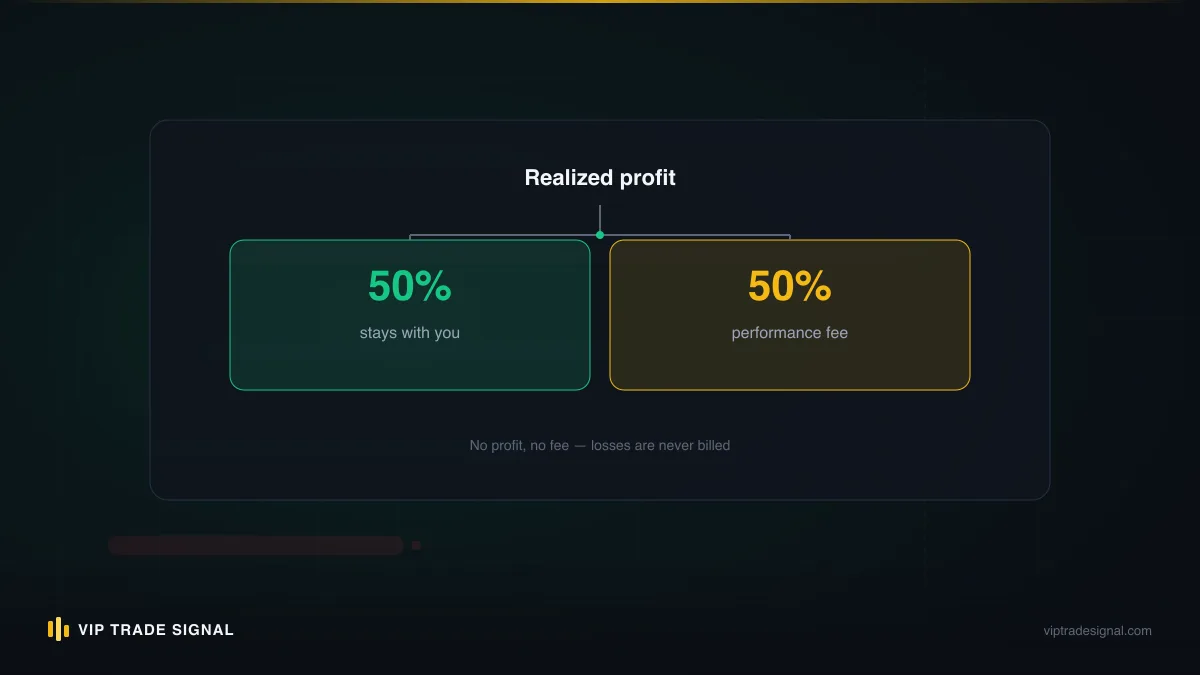
There are three mechanisms in the wild, and they are not equally safe.
Client-initiated payment. The manager issues an invoice referencing the statement; the client pays it — bank transfer, card, however the agreement says. Slightly more friction, maximum safety: the manager's hands never touch the account, and a disputed fee is a conversation, not a fait accompli. This is our model, paired with one wrinkle worth explaining honestly: a $200 minimum advance, paid up front and offset against the first profit fees. It exists because managing an account costs real hours before the first dollar of profit is realized, and it filters out the tyre-kickers who want a week of free management before vanishing. It is not a management fee — it's a deposit against future performance fees, and if the profit share earned in the early months exceeds it, it has simply pre-paid that share. The full mechanics, minimums and all, are on our account management service page.
Broker-side deduction. In PAMM and some MAM structures at regulated brokers, the platform itself calculates the split at each settlement period and credits the manager's fee automatically. Clean and tamper-resistant when the broker is reputable, because the same automation at an offshore bucket shop just means the skimming is programmatic.
Manager self-deduction from the account. The manager withdraws their fee directly. Outside of formal PAMM automation, this should worry you, because it requires the manager to have withdrawal ability — and withdrawal ability is exactly what stage two was supposed to deny them. Any setup where a human manager can pull money from your account at will has already failed the design test, regardless of how honest this month's invoice looks.
One more piece of arithmetic people avoid doing: after the $175 fee, Dana's net for the month is $175, or 3.5% on her $5,000. Is half the profit a lot? Yes. Would she have made the 7% herself? That's the only question that matters, and it deserves an honest answer rather than a flattering one. For some readers the honest answer is "eventually, yes — so learn instead," and if that's you, our piece on how to become a forex fund manager is the longer road worth reading about. Managed accounts are for the people whose honest answer is no, or whose hours are worth more elsewhere.
Stage 7: withdrawals and who initiates them
Short stage, enormous importance.
Dana wants to take $500 out — profit plus a bit, because it's her money and she doesn't need a reason. She logs into her broker portal (not MT5 — the portal, with the login the manager has never seen), requests a withdrawal to her registered bank account, and the broker processes it under the same identity checks it applied when she deposited. The manager finds out when the balance changes. That's the entire process, and every word of it is load-bearing:
- The client initiates. Always. A manager who offers to "handle" withdrawals is offering to handle your exit, which is the one thing you must own.
- Funds go to the verified owner. Real brokers return money to the account holder's own bank or card. There is no mechanism for a withdrawal to land in the manager's pocket, which is precisely why scam services avoid real brokers.
- No permission required. Dana doesn't ask the manager. Courtesy says give a heads-up — yanking half the equity while positions are open changes the margin picture and forces the manager to resize or close things — but courtesy is not consent. If an agreement requires manager approval for withdrawals, that clause alone should end the discussion.
Timing deserves one practical note. Withdrawals reduce equity, and equity is what the next trade gets sized against, so a $500 withdrawal from a $5,350 account means the manager's next position is about 9% smaller. That's fine — it's how the maths should work — but it's why the heads-up matters, and why pulling money mid-trade rather than between trades occasionally forces an early close. None of this restricts your right to withdraw. It just means the polite version of exercising that right takes one message and thirty seconds.
A good habit worth stating as a rule: withdraw profits on a schedule. Quarterly, say. An account that has paid out real money to your real bank has proven the entire pipeline end to end — agreement, access, execution, settlement, exit ramp — in a way no statement can. Scams universally discourage withdrawals ("you'll break the compounding," "there's a bonus you'd forfeit"). Real services are indifferent to them, and the good ones actively encourage that first small test withdrawal in week one, before serious trading even starts. Ten dollars out to your bank teaches you more than ten hours of due diligence.
Stage 8: ending the relationship cleanly
Everything ends. Maybe Dana's circumstances changed, maybe performance disappointed, maybe she's learned enough to trade herself. A well-designed arrangement ends like this:
She gives notice per the agreement — typically written notice, effective within days. Open positions are handled per the agreed procedure: closed at market, or managed to their stops and targets over a defined wind-down window, but no new positions after notice. Final settlement runs exactly like a month end: broker statement, realized profit above the high-water mark, one last fee if any is due. Then access is revoked — she changes her master password, or instructs the broker to cancel the LPOA, and the manager's ability to touch the account evaporates instantly. The account, the balance, and the entire trade history stay with her, because they were always hers.
Total time from decision to fully out: under a week, most of which is just letting open trades resolve. Compare that with what leaving looks like in the structures we warned about — pooled schemes with 90-day lock-ups, "processing" queues for redemption, exit fees invented at exit time. The ease of leaving is not a side detail. It's the discipline that keeps every earlier stage honest, because a manager you can fire by Friday has a permanent incentive to be worth keeping.
If you're at the other end of this pipeline — not leaving, but starting — the setup steps are laid out in how to open a managed forex account, which is effectively stages one and two of this article expanded into a checklist you can follow in an afternoon.
What breaks at each stage in bad services
Here's the same eight-stage pipeline run through a bad service, because scams aren't formless — they break the pipeline at specific, predictable joints, and knowing the joints is most of your protection.
Stage 1 breaks as a missing or meaningless agreement. No document at all, or a one-pager promising "10-15% monthly" — a number that, sustained, would outperform every fund in recorded history from a Telegram account with a Lamborghini avatar. Guaranteed returns in the agreement are not a strong version of confidence. They're the tell.
Stage 2 breaks as custody. "Deposit to our company wallet." "We only work through our partner broker" — an unlicensed shell where your "account" is a number in their database. This is the load-bearing break; every later stage of the scam depends on it, because once they hold the money, the platform, the statements, and the withdrawal button are all theirs to fabricate.
Stage 3 breaks as invisible or reckless execution. You can't watch trades live because there's no real account to watch — just weekly screenshots, which cost nothing to forge. Or the trading is real but the sizing is savage: 10% risk per trade, no stops, martingale into every loser. Big months, then one obituary.
Stage 4 breaks as the reporting-portal trick — a slick dashboard showing smooth 2% weeks, unfalsifiable because it's the only window you're given. Ask for investor-password access to a real MT4/MT5 account and watch the excuses arrive.
Stage 5 breaks as billing on floating profit, "adjusted" statements, or a high-water mark that resets whenever remembering it would cost the manager money.
Stage 6 breaks as self-service fees — deductions you notice after the fact, at rates that migrate upward from the agreed figure.
Stage 7 breaks loudest of all: the withdrawal that "needs a release fee," the "tax payment" required before funds unlock, the support inbox that goes quiet. By the time a service invents a fee you must pay in order to withdraw, the money was gone weeks ago; the fee is just a last pass of the net.
Stage 8 breaks as lock-ins and hostage exits — penalties for leaving, endless "processing," or simple disappearance.
Run any prospective service down that list before you sign. It takes twenty minutes and it filters out the overwhelming majority of the industry's garbage, because the honest pipeline is hard to fake at every stage simultaneously. A scam can forge a statement, but it can't give you trade-only access to a real broker account and forge that too.
The questions that expose the pipeline in one conversation
You now know the machinery. Here's how to compress this whole article into a fifteen-minute conversation with any manager. Ask these, in roughly this order, and listen for hesitation as much as content:
- "Where does my money sit, and in whose name?" — Only acceptable answer: your own account, your own name, a broker you choose or at least verify.
- "What access do you need, exactly?" — Trade-only. Any request for withdrawal rights or broker-portal logins ends the conversation.
- "Show me a real account's history, live, on the platform." — Investor-password access to a genuine track record, wins and losses both. Screenshots don't count. (This standard cuts both ways, which is why our own signal results sit publicly at /signals/history, red months included.)
- "What's the fee, on what base, and is there a high-water mark?" — They should answer in one breath. Fumbling the base — realized versus floating — is disqualifying, not a detail.
- "What's your maximum risk per trade on my account, and will you put it in writing?" — A number, in the agreement, or no deal.
- "Walk me through how I leave." — If the answer takes longer than a minute or contains the word "lock-up," you have your answer about everything else too.
- "What was your worst month, and what did clients see during it?" — Every real manager has one and can describe it without flinching. The manager with no bad months has no track record, no honesty, or no memory. All three are fatal.
Then run the ten-dollar test: fund modestly, let a trade or two close, pull a small withdrawal to your bank. The pipeline either works end to end or it doesn't, and no sales conversation can counterfeit a bank deposit.
Where this leaves Dana — and you
Strip away the jargon and the whole machine is three promises kept simultaneously: you hold the money, they hold the trading, the broker holds the record. Every stage we walked through — the LPOA, the investor password, the trade-only access, the high-water mark, the client-initiated withdrawal — is just engineering in service of those three promises. And every scam in this industry is an attempt to quietly collapse one of them: to hold your money for you, to keep the record themselves, to make leaving expensive.
Dana's year, if it goes the way managed accounts realistically go, will include losing months. Perhaps a quarter where the account grinds sideways and she wonders why she's paying anyone anything — then remembers she isn't, because nothing was realized above the mark. Perhaps a strong run where the 50% split stings precisely because the profits are real. Nobody can promise her the balance ends higher; anyone who does has broken the honesty rule that everything else here depends on, and gold in particular can produce drawdowns that test the nerve of managers and clients alike. What the pipeline can promise is narrower and more valuable: that whatever happens will happen in the open, on her account, in records she controls, with an exit she can take any Friday she chooses.
That's the standard. If you take one action from five thousand words, take this one: never again evaluate a manager by their returns first. Evaluate the pipeline first — custody, access, statements, settlement, exit — and only then, if the pipeline is clean, let the track record argue for itself. Returns attract you to a service. Structure is what protects you from it.
And if you want to see one concrete implementation of the clean version — flat profit split, your account, your master password, your withdrawal button — the full terms of our own account management service are public, minimums, fee mechanics and all. Read them the same skeptical way this article just taught you to read everyone else's. That's not false modesty; it's the point.