It's late. The platform is open in one tab and this article is open in the other, and the number at the top of the platform is a lot smaller than it was three months ago. Maybe there's a hedge locked across four positions you don't fully understand any more. Maybe margin level is sitting at 240% and falling. And somewhere in the last hour you typed something like "hire a professional trader to recover my account" into a search bar, half hoping the answer exists and half braced for it to be a scam.
Both halves are right, which is the annoying truth of this whole subject. Legitimate professionals who repair damaged retail accounts do exist. So do several thousand Telegram accounts with a stock photo of a man in a suit, a screenshot of someone else's MyFxBook, and a "recovery expert" bio. The search you just ran feeds you both, mixed together, and the scammers spend more on marketing.
So this piece is the conversation we'd have if you rang the desk tonight. What hiring help actually involves. What it costs under the models you'll actually be offered. What access you grant, and the one thing you never hand over no matter who's asking. And, because honesty is cheaper than regret, a straight section on when hiring anyone at all is the wrong move.
The 2am search: what you're really asking for
Start by being precise about the request, because "recover my account" hides three different asks and they need three different people.
The first ask is surgical: there's a specific mess on the account right now. A hedge that's locked in a loss, an overleveraged cluster of positions eating margin, a grid that's four levels deep. You don't need a fund manager. You need someone to spend a week unwinding the position without triggering a margin call, the way a good mechanic gets a seized bolt out without snapping it. If that's you, and the mess is a hedge specifically, we've written a whole piece on how to exit a hedged position that might solve tonight's problem for free.
The second ask is managerial: the account is down but liquid, nothing is on fire, and what you actually want is for someone competent to trade it for a stretch because you've proven, to your own satisfaction, that you currently can't. That's account management with a recovery flavour. It's the most common version of this search and most of this article is aimed at it.
The third ask is the dangerous one, and it's worth saying out loud because plenty of people won't admit it to themselves at 2am. It goes: "I'm down $6,000 and I want someone to make it back fast." Not steadily. Fast. Anyone who hears that ask and says yes is either lying to you or planning to gamble with what's left, because speed of recovery is bought with risk, and risk is what dug the hole. A professional's first real service is refusing that version of the job.
Know which of the three you're making before you talk to anyone. The trader who's right for the first is often wrong for the second, and nobody legitimate is right for the third.
What a professional can actually do with a damaged account
Here's the fair case for hiring help, because it's real and it's bigger than "they pick better trades."
The first thing a professional brings is distance. Your account has history for you. That short from 3,340 isn't a position, it's the trade that started the losing streak, and every decision you make near it is partly a negotiation with your own ego. A hired trader opens the platform and sees positions, margin, and levels. Nothing else. No memory of what the balance used to be, no revenge list. On a damaged account, that emotional flatness is worth more than any indicator.
The second is triage. A competent manager's first day on a wounded account is mostly closing and cutting, not trading. Rank every open position by margin consumed against realistic recovery odds. Kill the hopeless ones even though it hurts, because a realised loss you chose beats an unrealised one that chooses its own timing. Reduce the survivable ones to sizes the equity can carry. It's unglamorous work and it's the part most account owners physically cannot make themselves do.
The third is arithmetic without flinching. A $10,000 account that's fallen to $6,000 is down 40% and needs 66.7% to get home. At a sane 1% risk per trade, that's $60 of risk per position, and the road back is measured in months of small, boring wins. A professional plans for that road. An amateur, including the amateur you become at 2am, plans for the shortcut, and the shortcut is how $6,000 becomes $3,000.
And the fourth thing, underrated: a professional stops the bleeding of new mistakes. Half the damage on most blown retail accounts happens after the original bad trade, in the doubling-down and the hedging-into-a-corner and the martingale "just this once." Simply removing your hands from the wheel for eight weeks has value even before the hired trader wins anything.
What all four have in common is that none of them is magic. They're discipline, applied by someone who isn't emotionally invested. That's the product. Everything beyond that is marketing.
What no professional can do, and the promises that tell you to run
Now the other side of the ledger, because the recovery market sells fantasy by the kilo.
No professional can guarantee your money back. Not partially, not "in 30 days," not with an insurance fund, not with a certificate. Markets don't cooperate with promises, and gold, which is all we trade, will happily move $40 against a perfectly reasoned position on one Fed sentence. Anyone offering a guaranteed recovery has decided you're desperate enough not to ask how, and the honest answer to "how" is always one of: they'll gamble, they'll churn you for fees, or they'll simply take the money.
A short field guide to the promises that should end the conversation:
- "Guaranteed recovery" in any wording. Recovery is probabilistic. Guarantee language is a tell, full stop.
- A precise monthly return. "10-15% monthly, consistent" describes a return profile the best funds on earth don't sustain. It's a number chosen because it sounds believable to someone who's down.
- "Send funds to our account / our platform." Real management happens on your account at your broker. Money that leaves your broker is not being managed, it's being taken.
- Pressure and countdowns. "Slots close tonight." Your account has been down for months; anyone insisting the decision can't survive 48 hours of thought is selling the urgency, not the service.
- Recovery of money lost to a scam. A separate, thriving fraud: "recovery agents" who claim they can claw funds back from the broker or blockchain for an upfront fee. They cannot. It's the same scammers making a second pass at the same victims.
There's also a softer category of impossible: no professional can recover an account whose maths no longer works. An account down to $400 with a broker minimum lot size that forces 5% risk per trade isn't a recovery candidate, it's a redeposit-or-withdraw decision, and a decent trader will tell you that in the first conversation instead of taking your advance. We say the same thing several times a month. It costs us business and saves everyone a miserable quarter.
The honest sales pitch for account recovery is genuinely unimpressive. It sounds like: "We'll probably stop it getting worse, we'll grind it back slowly if the market gives us anything, some months will lose, and there's a real chance the account ends flat or lower." If that pitch sounds too weak to pay for, fair enough. But that's the true product, and everyone selling a shinier one is lying somewhere.
The most valuable sentence a recovery trader can say is "no, that's not realistic," and it's the sentence the worst ones never say.
Access: what you grant, and the line you never cross
This section matters more than the cost section, because pricing mistakes cost you a percentage and access mistakes can cost you everything.
Modern brokers, MT4 and MT5 included, separate account access into layers, and the whole game of safe delegation is granting the middle layer only.
Layer one: the master password. This is ownership. It can change settings, request withdrawals in some setups, and reset the other passwords. Nobody you hire ever gets this. Not "temporarily to set things up," not "because our system requires it," not for any reason a human can phrase. A manager who asks for the master password has told you everything you need to know, and the correct response is to end the relationship in the same message.
Layer two: the investor (read-only) password. This lets someone view the account without touching it. Useful in the other direction: you can give a prospective manager investor access to look at your current mess before quoting, and they can give you investor access to a live account of theirs as proof. Handing this out is low-risk. Money can't move through a window.
Layer three: trade-only access. On MT4/MT5 this is the trading password, or better, a limited power of attorney (LPOA) arranged through the broker, which formally authorises trading while explicitly excluding withdrawals. This is the correct grant. The trader can open, close, and modify positions. They cannot withdraw a cent, and you can revoke access in five minutes by changing one password.
Two supporting rules make the structure solid. First, withdrawals should point only at accounts in your own name, which most regulated brokers enforce anyway; confirm it before the handover rather than after. Second, keep your own investor-level eyes on the account daily. Not to second-guess trades, we'll get to why that's poison later, but because a manager who knows the owner watches behaves differently from one who knows the owner doesn't.
If a would-be manager resists this structure in any direction, wants your credentials, wants funds moved to "their" platform, gets vague about LPOA, walk. There is no legitimate operational reason for any of it. On our own account management service the structure is exactly what's described above: your broker, your account, your master password, trade-only access for the desk, and you can lock us out whenever you like. Any professional worth hiring will describe the same shape without being prompted, because it protects them too. Nobody serious wants to be within arm's reach of your withdrawal button when a dispute starts.
What it costs: hourly, monthly, and profit share compared
Three pricing models cover almost everything you'll be offered. Each one pays the trader to care about something slightly different, and the differences matter more on a damaged account than a healthy one.
| Model | Typical range | Trader is paid for | Fails you when |
|---|---|---|---|
| Hourly / one-off consult | $50-$200 per hour | Their time and advice | You needed execution over months, not a phone call |
| Monthly retainer | $200-$1,000+ per month | Showing up, win or lose | The account keeps sliding and the invoices keep landing |
| Profit share | 20-50% of gains | Results only | High-water terms are vague, or the share tempts overtrading |
Hourly suits the surgical ask from earlier. Two hours of a genuinely experienced trader walking through your locked hedge and writing an exit plan might be the best $300 you spend this year, and then the engagement ends. It's clean. Its limit is obvious: advice isn't execution, and if your problem is that you can't follow a plan under pressure, a plan is not the missing piece.
Retainers pay for attention regardless of outcome. There's an honest argument for them: the trader isn't tempted to force trades to earn, so a retainer manager can comfortably sit flat for a fortnight when conditions are poor, which is often exactly right. The dishonest version is the subscription that quietly bleeds a wounded account $500 a month while performance goes sideways. If you take a retainer arrangement, put a review date on it in writing. Three months, then a hard look.
Profit share aligns incentives best on paper and it's the model we use, so read this part knowing who's talking. The trader eats only if you do. On a recovery specifically, the details carry all the weight:
- The baseline. Recovery profit shares should be measured from a jointly recorded starting equity, screenshotted and agreed in writing on day one. No baseline, no deal.
- High-water mark. Fees on new net profit only. If the account makes $800, gives back $500, then makes $400, the trader has earned fees on $700 of net progress, not on $1,200 of gross wins. A manager who charges on every winning month while ignoring losing ones is billing you for a round trip.
- Realised, not floating. Fees settle on closed profit. Floating gains are weather.
- The percentage. Industry runs roughly 20-50%. Ours is a flat 50% of realised profit with a $200 minimum advance, which is the top of that range, and the honest reason is structural: we take small accounts most managers won't touch, there's no lock-in, and there are no fees at all in months we don't produce. On a $50,000 account, a 30% deal elsewhere is likely cheaper. On a $3,000 account, most of the cheaper desks won't return your email. Price against your actual account size, not against the best rate printed anywhere on the internet.
A worked month, so the numbers stop being abstract
Take a $6,000 account under a 50% profit share with a written baseline of $6,000. Month one, the manager closes $520 of realised profit and carries one open position floating $80 down. The fee is $260, half of the realised figure; the floating loss doesn't reduce the bill yet, and the floating gain wouldn't have raised it either. Equity ends around $6,240 after fees.
Month two is bad. Realised losses of $340, no fee, obviously, and the high-water mark now sits at the previous peak. Month three closes $410 of profit, but only $70 of that is above the prior peak, so under proper high-water terms the fee is $35, not $205. Run that same quarter past any prospective manager and ask them to price it. The ones who bill $205 for month three have just shown you their terms in practice, whatever the contract says, and the ones who can't answer at all have never actually administered a profit share. Five minutes of arithmetic, and it filters better than an hour of testimonials.
One more cost that isn't on any invoice: profit share creates a temptation for the trader to push size, because half of a big month is a big number. That's why the next section exists. The fee model tells you how they're paid. Vetting tells you whether they can be trusted with the incentive.
Vetting: how to tell a trader from a costume
Assume every candidate is fake until the evidence forces you to change your mind. That's not cynicism, it's base rates. The phrase "account recovery" attracts fraud the way an open jam jar attracts wasps, and we've covered the wider question of whether forex account management is legitimate at length. Here's the condensed field method.
Demand a track record with the losses left in. This is the single sharpest filter available. Real trading has losing trades, losing weeks, and losing months, so a history that shows only wins has been curated, and curation is just fraud with better presentation. Ask for a third-party verified feed (MyFxBook or FxBlue linked to a live account, not a screenshot of one) or investor-password access to a live account. On our side, every closed signal the desk has issued sits publicly at /signals/history, red ones included, precisely because a record without losses proves nothing. Whatever you think of us, hold everyone else to the same bar.
Check the drawdown, not the return. A 90% annual return with 60% drawdown is a coin flip that hasn't landed on tails yet. For recovery work you want the opposite profile: modest returns with shallow, controlled drawdowns, because your account cannot survive a manager's bad quarter. If maximum drawdown isn't shown, ask. If asking causes offence, you've learned what you needed.
Interrogate the method in plain words. You don't need to audit their strategy, you need to hear whether one exists. "What do you risk per trade? What happens after three losses in a row? What would make you stop trading my account and call me?" A professional answers in numbers and rules within a minute. A costume answers in vibes: proprietary algorithm, institutional secrets, trust the process.
References, carefully. Two or three past clients you can actually speak to is reasonable for an ongoing management engagement. Understand that references are a weak signal alone (happy clients are easy to manufacture), so treat them as one leg of the stool, not the stool.
Verify the person exists. A real name that matches a payment identity, a consistent history longer than eighteen months, a way to have a voice conversation. None of this proves skill. It proves accountability, which is the thing scammers structurally cannot offer, because their whole design is being unfindable the day it matters.
Give the process a week even if you're bleeding. Especially if you're bleeding. Desperation compresses diligence, and everyone hunting desperate traders knows it.
The handover: baseline, rules of engagement, reporting
Say the vetting passed. The handover is where a decent arrangement is made durable, and it's short enough to do properly in two days.
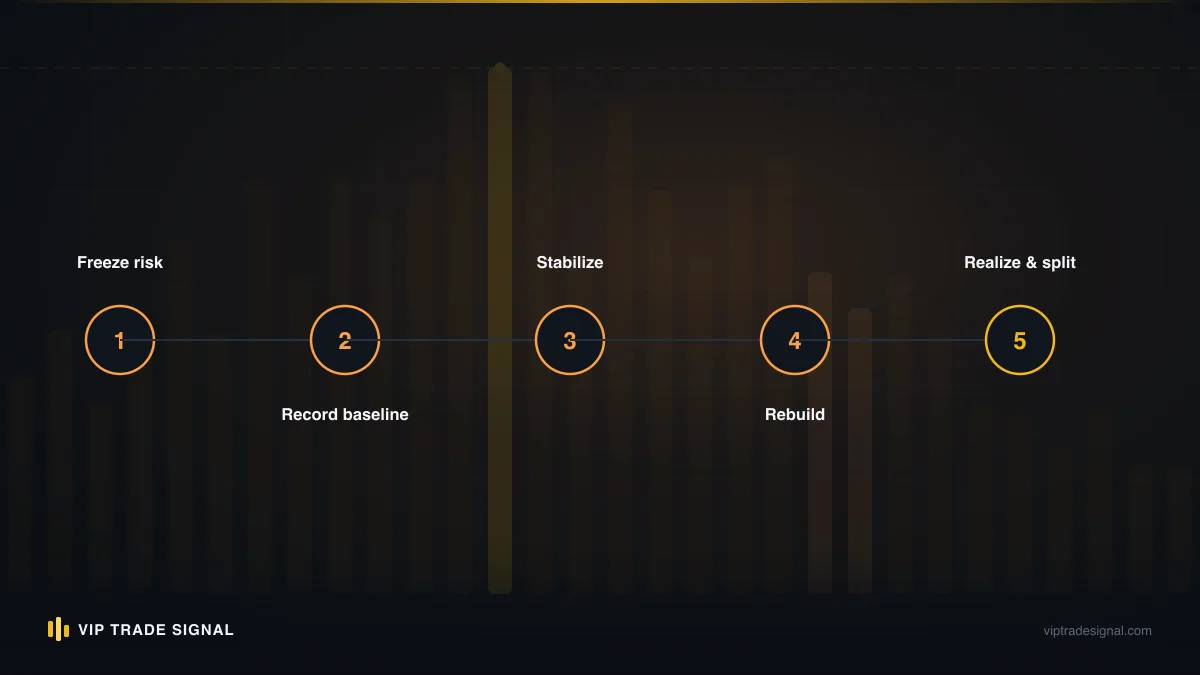
Day one: the intake review. The trader looks at the account with investor access before anything is signed. Every open position, the margin situation, the broker's stop-out level, swap costs on anything being carried. If your immediate risk is margin, it's worth understanding that mechanism yourself first; our piece on avoiding a margin call covers the maths in full. Out of this review comes a one-page plan: what gets closed immediately, what gets held, what the first month looks like. If a manager wants access before they've looked, or can't produce the one-pager, stop.
Day one, continued: the baseline. Record starting equity and balance, timestamped, screenshots held by both sides. This number is the foundation of every future fee calculation and every future disagreement, which is why it gets written down while everyone's still friendly. On our drawdown engagements this is contractual and non-negotiable, for accounts floating roughly $5k-$10k down we charge a flat 50% of recovered profit above exactly this recorded baseline, and if there's no recovery above it, there's no fee, and no, there's never a guarantee attached.
Day two: rules of engagement, in writing. Not a forty-page contract. One page: maximum risk per trade, a maximum drawdown from baseline at which trading halts and you talk (10-15% is a sane bracket), which instruments are in scope, what the trader may never do (add funds requests, martingale, moving your stop-out exposure), fee terms, and how either side terminates. Termination should be simple and immediate: you change the trading password, the engagement ends, outstanding fees on realised profit settle. Anyone proposing exit penalties on a recovery account is building a cage, not a service.
Then: access and reporting rhythm. Trade-only access granted per the earlier section. Agree the reporting cadence up front, weekly written summaries are the workable standard: trades taken, current equity versus baseline, plan for the coming week. Daily reporting sounds attentive but mostly feeds the owner's anxiety, and you'll have real-time investor access anyway for the nights you can't help looking.
The whole apparatus, baseline, one-pager, written rules, sounds bureaucratic for a $4,000 account. It takes two hours total. Every hour of it is cheaper than the argument it prevents.
The psychology of letting go
Nobody warns you about this part, so we will: the hardest weeks of hiring a professional come after the handover, and the account owner is the biggest threat to the engagement.
It starts the first time you check the platform and see an open loss. Doesn't matter that it's a planned, correctly sized position, down $35 within its stop. Your nervous system has spent months associating red numbers on this account with catastrophe, and it fires accordingly. So you message the trader. Just checking. Then a position gets closed for a small loss and you message again, and by week three you're effectively co-managing, which means the professional distance you paid for, the actual product, has been dismantled by its purchaser.
We've watched this cycle enough times to describe it precisely. A trader we'll call Sam hands over a $7,000 account that used to be $11,000. Week one, Sam is relieved. Week two, Sam is watching every tick with investor access, because watching feels like diligence. Week three, Sam asks the desk to skip shorts, because Sam has a feeling gold's going up. Week five, Sam wants a losing position held "a bit longer" instead of stopped. By week eight the account is being traded by a committee of two, one of whom is the person whose decisions dug the hole, and the results have regressed to exactly what Sam produced alone.
A few things genuinely help. Decide before handover which decisions are yours, halting at the drawdown limit, terminating, and which are theirs, everything inside the written rules, and then honour the boundary you designed while calm. Judge in review windows, not in real time: monthly, against baseline, against the drawdown limit, and never against "what I would have done on Tuesday." Check the account on a schedule instead of a compulsion; daily at a set time beats forty anxious glances. And route worry into the reporting channel, questions in the weekly summary get thoughtful answers, 11pm messages get an anxious relationship.
There's a quieter thing underneath, worth naming once. Handing the account over means admitting, concretely and with paperwork, that the losses were yours. Some people find that harder than the losses. If you notice yourself sabotaging the arrangement, interfering, overriding, terminating at the first losing week, it's worth asking whether you're protecting the account or protecting the version of events where you were about to turn it around yourself.
When "hire a professional trader to recover my account" is the wrong search
We sell recovery management, so a section arguing against it costs us money. It stays in, because sending the wrong people to the service is how a service earns the reputation the industry already has.
When the account is too small for the maths. Below roughly $1,000-$2,000, honest management barely functions. Sized-down risk on a $700 account is $7 a trade; months of good work might produce $150 of profit, of which a fee takes half. Nobody's time is well spent, and any manager promising meaningful returns at that size can only mean oversized risk. The better uses of a small damaged account are usually: withdraw it, or treat what's left as tuition and trade it yourself at tiny size while you rebuild skill.
When you'd be delegating a skill you actually want. If your goal is to become a trader, outsourcing the recovery teaches you nothing, and the drawdown you're in is, brutally, the best classroom you'll ever get, provided you cut risk far enough to survive the lessons. Hire help when your goal is the account's health. Trade it yourself, small, when your goal is your own development. Different goals, different answers, and it's fine for the answer to be "both, on two separate accounts."
When the money is money you can't lose. If the account holds rent, a wedding fund, or borrowed money, no manager is the answer, because no manager can remove the possibility of further loss and every honest one will tell you so. The right move is withdrawal, tonight, and the fact that withdrawing crystallises the loss is exactly why it's hard and exactly why it's right. Risk capital is capital whose loss changes nothing about your life. Everything else doesn't belong on a gold CFD platform, ours or anyone's.
When what's actually broken is the strategy, and you know it. Some readers don't need a manager, they need to stop running a martingale grid. If you can name the exact behaviour that caused the damage, and you can genuinely stop it, the cheapest professional help is a one-off consult and a rulebook, not a standing engagement.
When you can't afford to leave it alone. If you already know, reading the psychology section above, that you'll interfere weekly, save everyone the trouble. A sabotaged engagement costs fees and returns, and ends with you blaming the manager for a hybrid neither of you was running.
Roughly a third of the people who contact us about recovery get some version of "we're not the right move for this account." That's not virtue signalling, it's survival. Managed badly, or managed when management was never the answer, a damaged account becomes a dead one, and dead accounts write angry reviews.
Our answer to this search, stated plainly
You've read four thousand words of caveats, so here's the plain version of what we actually do, and you can hold it against every standard in this article.
VIP Trade Signal runs a small desk that trades one instrument: gold, XAU/USD. For damaged accounts we offer drawdown management, built for accounts floating roughly $5,000-$10,000 down. It works on your own MT4 or MT5 account at your existing broker. We take trade-only access; you keep the master password and full withdrawal control. Starting equity is recorded as a written baseline on day one, and our fee is a flat 50% of recovered profit above that baseline, settled on realised gains. No recovery, no fee. There is no guarantee of recovery, ever, in any wording, and if your situation looks unrecoverable to us we'll say so in the first conversation rather than the last.
For healthy accounts the equivalent service is standard account management on the same structure, flat 50% of realised profit, $200 minimum advance, your keys, your broker. The fee sits at the top of the industry range and we've explained why in the cost section rather than hiding it: low minimums, no lock-in, pay-as-you-go. If a cheaper structure elsewhere passes the vetting standards above, take it with our blessing.
And if you want to see how the desk actually trades before trusting it with anything, every closed signal we've issued, winners and losers, is public at /signals/history. Who's behind it is on the about page. That's the whole pitch. It's deliberately boring, because you've seen tonight what the exciting version of this industry looks like.
The first conversation: a checklist to bring
Whoever you end up talking to, us included, walk in with this list. A professional will enjoy the questions. The other kind will wilt somewhere around number four.
- "Show me a verified track record, with the losing months." Third-party feed or investor access to a live account. Screenshots don't count. Curated win-reels count against.
- "What's your maximum drawdown, and what happens on my account if we hit 10% below baseline?" You're listening for a hard number and a halt-and-talk rule, not reassurance.
- "What access do you need?" The only acceptable answer is trade-only access or LPOA on your account at your broker. Master password, credentials, or funds moved to their platform ends the meeting.
- "How is the fee calculated, from what baseline, and what happens in a losing month?" You want: written baseline, realised profit only, high-water mark, nothing owed on losses.
- "What would make you refuse this account?" Real professionals have refusal criteria and will list them. "We take everyone" means the intake filter is your deposit clearing.
- "How do I end this, today, if I want to?" Correct answer: change the trading password, settle earned fees, done. Notice periods and exit penalties are cages.
- "What do you expect from me?" The good ones have requirements for you too, no interference inside the rules, no midnight instructions, judgement at monthly reviews. A manager who demands nothing of the client is planning a short relationship.
Then give yourself one final rule: sleep on it. Twice. Any offer that can't survive two nights of thought was priced for the version of you that searched at 2am, and that version, as you've probably gathered by now, is the worst negotiator you own. If after two nights the numbers still make sense, the access model is clean, and the person on the other end has shown you their losses without being cornered into it, then hiring help is a reasonable, adult move, and you can start the conversation whenever you're ready. The account got damaged by decisions made in a hurry. Let the recovery start with one that wasn't.