Nobody hires an accountant by replying to a stranger who slid into their Instagram DMs promising to triple their tax refund. Yet every week, people with real savings hand trading access to someone they found in exactly that way, on the strength of a screenshot and a profile photo of a rented Lamborghini.
If you want to hire a forex trader to run your money, the single most useful mental shift you can make is this: you are not a customer buying a product. You are an employer filling a position. The position happens to be "person with the power to lose my capital", which makes it roughly as sensitive as hiring a nanny or a bookkeeper, and yet most people spend less time on it than they'd spend choosing a fridge.
This piece walks through the whole process the way an actual hiring manager would run it — sourcing candidates, reading the CV, interviewing, checking references, structuring pay, running a probation period, and knowing when to fire. It's long because the decision deserves it. Skim it now if you must, but come back before you send anyone your login.
You're an employer. Act like one
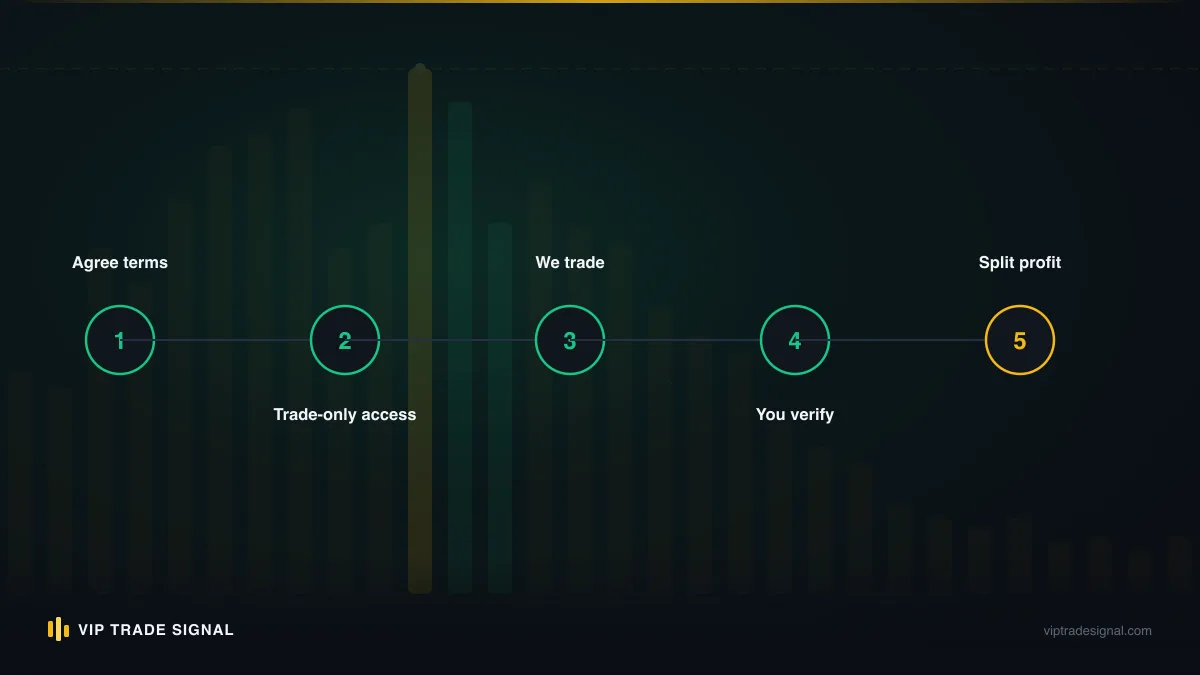
Ask yourself what a competent small-business owner does before hiring someone to handle their books. They advertise or ask around. They read CVs and bin most of them. They interview the shortlist and ask awkward questions. They call references. They agree pay in writing. Then — and this is the part almost everyone skips with trading — they start the new hire on a trial period with limited responsibility, and watch.
Now compare that with how the typical person hires someone to trade their account. A channel posts a screenshot showing +340% in a month. The person messages "how do I join". The "manager" asks for $500. Money moves. That's the entire process. No interview, no references, no probation, no contract. If you described that sequence to the same person in the context of hiring an office manager, they'd laugh at you.
The employer's mindset changes every step that follows. Employers assume most applicants are unsuitable and a few are lying. Employers know the CV is a marketing document until verified. Employers understand that a confident interview performance proves confidence, not competence. And employers never give a new hire the keys to everything on day one.
The person managing your money is your employee, not your saviour. Interview them like one, pay them like one, and be willing to fire them like one.
One more thing before we get into mechanics. Hiring a good trader does not remove risk. Trading gold and forex is a high-risk activity whoever holds the mouse, losing months are part of even genuinely good performance, and no manager anywhere can promise you profit. What good hiring does is filter out the frauds and the gamblers, which is most of the field. That alone is worth the effort.
Can you actually pay someone to trade forex for you?
Yes — with caveats worth understanding before you start shopping, because the answer shapes where you look.
The question "can I pay someone to trade forex for me" has three legitimate answers and one illegitimate one. Legitimately, you can invest in a regulated fund (high minimums, real oversight, you never touch the trading), you can join a broker-hosted copy or PAMM arrangement (the broker enforces the plumbing, you pick the strategy provider), or you can hire someone to trade your own personal account via its trading password — the account stays in your name, at your broker, with your withdrawal rights intact. The illegitimate version is sending money to a stranger's wallet so they can "trade it for you" on your behalf. That last one is not account management. It's a donation.
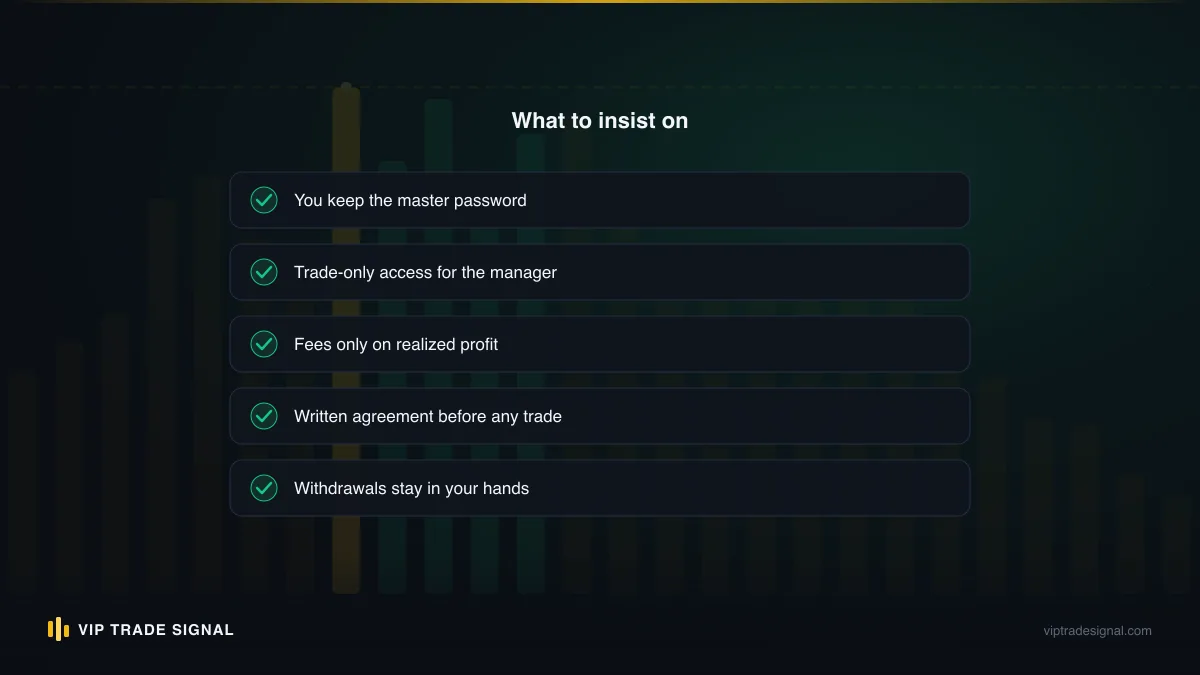
This article is mostly about the third option — hiring a trader or a firm to run your own account — because it's the version accessible to someone with $500 to $20,000, which regulated funds won't touch. It's also the version where your own diligence does the most work, since there's no regulator standing between you and a bad hire. If you want the full mechanical picture of how that arrangement works — passwords, access levels, who can withdraw what — we've written it up separately in how forex account management actually works. Short version: the trader gets the trade-only password, you keep the master password, and money only ever moves between your bank and your broker. Any candidate who pushes against that structure has failed the interview before it starts.
One legal note. In many jurisdictions, managing other people's money as a business requires a licence, and plenty of individual traders for hire operate in a grey zone. A trader being unlicensed doesn't automatically make them a thief — the licensing thresholds are built for funds, not for one person running five accounts — but it does mean the protection you'd get from a regulator mostly isn't there. Your protection is the structure: your account, your broker, your master password. Build the safety in, because nobody else will.
Where forex traders for hire actually are — and where they aren't
Sourcing is where most hires go wrong, because the places that shout loudest are the worst places to look.
Start with where not to source. Instagram and TikTok accounts posting lifestyle content and profit screenshots are marketing funnels, nearly always for something other than actual trading — usually deposits to an unregulated broker paying them commission, or a "management" scheme where your money goes to them directly. Telegram channels that DM you first are the same. The pattern is consistent enough to be a rule: anyone who found you is disqualified. Real demand for competent traders exceeds supply. The good ones are not cold-messaging strangers.
Better sourcing channels, roughly in order:
- Verified track-record platforms. Myfxbook, FX Blue and similar services connect directly to a trading account and publish its results, updated automatically. Traders who publicise a verified multi-year record are at least showing you real data. This is the closest thing the industry has to a CV database.
- Broker copy-trading and PAMM leaderboards. Signal-provider and money-manager rankings inside regulated brokers. The broker verifies the numbers by definition — the trades happened on their servers. Sort by age of account and drawdown, never by monthly return.
- Established firms with public results. Companies that do account management as a business, with a published history of every trade, an identifiable team and a fee structure in writing. Fewer unknowns than an individual, though you're hiring a desk rather than a person.
- Personal referrals — verified anyway. A friend who's genuinely used a manager for a year is a real signal. But friends exaggerate and remember selectively, so a referral earns a candidate an interview, not the job.
Notice what's common across all four: in each case, there exists evidence you can check without trusting the candidate's own word. That's the sourcing filter in one sentence. If the only evidence for a trader's skill is material the trader themselves controls — screenshots, self-reported stats, testimonials — they don't make the shortlist. For what it's worth, this is why we publish every closed trade, wins and losses alike, at /signals/history; a desk that won't show you the losing trades is asking you to hire on faith.
Expect the funnel to be brutal. If you gather ten candidates, expect seven to fall at the evidence stage, two at the interview or reference stage, and to feel only lukewarm about the one who survives. That's normal. It's also infinitely better than the alternative funnel, which is one candidate, zero checks, full deposit.
The CV: what a verifiable track record looks like
A trader's CV is their track record, and the first thing to understand is that an unverified track record is not a weak CV — it's no CV. Screenshots are trivially faked. MT4 statements are editable HTML. Demo accounts look identical to live ones in a cropped image. "Results" that exist only as images the candidate sent you carry exactly zero information, and you should treat a candidate who offers nothing else as an applicant who submitted a blank page.
A real CV, in this business, has specific properties:
- Third-party verification. The results come from a tracking platform linked to the account, or from a broker's own leaderboard, or from a public trade log posted before outcomes were known. Not from the candidate's screenshots.
- Length. Two years minimum, three or more preferred. A brilliant six months is noise; retail forex is full of traders who doubled an account in a quarter by over-leveraging and blew it in month seven. Time is the one credential that can't be faked quickly.
- Losses on display. Every real record has red in it. Losing trades, losing weeks, at least a few losing months over multi-year periods. A record with no visible losses has been curated, and curation is the polite word.
- Drawdown data. Maximum drawdown tells you what the ride felt like. A trader returning 30% a year with a 12% max drawdown and a trader returning 30% with a 55% max drawdown are entirely different hires; the second one has already shown you they'll flirt with ruin.
- Consistent risk. Look at position sizes across the history. A record where lot sizes triple after losses is a martingale in progress — the strategy that works right up until the account vanishes.
What about numbers? Here's the uncomfortable calibration: sustainable discretionary trading tends to produce somewhere in the region of 2-6% a month over the long haul, with negative months mixed in, and even that range would put a trader in the industry's upper tier if held for years. A record showing 40% monthly is not a stronger CV. It's a disqualifying one, because returns like that require risk levels that eventually produce a zero, and "eventually" has a habit of arriving right after you deposit.
Fabricated precision cuts the other way too. A candidate quoting an "87.3% win rate" should be asked where that number lives publicly. If it lives nowhere, it's decoration.
The interview: questions that separate traders from salesmen
Once a candidate survives the CV screen, interview them. Actually interview them — a call or a structured message exchange where you ask prepared questions and note the answers. The purpose is not to test whether you like them. Charm is the fraudster's core competency. The purpose is to test whether their answers are consistent with someone who trades for a living, because trading leaves fingerprints on the way a person talks about risk.
The questions that earn their place:
"Describe your worst drawdown. What caused it and what did you change?" Every real trader has a scar and a specific story: the pair, the period, the mistake, the fix. A candidate who claims they've never had a serious drawdown, or answers in vague inspirational language about resilience, has never traded through one.
"What's your maximum risk per trade and per open cluster, and what happens when it's hit?" You want a number and a rule. "1% per trade, hard stop on every position, no more than 3% exposed across correlated trades, and if the account draws down 10% I halve size" is a trader's answer. "I manage risk dynamically based on market conditions" is a horoscope.
"What monthly loss should I expect in a bad month?" This is my favourite, because it can only be answered honestly by admitting losses will happen. The honest answer is a range with a minus sign in it. Any answer shaped like "with my strategy, losing months are extremely rare" ends the interview.
"Why isn't your own capital enough?" A fair question with fair answers — profit share on client money scales in ways personal capital doesn't, and management income smooths the lumpy income of trading. But watch how they take it. Evasiveness or offence here tells you plenty.
"Walk me through the last trade you lost money on." Recency matters. A real trader lost money recently — this week, probably — and can tell you the instrument, the setup, where the stop was and why. Fumbling for an example means the losses are hidden or the trading is imaginary.
Then there are the answers that end interviews on the spot, whatever prompted them: any use of the word "guaranteed"; any request that you send funds to them rather than to your own broker account; any request for your master password or withdrawal access; any pressure tactic ("this price is only for today"); and any promised return quoted with confidence and no risk attached. One strike is enough. Employers don't hire people who lie in the interview, even once, even charmingly.
Score it. Literally — write the questions down beforehand, note each answer, mark it pass or fail. It sounds bureaucratic for what might be a $2,000 account. It isn't. The scorecard exists to protect you from your own first impression, which will otherwise be formed entirely by confidence and rapport, the two qualities every scammer has in surplus.
Reference checks: verifying results without taking anyone's word
In a normal hire, this is where you phone the previous employer. In this one, references are mostly documents rather than people — but the principle is identical: verify the story through channels the candidate doesn't control.
The core check is independent confirmation of the track record. If they cite a Myfxbook or FX Blue page, open it yourself — don't click a link they send, search the platform directly, since fake "verification" pages are a known trick. On the page, check three things: that track-record verification and trading-privileges verification are both green (an unverified page proves nothing), that the account is real rather than demo, and that the history length matches the claim. If they cite a broker leaderboard, find them on it from the broker's own site.
Second, verify the broker relationship. A manager who insists you open your account at one specific obscure broker — especially an unregulated one you've never heard of — is very likely being paid by that broker per deposit, and the worst version of this is a fake broker whose platform shows you fictional profits while your deposit is already gone. You choose the broker. A legitimate trader for hire will work at any reputable, regulated venue, or at most offer a shortlist of major names. (Partner-broker arrangements do exist legitimately — we have them ourselves and say so on our about page — but "we have a partnership, here are several regulated options, or use your own broker" is a different sentence from "you must deposit at BrokerYouCannotGoogle.")
Third, verify the human. A real name that appears somewhere beyond the sales conversation. A company registration if they claim one — company registries in most countries are free to search. A face that survives a reverse image search without turning out to be a stock photo or a stolen profile. For a firm, some evidence the operation is older than its Telegram channel.
And fourth, search for the wreckage. Search the trader's name and company plus "scam", "review", "withdrawal problem". Check forum threads, not just review sites (review sites can be bought). Absence of complaints proves little for a small operator, but presence of a pattern — multiple unrelated people describing the same disappearing act — is definitive. Ten minutes of searching has killed more bad hires than every regulator combined.
None of this requires skill. It requires only the willingness to spend an evening on it, which is precisely what separates the people who get burned from the people who don't. The burned ones almost always say the same thing afterwards: the warning signs were there, and they didn't look.
Compensation: how to pay a hired trader
Employers think hard about pay structure because pay creates behaviour. The same is true here, and the industry has effectively three models.
Flat fees — a monthly retainer regardless of results — are honest but poorly aligned: the trader gets paid the same whether you profit or not, which is fine for a signal subscription where you keep the execution decision, and less fine for full management where they hold the wheel.
Percentage of account balance (the classic 2%-of-assets model from the fund world) pays the manager for gathering assets rather than growing them. At retail size it's rare, and good riddance.
Profit share is the standard for hired traders and account managers, and for good reason: the trader earns a percentage of realized profit, and only when there is realized profit. No profit, no fee. Typical retail splits run anywhere from 20% to 50% of profits depending on account size and service level — bigger accounts negotiate lower percentages; low-minimum, pay-as-you-go services sit at the top of that range. Ours, to be concrete, is a flat 50% of realized profit with a $200 minimum advance, which is honestly at the high end — the trade-off is that you can start small, there's no lock-in, and the structure is fully public on the account management service page. Whether that trade-off suits you depends on your account size; a $50,000 account should be negotiating a much lower split somewhere else.
Whatever the split, three contract details matter more than the headline number:
| Term | The right answer | The trap |
|---|---|---|
| Charged on | Realized (closed) profit only | Fees on floating/unrealized gains |
| High-water mark | Yes — losses recovered before new fees | Paying twice for the same equity |
| Payment flow | You pay the fee out; trader never withdraws | Trader has withdrawal access "for convenience" |
The high-water mark deserves a plain-English example, because it's the clause most people have never heard of. Say your $5,000 account grows to $6,000 — the trader takes their share of the $1,000. The account then falls to $5,400 before climbing back to $6,000. With a high-water mark, no fee is due on that recovery, because you've already paid for equity above $5,400 once. Without one, the trader bills you again for ground you already owned. Any professional arrangement includes it; ask directly, and treat a blank stare as a red flag.
And a warning about the opposite extreme: a very high profit share with no downside exposure creates a lottery-ticket incentive — the trader keeps half your wins and shares none of your losses, so maximum aggression is mathematically their best play. You mitigate that not through the fee (there's no fee structure that fully solves it) but through the risk limits and probation rules below. Pay structure aligns interest; rules constrain behaviour. You need both.
The probation period: small capital, hard rules
Here's the step that does more protective work than everything above combined, and it's the one people skip because they're impatient: never start a new trader at full size. Every employer knows the interview star who couldn't do the job. Probation exists because the only reliable test of performance is performance, observed by you, with limited downside.
The structure is simple. Fund the account with the minimum viable amount — the service's minimum, or 10-20% of what you ultimately intend to allocate, whichever is smaller. If you plan to eventually place $10,000, start with $1,000-$2,000. If the trader's minimum is $500, start with $500. A trader who pressures you to start bigger "because the strategy needs room" is telling you something; competent management scales, and a strategy that only works above $10,000 will still work above $10,000 in four months.
Then run the trial for a real length of time — 90 days is a sensible default, and six months is better if you can stand it. A month tells you almost nothing; anyone can have a good month, including a martingale strategy one step from detonation. Three months at least forces the strategy through some varied conditions, and with gold in the mix, "varied" arrives quickly.
During probation, you're watching for specific things, in roughly this order of importance:
- Risk discipline. Does every trade carry a stop-loss? Are position sizes consistent with the risk-per-trade number from the interview? A trader who said "1% per trade" and is running 5% positions in week two has already failed probation, even if those positions won.
- Behaviour after losses. This is the single most revealing observation available to you. After a losing trade or a losing week, does size stay constant, or does it grow? Growing size after losses is revenge trading or martingale, and either one fires the trader immediately. Not at the end of the trial. Immediately.
- Drawdown against the stated maximum. If they said drawdowns rarely exceed 15% and you're floating 25% down in month two, the interview answer was false. What they do next is irrelevant; the honesty test is already graded.
- Reporting quality. Do you get a periodic summary that includes the losers? Are questions answered plainly? A manager who goes quiet during a rough patch during probation will vanish entirely during a rough patch at full size.
- Results — last. Genuinely last. A modest profit with tight discipline is a pass. A large profit built on stop-less positions and doubled-up losers is a fail that happens to have been lucky. You're not grading the outcome of 40 trades, which is mostly noise; you're grading the process, which is mostly signal.
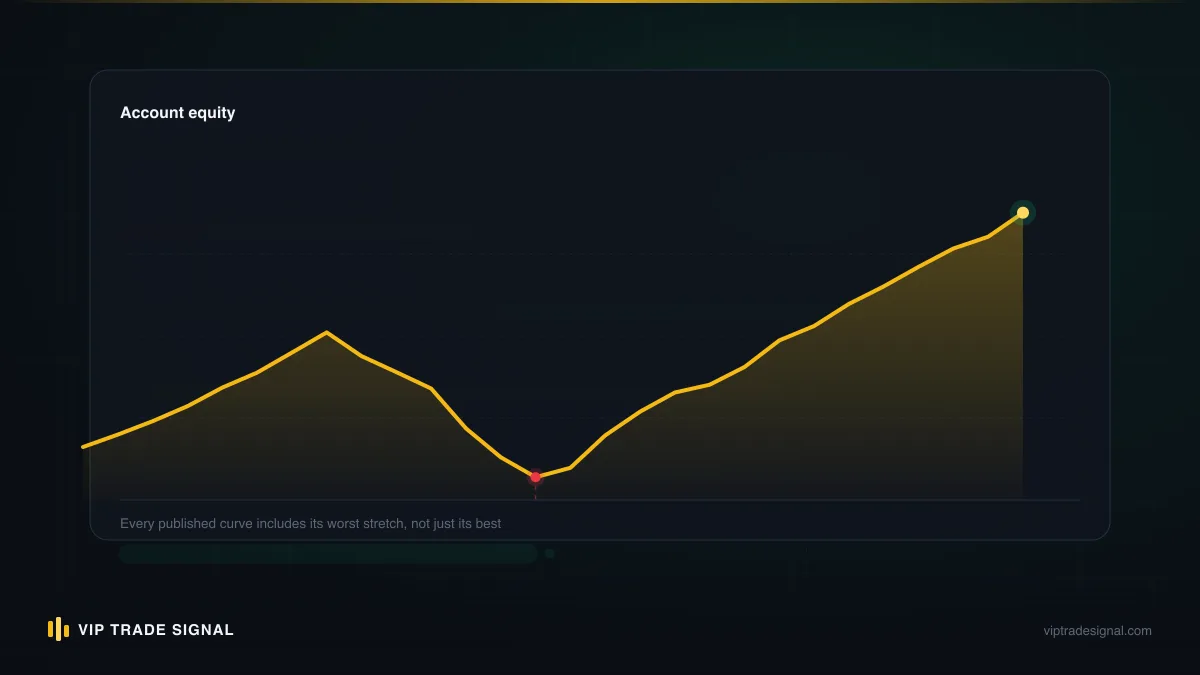
Set checkpoints — a deliberate review at 30, 60 and 90 days where you sit down with the account history and your scorecard from the interview and check the promises against the record. And decide your abort criteria in advance, in writing, before the money goes in: mine would be any trade without a stop, any request for more access or more money mid-trial, position sizing that grows after losses, or drawdown beyond 1.5 times the stated maximum. Deciding in advance matters because mid-drawdown you will be the worst decision-maker available — either too scared to stay or too invested to leave.
Only after a clean probation does the allocation scale up. And even then, scale in steps — half the intended amount for the next quarter, then full size — rather than in one grateful lump.
The contract: access, limits, and termination
Even a two-page agreement — even a clear email exchange both sides acknowledge — beats the handshake-over-Telegram standard the industry runs on. What it needs to nail down:
Access. The trader receives the investor-plus-trading credentials only. You keep the master password, the email on the account, and the sole ability to withdraw or change passwords. This is the load-bearing wall of the entire arrangement, and it's non-negotiable in both directions: never grant more, and walk away from any trader who requests more. The reason you can afford to hire an unregulated individual at all is that this structure caps what they can steal at, roughly, nothing — the worst they can do is lose money trading, which is a risk you're accepting, not a theft you're enabling.
Risk limits, in numbers. Maximum risk per trade. Maximum open exposure. A drawdown ceiling — say 20% from the starting balance or the last high-water mark — at which trading stops and a conversation happens before it resumes. Vague commitments to "conservative risk management" are unenforceable and unmeasurable; numbers are both.
Fees, precisely. The split, the high-water mark, when fees are calculated (monthly, on realized profit), and how they're paid (you send payment out; the trader never touches the balance).
Reporting. What you'll receive and how often — a weekly or monthly summary of closed trades, P&L and current drawdown is a reasonable ask.
Termination. Either side can end it, with immediate effect on your side: you change the password, and it's over. No exit fees, no notice period on your capital, no "the strategy needs time to unwind" — if there are open positions at termination, agree in advance how they're handled (typically: closed, or left to you). Any arrangement you can't leave in five minutes is a trap with a fee schedule.
If a candidate resists putting any of this in writing, that's your answer about the candidate. The good ones prefer written terms too — it protects them from clients who remember conversations selectively.
Managing without micromanaging
Congratulations, you've hired someone. Now comes a subtler failure mode: being a terrible boss.
The two bad-boss archetypes both destroy the arrangement. The absentee owner hands over access and doesn't look at the account for six months — which means that when something goes wrong (risk creep, drawdown breach, a strategy quietly abandoned for revenge trading), it's been going wrong for months before anyone notices. The micromanager, meanwhile, messages after every losing trade, asks the trader to close positions early, second-guesses entries, and eventually is trading the account by proxy — at which point they're paying 50% of profits for the privilege of their own anxiety.
The professional middle: check the account weekly, briefly — five minutes against your written limits, not against your feelings. Hold a proper review monthly, looking at closed-trade history, drawdown versus ceiling, and sizing consistency. Judge the process on rolling quarters, not on individual weeks, because a good process shows losing weeks as a matter of course and gold in particular hands out red weeks freely. And say nothing about individual trades. You hired a trader precisely so that trade-by-trade decisions wouldn't be yours; interfering with them converts their process into no one's process.
One boundary worth stating out loud, since this whole piece is about money: nothing here is personalized financial advice — we're not licensed advisors, and neither is almost anyone offering to trade your account. What you allocate to a hired trader should be money whose total loss would annoy you rather than change your life. That rule doesn't relax after a good probation. Good quarters recruit overconfidence, and overconfidence recruits deposits.
When to fire your forex trader
Every employer eventually faces the termination decision, and the useful discipline is separating fireable process failures from ordinary performance noise — because firing for the wrong reason is nearly as costly as not firing for the right one.
Fire immediately, no conversation required, for any of these:
- A trade without a stop-loss, or a stop removed as price approached it. Once is policy.
- Position sizes growing after losses. Martingale behaviour is a countdown, and you don't need to watch it reach zero.
- Any request for more access — withdrawal rights, your master password, your broker email — or any suggestion you move funds to a different broker mid-arrangement.
- Breach of the drawdown ceiling without pausing, as agreed. The number existed for exactly this moment.
- Dishonesty of any size. A misreported result, a deleted trade, a story that changed. Someone who lies about small things while holding your trading password is not a person you renegotiate with.
Investigate first, then possibly fire, for these:
- Strategy drift. You hired a trader running 2-4 trades a week with tight stops; the account now shows 30 trades a week in instruments they never mentioned. Ask. Sometimes there's a legitimate evolution; often the original strategy stopped working and what you now own is improvisation.
- Reporting decay. Summaries arriving late, then thin, then not at all — especially during a losing stretch. Silence correlates with problems being hidden.
- Drawdown far beyond the historical pattern, even if under the ceiling. If the three-year record showed 12% max and you're at 19%, something changed — market, strategy, or discipline — and you're entitled to know which.
And explicitly do not fire for: a losing week; a losing month inside the stated drawdown expectations; underperforming the sales pitch of some other channel you saw yesterday; or trailing a hot streak your mate's manager is having. Performance-chasing between managers is how people convert one mediocre arrangement into a sequence of terrible ones, paying spreads and fees at every hop.
The mechanics of firing are the easy part, if you built the structure right: change the trading password at your broker, confirm open positions are handled per the agreement, settle any legitimately owed fees on realized profit, and say thanks. Five minutes. If firing your trader would take longer than that — if they hold anything you'd need to ask for back — the structure was wrong from the start, and this is your reminder to fix it before, not after, you need to.
The employer's checklist
Everything above, compressed into the sequence you'd actually run:
- Decide the structure first. Your account, your regulated broker, trade-only access, master password stays with you. Anyone incompatible with that structure is out before sourcing begins.
- Source from evidence, not from inboxes. Verified track-record platforms, broker leaderboards, firms with full public histories. Anyone who DM'd you first is disqualified by definition.
- Screen the CV hard. Two-plus years, third-party verified, losses visible, drawdown stated, sizing consistent. No verification, no interview.
- Interview with a scorecard. Drawdown story, risk numbers, expected bad month, most recent loss. One "guaranteed", one request for your funds or your master password — done.
- Check references independently. Open the verification pages yourself, verify the broker, search the name plus "scam", find the human behind the handle.
- Agree pay in writing. Profit share on realized profit, high-water mark, you control every payment. At small account sizes expect the split to be steep; at large ones, negotiate.
- Run a real probation. Small capital, 90 days minimum, written abort criteria, checkpoints at 30/60/90. Grade process over profit.
- Manage like a professional. Weekly glance, monthly review, quarterly judgement, zero trade-by-trade interference.
- Fire on process, not on noise. Instantly for stops, sizing, access or honesty; never for an ordinary losing month.
If you're now weighing up a specific manager, our piece on how to choose a forex account manager goes deeper on the selection criteria, and if you're curious what the job looks like from the other side of the desk — what a competent manager's incentives and constraints actually are — how fund managers get there is worth twenty minutes.
Here's the closing thought, and it's the same one we opened with. The overwhelming majority of "hire a forex trader" disasters were not sophisticated frauds. They were unforced errors — money sent to strangers, passwords handed over whole, screenshots believed, probation skipped — that a single evening of employer-grade diligence would have prevented. The market can take your money even when you do everything right; that's the honest risk of trading and no hire eliminates it. But the frauds and the gamblers, who between them cause most of the carnage, can only take it when you skip the interview. So don't. You're the employer. The keys are yours to keep.