Say a manager grows your $10,000 account to $12,000 and takes a performance fee on the $2,000 gain. Fair enough. Then the account drops back to $10,500, climbs to $12,000 again, and the manager bills you a second time on the same $1,500 of recovery. You have now paid twice for profit you only received once. Your account is exactly where it was, and your fee bill has roughly doubled.
That is not a hypothetical edge case. It is the default outcome of a badly written agreement, and plenty of retail account managers write their agreements badly on purpose. The clause that stops it is called a high water mark, and the way a high water mark performance fee works is one of those things almost nobody checks before handing over trading access, then everybody wishes they had checked afterwards.
This article does two things. It explains the high water mark and its cousin, the hurdle rate, using actual numbers and billing sequences rather than dictionary definitions. And it gives you the framing we think matters most: these clauses are not accounting trivia. They are your armour. A manager who resists them is telling you something, and you should listen.
The problem these clauses solve: paying twice for the same profit
Performance fees exist because they are, in principle, the fairest fee structure in money management. A management fee charges you a percentage of assets whether the manager performs or not. A performance fee only bills when there is profit. That is the whole appeal of performance fee vs management fee forex arrangements: no profit, no bill.
But "only bills when there is profit" hides a nasty ambiguity. Profit measured from where?
If the answer is "from the start of each billing period", you have a problem. Trading is not a smooth ride upwards. Accounts draw down. A gold account can float 8% underwater for three weeks and finish the quarter flat, and anyone who tells you otherwise has never actually traded XAU/USD through a Fed week. So under period-based billing with no memory, the sequence looks like this:
- Month 1: account goes $10,000 to $12,000. Fee charged on $2,000.
- Month 2: account falls to $10,000. No fee. But no refund either.
- Month 3: account recovers to $12,000. Fee charged on $2,000. Again.
Across three months your account went nowhere and you paid two full performance fees. At a 30% fee that is $1,200 in charges on zero net gain, which means your "no profit, no bill" arrangement quietly billed you 12% of your account for the privilege of standing still.
The manager, meanwhile, has a horrible incentive. Volatility becomes profitable for them even when it is not profitable for you. Big swings up generate fees; big swings down cost them nothing. A manager on a no-memory billing structure is being paid to gamble with your money, and some of them behave exactly as you would expect.
It is worth being clear about what a performance fee is being compared against, too, because "at least it's not a management fee" gets used to excuse a lot. A classic management fee, the hedge fund's 2% of assets per year, bills you regardless of results; on a $10,000 account that is $200 a year for existing. Most retail forex managers skip the management fee entirely and run pure performance billing, and that is genuinely better for you, but only if the performance measurement is honest. A pure performance fee with no memory can easily cost more than a management fee plus a properly marked performance fee would have. The label on the fee matters less than the ruler it is measured with.
The high water mark is that ruler. The hurdle rate handles a different but related problem, which we will get to. First, the mark itself.
How a high water mark performance fee actually works
Forget formulas for a second and picture your equity curve, the line that plots your account balance over time. Now draw a second line that only ever moves up: it sits at the highest point your account has ever reached at the end of a billing period. That second line is your high water mark.
The rule is one sentence. The manager may only charge performance fees on profit above the high water mark, and the mark rises to each new peak once fees are settled there.
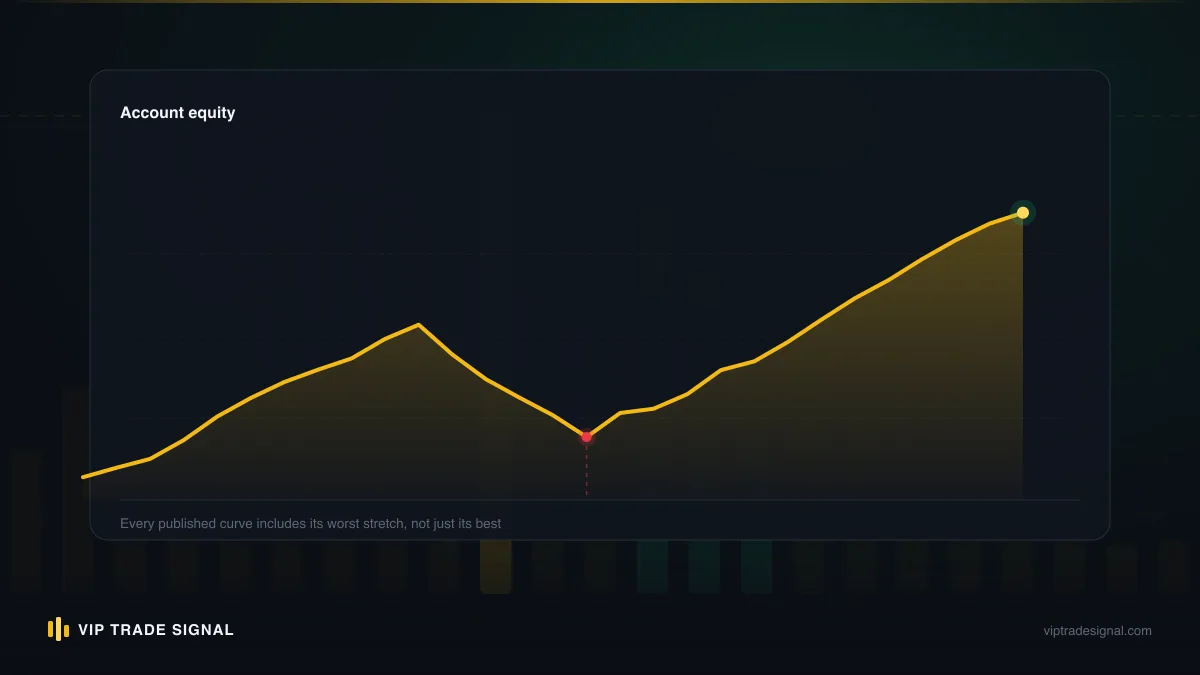
Everything below the line is dead ground, fee-wise. If your account has been to $12,000 before, the journey from $10,000 back up to $12,000 is recovery, not new profit, and recovery is never billable. The manager already got paid on that ground once. They do not get paid on it again.
Run the same three months through a high water mark and watch what changes:
- Month 1: $10,000 to $12,000. New peak. Fee on $2,000. Mark set at $12,000.
- Month 2: falls to $10,000. No fee. Mark stays at $12,000.
- Month 3: recovers to $12,000. Account touches the mark but does not exceed it. No fee.
Same trading, same equity path, half the fees. And the incentive structure flips. A manager underwater on the mark earns nothing until they climb all the way back above it. Drawdowns now cost the manager real money in delayed income, which is exactly the alignment you want: their losses hurt them, not just you.
One important detail people miss: the mark is usually measured at billing points, not tick by tick. If your account spikes to $12,600 intraday but closes the billing period at $12,000, the mark is $12,000. Fees crystallise at settlement, and so does the mark. Any agreement should say explicitly when the mark is measured, because "highest ever balance" and "highest ever settled balance" can differ by a lot in a leveraged gold account.
Second detail: deposits and withdrawals have to adjust the mark. If your mark is $12,000 and you deposit $3,000, the mark moves to $15,000; otherwise the manager charges a performance fee on money you posted yourself, which is theft with extra steps. Withdrawals reduce the mark proportionally. A serious agreement spells out the arithmetic. A sloppy one does not mention deposits at all, and you should treat that silence as a red flag rather than an oversight.
A drawdown and recovery, billed month by month
Definitions are fine. Sequences are better. Here is a twelve-month run on a $10,000 account with a 50% performance fee, settled monthly, high water mark in force. The percentages are illustrative, not a projection; a real year trading gold will be lumpier than this and might well end lower, which is the honest caveat every fee discussion needs.
| Month | Closing balance | High water mark (before billing) | Billable profit | Fee (50%) | Mark after billing |
|---|---|---|---|---|---|
| Jan | $10,800 | $10,000 | $800 | $400 | $10,800 |
| Feb | $11,500 | $10,800 | $700 | $350 | $11,500 |
| Mar | $10,600 | $11,500 | $0 | $0 | $11,500 |
| Apr | $9,900 | $11,500 | $0 | $0 | $11,500 |
| May | $10,700 | $11,500 | $0 | $0 | $11,500 |
| Jun | $11,500 | $11,500 | $0 | $0 | $11,500 |
| Jul | $12,300 | $11,500 | $800 | $400 | $12,300 |
Look at March through June. Four consecutive months where the manager traded, took risk, did work, recovered $1,600 of drawdown, and earned nothing. That is the mark doing its job. The client pays for net new wealth only. The manager eats the recovery period as the cost of having drawn down in the first place.
Notice July as well. The account pushed $800 above the old peak, and only that $800 was billable, not the $2,400 climb from the April low. Without the mark, a monthly billing cycle would have charged fees in May, June and July on ground the account had already covered in January and February. On this sequence the difference is about $800 in fees on identical trading. Over years, on larger accounts, the difference is thousands.
There is a psychological effect worth naming too. A manager sitting below their mark has an incentive to swing harder to get back above it, because they earn nothing until they do. That is the dark side of the mark, and it is real; funds call it the "lottery ticket" problem. It is one reason you want a manager whose risk per trade is fixed by rule rather than by mood, and why you should ask directly what happens to position sizing during a drawdown. The right answer is "nothing, it stays the same or gets smaller". The wrong answer is a speech about conviction.
Hurdle rates: the other half of the armour
The high water mark stops you paying twice for the same profit. The hurdle rate stops you paying for profit that is not really performance at all.
A hurdle rate performance fee structure says: no fees until returns clear a stated threshold. If the hurdle is 5% annually, the first 5% of gains are fee-free, because 5% is roughly what your money could have earned sitting in something boring. The manager only charges for the part of the return that required actual skill, or at least actual risk-taking beyond parking cash.
Hurdles come in two flavours, and the difference matters more than most people realise.
A hard hurdle means fees apply only to profit above the threshold. Account returns 12% against a 5% hard hurdle: fees are calculated on 7 percentage points of gain. On $10,000 with a 30% fee, that is 30% of $700, so $210.
A soft hurdle means the threshold is a trigger, not a floor. Clear 5% and fees apply to the entire gain from zero. Same 12% return, same 30% fee: 30% of $1,200, so $360. The hurdle did not reduce your bill at all; it only decided whether the bill exists.
Soft hurdles are common in hedge fund land because managers prefer them, obviously. If you are offered a hurdle at all in a retail forex arrangement, ask which kind, and expect the person offering it not to know. That in itself is useful information.
What is typical? In institutional money, hurdles of 4% to 8% linked to a cash rate or index were standard for years, with plenty of funds abandoning them when money was cheap. In retail forex and gold account management, hurdles are rare. The honest reason is that retail arrangements bill monthly or per-cycle rather than annually, and a meaningful annual hurdle is awkward to administer on a monthly cycle. The less honest reason is that nobody asks for one.
Our view, since this desk has one: for retail-sized accounts the high water mark is the clause that matters and the hurdle is a nice-to-have. A mark protects you from the most common and most expensive abuse. A hurdle shaves fees at the margin. If a provider offers neither, walk. If they offer a mark but no hurdle, that is normal and defensible. If they offer a hurdle but no mark, someone has dressed the agreement up to look sophisticated while leaving the actual hole open, and you should read everything else in it twice.
When both clauses apply at once
Funds that use both stack them, and the order of operations is fixed: the high water mark comes first, then the hurdle applies to profit above the mark.
Concrete run. Mark at $12,000. Hard hurdle of 5% per period. Account climbs from $10,000 to $13,000.
- Profit above the mark: $13,000 minus $12,000 is $1,000. The $2,000 of recovery below the mark is ignored entirely.
- Hurdle on the marked capital: 5% of $12,000 is $600. Subtract from the $1,000.
- Billable profit: $400. At a 30% fee, the bill is $120.
Total account growth this period: $3,000. Fee: $120. That is what a client-protective structure looks like when both pieces of armour are on. The manager still gets paid for genuine outperformance above the previous peak and above the threshold; they get nothing for recovery and nothing for the first slice of new gains.
One interaction trap to know about: some agreements reset the hurdle clock but not the mark, or vice versa, at year end. If the hurdle is "5% per calendar year, pro-rated", a December signing means your first hurdle period is a stub, and a manager can time crystallisation around it. This is deep-in-the-weeds stuff for a retail account, and frankly if your prospective manager's agreement is complicated enough to contain hurdle pro-ration mechanics, ask yourself whether the complexity is serving you or them. Sophistication in fee clauses correlates with fee extraction more often than with fee fairness. Simple and airtight beats elaborate and porous.
Crystallisation: how often the till rings
One more lever hides inside every forex performance fee calculation, and it gets almost no attention: how often fees crystallise. Crystallisation is the moment billable profit is measured, charged, and locked in, the moment the mark ratchets up. It can happen monthly, quarterly, annually, or per settlement cycle, and the frequency changes your bill even when every other clause is identical.
Here is the mechanism. Suppose your account gains $1,000 in month one and loses $600 in month two. Under monthly crystallisation, month one bills a fee on the full $1,000; month two bills nothing, but the fee on the round-tripped $600 is already gone. Under quarterly crystallisation, the two months net against each other first, and the fee applies to $400. Same trades, same mark, and the monthly biller collected fees on $600 of profit that had evaporated by the time the quarter closed. Shorter periods systematically favour the manager, because they snapshot the peaks before the givebacks arrive. Annual crystallisation is the most client-friendly common option, which is precisely why you will almost never see it at retail.
Does that mean monthly billing is a scam? No, and we will not pretend otherwise while billing per closed cycle ourselves. Short crystallisation periods are partly a practical necessity in retail arrangements: a manager with a $200 minimum advance and no locked capital cannot wait twelve months to invoice, and a client who can withdraw at will cannot be net-settled a year later. The honest framing is that crystallisation frequency is a real cost, it runs in the manager's favour, and it should be priced into how you compare providers. A 30% fee crystallised monthly can cost you more across a choppy year than a 40% fee crystallised quarterly. Almost nobody runs that comparison. Run it.
What frequency cannot excuse is any weakening of the mark itself. Frequent crystallisation with a permanent high water mark is a defensible retail compromise: you pay a timing cost on interim peaks, but every fee still ratchets the mark upward and no ground is ever billed twice. Frequent crystallisation without a mark is the per-trade trap from the next section with a calendar stapled to it. When you read an agreement, keep the two ideas separate in your head: the mark decides what is ever billable, the crystallisation schedule decides when the measurement happens. A good agreement is tight on both. A bad one hopes you will not notice they are different questions.
The loopholes that gut a high water mark
A clause is only as good as its weakest exception. These are the four we see most, in roughly ascending order of cheek.
The annual reset
The agreement grants a high water mark, then adds that the mark "resets to the account balance at the start of each calendar year". Sounds administrative. It is not. A reset mark forgets your peak. If your account hit $15,000 in October and sits at $12,000 in January, a reset means the January-to-October climb back to $15,000 is billable all over again. The reset converts a permanent protection into a temporary one, and drawdowns that straddle year end become fee generators. A real high water mark has no expiry. The correct duration of the mark is: as long as the account exists.
The rolling mark
Sneakier variant: the mark is defined as the highest balance "over the trailing six months" or similar. Same trick, continuous version. Hold an account underwater for longer than the window and the peak rolls off the edge of the lookback, and suddenly mediocre recovery is billable profit. Any mark with a lookback window is a reset on a conveyor belt. Refuse it.
Per-trade billing
This is the retail favourite, and it deserves special contempt because it is usually not even framed as a loophole. The manager charges a share of profit per closed trade, or per closed cycle of a few days. Win a trade, pay a fee. Lose the next trade, no refund. There is no mark because there is no account-level measurement at all.
Run the maths on why this is so bad. Ten trades: six winners of $300, four losers of $400. Net result: $1,800 won, $1,600 lost, account up $200. A 40% per-trade fee bills 40% of each winner: $720 in fees on $200 of actual profit. Your manager made three and a half times more from your account than you did, on trading that barely broke even. Under a proper high water mark on the same sequence, the billable profit is $200 and the fee is $80. Per-trade billing is not a fee structure with a flaw. It is the flaw, wearing a fee structure as a disguise.
If you take one number from this article, take that one: $720 versus $80 on identical trades. That is what the clause is worth.
The deposit shuffle
Rarer, uglier: the mark that does not adjust for deposits, mentioned earlier. You top up $5,000, the account balance leaps over the old peak, and the agreement treats the jump as billable "profit". Any manager who bills a fee on your own deposit was never confused about the arithmetic. Check the clause; if deposits are not mentioned, ask in writing before funding, and keep the reply.
A high water mark with a reset, a window, or a per-trade carve-out is not a high water mark. It is a costume.
What the absence of a high water mark tells you
Here is the part we would put in bold on a billboard if billboards took long-form copy. The high water mark costs an honest manager almost nothing.
Think about who actually loses money to the mark. A manager who compounds steadily, with shallow drawdowns and consistent recovery to new highs, gives up very little; their equity curve spends most of its life at or near its peak, so most profit is billable anyway. The mark only bites hard against a manager whose curve is a saw blade, big wins, big givebacks, repeated round trips over the same ground. In other words, the clause is nearly free for the manager who trades well and expensive for the manager who churns.
So when a provider refuses the mark, or waffles, or says their "system makes it unnecessary", they are telling you which kind of curve they expect to produce. Nobody negotiates hard against a clause they do not expect to trigger. It is the same logic as a builder who refuses to guarantee their work: the refusal is the information.
There are a couple of innocent-ish explanations, to be fair. Some retail managers genuinely have never heard the term and bill per-cycle because everyone in their Telegram circle does. Ignorance is more common than malice in this industry, though from your side of the account the outcome is identical. And some copy-trading platforms make account-level marks technically awkward because fees are computed by the platform per settlement period; even then, the good platforms implemented high water mark logic years ago, so "the platform can't do it" mostly means "we picked a platform that lets us bill more".
Either way, your move is the same. The mark is a filter. Providers who accept it readily are not guaranteed to be good, but providers who resist it are close to guaranteed to be a problem. Filters that cheap are rare. Use it.
The same reasoning applies double in recovery work. An account that is already $5,000 or $10,000 underwater is exactly where a no-mark biller feasts, because every inch of recovery is "profit" to them even though it is just repair to you. Any drawdown recovery arrangement that does not fix a baseline in writing before trading starts, and bill only above it, is set up to charge you for refilling your own hole. We will come back to how a baseline works in practice, because it is really a high water mark under another name.
Reading the clause in a real agreement
Most people skim fee sections the way they skim software licences. Do not. The whole document usually turns on fifteen lines. Here is how to read them.
Find the measurement point. Search for "high water" or "watermark" first; if neither appears, search "performance fee" and read every sentence around it. You are looking for the answer to one question: profit measured relative to what? The only good answer contains words like "highest previous value at which fees were charged". Answers like "net profit for the period" or "realized profit per position" mean no mark exists, whatever the marketing page said.
Check for expiry language. Now hunt near the mark clause for "reset", "recalculated", "each year", "rolling", "trailing", "lookback". Any of these near the mark and you have found a costume, per the section above. The clause should be silent about time, because a real mark is permanent.
Check the deposit arithmetic. The words "net of deposits and withdrawals" or an explicit adjustment formula should appear. Silence here is fixable by email before you fund, and the email becomes part of your paper trail.
Check crystallisation. When do fees actually get charged, and on realised or floating profit? Fees on floating profit are a horror show: a manager can bill you on open winners that later reverse into losses. You want fees calculated on closed, realised results at defined settlement points. On this desk, that means realised profit at the close of a signal cycle, never on open positions, and any agreement you sign anywhere should be equally specific.
Check who does the counting. Is the fee computed from the platform's records, the manager's spreadsheet, or your own statement? Insist on the account statement as the source of truth, because it is the one document the manager cannot edit. If you have read our piece on how forex account management works, you already know the master password and the withdrawal rights stay with you; the fee record should be just as tamper-proof.
Ten minutes with a highlighter. That is the whole job. And if the agreement is a WhatsApp voice note rather than a document, you have learned everything you need to know at a considerable discount.
How we apply this in a 50/50 split
Time for the brief bit about us, because this is an area where we would rather be checked than trusted.
Our account management runs on a flat 50% share of realised profit, with a $200 minimum advance, on your own MT4 or MT5 account where you keep the master password and full withdrawal control. Fifty percent is the high end of the market and we say so plainly on the pricing page: you are paying for low minimums and pay-as-you-go terms rather than locked capital and monthly retainers. Plenty of managers charge 25% to 35% with higher minimums and lock-ins. Whether our trade-off suits you depends on your account size and your appetite for commitment, and for some readers the honest answer is that a cheaper percentage elsewhere is the better deal.
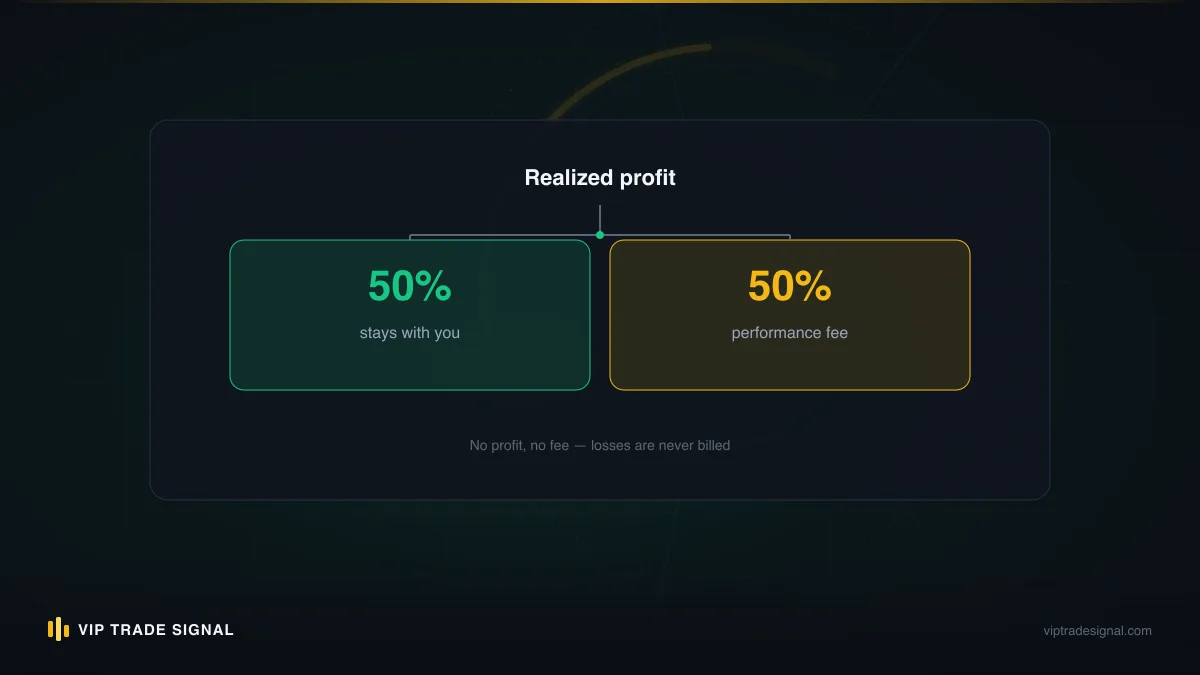
But the percentage is the negotiable part. The structure is not. The split applies to realised profit above your account's recorded peak, full stop. If we draw your account down, and we will at some point, because every trading approach that takes risk draws down, we earn nothing until the account is back above where it was. Not a reduced share. Nothing. The recovery months are on us, exactly like the March-to-June stretch in the table earlier. There is no annual reset, no rolling window, no per-trade billing, and deposits adjust the baseline the day they land.
In drawdown management the same mechanism gets a different name. Before we touch an account that is floating $5,000 to $10,000 down, both sides record a baseline in writing: the account state on day one. Our 50% applies only to recovered profit above that baseline. And, because this is the sentence the industry hates writing: there are no recovery guarantees. None. Some accounts we take on will not recover, or will recover partially, and the baseline structure means those outcomes cost you a fee of exactly zero. That is the entire point of the architecture. The clause does its best work in the scenarios nobody puts in the brochure.
Why volunteer all this? Because the fee structure is the loudest honest signal a provider can send, far louder than testimonials or screenshots. Anyone can post a green month. Publishing every closed result, wins and losses, the way we do with signals, and binding fees to a permanent mark, are commitments that only make sense if you expect to be around, above the mark, next year. We would rather compete on structure than on promises, partly because promises in this industry are worthless and partly because the structure is where we win.
Ten questions to ask any manager about fees
Print these, or paraphrase them in your own words, and put them to any manager before funding, including us. The questions are simple. The hesitations are diagnostic.
- Is there a high water mark, and does it ever reset? The only acceptable answer is yes, and never. Any qualifier after "yes" needs reading in full.
- Show me the exact clause. Not a summary. The text. A manager who paraphrases their own agreement instead of pasting it has read it more carefully than they want you to.
- Fees on realised or floating profit? Realised only. Fees on floating profit let a manager bill you for trades that have not finished losing yet.
- What happens to the mark when I deposit or withdraw? They should describe the adjustment without checking. This is arithmetic a fee-charger performs constantly; fumbling it means it is not being performed.
- Walk me through billing after a 20% drawdown. You want to hear, unprompted, that they earn nothing until the account exceeds its prior peak. If the walkthrough drifts into per-trade or per-cycle language, you have your answer.
- Is any fee charged per trade or per position? No is the answer. Per-trade billing and a high water mark cannot coexist; a provider claiming both has not understood one of them.
- Is there a hurdle, and is it soft or hard? Absence is normal at retail. Confusion about the soft/hard distinction from someone who advertises a hurdle is not.
- Who calculates the fee, from which records? The broker statement, which they cannot edit, not their spreadsheet, which they can.
- What are your worst three months, and did you bill during them? Every manager with real history has bad months. "We don't really have losing months" ends the conversation, and you can find our thoughts on vetting track records in the guide to hiring a forex trader.
- If I stop the arrangement mid-drawdown, what do I owe? Correct answer: nothing beyond fees already crystallised on past peaks. If leaving underwater triggers a charge, the exit fee is a performance fee in disguise, billed on losses.
Two or three shaky answers is a pattern, not bad luck. And notice that none of these questions requires you to evaluate anyone's trading skill, which is genuinely hard even for professionals. Fee structure is the rare part of due diligence where a careful amateur can reach a firm conclusion in one conversation. If you are on the other side of the table, incidentally, building a management operation of your own, the same list is your blueprint in reverse; our piece on becoming a forex fund manager goes into why offering the mark voluntarily is the cheapest credibility you will ever buy.
Where this leaves you
Strip everything above down to its load-bearing walls and you get three sentences. A high water mark performance fee means you pay once, ever, for each dollar of new wealth, and recovery is always free. A hurdle rate means the first slice of return, the slice a savings account could have matched, is free too. Every loophole, reset, rolling window, per-trade carve-out, deposit shuffle, exists to quietly delete one of those two protections while keeping the vocabulary.
Our advice, stated as the opinion it is: treat the mark as non-negotiable and everything else as detail. Do not be charmed out of it by performance screenshots, and do not accept "our strategy doesn't really draw down" as a substitute, because that sentence is either naive or a lie and both are disqualifying. Gold trading, the only thing this desk does, produces drawdowns on any honest timeline; the question was never whether your manager will go underwater but who pays while they swim back.
Read the clause before you fund. Ask the ten questions and watch for the flinch. If you want to see how we answer them, the FAQ covers our fee mechanics in writing, and the agreement text says the same thing in duller prose, which is exactly what agreement text is for. And if a manager anywhere offers you brilliance without a mark, remember the builder who will not guarantee the roof. The refusal is the information. Walk.