There's a specific message we get on the desk more often than any other. It arrives at odd hours, usually from someone who hasn't slept well, and it goes something like this: "I have a buy and a sell open on gold, same size, and I can't close either one. What do I do?"
Nobody plans to end up there. They end up there because months earlier, facing a losing trade, they had to choose between two ways of capping the damage. The hedging vs stop loss decision looks like a coin flip when you first meet it. Both promise the same thing: from this point on, the loss gets no worse. One of them costs you a fixed, visible amount and it's over in a second. The other costs you nothing today, which is exactly why it's so seductive, and then quietly charges you rent for months.
We've spent enough time unwinding other people's hedges to have a firm opinion here. This article is that opinion, with the numbers attached. We'll concede the cases where a hedge genuinely earns its keep, because there are a few. But if you came here hoping to be told your locked gold position was a clever move, you should probably brace yourself.
Hedging vs stop loss: two answers to the same question
Strip away the jargon and both tools answer one question: what is the maximum this trade can take from me?
A stop loss answers it by ending the trade. You're long gold from 3,350, your stop sits at 3,320, and if price touches it you're out for 30 dollars per ounce of exposure, plus a bit of slippage on a bad day. The loss is realised, the margin comes back, and your account is smaller but entirely yours again. Simple. Brutal, occasionally, but simple.
A hedge answers it by freezing the trade. Same losing long from 3,350, price now at 3,290, and instead of closing you open a sell of equal size. From that second, every dollar the long loses, the short gains. Your floating loss is locked at 60 dollars per ounce and it will stay 60 whether gold goes to 2,900 or 3,900. On paper, that's a cap too.
And here's the thing: on the day you place it, the hedge genuinely does the job. The bleeding stops. Your equity curve flatlines. If capping the loss were the whole question, we could end the article here and go home early.
But it isn't the whole question. The real question has three parts: how much does the cap cost, what state does it leave your account in, and what does it do to your decision-making afterwards? The stop loss and the hedge give wildly different answers to all three, and almost everyone who chooses the hedge is answering only the first part, and answering it wrong.
One more thing before we go further. In most jurisdictions your broker nets the two positions anyway, or charges margin on both, so "hedging" in the retail forex sense (holding an open buy and sell on the same instrument in the same account) is a peculiarity of MT4/MT5-style platforms more than a strategy the professional world recognises. That should tell you something. It rarely does.
What a stop loss actually costs you
Let's be fair to the stop loss by being honest about its bill, because it isn't free and pretending otherwise is how people talk themselves into hedging.
First, the realised loss itself. Obvious, but it's the part that hurts, so say it plainly: a stop turns a paper loss into a real one. If you risked 1% of a $10,000 account, you now have $9,900. That's the entire design. The cost is the point.
Second, slippage. Stops are market orders once triggered, and on gold around a hot CPI print or an FOMC statement, a stop at 3,320 can fill at 3,317 or worse. On one standard lot that's an extra $300. It's real, it stings, and it's also survivable in a way the alternatives are not. Slippage is a tax on volatile instruments; you pay it a few times a year, not nightly.
Third, the whipsaw. This is the one traders actually rage about. Price hits your stop to the pip, takes you out, then reverses and marches 80 dollars in your original direction without you. Everyone who has traded gold for more than a month has a story like this, and everyone remembers theirs vividly while forgetting the dozen times the stop saved them from a genuine trend against them. Our memory keeps the receipts selectively.
Fourth, a subtle one: a stop costs you the trade thesis. Once you're out, re-entering requires a new decision, new spread, and the humility to buy back in above where you were stopped. Plenty of people can't do it, so a stop sometimes converts a temporary loss into a missed recovery.
Add all that up and the stop loss is a genuinely imperfect tool. Anyone selling it as painless hasn't used one. But notice the shape of its costs: they are bounded, immediate, and known in advance. You can size a position so that a stopped trade costs 1% and a stopped trade with ugly slippage costs 1.3%. There is no version of the stop loss that quietly compounds while you sleep. That property, boring as it sounds, is worth more than any of its flaws.
What a hedge actually costs you: swaps, margin, attention
Now the hedge's bill, which arrives in three envelopes, none of them marked clearly.
Envelope one: swaps. Hold a position overnight and your broker credits or debits a financing charge. On gold, the long swap is almost always negative, and the short swap is usually negative too, because you're paying carry both ways on a metal. Numbers vary by broker, but on one standard lot of XAU/USD it's common to see something like minus $25 to $45 per night on the long side and a smaller negative, or occasionally a token positive, on the short. Triple swap on Wednesday nights to cover the weekend. A hedged lot can easily bleed $30 to $50 a night combined.
Run that forward. Thirty nights of an average $35 combined debit is roughly $1,050 a month. On a locked position whose frozen loss was $3,000, you're paying about a third of the loss again, every single month, for the privilege of not admitting it. Six months of that and the rent has exceeded the original damage. We'll do a fuller version of this arithmetic below, because it's the part that finally moves people.
Envelope two: margin. Some brokers offer reduced or zero margin on fully hedged positions; many charge margin on the larger leg or on both. Either way, the capital involved isn't working. Your equity is pinned to the locked loss, your free margin is diminished, and any new trade you take sits on top of a structure that will amplify a margin call if you unbalance it carelessly. An account carrying a locked lot of gold is not a $10,000 account with a $3,000 problem. It's a $7,000 account wearing a costume.
Envelope three: attention. The least measurable and possibly the most expensive. A hedged account demands a decision every day and receives one on none of them. You check it in the morning. You check it at night. You draw exit plans you don't execute. The mental bandwidth this consumes would fund a dozen well-planned trades, and instead it funds a standoff with yourself.
The pattern to notice: every cost in the stop's column happens once. Every cost in the hedge's column recurs. Whenever you're comparing a one-off cost against a recurring one, the recurring one wins the pain contest eventually. Always.
The psychology: why hedging feels safer and usually isn't
If the maths is this lopsided, why do intelligent people hedge losing trades? Because the hedge exploits three bugs in human wiring, and it exploits them beautifully.
The first is loss aversion's strange cousin: realisation aversion. A floating loss doesn't feel fully real. It's provisional, arguable, still in play. Clicking close makes it permanent, and behavioural research has shown for decades that people will accept objectively worse gambles to avoid converting a paper loss into a fact. The hedge is realisation aversion built into a trading platform. It lets you keep the loss provisional forever, for a nightly fee.
The second is the illusion of action. Placing a hedge feels like doing something sophisticated. There are two positions now. There's structure. You can tell yourself, and worse, tell your spouse, that the situation is "managed". Closing at a loss feels like defeat; hedging feels like chess. But watch what each actually does to your risk. The stop reduces your exposure to zero. The hedge also reduces your net exposure to zero, while doubling your gross exposure, your swap bill, and the number of decisions required to get your money back. That's not chess. That's paying to postpone checkers.
The third bug is hope with a receipt. The hedger almost never intends to stay hedged. The plan, always, is to "remove the hedge at the right moment": close the short at the bottom, let the long recover, exit the whole mess at breakeven. Notice what that plan requires. It requires you to call the bottom of a move you already called wrong once. The hedge converts one hard problem (was my entry right?) into two harder ones (where is the exact bottom, and where is the exact recovery top?), and hands them to the same forecaster who created the situation.
A hedge doesn't cap your loss. It caps your ability to be wrong only once.
We're not sneering here. Everyone on this desk has hedged a loser at some point in their early years, and everyone remembers how calm it felt for the first week. The calm is the product. You're buying it on a subscription.
When a hedge is legitimate: the short honest list
Having spent three sections attacking the hedge, honesty requires the other side, because there are real uses. The list is short. It fits here.
One: event risk on a position you have researched reasons to keep. You're long gold as a multi-week position with a thesis still intact, and NFP lands in forty minutes. Spreads will blow out, stops will slip, and you don't want out, you want insulation for one hour. A short-dated hedge, placed before the event and closed within the session, is a defensible tool. Key phrase: closed within the session. The legitimate version has an expiry written down before it's opened.
Two: hedging across genuinely different exposures. A miner hedging production, an importer hedging currency payables, a portfolio short dollars overall using gold as a partial offset. These are hedges in the original sense, offsetting a real-world exposure, not freezing a losing speculation. If you don't have an underlying business exposure, this row isn't yours.
Three: broker or platform constraints. A prop firm account with rules that punish closed losses differently from floating ones, or a weekend where you cannot access the platform and want exposure flattened without closing. Ugly, situational, occasionally rational. Rare.
Four: partial hedges as a de-risking step. Shorting half your size against a long you intend to keep, explicitly to cut delta while a correction plays out, with a written level at which the hedge comes off. This is really just position-size reduction wearing a different jacket, and closing half the long is usually cleaner, but we'll allow it.
Read the list again and notice what every legitimate item shares: a purpose other than avoiding the realisation of a loss, and a defined end. Purpose and expiry. If your hedge has both, written down somewhere you can't edit quietly, it might be one of the honest ones.
If your hedge exists because closing hurt too much, and its exit plan is "when things improve", it isn't on this list. It's on the next one.
The hedge that becomes a locked account
Here is the life cycle we see over and over, close to verbatim, in the accounts that eventually reach our drawdown management desk.
Week one: a long gold position goes $2,000 underwater. The trader can't stomach closing, hedges full size, and feels immediate relief. Equity stops moving. Sleep returns.
Week three: gold drops another 90 dollars. The trader feels clever, and here the trap sets properly, because now the plan upgrades itself. Why merely escape at breakeven? Close the short here, bank its gain, and let the long ride the recovery. So the short gets closed near what feels like the bottom.
Week four: it wasn't the bottom. Gold falls another 60. The long's loss, no longer offset, balloons past the original frozen figure. Panicked, the trader re-hedges, at a worse level than before. The locked loss is now bigger than the one the first hedge froze.
Month three: there have been two more attempts to trade out of it, each adding a layer. The account now holds a 2-lot long, a 1.5-lot short, and a 0.5-lot short from different eras, like sediment. Swaps are draining $60 a night. Free margin is thin enough that a normal-sized new trade risks a stop-out of the whole structure, a scenario we've written about separately in our piece on avoiding a margin call in forex.
Month six: the trader no longer has a losing trade. They have a losing account, and the loss is no longer priced in dollars alone. It's priced in months of avoided decisions, in swap bleed that exceeded the original damage, and in the corrosive daily habit of opening the platform only to confirm that nothing has changed.
The stop loss version of this story fits in one line: the trader lost $2,000 in week one and was free by lunchtime.
That's the actual comparison. Not "stop versus hedge on day one", where they look similar, but "stop versus hedge plus every decision the hedge forces afterwards". A stop loss is one decision. A hedge is a decision generator, and it generates them at the worst possible moments, addressed to a person who has already demonstrated, by hedging, that deciding under loss is not their strong suit. We include ourselves in that description on bad days. It's a human weakness, not a fool's.
Case walk-through: one losing gold long, two endings
Let's make it concrete with a trader we'll call Dan. Illustrative numbers, generic scenario, no crystal ball.
Dan has a $10,000 account. He buys 0.5 lots of XAU/USD at 3,350, which at $5 per point per half-lot means every dollar gold moves is worth $50 to him. Gold slides to 3,310. He's floating minus $2,000, 20% of the account, already oversized, but that's a different article. Here the road forks.
Ending one: the stop. Dan closes at 3,310, eats a $2,000 realised loss, and holds $8,000 of clean, unencumbered capital. It's a horrible day. He takes a week off, halves his size, and needs 25% gain to get back to even, which at a sane 1% risk per trade is a long, boring campaign of months. Boring is the good outcome. Every one of those future trades is a free choice made with full margin and a clear head.
Ending two: the hedge. Dan sells 0.5 lots at 3,310. Equity is frozen at $8,000, same as ending one, and this is the seduction: on day one the endings look identical, except one of them didn't require Dan to admit anything.
Now run the tape. Combined swaps on the hedged half-lot come to roughly $18 a night; call it $540 a month. Three months of waiting for the perfect unwind costs $1,620, most of the way to a second $2,000 loss, while the frozen one hasn't moved. Twice in that stretch Dan tries to lift the short at a bottom and re-hedges worse, adding another $700 of damage across the attempts. By month four his equity is near $5,700, his margin is tangled, and his win condition has degraded from "make good trades" to "escape".
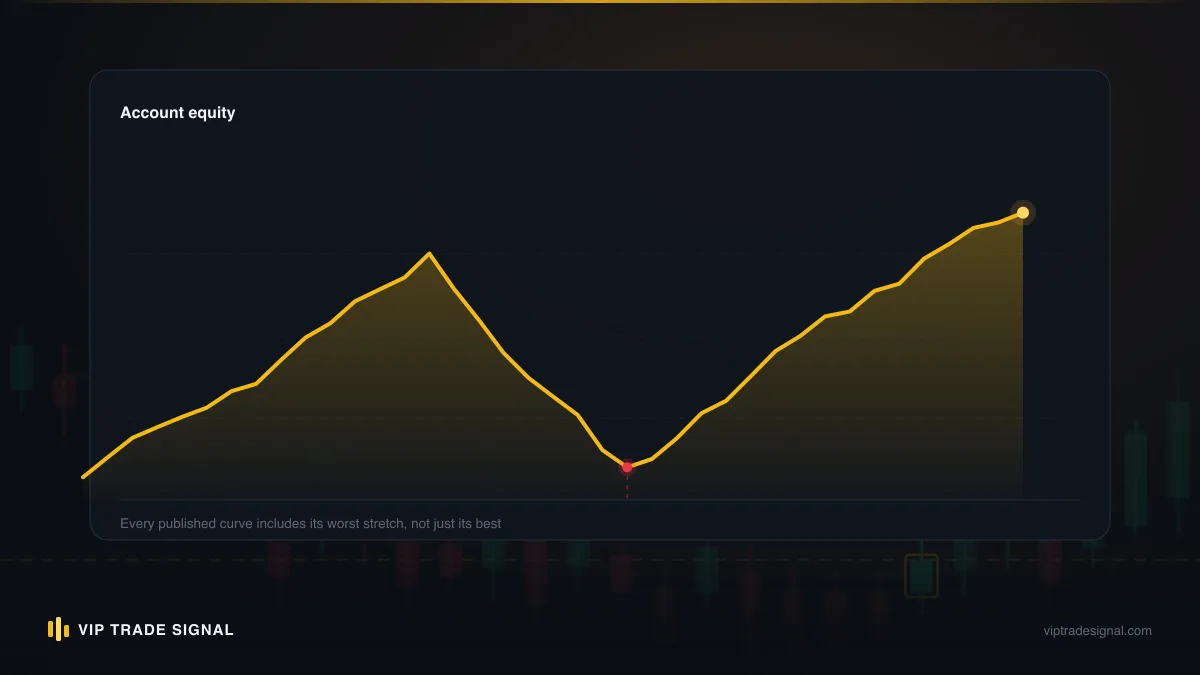
Same trade. Same initial mistake. The difference between $8,000 rebuilding and $5,700 decaying wasn't market skill. It was which loss-capping tool Dan reached for, and everything that tool demanded of him afterwards.
Swap arithmetic: the monthly rent on a locked position
Because the swap bleed is the cost people most consistently underestimate, let's give it its own section and a table. These are representative retail-broker figures for gold; yours will differ, so pull the exact numbers from your platform's specification window before believing anything, including us.
Say the long swap on XAU/USD is minus $28 per lot per night and the short swap is minus $9 per lot per night, with Wednesday's rollover charged triple to cover the weekend.
| Structure | Nightly swap | Monthly (≈30 nights + triples) | 6 months | 12 months |
|---|---|---|---|---|
| 0.5 lot hedged | −$18.50 | ≈ −$555 | ≈ −$3,330 | ≈ −$6,660 |
| 1 lot hedged | −$37 | ≈ −$1,110 | ≈ −$6,660 | ≈ −$13,320 |
| 2 lots hedged | −$74 | ≈ −$2,220 | ≈ −$13,320 | ≈ −$26,640 |
Now put those figures next to the loss the hedge was protecting. A 1-lot hedge locked around a $3,000 floating loss pays that entire loss again in swaps in under three months. Within a year the rent has more than quadrupled the original bill. And the frozen loss is still there, untouched, waiting at the end like a final boss you've been paying to postpone.
The truly perverse part: the swap bill is a realised loss. The thing the hedger couldn't bear to do in one click, they do anyway, in nightly instalments, at a dramatic markup. It's the trading equivalent of refusing to pay a £100 parking fine and instead paying £4 a day, forever, for the space.
A couple of refinements so we're precise rather than merely dramatic. Some brokers offer swap-free accounts, which changes this arithmetic considerably, though many recoup it through wider spreads or admin fees after a grace period, so read the terms rather than the headline. And swap rates float with interest rates; the specific figures above will age, the structure of the argument won't. Whenever holding both sides costs a net negative per night, which for retail gold it almost always does, a locked position is a liability with a subscription fee, and the correct question isn't "when will price come back" but "how much am I paying per month for a number on a screen to stay frozen".
Do that division for your own account tonight. Locked loss divided by monthly swap cost. If the answer is under six, your hedge will double your damage within half a year of indecision. Most people have never run it. Most people, when they finally do, close something within the week.
Stop loss alternatives, and why most of them are hedges in disguise
Before we get to how professionals handle this, a detour worth taking, because the search term that probably brought some of you here is "stop loss alternatives", and the honest answer is that most of what gets sold under that heading is the hedge wearing different hats.
Mental stops. The plan to close manually when price reaches a level, without an order in the system. In theory identical to a hard stop. In practice, the moment price arrives at the level, the same brain that couldn't stomach placing a real stop renegotiates. "It's about to bounce." "The candle hasn't closed." "I'll give it five more dollars." A mental stop is a stop loss with a veto held by the least reliable committee member you know. If you've ever watched a mental stop level recede behind you like a station platform, you already know how this one ends. Hard stops exist precisely because future-you cannot be trusted with the decision present-you already made.
Averaging down. Adding to the loser to improve the entry price. This is worse than hedging, not better; the hedge at least freezes the damage, while averaging grows it. A 0.5-lot loser doubled at a worse price is a 1-lot problem with a slightly prettier breakeven and twice the speed of destruction if the move continues. Gold trends. Averaging into a gold trend is how five-figure accounts become three-figure stories.
Options as protection. Buying a put against a long gold position is the one genuine alternative on this list. It caps downside for a known, one-off premium, keeps the upside open, and expires on a printed date, no permit needed because the purpose, expiry and cost come built in. Two catches. Retail spot traders usually don't have clean access to gold options at sensible size, and the premium on anything worth having is roughly the honest price of the risk, which is to say it often costs about what taking the stop would. Options don't remove the cost of being wrong. They just invoice it upfront, which is exactly why they're respectable.
Reducing size instead of exiting. Closing half the loser and keeping half. Legitimate, and often a decent compromise for a position where the thesis is bruised rather than dead. Note what it involves though: realising part of the loss. It works precisely because it contains the ingredient the other alternatives are designed to avoid.
Switching to a "no stop, small size" model. Some traders run tiny positions with wide or no stops, treating the whole position as the risk. Coherent, if genuinely small, and some long-horizon gold accumulators operate this way with sizes so modest a 400-dollar move reads as noise. But it's a sizing philosophy, not a rescue technique. Adopting it retroactively, on an oversized position already underwater, isn't a strategy change. It's surrender with a rebrand.
Rank them and the pattern from earlier repeats. The alternatives that work (options, partial closes, honest small sizing) all pay the cost of being wrong somewhere visible. The ones that fail (mental stops, averaging, the full hedge) all promise to make that cost disappear, and merely relocate it somewhere darker with interest. There is no fourth category. If someone sells you one, check for a subscription fee.
How professionals think about loss caps
Watch how people who manage risk for a living handle this question, because the contrast with retail hedging is stark.
On any serious desk, the loss cap is decided before the trade exists, expressed in money at risk, and executed without a committee meeting. A position that hits its invalidation level gets cut. Not hedged, not averaged, not "monitored closely". Cut. The trader might re-enter an hour later if the picture changes, and nobody considers that embarrassing, because the stop and the thesis are separate objects. The stop protects capital; the thesis can be resubmitted any time.
Notice also what professionals actually mean by hedging: offsetting exposures across instruments, books, or time horizons, options against spot, one currency pair against a correlated basket, portfolio-level delta trimmed with futures. What they essentially never do is hold a spot long and an identical spot short on the same instrument in the same book, because netted flat with a financing bill is strictly worse than flat. Any risk manager who found that structure on their desk would ask one question: why are we paying carry to have no position?
That question is the whole argument, honestly. Sit with it.
There's a reason our own service publishes every closed signal, wins and losses alike, at our signal history page: every one of those trades carried a hard stop, and a visible chunk of them hit it. Losing trades aren't a malfunction of the method, they're a line item in it. The month always contains stopped trades; the discipline is in what a stopped trade costs, never more than the planned fraction, never a locked structure, never rent. Gold moves too fast and too far to trade it any other way, and it's precisely gold's habit of trending hard, 200 dollars without a meaningful pullback, that makes "hedge and wait for the retrace" such an expensive religion on this particular instrument.
The retail trader's edge over an institution is supposed to be agility: no committee, no mandate, the ability to be flat in one click. Hedging a loser surrenders exactly that advantage and keeps all the disadvantages. You end up with an institution's inertia and a retail account's capital. Worst of both.
Unwinding an old hedge without detonating the account
Maybe you're not reading this ahead of the decision. Maybe the hedge already exists, has existed for months, and the previous section made your ears go warm. Right then. Here's the shape of a sane exit, briefly, and we've written a fuller step-by-step in how to exit a hedged position if you need the long version.
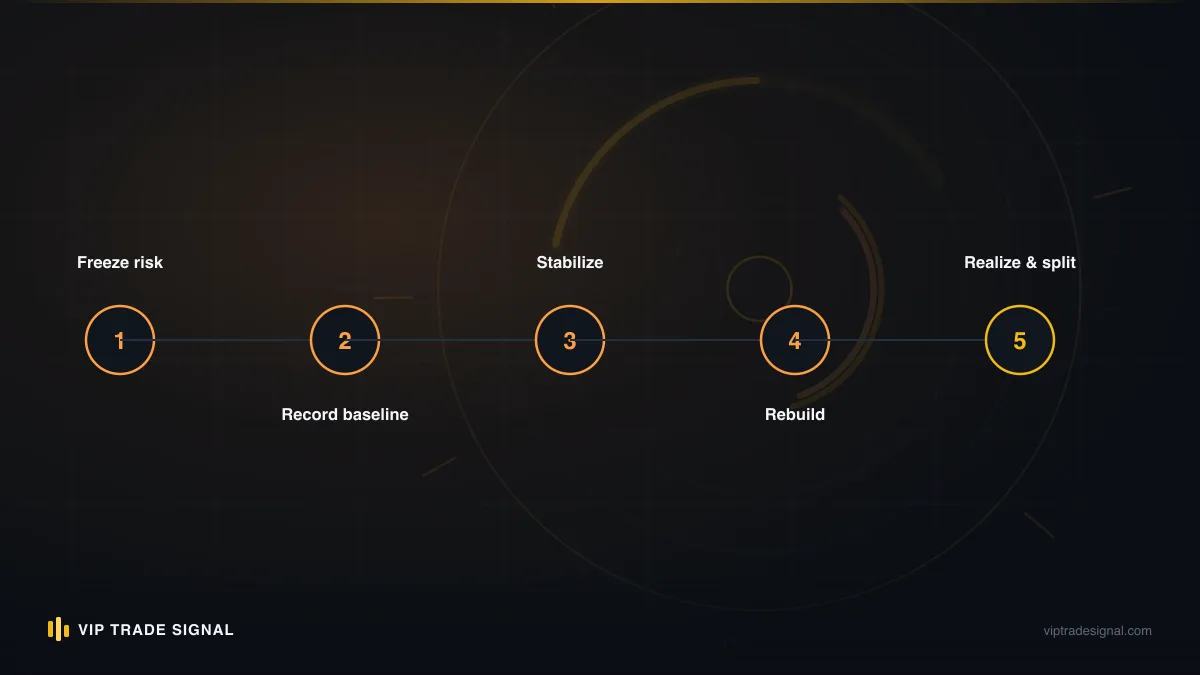
- Measure the real position. Net loss if everything closed now, monthly swap bill, margin consumed. Write the three numbers down. Most people carrying a locked position have never written them down, because vagueness is part of the anaesthetic.
- Accept the frozen loss as spent. It happened months ago; the platform just hasn't printed the receipt. Every unwind plan that works starts from this admission, and every plan that fails, "trade out of it", "lift the hedge at the bottom", is an attempt to dodge it.
- Prefer the boring exit. Close both legs, or close in matched halves over a few sessions if size and spread argue for it. Simultaneous closure means no moment of naked re-exposure. Yes, it crystallises the loss. That's the treatment, not a side effect.
- Resist the clever exit. Lifting one leg to "let the winner run" reopens full directional risk at the exact spot your judgement is most compromised. If you genuinely have a fresh thesis, close everything flat first, breathe, then place the new trade at deliberate size with a stop. Making the new trade a separate decision from the funeral is most of the skill.
- Only then rebuild. Smaller size, hard stops, and a written rule about what happens at invalidation, so the next losing trade meets a policy instead of a mood.
If the structure is large, layered across multiple entries, or the account is floating five figures down, that's the territory where a second pair of hands stops being a luxury; it's roughly the situation our piece on hiring a professional to recover an account walks through, including the fee maths and the trust problems. Whoever helps you, the first honest step is identical: the hedge comes off, the loss becomes a number instead of a hostage, and the account starts breathing again. No recovery of any kind, ours or anyone's, begins while the position is still locked.
Choosing your default: a decision rule you can keep
Time to land this. You don't need a philosophy of hedging vs stop loss. You need a default you'll actually follow at 11pm with a position 40 dollars offside, because that's when the choice really gets made, and defaults chosen calmly beat decisions improvised in pain.
Here's ours, and we'd suggest stealing it wholesale:
The stop loss is the default. The hedge requires a permit.
Every trade gets a stop at the level where the idea is wrong, sized so hitting it costs a fixed, survivable fraction of the account, 1% or so for most people. That's the whole risk policy for 95% of situations, and its greatest feature is that it runs without you. No midnight judgement calls, no bottom-picking, no rent.
A hedge is allowed only with a permit, written before the hedge is placed, answering three questions in one honest sentence each:
- Purpose: what is this hedge for, other than not realising a loss? (Event insulation, offsetting a real underlying exposure, a platform constraint. "Price will probably come back" is not a purpose, it's a hope with a swap bill.)
- Expiry: the date or event at which the hedge comes off, no matter what. Hours or days. Never "when things improve".
- Cost: the swap and margin arithmetic over the permit's life, in dollars, next to the loss you'd realise by just closing. If closing is cheaper, and you'll find it usually is, close.
Can't fill in all three? Then what you're reaching for isn't a hedge, it's anaesthetic, and the kindest thing you can do for the account is press close and feel the sting while it's still small. The sting is information. The numbness is interest-bearing.
One last scenario, and be honest with yourself as you read it. Two traders take the identical bad long on gold tonight. By Friday, one has a realised 1% loss and a flat account. The other has an untouched ego, a frozen 4% hole, and a meter running. Ask which trader you'd rather be in six months. Then ask which one your current habits are quietly turning you into. If the second answer bothers you, and you're not sure your own hand will stay steady when the next loser arrives, our FAQ explains how the desk handles stops on every signal we publish, losses included, because they're included. Losses always are. The only choice you get is whether they're paid once, or monthly.