A trader we'll call Danish joined our signal channel in the spring with $1,400 in an MT5 account and a genuine willingness to do the work. Six weeks later he messaged us with a question we've heard a hundred times in different clothes: "Your signals are up this month. Why am I down?"
He wasn't accusing us of anything. He was confused. He'd taken most of the trades, skipped a few, moved one stop because it "felt fine", and entered two late because he was in meetings. Small decisions. Together they turned a winning month into a losing one.
That conversation is the whole forex signals vs account management debate in miniature. Both products can sit on top of the exact same trading strategy (same entries, same stops, same targets) and produce completely different results, because one of them routes every trade through you and the other one doesn't. We sell both, so we have no incentive to pretend either is magic. What we can do is tell you precisely where each one breaks, what each one actually costs, and how to work out which side of the line you belong on.
Two products, one strategy underneath
Strip away the marketing and the difference is embarrassingly simple.
A signal service sends you trade instructions. Instrument, direction, entry, stop loss, take profit. You read them, decide whether to act, and place the trade in your own platform with your own hands. The analysis is outsourced; the execution is yours.
Account management flips it. You hand over trading access to your account (investor-style access, in any arrangement worth touching) and someone else places the trades directly. The analysis and the execution are both outsourced. Your job shrinks to funding the account, watching the statement, and deciding whether to continue.
At our desk, both products run on the same gold analysis. The XAU/USD setups that go out to the signal channel are the same family of setups traded on managed accounts. So when someone asks us which performs better, the honest answer is uncomfortable: the strategy performs the same, because it is the same. What differs is how much of the strategy's edge survives contact with the person implementing it.
And that gap is bigger than almost anyone expects.
There's a third cousin worth naming here because people constantly confuse it with both: copy trading. Copy trading vs forex signals is really a question of automation: a copy trading platform mirrors a master account into yours automatically, no manual execution, but usually also no stop-loss visibility, no reasoning, and no control over individual trades. It sits somewhere between signals and management, with the transparency of neither. We'll touch on it again later, but this article is mostly about the two ends of the spectrum, because that's where the real decision lives.
What a signal service actually demands from you
Signal sellers advertise the product as passive. It is not passive. It's a part-time job with irregular hours.
Here's what following gold trading signals properly looks like in practice:
- Availability. Gold moves hardest during the London and New York sessions. If signals land at 14:30 your time and you're in a meeting until 15:15, you either miss the entry or chase a worse one. There is no polite scheduling in this business.
- A funded, working platform. MT4 or MT5, logged in, with sensible leverage and a broker whose gold spreads don't eat the trade before it starts.
- Position sizing maths, every single time. A signal says where to enter and where the stop goes. It cannot say how many lots, because it doesn't know your balance. A $1,000 account risking 1% on a signal with a 400-point gold stop needs a very different lot size than a $10,000 account risking 2%. Get this wrong once and you've undone a month of careful trading.
- Emotional compliance. The hard one. Taking the trade you don't like the look of. Not taking the revenge trade after a loss. Leaving the stop where it was put.
That last item is where most people quietly fail, and it deserves its own section, because it's the single biggest reason the same signal produces different results in a hundred different accounts. If you want the deeper mechanics of reading an alert properly (pending versus market orders, how to handle a signal that's already moved) we've written that up separately, and it pairs well with this piece.
The point for now: a signal subscription buys you analysis. It does not buy you discipline, availability, or arithmetic. Those stay firmly on your side of the table.
A day in the life of doing it properly
To make the demand concrete, here's what a well-executed signal day actually looks like. Morning: check the channel before London opens, note any pending setups, confirm your platform is logged in and your balance is what you think it is. Midday: an alert lands. Long gold at 3,312, stop 3,301, targets 3,324 and 3,338. You open your sizing calculator, not the order ticket. Eleven dollars of stop distance, 1% risk on your $3,000 account is $30, so the lot size falls out of the maths in about forty seconds. You place the order, set the stop and both targets, and put the phone down. Afternoon: the trade hits the first target; the signal says move the stop to breakeven, so you do: no improvising, no "letting it breathe". Evening: log the trade. Entry versus signalled entry, exit versus signalled exit, risk taken. Two lines in a spreadsheet.
Nothing in that day is difficult. Every step is teachable in an afternoon. What's hard is doing all of it, in order, on the ninth consecutive day, when the last three trades were losers and the alert arrives during your daughter's school play. The skill of following signals isn't intellectual. It's the same skill as flossing.
Execution drift: why followers underperform the signal they follow
We run a public record of every closed signal at /signals/history, wins and losses, no curation. And we can tell you from years of follower conversations that the account results of people following those signals scatter widely around the published outcome. Some do better, briefly. Most do somewhat worse. A few do dramatically worse. The industry doesn't have a tidy name for this, so we call it execution drift.
Drift has four main sources, and you'll recognise yourself in at least one.
Late entries. A gold signal fires at 3,318 with a stop at 3,306. You see the alert twenty minutes later and price is at 3,324. Enter now and your effective risk is wider and your reward thinner: the trade's maths have changed underneath the same instruction. Do this across twenty trades and you've built yourself a systematically worse version of the strategy. Chasing six dollars of gold movement doesn't feel reckless in the moment. Compounded, it's a tax.
Skipped trades. Nobody skips randomly. People skip the trades that look scary: the counter-trend entries, the ones right after a loss, the ones during ugly candles. And in most real strategies, the uncomfortable trades carry a disproportionate share of the profit, because discomfort is roughly where the edge lives. Skip the scary ones and you keep the mediocre middle of the distribution while cutting off the right tail.
Modified stops and early exits. The signal says hold to 3,340; you close at 3,326 because you're up $40 and the candle wobbled. Or the stop is at 3,306 and you move it to 3,300 to "give it room", converting a defined loss into a bigger one. Every modification feels like judgment. Statistically, it's noise at best and self-harm at worst.
Inconsistent sizing. Risking 0.5% when nervous and 3% when confident means your results are dominated by your mood, not the strategy. One oversized loser can erase five correctly sized winners, and the cruel part is that confidence peaks right after a winning streak, precisely when the next loss is due.
Now, here's the thing worth being blunt about. Execution drift isn't a character flaw. It's what happens when you route a mechanical process through a human being with a job, a family, a phone battery, and a nervous system. Some people can suppress it with checklists and repetition. Plenty of intelligent, disciplined-in-every-other-way adults simply can't, and no amount of self-scolding changes it.
The strategy's edge is decided on the chart. How much of that edge you keep is decided in your head, and in your calendar.
If, after three months of honest effort, your account consistently underperforms the published signal record, you have learned something valuable and expensive: the bottleneck is not the analysis. It's the pipe the analysis flows through. Which brings us to the product built specifically to remove that pipe.
How account management removes the human bottleneck
A managed account takes every failure mode in the previous section and deletes it by deleting your involvement.
Under our arrangement (and this is broadly how reputable forex account management services structure things) you keep your own broker account. Your name, your money, your withdrawal rights. You hand over trading access only. At our desk you keep the master password entirely; we work on the account with trading permissions and never touch withdrawals, and any manager who asks for withdrawal access or wants you to deposit into their account has told you everything you need to know about them. Walk away.
With execution centralised, the drift disappears by construction. Entries happen at the signal price because the signal and the execution are the same event. No trade gets skipped for being scary. Stops sit where the strategy puts them. Sizing follows a fixed risk model instead of a mood. The result the account produces is the result the strategy produced (fees aside, which we'll get to) rather than a degraded copy of it.
We should be equally blunt about what management does not do. It doesn't make the strategy win more. Losing weeks still happen; drawdowns still happen; gold still spikes through stops on a Fed headline now and again. Anyone offering managed trading with guaranteed monthly returns is running a scheme, not a service. We've written a whole piece on why guaranteed returns are the loudest scam signal in forex, and the short version is that a guarantee of profit in a leveraged market is a mathematical impossibility wearing a suit. Management removes execution error. Market risk stays, undiminished, and it's your capital carrying it.
It also introduces a new dependency: the manager. You're now trusting someone else's process, someone else's risk limits, someone else's honesty. That trust should be earned with a public track record, sensible answers to hard questions, and structural protections (your account, your password, your withdrawals), never with screenshots and promises. For gold specifically, we've laid out how a properly structured arrangement works in our piece on gold trading account management, and if religious compliance matters to you, the halal managed forex account question has real substance to it beyond the marketing label.
What each one costs, and where the break-even sits
Money time. This is where the comparison gets concrete, and where our own pricing serves as a worked example precisely because it sits at the honest, expensive end of the market.
Signals first. Our gold signal service runs $99/month flat, unlimited signals, or free if you trade through one of our partner brokers (Exness, XM, IC Markets, Vantage) and keep $250 or more in the account. Industry-wide, paid channels run anywhere from $30 to $300 a month, and the price tells you almost nothing about quality; some of the worst channels we've audited were the most expensive. The full breakdown of what we charge and why lives on our pricing page.
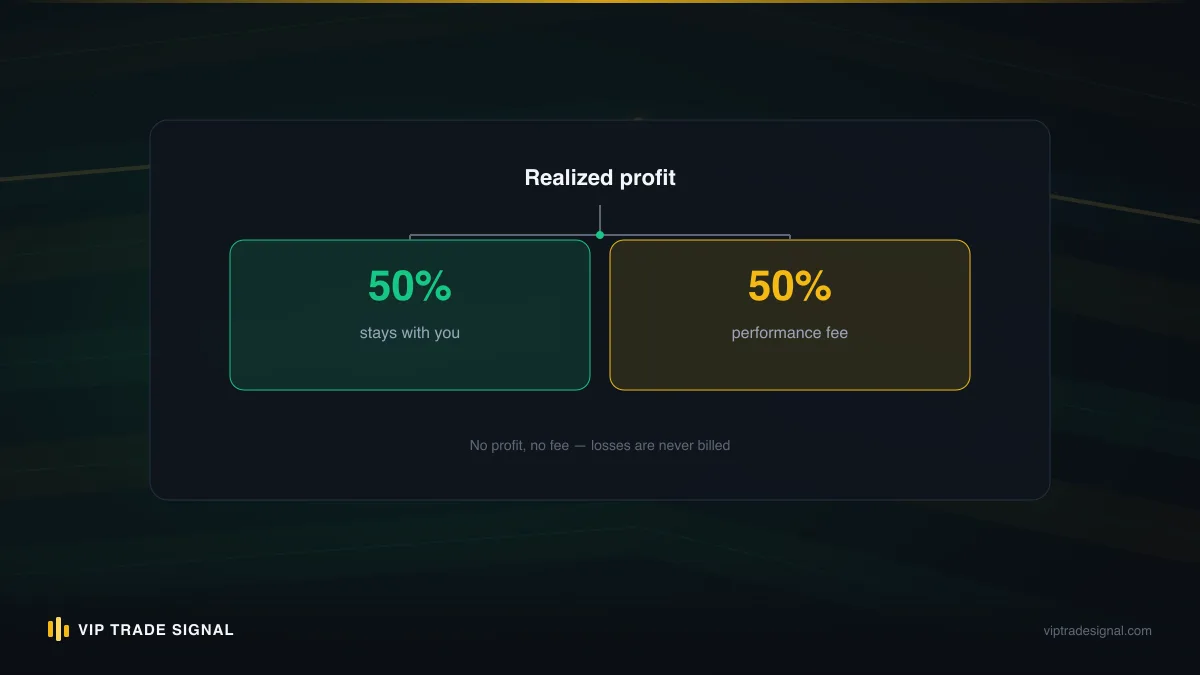
Management runs on a completely different logic: no subscription, no management fee, a flat 50% of realized profit, settled from actual closed results, with a $200 minimum advance. Fifty percent is high (most of the industry quotes 20-35%) and we say so plainly. The trade-off is structural: no minimum account size in the tens of thousands, no lock-in, no fee charged on a losing month. You pay when there's profit and only then. Whether that trade-off suits you depends entirely on your account size, which is what the break-even maths below is for.
Run the numbers on three account sizes, assuming (purely for arithmetic, not as any kind of projection) a month where the strategy nets 5% before fees. Some months will be worse than zero. That's trading.
| Account size | Gross at +5% | Signals: $99 fee, net | Management: 50% share, net |
|---|---|---|---|
| $1,000 | $50 | −$49 (fee exceeds gross) | $25 |
| $5,000 | $250 | $151 | $125 |
| $20,000 | $1,000 | $901 | $500 |
Read that middle column carefully. On a $1,000 account, a $99 subscription is nearly 10% of your capital per month: the strategy has to clear 10% just to pay for its own signals, which is why we push small accounts toward the free-via-broker route at every opportunity. On $20,000, the same subscription is a rounding error, and the profit share starts looking expensive by comparison: $500 versus $99 for the same underlying trades.
So the naive conclusion is: small accounts should prefer profit share, large accounts should prefer a flat fee. And on pure fee arithmetic, that's right. But the naive conclusion assumes you capture 100% of the signal performance, and the entire previous section was about why you probably won't. If execution drift costs you, say, a third of the strategy's edge (late entries here, a skipped winner there, one moved stop) the signal column shrinks fast, while the management column doesn't move. A $20,000 account that executes at 65% efficiency nets around $551 after the subscription. Suddenly the 50% share at $500 is nearly the same money, with none of the labour.
Nobody can tell you your personal drift number in advance. But if you've traded signals before and kept records, you can calculate it: your actual return divided by the published signal return over the same period. Most people who do this exercise honestly find a number that reshapes the whole fee comparison.
Two smaller cost lines deserve a mention before we move on, because they hide in both columns. Spread and slippage hit signal followers harder than managed accounts, oddly enough. Not because the broker treats them differently, but because a follower entering late often crosses the spread at a worse moment, and a follower on a high-spread broker pays a toll on every single trade that the published signal record never shows. If your broker quotes gold at a 35-cent spread while ours assumes 20, you're running a quiet handicap of your own choosing. And on the management side, remember the advance: our $200 minimum advance is credited against future profit share, not an extra fee, but it is money out the door on day one, and you should treat it that way when comparing. Honest accounting counts everything, including the small stuff. Especially the small stuff, because it compounds.
The time cost, honestly measured
Costs aren't only in dollars, and this is the axis where the two products aren't even playing the same sport.
Following signals properly costs, in our experience, somewhere between five and ten hours a week. That sounds high until you itemise it. Checking the channel several times daily. Being genuinely interruptible during London and New York hours. Calculating position size before each entry. Managing trades that are running while you're doing something else. Reviewing your own execution at the weekend, which almost nobody does, and which is precisely why almost nobody improves. None of these blocks is long. All of them fragment your day.
And the hidden cost isn't the hours; it's the attention residue. A running gold position leaks into whatever else you're doing. You check the chart during dinner. You wake up and reach for the phone before your eyes fully open. Ask anyone who's traded through a nonfarm payrolls Friday with an open position and a family lunch: the position wins the attention war, every time.
Management costs perhaps fifteen minutes a week: read the statement, glance at open trades if you're curious, confirm the equity curve matches what's being reported. Once a month, reconcile the profit split against closed trades. That's it. That's the entire job.
For a specific kind of person (the one with a demanding career, a business, young kids, a life that doesn't pause for the London open) this axis alone decides the question. The fee comparison is academic if you structurally cannot be at the screen when the trades happen. We'd rather tell you that plainly than sell you a subscription you'll execute at 40% efficiency and quietly resent.
The learning dimension: signals teach, management doesn't
Here's the strongest argument for signals, and it has nothing to do with fees.
Every signal you follow with your own hands is a small apprenticeship. You see where the entry was placed relative to structure. You watch which setups get stopped out and which run. Over six months of following gold trading signals on XAU/USD, an attentive follower absorbs a real education in how the metal moves: how it behaves into the London fix, what it does around Fed days, why stops on gold need more room than forex-trained instincts expect. You start predicting the signals before they arrive. That's not a party trick. That's a skill forming.
Management teaches you nothing. Zero. The account grows or shrinks and you understand exactly as much about trading at the end of the year as you did at the start. For plenty of clients that's the entire point: they no more want to learn gold trading than they want to learn dentistry from their dentist. Fair enough. It's only a problem when it's unacknowledged.
But be honest with yourself about whether the learning argument actually applies to you, because it comes with two conditions people skip. First, learning requires attention: if you're auto-following alerts while distracted, you're getting the labour of signals with the education of management, the worst corner of the grid. Second, learning has tuition costs, and the tuition is your execution drift. The months you spend developing judgment are months of late entries and skipped trades, paid for in real money. Sometimes that tuition is a bargain. A follower who graduates to independent trading has bought a permanent skill. A follower who was never going to trade independently has paid tuition for a degree they'll never use.
Ask yourself the question directly: in two years, do you want to be a trader, or do you want to have a traded account? Different destinations. Different vehicles.
Who actually holds the risk decisions
This section matters more than the fee section, and gets read less.
In both models, the capital risk is entirely yours. Your account, your money, your drawdown. No fee structure changes that, and gold is a violent instrument: a hundred-dollar range in a week is not unusual, and leveraged exposure to that range can mark an account down fast in either direction. Anyone comfortable in this market has made peace with losing weeks. If you haven't, neither product is ready for you yet.
What differs is who holds the decision risk: the risk of a human making a bad call under pressure.
With signals, the decision risk is split and murky. We decide the setups; you decide participation, timing, and size. When a month goes wrong, untangling whose decisions caused it takes honest record-keeping that few followers maintain. Was it a bad signal month, or a badly executed one? Our public history at /signals answers the first question. Only your own trade log answers the second, and most people would rather not know.
With management, the decision risk consolidates onto the manager, which is cleaner and more dangerous at once. Cleaner, because accountability is total: the statement is the manager's report card, unexcused. More dangerous, because a manager with bad risk habits can hurt you faster than your own hesitant hands ever would. You've handed the weapon to someone who actually knows how to swing it. This is why the structural questions are non-negotiable before any account management arrangement: What's the maximum risk per trade? Is there a drawdown level at which trading pauses and we talk? Do I keep withdrawal control? (With us: defined risk caps per trade, yes there's a pause-and-talk threshold, and you keep the master password and withdrawals, always.) A manager who bristles at those questions is a manager auditioning for a scam piece.
One more asymmetry worth naming. With signals, you can stop instantly: close the platform, mute the channel, done. With management you can revoke access any time too, but there may be open positions, and the unwind takes a conversation. Not a real barrier with an honest manager. Worth knowing about in advance regardless.
Forex signals vs account management: a decision framework
Enough theory. Here's how we'd actually route you, based on the three variables that decide almost every case.
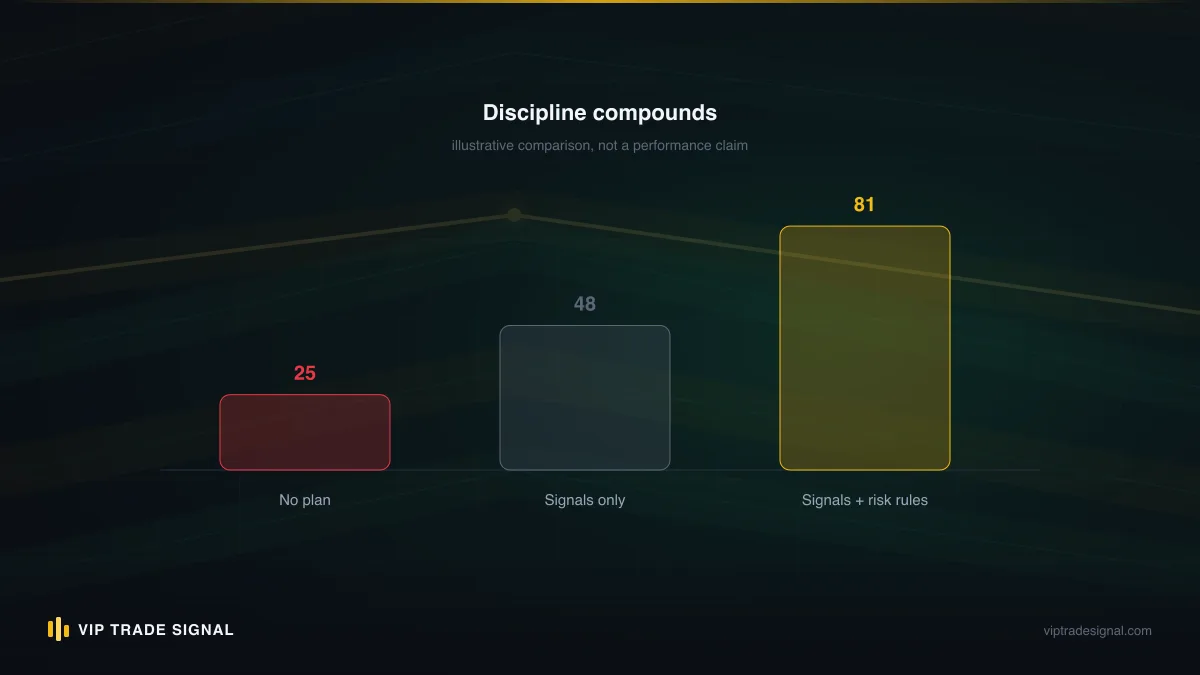
Capital. Under $1,000, a paid subscription is mathematically hostile; the fee is too large a share of the account. Take signals free via a partner broker with $250+ maintained, keep risk tiny, and treat the year as education. Between roughly $1,000 and $5,000, both models genuinely work; the deciding vote goes to schedule and temperament. Above $10,000, the profit share gets expensive in absolute dollars, and signals become attractive if and only if your execution is clean; a big account executing badly loses more to drift than it saves in fees.
Schedule. Be brutal. Can you act on an alert within ten minutes during London and New York sessions on most days? If the honest answer is no (meetings, shift work, a timezone where the sessions cross your night) signals will structurally underperform for you regardless of quality, and no willpower fixes a calendar. That's a management profile, or at minimum a pending-orders-only signal style with reduced expectations.
Temperament and goals. If you've traded before and know you interfere with positions (moving stops, closing early, revenge trading) you have the self-knowledge most people pay years for. Use it. Handing execution to a process you can't sabotage isn't weakness; it's the same logic as not keeping biscuits in the house. Conversely, if you have the discipline of a metronome and the ambition to eventually trade independently, signals are your apprenticeship, and paying a profit share would be paying someone else to attend your own classes.
For the beginner with modest capital wondering about a managed forex account for beginners specifically: the honest answer is that management suits beginners with money and no time, while signals suit beginners with time and modest money. A beginner with neither should be on a demo account, not a payment page, and we'd genuinely rather say that and lose the sale.
And copy trading, our third cousin from earlier? It suits almost nobody we'd want as a client, frankly. You inherit the automation of management without its accountability, and the detachment of signals without their education. The master trader owes you nothing, often trades without visible stops to keep the win rate cosmetic, and can change style overnight. If you want automation, take it with a named, questionable, accountable human attached.
Using signals as a trial run before management
Here's the play almost nobody suggests, because most companies sell one product or the other and have no reason to sequence them. We sell both, so we can.
Run signals first (free via a partner broker if the account is small) for a fixed trial of two or three months. Not to make money, primarily. To generate data. During the trial, keep a simple log: every signal published, whether you took it, your actual entry versus the signal entry, your exit versus the signalled exit, and your risk per trade. Ten seconds per trade in a spreadsheet. At the end, compute one number: your account's return divided by the published signal return over the same window.
That number is your personal execution efficiency, and it converts this whole article from opinion into arithmetic for your specific case.
- Above ~90%: you execute cleanly. Stay on signals; a profit share buys you little you don't already have, and the flat fee is the cheaper pipe for the same water.
- Roughly 60–90%: you're leaking. Diagnose before you decide: if the leak is schedule (late entries clustered in work hours), management fixes what discipline can't. If it's nerves (skipped scary trades, moved stops), you can either train it out with strict rules or admit the biscuit-tin logic applies to you.
- Below ~60%, or you dreaded every alert: the experiment worked perfectly. It just told you the answer was management. Moving to a model where your 50% share comes out of undegraded strategy performance will likely leave you with more actual money than keeping 100% of a heavily degraded one, and it will certainly leave you with your evenings.
The trial costs you two months and a small account's worth of tightly controlled risk. Compare that with the usual approach: picking a model on vibes, running it for a year, and never knowing whether the results reflect the strategy or your own interference. Cheap information, honestly earned.
A few rules to keep the trial honest, because a corrupted experiment is worse than none. Fix your risk per trade before you start and never change it mid-trial; if sizing floats with your confidence, the efficiency number measures your mood, not your execution. Log the trades you skip as well as the ones you take, with a one-word reason ("meeting", "scared", "asleep") because the pattern in that column is often the entire diagnosis. Don't run the trial during a holiday month or a week you know is chaos at work; you want a representative sample of your real life, not your best behaviour. And resist the urge to end it early after a good fortnight. Twenty trades is a bare minimum before the number means anything; forty is better. Danish, from the top of this piece, ran exactly this exercise after our conversation. His number came out around 70%, his skip column said "scared" eleven times, and he made his decision with no hard feelings in either direction. That's the outcome we're after: not a convert, a clear-eyed customer.
Where this leaves you
Strip the whole comparison down to one sentence: signals sell you analysis and keep you as the bottleneck; management removes the bottleneck and charges you for the removal.
Everything else follows from that. The fee structures, the time demands, the learning curve, the trust requirements: all of them are downstream of whether the trades pass through your hands or don't. Which means the real question was never "which product is better". It's narrower and more personal: are you a good pipe? Available when the market is, calm when the position is against you, consistent when your mood isn't. Some people are, and for them signals are clearly the better economics. Many aren't, hate admitting it, and burn eighteen months proving it to themselves the expensive way.
Our suggestion, in order. Check the public record at /signals/history first (every closed gold signal, wins and losses) because no comparison matters until you trust the underlying strategy. If the record convinces you, run the two-month signal trial and log your execution honestly. Then let your own number, not our marketing and not your self-image, choose between the $99 subscription and the managed account with its 50% profit share and $200 advance.
One product teaches you to trade. The other trades so you don't have to. Both lose money some months, because that's what trading is, and anyone telling you otherwise is selling the third product — the one where the only guaranteed profit is theirs. Know which of the first two you actually need, prove it with a cheap experiment, and ignore anyone who claims the answer is the same for everyone.