Two traders hand their accounts to two different managers in the same month. One agrees to give up 50% of profits. The other negotiates hard and gets 20%. Six months later, the trader on the 50% deal has paid less in fees — meaningfully less — than the one who thought he'd won the negotiation.
That's not a riddle. It happens constantly, and it happens because the forex profit split number everyone fixates on is the least important term in the agreement. The percentage is the headline. The base it's applied to — realized or floating profit, gross or net of losses, reset monthly or tracked against a high-water mark — is the actual price. Change the base and a 20% split can quietly become the most expensive deal on the table.
We run an account management desk, we charge a flat 50%, and we'll defend that number later in this piece. But mostly this article is about the machinery underneath the number, because once you understand the machinery you can evaluate any profit sharing agreement in about ten minutes, ours included. That's the goal. Not to sell you a percentage — to make you the person in the room who asks the questions the percentage was designed to distract you from.
Why the profit split model exists at all
Start with the alternative, because the profit split only makes sense in contrast to it.
The old model for managed money was fixed fees: a percentage of assets under management, charged whether the manager made you money or lost it. Hedge funds still run a version of this — the famous "2 and 20" is 2% of your capital every year plus 20% of profits. That 2% arrives rain or shine. A fund managing $100 million collects $2 million a year for existing.
Retail forex account management mostly dropped the fixed component, and for a sensible reason: the account sizes are too small for it to work. If someone hands you a $3,000 MT4 account, a 2% management fee is $60 a year. Nobody is watching gold through a London session for $60 a year. So the industry converged on performance-only pricing: the manager eats what they kill, and if the account doesn't grow, the manager earns nothing.
This is, genuinely, a good structure. It's one of the few fee models in retail trading where the incentives roughly point the same direction. You want profit. The manager only gets paid from profit. Compare that to a signal seller charging a monthly subscription regardless of results, or a broker earning spread on every trade whether it wins or loses, and profit sharing looks almost quaint in its fairness.
Almost. Because "the manager only gets paid from profit" has a load-bearing word in it, and the word is profit. Define it one way and the model is fair. Define it another way and the manager can invoice you for money you never actually made. The rest of this article is about that word.
One more thing worth saying up front: performance-only pricing does not make the underlying activity safe. Trading leveraged forex and gold is high risk however the fees are structured, and a manager working for 50% of profits can still produce a losing year. The split governs how gains are shared. It says nothing about whether there will be gains.
The forex profit split number vs the base it's calculated on
Here's the exercise we'd put in front of anyone comparing managers. Take the sentence "we charge X% of profits" and ask four questions:
- Profits measured when? At settlement, or including trades still open?
- Profits measured against what? This month's starting balance, or the highest point the account has ever reached?
- Do losses count? If the account drops $800 one month and gains $800 the next, is that a profit?
- Is X% the whole price? Or is there a monthly fee, a per-lot charge, a "technology fee", a markup on spread through a mandated broker?
Two managers can quote you the same percentage and give opposite answers to all four. At that point they're not offering the same product at the same price. They're offering different products that happen to share a marketing number.
The pattern you'll notice, once you start asking, is that the lower the headline percentage, the murkier the answers tend to get. That's not a coincidence. A manager who genuinely lives on performance fees alone has to charge a percentage that keeps the lights on — and has every reason to define profit conservatively, because their reputation is the business. A manager advertising 15% either has enormous accounts (in which case they're not talking to retail), or is making up the difference somewhere you haven't looked yet. Common somewheres: rebates from a broker they insist you use, per-trade commissions, "account setup" charges, or a profit definition so generous to them that 15% of it exceeds 50% of the honest number.
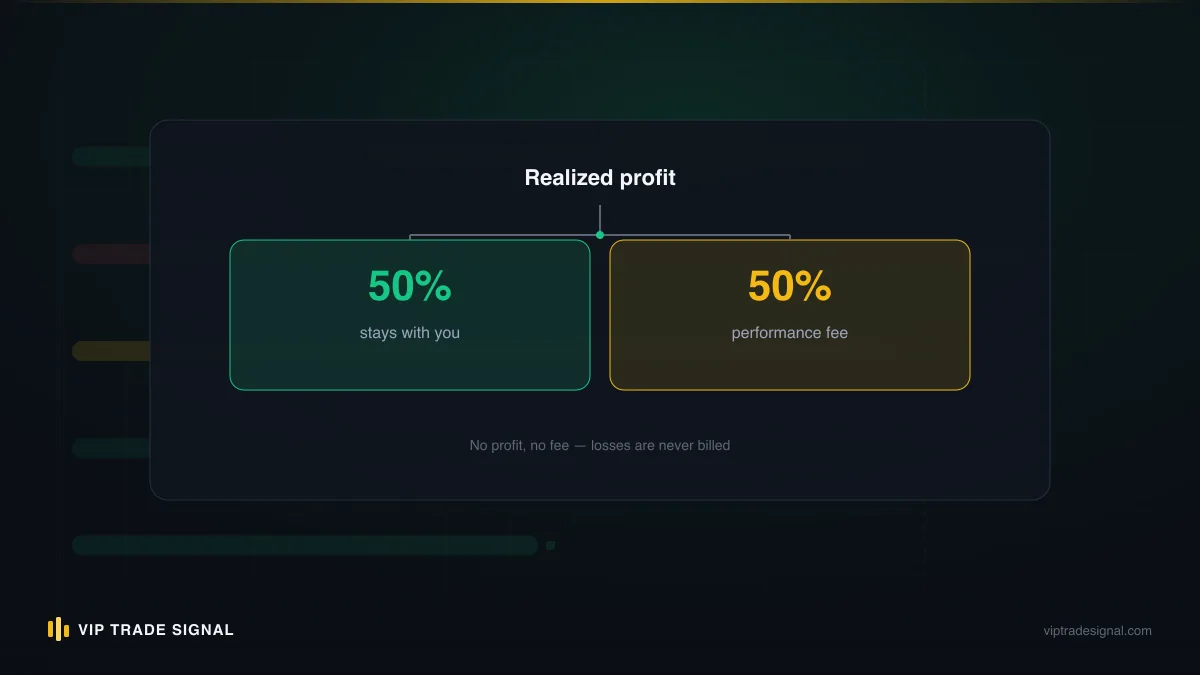
We'll walk through each of the four questions properly, because each one is its own small minefield. But hold onto the framing: percentage is the sticker, base is the price. You wouldn't buy a car advertised at "£300 a month" without asking for how many months. Don't buy a profit split without asking "of what?"
Realized vs floating profit: the manipulation zone
This is the single most important clause in any forex profit sharing agreement, and it's the one most likely to be missing from the agreement entirely.
Realized profit is money from closed trades. The position is flat, the P&L is booked, the number is final. Floating (or unrealized) profit is the paper value of trades still open. It can evaporate in an hour. If you've ever watched a gold long swing from +$400 to −$150 over a Fed press conference, you know exactly how solid floating profit is.
A fair agreement charges the split on realized profit only. Full stop. If the manager's fee is calculated on floating profit, you can be billed for gains that never existed by the time you could have touched them.
Worse, floating-profit billing creates a specific, ugly incentive around losing trades. Picture a manager who's long gold from 3,340, and the trade goes against them. If fees are charged on realized results, they have a reason to close the loser, book the loss, and let it offset future gains. If fees are charged on floating equity measured at a convenient moment — or if realized losses simply don't count against realized wins — the incentive flips: keep the loser open forever, never realize it, and keep invoicing on the winners around it. This is how you get accounts showing a "profitable" history of closed trades while three underwater positions from months ago quietly consume the margin. Traders who've spent time around Telegram-run managed accounts will recognise the shape.
Say you start a month at $5,000. The manager closes $600 of winning trades and leaves one position floating at −$450. What's the profit? On a realized-only, loss-blind reading: $600, and at 30% you owe $180 — on an account that is actually up $150. A cleaner reading nets the open risk or waits for it to resolve. The difference between those two readings, compounded over a year, is frequently larger than the difference between a 30% and a 50% split.
Questions to ask, verbatim if you like: Is your fee calculated on closed trades only? What happens to open positions at settlement time? If a position is floating down when we settle, does that reduce the fee? A manager with clean terms answers in one sentence each. A manager who starts explaining why it's complicated has just answered a different question, and you should hear it.
For what it's worth, this is why our own terms use the phrase "realized profit" rather than just "profit". On our account management service the 50% applies to booked results, you keep the master password, and you can see every open position yourself at any time — which makes the floating-profit game structurally impossible to play. Not because we're saints. Because the setup doesn't allow it, which is better than trust.
Loss netting: does last month's loss offset this month's fee?
Second minefield. Suppose the account loses $700 in March and makes $700 in April. Over two months you have made nothing. Do you owe a fee?
Under a netting arrangement — usually implemented as a high-water mark — the answer is no. The manager only charges on profit above the account's previous peak. March took the account below its peak; April merely got it back. New fees start once the account makes new ground. This is the standard in the professional fund world, and it's the standard for a reason: without it, volatility itself becomes billable.
Under a monthly reset arrangement, each month starts from zero. March's loss is forgotten on 1 April, and April's $700 gain is fully chargeable. At 30%, you'd pay $210 for the privilege of breaking even. String a few of those cycles together — down $500, up $500, down $400, up $600 — and a flat account has generated hundreds of dollars in fees. The manager hasn't grown your money at all. They've monetized its wobble.
A profit split without loss netting isn't a performance fee. It's a volatility tax with better branding.
Monthly resets aren't always malicious. Some small desks use them because tracking high-water marks per client is administrative work, and some are upfront about it. But the economics are what they are: a reset structure pays the manager for round trips, and round trips are the easiest thing in trading to produce. You should treat the absence of netting as a price increase — a large, invisible one — and weigh it accordingly. A 25% split with monthly resets on a choppy account can cost more than a 50% split with a high-water mark. Not can — usually does, on any account that experiences normal drawdowns, which is every account.
The middle-ground version you'll sometimes meet is netting within a settlement period but not across periods. Losses in the same month offset gains in the same month, but January's drawdown never carries into February. Better than nothing. Still worth pricing in: ask how deep a drawdown has to get before the structure starts charging you for the recovery, and think honestly about whether the strategy being traded will visit that zone. Aggressive gold strategies visit it regularly. Ours included — we publish every closed signal, losers and all, precisely because pretending drawdowns don't happen is how this industry got its reputation.
While you're asking: get the netting rule in writing, with a worked example, in the agreement itself. "We're fair about that" is not a clause.
Settlement timing: monthly, quarterly, or per-withdrawal
When the fee gets calculated matters almost as much as how, because timing decides how much noise gets crystallised into charges.
Monthly settlement is the retail default. Every month, profit is tallied and the split is taken or invoiced. It's simple and predictable, and the manager gets paid often enough to stay motivated. The weakness: months are short. A strategy can be up in eight months of a flat year, and without a high-water mark you'll pay in all eight. Even with one, monthly settlement locks in the manager's share of any gain that later gives itself back.
Quarterly settlement smooths this. More of the up-and-down cancels out before anyone gets billed. Managers dislike it for cash-flow reasons, which is fair — three months is a long time to work unpaid — but from the client's side, longer periods are almost mechanically cheaper on the same terms.
Per-withdrawal settlement charges the split only when you actually take money off the account. This is the purist's version: nothing is "profit" until it's in your bank. It's rare, because it can starve the manager for months, but where it's offered it removes the realized-vs-floating argument entirely. You can't dispute the reality of a withdrawal.
Advance-based settlement flips the direction: you pay something up front, and it's reconciled against your share later. Treat these with care. An advance is fine when it's small, disclosed, and genuinely netted against future fees — we take a $200 minimum advance ourselves, and the pricing page says so in plain text, because a desk trading your account for weeks before any possible payout needs some commitment from your side too. An advance is not fine when it's large, non-refundable, and quietly additional to the split rather than part of it. "Pay $2,000 to activate premium management" is not an advance. It's the product.
There's a timing trick worth knowing about even under honest monthly settlement: the boundary itself. A manager holding a large floating winner on the 30th can close it on the 31st or the 1st, and where the fee lands depends entirely on which side of midnight the click happens. On its own that's harmless. Combined with a monthly-reset structure it isn't — closing winners just before settlement and losers just after it turns each month's chargeable number into something the manager partly chooses. High-water marks make the game pointless, which is yet another argument for insisting on one. Boundary rules — what happens to trades open at settlement, who decides when they close relative to the fee date — deserve a sentence in the agreement, not a shrug on a call.
The question that cuts through all of it: walk me through last month's settlement on a real account, numbers redacted. A legitimate manager can sketch it in two minutes — starting equity, closed P&L, high-water mark, fee, done. If the walkthrough requires a spreadsheet you're not allowed to see, the spreadsheet is the business model.
What common split levels actually signal
Percentages cluster, and the clusters tell you things. Rough map of the retail landscape:
| Split level | Where you see it | What it usually signals |
|---|---|---|
| 10–20% | "Too good" offers, PAMM marketing, Telegram ads | Revenue is coming from somewhere else: broker rebates, mandated deposits, volume commissions, or a base that inflates "profit" |
| 20–30% | Larger PAMM/MAM managers, some prop-style arrangements | Viable on big pooled capital; on a $2,000 account, nobody can live on this honestly |
| 30–40% | Established managers with real minimums ($10k+) | Often legitimate — the account size does the earning |
| 50% | Low-minimum retail desks, recovery/drawdown work | High, and honest about it: small accounts, pay-as-you-go, no other charges — if the base is clean |
| 60%+ | Desperation territory | Either genuinely elite and closed to you anyway, or a manager who plans to earn once and disappear |
The pattern to internalise: the percentage has to make sense as a living. A manager running $5 million of pooled client money at 25% earns well from modest returns. A manager running a book of $1,500–$5,000 retail accounts cannot survive on 20% of anything. So when a low-minimum service advertises a low split, your first question shouldn't be "great, where do I sign" — it should be "what am I not seeing?" Usually you're not seeing the broker relationship. Managers who earn per-lot rebates from an introducing-broker deal get paid on volume, not profit, and their trading will reflect it: more trades, bigger sizes, tighter churn. The split was never the price. The spread was.
How do profit sharing agreements work in forex at the honest end of the market? Broadly: the split is high enough to be the entire revenue, the base is realized profit above a recorded mark, and the manager's upside is strictly a fraction of yours. Every deviation from that shape is a place where their incentives and your interests start pointing different directions, and incentives, over enough trades, always win. We've written before about how the free-signal economy runs on exactly this kind of hidden broker economics — the mechanics in signals versus account management rhyme with everything in this table.
The 50/50 split: when it's fair and when it's greedy
So let's talk about 50%, since it's what we charge and it's the number that makes people flinch.
Flinching is reasonable. Half is a lot. A hedge fund charging 50% of profits would be laughed out of the room — the standard there is 20%, trending lower. If your instinct says "50% is more than double the professional norm", your instinct is correct, and any desk charging it owes you an explanation rather than a shrug.
Here's the explanation, and you can judge it. The professional norm is 20% plus 2% of assets annually on institutional money. Two percent of a $50 million allocation is a million dollars before performance enters the conversation. The 50/50 profit share trading arrangement exists at the opposite end: accounts of $200 to a few thousand dollars, no management fee, no minimum term, no charge in losing months, nothing on the spread. All the revenue has to come out of the one number, and the accounts are small. Fifty percent of a good month on a $2,000 account might be $150. That's the whole invoice for weeks of screen time. Charge institutional percentages on retail sizes and the maths simply dies; every desk that claims otherwise is being paid through a door you can't see.
When is 50% fair, then? When four things are simultaneously true:
- The base is clean. Realized profit, netted against losses, above a recorded baseline. Fifty percent of an honest number.
- It's the only charge. No monthly fee, no setup fee, no mandated broker with widened spreads. If any of those exist, the real split is higher than 50 and they're hiding it.
- You keep control. Your account, your broker, your master password, withdrawals in your hands. A 50% partner who can't touch the capital is a very different proposition from one holding your funds.
- Losses cost the manager too — in the sense that a losing month means they worked for nothing, and the high-water mark means they keep working for nothing until it's recovered.
And when is 50% greedy? When it's layered on top of other revenue. Fifty percent plus a monthly retainer is not a profit split, it's a subscription with a bonus. Fifty percent calculated on floating gains or gross wins is not 50% — run the numbers and it's often the economic equivalent of 70 or 80 on the honest base. The percentage was never the problem. The stacking is.
There's also a psychological argument for the flat structure that gets less airtime than the arithmetic, and it's this: a manager whose entire income is half your realized gain wants exactly what you want, at exactly the same moments. No incentive to churn, because volume pays nothing. No incentive to hide losers, because unrealized trades pay nothing. No incentive to keep a doomed account limping along for its retainer, because there is no retainer. The alignment isn't a virtue of the people involved. It's a property of the structure — which is precisely why you should prefer structures that don't require the people to be virtuous.
One scenario for texture. A trader we'll call Priya puts $2,500 under management on a flat 50/50 with a high-water mark. Month one: +$300 realized. She pays $150. Month two: −$210. She pays nothing. Month three: +$280, but the mark sits at $2,800 from month one, so only the $70 above it is chargeable — $35 to the manager. Total over the quarter: account up $370, fees $185, everything visible on her own MT5 login. Boring. Auditable. Exactly what this arrangement should feel like.
The clauses in a profit sharing agreement that define everything
The percentage takes one line of the agreement. Everything that actually determines your outcome lives in the other clauses, and most people skim them. Don't. Here is the checklist we'd run any forex profit sharing agreement through — including ours, which is partly why the FAQ answers most of these in plain language rather than making you dig.
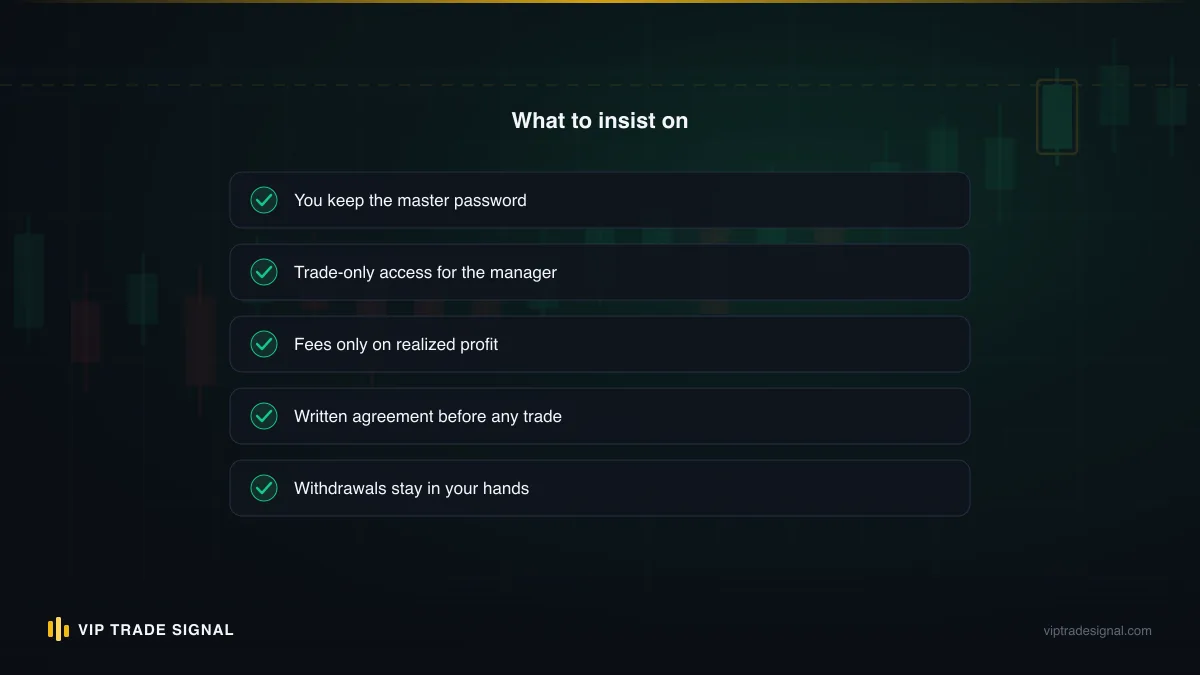
- Profit definition. The words "realized" or "closed trades" must appear. If the agreement says only "profits", ask why, then ask again in writing.
- Baseline and high-water mark. The starting equity should be recorded — screenshot, statement, both signatures — and the agreement should state whether the mark persists across periods. This is the loss-netting clause wearing formal clothes.
- Settlement period and mechanics. When is the fee calculated, how is it paid, and what happens to open trades at the boundary?
- Custody and access. Who holds the master password? Who can withdraw? The only good answer is you, and only you. A manager needs trade-only (investor-level trading) access, never withdrawal rights. Any agreement that requires moving money to the manager's own account or wallet is not account management. It's a transfer, and transfers to strangers on the internet have a well-documented failure mode.
- Risk parameters. Maximum lot size, maximum open exposure, whether a hard equity floor triggers a stop. Vague is bad. "Risk is managed dynamically" means "we'd rather not say".
- Termination. You should be able to revoke trading access same-day, at your broker, without the manager's cooperation. If ending the relationship requires their permission, you don't have a manager, you have a hostage-taker with a nicer website.
- What is not promised. This one sounds strange until you've read enough scam agreements. An honest contract explicitly disclaims guaranteed returns, because honest managers lose sometimes and say so. A contract promising "10% monthly" or "capital protection" is describing something that doesn't exist — the anatomy of that particular lie gets a full article in guaranteed returns and why they're always a scam.
- Fee on what instrument, at which broker. If the manager insists on one specific broker, ask directly whether they receive rebates or commissions from it. The answer changes everything about how to read their trade frequency.
None of this is exotic. It's an afternoon's reading and a few blunt emails. The managers worth working with answer blunt emails quickly, because they've answered them a hundred times. The ones who go quiet, or reply with enthusiasm about opportunity instead of clauses, have told you what the clauses would have.
Worked scenarios: same returns, three splits, three very different bills
Time to put numbers on the thesis, because "the base matters more than the percentage" is the kind of claim that should have to prove itself.
Take one account and one year of identical trading. Starting balance $5,000. Twelve months of results, realized: +$400, −$250, +$350, +$500, −$400, +$300, −$150, +$450, +$250, −$300, +$400, +$350. Total net profit for the year: $1,900. A 38% year — a good year, and an honest shape for one, with four losing months in it.
Now bill that same year under three structures you'll genuinely meet in the wild:
Structure A — flat 50%, realized profit, high-water mark. The mark starts at $5,000 and ratchets up. Losing months cost nothing; recovery months only charge above the previous peak. Work it through month by month and the chargeable profit is exactly the net $1,900 — the high-water mark guarantees you never pay on the same dollar twice. Fee: $950. You keep $950. Painful-looking percentage, clean arithmetic.
Structure B — 30% with monthly resets, no netting. Each month stands alone; losses vanish from memory. Chargeable months are the eight winners: 400 + 350 + 500 + 300 + 450 + 250 + 400 + 350 = $3,000 of "profit" — on an account that made $1,900. Fee: 30% × $3,000 = $900. Nearly the flat-50 bill, at a headline rate people call cheap. Make the year choppier — same $1,900 net, bigger swings — and Structure B sails past Structure A without slowing down.
Structure C — 20% split, plus $99 monthly "platform fee", at the manager's mandated broker. The split: 20% of $3,000 (they also reset monthly, they always do) = $600. The platform fee: $1,188 across the year, charged in losing months too. Total visible cost: $1,788 — and that's before the broker spread markup, which on an actively traded gold account can quietly add hundreds more. The 20% deal costs almost twice the 50% deal, on identical trading.
| A: 50%, netted | B: 30%, monthly reset | C: 20% + $99/mo | |
|---|---|---|---|
| Headline rate | 50% | 30% | 20% |
| Chargeable base | $1,900 | $3,000 | $3,000 |
| Performance fee | $950 | $900 | $600 |
| Other charges | $0 | $0 | $1,188+ |
| Total cost | $950 | $900 | $1,788+ |
| Cost as % of real profit | 50% | 47% | 94%+ |
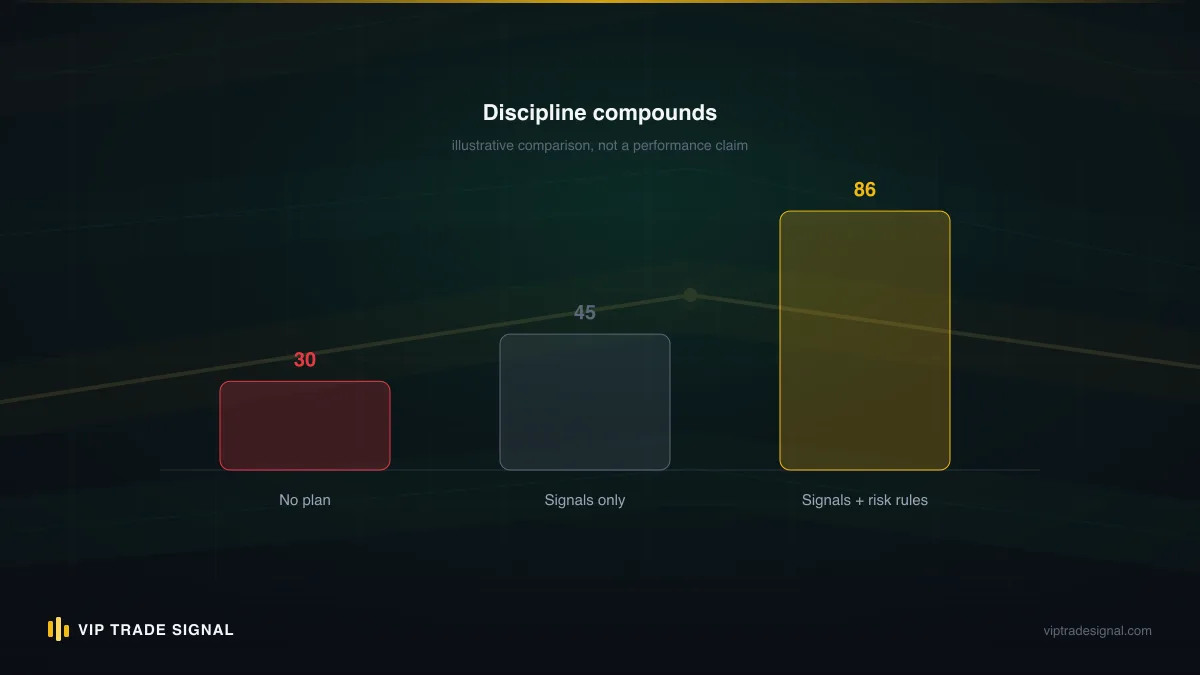
Look at the bottom row. The "expensive" structure took half your profit and said so on the label. The "cheap" one took nearly all of it. And this modelled a good year — run the same three structures over a flat year (net $0, same swings) and Structure A charges nothing at all, B charges hundreds, and C charges over a thousand dollars for the privilege of going nowhere.
That's the whole argument, really. The percentage tells you how gains are shared. The structure decides whether there's anything left to share.
Negotiating your split: what's actually movable
Once you can read the machinery, you can negotiate it — and it's worth knowing which levers move, because retail traders reliably pull the wrong one.
The wrong one is the percentage. On small accounts, the split itself has almost no give, and pushing on it produces bad outcomes even when you "win". A manager who accepts 30% on a $2,000 account when their book is priced at 50% has just agreed to earn $60 on a 10% month. They will make that shortfall back somewhere — bigger position sizes to juice the fee base, less attention to your account than to the full-fare ones, or a quiet broker rebate you never hear about. A negotiated-down manager is a conflicted manager. You didn't get a discount. You got a downgrade.
What actually moves:
- The base. If the agreement charges on gross wins, push for netting. If there's no high-water mark, ask for one. Managers who intend to trade well lose nothing by agreeing, which makes this request a diagnostic as much as a negotiation: resistance here is information.
- Settlement length. Monthly to quarterly is often achievable and mechanically favours you.
- Risk parameters. Maximum lot size and a hard equity floor are usually negotiable, and matter more to your survival than any fee term. On gold especially — where a single position sized wrong can do a month's damage in an hour — this is the clause to fight over.
- The advance. Size and refundability. Small and creditable against fees: fine. Large and non-refundable: walk.
- Scope. Which instruments, how many concurrent positions, news-event behaviour. Narrower scope, easier auditing.
And know when the right move is not negotiating a management deal at all. If your account is a few hundred dollars, the honest maths says almost no manager can serve you well at any split — you're likely better off trading signals yourself and keeping 100% of whatever you make, which is a different trade-off with its own failure modes. If your account is already deep underwater, you're not shopping for standard management either; recovery work is its own discipline with its own baseline questions, closer to what we cover in gold trading account management than anything in a standard split negotiation.
The strongest negotiating position, as ever, is the willingness to leave. Any manager whose terms can't survive the eight questions in this article was going to cost you more than the walking away does.
Where this leaves you
Strip everything above down to a pocket version and it's this: never evaluate a forex profit split by its percentage. Evaluate it by the sentence the percentage lives in. "Fifty percent of realized profit above your recorded high-water mark, no other charges, your password, your withdrawals" is a complete, checkable price. "Twenty percent of profits" is not a price at all — it's an opening bid with the expensive words missing.
Before you sign anything, get written answers to five questions. Realized or floating? Netted against losses, with a persistent high-water mark? Settled when, and what happens to open trades at the boundary? Is the split the entire cost, including the broker relationship? And can you revoke access and withdraw today, alone, without anyone's cooperation? Five questions, one email, ten minutes of someone's time. Every honest desk in this industry can answer them before lunch. Most of the other kind will simply stop replying, which is the cheapest due diligence you'll ever run.
Our answers, for the record: realized only, netted above a jointly recorded baseline, your MT4/MT5 account at your broker, master password and withdrawals stay with you, flat 50% and a $200 minimum advance as the entire price — no monthly fee, no charge in losing months, no promises about what the market will do, because nobody honest makes those. Losses happen on our desk like every other; the difference is you'll see them on your own login, not in a redacted spreadsheet.
If that shape of deal interests you, the account management page lays out the full terms. If it doesn't, take the five questions anyway. They're free, they work on every manager on the internet, and they'll save you more money than any percentage you'll ever negotiate.