There is a version of this article on every account management website in existence. It is two sentences long, it sits in grey six-point text at the bottom of the page, and it says something like "trading involves risk of loss". That is the entire risk disclosure for a service that asks you to hand trading control of your money to a stranger on the internet.
We think that is ridiculous, so we are writing the long version ourselves. This is a complete catalogue of forex managed account risks, written by a firm that manages forex accounts. Every risk in here applies to us as much as to anyone else you might hire. Some of them we have structural answers for. A couple of them we genuinely do not, and we will say so when we get there.
Why publish this at all? Partly because a client who understands the downside is a client who does not panic at the first losing week, and panicking clients are how everyone loses money. And partly because the industry's silence on this subject is doing real damage. People wire $5,000 to a Telegram stranger promising 20% a month, lose the lot, and conclude that all account management is a scam. It isn't. But the risks are real, they are specific, and every single one of them has a mitigation you can demand in writing before you sign anything. That's the article: the risk, the loss scenario, the clause that protects you. In that order, ten times.
Why a management firm is writing its own risk disclosure
A quick note on incentives before the catalogue, because you should be suspicious of this article too.
We run a gold-only signal and account management desk. We charge a flat 50% of realized profit on managed accounts, which is the high end of the industry, and we are open about why: the minimum is low ($200 advance), there are no lock-ins, and everything is pay-as-you-go. Our incentive in publishing this piece is straightforward. The clients who blow up relationships with managers, ours included, are almost always the ones who didn't understand what they were signing up for. A losing month arrives, they thought losing months were something that happened to other people, and the whole thing unravels in a week of angry messages and a withdrawal at the worst possible moment.
So treat this as enlightened self-interest. We would rather you read 5,000 words of downside and walk away than sign up expecting a money printer.
One more framing point. The risks below split into two families. The first family is manager-side: things the person trading your account can do to hurt you, through incompetence, bad incentives, or bad luck. The second family is client-side, and this is the part nobody writes about: things you will do to hurt yourself, mid-strategy, with the best of intentions. In our experience the client-side risks destroy at least as much money as the manager-side ones. We will get to those. The manager risks come first because they are the ones you can actually contract against.
Risk 1: manager drawdown will happen, full stop
Start with the risk that is not a maybe. Every trading strategy that has ever existed goes through drawdown. Not "might go through". Goes through. A manager showing you an equity curve with no meaningful dips is showing you either a curve too short to mean anything, a martingale that hasn't detonated yet, or a fabrication.
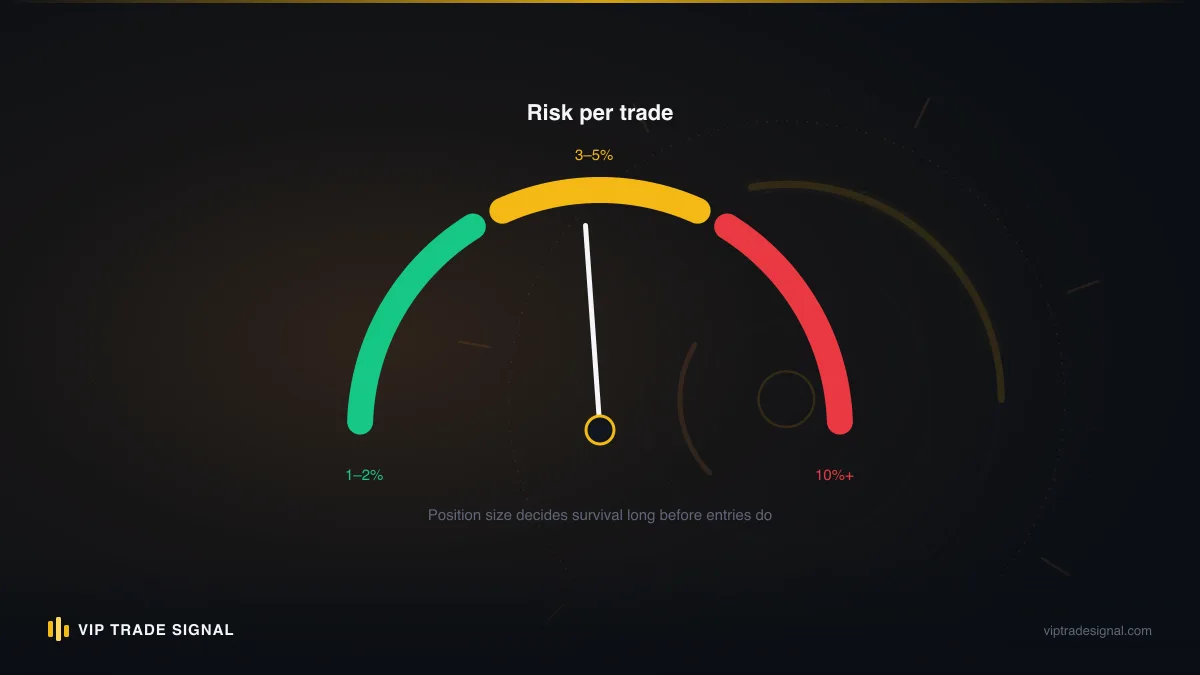
Here is what that means in pounds and pence. Say a competent manager runs your $10,000 account with a genuine edge: 55% of trades win, winners slightly larger than losers, roughly 1% of equity risked per position. That is a good, honest profile. Run the arithmetic on it and a streak of six or seven consecutive losers is not a black swan; over a few hundred trades it is close to a certainty. Cluster a couple of those streaks together, which happens, and your account is floating 10-15% down while the strategy is working exactly as designed. Nothing broke. The dice just came up cold for six weeks.
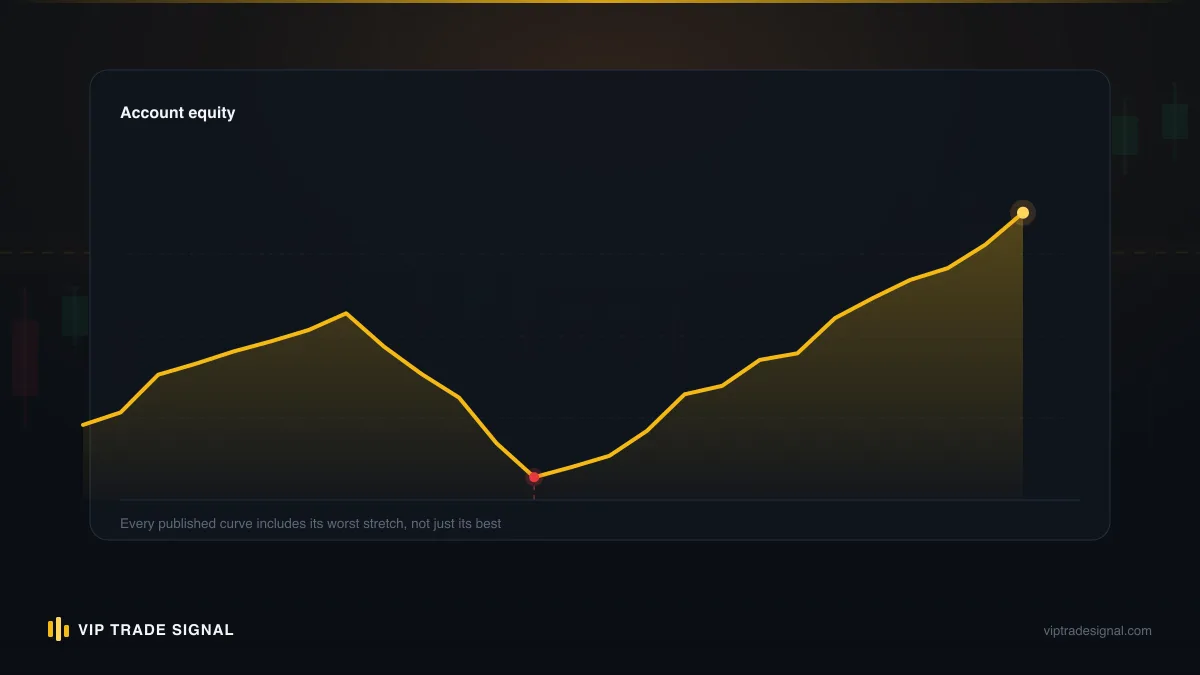
The loss scenario you actually need to fear is not that drawdown. It is what an unprepared manager, or an unprepared you, does inside it. Managers under water on a performance fee have a documented tendency to press: bigger positions, looser stops, revenge entries, anything to get back above the high-water mark and start earning again. That is how a routine 12% dip becomes a 40% crater. The maths of recovery are brutally asymmetric, and if you have never worked through them, our piece on the gain needed to recover a loss will change how you look at every drawdown number in this article. Down 12% needs about 13.6% to get back. Down 40% needs 67%. Down 60% needs 150%. The hole gets exponentially deeper than the fall.
The high-water mark, and why it can make drawdowns more dangerous
A quick detour into fee mechanics, because it explains why the pressing happens. Most performance-fee arrangements, ours included, use a high-water mark: the manager only earns on profit above the account's previous peak. It is a fair mechanism, and you should insist on it, because without one you can be charged twice for the same recovered ground. But understand its side effect. A manager 15% below the high-water mark is working for free until the account claws all the way back, and the deeper the hole, the longer the unpaid stretch. Some managers respond to that honestly, by grinding back at normal risk. Others respond the way a losing poker player responds to being down at 2am. The clause that separates them is the drawdown trigger: a hard equity level at which pressing becomes impossible because trading has stopped. The high-water mark protects your fees. The trigger protects your capital. You want both, and they only work as a pair.
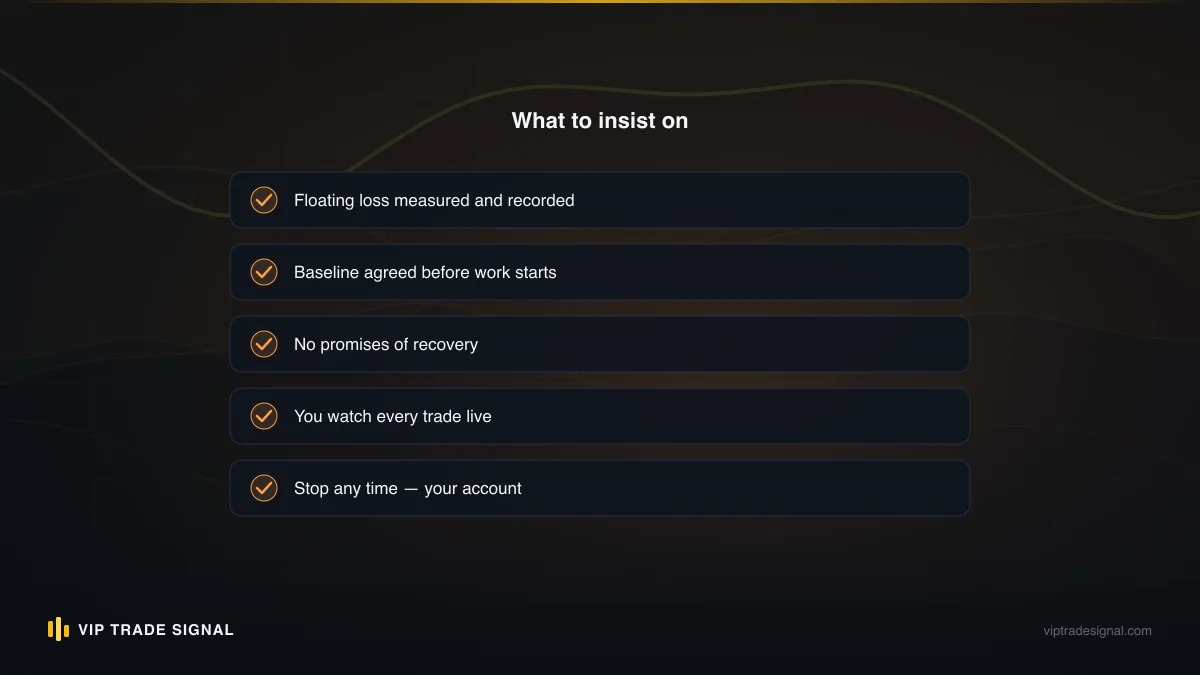
What to establish before you sign: the manager's expected and maximum historical drawdown, in writing, and what mechanically happens when it is breached. Not "we manage risk carefully". A number, and a trigger. "If the account closes 20% below its starting balance, all positions are flattened and trading pauses pending your instruction" is a real clause. If a manager will not name a drawdown level at which they stop, they have not thought about it, and you are the one funding the experiment.
Risk 2: style drift, or the strategy you hired quietly leaving the building
This one is sneakier than drawdown because nothing on your statement announces it. You hired a manager on the strength of a track record built one way. Six months later the account is being traded a completely different way, and the track record you did your due diligence on now describes a strategy that no longer exists.
Drift has a few classic flavours. The swing trader who starts scalping because the market went quiet and the performance fee needs feeding. The one-instrument specialist who "diversifies" into pairs they have no edge in, usually right after a losing month on their home turf. The 1%-risk manager who nudges it to 2%, then 3%, because the last four trades won and confidence is a hell of a drug. And the grimmest one: the stop-loss trader who quietly stops using stops, so the win rate looks glorious for months while one open position swells into a floating loss the size of the account. If you want to see the end state of that particular drift, we wrote up how grid and martingale systems hide their risk until the day they can't. The equity curve is a smooth staircase up, right until it is a lift shaft down.
The reason drift is dangerous, rather than merely dishonest, is that it invalidates every piece of due diligence you did. Your risk tolerance, the drawdown you agreed to stomach, the correlation with your other investments: all of it was priced against strategy A. You are now unknowingly holding strategy B, and you'll find out which strategy B was during its first bad week.
What to demand: a written strategy description specific enough to be falsifiable. Instrument or instruments. Typical hold time. Maximum risk per position. Whether every trade carries a hard stop. Maximum simultaneous exposure. Then, and this is the part most clients skip, actually check the trade history against it monthly. If the document says "gold, hard stops, maximum 2% risk per trade" and you see a stopless EUR/USD position sized at 5%, you don't need an argument. You need the contract clause that says material deviation from the written strategy is grounds for immediate termination with fees forfeited. Get that clause.
Risk 3: over-trading, because some fee structures pay the manager to churn
Follow the money. It explains more manager behaviour than any amount of chart analysis.
There are three common ways managers get paid, and they build three different animals. Fee on profit only, and the manager eats when you eat. Fee on volume or per-lot rebates from the broker, and the manager eats when you trade, win or lose. Fixed monthly fee regardless of anything, and the manager eats when you stay subscribed, which at least is only mildly perverse. The middle one is the killer. A manager collecting, say, $8 per lot in broker rebates has a direct financial incentive to trade as many lots as possible. Your account is not a portfolio to them. It is a volume engine.
The loss scenario here is a slow bleed rather than a blow-up, which is exactly why people miss it. Forty trades a week, each individually defensible, each paying spread and commission, each generating rebate. The account grinds sideways-to-down while the manager earns steadily. On a $10,000 account trading gold, where the spread might cost you $20-30 per round-turn lot, a churned 30 lots a month is $600-900 in friction before a single pip of edge is required. That is 6-9% a month, silently, and the manager collecting rebates on it will describe it to you as "active management".
The tell is on your statement, not in your P&L. Count the trades. Compare against the written strategy from Risk 2: a swing strategy averaging 40 trades a week is not a swing strategy. And ask the one question that makes rebate-paid managers visibly uncomfortable: "Do you receive any payment from the broker based on my trading volume?" Get the answer in writing. A profit-share-only manager can be wrong about the market, but at least they lose alongside you. A volume-paid manager can be perfectly right about the market and still bleed you dry.
A profit-share manager can be wrong and cost you money. A volume-paid manager can be right and still cost you money.
Worth saying plainly: this is the reason our own account management runs on profit share only, and it is also why performance fees across the industry look expensive. You are paying extra precisely so the manager has no reason to trade when there is nothing to do. Cheap management funded by rebates is the most expensive kind there is.
Risk 4: key-person risk, or what happens when the manager gets flu
Here is a question almost nobody asks on the sales call: who else can see my account?
Most retail account management is one person. One person with the strategy in their head, the passwords in their browser, and open positions in your account when they get food poisoning, or divorced, or bored. That is key-person risk, and in a small operation it is total. If the one trader is unavailable, your account is not "managed conservatively in their absence". It is unmanaged, with live exposure, and gold does not pause out of sympathy.
Play the scenario forward. Your manager is running three open gold positions into a Fed week. On Tuesday they go silent. No trades adjusted, no messages answered. Wednesday the statement drops 300 points against the positions and the stops, if there are stops, are the only thing between you and a margin call. You have the investor password, so you can watch it happen in real time, which is its own special kind of misery. Can you intervene? Legally, on your own account, usually yes. Do you know what to close and what to keep? Almost certainly not; that was the entire point of hiring someone.
Operational risk is the boring sibling of the same problem. Does the manager have a process, or vibes? Are trades logged with reasons? Is there a written procedure for what happens to open positions if they are offline for 48 hours? Is the operation a company you could actually pursue, or a first name and a profile photo? None of this is exciting, and all of it decides what your losing scenario looks like when life happens to the human being trading your money.
What to demand: a named continuity procedure in writing. Ours, for what it's worth, is blunt: positions are never left open unattended into major scheduled events, and any prolonged absence means flat. Yours can differ. It has to exist, and it has to be on paper, because "don't worry, I'm always around" is not a procedure. It's a hope.
Risk 5: platform, custody and access, where most of the outright theft lives
Everything so far has assumed a manager who is honest but flawed. This section is where the actual scams live, and it comes down to one architectural question: whose account holds the money?
There are two models. In the first, the money sits in your own brokerage account, in your name, at a broker you chose, and the manager receives trading access only. In the second, you wire money to the manager, or to a "pooled fund", or to a platform they recommend, and what you own is a login to a dashboard that shows you numbers. The first model can lose your money through bad trading. The second model can lose your money through bad trading, and also by the simpler method of the dashboard being fiction. Nearly every managed-account horror story you have read, the disappearing "fund", the withdrawal that stays "pending" for a month and then forever, involved model two. The dashboard showed +64%. The dashboard was a web page.
Even inside the honest model there is an access hierarchy worth understanding, because MT4 and MT5 make it concrete. The master password controls everything: trading, withdrawals, changing the passwords themselves. The investor password is read-only. A correctly structured arrangement gives the manager trading access while you keep the master password and the broker relationship, meaning you can watch everything, and only you can move money out. Hand over the master password and you have handed over the account. There is no legitimate reason a manager needs it. None. A manager who asks for it is either ignorant of their own platform, which is disqualifying, or testing you, which is worse.
The remaining platform risks are smaller but real: the broker itself failing or freezing withdrawals (use regulated brokers you selected, not one the manager insists on), and password hygiene (change the trading password when the relationship ends, because former managers retaining live access to old client accounts is more common than anyone admits). Custody in your name, master password in your hands, broker of your choosing. Those three phrases in writing eliminate the entire fraud tail of this business. Everything left after that is trading risk, which at least is the risk you meant to take.
The client-side risks, part one: interference mid-strategy
Now the uncomfortable half of the catalogue. Because after years around managed accounts, here is an honest observation: the manager is not always the biggest risk to the account. Frequently it's the client.
Interference is the polite word for it. The account is down 6% in week three, inside the drawdown range everyone agreed to in writing, and the client starts helping. A message asking the manager to "maybe go easy for a bit". A manually closed position, taken at a loss, that was 40 points from its take-profit. A suddenly reduced risk setting. A deposit yanked out mid-trade "just to be safe", which changes the margin maths under every open position. Each act feels prudent in the moment. Collectively they convert a coherent strategy into an incoherent one, and incoherent strategies lose.
The mechanism is worth spelling out, because it is not obvious until you have watched it. A strategy's edge lives across its full distribution of trades. The winners pay for the losers on a schedule nobody controls. When a client interferes selectively, and they always interfere selectively, they interfere during drawdowns, which means they systematically cancel trades at the bottom of the distribution. The losers get realized in full; the recoveries that were statistically queued up behind them get cancelled. It is a machine for harvesting the strategy's losses while discarding its wins, operated by the person who paid for the strategy.
There's a scenario we describe to every prospective client, a composite we'll call Sam. Sam signs up for a gold strategy with a stated 15% expected drawdown, hits 8% down in month two, and starts closing the manager's positions on red days. By month four Sam's account is down 14% while the strategy's model account, untouched, is up 3% over the same window. Same trades. One account had Sam in it.
The mitigation here is contractual and mutual, which surprises people. A good management agreement constrains the client too: the client agrees not to trade the account or close the manager's positions while the agreement runs, and in exchange gets a clean escape hatch, a written right to demand everything flattened and the arrangement paused at any time. Full stop or hands off. The one thing the contract should make impossible is the middle path, co-piloting, because the middle path is where accounts go to die.
The client-side risks, part two: the panic withdrawal at the bottom
The second client-side risk deserves its own section because it is the single most expensive behaviour in retail investing, managed accounts included. Withdrawing at the bottom of a drawdown.
The pattern is depressingly reliable. Client funds an account at $10,000, having agreed, verbally and in writing, that drawdowns up to 20% are part of the deal. The account climbs to $11,200, and the client is delighted and talks about adding funds. Then a normal losing streak drags it to $9,100. That is a 19% drawdown from the peak, inside the agreed range, and it feels nothing like the number they agreed to in a calm conference call three months earlier. It feels like watching a house fire. The client withdraws everything at $9,100, locking in a $900 loss on a strategy that was behaving within specification, and often the account's equity curve recovers over the following quarter with nobody in it.
The cruelty is in the sequencing. Agreed to 20% in theory; experienced 19% in practice; discovered those are different things. Every manager who has done this for more than a year has watched some version of it, and gold makes it worse than most instruments because the drawdowns arrive fast and violently rather than as a gentle slide. We wrote about the specific character of gold trading drawdowns separately, and if you are considering managed gold exposure, read it first, because a 15% drawdown that arrives in eight days tests you very differently from one that takes three months.
What actually helps, in rough order of effectiveness: fund the account only with money whose loss would not change your life, which is the boring advice everyone ignores and the single biggest predictor of whether you'll hold through a drawdown; halve whatever allocation you were planning, because the position you can sleep through outperforms the position you can't; agree a rule with yourself, in advance and in writing, about what would make you withdraw, so the decision is made by calm-you rather than 2am-you; and check the account weekly, not hourly, because nobody has ever improved their returns by refreshing MT5 during a news spike. None of this can be enforced by contract. This risk is yours to manage, and no manager on earth can do it for you.
Reading a track record without being lied to
Before the mitigation table, one skill that cuts across every risk above: reading the track record you'll be shown, because you will be shown one, and the way it is presented tells you as much as the numbers in it.
Start with what counts as evidence. A screenshot is not evidence; it is a graphics exercise anyone can complete in ten minutes. A PDF statement is barely better. The minimum acceptable standard in 2025 is third-party verified history, a Myfxbook or FX Blue link with the track record and, ideally, the risk pages public, or read-only investor access to a live account you can watch update in real time. If a manager's proof of performance cannot be verified outside their own website, you do not have proof of performance. You have marketing.
Then look at the shape, not the headline. A monthly return figure means nothing without the drawdown that bought it; 8% a month with a hidden 60% historical drawdown is a coin toss wearing a suit. Check the length: two good quarters is weather, three years is closer to climate. Check for the martingale fingerprint we described under style drift, the eerily smooth curve with a 95% win rate, because the missing 5% is where the account dies. And check the losses are actually in there. A history with no red is a history with the red removed.
The gold-plated version of this check is watching a manager publish losses in real time, before outcomes are known, not curated afterwards. It is why our own signal history, every close, wins and losses alike, sits publicly at /signals/history. Not because our record is spotless. It isn't, and no honest record is. Because a firm that shows you its losses while they are fresh has removed its own ability to lie to you later, and that structural inability to lie is worth more than any performance number on any sales page.
Forex managed account risks and the mitigation to demand for each
Everything above compresses into one page. If you take a single thing from this article, take this table into your next conversation with any prospective manager, ours included, and do not accept a verbal answer to anything in the right-hand column.
| Risk | Loss scenario | Mitigation to demand, in writing |
|---|---|---|
| Manager drawdown | Normal losing streak becomes a crater when the manager presses to recover | Stated maximum drawdown with a hard stop-trading trigger at a named equity level |
| Style drift | The audited strategy is quietly replaced by an unaudited one | Falsifiable written strategy spec (instrument, risk per trade, stops, exposure) plus termination rights on deviation |
| Over-trading | Slow bleed via spread, commission and volume rebates | Profit-share-only compensation and written disclosure of any broker rebates |
| Key-person risk | Open positions with an absent manager | Named continuity procedure; no unattended positions into major events |
| Custody and access | The pooled "fund" or dashboard was never real; or an ex-manager keeps access | Money in your own brokerage account; you keep the master password; passwords rotated on exit |
| Client interference | Selective trade-cancelling during drawdowns destroys the edge | Hands-off clause with an unconditional right to demand full flattening at any time |
| Panic withdrawal | Loss locked in at the bottom of a within-spec drawdown | Cannot be contracted away; sized allocation and a pre-written personal exit rule |
Two observations about this table. First, notice how cheap the mitigations are. Not one of them costs the manager money or handicaps a legitimate strategy. They cost paperwork and honesty, which is exactly why refusal is informative: a manager who bristles at putting a drawdown trigger or a rebate disclosure in writing has told you everything, politely. Second, notice the last row. It is the only risk with no contractual fix, and it is arguably the biggest one in the table. Sit with that before you fund anything.
There is a longer treatment of several of these questions, particularly custody and password mechanics, in our FAQ, which exists mostly because prospective clients kept asking versions of "wait, you don't hold my money?" and deserved a permanent answer.
How our structure handles each of these, and the two places it can't
Time to mark our own homework, since we picked the fight. Here is how our account management service maps against the catalogue, including the honest gaps.
Custody and access: the strongest part of our answer, because we simply refused to build the dangerous version. We trade your own MT4 or MT5 account at your own broker. You keep the master password. Only you can withdraw. We never touch your money directly; we could not run off with it if we wanted to, which is precisely the point of the design. Over-trading: our fee is a flat 50% of realized profit and nothing else, no volume rebates, no per-lot anything, so a month with no good setups is a month we simply don't earn, and we are fine with that. High fee, clean incentive; we think that trade is obviously right, and we have said elsewhere that our pricing sits at the expensive end because the minimums are low and nothing is locked in. Style drift: we are structurally incapable of the most common drift, instrument creep, because the whole desk trades XAU/USD and nothing else. If a EUR/USD position ever appears in an account we manage, something has gone genuinely wrong and you should invoke your termination clause that day. Manager drawdown: it will happen to us, exactly as section one says, and we put drawdown pause levels into the agreement rather than asking for trust. For accounts that come to us already deep underwater, the drawdown management arrangement works from a jointly recorded baseline with fees only on recovered profit above it, and carries no recovery guarantee, because nobody honest can offer one.
Now the gaps, because there are two. Key-person risk: we are a small desk. We run the continuity procedure described above, flat before absences and no unattended positions into major scheduled events, but a small firm cannot honestly claim the operational redundancy of an institution, and we won't pretend otherwise. And client-side risk: we can write the hands-off clause, we can talk you through drawdown maths before you fund, we can point you at every losing signal in our public history so your expectations are calibrated on reality. We cannot stop you withdrawing at the bottom. Nobody can. That one is yours.
The residual risk you accept with any manager, including us
Suppose you did everything in this article. Custody in your name, drawdown trigger in the contract, profit-share-only fees, falsifiable strategy spec, continuity procedure, hands-off clause, an allocation sized so you can sleep. What is left?
Trading risk. The real thing, undiluted. The possibility that a competent, honest, correctly incentivised manager, operating exactly within the agreed strategy, loses your money anyway, because that is a thing markets do to good strategies for months at a time. Most retail forex and CFD accounts lose money; that is an industry commonplace for a reason, and a managed account is not an exemption certificate. It is the same risk with, hopefully, better decision-making attached. Every safeguard in this article exists to strip away the avoidable losses: the frauds, the churns, the drifts, the panics. None of them touches the irreducible core, which is that you are taking leveraged positions in one of the most volatile instruments on the planet, and sometimes the market pays you and sometimes it takes.
If that residual risk is not acceptable to you, then no contract clause makes account management suitable, and the honest move is to walk away entirely. We would rather you did that than fund an account with money you cannot afford to see drop 20%.
So, where this leaves you. Three moves, in order. First, take the mitigation table to whoever you are considering, us included, and get every row answered in writing; the refusals will do half your due diligence for you. Second, before funding anything, look at a real trade history with the losses left in, ours is public at /signals/history precisely so this step costs you nothing, and ask yourself honestly how the worst stretch on it would have felt with your money in it. Third, decide your walk-away point now, on paper, while nothing is at stake. The manager's job is the trading. Yours is choosing well once and then staying out of the way. Of the two jobs, we would argue yours is harder, and it is the one this entire industry pretends does not exist.