The cruellest scam in retail trading isn't the one that takes your money the first time. It's the one that rings you three weeks later, sounding like a lawyer, promising to get it back.
If you've lost money to a dodgy broker or a fake signal group, you are now on a list. That list gets sold. And the people who buy it run what fraud investigators call recovery rooms: boiler-room operations that target victims of the first scam with a second one, dressed up as help. Knowing which forex loss recovery scams to avoid is not optional reading once you're on that list. It's the difference between losing once and losing twice.
We have skin in this game, and we'll be honest about why. We run a drawdown management service for traders sitting on open losses, which means we live in the same search results these scammers poison. Every recovery-room operation that takes a deposit and vanishes makes people rightly suspicious of anyone who says the word "recovery" out loud. So this article documents their playbook in full. Partly because you deserve the warning. Partly because the clearest way to show you what legitimate looks like is to show you, in detail, what it doesn't.
The recovery room: a scam that hunts the already-scammed
A recovery room is a call centre that contacts people who have already lost money, claims it can retrieve those funds, and charges fees for a recovery that never happens. The name comes from old boiler-room slang: the first room sells you the worthless shares, the recovery room sells you the rescue.
The economics are grimly elegant. Fresh scam victims are the best possible sales leads. They have three things a cold-caller normally has to work months to create: proven willingness to send money to strangers, an emotional wound, and a specific sum they desperately want back. A person who wired $8,000 to an unregulated broker in Vanuatu has already demonstrated everything a fraudster needs to know about them.
And the victim's own psychology does half the selling. Loss aversion is the strongest force in trading, stronger than greed by most accounts. It's why traders hold losers too long, and it's exactly the muscle the recovery scammer leans on. Paying $1,500 to get $8,000 back feels rational. It feels, in fact, like the first sensible decision you've made in months. That feeling is the product they're selling.
The regulators know this pattern well. The FCA, ASIC, CySEC and the CFTC have all published repeated warnings about recovery fraud, and several keep public lists of clone firms and known recovery-room operations. The FBI's internet crime reports have flagged recovery schemes as a persistent follow-on to investment fraud for years. This is not a niche problem. Wherever there is a pool of trading-scam victims, a second industry forms around it within weeks.
None of this means every firm that mentions recovery is criminal. It means the word itself has been captured, and your default setting when you hear it should be suspicion until proven otherwise. Including with us. We'll get to how you verify anyone in this space, us included, near the end.
How they find you: lists, groups, fake reviews
Recovery scammers don't find you by accident, and they rarely find you by advertising. They buy you.
When a scam brokerage winds down, or gets breached, or simply wants a second revenue stream, its client list goes up for sale on fraud forums. These are called sucker lists in the trade, and they are precise: name, phone number, email, amount deposited, sometimes the exact dates and payment methods. A caller who opens with "I understand you lost $6,400 with GlobalTradeFX in March" is not psychic. He's reading your row in a spreadsheet, and quite often the recovery room is run by the same people who ran the broker. They scammed you retail; now they're scamming you wholesale.
The second channel is public grief. Post "XYZ broker stole my money, anyone know what to do?" in a Facebook group, a subreddit or a Trustpilot review, and watch what happens. Within a day you'll have replies and DMs recommending a "certified recovery expert" or a "crypto forensics specialist" who "got my $12,000 back in two weeks". Those accounts are sock puppets. Some scam operations employ people whose entire job is monitoring complaint threads and steering victims into the funnel. The testimonial is the bait; the helpful stranger is the hook.
Third, they farm search intent. Type "recover money from forex broker" into Google and the results are a minefield: lead-generation sites dressed as consumer watchdogs, fake review portals that rank recovery firms (all owned by the firms being ranked), and paid ads from outfits with names built from the words Global, Asset, Refund and Chargeback shuffled into different orders. Some run fake news articles about a regulator "ordering compensation" for victims of the exact broker you searched for.
There's a fourth channel worth knowing about because it's newer and nastier: the long game inside "support" communities. Some operations seed and even run entire groups for scam victims, Telegram channels called things like "GlobalTradeFX Victims Unite", where they play both moderator and shepherd. For weeks the group is genuinely useful. Templates for complaint letters, sympathy, shared timelines. Then, once trust is built, the moderator quietly mentions the firm that "finally sorted my case". A funnel wearing a support group as a skin. If you join a victims' group, and the genuine ones do exist and do help, treat any service recommendation inside it exactly as you'd treat a cold call, however warm the room feels by then.
The practical rule that falls out of all this is simple, and worth writing down: anyone who contacts you first about recovering a trading loss is presumed to be a scammer. Not "might be". Presumed. Legitimate professionals in this area, lawyers, regulators, your card issuer's dispute team, do not cold-call, do not slide into DMs, and do not answer Reddit threads with a WhatsApp number.
The playbook: urgency, upfront fees, official-sounding entities
Sit through enough recordings of these calls (regulators publish transcripts, and they make bleak reading) and you notice the script barely changes between operations. It has four movements.
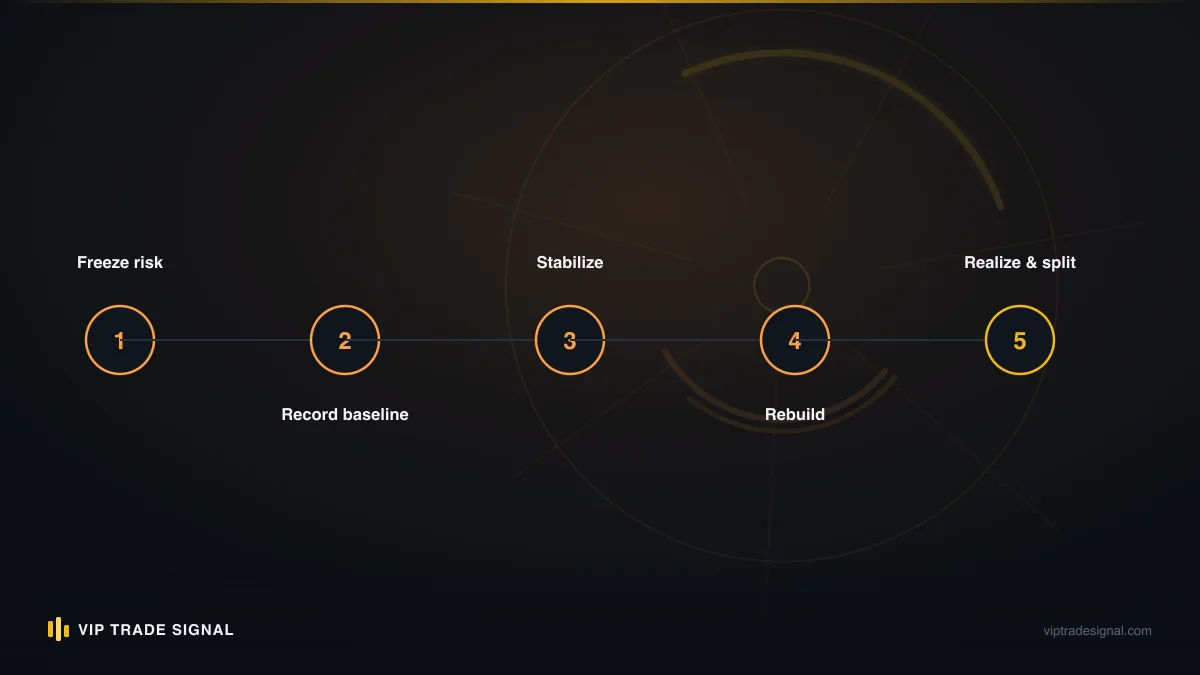
Movement one: credibility. The caller represents something that sounds institutional. A "fund recovery bureau". A "chargeback litigation group". Sometimes a clone of a real law firm or, boldly, the regulator itself; the FCA has warned repeatedly about fraudsters impersonating FCA staff and offering to recover losses for a fee. You'll be given case numbers, reference codes, a professional-looking portal to log into. All of it is set dressing, and all of it can be manufactured in an afternoon.
Movement two: false specificity. They know your loss. Amount, broker, roughly when. This detail does enormous work, because your honest reaction is "how could they know that unless they're official?" The answer, as above, is that they bought it. But in the moment, specificity reads as legitimacy, and the script is built around that misread.
Movement three: urgency. There is always a deadline. The broker's assets are being frozen on Friday. The class action closes this month. The regulator's compensation window expires in ten days. Urgency exists for one reason: to stop you doing the single thing that kills the scam, which is putting the phone down and checking independently. Real legal and regulatory processes are slow. Glacially, maddeningly slow. A genuine chargeback takes weeks; a genuine regulatory action takes years. Anyone whose process requires your money this week is describing a process that doesn't exist.
Movement four: the fee. Called a retainer, a processing fee, a tax clearance, a "release" fee for funds supposedly already recovered and waiting. This is the entire business model, and it escalates. Pay the first $500 and there will be a $1,200 court fee, then a $2,000 international transfer levy, each one framed as the last obstacle between you and your money. Victims of recovery fraud frequently end up losing more to the recovery than they lost to the original scam, precisely because each new fee is anchored against the full sum "waiting" for them.
A detail worth flagging: the payment method requested is almost always irreversible. Bank wire, crypto, gift cards in the shabbier operations. An outfit that claims deep expertise in reversing payments, yet insists on being paid by methods that can never be reversed, has told you everything.
To see how the four movements land on an actual human, take a trader we'll call Dan. Illustrative, not a real client, but assembled from patterns any fraud investigator would recognise. Dan put $7,000 into an offshore broker he found through an Instagram "mentor", watched it evaporate over six weeks, and told nobody, because who wants to admit that at dinner? Two months later his phone rings. A calm English voice from the "International Claims Division" reads out his deposit dates and tells him $6,100 of his funds have been located in a frozen settlement account, recoverable once a 4% verification fee clears. Dan is not stupid. Dan is a project manager who runs budgets for a living. But he's also spent two months privately replaying the loss, and here is a stranger telling him the story he most wants to hear, with dates. He pays the $244 because it's small against $6,100. Then the court stamp fee, $580. Then the international release levy, $1,100, and it's only somewhere around the "anti-money-laundering clearance certificate" that the fog lifts and Dan realises he's now down $8,900 and change instead of $7,000.
Read that back and notice the design. Each fee was small relative to the promised sum. Each came with paperwork. Each arrived after Dan had already paid once, when stopping would mean admitting the previous payments were wasted, which is the same sunk-cost trap that kept him in the losing trades. The scam isn't aimed at stupidity. It's aimed at hope with a spreadsheet.
"We can get your money back from the broker," examined
Strip the script away and the recovery room makes one core claim: we have a mechanism to extract your specific funds from that specific broker. So let's examine whether such a mechanism could exist, because this is where the whole thing falls over on contact with how money actually moves.
Say you deposited $10,000 with an unregulated offshore broker over four months and lost it, some to spreads and slippage, some to trades, possibly some to outright manipulation. Where is that money now? It isn't sitting in an account with your name on it. It was commingled the moment it arrived, cycled through payment processors, moved between corporate shells in two or three jurisdictions, and paid out as the operators' profit. There is no vault with your name on the door. Recovering it would mean litigation across borders against shell companies designed for exactly this scenario, and even successful regulatory actions against such firms usually return cents on the dollar, years later, distributed by a court-appointed liquidator. Not by a firm in a WhatsApp chat.
Now run the claim against each thing a private "recovery agent" says they can do. Can they compel an offshore broker to pay? No; they have no jurisdiction and no standing. Can they "hack the funds back"? No, and if they genuinely could, you'd be paying for a crime and would likely be handing your remaining account details to a criminal. Can they access a regulator's compensation scheme on your behalf for a fee? Schemes like the UK's FSCS are free to claim from directly and cover regulated firms only, which your offshore broker was not. Can they run a chargeback for you? This is the only claim with a grain of truth in it, and the grain is small: a chargeback is something you initiate with your own card issuer, for free, and no third party has special access to that process. Firms charging 20-30% to "manage" a chargeback are charging you for filling in a form, and often torpedo the claim with templated submissions banks have learned to reject.
The moment someone quotes a fee to recover money from an unregulated broker, they have told you the money is not recoverable. If it were, they'd take a cut of the recovery, not a cheque up front.
That line is worth keeping. Contingency is how genuinely recoverable claims get handled everywhere in law. Upfront-fee-only is how unrecoverable ones get monetised.
Real routes for genuine broker disputes
None of this means you're always helpless. There are legitimate routes, and part of knowing which forex scam recovery services are fake is knowing what the real machinery looks like. It's unglamorous, mostly free, and you drive it yourself.
Your card issuer or bank, first and fast. If you deposited by debit or credit card, you may have chargeback rights for services not rendered or merchant fraud, and card networks impose time limits, typically 120 days from the transaction or from when you reasonably discovered the problem. If you paid by bank transfer, ask your bank about recall procedures immediately; the odds are worse but not zero if you move within days. This is free. Do it yourself, in writing, with dates and evidence.
The broker's regulator, if one exists. A broker regulated by the FCA, ASIC, CySEC or similar is subject to complaint procedures with teeth. Exhaust the broker's internal complaint process, then escalate: the Financial Ombudsman Service in the UK, AFCA in Australia, CySEC's complaint channel in Cyprus. Free again. Slow, but real. If the broker was regulated somewhere obscure or nowhere at all, be honest with yourself that this route is mostly closed, though filing anyway helps build the record that gets operations shut down.
Police and national fraud reporting. Action Fraud in the UK, the FBI's IC3 in the US, your local equivalent elsewhere. An individual report rarely triggers an individual recovery, so go in expecting that. But aggregated reports are how prosecutions and freezing orders happen, and if funds ever are clawed back by authorities, being on the victim record is what gets you a share.
An actual licensed lawyer, for large losses. For five figures and up, a real solicitor or attorney with fraud-litigation experience can assess whether there's a viable claim, and will tell you plainly when there isn't. You find them through the law society's directory, not through an ad. You verify their licence number independently. And you notice the difference in posture immediately: a real lawyer spends the first meeting managing your expectations down, not up.
For a sense of scale, here's how the real routes stack up against each other, and against the fantasy version the recovery room sells:
| Route | Cost to you | Realistic timescale | Honest odds |
|---|---|---|---|
| Card chargeback (within window) | Free | Weeks to a few months | Fair, with evidence and a card payment |
| Bank transfer recall | Free | Days matter; act within 72 hours | Poor after the first week |
| Regulated-broker ombudsman complaint | Free | Six months to two years | Reasonable if the broker was genuinely regulated |
| Police / national fraud report | Free | Years, if ever | Near zero individually; builds collective cases |
| Licensed fraud lawyer | Hourly or contingency, disclosed | One to three years | Case-dependent; honest ones decline weak claims |
| "Recovery agent" who called you | $500 upfront, then more | "Days", allegedly | Zero, minus the fees |
Notice what every legitimate route shares. You initiate it. It's free or transparently billed by a verifiable professional. Nobody promises an outcome. And nothing about it moves fast. The bottom row is the only one that promises speed, certainty and convenience, which is exactly why it's the only one that returns nothing.
The hard truth: which losses are gone
Here's the section nobody selling you anything will write, so we will.
Some losses are simply gone, and the most dangerous moment in this whole story is the moment you refuse to believe that. Because a person still hunting for their unrecoverable money is a person still in the market for whoever lies to them best.
So, plainly. Money lost to legitimate trading, your trades, your decisions, executed at a real broker at real prices, is not recoverable by anyone, ever, through any process. There was no fraud; there is no claim. We've written before about the brutal arithmetic here: a 50% loss needs a 100% gain just to get back to flat, and the maths of what it actually takes to climb out of a hole is sobering enough without a scammer promising to skip it. Losing money on trades is not a crime committed against you. It's the risk you were carrying. It happens to us too, and anyone in this industry who won't say that out loud is already lying to you.
Money wired to an unregulated offshore broker that has stopped answering is, in practical terms, almost always gone as well. Not legally gone, morally you're owed every cent, but functionally gone, because the machinery to retrieve it either doesn't exist or costs more than the loss. If a bank recall inside the first week fails and there's no card chargeback available, the honest expected recovery is close to zero.
Crypto sent to a scam wallet sits in the same bucket. Blockchain analysis firms can sometimes trace where it went, which is occasionally useful to law enforcement. Tracing is not recovering. The "crypto recovery specialists" who advertise otherwise are the fastest-growing wing of trading loss recovery fraud, for the obvious reason that crypto victims skew inexperienced and the payments are perfectly irreversible.
What's genuinely worth pursuing: card payments inside the chargeback window, disputes against regulated brokers, and large documented frauds worth a real lawyer's time. That's the list. It's short. Grieve the rest and close the door, because the open door is what the recovery room walks through.
And there's a practical reason to close it beyond avoiding the next scam. Every hour spent chasing dead money is an hour not spent on the two things that actually change your position: protecting what's left, and deciding, coldly, whether and how you trade again. We've watched traders burn six months emailing an offshore broker's dead support address while their remaining capital sat idle and their skills rusted. The loss already happened. The only live question is what the next twelve months look like, and no answer to that question involves a stranger with a case number.
Legitimate recovery means managing your open account, nothing else
There is exactly one honest meaning of "recovery" in trading, and it has nothing to do with retrieving money from anyone. It means this: you have a live account, currently in drawdown, and the road back to breakeven runs through disciplined trading of the capital you still have. Forward, not backward.
That is the service we actually run, so let us describe it with the specificity we've been demanding from everyone else, because the structural details are the point.
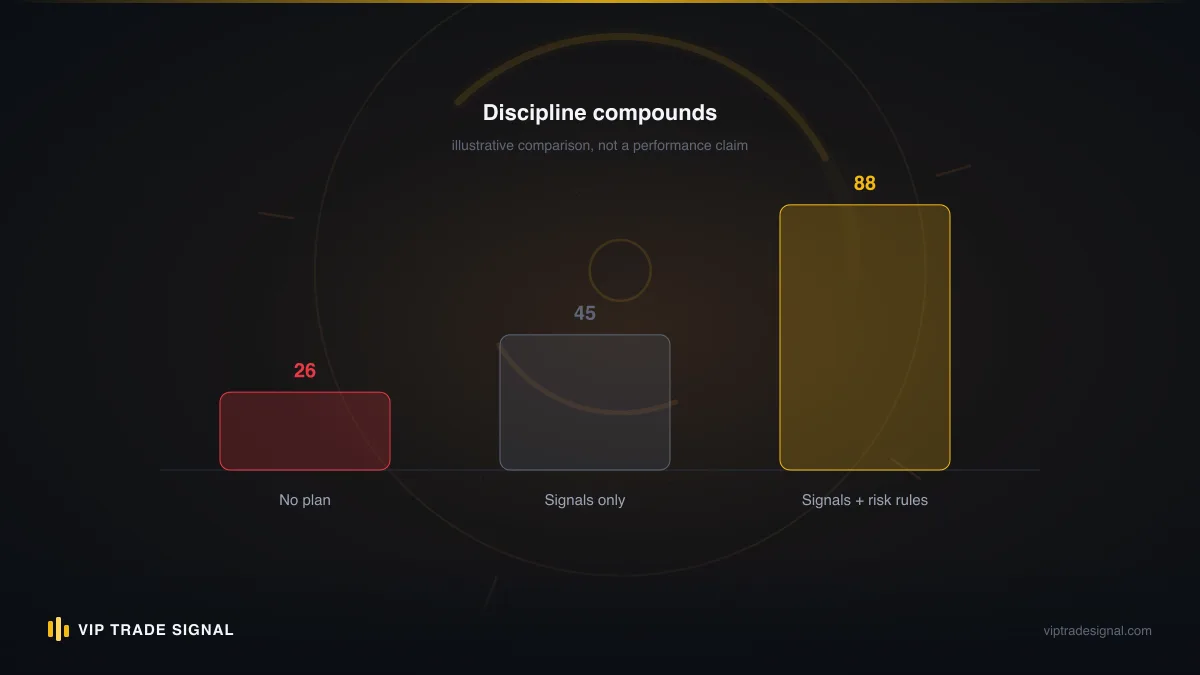
Our drawdown management service takes on accounts floating roughly $5k-$10k down and trades them on gold, XAU/USD, which is the only market we touch. The fee is a flat 50% of recovered profit above a baseline that you and we record together, in writing, before a single trade goes on. Your money never moves to us. The account stays yours, at your broker; we connect to your MT4 or MT5 with trading access only, while you keep the master password and the withdrawals. Yes, 50% is the high end of the industry, and we've laid out on our about page why we price it that way: low minimums, pay-as-you-go, and you pay nothing unless the account actually climbs. And, the sentence that matters most: there is no recovery guarantee. Ever. The account can go further down. Gold moves hard, drawdowns within a recovery attempt are normal, and any structure that removed that risk would be a structure that removed the trading.
Line that up against the recovery room and notice the inversions. They look backward at lost money; legitimate work looks forward with surviving money. They need your funds moved to them; legitimate management never takes custody. They charge before results; a real performance fee exists only after them. They guarantee outcomes; honest operators lead with risk. Managed trading has its own genuine hazards, we've written a full piece on what can go wrong with managed forex accounts and it pulls no punches about our own model, but the hazards are trading hazards, disclosed up front, not a con.
One more inversion worth naming. A recovery scammer wants you emotional, because urgency lives there. A legitimate operator managing a drawdown wants you calm, because recovering from drawdown is a long, boring discipline of position sizing and patience, and a client chasing their losses is the biggest risk to it.
Forex loss recovery scams to avoid: 12 tells in the first call
Most recovery scams identify themselves inside the first conversation, if you know what you're listening for. Here's the working list. One of these is a yellow flag. Two is a pattern. Three, hang up.
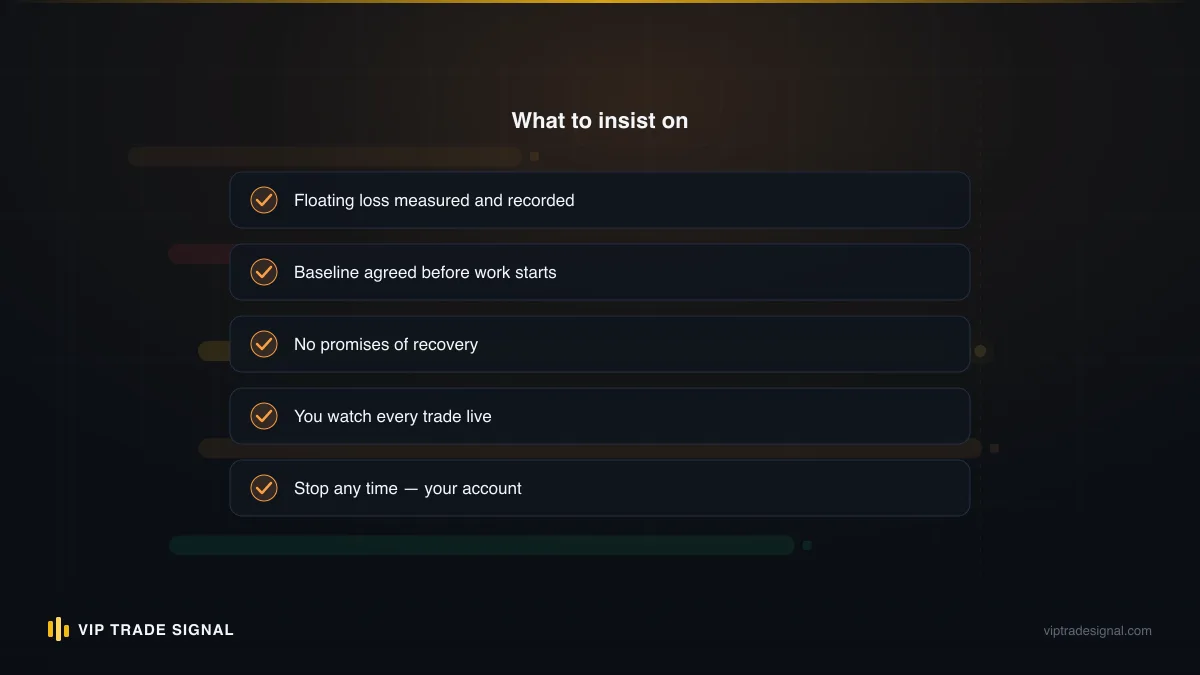
- They contacted you first. Cold call, DM, email, a helpful reply to your complaint post. Legitimate recovery help is never inbound.
- They already know your loss. Broker name, amount, dates. That's a purchased sucker list talking, not an official record.
- Upfront fee, any label. Retainer, processing, tax, activation, "release fee". The label changes; the model doesn't.
- A guarantee, or a success rate. "Guaranteed recovery", "98% success". No honest party in this space guarantees anything.
- A deadline. Freezing orders, closing compensation windows, Friday. Urgency is manufactured for exactly one purpose.
- Irreversible payment methods. Wire, crypto, gift cards, from people claiming to be payment-reversal experts.
- Impersonation or its cousins. Claiming to be, or be "working with", a regulator, a bank, Interpol. Regulators do not phone victims, and they never charge fees.
- Untraceable comms. WhatsApp and Telegram only, Gmail addresses, no verifiable office, no named licensed individuals.
- They claim your funds are already located. "We've found your money; it's being held pending a clearance fee." Money from these scams is dispersed, not parked.
- Pressure not to tell anyone. Especially your bank, "because it will complicate the case". The opposite is true, and they know it.
- They request account access or identity documents early. Broker logins, banking passwords, passport scans. That's the setup for round three.
- The website is weeks old. Check the domain registration date. A "leading recovery firm since 2009" registered eleven weeks ago has answered your question.
Notice that none of these tells require you to assess whether the person sounds credible. They will sound credible; that's the one thing the operation genuinely invests in. The tells are structural, which is why they work.
If you've already paid a recovery scammer
If you're reading this a step too late, having paid one of these outfits, move quickly and in this order. Speed matters far more than embarrassment here.
Stop all payment, today. Whatever fee they're asking for next, the "final" one, the court fee, the tax clearance, do not pay it. There is no sum that releases your money, because your money is not being held anywhere. Every escalating fee is anchored against a recovery that was never real. Expect an aggressive retention call when you refuse; scripted outrage is part of the product.
Call your bank or card issuer, now. If any payment to the recovery firm went by card, dispute it as fraud. If by transfer, request a recall; inside 24-72 hours there's a genuine chance, after that it drops fast but is still worth the call. Tell your bank the full picture, including the original loss, so they can flag your account. Do this before the scammer's "case worker" talks you out of it.
Lock down what you handed over. If they got copies of your ID, register with a credit-monitoring or fraud-alert service (CIFAS protective registration in the UK, credit-bureau fraud alerts in the US). If they ever had remote access to your computer, via AnyDesk, TeamViewer or similar, treat that machine as compromised: run a clean-up, change every financial password from a different device, and enable two-factor authentication everywhere it exists.
Report it, with the paper trail. Action Fraud, IC3, or your national equivalent, plus the regulator whose name they abused if they impersonated one. Attach everything: numbers they called from, wallet addresses, account details, emails, the fake portal URL. You are probably not getting this money back either, and it's kinder to say so than to let you swap one false hope for another. But recovery rooms get shut down by aggregated reports, and yours shortens someone else's list.
Then expect the third call. Sucker lists get resold, and victims of recovery fraud go on a premium version of them. Some operations run a second brand that "investigates recovery scams" and rings you about the firm that just took your fee. The audacity is the point. The defence is the same rule as always: nobody legitimate calls first.
How to verify anyone in this space, including us
Suspicion is the right default, but it needs a method, or it just becomes paralysis that keeps you from the few legitimate options you have. So here's the verification routine we'd run on any firm in this space. Run it on us too; we mean that literally.
Check what's verifiable, not what's claimed. Testimonials, trust badges, "as featured in" logos and success rates are all manufactured in an hour. What can't be faked cheaply: a full public track record, a company's registration and age, named humans with checkable histories, and regulator databases. Start there and ignore the rest.
Talk to a named, licensed human. Before money moves anywhere, you should know the name of at least one real person with a checkable professional footprint: a directorship on the company register, a licence number a regulator's database confirms, a work history that predates the website. Recovery rooms are staffed by first names and job titles, "Michael from Claims", and the moment you ask for a surname and a registration number the warmth drains out of the call. Ask anyway. It's a thirty-second question that collapses most of the fraud in this space, because fake credentials survive glances but not lookups.
Demand the losses. Anyone competent in trading has losing trades, weeks and months, and anyone honest will show them. Our own record is the sharpest verification tool we can hand you: every closed signal we've ever issued is public at /signals/history, wins and losses, and if you find a provider whose public record shows no losses, you've found either no record or a fake one. There is no third option in this business.
Interrogate the fee structure like an engineer. Where does the firm's money come from, and when? Fees charged only on realised results, from an account you control, structurally limit how badly you can be robbed. Fees charged up front, into their account, before anything happens, are the recovery-room shape regardless of how polished the brand is. This one test alone filters out most of the fraud.
Test the custody question. Ask, in writing: "Do you ever take custody of my funds, and can you withdraw from my account?" The only acceptable answer is no, and no. With us, the account is yours, the master password is yours, withdrawals are yours; we hold trading access only, and you can cut it off in two minutes from your broker's dashboard. Any hesitation on this question, from anyone, ends the conversation.
Ask the question a scammer can't answer well: "What can go wrong?" A fraud's script has no good response, because the pitch is built entirely of upside. An honest firm answers instantly and in detail, because managing the downside is the actual job. Ask us and you'll get a list: gold's volatility can deepen your drawdown before it improves, a recovery attempt can fail outright, 50% of recovered profit is expensive if your account was only slightly down, and none of what we publish is personalised investment advice, we're not licensed advisors and we say so plainly in our FAQ. If our answer ever gets shorter than that, treat us with exactly the suspicion this article taught you.
Slow everything down. Every scam in this piece needs speed. Every legitimate process tolerates a week of due diligence without complaint. So take the week, every time: search the firm's name plus "scam" and "review" past the first page of results, check the regulator warning lists (FCA, ASIC, CySEC and the CFTC all publish them, searchable and free), look up the domain age, and ask a person you trust who has no stake in your decision. If the opportunity can't survive seven days of daylight, it was never an opportunity.
The recovery room only works on people who want to believe faster than they're willing to check. Be slower than that. Your first loss cost you money. The second one is optional.