There's a particular kind of silence that settles over a trading account when it's $7,000 underwater. You stop opening the platform in the morning. You check it once, late at night, thumb hovering over the app, hoping the floating loss shrank while you weren't looking. It never shrinks much. Sometimes it grows. And at some point, usually around week three, you type something like "forex account recovery service" into Google and hope somebody out there knows how to fix this.
Here's the problem with that search. The results are a coin toss between two completely different industries that happen to share a name. One of them is a real, unglamorous, technical service: a trader takes over the management of your open positions and works the account back toward its starting equity, trade by trade, over weeks or months. The other is a fraud category so common that regulators publish standing warnings about it: fake "recovery agents" who promise to claw your lost money back from a broker or a scammer, charge you an upfront fee, and disappear.
We run the first kind of service, so you can weigh that bias however you like. But this piece isn't a pitch. It's the page we wish existed when clients come to us after paying £800 to a recovery agent who did nothing, or after handing full account control to a stranger from Telegram who doubled the damage in a week. If you're going to hire anyone to rescue your trading account, including us, you should know exactly how the legitimate version works, what it costs, what it can't promise, and which questions expose the frauds in under twenty minutes.
Two industries share one name, and only one is real
Let's kill the confusion first, because everything else depends on it.
Fund recovery, chargeback agents, "wealth recovery specialists." These outfits target people who lost money to scam brokers, fake investment platforms, or romance fraud. Their promise is that they'll get the money back: from the broker, from the bank, through some legal channel they describe vaguely. A few legitimate law firms do genuine work in this space, on formal retainers, with real regulatory standing. The overwhelming majority of what you'll find online is a second scam layered on the first. They charge upfront "processing fees," ask for remote access to your computer, request your ID documents, and then either vanish or come back asking for more fees to "release" your recovered funds. Money lost to a scam broker is, in almost every case, gone. Anyone who guarantees otherwise for a fee paid in advance is the next scam in the chain. We wrote up the specific patterns in our piece on forex loss recovery scams, and if that's your situation, read that one instead of this one, then talk to your bank and your national fraud reporting service. Not a recovery agent.
Trading account recovery. This is different in kind, not degree. Here, the money isn't gone. It's trapped. You have a live account at a real broker with open positions floating at a loss, or a closed-out account sitting well below where it started, and you want a professional to manage the account back toward breakeven. Nobody is chasing anyone. Nobody is filing chargebacks. It's trading, done by someone with more distance from the wreckage than you currently have.
The second category is what a legitimate trading account recovery service actually sells. It is real, it is difficult, and it fails sometimes, which is precisely why the honest version of it never guarantees a result.
One quick test separates the two instantly. Ask where the recovered money comes from. If the answer is "from the broker" or "from the scammers," you're talking to category one, and you should leave. If the answer is "from future trading profit in your own account, which may or may not materialise," you're at least talking to someone honest about the mechanics.
What a legitimate forex account recovery service actually does
Strip away the marketing and a real forex account recovery service does three things, in roughly this order.
First, it stops the bleeding. Most rescue cases don't arrive as clean, flat accounts that simply need profitable trading. They arrive as a tangle: six open positions, two of them hedged against each other, margin level at 140%, and a trader who has been averaging down into a trend for a month. Before anyone talks about making money back, someone has to decide what happens to the mess that already exists. Which positions get closed and the loss realised. Which get held. Whether the hedge gets unwound now, in stages, or not at all. This triage is the most valuable part of the service and the least discussed, because "we'll help you close losing trades" is a terrible slogan even when it's the correct medicine.
Second, it re-establishes risk control. The account that got into trouble almost always got there through position sizing, not bad market calls. A $10,000 account doesn't go $7,000 underwater because someone misread a chart. It gets there because someone traded 2 lots of gold on a $10,000 account, which means every $10 move in the metal swings the equity by $2,000. A recovery trader's first structural change is usually brutal downsizing: risk per trade drops to somewhere between 0.5% and 1.5% of remaining equity, and it stays there no matter how slow that feels.
Third, it trades. Ordinary, patient, boring trading, aimed at grinding equity back above an agreed reference point. On our desk that's gold, because XAU/USD is the only market we trade, and its daily range gives a disciplined trader enough movement to work with without needing to hold oversized positions. Other legitimate desks do it on indices or majors. The instrument matters less than the arithmetic, and the arithmetic is unforgiving.
Because here's the number most people in drawdown haven't sat with yet. A 40% loss doesn't need a 40% gain to repair. It needs 66.7%. Down 50%? You need 100% just to get back to where you started. We walked through the full table in the maths of recovering a loss, and it's worth ten minutes of your time, because it explains why every honest recovery plan is measured in months. A trader compounding 5% a month, which is genuinely good sustained performance, takes around ten months to repair a 40% hole. Anyone offering to do it in three weeks is planning to gamble with what's left of your money.
What we mean by a recorded baseline
If you remember one concept from this entire article, make it this one, because the baseline is where honest recovery pricing lives or dies.
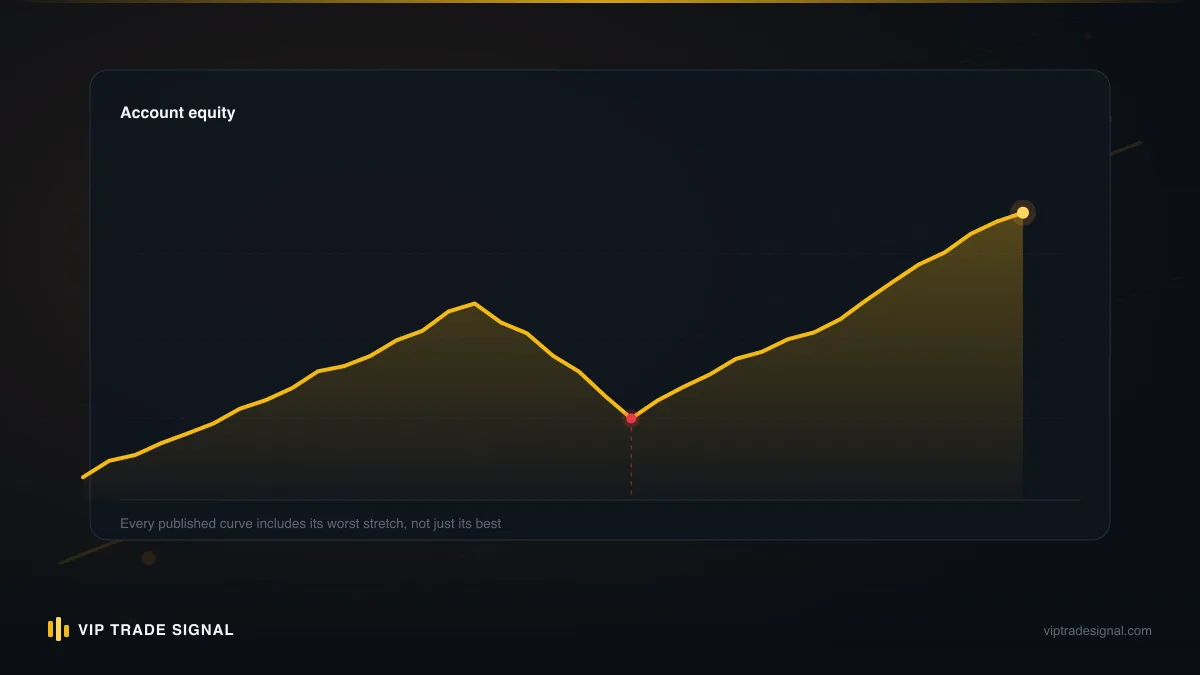
The baseline is the account's equity, agreed and written down by both parties, at the moment the recovery service takes over. Not the balance, which ignores floating losses. The equity: balance plus or minus everything currently open. Say your account shows a balance of $10,200 but carries $6,700 in floating losses. The equity is $3,500, and $3,500 is the baseline. Screenshot taken, figure stated in writing, both sides holding a copy. On our desk this goes into the agreement before a single trade is placed, alongside the date and the account number.
Why does this matter so much? Because "profit share on recovered funds" is meaningless until you define where recovery starts, and a dishonest operator can move that line to charge you for money you already had.
Watch the trick. A shady service takes over the same account and quietly defines the baseline as the balance, $10,200, or worse, doesn't define it at all. Then they close your hedged positions, realising losses that were already sitting there as floating red, and the balance drops to $3,500. Now every dollar of trading from $3,500 back up toward $10,200 gets billed as "recovered profit." You'd pay a performance fee on $6,700 of movement that merely restored equity you technically still had on day one. Same trades, same outcome, wildly different bill.
The honest version: baseline equals equity at handover, fees apply only to realised profit above that line, and the line never moves. If the account dips below the baseline before recovering, no fee is due until it's back above the previous high point. That last part is just a high-water mark, the same convention hedge funds have used for decades, and any service that hasn't heard of it hasn't thought hard about being fair.
If a recovery service can't tell you, in one sentence, the exact number their fee is measured from, they haven't defined it, and that ambiguity will not be resolved in your favour.
While we're at it: the baseline conversation also forces a second useful question, which is what counts as "recovered." Realised profit only, in our view. Floating gains aren't recovered anything; they're open risk wearing a green shirt.
The recovery process, step by step
Every desk runs this slightly differently, but a legitimate engagement follows a recognisable shape. Ours looks like this, and the honest competition looks similar.
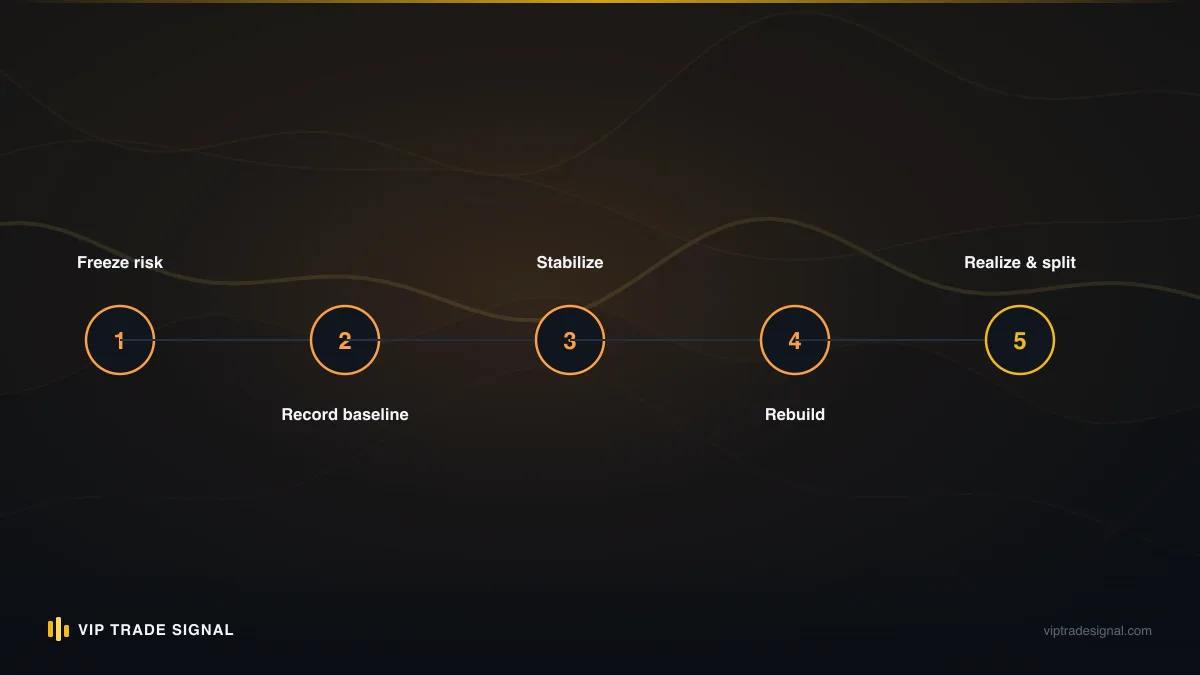
- Assessment before commitment. You share read-only access, or investor-password access, or even just full-history screenshots. Someone senior actually looks at the account: instrument exposure, swap bleed on old positions, margin health, how the hole was dug. This costs you nothing and commits you to nothing. On our desk the assessment happens through a conversation you start on the contact page, and roughly a third of the accounts we look at get told some version of "don't hire us."
- A written plan, in plain language. What gets closed and when. What the target is. What risk per trade will be. What happens if the market moves against the plan. If you can't understand the plan, that's not your failure; it's a sales document pretending to be a strategy.
- Baseline recorded. Equity captured, dated, agreed in writing. Covered above, and non-negotiable.
- Limited access granted. The service receives trading access to your account, nothing more. On MT4 or MT5 that means you either change the password after creating a dedicated setup, or more commonly, the manager trades while you keep the master password and the sole ability to withdraw. You should never move money to the service's own account, never grant access to your broker's client portal, and never let anyone talk you out of keeping withdrawal control. We wrote about why in the risks of handing over a managed account, and every word of it applies double when the account is already wounded.
- The triage phase. Weeks one to maybe four. Oversized positions reduced, hopeless ones closed and grieved, salvageable ones managed. Equity often gets worse on paper here, because floating losses become realised ones. This is the phase where clients panic and where good communication earns its keep.
- The grind. The long middle. Small positions, defined stops, a few setups a week, monthly progress you can measure against the baseline. Unspectacular by design. If your statement from this phase looks exciting, something has gone wrong.
- Settlement and exit. The account reaches the agreed target, or you decide you're done, and the fee is calculated on realised profit above the baseline. Then, and we think this is a marker of a real service, they should be willing to hand back a healthier account and walk away, rather than engineering reasons to stay attached to it forever.
A word on the quiet cost nobody mentions during triage: swaps. Old positions held for months don't just sit there; on most brokers they bleed overnight financing every single day. We've assessed accounts where the hedge that "protected" the trader was costing $9 a night in combined swap charges, which is $270 a month leaking out of an account that could least afford it. Sometimes closing a hedge and eating the realised loss is cheaper than another quarter of financing charges, and that calculation, done coldly with a spreadsheet rather than hopefully with a feeling, is exactly the kind of decision the triage phase exists for. It's also a decision the account owner almost never makes alone, because closing the hedge means admitting the loss is real.
Timeline honesty: for the accounts we take, floating roughly $5,000 to $10,000 down, meaningful repair takes three to nine months. Faster happens when the market cooperates. Slower happens too. Anyone quoting days is quoting a gamble.
Fee models compared: upfront, monthly, profit share
There are only three ways to charge for recovery work, and the model a service picks tells you almost everything about its incentives.
| Model | How it works | Who carries the risk | Watch for |
|---|---|---|---|
| Upfront fee | Fixed payment before work starts, e.g. $500-$2,000 | You, entirely | The service is paid whether or not anything recovers. Standard model for outright scams |
| Monthly retainer | Recurring fee, e.g. $200-$500/month while engaged | Mostly you | Incentive to stretch the engagement. Slow recovery becomes a revenue feature |
| Profit share | Percentage of realised profit above an agreed baseline | Mostly the service | Only works honestly if the baseline is recorded. Check the percentage and the high-water mark |
Upfront fees are the scammer's natural habitat, because the transaction completes before any work has to. That doesn't make every upfront charge a fraud. A genuine firm might bill a modest fixed amount for a detailed written assessment. But upfront recovery fees, money for the outcome rather than the analysis, deserve extreme suspicion, and in the fund-recovery scam world they're the entire business model.
Retainers are more defensible and still misaligned. A service billing $400 a month has a quiet incentive for your recovery to take eleven months instead of five. Most retainer operators aren't consciously slow-walking anything. Incentives don't need consciousness to work.
Profit share aligns the interests as well as anything can: the service earns nothing unless your account actually climbs above the recorded line. The catch is the details. What percentage? Measured from where? Realised or floating? Billed when? A profit share with a vague baseline is worse than a retainer, because the vagueness is where the money leaks out.
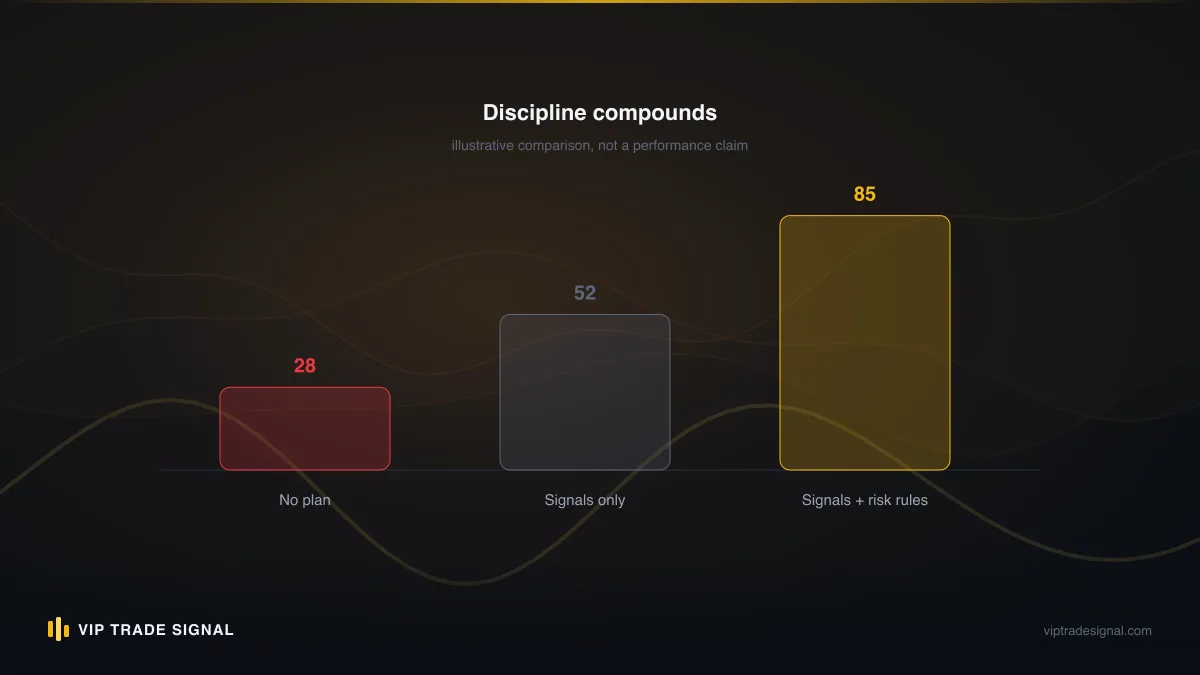
Industry-wide, profit shares on recovery and managed-account work run anywhere from 20% to 50%. Ours sits at the top of that range, and the next section explains why we think that's the honest place for it to sit rather than a number to mumble past.
Our model: flat 50% of profit above baseline, nothing else
Here's the entirety of how our drawdown management service charges, and then the uncomfortable part.
We take accounts floating roughly $5,000 to $10,000 down. We record the baseline, in writing, before touching anything. We trade the account, gold only, on your own MT4 or MT5 login, while you keep the master password and withdrawal control throughout. When realised profit accumulates above the baseline, we take a flat 50% of it. That's the whole model. No upfront fee, no retainer, no charge for the assessment, no fee of any kind if the account never climbs above the line. Every cost is listed on the pricing page, mostly so nobody can claim they found a surprise later.
Now the uncomfortable part, said plainly: 50% is at the high end of the market. A fund manager running institutional money would charge 20%, sometimes with a management fee stapled on. So why would you pay us more than a hedge fund charges?
Because the economics of small, damaged accounts don't resemble the economics of a fund. A desk managing $50 million at 20% of profits earns a living from scale. A desk repairing a $6,000 hole in a retail account is doing weeks of skilled, attention-heavy work on an amount of capital where 20% of a realistic recovery wouldn't cover the hours. The honest choices are: charge upfront (we won't), charge a retainer (misaligned), refuse small accounts entirely (which abandons exactly the people searching for this page), or charge a high share of profit that only exists if the work succeeds. We picked the last one. You're welcome to think 50% is steep. It is steep. It's also the only number on the bill, and it's zero if we fail.
Run the arithmetic on a real scenario before deciding how it sits with you. Baseline recorded at $3,500 on an account that was once $10,000. Over seven months the account grinds up to $9,100. Realised profit above baseline: $5,600. Our share: $2,800. Yours: $2,800, plus the fact that your $3,500 account is now a $6,300 one under your full control. Would you rather have paid a $1,500 upfront fee to someone who might have delivered nothing? Some people would still say yes to a cheaper percentage elsewhere, and that's a fair choice, provided the cheaper service also has a recorded baseline, also skips the retainer, and also lets you keep the withdrawal keys. Compare whole models, not single numbers.
One more of our rules, since this section is the advert and you may as well have all of it: we publish every closed signal from our signal side, wins and losses, at /signals/history. Not because recovery clients trade our signals, but because a desk that hides its losing trades in one part of the business will hide them everywhere.
What recovery can and cannot promise
This section exists because the search phrase "recover forex losses" attracts people at their most persuadable, and persuadable people get sold certainty. So, bluntly.
Recovery can: impose risk discipline the account didn't have. Untangle hedges and margin problems with a professional's detachment. Convert a chaotic, emotionally radioactive account into a managed position with a plan. Give you a realistic monthly grind toward the baseline and beyond. Take the phone out of your hand at 2am, which is worth more than most people admit.
Recovery cannot: guarantee the account gets back to its original size. Guarantee any profit at all. Beat arithmetic: a 65% drawdown still needs a 186% gain, whoever is trading. Work faster than the market allows without taking risks that recreate the original disaster. And it cannot succeed every time. Ours doesn't. Nobody's does. Trading gold, forex, CFDs, any leveraged product, carries a real chance of further loss, and an account in recovery can go lower before it goes higher, or just go lower. If that sentence makes a service's marketing collapse, the marketing was the problem.
There's a version of this conversation we have often. A trader, call him Sam, comes in $8,200 down on what was a $12,000 account. Sam wants to know how long until he's "back." The honest answer is that "back" is the wrong target for month one. The first target is stabilisation: no more growth in the hole. The second is the baseline plus something, anything, that proves the process works. Original equity is target three, and it might be a year away, and it might not arrive. Sam usually hates this answer for about a week. Then he notices he's sleeping again.
What should worry you is any service that skips this conversation. Guaranteed-recovery language isn't just optimistic, it's diagnostic: the person saying it either doesn't understand drawdown arithmetic or is lying about it, and both disqualify them from touching your account.
The cases we decline, and why
Roughly a third of assessments end with us saying no. The reasons are worth listing, partly so you can pre-check your own situation, and partly because a recovery service that never declines anyone is itself a warning sign. Selectivity is what having a real method looks like.
The money is already gone. Closed positions, withdrawn balance, or a scam broker that will never process a withdrawal. There's nothing to trade. We say so, point people at the fraud-reporting route, and take no fee, because taking one would make us the second scam.
The hole is too deep for the equity left. An account down 85% has $1,500 left and needs a 567% gain. Recovering that through disciplined trading isn't a plan, it's a lottery ticket with extra steps. We'd rather someone withdraw the $1,500 than pay us half of a miracle that won't come.
The account is smaller than the work. Below roughly $5,000 of drawdown, the honest maths of profit-share doesn't cover proper attention, and we won't do inattentive recovery. Our published band, $5,000 to $10,000 floating down, exists because that's where our model actually functions.
The trader won't step back. Recovery fails when two people trade one account. If you want to keep placing your own trades alongside the plan, the plan is fiction. We need the trading to be ours for the duration; you keep the master password and the withdrawals, but the positions are ours to manage or the engagement doesn't work.
Prop firm and bonus-restricted accounts. Funded challenge accounts have rules that third-party management usually violates outright, and deposit-bonus accounts often void the bonus on a management arrangement. Not our call to burn your funded account for you.
Anyone who wants a guarantee. If the assessment call ends with "but can you promise," we can't, and we'd rather lose the client than start the relationship with a lie.
How to vet any recovery service in 20 minutes
You don't need weeks of due diligence to filter this market. You need a browser, a stopwatch's worth of patience, and the willingness to walk away on a single red flag. Here's the twenty-minute version, usable on us as much as anyone.
Minutes 1-5: identify which industry they're in. Read their site and answer one question: where does the recovered money come from? Trading future profit in your account, or clawing money back from brokers and scammers? If it's the second, you're on a fund-recovery site, and the vetting is over, because the legitimate version of that work is done by regulated law firms, not websites with countdown timers. Check for the classic tells: testimonials with stock photos, claimed relationships with regulators, "success rates" for recovery, pressure to act today.
Minutes 5-10: find the fee and the baseline. A real service states its model in numbers you can repeat back. Percentage, reference point, when it's billed. If the pricing page is a contact form, or the fee "depends on your case" with no stated structure, assume the structure will depend on how much they think you'll pay. Then look for the baseline concept, in any wording. A profit-share service with no visible concept of a starting reference either hasn't thought about fairness or has, and decided against it.
Minutes 10-15: check the access model. Somewhere, the service should describe what access it takes. The only acceptable answer is trading access to your own account at your own broker, with you keeping the master password and exclusive withdrawal control. Wiring funds to their "pooled account," giving them your broker portal login, or installing their remote-access software are each individually disqualifying. No exceptions for how trustworthy they seem. Trustworthy-seeming is the scammer's core product.
Minutes 15-20: look for published losses. Any operation that trades has losing trades. Find where they admit it. A public trade history that includes red, a drawdown figure in their own performance discussion, a plain sentence saying recovery sometimes fails. Absence of any visible loss, anywhere, isn't a sign of skill. Skill leaves losses on the record and context around them. While you're there, search the company name plus "scam" and plus "review" and read past the first page, because burying complaints under fresh SEO pages is a service industry of its own.
If you have a spare five minutes beyond the twenty, do one more thing: ask them to walk you through a case that went badly. Not their worst-case disclaimer, an actual engagement where the account didn't recover, what they did, what the client paid, how it ended. A desk that has been doing this work for any length of time has these stories, and the ones worth hiring will tell you one without flinching, names removed. The ones who claim there aren't any are either brand new, which you'd want to know, or lying, which you'd want to know more.
Twenty minutes. Most of the market fails inside the first ten, which saves you the rest.
Questions to ask before granting account access
Suppose a service survived the vetting and you're on a call. Access to a live trading account is the last thing you hand over, so this conversation is where you get specific. Ask these, in roughly this order, and write the answers down.
- "What exact figure is the baseline, and where is it recorded?" The answer must be a number, your account's current equity, in a document both of you keep. "We'll sort that out once we start" ends the call.
- "Is your fee calculated on realised profit only?" Floating profit is open risk. A service billing on unrealised gains gets paid for positions that can still turn red.
- "Is there a high-water mark?" If the account makes $1,000 above baseline, dips, then re-makes the same $1,000, you should pay once, not twice.
- "What risk per trade will you use, and what's the maximum open exposure?" You want a percentage, not an adjective. "Conservative" is not a number. Somewhere around 0.5%-1.5% per trade is the sane band for a wounded account.
- "What happens if equity falls a further X% below baseline?" There should be a pre-agreed stop point where trading pauses and you talk. A service with no defined uncle point intends to trade your account to zero before admitting difficulty.
- "Can I watch every trade in real time?" On your own MT4/MT5 login, you can, by definition. Any resistance to live visibility means the account isn't really yours anymore.
- "Who else will have access?" Named humans, not "our team." You're entitled to know how many hands are on the wheel.
- "How do I end this?" The exit should be simple: you say stop, open positions are closed or handed over on an agreed protocol, fees settle on realised profit above baseline as of that day. Notice periods longer than a few days, or exit penalties of any kind, are shackles dressed as terms.
- "What happens if you fail?" The only honest answer is some version of: you'll have lost further money, you'll owe nothing, and we'll have told you the risk before starting. Listen for whether they can say the first part out loud.
None of these questions are aggressive. They're the ordinary hygiene of handing a stranger the keys to money you've already watched shrink once. A professional will answer them comfortably, because a professional has heard them before. The ones who bristle are telling you something more useful than their answers would have.
And one question for yourself, before any of the above: do you actually need a service? If your account is down 15% and flat, with no tangled positions, what you likely need is smaller sizing and patience, not a manager taking half your upside. Recovery services earn their fee on genuinely stuck accounts. Hiring one for a routine drawdown is paying for surgery when you needed sleep.
Where this leaves you
If you've read this far with a damaged account open in another tab, here's the order of operations we'd give a friend.
First, establish which problem you actually have. Money stolen by a fake broker is a fraud case: bank, card issuer, national fraud reporting, and total silence toward anyone who emails offering to get it back for a fee. Money trapped in a real account at a real broker is a trading problem, and trading problems have trading answers.
Second, stop digging tonight. Not with a grand plan, just literally: no new positions, no doubling the hedge, no revenge lot sizes. Every recovery, self-managed or hired, starts from the moment the hole stops growing. That step costs nothing and most people skip it for another month.
Third, write down your own baseline even if you never hire anyone. Current equity, today's date. Progress you can't measure is progress you'll misremember, and drawdown makes unreliable narrators of all of us.
Fourth, decide honestly whether you can do the grind yourself. Some traders can, once the sizing is fixed and the emotion has cooled. Plenty can't, not for lack of knowledge but because it's their own money and their own mistake staring back from the chart, and detachment is precisely the thing they can't buy back. That's the actual product a recovery desk sells. Not magic. Distance, plus discipline, at a price.
If you want our eyes on your specific situation, the assessment costs nothing and obliges you to nothing: send the details through the contact page and someone senior will tell you plainly whether your account fits our band, what a realistic plan looks like, or whether the kindest advice is to withdraw what's left and keep it. We take a flat half of what we recover above the line we record together, and if we recover nothing, you owe nothing. That's the whole deal, and after everything above, you now know exactly how to check that we honour it.
Steep fee, recorded baseline, your keys, no promises. If someone offers you better than that, make them show you where the baseline is written down. Then count to twenty minutes.