Two managers offer to trade your account. One wants 25% of profits. The other wants 50%. Which is cheaper?
You genuinely cannot answer that question yet, because a forex account manager profit split is defined by its terms, not its headline percentage, and anyone who thinks otherwise has never read a management agreement properly. The 25% manager might charge his quarter on every winning trade individually, ignore the losers, and reset his baseline every month, which means he can collect fees from you in a quarter where your account finished down. The 50% manager might charge only on net new profit above the highest point your account has ever reached, banked and withdrawn-able, with the starting figure written down where both of you can see it. Run realistic numbers through both structures and the "expensive" manager frequently costs you less in actual dollars, while the "cheap" one quietly becomes the most expensive financial relationship you have ever had.
That is the whole subject of this piece: how a forex account manager profit split really works underneath the headline percentage. We are going to take apart high-water marks, hurdle rates, baselines and resets, walk one recovery scenario through four different fee models so you can watch the dollars move, and show you our own maths in full, since we charge one of those big scary percentages ourselves and think we can defend it in daylight. By the end you should be able to read a fee clause and know, within about thirty seconds, whether the person who wrote it plans to make money with you or from you.
The fee structure is a confession
Here is an opinion we hold strongly after years around this business: a manager's fee structure tells you more about how they will trade than anything they say about strategy. Strategy talk is cheap. Everybody claims discipline, everybody claims risk management, everybody has a screenshot of a good month. The fee clause is different, because it is the one place where the manager had to sit down and decide, in writing, exactly which of your outcomes puts money in their pocket.
Think about what each structure pays for. A manager on a fixed monthly fee gets paid whether you profit or not, so their real incentive is retention: keep the account alive, keep the client calm, avoid anything dramatic. That can mean sensible conservatism. It can also mean a year of doing nearly nothing while the invoices go out. A manager paid a percentage of profits only eats when you eat, which sounds perfectly aligned until you notice that they share your upside but not your downside, and that asymmetry is exactly what makes some of them swing far too big. Heads they take a cut, tails it was your capital.
And then there are the structures designed by people who understand both problems and have thought about how to be honest anyway: performance fee only, but measured on net realized profit, above a high-water mark or a recorded baseline, with the client holding the withdrawal keys. No structure removes risk. Gold and forex trading can lose money under any fee model, and a well-designed split does not make a bad trader good. But the structure determines which direction the pressure leans, every single day, on every single trade. Read it first. Read it before the track record, before the Telegram channel, before the polished onboarding call.
One more thing before the mechanics. Everything below applies whether your account is at its starting balance or sitting in a hole. Fee design actually matters more in a drawdown, because a recovery is where reset tricks do their worst damage, and we have written separately about how account recovery services use exactly these levers.
The three basic models, and the hybrid trap
Nearly every management arrangement you will meet is built from three components, alone or blended.
The management fee. A fixed charge for having your money managed: 1-2% of account value per year in the traditional fund world, or a flat monthly amount in retail arrangements. It pays the manager for existing. In institutional asset management there is a defensible case for it, since running a regulated fund has real fixed costs. In retail forex it is mostly a way to monetise accounts that are not making money. If a trader managing your $5,000 MT5 account wants $150 a month regardless of results, that is 36% of your capital a year as a hurdle before you make a cent. Walk.
The performance fee. A percentage of profit, and nothing else. This is the performance fee only account management model: no monthly charge, no percentage of assets, the manager earns zero in a losing month. Retail percentages run anywhere from 20% to 50%, much higher than the hedge fund world's traditional 20% because the account sizes are tiny. A manager taking 20% of profits on a $3,000 account is working for pocket change, which is why serious operators at small account sizes either set high minimums or charge a bigger split. Both are legitimate. What matters, as we will spend the rest of this article showing, is the base the percentage applies to.
The hybrid. "2 and 20" is the famous version: 2% management fee plus 20% of profits. Retail hybrids are usually uglier, something like $99 a month plus 30% of profits, and here is the trap: each component gets defended by pointing at the other. The monthly fee is small "because we mostly earn from performance"; the performance cut is fair "because the monthly fee barely covers costs". Add them up across a flat year and you discover you paid a full fee load for zero net gain. Hybrids are not automatically dishonest, but every hybrid deserves one blunt question: if your performance is good enough to earn the split, what exactly is the fixed fee for?
Our bias, openly stated: for retail-sized accounts, performance-only is the least gameable starting point, because it forces the manager's income to zero when the client makes nothing. That is the model we use ourselves. But performance-only with a rotten measurement base is worse than an honest hybrid, so the model name alone settles nothing. The measurement is everything.
How a forex account manager profit split actually applies
Say the agreement reads "50% profit split". Fifty percent of what, measured when, on which trades? There are at least five materially different answers, and the gap between the best and worst of them is enormous.
Per-trade. The manager takes their cut of each winning trade as it closes. Sounds intuitive, is actually the worst common structure in retail, because losing trades do not generate negative fees. Ten trades: five winners totalling $1,000, five losers totalling $1,000. Your net profit is zero. A per-trade 50% split charges you $500 on the winners and refunds nothing on the losers, so you finish the sequence down $500 on flat trading. The manager finished up $500. On flat trading. Sit with that for a moment, because thousands of people have signed it.
Per-period on realized profit. At the end of each week or month, the manager totals closed profits minus closed losses and takes the percentage of the net figure if it is positive. This is the honest baseline retail structure. Losers offset winners inside the period. Its one weakness is the period boundary itself, which is what high-water marks exist to fix, and we will get there shortly.
Per-period on equity including floating positions. The split is charged on the change in account equity, open trades included. Dangerous. A manager can open positions, mark them at a paper gain at month-end, invoice you on unrealized profit, and watch the positions give it all back in the following weeks. You paid real dollars on gains that never existed as withdrawable money. Any agreement that charges fees on floating profit should be declined without negotiation.
Above a high-water mark. Net realized profit is measured only above the highest level previously reached and charged upon. The gold standard, covered properly in the next section.
Above a recorded baseline. A fixed starting figure, written down and agreed by both sides, with the split applying only to profit above it. Simpler than a rolling high-water mark, and the model we use, especially in drawdown situations where "the highest level previously reached" might be a peak from eighteen months ago that no honest party expects to see again soon.
Notice something? The percentage has not appeared once in this section. A 30% split applied per-trade will usually cost you more real money than a 50% split applied to net realized profit above a fixed baseline. The base is the fee. The percentage is just the multiplier on it.
High-water marks: the clause doing the heavy lifting
If you learn one term from this article, make it this one, because a high water mark explained properly is the difference between paying for performance and paying for volatility.
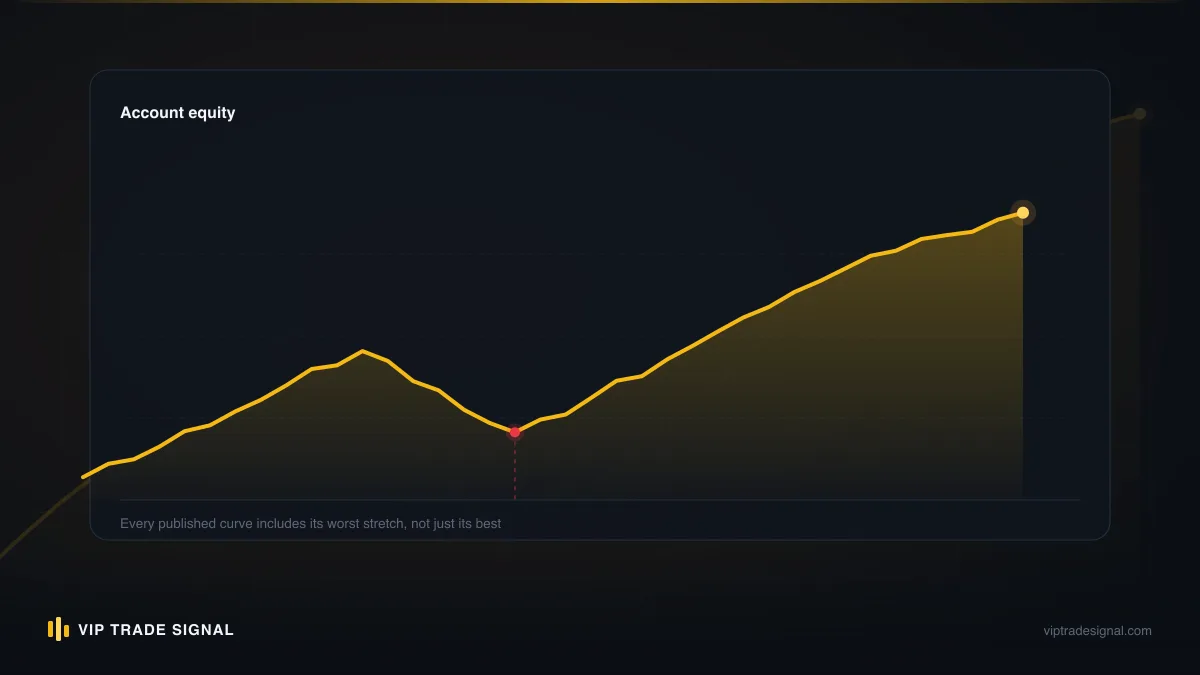
The mechanics are simple. Your account's high-water mark is the highest value on which fees have previously been charged. Performance fees apply only to profit above that mark. If the account falls below it, the manager earns nothing until the loss is fully recovered and the old peak is exceeded, and only the amount above the peak is fee-eligible.
Run it in dollars. You start at $10,000. Month one, the manager makes $2,000; account at $12,000, and with a 30% fee you pay $600. The high-water mark is now $12,000. Month two goes badly and the account drops to $9,500. Fee: nothing, obviously. Month three, the manager grinds it back up to $12,500. Without a high-water mark, month three looks like a $3,000 profit and a 30% split would invoice you $900 for it. With one, only the $500 above the $12,000 mark is billable, so you pay $150. The other $2,500 was not profit. It was repair work, un-losing money you already had, and you already paid a fee the first time that money was earned.
That is the entire moral logic of the clause: you should never pay twice for the same dollar of profit. Any fee model without a high-water mark or an equivalent fixed baseline charges you every time your equity crosses the same level on the way up, and in a choppy market an account can cross the same level six times in a year. Six invoices. One dollar of actual progress.
There is a second-order effect worth respecting too. A manager sitting below their high-water mark works for free until the account recovers, which does two useful things at once. It punishes recklessness that causes deep drawdowns, since deep holes mean long unpaid stretches. And it filters the industry: operators who know their strategy cannot sustain performance will not sign up to a structure where drawdowns switch their income off. When a manager cheerfully accepts a hard high-water mark in writing, that is not proof of skill, nothing is, but it is real evidence they expect to be above water more often than below it.
So the practical rule is short. Performance fee without a high-water mark or a fixed recorded baseline is not a performance fee. It is a toll booth on volatility, and volatile is the one thing every forex account will reliably be.
Hurdle rates, baselines, and who holds the pen
Two refinements on the basic mark, one you will rarely need and one you absolutely will.
A hurdle rate says the manager earns fees only on returns above some minimum, say 5% a year, on the logic that you could have earned the risk-free rate without them. In institutional funds, reasonable. In retail forex management it is mostly theatre. A managed MT5 account is not competing with treasury bills; nobody puts $5,000 with a gold trader as a bond substitute. If a retail manager advertises a hurdle, treat it as marketing polish and go read the clauses that actually move money: the measurement base and the reset terms.
A baseline, on the other hand, is the load-bearing wall of any honest retail agreement, and doubly so in drawdown work. It is one number: the account value from which profit will be measured. Everything the split applies to is defined relative to it. Which raises the only questions that matter. Who recorded it? When? Where? Can both parties still see it?
Get this in writing before a single trade. The baseline should be captured on a specific date, tied to a specific account statement, and stored somewhere neither side can quietly edit, in the agreement itself, in an email both parties hold, ideally against a broker statement with a timestamp. Our own drawdown process starts exactly here: the account's equity is recorded jointly on day one, both sides keep the record, and the flat 50% applies only to realized profit above that figure. If recovery stalls below the line, the fee is zero. Not reduced. Zero.
Now the dark side, because a baseline someone else controls is a weapon. The classic move is the baseline reset. Terms get "updated", the agreement "renews", the account "migrates" to a new structure, and the measurement point quietly moves from $10,000 to wherever the account sits today, say $7,600. Every dollar of recovery from $7,600 back to $10,000, which under the original terms was free repair work, is now billable profit. A manager who dug the hole gets paid to fill it in. One sentence of protection kills the entire trick: the baseline may not change without written agreement from both parties, and no drawdown resets it. If a manager resists that sentence, you have learned everything you needed to know for the price of one awkward conversation.
How splits get gamed: the three quiet tricks
Most fee abuse in retail account management is not forgery or theft. It is structure. The client signed the mechanism that fleeced them, which is exactly why the mechanisms deserve names.
Churning against a per-trade split. Under per-trade fees, the manager's income scales with the number and size of winning trades, not with your net outcome. So the rational strategy is volume: lots of trades, quick profit-taking on winners so each one generates an invoice, patience with losers since they cost the manager nothing. A hundred trades that net you $400 can produce thousands in fees. You will notice the account is busy and feel like you are getting service. You are getting harvested. The tell is always the same: fee income growing faster than account equity.
The reset carousel. Described above, worth repeating because of how it is disguised. Resets rarely announce themselves. They arrive dressed as good news: a new "recovery plan", an upgraded "tier", a fresh agreement after a rough patch, a switch of broker or platform where the paperwork starts clean. Each costume change moves the measurement point down to current equity. The question that unmasks every version of it: under this new agreement, at what exact account value do fees begin? If the answer is lower than the old baseline, the recovery you were owed for free just became a product you are buying.
Fee-on-floating. Charging the split on unrealized, open-position profit. This one deserves special contempt because it is trivially exploitable by anyone controlling the trade tickets. Open a large position, let it float into paper profit at the measurement date, invoice the client, then close it flat or worse later. Realized outcome: nothing, or a loss. Fees collected: real, and non-refundable. A cousin of this trick involves holding losers open across the fee date so they do not count against the period's "realized" profit, which is why the honest formulation is net realized profit, with all open positions marked against the calculation or the fee deferred until they close. Floating profit is a rumour. Nobody should be paying cash for rumours.
There is a broader family of outright cons wearing account-management clothes, guaranteed-recovery pitches and upfront "release fees" among them, and we have taken those apart separately in our piece on loss recovery scams. The three above are nastier in one way: they operate entirely inside a signed agreement, so there is nobody to report and nothing to reverse. Your protection is entirely at the reading stage. Which is the point of this article.
One recovery, four fee models
Time to make the dollars move. The scenario, generic on purpose: a trader we will call Dan has a $10,000 account that a bad stretch has taken down to $7,000, a $3,000 hole. He hands it to a manager, and over four months the account recovers to $10,600. Along the way the trading is realistic rather than smooth: month one makes $1,500, month two loses $700, month three makes $1,900, month four makes $900. Net gain over the whole engagement: $3,600, of which $3,000 is recovery of Dan's own lost money and $600 is genuinely new profit above his original $10,000.
Here is what four common fee structures charge for that identical trading.
| Fee model | What it charges on | Fee charged | Dan keeps of the $3,600 |
|---|---|---|---|
| Per-trade 30% split | Each winning month, losers ignored | 30% × ($1,500 + $1,900 + $900) = $1,290 | $2,310 |
| Monthly 25% split, resets each month | Each positive month's net, no memory | 25% × ($1,500 + $1,900 + $900) = $1,075 | $2,525 |
| 30% with high-water mark at $10,000 peak | Only profit above the old $10,000 high | 30% × $600 = $180 | $3,420 |
| Flat 50% above recorded $7,000 baseline | All net realized profit above start of engagement | 50% × $3,600 = $1,800 | $1,800 |
Look at what happened. The "cheap" 25% monthly-reset model charged Dan $1,075, and roughly $900 of that was fees on recovering his own money, because each month's profit was measured with no memory of the loss that preceded the engagement or even the losing month inside it. The per-trade 30% model was worse again. The high-water-mark model charged almost nothing, $180, because nearly everything earned was repair back to a peak Dan had already reached, which is precisely what the clause is designed to recognise.
And our own model, the flat 50% above the engagement baseline, charged the most in absolute dollars: $1,800. We put that row in deliberately, in an article we wrote, because pretending otherwise would be exactly the kind of marketing this blog exists to mock. When a manager takes on an account at $7,000, the $7,000 is the honest starting line for that engagement; the earlier peak belonged to a different chapter with a different trader at the controls. The client is paying half of everything the engagement genuinely produces, recovery included, and the manager is paid zero unless the account actually climbs. Whether that trade-off is worth it depends on a question the table cannot answer: what would the account have done in month five, six, and twelve under each manager's incentives? Which brings us to our maths, and then to the argument.
Our maths: flat 50% above a recorded baseline, in dollars
Since we have spent two thousand words telling you to demand fee transparency from managers, here is ours, completely, with nothing held back for the sales call.
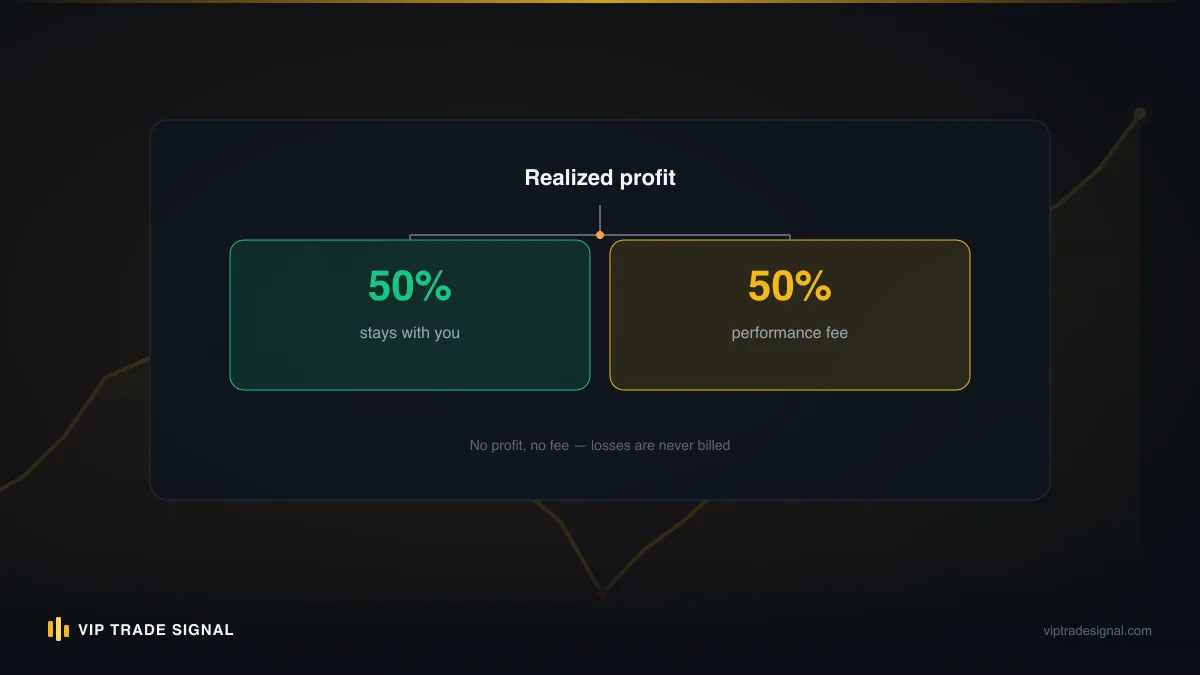
For standard account management, you keep your own MT4 or MT5 account at your own broker. We never hold your funds. You keep the master password; we trade on an investor-level connection, and you can withdraw or revoke access any day you like. On day one, the account's equity is recorded and agreed by both sides. That figure is the baseline for the engagement and it does not move, not after a drawdown, not at renewal, not ever, without both signatures. Our fee is a flat 50% of net realized profit above that baseline, settled at agreed intervals, with a $200 minimum advance that counts toward fees. No monthly charge. No fee on floating profit, full stop. If the account sits at or below baseline, our fee for the period is zero, and every dollar of climb back to the line is unpaid work on our side.
Dollars, then. Baseline recorded at $8,000. Over the settlement period the account closes trades worth +$2,400 and −$1,000, no open positions at settlement. Net realized profit: $1,400, account at $9,400. Fee: $700. You keep $700 of new money plus everything you started with. Next period the account slips to $8,900. That is $500 below the previous settlement point but still above baseline, and here is the part people ask about at least once a week through our FAQ: we apply high-water logic between settlements, so having charged you at $9,400, nothing more is billable until the account exceeds $9,400 again. You will never pay twice for the same dollar. If a period ends below the last charged level, the bill is zero and the clock waits.
For drawdown engagements the structure is identical with the baseline set at the recovered account's starting equity, and one honesty rule stated louder: there are no recovery guarantees. None. An account that is down $6,000 can go down further, and any manager who promises otherwise is lying to you by definition, because leveraged gold trading does not offer certainty to anyone at any fee level. Half of what we actually recover, nothing on what we do not, your money in your account throughout. That is the whole product. If you can find the hidden clause in that paragraph, write in, because we could not fit one.
Why we think incentive-aligned beats cheap
Now the argument, because "our 50% is honest" invites an obvious reply: fine, but 50% is still a lot. It is. Ours sits at the very top of the retail range, and you deserve the reasoning rather than a slogan.
Retail account management has brutal economics at small sizes. A skilled trader managing a $5,000 account who earns a genuinely good 4% in a month has produced $200 of profit. At a 20% split, their income is $40. Nobody competent works a month for $40, so managers offering small-account access at small splits must be making the money somewhere else, and there are only a few somewheres: volume of clients traded identically with minimal attention, hidden spread or commission kickbacks from an introducing-broker arrangement, per-trade or reset structures that tax you invisibly, or simple churn until the account dies and the next client arrives. The advertised percentage was never the price. It was the lure.
A big split on strict terms inverts every one of those pressures. When we only earn above a fixed line, on realized profit, with double-charging structurally impossible, the single path to our fee is the client's account actually growing. Overtrading does not pay us. Volatility does not pay us. Paper profit does not pay us. A blown account pays us nothing forever. We are, mechanically and not rhetorically, on the same side of the trade as the client, and we would rather defend a visible 50% of real profit than pretend 20% of a rigged base is a bargain. Losses still happen under our model, let us keep saying so, and a fair structure does not shrink them. What it changes is whose problem they are. Under our terms, a losing month is our unpaid month. Under a reset model, a losing month is next month's billable recovery.
There is a cheaper way to get our trading entirely, and it is not a secret: the signal side of the desk publishes unlimited XAU/USD signals at $99 a month, or free if you keep $250 or more with a partner broker (Exness, XM, IC Markets or Vantage), with every closed call, wins and losses, public at /signals/history. Full pricing is on one page with no call required. Management exists for people who want hands off the wheel, and hands off the wheel is precisely when the fee mechanics you cannot see become the entire game. Pay for alignment or do not pay at all. The expensive option is the middle: cheap-looking management with a base you never checked.
The percentage is the price tag. The measurement base is the price.
Negotiating and verifying before you hand over a login
Agreements are drafts until signed, and retail managers expect fewer questions than you should ask. Here is the pre-signature routine we would use on ourselves.
- Get the fee clause in writing and rewrite it in your own words. One paragraph: what is charged, on what base, measured when, reset how. Send your version back and ask the manager to confirm it is accurate. An honest operator confirms in a sentence. A structure-gamer starts adding qualifiers, and every qualifier is a flag.
- Pin the baseline. Exact dollar figure, exact date, tied to a broker statement, held by both parties, changeable only in writing by both. Insist on the no-reset sentence from earlier verbatim.
- Demand realized-only measurement. The words "net realized profit" should appear. If open positions exist at settlement, they either count against the calculation or defer the fee. No fee on floating anything.
- Confirm high-water treatment between periods. Ask directly: if you charge me this month and the account then dips and recovers to the same level, do I pay again? The only acceptable answer is no.
- Keep custody. Your broker, your account, your master password, your withdrawal rights, investor access for the manager. Any request to move money to them, to a "pooled account", or to a broker you cannot verify independently is where this stops being a fee conversation.
- Verify the counting yourself. Your MT4/MT5 statement is the ground truth and nobody can fake it retroactively on your own broker's server. Reconcile every invoice against it. A manager whose invoices you cannot reproduce from your own statement within a few dollars is either sloppy or hoping you will not check, and you cannot afford either.
None of this is adversarial. We put clients through this exact conversation on purpose, because a client who understands the maths in month one does not become a dispute in month six. A manager who bristles at scrutiny of their own fee clause is telling you how every future disagreement will go. Believe them the first time.
Fee questions that expose a bad operator instantly
Interviewing a manager and short on time? These seven questions do the work of a full audit, because each one has exactly one honest answer and improvisation is audible.
- What base does your percentage apply to: per trade, per period, or above a mark? Anything but a clean answer ending in "net realized profit above a fixed reference" needs unpacking before you continue.
- If the account loses $2,000 and then makes $2,000 back, what do I owe you? The honest answer is nothing. Hesitation here is the reset carousel warming up.
- Do you ever charge on open positions? One word suffices. Two paragraphs means yes.
- Where is my baseline recorded and can I see it right now? "I'll send it over" is fine. "It's in our system" is not a location.
- What happens to your income in a month where I make nothing? You want to hear "zero" said without flinching. A manager who cannot survive an unpaid month is carrying pressure that will end up expressed in your position sizes.
- Do you receive anything from my broker: rebates, commissions, introducing-broker payments? Kickbacks are not automatically disqualifying, but undisclosed ones are, because a manager paid per lot has a second employer whose interests are not yours.
- Can I withdraw or revoke access tomorrow without penalty? Exit friction is a fee. Lock-ins, exit charges and notice periods measured in months are how bad structures keep clients who have done the maths.
Score it simply. Seven clean answers means you can proceed to judging the actual trading, which is its own separate diligence. One evasive answer means slow down and get everything in writing. Two means walk, whatever the track record says, because track records end and structures do not.
Where this leaves you
Strip everything above down to a card you could keep in a drawer. The percentage is the least informative number in any management agreement. The base is the fee: demand net realized profit, above a fixed baseline or high-water mark, recorded in writing, immune to resets, with custody and withdrawals staying in your hands. Any profit split account management deal that passes those tests is negotiable on price. Any deal that fails them is not cheap at any price, because the discount is coming out of a pocket you have not found yet.
And be suspicious of your own eye for bargains here. The whole reason rigged structures survive is that a small percentage feels safe and a big one feels greedy, when the real risk was never the multiplier, it was the measurement. A 20% split on a base that taxes your recoveries will beat you slowly and politely. A 50% split on an honest base is expensive in exactly one situation: when the manager actually makes you money, which is the one situation you were hoping for.
Our terms are on the table for whoever wants to inspect them: flat 50% of net realized profit above a jointly recorded baseline, $200 minimum advance, your account, your keys, zero guarantees offered because zero exist. If that maths reads fair, the account management page has the rest of the detail. If it reads steep, take this article's checklist and go price the market with it. Either way you will sign your next agreement knowing precisely which dollar the percentage touches, and that knowledge, unlike most things sold in this industry, is free.