A man messaged us last spring after wiring $4,000 to something calling itself an "institutional FX desk" he'd found through an Instagram advert. He never opened a trading account. He never saw a platform. He sent money to a company, the company sent him screenshots of a dashboard for six weeks, and then the dashboard stopped loading. That is not a forex account management service. That is a donation with extra steps.
The frustrating part is that real account management exists, works in a fairly boring mechanical way, and is easy to inspect once you know which four or five questions to ask. But the industry has let the scammers write the marketing playbook, so the average person searching for a forex account management service can't tell the difference between a legitimate profit-split arrangement on their own brokerage account and a Ponzi scheme wearing a suit.
We run a management desk, so you should read everything here knowing we have a horse in the race. Fine. We'd rather you read a biased walkthrough that teaches you how to verify things than an "unbiased" listicle written by an affiliate marketer who has never placed a trade. By the end of this you should be able to take any management pitch, ours included, and pull it apart in an afternoon.
What account management is, and what it definitely is not
Strip away the branding and account management is one simple arrangement: you own a trading account at a broker, and you give a third party permission to place trades on it. That's it. The manager trades, you watch, profits get split according to whatever you agreed, and either side can end the arrangement whenever they like.
Notice what's missing from that description. Nobody "holds your funds". Nobody "pools your capital". Nobody asks you to send money to their company account, their crypto wallet, or their cousin's Wise account. The money sits at a regulated broker, in an account with your name on it, and it never moves anywhere on the manager's say-so. If a pitch involves sending money anywhere other than your own brokerage account, you are not looking at account management. You are looking at either an unregulated fund (illegal to offer to retail clients in most jurisdictions) or a theft in progress.
There's a second thing management is not: a magic detachment from risk. Your account can lose money under management just as it can lose money under your own thumb. A manager who is honest will say the word "loss" early and often. A manager who talks only about monthly returns, compounding tables and "capital growth plans" is selling a fantasy, because anyone who has traded through a proper losing streak knows the equity curve spends a lot of its life below its last peak.
And one more, because the confusion is everywhere: management is not the same as copy trading. Copy trading mirrors another account's trades into yours through a platform feature, usually with no contract, no agreed risk cap, and no relationship. Management is a direct arrangement with agreed terms. Copy trading has its uses. But when something goes wrong on a copy platform, there's nobody across the table from you.
How access actually works: investor passwords versus full control
MetaTrader accounts, which is where most retail management happens, come with two passwords. The master password can do everything: trade, change settings, request withdrawals through the broker portal it's linked to. The investor password is read-only. Whoever holds it can watch every trade, every balance change, every open position, but cannot touch anything.
The correct configuration for a managed account is almost embarrassingly simple. You keep the master password. The manager trades through their own access, typically a trade-only linkage or, in cruder setups, a master password on a sub-account you fund specifically for this purpose and can drain at will. You hand out the investor password freely, because read-only access is how the manager proves things to you and how you check on them from your phone at 11pm.
What you never do is hand over control of withdrawals. A manager needs the ability to open and close positions. That is the entire job. Any request beyond that, your broker portal login, your email access "to speed up verification", your card details, is a request for the ability to steal, and it deserves exactly one response.
The only permission a manager needs is the permission to trade. Everything else they ask for is the permission to take.
Some brokers offer formal structures for this, MAM and PAMM accounts, where a manager trades a master account and allocations flow to sub-accounts automatically. These are genuinely fine when run through a regulated broker, and they solve the access problem neatly because withdrawal rights stay with each investor. But plenty of legitimate management, ours included, happens on plain individual MT4/MT5 accounts, because at retail sizes the plumbing of a PAMM is overkill. The structure matters less than the principle: your money moves only on your instruction.
Who your money actually sits with (spoiler: your broker)
This is the question that would have saved the man with the Instagram dashboard $4,000, so let's dwell on it.
In real account management there are three parties. You, the client, own the account and the money in it. The broker holds the funds, executes the trades, and answers to a regulator (quality varies wildly, which we'll get to). The manager holds trading permission and nothing else. Three parties, three distinct roles, and the money touches exactly one of them: the broker.
Test any pitch against this triangle. Ask, in plain words: "If I proceed, whose name is on the trading account, and who processes my withdrawal when I want out?" The only acceptable answers are "yours" and "your broker". A firm that wants to open the account for you, at a broker you've never heard of, with an email address they control, has collapsed the triangle into a straight line pointed at your wallet.
The broker-of-convenience trick deserves its own paragraph because it's the most common laundering of this scam into respectable clothing. The pitch says: "We only work with our partner broker, FinexoPrimeMarkets or whatever it's called this quarter, because our systems are integrated there." The "broker" is a website the same people own. The platform shows whatever numbers keep you depositing. Real managers work on accounts at brokers you chose, or at minimum at large, independently regulated brokers you can verify exist beyond the pitch. We trade client accounts at whichever proper MT4/MT5 broker the client already uses. If a manager can only perform at one obscure venue, the venue is the trick.
While you're at it, verify the broker itself. Look the entity up on the regulator's own register, not on a review site. Check the entity name on your account statement matches the regulated entity, because plenty of brands run a regulated company in one country and put actual clients under an offshore twin. Ten minutes of this before funding beats ten months of it after.
What a managed forex account looks like day to day
People ask about a managed forex account how it works in the abstract, but the abstract hides the texture. Here's the shape of a properly run arrangement from day one, so you can compare it against whatever you're offered.
Day one is paperwork and plumbing, not trading. You and the manager agree terms in writing: the profit split, the baseline balance it's measured from, the risk cap per trade, and how either side ends the arrangement. You record the starting balance together, ideally with a screenshot both parties keep, because that number is what every future fee calculation hangs on. Then access gets configured: the manager receives trading permission, you confirm you still hold the master password by changing it and logging back in, and the investor password goes to you and anyone else you want watching. That last check, actually changing the master password yourself before a single trade, takes ninety seconds and proves the exit door works before you need it.
Week one should be quiet. A sensible manager opens small, not because the strategy changed but because the first job on a new account is calibrating to its size and the broker's execution. If your $3,000 account sees full-size positions in the first forty-eight hours, you've hired an impatient person, and impatience in this business has a body count. You, meanwhile, should be logging in read-only every day or two. Not to second-guess trades, but to build the habit of looking, because clients who never look are the clients things happen to.
Month one is where the rhythm settles. Trades open and close, some win, some lose, and the account history accumulates into something you can actually evaluate. Fee settlement happens on whatever schedule you agreed, monthly is typical, and only on realized profit above the recorded baseline. A good manager sends a plain summary alongside the raw history: what was traded, what the month's drawdown touched, anything that deviated from plan. What you should not experience in month one, or ever, is a request for more money to "activate the next tier", a sudden change of broker, or fee maths you can't reproduce yourself from the account history. The whole arrangement should feel slightly boring. Boring is the texture of legitimacy.
And through all of it, nothing about your relationship with your broker changes. Deposits, withdrawals, statements, tax records: all yours, all direct, exactly as they were before the manager existed. If the day-to-day reality involves the manager mediating between you and your own money at any point, the structure has failed the test from a few sections back, whatever the contract says.
Fee structures across the industry, and what they do to your money
Management fees come in a handful of shapes, and the shape tells you a lot about the incentives you're buying.
| Fee model | How it works | Whose side it's on |
|---|---|---|
| Performance fee only | Manager takes a percentage of realized profit, typically 20-50% | Mostly yours; manager earns nothing in losing months |
| Management fee + performance | 1-2% of the account annually, plus 20-30% of profit | The manager's; they're paid even while losing |
| Flat monthly fee | Fixed charge regardless of results | Depends on size; brutal on small accounts |
| Per-lot or spread markup | Manager earns on trading volume | The manager's, dangerously; it pays them to overtrade |
The performance-only model with a high-water mark is the cleanest incentive alignment retail money can buy. High-water mark means the manager only charges on profit above the account's previous peak. Lose 10%, recover 10%, and there's nothing to charge, because you're merely back where you started. Without a high-water mark, a manager can lose your money, win some of it back, and bill you for the round trip. Any performance fee without a high-water mark, or at least a jointly recorded baseline that fees are only ever charged above, is quietly poisonous, and you should say the words "high-water mark" in your first conversation just to watch how the pitch handles them.
The per-lot model is the one to run from at speed. A manager paid per traded lot makes money whether you do or not, and makes more money the more they trade. Every incentive points at churning your account. Some of the ugliest blow-ups we've seen post-mortems on were volume-paid managers running 30 trades a day on accounts that had no business seeing three.
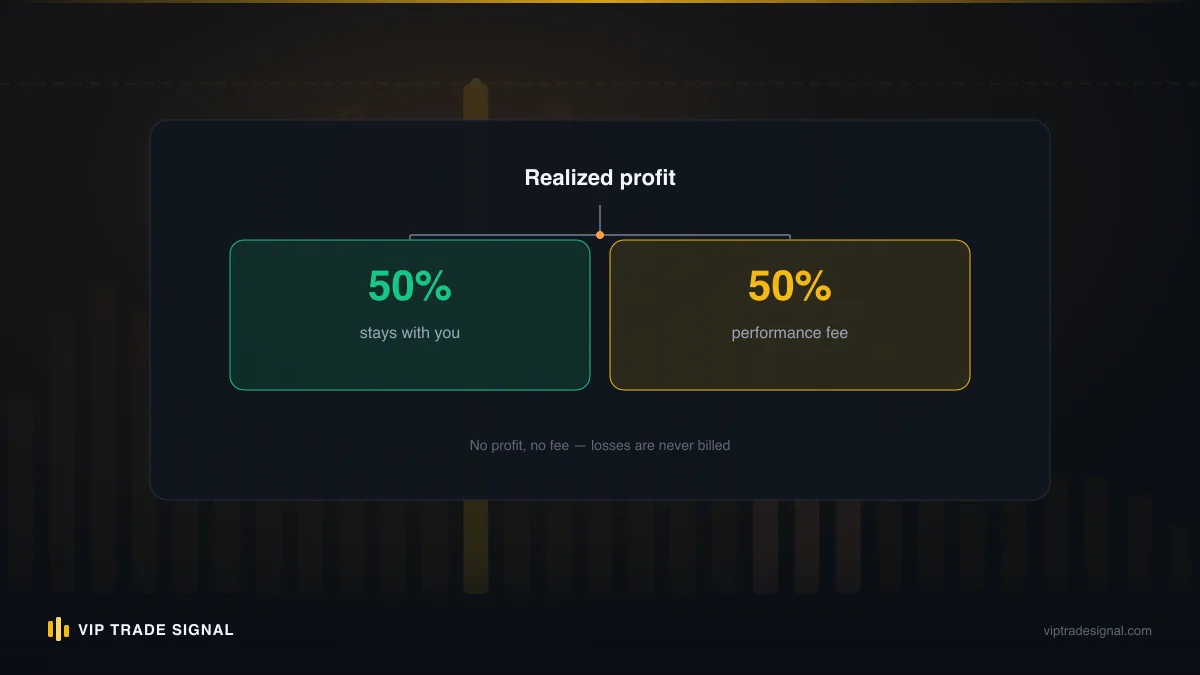
Percentages need context too. A 20% performance fee sounds obviously better than 50% until you look at minimums. The 20% managers generally want $25,000 or more to bother, because their economics need size. Desks that take small accounts charge more per dollar of profit because the work of managing a $2,000 account is not much less than the work of managing a $20,000 one. Our own fee sits at the high end, a flat 50% of realized profit, precisely because our minimum advance is $200 and everything runs pay-as-you-go with no lock-in. That trade-off is legitimate in both directions. What isn't legitimate is a high fee and a high minimum and a lock-in, which is a fee structure shaped entirely like a trap.
Whatever the numbers, insist the whole schedule is written down before a single trade: the split, the baseline it's measured from, when it's calculated, and how it's collected. Fees that materialize retroactively are not fees. They're negotiating positions.
Reporting you should demand: full history, losses included
Here's a sentence that should be uncontroversial and somehow isn't: you are entitled to see every trade ever placed on your account, including the losers, forever.
The investor password makes this technically trivial. Anyone with read-only access can pull the full account history out of MetaTrader in ten seconds. So when a manager's reporting consists of a weekly WhatsApp message saying "+3.2% this week" with a green tick doing the work of a trade history, something is being managed, and it's your perception rather than your account. Real reporting is the raw record: every position, open time, close time, size, and result, with the red rows left in.
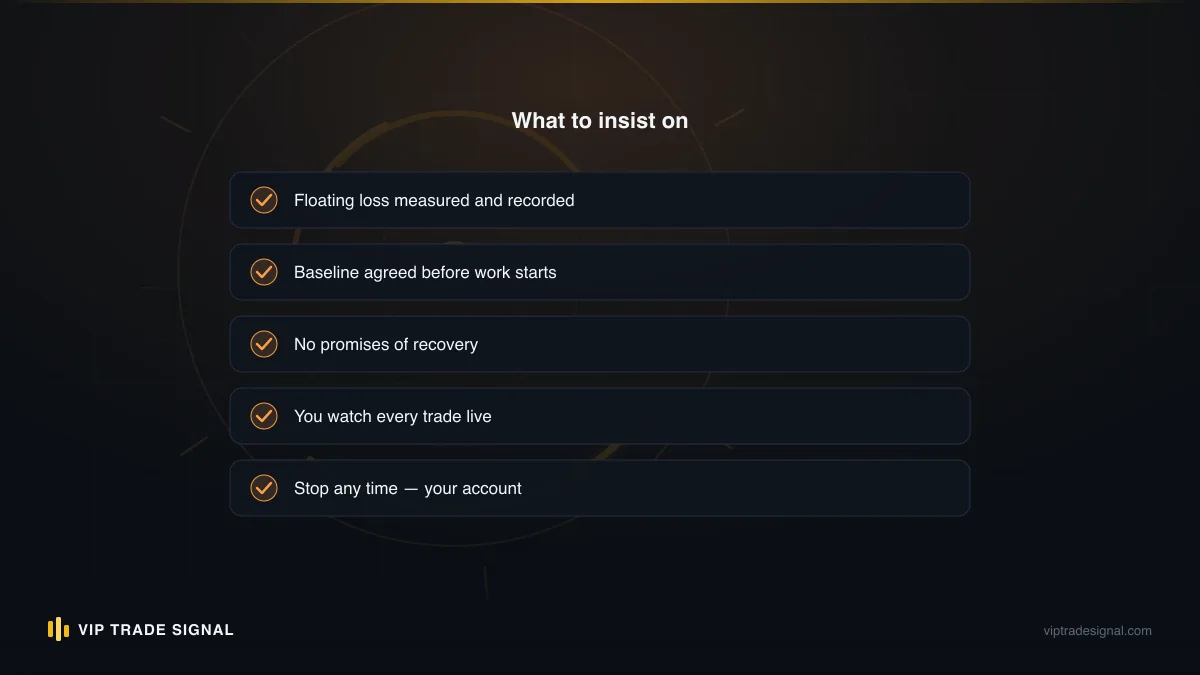
The standard we hold ourselves to, and think you should hold anyone to, looks like this:
- Live read-only access to the actual account, not a dashboard the manager built. Dashboards can lie. MT5 investor mode can't, short of the broker itself being fake, which is why the broker question came first.
- Full closed history, not curated highlights. We publish every closed signal, wins and losses, at /signals/history, and the same logic applies to management: history with the losses removed is fiction with a spreadsheet aesthetic.
- Drawdown reported as prominently as returns. A manager who made 60% in a year with a 55% peak drawdown nearly killed the account on the way. If the pitch shows you the 60% and you have to excavate for the 55%, you've learned what kind of pitch it is.
- Third-party verification where possible. A Myfxbook or FXBlue link tied to the real account, with the track record covering a year or more, beats any PDF. PDFs are where performance numbers go to be invented.
One more thing worth demanding, because almost nobody does: ask to see a bad month. Not the aggregate stats. An actual month where the strategy lost, and what the manager did about it. Every real strategy has them. A manager who can walk you through their worst stretch calmly, what the drawdown was, whether they cut size, what the client communication looked like, is showing you the thing that actually matters. A manager with no bad month to show you has either been trading for twenty minutes or is lying, and both answers end the meeting.
The five-minute fire test: how easily can you leave?
Here's the section you won't find on most providers' sites, which is precisely why it belongs in a forex account management service review or walkthrough of any kind. Before you hire a manager, work out exactly how you'd fire them. Not in principle. Mechanically, step by step, with a stopwatch running.
In a properly structured arrangement, firing your manager looks like this:
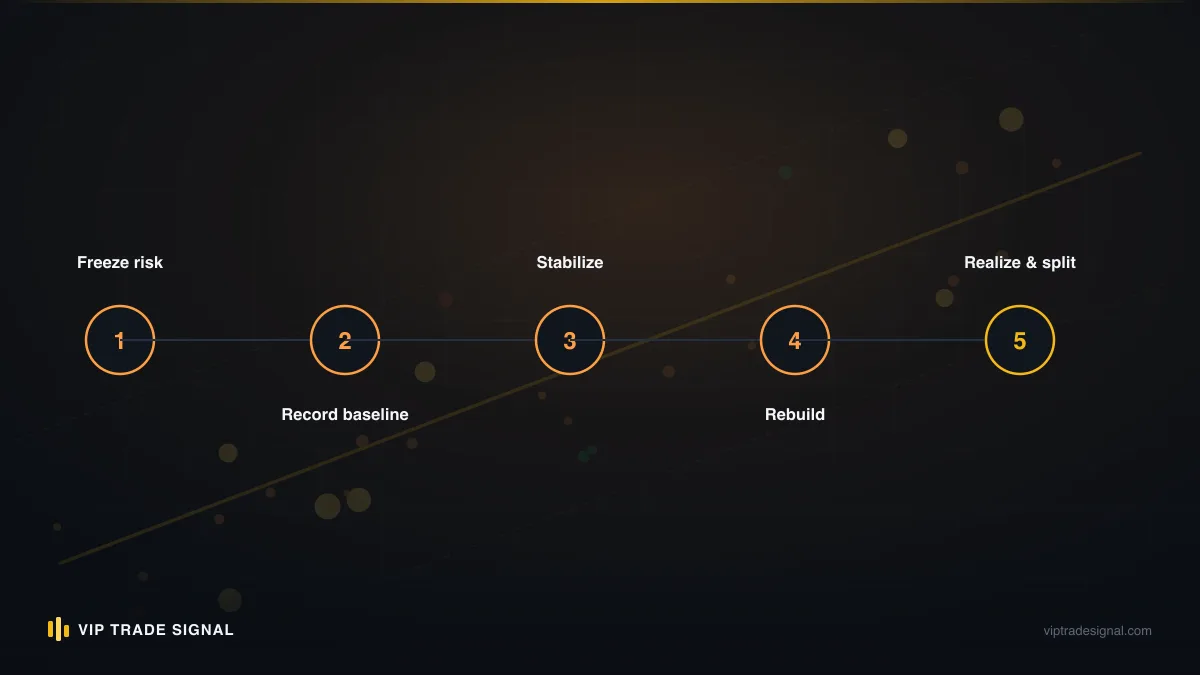
- Log in to your broker portal with credentials only you hold.
- Change the account's master password, which kills the manager's trading access instantly.
- Close any open positions yourself, or leave them if you choose to.
- Request a withdrawal to your own bank account.
- Send the manager a message telling them, as a courtesy, that you've done all of the above.
Five steps. Under five minutes. No permission requested from anyone, no notice period served, no exit paperwork, no "processing window". Note the order: you leave first and inform them after, because a structure that requires their cooperation to exit is a structure in which you don't actually control your own money.
Now run the test against whatever pitch is in front of you. Can't change the password because the manager registered the account? Fail. Withdrawals need the manager's sign-off, or a "release request", or clear only after month-end fee settlement? Fail. There's a 90-day lock-in, an early exit charge, or your capital is "deployed in positions" that only they can unwind? Fail, fail, fail. Every one of those frictions was designed in deliberately, and it was designed by someone thinking about the day you'd want to leave. Believe what the design tells you.
The fire test is also the fastest scam detector we know, faster than checking regulation, because it doesn't rely on any external database. A fraudulent operation cannot pass it even in theory. Their entire model depends on standing between you and your money, so the moment you ask "walk me through how I remove you unilaterally", the pitch has to either change the subject or start explaining why unilateral exit is "not how professional desks work". It is exactly how professional desks work. Any client of ours can lock us out mid-trade without asking, and while we'd rather you tell us first so we're not managing a position that no longer exists, the ability itself is non-negotiable. It's your account. We just work here.
Realistic returns versus what the adverts say
Type "managed forex" into any search engine and the adverts will offer you 10% a month, 15% a month, sometimes "up to 40% monthly" from outfits whose graphic designer is clearly paid better than their risk manager. So let's put numbers against reality.
The most scrutinized money managers on earth, hedge funds with PhDs, prime brokerage and infrastructure retail can't imagine, have historically been pleased with 15-25% in a good year. The famous long-run compounders sat around 20-30% annually and are studied precisely because that was extraordinary. Against that backdrop, a stranger on Telegram offering 10% a month, which compounds to over 200% a year, is making a claim that would make them the greatest money manager in recorded history. They are not the greatest money manager in recorded history. They are a person with a phone.
Here's the arithmetic that unravels every one of these pitches: anyone who could genuinely compound at 10% monthly wouldn't need your $2,000. They'd trade their own capital, borrow more, and quietly become one of the wealthiest people alive within a decade. The act of chasing small retail deposits is itself the proof the returns aren't real. Managers advertise to retail because the fee income is the business, not because they're sharing an abundance.
So what does honest look like? Wide, and unpredictable. A competent retail manager might produce 20-60% in a strong year on an aggressive book, might produce low single digits, and will sometimes finish a year down. Gold, which is all we trade, moves enough that aggressive months can print well into double digits, and the same volatility means losing months arrive without apology. Anyone quoting you a precise expected monthly figure is quoting marketing, because markets don't sign contracts. The honest version of a projection is a range with a minus sign on one end.
The variable that matters more than the return is the drawdown behind it. Two managers both made 40% last year. One never floated more than 12% down. The other spent March at minus 48%, martingaling into a losing position, and got bailed out by a reversal. Same return, utterly different risk of ruin, and only the account history tells you which one you're hiring. This is also why picking a manager by headline return is like picking a surgeon by confidence.
Regulation and the legal ground, region by region
Here's an uncomfortable truth the industry mumbles past: most retail forex account management operates in a regulatory grey zone, and how grey depends on where you and the manager sit.
In the UK, managing investments is an FCA-regulated activity, and doing it for others as a business without authorization is a criminal offence. In practice, virtually nobody offering managed forex accounts UK clients actually holds discretionary management permissions, because the capital and compliance costs are built for firms handling institutional money. The same picture repeats across the EU under MiFID, in Australia under ASIC's licensing regime, and in the US, where the CFTC/NFA rules are so restrictive that legitimate retail forex management barely exists onshore at all. The result is that most real-world retail management is either offshore, structured as the client granting a power of attorney or limited trading authorization on their own account, or both.
What does that mean for you, practically? Three things.
First, understand that "regulated" in most pitches refers to the broker, not the manager, and the broker's licence does not extend one millimetre to the person trading your account. A manager saying "we're fully regulated, we work with FCA brokers" is performing a word-association trick. The broker being properly regulated still matters enormously, because it's what makes custody and withdrawals real. It just doesn't vouch for the trading.
Second, know that if an unregulated manager wrongs you, your legal recourse is usually poor. No compensation scheme covers the trading decisions. Your protection comes almost entirely from the structure itself: your account, your broker, your master password, your withdrawal rights. This is why we've spent half this article on structure. Where the law is thin, the plumbing is your regulation.
Third, be honest with yourself about which side of the trade-off you're choosing. A fully regulated discretionary manager with a $250,000 minimum offers legal protection and institutional process. A structurally sound but unregulated arrangement on your own $2,000 account offers access and control but leans entirely on that structure. Both are defensible choices made with open eyes. Drifting into the second one while believing you have the protections of the first is the mistake, and it's the mistake the marketing is engineered to produce.
How our gold-only management works, and what it costs
You've read this far through our lens, so here is our arrangement laid out flat, in the same terms we've been demanding of everyone else. Judge it with the same knife.
We trade one instrument: gold, XAU/USD. Not because other markets are beneath us, but because a desk that claims deep expertise in thirty pairs has deep expertise in none, and gold's volatility and liquidity suit how we trade. The account is yours, at your existing MT4/MT5 broker. You keep the master password and full withdrawal rights from the first minute to the last. We receive trading access and an investor password goes wherever you want it to go, including to your most sceptical friend.
The fee is a flat 50% of realized profit, measured against a baseline we record together before the first trade, so we're only ever paid on money that actually exists above where you started. There's a $200 minimum advance and no other charges: no management fee, no lock-in, no exit cost, nothing per lot. Losing periods cost you the losses, which are real and should be said plainly, but they generate no fees, because charging you while underwater is the incentive structure we spent an earlier section calling poisonous. The full mechanics and current terms are on our account management service page, the numbers sit on the pricing page next to everything else we charge for, and the questions people actually ask before signing up are answered honestly in the FAQ.
Is 50% high? Against the 20-30% institutional norm, yes, and we said so in the fees section before we got to ourselves. The price buys a low minimum, month-to-month freedom, and a desk that publishes every closed result including the losing ones. If you have $50,000 and want a 20% fee with a regulated wrapper, you have better options than us and you should take them. If you have a small account and want a structurally clean arrangement you can inspect daily and exit in five minutes, that's the client we built this for. We've written more about why the split works the way it does in our piece on how a forex account manager profit split actually gets calculated, including the baseline and high-water mechanics that stop a split becoming a scam.
And to be clear about the boundary: we are not a licensed financial advisor, nothing here is personalized investment advice, and gold trades with leverage that can and does produce losses. Anyone who tells you otherwise, including a future version of us if we ever lose the plot, should fail your fire test on the spot.
Red flags in any forex account management service pitch, ranked by how fast you should leave
Some warning signs merit a follow-up question. Others merit standing up mid-coffee. In rough order of severity:
Leave immediately:
- Any request to send funds anywhere other than your own account at a broker you can independently verify. This is the whole scam in one sentence.
- Guaranteed returns, "risk-free" anything, or capital protection promises. Nobody legitimate says these words. They're not even legal to say in most places.
- The manager wants to open the account for you, using their email, at their partner broker. You'd own a login to a stage set.
- Withdrawal friction of any kind baked into the structure: approvals, lock-ins, "release fees", notice periods on your own money.
- Recovery-flavoured pressure: "deposit more so we can trade you back to breakeven". That instinct is how $5k holes become $15k ones, and it's exactly the dynamic we pulled apart in our piece on forex loss recovery scams.
Interrogate hard, then probably leave:
- No live third-party-verifiable track record, only screenshots and PDFs. Screenshots take four minutes to fake and we could teach you in two.
- Performance fees without a high-water mark or recorded baseline.
- Per-lot compensation, or evasiveness about how exactly they're paid.
- A track record shorter than a full year. Six good months tells you almost nothing except that the strategy hasn't met its bad regime yet.
- Pressure and urgency: closing slots, expiring bonuses, "the fund reopens Monday only". Real capacity constraints exist in institutional money. In retail management, urgency is a sales tool, full stop.
- They found you, via a DM, a "wrong number" text, or a romance-adjacent chat that swerved into trading. Legitimate managers are found; they do not hunt.
Softer signals worth weighing:
- Vagueness about strategy. You don't need their source code, but "we trade price action with proprietary AI" is a lava lamp of an answer.
- Lifestyle marketing. Watches and rented Lamborghinis correlate with fee income, not trading skill, and often with neither.
- Reluctance to put terms in writing. A manager who won't email you the fee schedule is planning to renegotiate it after you're up, or worse, after you're down.
No single soft signal is fatal. Three of them in one pitch is a pattern, and patterns are how you avoid being a story someone else's blog opens with.
Is management even right for you? A decision worth making slowly
After all this plumbing, step back and ask the prior question: should you hand your account to anyone at all?
Management genuinely fits some situations. You have capital but no time, and you know from experience that trading tired at midnight after work produces donations, not returns. Or you have time but have proven to yourself, expensively, that your discipline collapses in live markets even when your analysis is fine. Or you're rebuilding after a bad stretch and want a professional process around an account you've decided not to touch for a while. In those cases a well-structured arrangement, entered with everything above verified, is a rational tool. For accounts already sitting in a deep hole, a managed recovery arrangement is a related but distinct thing, with its own baseline mechanics and its own hazards, which we walked through separately in our guide to forex account recovery services.
Management fits badly in other situations, and honesty costs us potential clients here. If the money you'd allocate is money you can't afford to lose entirely, no manager should touch it, us included, because losing it entirely is a real outcome of leveraged trading no matter who holds the wheel. If you're reaching for management as a lottery ticket, hoping a stranger will turn $500 into a salary, the maths was never there and the disappointment is pre-booked. And if you can't stomach watching someone else hold a losing position on your account without panicking, you'll interfere at the worst moments and inherit the losses of two strategies while capturing the gains of neither. Some people should trade their own accounts. Some should use signals and keep their own finger on the trigger. Some should do neither and buy an index fund. All three are respectable answers.
So here's the closing take, and the homework. Before you hire anyone, write down five things: whose name is on the account, who can withdraw, exactly what the fee is and what baseline it's measured from, where the full loss-included history lives, and the five steps of your exit. If you can't fill in all five from what the provider has told you, the pitch is incomplete and so is your decision. If you can fill them in and every answer points at you keeping control, you've found one of the honest ones. There are fewer of those than the adverts suggest. But they exist, they'll survive every question in this article without flinching, and the ones that flinch have just saved you a great deal of money.