There is a particular breed of Instagram video that only really exists in one city. A man in a white shirt walks slowly past a supercar, talks about "passive income" over a beat, gestures at the Burj Khalifa behind him, and invites you to DM the word WEALTH. The car is rented by the hour. The apartment in the next shot is an Airbnb. The trading account he screenshots, if it exists at all, is a demo.
That's one face of forex account management in Dubai. The other face is that the same city, sometimes the same postcode, contains one of the most serious financial regulatory environments in the region, with licensed asset managers running genuine discretionary mandates under rules that would feel familiar to anyone from London or Singapore. The real thing and its cartoon exist side by side, use the same skyline in their marketing, and compete for the same deposits.
If you're weighing up handing a trading account to someone based in the UAE — or you're in the UAE yourself and wondering who's allowed to manage your money at all — the gap between those two worlds is where your capital either survives or disappears. This guide is about learning to see the gap. We run an account management service ourselves, so we have a view (and a bias, which we'll declare properly later), but most of what follows applies whoever you end up trusting.
Dubai's double identity: hub and theater
Start with the honest version, because it genuinely exists. The Dubai International Financial Centre — the DIFC — is a free zone with its own courts, its own commercial law modelled on English common law, and its own regulator, the Dubai Financial Services Authority. Firms licensed by the DFSA to manage assets are subject to capital requirements, fit-and-proper tests for senior staff, client money rules, and actual enforcement. The DFSA publishes fines and bans. It is not decorative.
Around that core sits a wider financial ecosystem: banks, family offices, brokerages licensed onshore by the Securities and Commodities Authority, and a large expatriate population with disposable income and, in many cases, no capital gains tax eating into whatever they make. Money is mobile here. People arrive, earn well for five or ten years, and want that money working. That's a legitimate market, and legitimate firms serve it.
Now the other version. Dubai is also, by a comfortable margin, the world capital of trading lifestyle fraud. Not because Emiratis are gullible — the victims are mostly foreign, reached through social media — but because the city photographs like wealth. A scammer in Manchester has to fake success against a backdrop of drizzle. A scammer in Dubai Marina gets the set for free. Add visa accessibility, a large itinerant population, and the practical difficulty of pursuing someone across borders once they've moved on, and you get an environment where the props are cheap and the exits are plentiful.
So when someone offers you managed forex accounts from a Dubai address, the address itself tells you almost nothing. It's compatible with a DFSA-licensed asset manager and equally compatible with a 24-year-old running a Telegram channel from a co-working space. The work is in finding out which one you're talking to.
The regulatory landscape: DFSA, SCA, and the free-zone maze
Here's where most people get lost, because the UAE doesn't have one regulator. It has several, layered by geography, and the differences matter enormously for forex account management in Dubai specifically.
The DFSA regulates firms inside the DIFC free zone. If a firm claims DFSA authorisation, you can check it in the DFSA's public register in about ninety seconds. The register shows what activities the firm is actually licensed for — and this detail is where checking pays off, because a licence to "arrange deals" or provide advice is not a licence to exercise discretion over your account. Managing your money on a discretionary basis is a specific regulated activity. Plenty of firms wave a DFSA registration that covers something far narrower than what they're selling.
The SCA — the Securities and Commodities Authority — is the federal onshore regulator. It licenses brokers and, following reforms over recent years, has tightened rules around who can promote and provide financial services to the UAE public. An onshore firm dealing with retail clients in Dubai proper (outside the financial free zones) generally answers to the SCA and the Central Bank, depending on the activity.
ADGM and the FSRA sit in Abu Dhabi — a separate financial free zone with its own regulator, the Financial Services Regulatory Authority. Similar model to the DIFC, different jurisdiction. A firm licensed there is regulated, but not by the DFSA, and a marketer who blurs the two either doesn't know the difference or hopes you don't.
Ordinary free zones are the trap. The UAE has dozens of commercial free zones — media zones, tech zones, general trading zones — where you can register a company in days. A company registered in one of these can print "Dubai, UAE" on its letterhead and its Instagram bio. What it cannot legally do is manage the public's money, because a free-zone trade licence for "management consultancy" or "marketing services" is not a financial services authorisation. It's the corporate equivalent of a gym membership card presented as a medical licence.
The practical test collapses to one question: which register, exactly, are you on, and for which activity? A legitimate manager answers in one sentence with a licence number. Everyone else answers with an office tour.
One more wrinkle worth knowing. A firm regulated somewhere else entirely — an FCA-authorised firm in the UK, say — can serve UAE residents cross-border in some circumstances, and many decent firms do. That's not automatically a red flag. But "we're regulated internationally" as a vague phrase, without a named regulator and number you can look up tonight, is the oldest dodge in the book.
Why lifestyle marketing concentrates here — and what it's hiding
It's worth sitting with the mechanics of the rented-Lamborghini economy for a minute, because understanding why it works tells you how to defend against it.
The pitch never leads with the trading. It leads with the life. The car, the rooftop, the business-class seat, the casually expensive watch filmed while the guru talks about mindset. The implied syllogism is simple: this person is rich; this person trades; therefore trading made them rich; therefore they can make me rich. Every link in that chain is doing fraudulent work. The wealth is usually staged. Where it's real, it came from selling courses and collecting management fees, not from trading. And even where somebody genuinely trades well, their results transfer to your account only through a specific, checkable mechanism — not through vibes.
Dubai supercharges the pitch for boring logistical reasons. Exotic car rental is a mature industry here; a Lamborghini Huracán for content purposes costs less per day than a mid-tier hotel room. Luxury backdrops are public and free. And the city's genuine wealth provides cover: enough real millionaires walk around that a fake one doesn't stand out.
What the lifestyle content is hiding is always the same thing: the absence of a verifiable track record and the absence of a regulator. Think about it from the other side. If you actually held a DFSA licence and had five years of audited performance, your marketing would say that, because it's the strongest possible claim and your compliance team would let you make it carefully. You would not need the car. The lifestyle content isn't decoration on top of substance — it's a substitute for substance. The louder the lifestyle, the less there is underneath. We've never seen an exception, and we've been watching this space since before "Dubai trader" was a search term.
The rented Lamborghini isn't decoration on top of a track record. It's what you show people when you don't have one.
There's a second, subtler thing being hidden: the business model. Many Dubai-facing "account managers" don't primarily earn from managing anything. They earn introducing-broker rebates — a cut of the spread or commission every time your account trades. That model pays them per trade, win or lose, which means their incentive is volume, not profit. An account churned to death generates a lovely IB income right up until it hits zero. If you take one structural lesson from this article, make it this: always ask how, precisely, the person touching your account gets paid, and keep asking until the answer is arithmetic rather than adjectives. We wrote a fuller breakdown of fee structures and their incentives in our piece on what forex account managers actually charge, and the incentive analysis there applies double in this market.
Vetting forex account management in Dubai: the extra steps
Everything in our general due-diligence playbook applies here — if you haven't read our full guide to forex account management, that's the foundation, and this section builds on it. But the UAE adds specific checks that don't apply in, say, London.
1. Match the entity, not the brand. Dubai marketing loves a grand trading name — "Something Capital", "Something Wealth Group" — that maps onto a legal entity with a different, blander name. Get the exact legal entity name and licence number in writing before anything else. Then check that that entity appears on the relevant register for the specific activity of discretionary management. A DFSA search takes minutes. If the names don't match, or the person gets slippery about which entity you'd contract with, stop there.
2. Ask which regulator, and listen for precision. "We're DFSA regulated" — checkable, good. "We're regulated in the DIFC" — probably fine, verify. "We're a licensed Dubai company" — this means a trade licence, which every juice bar in the city also holds, and it is the single most common verbal sleight of hand in the local market. The difference between a commercial licence and a financial services authorisation is the difference between a company being allowed to exist and being allowed to manage money.
3. Check where your money actually sits. A regulated structure typically has your funds at a custodian or a properly licensed broker, in an account in your name or a ring-fenced client account. The scam structure asks you to send money — increasingly in crypto, which should end the conversation on the spot — to the manager directly, who "allocates" it to a master account you can't independently see. If you cannot log into a broker account in your own name and watch every trade, you don't have a managed account. You have a donation with extra steps.
4. Discount the office. Prime DIFC and Downtown addresses are available as flexible desks and virtual offices for a few thousand dirhams a year. Scammers know that a marble lobby closes deals, and the "come to our office" meeting is a standard part of the choreography. An office proves the marketing budget, nothing else. We'd honestly rather you trusted a boring firm with a verifiable licence and no meeting room than a gorgeous suite with neither.
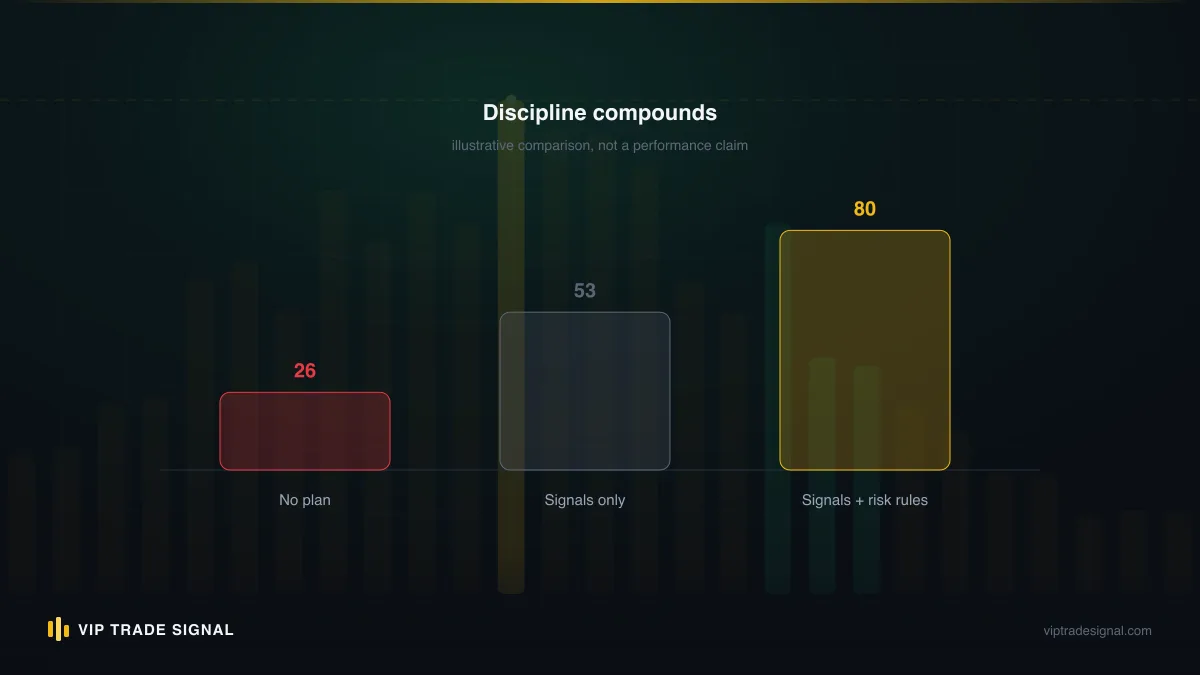
5. Ask for losing months. Real trading has them. A Dubai-facing provider showing 8-12% monthly with no red months is showing you fiction, full stop, and the fact that the fiction is dressed in a suit at a nice address changes nothing. Anyone honest will talk about drawdowns unprompted, because managing them is most of the actual job.
6. Search the person, not just the firm. The UAE's transient population is a feature for scammers: burn a name, fly out, rebrand. Search the individual's name plus "scam", plus previous company names, plus their face via reverse image search if the photos look too polished. A surprising number of Dubai gurus have a paper trail from a previous life in another country's regulatory warnings list.
None of this is exotic work. It's forty minutes with a laptop. The reason it filters so effectively is that the fraudulent end of the market is built entirely on the assumption that you won't do it — the whole funnel, from the reel to the office meeting to the WhatsApp follow-ups, is engineered to keep you feeling rather than checking.
The offshore-broker pattern
Here's a pattern so common among UAE-facing providers that it deserves its own section: the manager is in Dubai, the marketing is in Dubai, the meetings are in Dubai — and the broker holding your money is registered in St. Vincent and the Grenadines, Vanuatu, or an island you'd need two attempts to find on a map.
Why does this pattern exist? Because putting the client relationship in Dubai buys credibility, while putting the money offshore buys impunity. An offshore-registered broker with no meaningful regulator can manipulate pricing, refuse withdrawals, or simply evaporate, and your recourse is a strongly worded email. The Dubai front-end never legally touched your funds, so even a motivated UAE authority has limited purchase. The structure is not an accident. It's the design.
Some nuance, because honesty requires it: offshore registration alone doesn't prove fraud. Plenty of functional brokers maintain offshore entities for leverage reasons, and some managers use them for legitimate operational reasons. We're a signals-and-management desk, not a compliance firm, and our own partner brokers (Exness, XM, IC Markets, Vantage) run multiple entities across jurisdictions, some stricter than others. The question is whether the offshore entity is the only place your money can sit and whether anyone in the chain answers to a regulator with teeth. A manager who says "we can work with whichever properly regulated broker you prefer" passes. A manager who insists your funds must go to one specific unheard-of offshore broker — usually because that broker pays them the fattest rebate, sometimes because that broker is them under another name — fails.
A quick story that illustrates the mechanics. A reader we'll call Tariq — generic composite, not a client — met a manager at a Business Bay office in 2023. DFSA came up in conversation; the firm's marketing consultancy was indeed a registered Dubai company, which is what the framed certificate on the wall actually showed. His $30,000 went to a broker he'd never heard of, registered in the Comoros, via a payment link the manager sent on WhatsApp. Statements arrived monthly as PDFs, showing steady gains. When he requested a $5,000 withdrawal fourteen months in, the broker's support desk asked for a "compliance fee" of $1,800 to release funds. You know the rest of the story before I tell it, because it only ever ends one way. Every individual step had a checkable tell: the certificate that didn't say what he assumed, the broker nobody could vouch for, the payment link instead of a normal deposit flow, the PDFs instead of a live login.
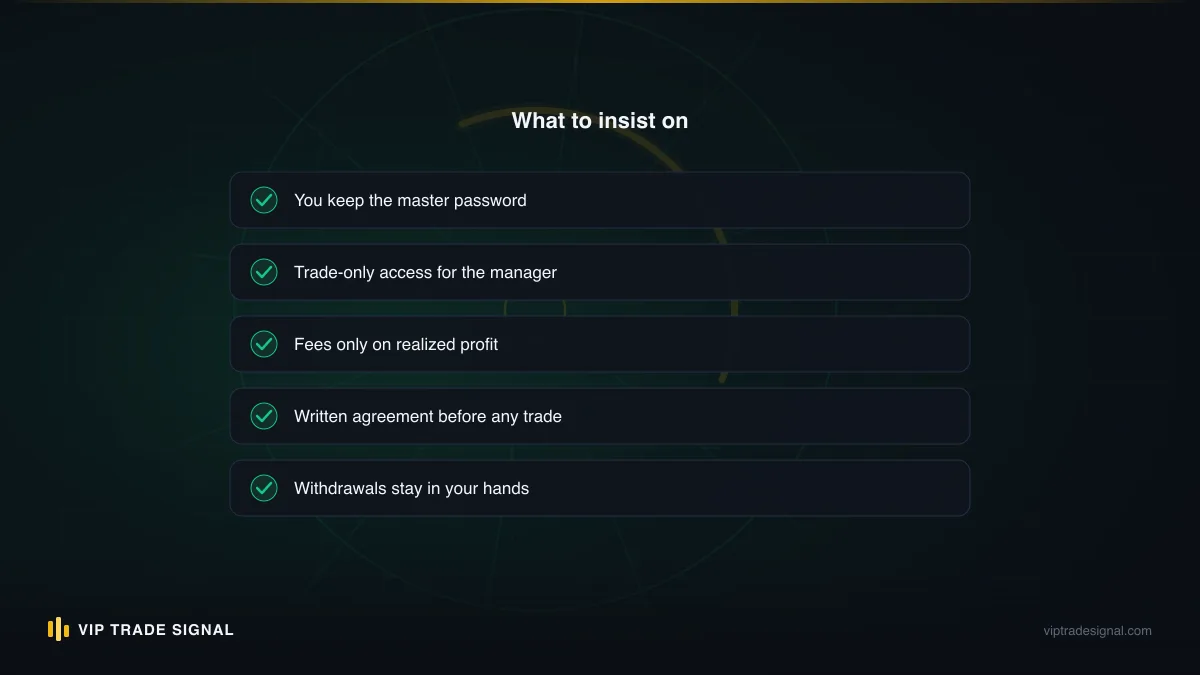
The clean test that would have saved him: open the broker account yourself, in your name, with a broker you chose or at least vetted, and grant the manager trading access only. Any provider who resists that arrangement is telling you something. Believe them.
Islamic accounts: the halal question
You can't write seriously about managed forex accounts in the Middle East without addressing the Islamic finance dimension, because for a large share of the regional market it isn't a preference — it's a requirement.
The core issue is riba: interest. A standard forex account charges or pays swap — an overnight interest adjustment on positions held past rollover — which is straightforwardly problematic under Islamic finance principles. The industry's answer is the swap-free or "Islamic" account: no overnight interest either way, with the broker typically compensating via a fixed administration fee on positions held beyond a set number of days, or slightly wider spreads. Every major broker serving the region offers one, and for gold — which is what we trade — swap-free structures are widely available and unremarkable.
Two honest caveats. First, whether leveraged spot trading is halal at all is genuinely debated among scholars; some accept swap-free margin trading of real underlying assets, others regard the leverage and lack of full possession as disqualifying regardless of swaps. That is a question for a qualified scholar, not for us, and any trading firm that hands out confident religious rulings as part of its sales pitch has left its lane. Second — and this is the part relevant to fraud — "halal" has become a marketing skin in this region. Scammers targeting Gulf and South Asian Muslim communities lead with Islamic branding precisely because it manufactures trust and borrowed authority. A green logo and the word "shariah-compliant" on a landing page carries exactly as much verification weight as the Lamborghini: none. The vetting steps above don't relax because the marketing quotes scripture. If anything, affinity-based pitches deserve more scrutiny, because exploiting shared faith or community is the oldest trick in investment fraud, and it works because checking up on someone from your own community feels rude. It isn't. It's stewardship.
On the practical side: if you require a swap-free structure, that's an account-level setting at the broker, arranged when you open the account in your name. A manager trading your account doesn't change your account's Islamic status one way or the other — which is another quiet argument for the structure where you own the broker relationship directly.
Expat considerations: cross-border money in and out of the UAE
A big slice of the people searching for forex account management in Dubai aren't Emiratis — they're expats. British, Indian, Pakistani, Filipino, South African, everyone. And expat status adds practical wrinkles that the marketing never mentions.
Tax doesn't disappear; it relocates. The UAE levies no personal income tax on trading gains, which is genuinely attractive. But your obligations may follow your passport or your other residencies. Americans owe the IRS wherever they live. Brits who remain UK tax resident, or who return within certain windows, can find gains dragged back into HMRC's reach. Indians face their own rules on foreign income and remittances, and several home countries restrict or scrutinise sending money abroad for margin forex in the first place. None of this is our field, and this isn't tax advice — but "it's tax-free in Dubai" is a half-sentence, and the missing half is where people get hurt. Spend an hour with a cross-border tax adviser before you fund anything meaningful.
Repatriation is the real test. Money flows into the UAE easily. Getting it out is also usually fine — the banking system is modern and transfers are routine — if the money sits in a proper broker or bank account in your name. Where expats get burned is the informal version: funds handed to an individual or an unlicensed entity, sometimes moved through crypto or a hawala-style arrangement to dodge someone's home-country restrictions. Once money leaves the regulated rails, it doesn't come back on them. If your plan for eventually extracting profits involves anyone doing you a favour, you don't have a plan.
Residency is temporary; your manager knows it. The average expat stint is a handful of years. Fraudulent providers exploit that clock deliberately: the mark leaves the country, pursuing anything cross-border becomes miserable, the file closes itself. Structure everything so that leaving the UAE changes nothing — your account, your broker, your login, your withdrawal rights, all independent of your postcode. Which, conveniently, is the same structure that protects you from everything else in this article.
Local red flags: seminars, suites, and 'meet the trader' theater
The Dubai fraud economy has a physical layer that most markets lack, and it's worth naming its set pieces so you recognise the script when you're standing in it.
The hotel seminar. A ballroom at a five-star property, a hundred chairs, a stage, a speaker who "flew in specially". Free to attend, naturally. The content is trading-flavoured motivation for ninety minutes, then the close: a "founding members" offer on a managed account or mentorship, available tonight only, card machines at the back. The venue is doing the persuading — your brain reads five-star hotel as institutional legitimacy, when what it actually proves is that ballrooms are rentable. Real asset managers do not close clients with countdown urgency in hotel function rooms. Not ever.
The office pilgrimage. You express interest online; the follow-up isn't documentation, it's an invitation. Come in, meet the team, see the operation. You get a floor of screens (displaying charts anyone can display), young men in good suits, an espresso, and a view. It's a showroom. Ask for the licence number in that meeting and watch the temperature change — the script handles enthusiasm beautifully and verification badly.
The live-trading flex. Someone opens a platform in front of you and takes trades that print money in real time. Demo accounts are indistinguishable from live ones across a desk. Even a genuinely live account proves one afternoon, cherry-picked from however many afternoons it took. Fifteen minutes of screen time is theatre; a year of third-party-verified statements is evidence, and only one of those can be faked with a free download.
The community anchor. A guru embedded in an expat community — same nationality, same mosque or church or gym, speaks your language, everyone's friend. Affinity fraud runs on the assumption that social proof substitutes for due diligence. It doesn't, and the community context usually means victims stay quiet longer out of embarrassment, which extends the scheme's life. The warmest referral you'll ever get still needs the same forty minutes of checking as a cold Instagram ad.
If you want a single behavioural tell that cuts across all of these: legitimate managers spend the first meeting asking about you — your capital, your risk tolerance, whether this is money you can afford to trade — because regulated suitability obligations and plain professionalism require it. The theatre spends the first meeting performing itself. Whoever does most of the talking is telling you what kind of operation you're in.
Legitimate paths for UAE-based investors
After nine sections of warnings, let's be constructive. Real options exist, and they sort into a few honest categories.
| Path | Regulated by | Typical minimum | Best for |
|---|---|---|---|
| DFSA/FSRA-licensed asset manager | DFSA or FSRA | Often $100k+ | Larger portfolios wanting full discretionary service |
| SCA-licensed onshore firm | SCA / Central Bank | Varies widely | Onshore retail access, local banking integration |
| Cross-border regulated manager | FCA, CySEC, ASIC etc. | From a few thousand | Expats comfortable with a remote, home-jurisdiction firm |
| Broker-hosted copy/PAMM | The broker's regulator | Low, sometimes $100s | Small accounts wanting transparency and instant exit |
| Independent manager on your own account | Nobody directly — structure is your protection | Provider-dependent | Hands-off traders who keep custody and control |
A few notes on the rows. Minimums are the first filter most readers hit. If you're bringing $5,000 or $10,000, the DIFC firms mostly won't return your call — not out of snobbery, but because their compliance and onboarding costs make small mandates uneconomic. That's precisely the gap the fraudulent end of the market feeds on: it exists because real regulated service starts at a level most people can't reach, leaving everyone below it to choose between the lower rows of this table and the Instagram economy. Choose the lower rows.
The licensed local managers are the gold standard if your capital clears their minimums, but many treat forex as a small satellite of a broader mandate — you're buying wealth management that happens to include FX, not a trading desk. The broker-hosted copy and PAMM route deserves more respect than its marketing gets: because the broker's own regulated infrastructure tracks every allocation, the record-keeping is honest by construction, and you can detach with a click. Its weakness is quality — most strategies on public leaderboards are over-leveraged sprints that look brilliant for six months and then give it all back in a week.
The last row is where services like ours live, so let's declare the bias and explain the model plainly. We run account management on the client's own MT4 or MT5 account: you open the account at a regulated broker, you hold the master password, you alone can withdraw, and we take trades under a limited trading login. Our fee is a flat 50% of realized profit — high, and we say so openly; it's the price of a $200 minimum advance, no lock-in, and nothing owed on losing periods — and if the idea of paying only after profit exists appeals to you, we've written about why no-upfront-fee structures change the incentives in detail. We trade gold only, XAU/USD, and every closed signal from our desk is public at /signals/history, losses included, because a track record with the red removed is just marketing.
We are not DFSA-licensed and we're not a licensed advisor anywhere — nothing here is personalised investment advice. What protects our clients isn't a badge; it's the structure: custody never leaves you. That's not us being modest, it's the honest trade-off of this category, and it's why the structure-based checks in this article matter more than any brand name, ours included. Losses happen on our desk like every other; anyone whose losses don't happen is lying about something.
Serving UAE clients from anywhere: why geography stopped mattering
Here's the quiet punchline of this whole guide. The thing Dubai's fraud economy sells hardest — physical presence, the office, the handshake, the man you can meet — is precisely the thing that modern account management structure makes irrelevant.
Think about what actually happens in a well-structured managed account. Your money sits at a regulated broker; you funded it from your own bank and only you can pull it back. The manager holds a trading-only login. Every position, every entry and exit, every fee event is visible in your own platform in real time, timestamped by the broker's servers, not by anyone's word. In that arrangement, what does the manager's street address contribute? Nothing. You could be in Jumeirah and the desk in another hemisphere, or the reverse, and not one protection changes. The broker's regulation, your custody, and the visible record do all the work that a marble lobby pretends to do.
Which reframes the vetting question for anyone in the UAE. Instead of "who's near me?", ask "which structure protects me?" — and then choose the best operator within that structure, wherever they sit. A trader in Dubai Marina with your money in his own offshore master account is infinitely more dangerous to you than a remote desk trading your own account through a broker you chose. Distance done right beats proximity done wrong, every single time.
Practicalities for UAE clients running the remote model: funding a broker like the majors we partner with is a routine card or transfer from a UAE bank; swap-free account variants are a standard checkbox for the region; and time zones actually work in your favour, since gold's busiest hours around the London-New York overlap land in the UAE evening, when you can watch your account live rather than asleep. If you want the granular mechanics — advances, profit splits, what happens after a losing month — our FAQ covers the sharp-edged questions, and the answers don't change based on your country code.
Where this leaves you
Strip everything above down to what you'd tell a friend over coffee, and it's this: Dubai is a real financial centre wearing a costume of itself, and your job is to ignore the costume entirely.
The costume is the skyline reel, the rented car, the office view, the hotel ballroom, the shariah-branded landing page, the friend-of-a-friend with the screenshots. The reality is a licence number on a register you checked yourself, a broker account in your own name, a manager who talks about drawdowns before you ask, and a fee model you can explain back in one sentence of arithmetic.
Before you fund anything — us, a DIFC firm, a copy-trading strategy, anyone — sit down for one evening and answer these on paper:
- Which legal entity am I contracting with, and on which regulator's register does it appear, for which activity? No answer, no money.
- Where does my money physically sit, and can I withdraw it alone, tonight, without anyone's permission? If custody isn't yours, walk.
- How does every person in the chain get paid, and does anyone earn when I merely trade rather than when I profit? Volume-paid hands churn accounts.
- Have I seen losing months, and did they volunteer them? Fiction has no red. Reality does.
- If I left the UAE tomorrow, what breaks? The right answer is nothing.
Five questions, one evening, maybe the price of a decent dinner in time. Against that, the alternative: the average victim of a Dubai-style managed account scheme doesn't lose a little — they lose the whole deposit, because the structure was built for exactly that outcome from the first DM. Trading gold or forex through anyone, including us, can lose you money the honest way too; leverage cuts both directions and no desk on earth escapes losing runs. But there's a world of difference between risk you chose with your eyes open and theft you were charmed into.
If our model fits what you're looking for — your account, your custody, our trading, paid only from profit — you can ask us anything through the contact page, and we'd genuinely rather you arrived holding this article's checklist than impressed by anything we say about ourselves. And if it doesn't fit, take the checklist anyway. It works on everyone, which is rather the point.