"You pay nothing unless we make you money."
If you've spent more than a week looking at managed forex accounts, you've read that sentence a dozen times. It's the most seductive line in the industry, and for good reason: it sounds like the manager is taking all the risk. No monthly retainer, no setup charge, no management fee quietly nibbling your balance. Just results, and a cut of them.
Here's the uncomfortable truth about forex account management no upfront fees offers: some of them are exactly what they claim, and some of them are the most expensive arrangements you will ever agree to. The trick is that the honest version and the predatory version use identical marketing. Same phrase, same promise, same "aligned incentives" pitch. The difference isn't in what they say. It's in where the money actually flows once you're signed up, and most people never trace it.
We run an account management service ourselves, and our model is a profit split with a small advance — so we have skin in this argument, and we'll disclose our own numbers line by line further down. But the point of this piece isn't to sell you our structure. It's to hand you the forensic toolkit: the four hidden revenue channels, the questions that expose them, and the maths that shows what "free" can cost over a year. By the end, you should be able to look at any no-fee offer and answer the only question that matters: if I'm not paying them, who is?
Why paying nothing upfront feels so right — and why your gut still itches
Let's be fair to the appeal first, because it's not stupid. Traditional asset management charges you whether it performs or not. The classic hedge fund model was "2 and 20" — 2% of assets every year plus 20% of profits — and that 2% arrives even in a losing year. Retail forex managers copied the structure at smaller scale: monthly management fees of $100 to $500, setup charges, "software licences", all payable before a single trade goes your way.
A performance fee only managed account flips that. The manager eats what they kill. If your account doesn't grow, they earn nothing. That's genuinely better alignment than a flat retainer, and any honest comparison of forex account manager fees should say so plainly. When we chose our own structure, this logic was most of the reason.
So why the itch? Because you've done the maths on their side of the table. A manager running a handful of $2,000 retail accounts on pure profit split has a rough life. Say they run ten accounts and produce a very respectable 5% month — that's $100 profit per account, $50 to the manager per account, $500 total for a month of full-time work. Nobody lives on that. And the losing months pay zero. Which means one of three things is true:
- They run serious volume — dozens or hundreds of accounts, or a few large ones — so the split adds up to a real income.
- They have another income source you can't see.
- They don't intend to be around long enough for it to matter.
Option one is fine. Options two and three are where your money quietly leaks, and they're common enough that suspicion is the correct default. Not cynicism — suspicion. The kind that asks questions before wiring funds, not after.
The four hidden revenue channels
When a no fee forex account management offer isn't earning primarily from the split, the income almost always comes through one of four channels. Learn these and you can dissect nearly any offer in the market.
Channel one: spread markups
Some brokers let introducing partners add a markup to the spread on accounts they bring in. The raw spread on gold might be 15 cents; your account sees 45. That extra 30 cents per ounce, on every single trade, flows back to the partner — your manager. You never see a fee line. You just see slightly worse entries and exits, forever, and unless you compare your fills against another account at the same broker, you'd never know.
The insidious part is that a spread markup pays the manager per trade, not per profit. Their income now scales with how often they trade, not how well. A manager earning from markups has a direct financial reason to trade you more — tighter timeframes, more positions, more "opportunities". Overtrading stops being a discipline failure and becomes the business model.
Channel two: IB rebates
Related but distinct, and worth its own section below because it's the single most common hidden channel in retail forex. The short version: brokers pay introducing brokers (IBs) a rebate for every lot their referred clients trade. The manager signs you up under their IB link, trades your account, and collects a slice of every position — win, lose, or scratch.
Channel three: the B-book
This one is darker. Some offshore brokers run a "B-book": instead of passing your trades to the real market, the broker takes the other side. Your loss is the broker's profit. Now imagine a manager who is secretly partnered with — or paid a share by — a B-book broker. Every dollar your account loses is revenue for the partnership. The manager doesn't need you to win. They need you to deposit, trade big, and blow up, ideally after being persuaded to "top up" once or twice.
If a "free" manager insists you must use one specific unregulated broker you've never heard of, this is the scenario you should assume until proven otherwise. It's not always the case. But the burden of proof sits entirely on them.
Channel four: churn
The crudest model of the lot, and it doesn't even need broker cooperation. The manager takes on lots of clients cheaply, trades every account aggressively — 10%, 20% risk per position — and lets variance do the sorting. Half the accounts blow up; those clients disappear quietly. The other half doubles; the manager takes 40-50% of the gains and screenshots the wins for marketing. Then the cycle repeats with a fresh crop of clients recruited by those very screenshots.
From the outside, the survivors look like proof the manager is brilliant. From the inside, it's a coin-flipping operation where clients supply the coins. The manager's expected income per client is positive even though the average client loses, because the fee structure is asymmetric: they take a cut of your wins and none of your losses. A profit split without any downside participation, run at maximum aggression, is a free option on your money — and the higher the risk, the more that option is worth. We wrote more about spotting this pattern in the red flags that give away a bad account manager.
What this looks like from the inside: a composite case
The channels sound abstract until you watch them operate on an account, so here's a composite scenario — a trader we'll call Dan, assembled from patterns we've seen repeatedly, not a real client of anyone.
Dan finds a manager through an Instagram ad. No upfront fees, 40% profit split, screenshots of monthly statements in lovely shades of green. The manager is friendly, responsive, and has one condition: Dan must open his account at a specific broker, registered in a jurisdiction Dan has to look up, using the manager's link. It's framed as a technical requirement — "our copier only supports this broker". Dan deposits $3,000.
Month one is busy. Forty-odd trades, lots of partial closes, and the account finishes up 4%. Dan pays $48 on the split and feels great about it. What he can't see: the spread on his gold trades is nearly triple the raw rate, and the manager's IB dashboard credited more from Dan's volume that month than the performance fee did. Month two is flat but even busier — sixty trades, no progress. The manager earns nothing on the split and quite a lot on the lots. Month three, a losing streak arrives, as losing streaks do, and instead of cutting risk the manager doubles position sizes to "recover quickly". By the time Dan asks questions, the account is down 60% and the manager is suggesting a top-up because "the market is about to turn".
Total invoiced fees across three months: $48. Actual cost: about $1,850 in losses driven by volume-hungry, recovery-chasing trading, plus a few hundred in marked-up spreads along the way. Dan paid more for "free" management than he'd have paid a $300-a-month retainer manager who traded sanely — and the manager still came out ahead, because Dan's losses were never the manager's problem. That's the whole grim elegance of the model. The fee structure was real. It just wasn't the income.
Every detail in Dan's story maps to a question in the checklist further down. He could have caught the broker requirement at question three, the spread at four, the volume at six, and the top-up culture at nine. Twenty minutes of asking. He'd have kept his $3,000.
How IB rebate deals quietly tax every trade
Rebates deserve the microscope because, unlike B-books and churn shops, they're everywhere — including inside otherwise legitimate services — and because the sums are bigger than most people guess.
Here's the mechanic with real-ish numbers. A broker pays its IBs somewhere between $5 and $15 per standard lot traded, sometimes more on gold. Say your manager gets $8 per lot. They trade your $5,000 account at moderate size — call it 0.5 lots per position, 40 positions a month. That's 20 lots monthly, or $160 a month in rebates from your account alone. Over a year, roughly $1,900. From an account that may have made you nothing.
Now scale it. Twenty clients on similar accounts is over $3,000 a month in rebate income before a single profit split lands. At that point the trading barely needs to work. Breakeven performance keeps clients around, keeps volume flowing, keeps rebates paying. The manager's real client is the broker.
A manager paid per lot doesn't need you to win. They need you to trade. Those are very different jobs.
And it warps the trading in ways you can measure on your own statement. Watch for:
- Position counts that seem high for the stated strategy. A "swing trading" service opening six positions a day is generating volume, not swings.
- Scaling in and out constantly. Four partial entries and three partial exits on one idea is seven commissions-worth of lots where one or two would do.
- Trading through dead sessions. Gold at 3 a.m. London time in a ten-cent range serves nobody except a rebate account.
- Grid and martingale styles. These generate enormous lot volume by design. Rebate-funded managers love them for reasons that have nothing to do with the equity curve.
To be scrupulously fair: IB relationships are not inherently corrupt. Plenty of transparent services use broker partnerships openly — our own signal side offers VIP access free through partner brokers instead of the $99 monthly subscription, and we say exactly that on the page. The distinction is disclosure and structure. A disclosed rebate that replaces a fee you'd otherwise pay is a trade-off you can evaluate. A hidden rebate stacked on top of a "free" management offer is a tax you were never told about, levied per lot, with an incentive to raise it.
Forex account management with no upfront fees, done honestly
It exists. Not every performance-only manager is running a hidden meter. The genuinely aligned version tends to share a recognisable shape, and once you've seen it a few times the imitations stand out.
First, the split is the income, and the manager can say so without flinching. Ask them "what percentage of your revenue comes from performance fees?" and an aligned manager answers "effectively all of it" and can explain how the business survives losing months — usually because they run enough accounts, or larger ones, that a normal month's split covers the office.
Second, broker choice is yours, or at least open. If they can trade your account at any decent regulated broker, there's no rebate machine forcing your hand. Some aligned managers do prefer certain brokers for execution reasons — that's reasonable — but "prefer" and "require one unregulated broker you've never heard of" are different animals.
Third, the risk parameters are agreed before trading and boring to look at. Something like 1-2% risk per trade, a hard monthly drawdown line, position sizes you can verify on your own statement. Aggression is the tell. A manager whose income is a free option on your equity wants volatility; a manager who intends to keep you as a client for three years wants survival. You can read which one you've got straight off the risk settings.
Fourth — and this is the one people skip — you keep control of the account. The money sits at your broker, in your name. The manager gets trade-only access via the investor structure or a limited password. They cannot withdraw. They cannot deposit. They cannot change the leverage or the master password. Any arrangement where you send money to the manager rather than to your own brokerage account has left the category of "account management" entirely and entered the category of "hoping a stranger gives your money back".
Fifth, the track record includes losses. Real managed trading has losing weeks and losing months, and an honest provider shows them. A history of nothing but green is either curated or brief.
None of this guarantees profit — nothing does, and anyone who says otherwise has told you everything you need to know. Gold and forex are leveraged markets; managed or not, you can lose money, and any account you hand to a manager should be money whose loss would annoy you rather than ruin you. Alignment doesn't remove risk. It just means the person trading shares your definition of a good outcome.
PAMM, MAM and password access: the plumbing changes where fees hide
One complication worth untangling before we defend the honest upfront charge: the structure of the managed account changes where hidden costs can live, and "no upfront fees" means slightly different things in each.
Password or copier access — the manager trades your ordinary account directly, either through a limited trade-only login or a trade copier mirroring a master account. This is the most transparent plumbing, because every trade sits on your own statement at your own broker and you can audit fills, spreads and frequency yourself any evening you like. It's also what we use, largely for that reason. The fee risks here are the ones this article covers: markups, rebates, and the trading behaviour they incentivise.
PAMM — percentage allocation management module. Your money joins a pooled master account at the broker; profits and losses are allocated to investors proportionally, and the broker's platform deducts the manager's fee automatically. The good news: fee deduction is mechanical and visible, and the broker enforces the split. The bad news: PAMM lives inside one broker by definition, so the broker-choice question is answered for you — and if that broker is an unregulated shop paying the manager handsomely per lot, you've bundled the rebate problem into the architecture. A PAMM at a properly regulated broker with published fee schedules is a reasonable structure. A PAMM at a broker whose regulator you can't name is the B-book scenario with better software.
MAM — multi-account manager, the institutional cousin, where the manager fires one order across many client sub-accounts with individual risk settings. Same analysis as PAMM, with one extra clause to hunt in the agreement: per-lot "technology" or "allocation" fees, which are a spread markup with a lanyard on.
The point isn't that one structure is safe and the others aren't. It's that "where would the hidden fee live?" has a different answer in each, and you should ask the question for the structure actually in front of you. Direct access: check your fills. PAMM and MAM: check the broker first, because you're marrying it.
Why some honest managers still charge something upfront
Now the awkward part of the argument, because it cuts against the headline: a small upfront charge is not automatically a red flag. Sometimes it's the opposite.
Think about what a zero-upfront model selects for on the client side. It attracts people with nothing committed — and clients with nothing committed behave badly. They panic at the first losing week, demand the password back mid-drawdown, close positions themselves at the worst possible moment, and disappear owing the performance fee on profits already realised. Every manager who has run other people's money has these stories. A modest advance against future fees filters for clients who are actually serious, and it covers the genuine costs of onboarding an account that might churn out in three weeks.
There's also a grubby practical problem with pure performance billing at retail scale: collection. The manager closes your month up $600, invoices you $300 — and some percentage of clients simply don't pay. On a $50,000 institutional mandate you solve this with contracts and lawyers. On a $2,000 retail account, the fee is smaller than the cost of chasing it. An advance solves the problem without drama: the fee is netted against money already on the table.
So the fairer framing isn't "upfront fees bad, performance fees good". It's a spectrum:
- Large upfront, small or no performance component — the manager is paid regardless of results. Weak alignment. This is where "management fee" retainer models sit, and why we don't like them.
- No upfront, performance only, hidden revenue channels — looks aligned, isn't. The worst of the four traps above live here.
- No upfront, performance only, genuinely split-funded — well aligned, but check how the business survives, and expect either scale or high fees.
- Small refundable-in-kind advance plus performance split — the advance filters clients and smooths collection; the split does the real earning. This is where we landed, for the reasons above.
The size matters enormously. A $200 advance netted against your first performance fees is a filter. A $2,000 "activation fee" is a retainer wearing a costume. Somewhere between those numbers the model changes character, and you should price that honestly when comparing offers — there's a fuller breakdown of the whole fee landscape in our guide to forex account manager fees.
Ten questions that expose where the money really comes from
You don't need to be forensic accountant to run this check. You need ten questions and the nerve to ask them before depositing, in writing, and to notice which ones get dodged.
- "What are all your revenue sources from my account — every one?" The complete answer should fit in one sentence. Watch for the pause.
- "Do you receive rebates, commissions, or any payment from the broker for my trading volume?" Yes is survivable if disclosed and quantified. "That's confidential" is a no from you.
- "Can I use my own broker?" If not, why not — and is the required broker regulated somewhere that means anything?
- "Is the spread or commission on my account the broker's standard rate?" Verifiable: open a personal account at the same broker and compare quotes side by side for a day.
- "What's your maximum risk per trade and per month, in writing?" No number, no deal.
- "How many lots per month do you typically trade on an account my size?" They know this number. High volume plus "free" equals rebates, almost every time.
- "Who holds the funds, and can you withdraw?" The only acceptable answer: your broker, your name, and no.
- "Show me a full account statement — including losing months." An investor-password view of a live account beats any PDF.
- "What happens in a drawdown — do you keep trading, stop, or ask me to top up?" "Top up" appearing anywhere in this answer is worth a very long think.
- "If I stop after one profitable month, what do I owe?" Exposes exit fees, lock-ins, and minimum terms that never appeared in the pitch.
An aligned manager answers all ten quickly, because the answers are their sales pitch. An extraction operation stalls on 2, 6, and 9. And if asking these questions annoys the provider — good. You've just saved yourself the deposit. The same interrogation logic applies to signal services, by the way; the questions differ but the principle of tracing the money is identical.
Reading the agreement for buried costs
The conversation tells you about the person. The agreement tells you about the business. Most people skim the management agreement the way they skim software terms, which is how a "no fees" arrangement ends up costing 8% a year. Slow down on these clauses specifically.
The fee base. Profit split of what, exactly? The gold standard is realized profit above a high-water mark: you only pay on new net gains, after losses have been recovered. The rot sets in with vaguer bases — "monthly gains" with no high-water mark means you pay on a bounce even if you're still down overall. Worked example: your $5,000 account drops to $4,400, then recovers to $4,900. With a high-water mark you owe nothing — you're still below $5,000. Without one, that $500 "gain" just cost you $250 in fees on an account that lost money. Same trading, same result, wildly different bill. We unpacked the mechanics properly in how profit splits actually work.
Floating versus realized. Fees should be charged on closed trades only. A clause letting the manager bill on floating (unrealized) profit means you can pay fees on a position that later reverses into a loss.
The exit clause. How do you leave? Immediately, by changing your password — or after 30 days' notice, a "early termination charge", and a final invoice calculated by a formula you can't follow? Any friction on exit is a cost, priced in units of your worst future week.
Broker and account clauses. Language obliging you to keep the account at a named broker, maintain a minimum balance, or trade a minimum volume is the rebate machine writing itself into the contract.
Liability and discretion. "The manager may adjust risk parameters at their sole discretion" quietly deletes the risk limits you negotiated. The parameters you agreed should be in the document, as numbers, changeable only in writing by both sides.
Silence. The most expensive clause is often the missing one. No mention of rebates doesn't mean there are none; it means they didn't have to tell you. Ask for a written statement that the manager receives no volume-based compensation from the broker. Honest providers sign it without blinking. The other kind suddenly need to check with a colleague.
Twenty minutes with the agreement and a highlighter. That's the whole cost of this section, against a downside measured in thousands.
Our structure, line by line
Since we've spent two thousand words telling you to demand disclosure, here's ours. Judge it by the same standard.
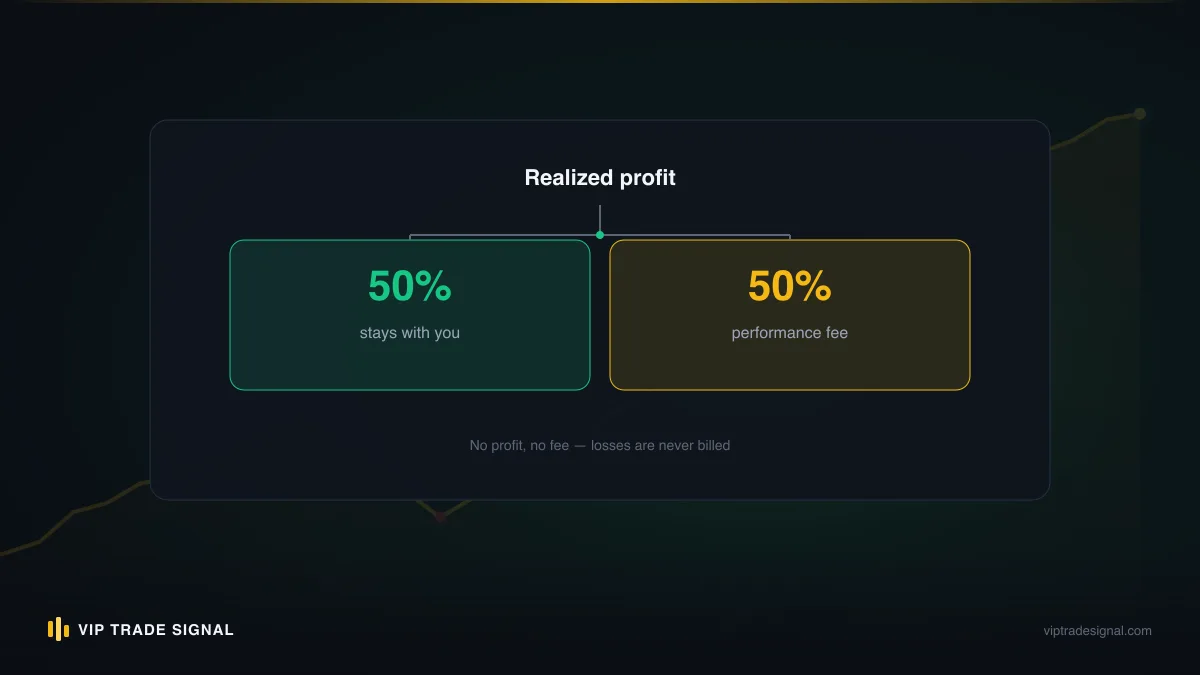
We trade gold — XAU/USD only, it's the single market we work — on your own MT4 or MT5 account, at your broker. The fee is a flat 50% of realized profit. There's a $200 minimum advance, which is netted against your performance fees, not charged on top: it's the client filter and collection buffer described earlier, not a second income stream. You keep the master password. You keep withdrawal rights. We get trade-only access, and if you want us gone, you change the password and we're gone — no notice period, no exit charge.
Where's the catch in ours? Two places, honestly. Fifty percent is at the high end of the market — institutional splits run 20-30% — and we charge it because our minimums are tiny by industry standards and everything is pay-as-you-go, with no lock-in subsidising us through quiet months. Small accounts cost nearly as much to run as large ones; the percentage is how the maths works at this scale. If you're bringing $50,000, you can negotiate better splits elsewhere and you probably should. And the advance means you're $200 committed before results, which is precisely the thing this article is suspicious of — so we keep it small, disclose it everywhere including the pricing page, and net it against fees so it never becomes profit on its own.
What we don't do: no broker requirement on managed accounts, no spread markups, no volume rebates on management clients, no billing on floating profit, no charging without a high-water-mark logic — losses get recovered before we earn again. And no guarantees. We have losing trades and losing stretches like everyone who has ever traded, our closed signal history sits public at /signals/history with the red included, and if the idea of a losing month on a managed account is unacceptable to you, the honest answer is that no manager should be running your money. There's more of this in plain terms on our FAQ.
That's the full income statement of our relationship with a management client: half of realized profit, minus nothing hidden. Hold every "no upfront fee" competitor to the same one-paragraph disclosure and see who can produce it.
What "free" costs over a year: four models compared
Time to put numbers on the whole argument. Take a $5,000 account, trading a moderate 20 standard lots a month, and run it through four fee models for a year. Two scenarios: a decent year where the trading makes 30% gross, and a flat year where it makes nothing. The figures are illustrative — round numbers chosen to show the shape, not a forecast of anyone's results.
| Model | Decent year (+30% gross, $1,500) | Flat year (0% gross) |
|---|---|---|
| Retainer: $150/month, 10% split | $1,800 fees + $150 split = $1,950 | $1,800 — while making you nothing |
| "Free" with hidden $8/lot rebate | $0 invoiced; ~$1,920/yr paid via spreads, plus 30% split ≈ $2,370 | ~$1,920, invisible, in a losing cause |
| Pure performance, 30% split | $450 | $0 |
| Advance + 50% split (ours) | $750, with $200 of it prepaid as the advance | $200 total exposure |
Read the flat-year column first, because flat and losing years are where fee structures show their true face. The retainer model charges $1,800 for nothing — you knew that going in, at least. The "free" model charges roughly the same, except you never see an invoice; it arrives as slightly worse fills, twenty lots a month, all year. The two performance models cost you nothing and $200 respectively. That column is the entire case for tracing revenue before you sign.
Now the decent year. Pure performance at 30% is the cheapest — if you can find it from a manager who genuinely lives on it and runs sane risk. Our model costs more in absolute terms, and we've told you why. But notice the "free" model is the most expensive in the good year too: the rebate meter never stops running, and the split stacks on top of it. Free was the priciest option on the table in both scenarios. That's not a coincidence. It's the design.
One more wrinkle the table can't show: the rebate model's cost scales with volume, not results, so the worse the manager trades — more positions, more churn, more revenge entries — the more you pay. The incentive gradient points exactly the wrong way, and over years, incentive gradients always win.
Where this leaves you: green flags, red flags, and the deposit decision
Strip everything above down to what you actually do with an offer in front of you.
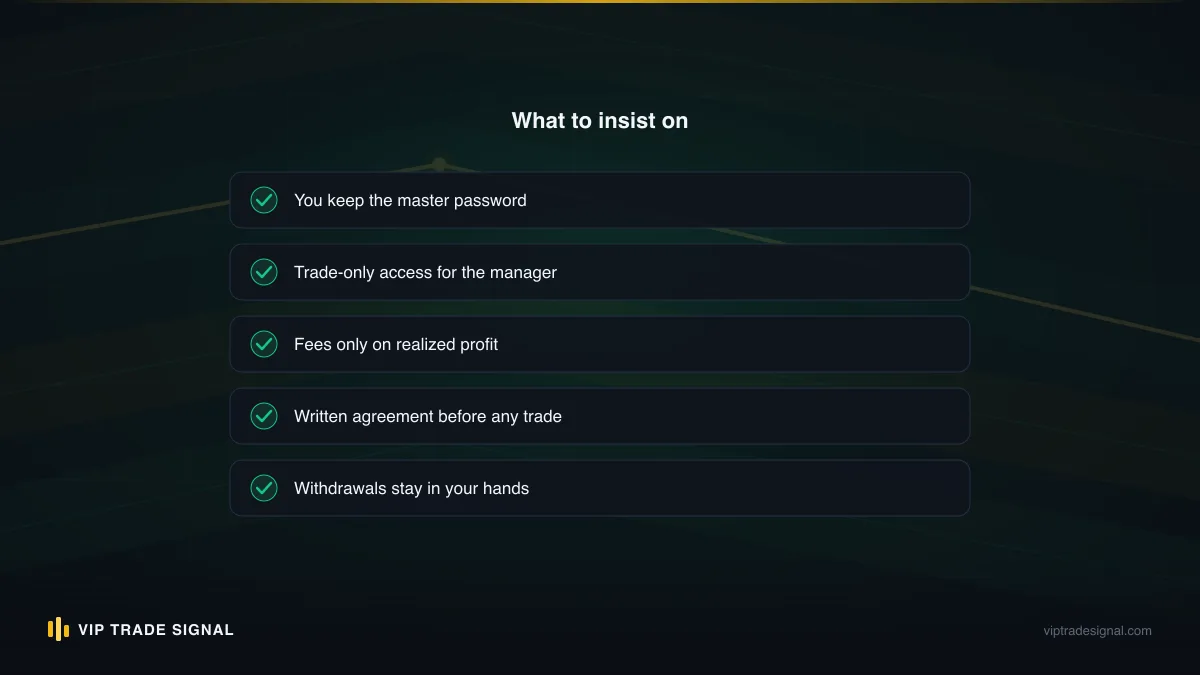
Green flags — none is proof alone, but together they describe an aligned operation:
- Full revenue disclosure in one sentence, unprompted or on first ask
- Your broker, your account, your master password, your withdrawals
- Written risk limits with numbers in the agreement
- High-water mark on realized profit, and a track record with visible losses
- Exit is instant and free
Red flags — one is a question, two is a pattern, three is a walk-away:
- Required use of a single unregulated broker
- Vague or defensive answers about rebates and volume payments
- Trading frequency that outruns the stated strategy
- Fees on floating profit, or no high-water mark
- Any request to send funds to the manager rather than your own brokerage account, and any appearance of the phrase "guaranteed"
And the deposit decision itself comes down to one honest exercise. Before you agree to any forex account management no upfront fees arrangement, write down — actually write down — your answer to "how does this business survive a losing quarter?" If the answer is "the split from their other accounts", you may have found an aligned manager; verify and proceed carefully, with money you can stand to lose, because managed gold and forex trading loses sometimes no matter who's driving. If the answer is "I don't know", you do know, really. The business survives on spreads you can't see, rebates you were never told about, or the next client's deposit. You'd just rather not say it out loud yet.
Nobody trades your account for free. The only choice you get is whether you pay a disclosed price to someone who wins when you win — or an undisclosed one to someone who gets paid either way. Take the twenty minutes. Ask the ten questions. Read the agreement with the highlighter. The catch is always findable, and the offers worth taking are the ones where you go looking for it and come back with nothing but a fee schedule someone was happy to explain.