Ask five account managers what they charge and you will get five answers that all sound roughly the same. "Twenty percent." "Two and twenty." "We only earn when you earn." Each one delivered with the confidence of a man quoting a fixed price for a haircut. And yet, run the numbers on an identical account over an identical year, and those five answers can produce total costs that differ by a factor of four. Sometimes more.
That gap is not an accident. The forex account management industry has learned that clients compare headline percentages and almost nothing else, so the headline percentage is where the marketing effort goes, and the rest of the cost gets buried in fee schedules, broker arrangements and clauses nobody reads. If you are trying to make sense of forex account manager fees before handing someone access to your money, the percentage on the pricing page is the beginning of the conversation, not the end of it.
This piece is the taxonomy. Every fee model currently in use, what it actually costs, who it favours, and (because abstract percentages are how people get fooled) a worked example running one $5,000 account through each model for a full year. We charge for account management ourselves, so we are not a neutral observer, and we will state our own numbers plainly near the end so you can judge them by the same standard. But the framework holds regardless of who you end up hiring. Or whether you hire anyone at all.
The five fee models in use today
Strip away the branding and almost every forex account management arrangement on earth is one of five structures, or a stack of two of them.
- Management fee. A fixed percentage of your account balance, charged on a schedule: monthly, quarterly or annually, regardless of whether the manager made you a penny.
- Performance fee. A percentage of the profit generated, usually calculated against a high-water mark, so the manager earns nothing in losing periods.
- Profit split. Functionally a performance fee, but framed as a partnership: profits divided on a ratio like 20/80 or 50/50, typically settled per period on realised gains.
- Hybrid. A smaller management fee plus a performance fee on top. The hedge fund classic, "two and twenty", imported into retail forex at softer numbers.
- Spread and rebate income. The manager charges you little or nothing directly and instead gets paid by the broker: a cut of the spread or commission on every trade your account places.
That last one deserves a flag straight away, because it is the model most retail traders are on without knowing it. If a manager's service is "free" and they insist you open your account at one specific broker, you are almost certainly on model five. The fee exists. It is just being collected per trade, invisibly, and it comes with an incentive problem we will get into properly later. A manager paid per trade has a reason to trade, whether or not trading is what your account needs that week.
Most of the arrangements you will actually be offered as a retail client are models two, three and five, occasionally stacked. Pure management fees are more common at the wealth-management end of the market. But you need to understand all five, because the expensive arrangements are usually the ones combining a reasonable-sounding version of one model with a quiet helping of another.
Management fees: paying regardless of results
The management fee is the oldest structure in professional money management, and the logic behind it is honest enough: running money takes work whether the month goes well or badly, so the manager charges for the work. In traditional funds it runs 1% to 2% of assets per year. In retail forex, where it appears at all, you will see anything from 0.5% to 3% annually, sometimes dressed up as a monthly "account maintenance" or "administration" charge of 0.1% to 0.25%.
On paper it looks tiny. On a $5,000 account, a 2% annual management fee is $100. Who argues about $100?
You should, for two reasons. The first is that the management fee is charged on your balance, not your profit, which means you pay it in losing years too. A manager who takes 2% while dropping your account 15% has charged you $100 for the privilege of losing you $750. Nothing about that is illegal or even unusual. It is simply a structure where the manager's downside is fully insulated and yours is not.
The second reason is compounding drag. A 2% annual fee does not sound like much until you remember that most retail forex accounts do not survive long enough for compounding to matter (the majority of retail traders lose money, which is exactly why people hire managers in the first place), and a fixed fee is a guaranteed subtraction from whatever edge exists. If the manager's genuine annual edge is 10% before costs, a 2% management fee has eaten a fifth of it before any performance fee touches the rest.
Our view, for what it is worth: a standalone management fee is a defensible structure for large, conservative accounts where the work is genuinely custodial. For a $5,000 retail forex account it is mostly a way of getting paid for existing. When you see one at retail size, it is nearly always half of a hybrid, and the question becomes what the whole stack costs. Which is the question this entire article exists to answer.
Performance fees, and what percentage forex account managers actually charge
The performance fee is the model everyone claims, because it sounds like alignment: the manager earns only when you do. And in fairness, done properly, it is the most honest structure available. The devil lives in three details. The percentage, the calculation base, and the high-water mark.
So, what percentage do forex account managers charge? Across the retail industry the honest range is wide: 20% at the low end, 50% at the high end, with 25% to 35% probably the fattest part of the distribution. Anything under 20% at retail size should make you suspicious rather than pleased; the manager is either inexperienced, or being paid somewhere else you cannot see, usually via the broker. Anything above 50% is rare and needs an unusual justification, like a genuinely tiny minimum or a service layered on top.
The calculation base matters more than the percentage. A fee on realised profit is charged on trades actually closed. A fee on floating or unrealised profit (and yes, some managers try this) means paying on open positions that can still reverse and wipe out the gain you just paid for. Never accept a fee calculated on unrealised profit. There is no legitimate reason for it.
Then the high-water mark, which is the clause that separates professional arrangements from clip joints. A high-water mark says the manager only charges performance fees on profit above the account's previous peak. Grow $5,000 to $6,000, pay a fee on the $1,000. If the account then falls to $5,400 and climbs back to $6,000, no new fee is due, because you already paid for that ground once. Without a high-water mark, a manager can charge you repeatedly for recovering the same losses, which turns choppy sideways performance into a fee machine. It is the single most important line to look for in any performance-fee agreement, and its absence is a walk-away item. We have written before about the warning signs that should end a conversation with a manager, and a missing high-water mark sits near the top of that list; the full rundown is in our piece on account manager red flags.
A scenario to make the high-water mark concrete, because it is the clause people nod along to without feeling. Take a trader we'll call Sam: $5,000 with a manager charging 30% and no high-water mark, settled monthly. Month one the account grows to $5,600, and Sam pays 30% of $600, which is $180. Month two it falls back to $5,100. No fee, fine. Month three it recovers to $5,600 again, and Sam pays 30% of $500, another $150, for arriving at a place he had already paid to reach. Two settlements, $330 in fees, and the account has made $600 total. His effective rate is not 30%. It is 55%. Now run the same choppy sequence for a year (retail forex produces this shape constantly, gold especially) and a no-high-water-mark agreement can quietly charge fees exceeding the account's entire net gain while every individual invoice looks correct. Sam never got cheated on any single calculation. He got cheated by the structure, which is the only kind of cheating that survives an audit.
Profit splits: how 20/80 to 50/50 deals differ in practice
A profit split is a performance fee wearing a friendlier jacket. Instead of "we charge a 30% performance fee", the manager says "we split profits 30/70". Same maths, different psychology; a split sounds like a partnership, and partnerships feel safer than fees.
Splits at retail run from 20/80 (manager takes 20%) up to 50/50, and the spread of terms is roughly the same as performance fees because they are the same thing. What genuinely differs in practice is settlement mechanics, and this is where people get burned.
A clean profit split settles on realised profit at a fixed interval, weekly or monthly, against a recorded baseline, with something functioning as a high-water mark between periods. You can check the arithmetic yourself from your own trade history in five minutes. A dirty one settles "on request", or per trade, or against a baseline that quietly resets each period so drawdowns get forgotten and recoveries get charged as fresh profit. Per-trade settlement is a particular menace: a manager who takes his cut of every winning trade individually, while losing trades simply reduce your balance, is not splitting profit with you at all. He is splitting your wins and keeping none of your losses. Over a realistic year with a normal mix of wins and losses, per-trade settlement can double the effective fee rate compared with proper period netting.
The ratio itself is the less interesting number, but it does carry information. A 20/80 split usually signals a manager working at volume: many accounts, standardised strategy, minimal contact. A 50/50 split should mean the opposite, low minimums and individual attention, with everything charged from performance and nothing else. If someone wants 50% and a management fee and broker rebates, the ratio has stopped meaning anything. The mechanics of splits (baselines, netting, settlement timing, what happens across a losing month) deserve more space than this section can give them, and we have gone through the whole machinery separately in how forex profit splits actually work.
A profit split is only a partnership if the manager's share is calculated the way a partner would calculate it: on what was actually made, net of what was actually lost.
Hybrid models: how "two and twenty" stacks the costs
The hybrid is the hedge fund structure, a management fee plus a performance fee, and at institutional scale there is a real argument for it. A fund running serious infrastructure has fixed costs; the management fee keeps the lights on, the performance fee provides the upside.
Retail forex borrowed the structure and kept the stacking without the infrastructure. A typical retail hybrid looks like 1% to 2% annually on balance plus 20% to 30% of profits, or a flat monthly charge of $25 to $100 plus a performance cut. Each half sounds moderate. That is the point of the design. A client who would balk at a 40% performance fee will accept "just 1.5% plus 25%" without doing the sum, and in a decent year on a small account the sum is often worse than the scary-sounding single number.
Run it quickly. A $5,000 account, a good year, 20% gross return: $1,000 of profit. The 1.5% management fee is $75, charged win or lose. The 25% performance fee, if it is calculated on profit after the management fee, takes 25% of $925, which is about $231. Total cost roughly $306, or nearly 31% of gross profit. If the performance fee is calculated before the management fee (read the schedule, because plenty are) you pay $250 plus $75, and the effective rate climbs to 32.5%. And in a flat year, the performance fee disappears but the $75 does not, so you pay a fee to stand still.
The stacking question to ask about any hybrid is brutally simple: what do I pay in a losing year? A pure performance model answers "nothing". A hybrid always answers with a number. That number is the price of the arrangement's downside insulation for the manager, and you should decide consciously whether you want to sell that insurance, because that is what you are doing.
None of this makes hybrids fraudulent. It makes them the model most dependent on you actually reading the schedule, because the true cost lives in the interaction between the two halves, and no single headline figure describes it.
The invisible fees: spreads, rebates and swap markups
Everything so far appears somewhere on a pricing page. Now the fees that do not.
The largest is broker rebate income, usually structured as an introducing broker (IB) arrangement. The manager registers as a partner of a broker, sends clients there, and receives a slice of the spread or commission on every trade those clients place: commonly somewhere between $2 and $10 per standard lot on majors and gold, paid to the manager for as long as the account trades. This is how "free" account management is funded, and it is also a quiet supplement to plenty of managers charging you performance fees at the same time.
The problem is not that IB income exists. Brokers pay for client flow across the whole industry; our own signal service has a free tier funded exactly this way, and we say so on the pricing page in plain text. The problem is undisclosed IB income attached to discretionary control of your account, because it rewires the incentive. A manager paid per lot earns more by trading more. Bigger positions, more frequent entries, both legs of a range instead of one. The polite name for the extreme version is overtrading. The regulatory name is churning. On a $5,000 account trading gold, a manager pushing an extra fifteen or twenty lots a month through your account at $6 a lot is quietly extracting $90 to $120 monthly, more than most management fees, and it never appears on any statement you receive. It shows up only as slightly worse fills, slightly more trades than the strategy seems to need, and an account that works hard to go nowhere.
Two smaller cousins round out the hidden layer. Spread markups: some white-label broker setups let a partner widen the spread on referred accounts, so you pay 25 cents of spread on gold where the raw feed shows 15, and the difference flows back to the manager. And swap markups, meaning inflated overnight financing rates on held positions, with the excess shared. Individually small. Compounding daily, on every trade, forever.
Which raises the fair question of how forex account managers get paid at all when the client pays nothing visible. The answer, nearly always, is one of three flows or a blend of them: the broker pays them per lot through an IB agreement; the broker pays them a share of net client losses (rarer, uglier, and confined to certain offshore B-book operations, but it exists and it is the worst incentive in the entire industry); or the "management" is really a funnel for something else, such as a course, a copy-trade subscription, or an upsell to a paid tier once the free account has done its marketing job. None of these is inherently a scam. All of them are a price. The rule of thumb we would give a friend: if you cannot identify, specifically and in writing, where a manager's income comes from, assume it comes from the least flattering of the three and act accordingly.
The defence is not complicated. Ask any prospective manager, in writing, "do you receive any compensation from the broker, per trade or otherwise?", and treat a dodge as a yes.
Worked example: one $5,000 account under each model for a year
Percentages hide things. Dollars do not. So take one illustrative account and push it through every model.
The setup, deliberately ordinary: $5,000 starting balance, a manager with a genuine but human edge, and a lumpy year, because real years are lumpy. Gross performance before any fees: up 8% in the first quarter, down 5% in the second, up 10% in the third, up 4% in the fourth. Compounded, that is roughly 17.5% gross for the year, about $875 of profit on the starting balance. A good year for retail forex. Most years are worse, and plenty of managed accounts finish down (that is the business), but a profitable year is where fee models differ most visibly, so it makes the cleanest comparison.
Fees settle quarterly, high-water marks apply where the model has one. Rounded to the nearest few dollars:
| Model | Terms | Year's fees | You keep | Effective cost of gross profit |
|---|---|---|---|---|
| Management fee only | 2% p.a. on balance | ~$105 | ~$770 | ~12% |
| Performance fee | 30%, high-water mark | ~$237 | ~$638 | ~27% |
| Profit split | 50/50, high-water mark | ~$395 | ~$480 | ~45% |
| Hybrid | 1.5% p.a. + 25% perf. | ~$277 | ~$598 | ~32% |
| "Free" (IB rebates) | ~$6/lot, ~25 lots/month | ~$1,800 | loss-making | ~200%+ |
Sit with that bottom row for a second. The "free" manager, trading actively enough to earn his rebates (twenty-five lots a month is entirely plausible for a rebate-motivated manager on a $5,000 gold account), extracts around $1,800 over the year through the spread. That is more than double the account's entire gross profit. The account finishes down despite the strategy itself being up 17.5%, and the client blames the market, because the extraction never appeared as a line item anywhere. The free option is the most expensive model on the table by a distance, and it is not close.
Notice too that the management-fee model looks cheapest here, and would look worst in the losing-year version of this table, where it is the only model that still charges. Run the same account down 10% for the year: the performance fee and profit split both collect zero, the hybrid collects its $70-odd fixed half, the management fee collects its full ~$95, and the rebate manager collects his $1,800 regardless, deepening the hole. Every model has a year that flatters it. Which is exactly why you cannot rank them on one number.
Should you pay for management at this account size at all? Honest question, separate article. The trade-off against simply taking signals and keeping control is one we have laid out in signals versus account management. But if you do pay, pay a structure whose worst case you have actually priced.
Why the headline percentage is the wrong comparison number
The table above is really an argument about a habit. When people compare forex account management cost, they line up headline percentages (20% here, 35% there, 50% over there) and pick the smallest, the way you would pick the cheapest of three identical toasters. The models are not identical toasters. A percentage is meaningless until you know four things about it.
What is it a percentage of? Balance or profit, realised or floating, gross or net of other fees. A 20% fee on balance is catastrophically more expensive than a 40% fee on realised profit in most years.
When does it reset? High-water mark or no high-water mark changes the cost of an ordinary choppy year by multiples, because without one you pay for the same recovered ground repeatedly.
What sits underneath it? A visible 25% plus invisible rebate income is not a 25% arrangement. It is an unknown-percentage arrangement with a 25% cover story.
What do you pay in a losing year? This is the question that sorts aligned managers from insulated ones faster than any other. Zero is an acceptable answer. A number can be acceptable too, if the service justifies it. "It depends" is not an answer, and neither is a laugh.
The comparison that actually works is the one the worked example forces: project a realistic good year, a flat year and a bad year on your actual account size, and compute the dollars out the door under each candidate's full terms. Thirty minutes with a spreadsheet. Tedious, yes. But every hour you skip here is an hour the fee schedule was designed to make you skip, and the difference between the arrangement you thought you signed and the one you actually signed routinely runs to hundreds of dollars a year on even a small account. On a big one it funds someone's car.
What fee level is fair for what service level
Cheap is not the goal. Correctly priced is the goal, and correct depends on what you are buying. A rough map of where fees should sit, in our opinion, given how the retail market actually prices:
20-25% performance fee is the fair zone for volume services: pooled or copy-trade style management, standardised strategy, hundreds of accounts, minimal individual attention, meaningful minimums. Often $10,000 or more, because the manager's economics need scale at that percentage. If you have the balance, this is efficient buying.
30-40% should buy you something more individual. A named human who knows your account, risk settings adjusted to your situation, real reporting, some access. At this level you are paying for judgement applied to you, not a strategy applied to everyone.
50% is the top of the honest market, and it is only fair when the structural conditions justify it: genuinely low minimums that a volume manager could not profitably serve, zero fees of any other kind, settlement on realised profit only, and full client control of the account. Fifty percent of profit with no downside charge is a big cut of good years, and the correct price for a service where the manager carries all the fee risk of bad ones and takes small accounts nobody else wants. We charge exactly this, and that reasoning is the reason; the numbers are two sections down.
Above 50%, or 50% stacked with anything else, and the arrangement has left the fair zone regardless of the story attached.
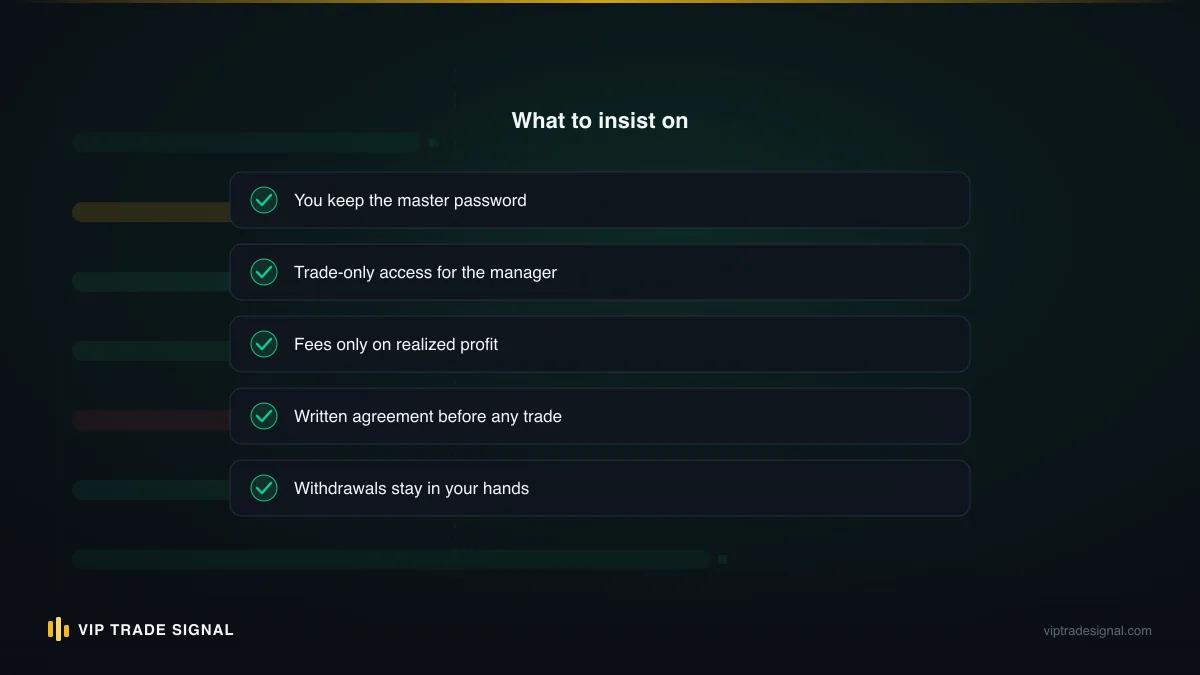
Two overriding rules cut across every band. Payment only from realised results always beats a lower headline number with fixed charges attached, at retail size, because the losing-year cost dominates over time. Losing periods are not an anomaly; they are half the calendar. And a manager who takes fees while you retain full control of the account (your broker login, your master password, your withdrawals) is charging for a fundamentally safer product than one who requires funds moved to him, whatever either of them charges. Price and custody are different axes. Never let a good price buy bad custody.
Reading a fee schedule before signing
The document exists. If a prospective manager cannot produce a written fee schedule, that is the end of the conversation. Not a negotiating position, the end. When you do get one, read it with a pen, and check these nine things in roughly this order:
- Every fee type, listed. Performance, management, admin, setup, platform, withdrawal, "inactivity". If the word "fee" appears anywhere in the document without a number attached, ask for the number.
- The calculation base, in writing. Realised profit only. The words "floating", "unrealised" or "equity" anywhere in the performance-fee clause mean redraft or walk.
- High-water mark. Named explicitly, or described mechanically: fees due only on profit above the previous settlement peak. Absence is a walk-away.
- Settlement frequency and mechanics. A fixed calendar, period netting of wins against losses, and an arithmetic you can verify from your own trade history.
- Broker compensation. A written yes-or-no on IB rebates, spread share and swap share. A yes is survivable if disclosed and modest; a refusal to answer is a no from you.
- Losing-year cost. Work it out from the document alone. If the document does not let you, it is incomplete.
- Exit terms. Notice period, termination fees, and what happens to open positions and pending fee claims when you leave. You should be able to leave in days, not quarters.
- Custody. The agreement should confirm the account is yours, at your broker, with your master password and your withdrawal rights untouched. Trading access only.
- Fee changes. How much notice you get, and whether changes need your consent. Silent unilateral revision clauses are common and obnoxious.
Then the sanity checks that live outside the document. Ask your questions over email so the answers are on record. Compare the schedule against what the salesperson said on the phone; divergence is diagnostic, and it never diverges in your favour. And check the manager's account of his own fees against what his existing material says publicly. If the website, the schedule and the human give you three different numbers, believe none of them. We keep a plain-English rundown of our own answers to exactly these questions in our FAQ, which is where any manager's answers should live: in public, in writing, in advance.
Our fee structure, stated plainly
Having spent four thousand words telling you to demand plain numbers, here are ours.
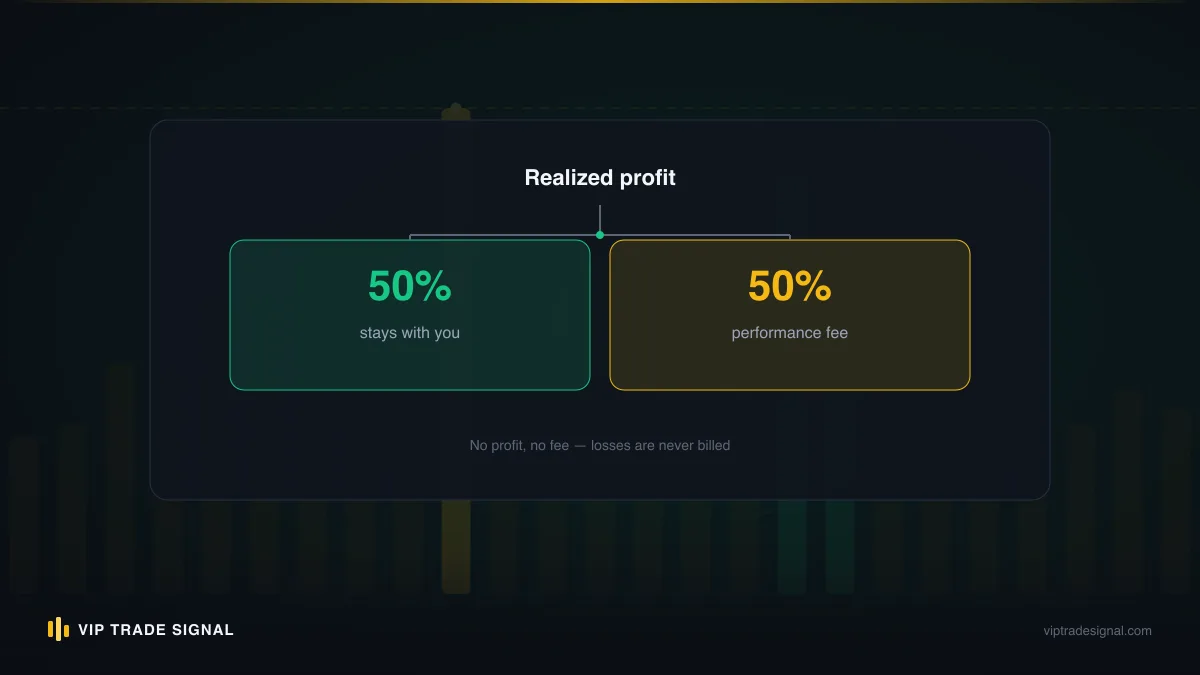
Our account management service charges a flat 50% of realised profit. No management fee, no admin fee, no setup charge, no percentage of balance, ever. We trade your own MT4 or MT5 account at your own broker. You keep the master password, you keep withdrawal rights, we get trading access only. Settlement is against realised profit with the baseline recorded when we start, so recovered ground is never charged twice. The minimum advance is $200, which is credited against future profit share, and it exists so that we are not fielding accounts from people who have not thought about this for even one evening.
Fifty percent is the top of the range we ourselves called fair, and you should apply the reasoning from this article to us without mercy. The case: we take small accounts the 20% volume operators will not touch, everything is pay-as-you-go with no fixed charges, a losing period costs you nothing in fees, and custody never leaves your hands. The case against: half of your good years is a lot, and if you have $25,000 and want standardised pooled management, a 20-25% operator is genuinely cheaper for you and you should go there. We would rather say that in print than have you discover it resentfully in year two. Trading gold is high-risk, managed or not; losing months happen on our book like everyone else's, and nothing here is personalised investment advice or a promise of profit. It is a fee structure, stated so you can check it.
The one-page version, and what to do with it
If you take nothing else from this piece, take the method. Ignore the headline percentage. Get the full schedule in writing. Identify which of the five models you are actually looking at, and check whether a second one is hiding underneath, on the broker's side of the table. Then run your own account, at its real size, through a good year, a flat year and a bad year, and compare dollars out the door. The model that survives that exercise with terms you can verify from your own statements is the one to consider. The manager who resists the exercise has answered your question already.
And keep hold of the asymmetry that sits under all of it. A fee percentage is a decision you make once, on a calm afternoon, with a calculator. The costs it controls repeat every month, in every market, for as long as the arrangement runs. Almost nowhere else in trading does thirty minutes of unglamorous reading buy you a permanent, guaranteed improvement in your results. Fees are the one part of this business with no variance — which is exactly why the industry would prefer you looked away, and exactly why you shouldn't.