Somewhere right now, a trader is wiring $5,000 to a stranger's "fund" because a Telegram profile with a rented Lamborghini told him to. That money is gone. Not might be gone. Gone. And the maddening part is that the thing he actually wanted, someone competent trading on his behalf while he keeps control of the cash, exists. It's called forex account management, and done properly it is one of the more sensible arrangements in retail trading.
Done improperly, it's the single fastest way to lose everything you deposit.
We manage accounts for a living, so you can weigh what follows however you like. But this piece isn't a pitch. It's the guide we wish every prospective client had read before their first conversation with any manager, us included, because the clients who understand custody, fee mechanics, and realistic drawdown are the ones who don't get robbed and don't panic in week three. We'll walk through how managed forex accounts actually work at the plumbing level, where the industry hides its costs, what a bad month looks like from both sides of the desk, and the handful of red flags that should end any conversation on the spot.
What forex account management actually is (and what it isn't)
Strip away the marketing and forex account management is a simple delegation: you own a trading account at a regulated broker, and you grant a manager permission to place trades on it. That's the whole thing. The manager never holds your money. They hold a set of credentials, or a limited power of attorney, that lets them open and close positions and nothing else.
Notice what's missing from that definition. There's no "send us your funds." There's no pooled wallet, no proprietary platform you've never heard of, no crypto deposit address. The moment someone asks you to move money to them rather than to a broker you chose and verified, you have left account management and entered something else. Usually theft with extra steps.
It's also worth separating account management from its cousins, because sellers blur them deliberately:
- Signals are trade ideas you execute yourself. You keep full control and full responsibility for pressing the button. We've written a separate deep piece on how that model works if that's more your speed.
- Copy trading is automated mirroring of someone else's account through a broker's copy platform. You control allocation but not trade selection, and the copier's slippage is your problem.
- PAMM and MAM accounts are broker-side structures that let one manager trade many client accounts as a block, with the broker allocating fills proportionally. This is legitimate account management with the broker acting as referee.
- "Forex fund management" in the true sense means a regulated collective vehicle, audited, with a custodian and an offering document. Almost nothing marketed to retail traders under that phrase is any of those things.
A managed fx account sits in the middle of that list: individual account, your name on it, someone else's hands on the trading. The appeal is obvious. You get a practitioner's execution without surrendering custody. The risk is equally obvious. You are trusting a stranger's judgement with real leverage, and leverage does not care whose judgement it was.
One more boundary line while we're here. A manager trading your account is not giving you personalised investment advice, and any honest one will say so plainly. We're not licensed advisors and we don't pretend to be. Whether delegating your trading makes sense for your finances is a question only you (or an actual regulated advisor) can answer.
Who should hand an account over, and who should keep self-trading
The honest answer is that most people asking about managed forex accounts fall into one of three groups, and only two of them should proceed.
The first group has money but no time. A dentist with a $10,000 account who checks charts between patients and takes revenge trades at 11pm is not going to out-trade a desk that does this all day. For them, delegation is rational the same way hiring an accountant is rational. Not because trading is impossible to learn, but because learning it properly takes a few thousand hours they'd rather spend drilling teeth.
The second group has already tried and knows it. They've blown an account or two, kept a journal long enough to see the pattern, and concluded, correctly, that their edge is earning money elsewhere, not extracting it from the gold chart. There's no shame in this. Most retail traders lose money; that's not our statistic, it's printed on every regulated broker's homepage in the risk warning, because regulators make them print it.
The third group should walk away, and it's the group we turn down most often: people who need the money to perform. If the account is your emergency fund, your rent buffer, or the deposit for a house you're buying next year, no manager on earth should touch it. Managed or self-traded, forex is high risk. A competent manager reduces the odds of catastrophic stupidity; nobody reduces the odds of losing months to zero. If a 20% drawdown would change your life, the correct allocation to any managed fx account is nothing.
And a quiet fourth group: traders who are actually good, consistent, and enjoy it. Keep self-trading. Why pay away half your profit for a job you do well and like doing? Account management is a tool for people whose time or temperament is better spent elsewhere. It is not an upgrade for everyone.
The sizing question comes up constantly, so here's our blunt view. Whatever number you're considering, ask what happens to your month if it halves. Not "would I be annoyed", but "would anything in my actual life change". Fund the account with the largest number that leaves that answer at "nothing", and not a dollar more.
The mechanics: broker account, LPOA, and trade-only access
Here's the sequence for a properly structured arrangement, start to finish, because the order of operations matters and scammers reverse it.
You open the account. You, personally, at a regulated broker, with your own identity documents, your own email, your own banking details for deposits and withdrawals. If a manager offers to "handle the paperwork" and open the account for you, refuse. An account opened by the manager is an account the manager controls at the root, whatever they tell you about access.
You fund the account. Directly, from your bank or card to the broker. The manager never appears anywhere in the money flow. Ever.
Then, and only then, access gets granted, and there are two clean ways to do it:
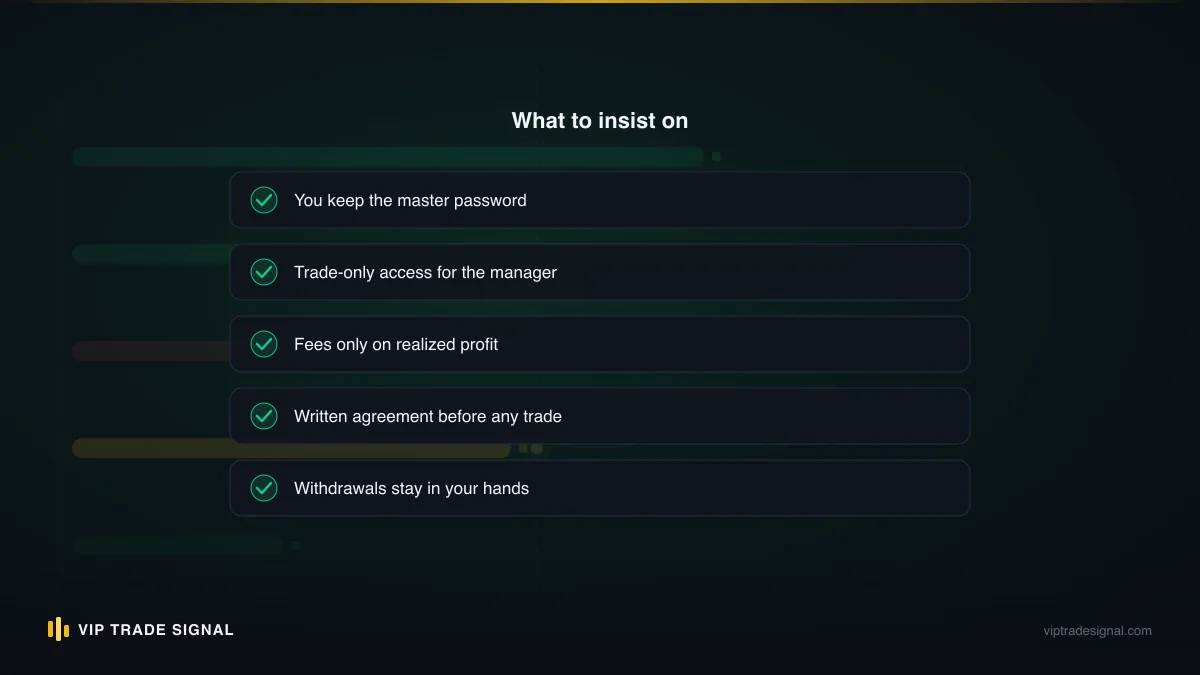
- Trade-only credentials. MT4 and MT5 accounts have two passwords: a master password that can do everything, and an investor or trading password with reduced rights. In a proper setup, the manager receives credentials that allow trading but cannot change the master password, cannot alter your registered email, and cannot request withdrawals. You keep the master password and never share it. This is how we run things on our own desk, for what it's worth: your account, your broker, your master password, our trading access and nothing more.
- Limited power of attorney (LPOA). The formal version, common with PAMM/MAM structures. You sign a document, lodged with the broker, authorising the manager to trade your account. The word doing all the work is limited. A real LPOA covers trading only. It explicitly excludes withdrawals, transfers, and changes to account ownership. Read it. If the authorisation is broad, vague, or drafted by the manager with no broker involvement, that's not an LPOA, it's a signed confession you'll regret.
Either way, test the boundaries before a single trade goes on. Change your master password after granting access and confirm the manager can still trade. Log into the broker portal and confirm withdrawals still route only to your bank. Five minutes of checking, and you've verified the one thing that matters more than any performance claim.
A detail people miss: the broker relationship stays yours. Statements come to you. The broker's client agreement is with you. If the manager vanishes tomorrow, nothing happens to your money; you change the trading password and carry on. That reversibility is the entire point of the structure, and it's why anyone steering you away from it deserves suspicion rather than benefit of the doubt.
Custody: why your money never leaves your own broker
Custody is the boring word for the only question that decides whether you can be robbed: who can move the money?
In a correct arrangement the answer is "you, and only you". The broker holds client funds (segregated from company money if the broker is properly regulated), withdrawals go to the bank account that funded the deposit, and the manager's access stops at the trade ticket. Under that structure, the worst a bad manager can do is lose money trading. That's a real and serious worst case, but it's a bounded one. They cannot take the balance and disappear.
Now flip it. Every managed-account horror story you've read, the WhatsApp "account managers", the fake fund platforms showing beautiful returns until the withdrawal button stops working, all of them share one feature: the client sent money to the manager, or to a platform the manager controlled. Once custody is gone, performance is irrelevant. The dashboard can show +400% because the dashboard is a picture. There was never a market position, just your deposit in someone else's wallet and a customer-service script to stall you while they collect a few more victims.
So make custody the first question in any conversation, before track record, before fees, before strategy.
If a manager can touch your withdrawals, you don't have a manager. You have someone holding your money who currently chooses not to keep it.
Two follow-on points. First, broker choice belongs to you. A manager can reasonably say they prefer certain brokers (execution and spreads on gold vary a lot, and a manager who trades XAU/USD all day has legitimate preferences), but "you must use this unheard-of broker registered in a country you can't place" converts a preference into a trap. Cross-check any suggested broker against the regulator's own register: FCA, ASIC, CySEC, whichever applies. Not the broker's website. The regulator's.
Second, watch for the soft custody grab. Some outfits skip "send us money" and instead ask for your master password "to set things up", or ask you to change the account's registered email to theirs "for notifications". Both hand over root control while feeling smaller than a wire transfer. The rule has no exceptions: master password and registered email are yours, permanently, and any manager who needs otherwise doesn't need a client, they need a mark.
Fee models compared: management fees, performance fees, and profit splits
Fees are where forex account management services quietly decide whose side they're on. The structure tells you more about incentives than any promise does, so let's lay the common models side by side.
| Model | How it charges | When you pay | The incentive it creates |
|---|---|---|---|
| Fixed monthly fee | Flat amount, e.g. $150/month | Every month, profit or loss | Manager earns by keeping you subscribed, not by performing |
| Management fee (AUM) | 1–2% of account balance yearly | Continuously, profit or loss | Manager earns by gathering accounts, performance secondary |
| 2-and-20 style | 2% of balance plus 20% of profit | The 2% always; the 20% on gains | Better, but the 2% still pays them to exist |
| Pure profit split | A percentage of realised profit only | Only when you're up | Manager eats what they kill; a flat month pays them nothing |
| Per-lot / volume rebates | Hidden in spread markups or lot commissions | Every trade, win or lose | The worst: manager earns by trading a lot, not trading well |
That last row deserves its own paragraph because it's the industry's favourite hiding place. Plenty of "free" account management is paid through introducing-broker rebates: the manager gets a cut of the spread or a per-lot commission from the broker on every trade placed on your account. You never see an invoice, which feels great right up until you understand what it incentivises. A rebate-paid manager earns the same whether a trade wins or loses, so their income scales with volume. Churn, in other words. Overtrading your account isn't a failure mode of that structure; it's the business model. We've gone deeper on the no-upfront-fee versions of this in a separate piece on how "free" management gets paid, because the mechanics deserve more space than one paragraph.
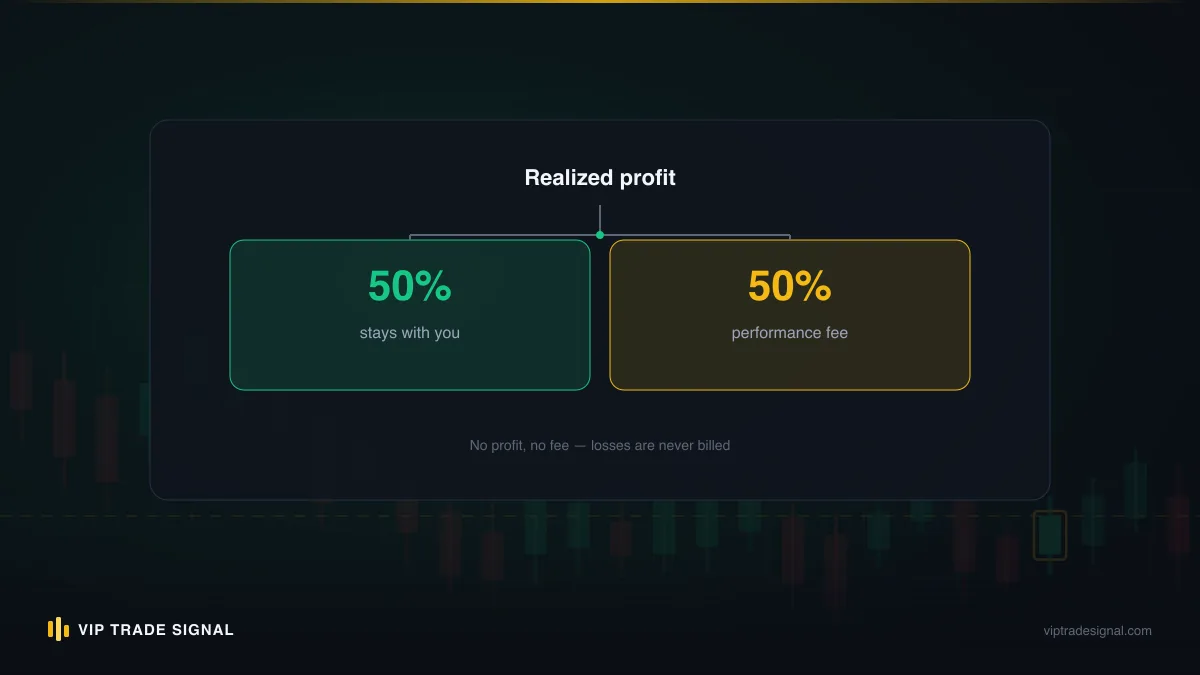
Pure profit splits align cleanest, but read the fine print on three things. Is the split on realised profit (closed trades) or floating profit? Realised is the only honest base; charging on open positions means paying fees on gains that can evaporate. Is there a high-water mark, meaning after a losing period the manager earns nothing until your balance passes its previous peak? There should be, or its practical equivalent. And what's the split percentage against the service you're getting? Industry performance fees run anywhere from 20% to 50%. Our own account management sits at the top of that range, a flat 50% of realised profit with a $200 minimum advance, and we'll say plainly why: no management fee, no volume games, low minimums, pay-as-you-go, so the split is the entire business. Whether that trade-off suits you depends on your account size; a 30% split with a 2% AUM fee and a $25,000 minimum can cost more in real dollars than a 50% split on a small account that pays nothing in flat months. Run the arithmetic on your numbers, not the headline percentage. We've published a full breakdown of what forex account managers charge across the industry if you want the long version, and our own numbers sit unhidden on the pricing page.
The test that cuts through every structure: in a month where your account makes nothing, what does the manager earn? If the answer isn't "nothing" or very close to it, you're carrying them through the flat spells, and flat spells are most of trading.
What realistic performance looks like month to month
Here's the section that loses us prospects and keeps us clients.
The numbers marketed to retail traders are fantasy. "10% a month" compounds to roughly 214% a year; sustained for a decade it turns $10,000 into over $800 million. Nobody managing retail fx accounts is quietly outperforming the greatest funds in history from a Telegram channel. When you see monthly double digits promised, you're not looking at a track record, you're looking at bait, and the piece we wrote on manager red flags treats it as exactly that.
So what's real? A competent manager trading with survivable risk is fighting for something like 2% to 6% in a good month. Some months are flat. Some months are red, and not slightly red: a 4% to 8% losing month inside a sound strategy is normal, expected, and budgeted for. Across a year, a manager who nets 20% to 40% with a worst drawdown under 15% is doing genuinely strong work. Most don't manage it. Plenty of professional funds don't manage it.
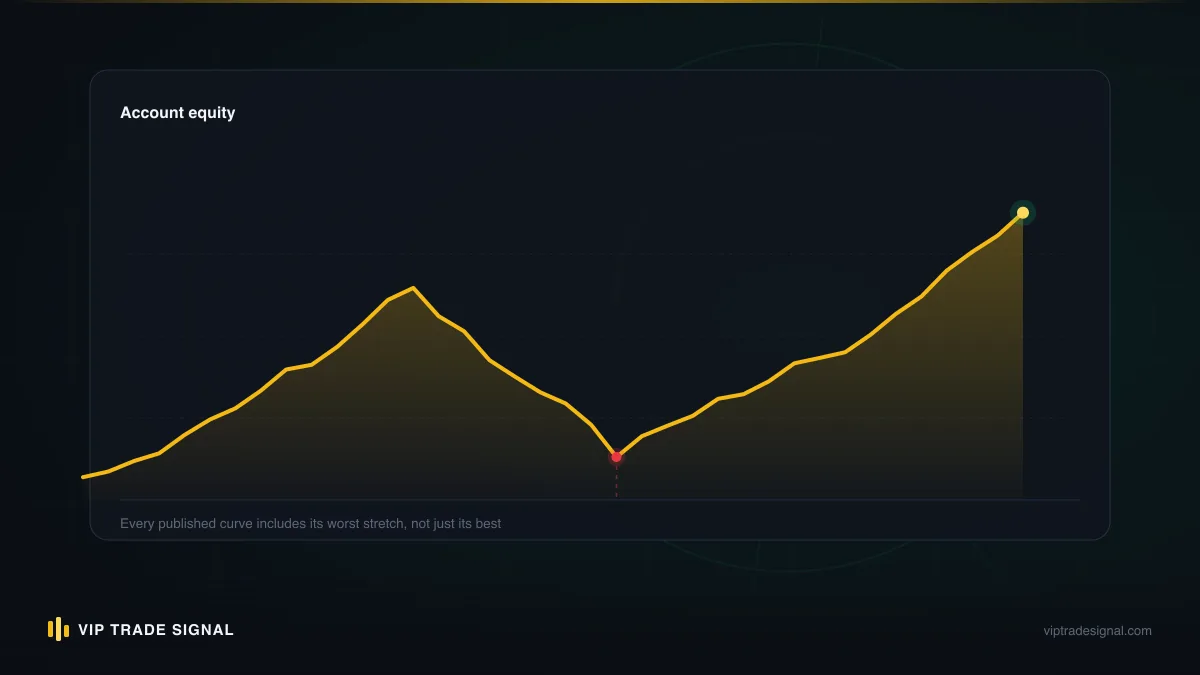
The month-to-month texture matters more than the annual number, because the texture is what you'll actually live through. Picture a plausible first year on a $5,000 managed account run at sane risk: up $180 in month one, up $310, down $260, flat, up $410, up $150, down $390 in a month where gold whipsawed through every level twice, then a recovery stretch. Ending the year around $6,100, call it 22%, with a worst peak-to-trough dip of about 9%. That year would sit comfortably in the top tier of retail account management. And here's the uncomfortable truth from our side of the desk: month seven is when clients quit. Not because the strategy broke, but because a $390 red month feels like betrayal when the marketing you absorbed elsewhere promised straight lines.
Which is why the number to interrogate before signing is never the return. It's the maximum drawdown, verified, over the longest period available, and the risk per trade that produced it. A 60% annual return achieved by risking 10% per trade isn't a track record; it's a coin that hasn't landed on tails yet. Ask for third-party verification (Myfxbook, FX Blue, or direct investor-password access to a live account) and treat screenshots as fiction, because editing a screenshot takes ninety seconds and every scammer knows it.
One more thing managers won't volunteer: your results will differ from the track record even when everything is honest. Different entry dates, different account sizes, different broker spreads. Two clients of the same manager can end the same year a few percent apart without anyone doing anything wrong. Ask how allocation works across accounts and how they keep the gap small.
Drawdown, risk limits, and how losses get handled
Every managed account agreement is really an agreement about losses. Profits take care of themselves; it's the red weeks that test whether you and the manager actually agreed on anything.
Start with risk per trade. A manager should be able to tell you, in one sentence, the maximum percentage of the account at risk on a single position, and the answer should make you slightly bored. Somewhere between 0.5% and 2% is the adult range. On a $10,000 account that's $50 to $200 of defined risk per trade, with a stop on every position, no exceptions, no "mental stops". If the answer involves the words "it depends on the setup" with no ceiling attached, the ceiling is your balance.
Then the account-level limit, which matters more. What total drawdown triggers a full stop? A serious manager names a number, commonly 15% to 25% from the starting balance or the high-water mark, at which all positions close and trading halts until you've spoken. Get it in writing. The purpose isn't that the number is magic; it's that a manager who pre-commits to a stop-everything line has thought about failure, and the ones who haven't thought about failure are the ones who dig. Averaging into losers, doubling risk to "recover", removing stops because price will "definitely come back": account autopsies read the same every time, and the fatal wound is never the first loss. It's the response to it.
Ask, too, what the manager does after a losing streak, because the honest answers are boring: risk comes down, size comes down, sometimes trading pauses for a few days. Streaks are where discipline shows. Anyone can follow rules while winning.
Now the part most guides skip: your obligations during drawdown. The deal you're making, implicitly, is that you'll judge the manager on process over months, not on P&L over days. If you're going to log in nightly and message the manager every time floating P&L goes red, save everyone the pain and don't start. Floating drawdown within agreed limits is the strategy working as designed, not an emergency. The time to act is when the rules get broken, a missing stop, risk beyond the agreed cap, a breached account limit with trading still open, and then the response isn't a message, it's changing your trading password. You always hold that power. That's what all the custody plumbing earlier was for.
A separate word if you're reading this already deep underwater on a self-traded account: recovery work is its own discipline with its own maths (a 50% loss needs a 100% gain just to get back to flat), and anyone guaranteeing to dig you out is lying by definition. We run drawdown recovery as a distinct service, priced only on recovered profit above a recorded baseline, with no guarantees attached, because attaching guarantees to recovery would make us exactly the kind of outfit this article warns about.
The red flags that end the conversation immediately
We keep a mental list, built from years of watching people arrive at our desk after being burned elsewhere. Any single item below is disqualifying. Not "proceed with caution". Done.
- They ask you to send money to them. The first rule and the last one. Deposits go to your broker, withdrawals come from your broker, the manager never touches either.
- Guaranteed returns, or "capital protection" promises. Nobody can guarantee profit in leveraged trading. The words "guaranteed" and "risk-free" are not optimism; in this industry they're a confession.
- They found you. Cold DMs on Instagram, WhatsApp, or Telegram from "account managers" are a scam category with its own name at this point. Real managers with real capacity aren't messaging strangers' holiday photos.
- The track record is screenshots. No investor access, no third-party verification, just images. Fiction until proven otherwise, and it won't be proven otherwise.
- They need your master password or want to change the account email. Root access dressed up as convenience.
- They push one obscure broker and won't work anywhere else. Preferences are fine; requirements pointing at an unregulated shop they probably run themselves are not.
- Pressure and urgency. "Slots close Friday", "this month's entry window", a countdown of any kind. Managed accounts have no windows. Urgency exists to stop you doing exactly the checking this article describes.
- They dodge the losing questions. Ask about their worst month and watch. A real manager answers with a number and a story; a fraud pivots to the good months.
- No written terms. If the fee, the split base, the drawdown limit, and the termination process aren't on paper, they don't exist. You'll discover the real terms during your first dispute, which is the most expensive possible time.
There's a longer treatment of each of these, with the psychology behind why they work on smart people, in our dedicated red-flags piece. The one-line summary: every scam in this industry needs either your custody or your urgency, and usually both. Refuse to give up either and you're most of the way to safe.
A due-diligence checklist before you sign anything
Assume the conversation has survived the red flags. Here's the boring, unskippable homework, in the order we'd do it ourselves.
Verify the broker, at the source. Look the broker up on the regulator's public register, matching the exact legal entity name, because scam operations love cloning the name of a regulated firm with one letter changed. Confirm the entity you're opening with is the regulated one, not an offshore sibling with similar branding.
Verify the manager exists. A real business name, a registration you can look up, a website older than three months, a person whose name appears somewhere other than their own marketing. None of this proves competence, but its absence proves plenty.
Demand verified performance, then read it properly. Investor-password access to a live account, or a Myfxbook/FX Blue link with verified track record and open trade history. Then check three things: track length (twelve months minimum, and treat anything under six as no track at all), maximum drawdown, and whether the equity curve shows the tell-tale staircase of martingale, long smooth climbs punctuated by cliff-edge drops. Smooth is a warning sign in this business, not a comfort.
Read the agreement like it will be used against you. Fee base (realised or floating?), high-water mark or reset, the drawdown stop-line, who pays swap and commission costs, notice period for termination, and, critically, confirmation in writing that withdrawals and the master password remain solely yours.
Test the access boundaries. Grant trade-only access, then confirm the manager cannot withdraw, cannot change the email, cannot touch the master password. Broker support will confirm the permission set on your account if you ask.
Ask the losing questions. Worst month, worst drawdown, what happened next, what they'd do if the account hit the stop-line in month one. You're listening less for the numbers than for whether losses are discussed like weather (normal, planned-for) or like slander (deflected, minimised).
Start small and stage in. Whatever you intend to allocate eventually, start with a fraction and let months of live experience, on your own statements from your own broker, earn the rest. A manager who objects to starting small is telling you the deposit matters more than the relationship. Believe them.
None of this takes long. An evening, maybe two. Against the alternative, which is discovering the answers after the money's committed, it's the best-paid time in your trading life.
How a gold-only 50/50 service is structured in practice
Since the brief for this whole article is "explain it from the manager's side of the desk", let us show you our own plumbing as a worked example. Not because our terms are the only fair ones, but because a concrete structure makes every abstract point above easier to judge, ours and anyone else's.
We trade one instrument: gold, XAU/USD, nothing else. That's a deliberate narrowing, not a limitation we apologise for. A desk that watches one market all day, every day, through every session's behaviour, knows that market's rhythm in a way no fifteen-pair generalist can. It also makes our results legible: one instrument, one strategy family, no burying a bad EUR/USD month under a lucky yen trade.
The structure follows everything this guide has argued. You open your own MT4 or MT5 account at your broker (we work with the majors our clients already use). You fund it directly. You grant trade-only access and keep the master password; withdrawals stay yours alone, permanently. We trade it under agreed risk limits with a stop on every position.
The fee is a flat 50% of realised profit, with a $200 minimum advance, and nothing else. No management fee, no monthly charge, no volume rebates, no charge on floating profit. A flat month costs you nothing beyond the broker's own trading costs, which means our income exists only where your closed profit does. We're upfront that 50% is the high end of the industry's range; the trade-off, as we said in the fees section, is that everything is pay-as-you-go with minimums most managers wouldn't get out of bed for. For some account sizes we're the expensive option and a cheaper AUM-based manager with a $25k minimum genuinely suits better. The arithmetic is yours to run, and the full terms sit on the account management service page rather than in a DM.
And because it bears saying inside our own example just as loudly as everywhere else: it's still trading, and trading loses sometimes. We have red months. Clients see them on their own broker statements, which is exactly where performance should live. Anyone whose worked example omits that sentence is writing an advert, not a guide.
Straight answers to the questions we get every week
A few questions arrive in our inbox so reliably that they belong in the pillar guide, answered the way we'd answer them on a call. (The broader running list lives on our FAQ page.)
How much do I need to start? Mechanically, whatever your broker's minimum is. Practically, a managed account under about $1,000 struggles to run proper risk sizing; at 1% risk per trade you're working with $10 of room, which forces either micro-lots on a tight leash or corner-cutting, and corner-cutting is how small accounts die. Under that level, honestly, signals you execute yourself are usually the better fit.
Can I still trade the account myself? Please don't. Two sets of hands on one account is how a hedged position becomes a naked one and how a manager's risk accounting stops meaning anything. If you want to self-trade, run a separate account for it. Every manager worth hiring will make the same request.
Can I withdraw whenever I want? Yes, structurally, because withdrawals were never anyone's to control but yours. Courtesy and good sense say give notice so open positions can be sized down first; pulling half the balance out from under open trades doubles the effective risk on what remains.
What happens if I want out? You change the trading password. That's genuinely the whole procedure. Settle any fees owed on realised profit to date, and you're done. Any arrangement where leaving is harder than that, exit penalties, lock-up periods, "processing" delays, has imported the worst feature of the pooled-fund world into a structure that exists specifically to avoid it.
Is any of this regulated? The broker holding your money should absolutely be. The management layer, for individual accounts, mostly isn't, in most jurisdictions, and anyone implying their "certification" from a marketing academy is a licence is misleading you. This is precisely why the custody structure carries the safety load: regulation protects the money at the broker, and the trade-only boundary protects it from the manager.
Will my results match the track record? Closely, not exactly. Spreads differ by broker, entry timing differs by start date, and proportional allocation has rounding edges on small accounts. A few percent of annual divergence between clients is normal; a large gap is a question worth asking.
Where this leaves you
Here's the whole guide compressed into something you can carry into any conversation with any forex account manager, including us.
The structure is the safety. Your account, your broker, your master password, your withdrawals; their trade-only access, revocable by you in thirty seconds. Agree the risk numbers before the first trade: percent risked per position, the account-level stop-line, what happens when it's hit. Pay for profit, ideally realised profit only, and know exactly what the manager earns in a flat month. Verify the track record at the source or treat it as fiction. Expect red months, because they're coming, and decide now, while you're calm, that you'll judge process over quarters rather than P&L over weekends.
And hold the two-question test in reserve for every pitch you'll ever hear. Who can move the money? What does the manager earn when I don't? Those two answers, honestly given, sort the entire industry into the small pile worth talking to and the large pile that wants your deposit more than your business.
If our own answers interest you, they're public: gold only, 50% of realised profit, $200 minimum advance, your custody untouched throughout. But whoever you end up talking to, walk in knowing the plumbing. The clients who get burned in this industry are almost never the ones who asked too many questions.