You have a trade open right now and it's red. That's why you're here. Nobody googles "should I close a losing trade or wait" from a position of comfort. You type that question with one eye on the search results and one eye on a floating loss that has stopped feeling like a number and started feeling like a verdict on you personally.
Good. This article was built for exactly that moment. Not for a calm Sunday review, not for your trading journal, not for some future version of you who has it all together. For now, with the position open and your pulse doing things it shouldn't.
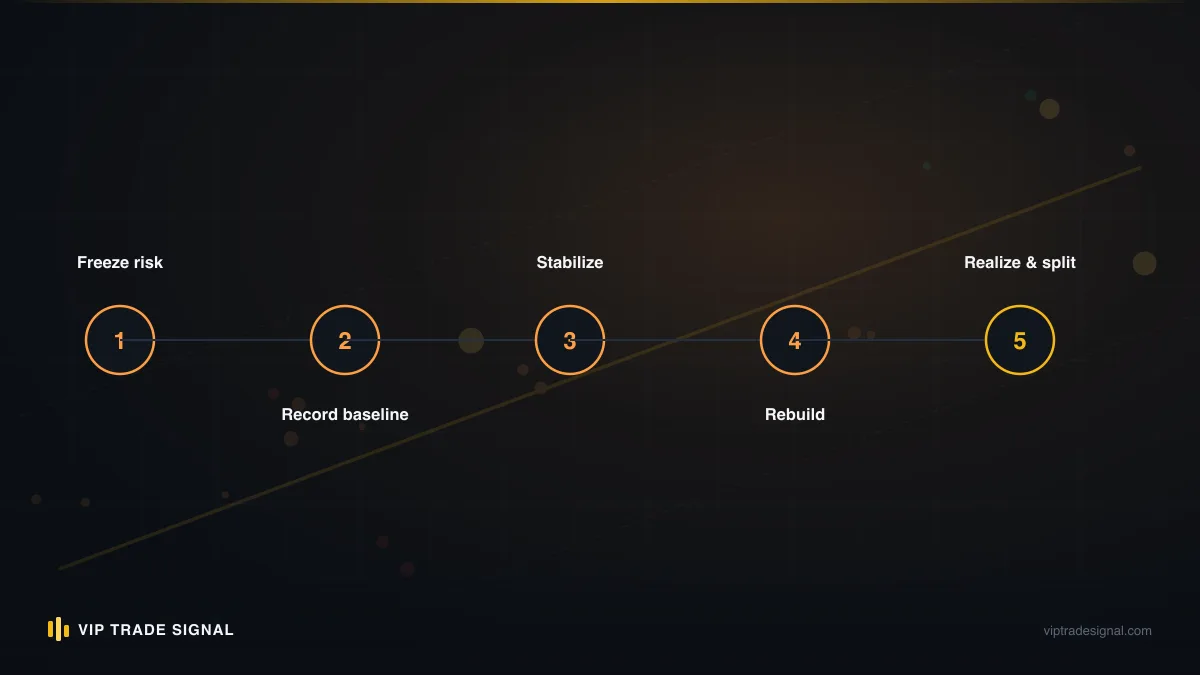
Here's the deal we're making. Over the next few thousand words I'm going to walk you through five questions. You answer each one honestly (I'll show you what honest looks like, because your brain is going to try to cheat) and each answer gets a score. At the end, the scores add up to one of three verdicts: close, reduce, or hold. Not "it depends". Not "consult your trading plan" (if you had one that covered this, you wouldn't be reading). An actual verdict, produced by a process you ran while emotional, which is the only kind of process that works when you're emotional.
Read this while the trade is still open
Most trading education has a dirty secret: it's written for the version of you that doesn't exist when it matters. The calm, rational, well-slept trader who journals every position and never risks more than 1% is the person the books address. The person who actually shows up at decision time is sweaty, defensive, and quietly negotiating with a chart.
So let's set the terms for reading this properly.
First, do not close the trade before finishing the five questions. I know that sounds odd from an article that will, statistically, tell most readers to close. But a panic close is nearly as bad as a hope hold. If you slam the position shut in the next ninety seconds because a stranger on the internet gave you permission, you haven't learned the process; you've just outsourced the panic. The whole point is that you produce the verdict, so that next time (there will be a next time) you can produce it without me.
Second, don't add to the position while reading. Averaging down mid-article is a special kind of self-sabotage and yes, people do it. The position stays exactly as it is until you have a verdict.
Third, write your answers down. Phone notes, the back of an envelope, whatever. Scored questions only work if the scores exist somewhere outside your head, because inside your head they will drift towards whatever verdict you secretly want. A trader we'll call Sam (you'll meet him a few times in this piece) once told me he'd "run the questions mentally" and concluded hold. When I made him write the same answers down, they added up to close. The gap between mental arithmetic and written arithmetic, when money's involved, is roughly the size of your hope.
One more thing before the questions. If your floating loss is not one bad trade but a whole account down 40, 50, 60 per cent, with a grid of positions and a margin level you check hourly, this article will help, but it's triage for a broken leg when you might need a hospital. The drawdown management playbook is written for that situation, and our desk runs a drawdown management service for accounts floating roughly $5k–$10k underwater, priced as a flat 50% of whatever gets recovered above a baseline we record together, with no guarantee of recovery, because nobody honest offers one. For a single losing trade, though, keep reading. This is the right room.
Why your judgment is compromised right now (and that's normal)
Before the questions, you need to accept one uncomfortable premise: you are currently the worst-qualified person on Earth to evaluate this trade.
Not because you're stupid. Because you're human, and three specific biases are running hot in your head at this exact moment, and every one of them votes hold.
Loss aversion. Losses hurt roughly twice as much as equivalent gains feel good; that's about as replicated as findings in behavioural economics get. The practical consequence: a floating loss doesn't feel like information, it feels like pain, and the fastest way to stop pain that hasn't been "realised" yet is to not realise it. Your brain has noticed that the loss only becomes real when you click close. So it has a strong opinion about clicking close.
The sunk cost fallacy. You've already "invested" in this trade: margin, hours of watching, the emotional cost of being wrong so far. None of that is recoverable, and none of it has any bearing on what the position is worth going forward. But it doesn't feel that way. It feels like closing now would "waste" everything you've put in, as if a trade were a gym membership.
The disposition effect. Study after study of retail brokerage accounts finds the same lopsided pattern: traders sell winners quickly and ride losers long. Not because losers recover more often (they don't) but because closing a winner feels like banking a victory and closing a loser feels like signing a confession.
Notice what all three have in common. They don't make you worse at reading charts. They make you worse at acting on what you read. You can see the structure perfectly well; the bias lives in the gap between seeing and clicking.
Which is precisely why this article is a scoring system and not a pep talk. You can't out-willpower a bias; decades of blown retail accounts are the evidence. What you can do is route the decision through a process the bias can't easily corrupt: specific questions, written answers, arithmetic. The bias can lean on any single judgment call. It struggles to lean on five of them at once, in writing, with a sum at the bottom.
There's a longer treatment of what floating losses do to your head in our piece on drawdown psychology, and it's worth your time later. For now, just carry this one sentence into the questions: the trade doesn't know you're in it. The market has no memory of your entry price. Every bias above depends on pretending it does.
Question 1: is the original thesis dead or alive?
Every trade worth taking had a reason. Maybe a good one (break and retest of a level that had held four times), maybe a flimsy one (a Telegram post and a feeling), but a reason. Question 1 asks whether that reason still exists.
Not whether the trade could work out. Anything could work out. Gold could gap 200 dollars in your favour tomorrow because a central bank sneezed. "Could work out" is true of every position ever opened and is therefore worthless as a criterion. The question is whether the specific mechanism you were betting on is still in play.
Say you went long XAU/USD at 3,340 because price had bounced off 3,320 three times in two weeks and you were betting the floor would hold for a push to 3,380. Price is now 3,317. Your thesis, "3,320 is a floor", is not wounded. It's dead. The entire reason for the trade was that a specific level would hold, and it didn't. Whatever happens next happens for reasons that have nothing to do with why you entered.
Now a different scenario. Same entry, but price is at 3,326: inside the zone, above the floor, just grinding sideways longer than you'd hoped while some US data reshuffled the room. Uncomfortable? Very. Thesis dead? No. The floor is holding; your timing was early. That's a live thesis having a bad week.
Here's the honesty test, because your brain will try to perform thesis surgery in real time: write down, in one sentence, the reason you entered, as you would have written it at entry. Not the upgraded version. If you entered because of a support bounce and you're now telling yourself it's "really a longer-term accumulation zone play", you haven't found a deeper thesis, you've written a eulogy and called it a diagnosis. Thesis migration, the quiet swapping of a dead reason for a fresh one at the same entry price without ever closing, is how a two-day trade becomes a two-month tomb.
And if you genuinely can't reconstruct why you entered? If the honest answer is "someone posted it" or "it looked oversold"? Then the thesis is dead by default, because a thesis you can't state is a thesis you can't evaluate. Harsh, but the scoring reflects it.
Score it: thesis clearly alive, the specific mechanism intact: 0 points. Thesis wounded, partially invalidated or you're genuinely unsure: 1 point. Thesis dead, or you can't state what it was: 2 points.
Write the number down. We're counting points towards closing, so higher is worse for the trade.
Question 2: what is waiting costing in margin and swap?
The hold-and-hope crowd talks about waiting as if it were free. Park the trade, live your life, check back when it's green. But waiting has a running cost, and on gold it's usually bigger than people think, and it comes in two currencies: swap and margin.
Swap is the overnight financing charge on your position, and for a retail long on XAU/USD it is almost always negative: you pay to hold, every night, with a triple charge one night a week to cover the weekend. The exact figure varies by broker and shifts with interest rates, so open your platform and look at yours right now; it's in the contract specification, and your open position window shows the accumulated total. Don't estimate. Look.
Then do the multiplication your brain has been avoiding. Say the swap on your position size works out to a few dollars a night. Feels like nothing. Over the six weeks that "waiting it out" typically turns into, a few dollars a night compounds into a three-figure sum on a modest position, a charge you're paying for the privilege of staying wrong. Sam, our recurring friend, once held a 0.5-lot gold long for 47 days. When he finally closed, the swap column had quietly eaten more than his original stop loss would have cost him on day one. He paid extra for the slow version of the same loss.
Margin is the sneakier cost. The margin locked under a losing position isn't just unavailable; it's a hostage. As the floating loss grows, your free margin shrinks, your margin level drops, and your account's ability to absorb anything else degrades. A $2,000 account with $600 of equity trapped under one bad gold position isn't a $2,000 account anymore; it's a $1,400 account with a landmine attached. One news spike against you and the broker starts making your decisions for you, and brokers make those decisions at the worst prices of the day. If your margin level is already flirting with the low hundreds of per cent, waiting isn't a strategy — it's a countdown.
Score it: costs trivial (small position, healthy margin level, swap you could pay for months without noticing): 0 points. Costs real but survivable, swap adding up, margin level fine but not fat: 1 point. Costs dangerous, meaning margin level compressed, swap material against your account size, or any scenario where a bad night could trigger a margin call: 2 points.
Question 3: what does the structure say, level or air?
Now, and only now, do we look at the chart. Deliberately third. If charts came first you'd read them the way a defendant reads character references, hunting for the friendly ones. With the thesis question and the cost question already answered in writing, you've got some scaffolding against that.
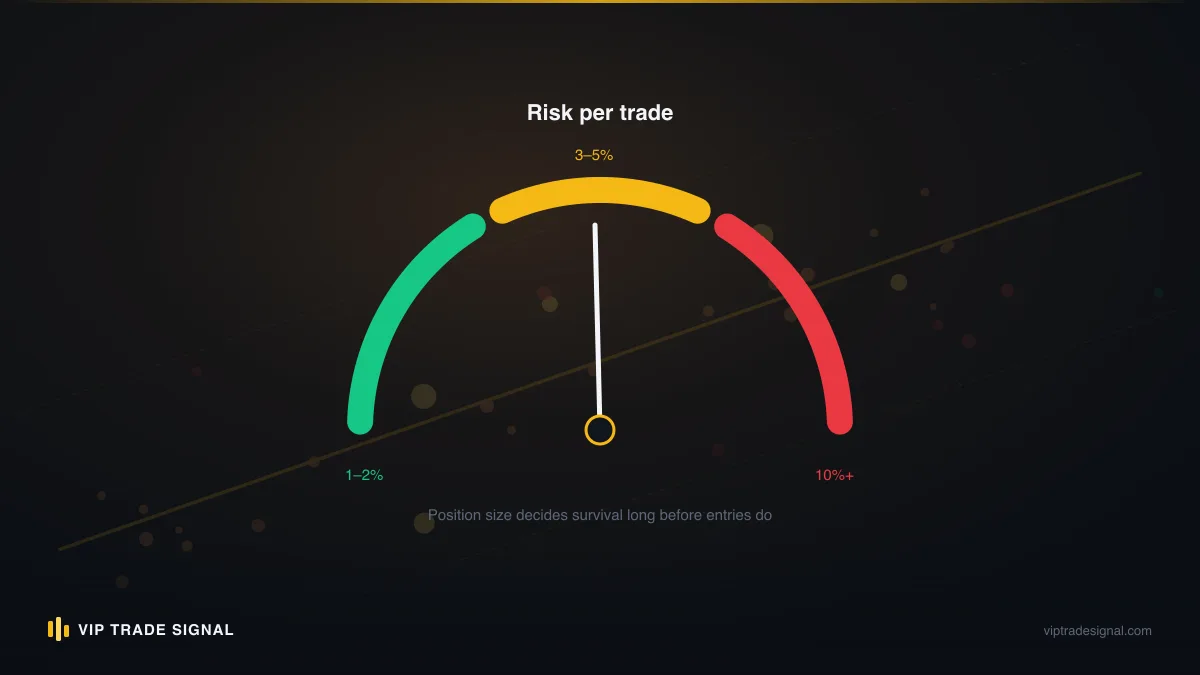
The question here is specific, and it is not "will price come back". It's this: is your position currently resting on structure, or hanging in air?
Structure means a level with a résumé. A zone that has demonstrably turned price before: multiple touches, visible on the timeframe you actually traded, ideally reinforced by something else (a prior consolidation, a high-timeframe level, a round number that gold's algorithms and Sam's fellow humans both watch). If you're long from 3,340, price is at 3,328, and there's a well-tested demand zone at 3,325–3,330 currently doing its job, buyers visibly stepping in and candles rejecting the lows, then your loss is sitting on something. The trade is wrong on entry timing but not yet wrong on structure.
Air means the opposite. Price sliced through your level without a fight and the next zone with any history is 40 dollars lower. Holding a loss in air is holding a falling object and admiring your grip strength. There is nothing between price and the next real level except your hope, and hope has never once appeared in the order book.
Two honesty rules for this one, because chart-reading under stress is where self-deception does its finest work:
- Stay on your entry timeframe. If you entered off the 1-hour chart, the 1-hour chart judges the trade. Zooming out to the weekly to find a "major support" three years old and 80 dollars away is not analysis. It's the technical-analysis version of thesis migration, and it's the single most common tell of a trader who has stopped trading and started coping.
- The level must predate your trade. If you first noticed this "support" after you were losing, it's not a level, it's a lifeboat you're sketching onto the ship's wallpaper. Real structure was on your chart before your entry, or would have been obvious to any stranger looking at the same timeframe.
And a word on indicators: oversold is not structure. RSI at 25 tells you price fell fast; it says nothing about where it stops. Strong trends stay "oversold" for weeks. If your entire case for holding is an indicator reading, score this one against yourself.
Score it: position sitting on genuine, pre-existing, currently-holding structure: 0 points. Structure nearby but untested, or holding by a thread: 1 point. Air, broken levels, or a "support" you discovered after the trade went red: 2 points.
Question 4: what else could this capital be doing?
This is the question nobody trapped in a losing trade wants to hear, because it reframes the whole situation. The first three questions asked "is this trade still good?" This one asks "compared to what?"
The margin and mental bandwidth locked under your losing position have an opportunity cost, and in trading that cost is unusually easy to see because the alternative is sitting right there: every setup you can't take, or can only take at reduced size, while the loser hogs the account.
Run the numbers on your actual situation. Say you've got $3,000 in the account and the losing position has $900 of equity effectively pinned under it between margin and floating loss. That's 30% of your firepower committed to a trade you're currently having to read an article about. If two clean setups a week cross your desk and you're skipping them or halving them because of the hostage situation, the loser isn't costing you what the P&L window says. It's costing that plus every trade it's crowding out. Over a month, the crowding-out cost can quietly exceed the loss itself.
There's a mental exercise that cuts through this faster than any spreadsheet, and it's worth doing properly rather than nodding at. Imagine the position is gone. Not stopped out, just gone, with the remaining equity sitting as cash. What's the first thing you'd do with it? If your honest answer is "immediately re-enter the exact same trade at this price", interesting; hold that thought for Question 5, where it becomes the whole exam. But if your honest answer is "take a breath, wait for the next clean setup, probably that pullback forming on the 4-hour", then you've just told yourself that you value the next opportunity more than this one. You're only holding the current trade because you happen to already be in it. That's not a reason. That's furniture.
One caveat, because fairness demands it: opportunity cost arguments can be abused in the other direction. If you're the type who'd take the freed capital and immediately spray it across three revenge trades, the "better use" you're imagining is fictional, and the discipline problem is bigger than this position. Answer this question as the trader you actually are, not the one you plan to become on Monday.
Score it: capital's not needed elsewhere, position small, no real setups being sacrificed: 0 points. Noticeable crowding-out, some reduced sizing on other trades: 1 point. The position is actively strangling your account's ability to function, or you're skipping A-grade setups to feed it: 2 points.
Question 5: would you open this exact trade right now?
The last question is the oldest one in the book, and it's last because it only works after the first four have softened the ground. Here it is, plainly: if you were flat right now, with no position, no entry price and no history, would you open this exact trade at the current price, with a stop where your pain limit actually is?
Not "would you buy gold somewhere around here eventually". This exact trade. Same direction, same size, entry at the current market price, and a stop at whatever level you're currently, secretly, unwilling to let price reach.
Almost everyone says no. And the reason is worth staring at: the position you're holding and the position you'd open are the same object. Identical direction, identical size, identical exposure to the next tick. The market will treat them identically because to the market they are identical (remember, the trade doesn't know you're in it). The only difference between "holding this" and "opening this" is that one of them requires you to admit the loss first. If you'd refuse to open it, but you're willing to hold it, then the loss admission is doing all the work in your decision. You're not holding a trade. You're holding a confession you don't want to sign, and paying swap on it nightly.
If you wouldn't open the trade at this price, every hour you hold it is a decision to open it again — you're just not writing it down.
The honest-answer mechanics matter here, because this question is famously easy to wave through. Don't answer in the abstract. Actually picture the order ticket: the size field, the price, the stop. A trader who says "yeah, I'd probably re-enter here" while flinching at the mental image of clicking buy has answered no. The flinch is the answer.
And occasionally, genuinely occasionally, the answer is yes, and means it. The thesis survived Question 1, price has pulled back into better structure than your original entry, and you'd happily take this position from flat. Fine. That's real, it happens, and the scoring respects it. A yes here is the strongest single vote for holding that this framework can produce. But it has to be a yes that would survive you saying it out loud to another trader without your voice doing anything strange.
Score it: clear, flinch-free yes: 0 points. Hesitation, a "maybe at smaller size", a yes with conditions: 1 point. No, or a yes you don't believe as you say it: 2 points.
So, should I close a losing trade or wait? The scorecard
Five questions, each scored 0, 1 or 2. Add them up. Ten points maximum, all of them pointing towards the exit.
| Total score | Verdict | What it means |
|---|---|---|
| 0–2 | Hold | Thesis alive, costs manageable, structure holding, and you'd take the trade again. The loss is drawdown-within-plan, not a broken position. |
| 3–5 | Reduce | Mixed picture. Something real supports the trade, and something real is wrong with it. Cut the position (half is the default) and set hard conditions for the rest. |
| 6–10 | Close | The trade is over. The market ended it a while ago; the paperwork is waiting for your click. Close it, flat, today. |
A few notes on using the table honestly, because a scoring system is only as good as the scorer.
No retroactive adjustments. If your total is 6 and you suddenly want to revisit Question 3 because "actually that level might be stronger than I scored it", no. The whole design assumes your first written answers, produced in sequence, are more honest than any revision made after you've seen the verdict. Revisions made downstream of a verdict you dislike aren't analysis. They're appeals, and this court doesn't hear them.
The boundaries are deliberately unforgiving. A 6 is a close, not a "strong reduce". If that feels arbitrary, good: arbitrary-but-fixed beats flexible-but-corruptible in every situation where the decision-maker is compromised, and we established two thousand words ago that you're compromised. Pilots run checklists precisely because "use your judgment" fails at altitude.
A worked example, for calibration. Sam, long gold from 3,340, price at 3,322. Thesis was the 3,320 floor holding: it's being tested this minute, wounded, not dead. 1 point. Swap accumulating on a position that's a third of his margin, level at 240%. 1 point. Price sitting directly on the multi-touch zone and so far respecting it. 0 points. He's skipped one decent setup this week nursing this. 1 point. Would he open it fresh here? He hesitated, said "at half size, maybe". 1 point. Total: 4. Verdict: reduce. Which, notice, is exactly the answer his hesitation on Question 5 was already whispering: half size. The framework didn't overrule his instinct. It made his instinct legible.
And what a hold verdict is not. A 0–2 score is permission to keep a planned trade open. It is not permission to remove the stop, add to the position, or stop monitoring. A held loser is still a loser until it isn't, and the risk warnings apply to it with full force: this is leveraged gold, losses are normal, and no framework changes that.
The partial close: the underused middle verdict
The reduce verdict deserves its own section, because almost nobody uses it and it's frequently the best tool in the drawer.
Retail traders treat position management as binary (in or out, hero or coward), which is strange, because sizing was continuous on the way in. Nobody forces you to open exactly 1.0 lots; nothing forces you to close exactly 100% of it. The partial close is how you act on a mixed scorecard without pretending the scorecard was clean.
Here's what it does mechanically. Say you're 0.6 lots long from 3,340, price at 3,324, floating about $960 down, and you scored a 4. Close 0.3 lots. You realise roughly $480 of the loss (it stings, it's supposed to) and instantly, three things improve. Your margin requirement halves, so the hostage situation from Question 2 relaxes. Your per-dollar exposure to further downside halves, so the scenario that's been keeping you up (a break below the zone) now costs half as much if it lands. And your remaining position can survive twice the adverse movement on the same pain budget, which means your stop can live where the chart says instead of where your stomach says.
But the psychological mechanics are the real product, and they cut both ways, so let's be honest about both.
The good: a partial close breaks the all-or-nothing spell. The loss stops being a hypothetical monster and becomes a known, survivable number you've already partly paid. Traders who can't bring themselves to sign the full confession will often sign half of it, and half a rational decision beats zero. It also converts you from a hostage into a manager: you've acted, on your own terms, before the market forced anything. That shift alone improves every decision that follows.
The trap: the partial close is also the procrastinator's favourite hiding place. Cutting half can become a ritual payment you make for permission to keep hoping with the rest, a way to feel decisive while remaining wrong. The tell is what happens next. A legitimate reduce comes with written conditions on the remainder (that's the next section). A cope-reduce comes with nothing but relief, and the remaining half quietly inherits all the old hope at half the size. Same disease, smaller patient.
So the rule: a reduce verdict is only complete once the surviving portion has a hard stop and a written invalidation condition. Cut the size, then immediately do the paperwork for what's left. If you find yourself reducing the same position a second time a week later, you didn't reduce; you closed in instalments and paid extra swap for the privilege.
If you hold: the conditions that convert it to a close
Suppose you scored a 2. Legitimate hold. The thesis lives, the costs are manageable, structure's doing its job, and you'd take the trade again from flat. Congratulations. Now for the part that separates a held trade from a drifting one.
A hold verdict is a lease, not a freehold. It's valid only while the conditions that produced it stay true, which means the moment you decide to hold, you write down (actually write down) the specific events that would flip the verdict. Not "if things get worse". Specific, observable, argument-proof events. Three types:
A price condition. The level that kills the thesis, stated as a number. "If gold gives a 1-hour close below 3,318, the floor thesis is dead and I close at market, no waiting for a bounce to exit better." The exit-on-a-bounce clause matters: waiting to exit at a friendlier price after invalidation is how a $300 loss becomes an $800 one while you stand there negotiating. And this level goes in the platform as an actual stop order, not a "mental stop". Mental stops are the leading cause of articles like this being read a second time.
A time condition. Theses have shelf lives. If your entry logic implied resolution within days, a position still bleeding swap three weeks later has failed on time even if no price line broke. "If this isn't back above breakeven by the 30th, I'm out regardless" is a perfectly good clause, and it's the only defence against the slow-motion version of holding-and-hoping, where nothing ever quite goes wrong enough to act on. Gold can grind sideways for a month while swap does its quiet work; a time stop puts a meter on the grind.
An account condition. The line at which this trade's survival stops being worth the account's. "If my margin level touches 180%, I close this regardless of the chart", because at some point the question is no longer whether the trade recovers but whether you're still solvent when it does. Being right eventually is worthless if the margin call arrives first. Traders wiped out at the bottom of moves that later reversed are a genre, not an anecdote.
Write all three, put the price one in the platform, put the time one in your calendar, and here's the clause that makes the whole thing binding: when a condition triggers, the close is automatic. No re-running the five questions. The framework already ran; the conditions are its standing orders. Re-scoring at the moment of trigger, with fresh hope and a slightly different chart, is just bias asking for a retrial with a friendlier jury. If you want a sense of what disciplined recovery looks like after a close, meaning how long it actually takes to earn back a given loss and why a 30% hole needs a 43% climb, spend ten minutes with the drawdown recovery calculator. The arithmetic is sobering in exactly the way a fresh hold decision needs.
If this decision keeps recurring, the problem is upstream
Now the uncomfortable epilogue, and I'll keep it honest even though it partly argues against articles like this one: if you're using this framework more than very occasionally, the framework isn't your problem.
The five questions exist for the exceptional case: the trade where something genuinely changed mid-flight, or the one that slipped through on a sloppy day. They are triage. And triage is what you do in an emergency, not every Tuesday. A trader who keeps finding themselves trapped in a losing trade wondering what to do doesn't have an exit problem. They have an entry problem wearing an exit problem's coat.
Look at what each question was really checking, and notice that every single one has an upstream twin that lives before the trade:
- Question 1 asked if your thesis was dead, which presumes you entered with a thesis stated clearly enough to die. Most recurring hold-or-fold agony traces back to entries that never had one sentence of written reasoning attached.
- Question 2 asked what waiting costs, a question that barely bites when position sizes are sane. A 0.1-lot position on a $3,000 account never holds your margin hostage. The hostage crisis was arranged at the order ticket.
- Question 3 asked about structure, and a trade entered at structure, with a stop just beyond it, mostly answers this before it's asked. Trades entered mid-air end up in air.
- Questions 4 and 5 asked about opportunity cost and re-entry, both of which are only agonising when the position is too big to think around.
In other words: the entire framework is a slow, stressful, mid-trade reconstruction of the checklist you could have run in ninety calm seconds before entering. A stop-loss placed at entry is all five questions answered in advance, at a price you chose while sane. That's the whole pitch for stops, and it's a better pitch than "discipline". Nobody needs discipline to follow a decision they already made comfortably; they need it to make hard decisions under fire, which is precisely the job you should stop giving yourself.
So after this trade is resolved (closed, reduced, or held to a written standard) do the boring thing. Go back through your last twenty trades and count how many had a written reason and a hard stop at entry. If the number embarrasses you, that's the actual finding of today's exercise, and it's worth more than the trade.
And where we fit, briefly, since you're on our site: every gold signal our desk publishes goes out with entry, stop and targets attached. The decision pre-made, at $99 a month, or free through a partner broker (Exness, XM, IC Markets or Vantage) with $250 or more maintained, and every closed result public at /signals/history including the losers, because a signal service that hides its losses is answering Question 1 dishonestly on your behalf. If your situation is past the single-trade stage, an account deep underwater and a decision too big to score alone, talk to us about the drawdown desk instead. We charge a flat 50% of recovered profit above a recorded baseline, we promise nothing, and we'd rather tell you a hard truth than sell you hope.
But first: you've got five questions to answer and a verdict to reach. Go do the arithmetic. The trade doesn't know you're in it; the least you can do is decide, on paper, whether you still want to be.